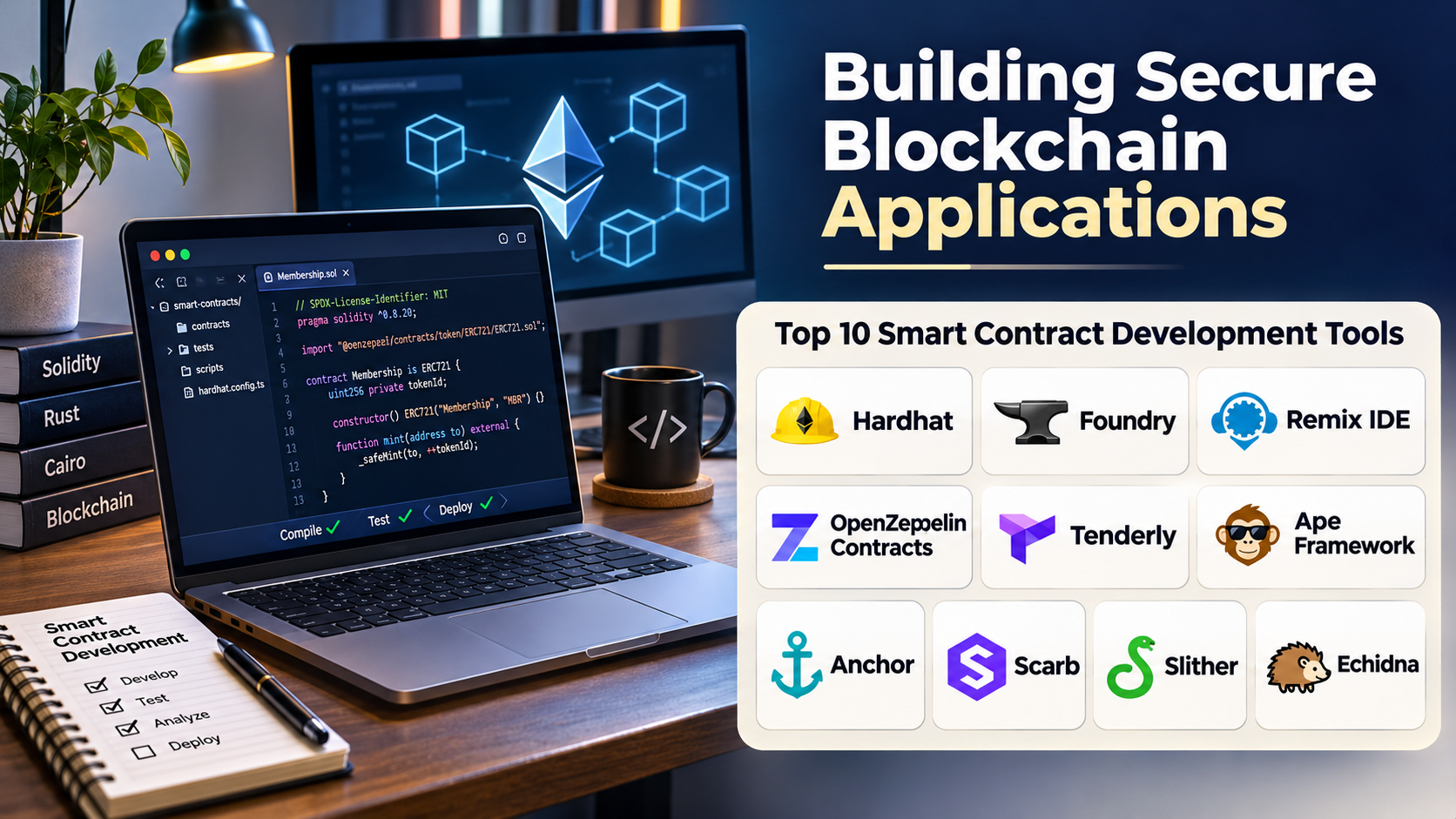
Introduction
Smart contract development tools provide specialized environments for creating, testing, debugging, deploying, and maintaining programmable blockchain applications. These tools help developers implement automated transaction logic while addressing the technical and security requirements of distributed ledger environments.
Traditional software applications frequently rely on centralized servers and administrative authorities to execute business rules. Smart contracts instead execute predefined operations according to the rules of compatible blockchain networks.
Developing smart contracts requires specialized programming languages, compilation environments, testing frameworks, and deployment mechanisms. Developers must also consider transaction execution costs, blockchain compatibility, access permissions, and the potential consequences of programming errors.
Modern smart contract development tools support automated testing, local blockchain simulation, reusable contract libraries, security analysis, and transaction debugging. These capabilities help development teams identify implementation problems before deploying applications to production networks.
Organizations use smart contracts for decentralized finance, digital asset management, supply chain automation, blockchain gaming, institutional settlement, and decentralized governance. Each application introduces different requirements involving security, scalability, transaction finality, and regulatory compliance.
This guide examines ten smart contract development tools, including their features, benefits, advantages, limitations, and practical applications. It also provides comparison tables, implementation guidance, security recommendations, practical examples, and frequently asked questions.
What Are Smart Contract Development Tools?
Smart contract development tools are software applications, frameworks, libraries, and programming environments designed to support blockchain-based application development. They help developers create programmable transaction logic and deploy it to compatible distributed ledger networks.
A smart contract is a program that executes predefined operations when appropriate transaction conditions are satisfied. Its behavior depends on the deployed code, available inputs, and applicable blockchain execution rules.
Development frameworks provide structured environments for compiling contracts, managing dependencies, executing tests, and automating deployments. These frameworks can improve development consistency and reduce repetitive manual activities.
Security analysis tools examine smart contract source code or execution behavior to identify potential vulnerabilities. Their findings help developers prioritize remediation, although automated analysis cannot guarantee complete application security.
Reusable smart contract libraries provide established implementations of commonly required functionality. These components may include digital asset standards, access control mechanisms, governance structures, and contract upgrade utilities.
Smart contract development environments vary according to supported blockchain architectures and programming languages. Developers should select compatible tools based on application requirements rather than assuming every framework supports every blockchain network.
How Do Smart Contract Development Tools Work?
- Define application requirements and transaction rules.
- Select the intended blockchain network.
- Choose a compatible programming language.
- Configure the development environment.
- Install approved software dependencies.
- Develop smart contract source code.
- Compile contracts into compatible executable representations.
- Configure a local blockchain or testing environment.
- Execute unit and integration tests.
- Perform automated security analysis.
- Review contract permissions and economic assumptions.
- Deploy contracts to a suitable test network.
- Validate application integrations.
- Conduct independent security assessments.
- Deploy approved contracts to production.
- Monitor transactions and application behavior.
- Maintain dependencies and approved upgrade mechanisms.
Traditional Development vs. Smart Contract Development
| Evaluation Area | Traditional Development | Smart Contract Development |
|---|---|---|
| Execution environment | Servers and application runtimes | Blockchain execution environments |
| Information storage | Conventional databases | Blockchain state and external storage |
| Deployment | Application servers | Blockchain transactions |
| Updates | Conventional software releases | Network-specific upgrade mechanisms |
| Transaction costs | Infrastructure expenses | Network execution fees |
| Authentication | Accounts and identity services | Cryptographic signatures and permissions |
| Testing | Conventional test environments | Local chains, testnets, and network forks |
| Security | Application and infrastructure security | Contract, protocol, and infrastructure security |
| Transaction verification | Application-controlled | Blockchain-defined validation |
| Error recovery | Administrative restoration | Contract-specific recovery mechanisms |
| Information visibility | Configurable application access | Network-dependent visibility |
| Business logic | Centralized application execution | Programmable distributed execution |
Common Applications of Smart Contract Development Tools
- Decentralized finance applications.
- Digital asset issuance.
- Tokenized real-world asset systems.
- Blockchain gaming applications.
- Automated commercial agreements.
- Decentralized governance.
- Digital collectible marketplaces.
- Supply chain transaction verification.
- Blockchain-based membership systems.
- Digital payment applications.
- Institutional settlement prototypes.
- Programmable escrow applications.
Key Components of Smart Contract Development Tools
| Component | Primary Function |
|---|---|
| Code editor | Supports contract source code development |
| Compiler | Converts source code into compatible executable code |
| Testing framework | Executes automated contract tests |
| Local blockchain | Simulates blockchain transaction execution |
| Debugger | Investigates transaction execution behavior |
| Deployment scripts | Automates contract deployment |
| Wallet interface | Supports transaction authorization |
| Contract library | Provides reusable contract implementations |
| Static analyzer | Examines source code for potential vulnerabilities |
| Fuzzing engine | Tests contracts using generated inputs |
| Gas profiler | Evaluates transaction execution costs |
| Network configuration | Defines target blockchain environments |
| Dependency manager | Maintains approved software dependencies |
| Transaction simulator | Evaluates potential transaction outcomes |
| Verification service | Associates source code with deployed contracts |
| Monitoring interface | Tracks deployed application behavior |
Types of Smart Contract Development Tools
Development Frameworks
Development frameworks provide integrated workflows for writing, compiling, testing, and deploying smart contracts. Hardhat, Foundry, and Ape Framework support structured development processes for compatible blockchain applications.
Integrated Development Environments
Integrated Development Environments (IDEs) combine source code editing with compilation, testing, and debugging capabilities. Remix provides a browser-accessible environment particularly relevant to Solidity development.
Smart Contract Libraries
Smart contract libraries provide reusable implementations of established contract functionality. OpenZeppelin Contracts supports widely used token standards, access control mechanisms, and other Ethereum-compatible components.
Blockchain-Specific Frameworks
Blockchain-specific frameworks address the programming models and execution requirements of particular networks. Anchor supports Solana program development, while Scarb supports Cairo-based project development.
Security Analysis Tools
Security analysis tools examine smart contracts for potentially unsafe implementation patterns. Slither provides static analysis capabilities, while Echidna supports property-based fuzz testing.
Blockchain Debugging Platforms
Blockchain debugging platforms provide transaction simulation, execution inspection, and operational monitoring capabilities. Tenderly supports these workflows for compatible Ethereum Virtual Machine environments.
Key Capabilities of Smart Contract Development Tools
- Smart contract source code development.
- Automated compilation.
- Unit and integration testing.
- Local blockchain simulation.
- Transaction execution debugging.
- Contract deployment automation.
- Reusable smart contract components.
- Static security analysis.
- Property-based fuzz testing.
- Transaction execution cost assessment.
- Source code verification.
- Blockchain application monitoring.
Top 10 Smart Contract Development Tools
The following tools represent complementary development frameworks, libraries, security analyzers, and debugging platforms. Their numbering is organizational rather than an independently measured performance ranking.
1. Hardhat
Short Description
Hardhat is an Ethereum-oriented development environment designed for compiling, testing, debugging, and deploying smart contracts. It provides structured workflows for developers building applications compatible with the Ethereum Virtual Machine (EVM).
The framework supports JavaScript and TypeScript development workflows alongside Solidity smart contracts. Its configurable project architecture enables teams to organize contract source code, tests, deployment scripts, and dependencies.
Hardhat provides local Ethereum-compatible development network capabilities. Developers can use these environments to simulate transactions and investigate contract behavior without immediately deploying to public networks.
Its extensible architecture supports integrations with compatible testing libraries, deployment systems, and blockchain application services. Available integrations depend on the installed Hardhat version and associated packages.
Hardhat is particularly suitable for teams requiring structured EVM application development and automated testing. Organizations should maintain compatible dependencies and independently validate contract security.
How Hardhat Works
- Initialize a compatible development project.
- Configure compiler and network settings.
- Develop Solidity smart contracts.
- Compile contracts and generate artifacts.
- Execute automated tests.
- Debug transaction execution.
- Deploy approved contracts to the target network.
Key Features
- Solidity compilation: Converts compatible contracts into executable bytecode.
- Local development network: Supports controlled transaction simulation.
- TypeScript integration: Enables typed development workflows.
- JavaScript integration: Supports conventional application scripting.
- Automated testing: Executes compatible contract test suites.
- Network configuration: Defines deployment environments.
- Plugin architecture: Extends supported development functionality.
- Deployment workflows: Automates compatible contract deployment.
- Execution debugging: Investigates contract failures.
- Network forking: Supports testing against selected blockchain state.
- Contract artifacts: Generates deployment and integration information.
- Task automation: Supports reusable development operations.
Benefits
- Improves development consistency.
- Supports automated contract testing.
- Reduces repetitive deployment activities.
- Facilitates transaction debugging.
- Supports collaborative development.
- Enables controlled blockchain experimentation.
- Improves application integration workflows.
- Facilitates continuous integration.
- Supports reusable project configurations.
- Enables early identification of implementation errors.
Pros
- Established Ethereum development ecosystem.
- Flexible project configuration.
- JavaScript and TypeScript compatibility.
- Local testing capabilities.
- Extensible architecture.
- Automated development workflows.
- Broad integration opportunities.
- Open-source availability.
Cons
- Dependency compatibility requires maintenance.
- Plugin behavior varies by version.
- Complex configurations require experience.
- EVM-oriented architecture limits direct applicability to other runtimes.
- Security analysis requires additional tools.
- Fork testing may depend on external services.
- Deployment errors remain possible.
Use Cases
- Solidity application development.
- Decentralized finance testing.
- Digital asset contract deployment.
- Automated blockchain testing.
- Enterprise EVM application development.
- Transaction debugging.
- Continuous integration pipelines.
- Blockchain application prototyping.
Industry Applications
- Financial technology.
- Blockchain gaming.
- Digital commerce.
- Enterprise software.
- Digital asset management.
Integration and Deployment
Hardhat integrates with compatible Ethereum libraries, Solidity compilers, wallet interfaces, and deployment tools. Teams can incorporate development commands into Continuous Integration and Continuous Delivery (CI/CD) pipelines.
Deployment requires appropriate network configuration and protected transaction authorization credentials. Organizations should separate development, testing, and production environments.
Pricing
Hardhat is available as open-source software. External blockchain infrastructure, hosted services, transaction fees, and commercial security assessments may introduce additional costs.
Best For
- Solidity developers.
- TypeScript developers.
- Ethereum application teams.
- Enterprise blockchain engineers.
- Automated testing teams.
- Decentralized finance developers.
- Web3 startups.
- EVM-compatible application projects.
Overall Assessment
Hardhat provides a flexible development environment for Ethereum-compatible smart contracts. Its configurable workflows and extensive integration opportunities make it relevant to both independent developers and enterprise teams.
Organizations should validate version compatibility and incorporate complementary security analysis. Development automation does not eliminate the need for independent contract review.
2. Foundry
Short Description
Foundry is a modular smart contract development toolkit designed for Ethereum-compatible applications. Its command-line tools support contract compilation, testing, blockchain interaction, and local network operation.
Forge provides smart contract compilation, testing, and deployment-related functionality. Developers can write tests directly in Solidity, reducing the need to switch between different programming languages.
Cast provides command-line capabilities for interacting with compatible blockchain networks and contracts. Anvil provides a local Ethereum-compatible development node for testing and simulation.
Foundry also supports fuzz testing and invariant testing, allowing developers to evaluate contract behavior across generated inputs and transaction sequences. These capabilities complement conventional unit testing.
Foundry is particularly relevant to developers requiring efficient command-line workflows and advanced Solidity testing. Its effectiveness depends on appropriate test design, configuration, and security review.
How Foundry Works
- Initialize a Foundry project.
- Configure dependencies and compiler settings.
- Develop Solidity contracts.
- Compile contracts using Forge.
- Execute unit, fuzz, and invariant tests.
- Simulate transactions using Anvil.
- Deploy and interact with contracts using supported tools.
Key Features
- Forge: Supports compilation and automated testing.
- Cast: Enables command-line blockchain interaction.
- Anvil: Provides a local development node.
- Chisel: Supports interactive Solidity experimentation.
- Solidity testing: Enables native contract test development.
- Fuzz testing: Evaluates generated transaction inputs.
- Invariant testing: Tests persistent contract properties.
- Gas reporting: Evaluates execution costs.
- Network forking: Supports selected blockchain state simulation.
- Deployment scripting: Automates compatible deployment operations.
- Execution tracing: Investigates contract behavior.
- Dependency management: Supports reusable project components.
Benefits
- Enables Solidity-native testing.
- Supports advanced security testing.
- Facilitates command-line automation.
- Improves transaction investigation.
- Supports reproducible development environments.
- Enables efficient local testing.
- Facilitates execution cost assessment.
- Supports automated deployment workflows.
- Improves development pipeline integration.
- Encourages property-oriented contract validation.
Pros
- Comprehensive command-line toolkit.
- Solidity-native test development.
- Integrated fuzz testing.
- Invariant testing capabilities.
- Local blockchain simulation.
- Detailed execution traces.
- Open-source availability.
- Suitable for automated development pipelines.
Cons
- Command-line workflows require familiarity.
- Advanced testing requires specialist knowledge.
- External integrations may require configuration.
- EVM-focused functionality.
- Fork testing requires suitable infrastructure.
- Incorrect invariants can create misleading confidence.
- Independent security assessments remain necessary.
Use Cases
- Solidity contract development.
- Decentralized finance testing.
- Automated security regression testing.
- Transaction execution analysis.
- Gas optimization.
- Local blockchain experimentation.
- Continuous integration.
- Contract deployment automation.
Industry Applications
- Financial technology.
- Blockchain security.
- Digital asset management.
- Enterprise blockchain.
- Decentralized application development.
Integration and Deployment
Foundry integrates with compatible Solidity libraries, blockchain RPC services, and command-line development environments. Its tools can be incorporated into automated build and testing pipelines.
Production deployment requires secure credential management and approved network configuration. Developers should independently validate deployment scripts and administrative permissions.
Pricing
Foundry is available as open-source software. Hosted blockchain infrastructure, transaction execution, security reviews, and application maintenance contribute to total costs.
Best For
- Advanced Solidity developers.
- Smart contract security engineers.
- Command-line development teams.
- Decentralized finance projects.
- Automated testing specialists.
- Blockchain infrastructure developers.
- Gas optimization teams.
- EVM application engineers.
Overall Assessment
Foundry provides a comprehensive toolkit for Solidity development and advanced contract testing. Its integrated fuzzing and invariant testing capabilities are particularly relevant to security-sensitive applications.
Organizations should combine Foundry with independent review and appropriate testing strategies. Automated test coverage cannot independently establish contract correctness.
3. Remix IDE
Short Description
Remix IDE is an integrated development environment designed primarily for Solidity smart contract development. Its browser-accessible interface enables developers to write, compile, test, and deploy compatible contracts.
The environment provides source code editing and compiler configuration capabilities. Developers can experiment with contract implementations without establishing a complete local development framework.
Remix supports simulated blockchain environments and connections to compatible external networks. These capabilities facilitate educational activities, application prototyping, and transaction testing.
Its debugging and analysis integrations help developers investigate contract execution and identify selected implementation issues. Available functionality depends on the enabled plugins and software version.
Remix is particularly relevant to beginners, educators, researchers, and developers creating contract prototypes. Larger applications may benefit from additional project management and automated testing frameworks.
How Remix IDE Works
- Create or import Solidity source files.
- Configure the compiler.
- Compile the smart contract.
- Select a compatible execution environment.
- Deploy the contract.
- Interact with exposed contract functions.
- Investigate execution behavior and errors.
Key Features
- Browser-based editor: Supports accessible contract development.
- Solidity compiler: Compiles compatible source code.
- Deployment interface: Supports interactive contract deployment.
- Simulated blockchain: Enables controlled experimentation.
- Transaction debugger: Investigates execution behavior.
- Plugin architecture: Extends supported functionality.
- Contract interaction: Enables function execution and inspection.
- Wallet connectivity: Supports compatible external authorization.
- File management: Organizes project source files.
- Compiler configuration: Supports compatible optimization settings.
- Analysis integrations: Identifies selected implementation issues.
- Educational workflows: Supports interactive blockchain learning.
Benefits
- Reduces initial environment setup.
- Supports rapid contract experimentation.
- Facilitates Solidity education.
- Enables interactive transaction testing.
- Improves accessibility for beginners.
- Supports contract debugging.
- Facilitates application demonstrations.
- Enables convenient compilation.
- Supports prototype deployment.
- Provides flexible development interfaces.
Pros
- Browser-accessible environment.
- Integrated compilation and deployment.
- Interactive contract execution.
- Suitable for beginners.
- Local simulation capabilities.
- Extensible plugin system.
- Open-source availability.
- Useful educational interface.
Cons
- Large projects may require additional frameworks.
- Automated pipeline integration is less central.
- Browser environment security requires attention.
- External network access depends on configuration.
- Advanced testing may require complementary tools.
- Project organization requires discipline.
- Production deployments require independent verification.
Use Cases
- Solidity education.
- Smart contract prototyping.
- Interactive transaction debugging.
- Digital asset contract experimentation.
- Blockchain workshops.
- Application demonstrations.
- Contract function testing.
- Research and development.
Industry Applications
- Education.
- Financial technology.
- Blockchain research.
- Software development.
- Enterprise innovation.
Integration and Deployment
Remix supports compatible wallets, Solidity dependencies, and blockchain execution environments. Developers can use simulated environments before connecting to external networks.
Organizations should maintain secure source code backups and avoid exposing production credentials. Complex deployment workflows should use appropriate version-controlled and reviewed processes.
Pricing
Remix IDE is available as open-source software. Public blockchain deployments may incur transaction fees, while external infrastructure and professional security services can introduce additional expenses.
Best For
- Blockchain beginners.
- Solidity students.
- Educators.
- Independent developers.
- Smart contract researchers.
- Prototype development teams.
- Blockchain workshop participants.
- Developers investigating individual contracts.
Overall Assessment
Remix provides an accessible environment for learning and experimenting with Solidity smart contracts. Its integrated interface reduces the complexity of initial blockchain development.
Production applications should incorporate additional testing, version control, and deployment governance where necessary. Interactive development should complement rather than replace structured engineering practices.
4. OpenZeppelin Contracts
Short Description
OpenZeppelin Contracts is an open-source library providing reusable smart contract implementations for Ethereum-compatible applications. It supports widely adopted digital asset standards and common contract security patterns.
The library includes implementations of Ethereum Request for Comments (ERC) token standards such as ERC-20, ERC-721, and ERC-1155. Developers can extend these components according to application requirements.
OpenZeppelin Contracts also provides access control, governance, and selected security-related utilities. These components can reduce the need to implement common contract functionality from the beginning.
Separate compatible upgradeable contract packages support applications using approved proxy-based upgrade architectures. Developers must understand initialization, storage compatibility, and administrative permissions when implementing upgradeable systems.
OpenZeppelin Contracts is particularly suitable for teams requiring reusable Solidity components and standardized digital asset functionality. Customized implementations still require comprehensive testing and independent security assessment.
How OpenZeppelin Contracts Works
- Identify required contract functionality.
- Install a compatible library version.
- Import approved contract components.
- Extend components with application-specific logic.
- Configure permissions and initialization.
- Execute comprehensive tests.
- Deploy and monitor approved contracts.
Key Features
- ERC-20 contracts: Supports fungible token implementations.
- ERC-721 contracts: Supports non-fungible token implementations.
- ERC-1155 contracts: Supports multiple token types.
- Access control: Enables configurable authorization.
- Ownership utilities: Supports owner-based permissions.
- Governance components: Enables compatible voting workflows.
- Reentrancy protection: Provides guards against selected reentrant calls.
- Pausable functionality: Supports controlled application suspension.
- Cryptographic utilities: Supports compatible verification operations.
- Proxy utilities: Supports selected upgrade architectures.
- Upgradeable packages: Provides compatible upgradeable components.
- Reusable interfaces: Facilitates standardized application integration.
Benefits
- Reduces repetitive contract development.
- Supports standardized digital assets.
- Facilitates reusable application components.
- Improves permission management consistency.
- Supports established implementation patterns.
- Enables compatible governance applications.
- Reduces selected implementation risks.
- Facilitates integration with development frameworks.
- Supports maintainable contract architecture.
- Encourages structured contract development.
Pros
- Established reusable contract library.
- Widely adopted token standards.
- Modular architecture.
- Configurable access controls.
- Compatible security utilities.
- Extensive documentation.
- Broad framework compatibility.
- Open-source availability.
Cons
- Not a complete development environment.
- Customized code requires independent review.
- Version upgrades may introduce compatibility changes.
- Proxy architectures increase complexity.
- Incorrect permission configuration creates risks.
- Reusable components can increase execution costs.
- Library usage does not guarantee application security.
Use Cases
- Fungible token development.
- Digital collectible applications.
- Governance contracts.
- Access-controlled applications.
- Upgradeable contract systems.
- Digital asset marketplaces.
- Decentralized finance applications.
- Enterprise EVM development.
Industry Applications
- Financial services.
- Digital commerce.
- Gaming.
- Asset management.
- Enterprise blockchain.
Integration and Deployment
OpenZeppelin Contracts integrates with Solidity development frameworks such as Hardhat and Foundry. Developers should pin compatible library versions and document customized functionality.
Deployment occurs through the selected development framework. Upgradeable applications require additional review of administrative controls and storage compatibility.
Pricing
OpenZeppelin Contracts is available as open-source software. Commercial auditing, infrastructure services, transaction fees, and maintenance are separate expenses.
Best For
- Solidity developers.
- Digital asset issuers.
- Governance application teams.
- Decentralized finance developers.
- Enterprise blockchain teams.
- Security-conscious development teams.
- Tokenized asset projects.
- Developers requiring reusable contract components.
Overall Assessment
OpenZeppelin Contracts provides standardized building blocks for common Ethereum-compatible smart contract requirements. Its reusable components can improve development consistency and reduce unnecessary implementation duplication.
Organizations should evaluate the complete customized application rather than relying solely on library reputation. Appropriate version management, testing, and permission reviews remain essential.
5. Tenderly
Short Description
Tenderly is a blockchain development and operational platform providing transaction simulation, debugging, and infrastructure capabilities for supported EVM networks. It helps developers investigate smart contract behavior during development and production operation.
Transaction simulation enables teams to evaluate potential transaction outcomes without immediately submitting the corresponding transaction to a live network. This functionality is useful for testing application interactions and investigating execution failures.
Tenderly provides virtual testing environments that can support development against selected blockchain state. Developers can evaluate complex application interactions within controlled environments.
The platform also provides transaction inspection and operational monitoring capabilities. Available features, supported networks, and usage allowances depend on the selected service configuration.
Tenderly is particularly relevant to teams requiring detailed transaction visibility and hosted blockchain development infrastructure. Organizations should evaluate information handling, service dependencies, and commercial requirements.
How Tenderly Works
- Configure a supported project and blockchain network.
- Connect compatible smart contracts.
- Create a simulation or virtual testing environment.
- Submit representative transaction inputs.
- Inspect execution traces and state changes.
- Investigate identified failures.
- Monitor supported production application activity.
Key Features
- Transaction simulation: Evaluates potential transaction outcomes.
- Execution debugging: Investigates smart contract behavior.
- Virtual testing environments: Supports controlled blockchain experimentation.
- Execution traces: Displays transaction call information.
- State inspection: Supports investigation of application state changes.
- Gas analysis: Evaluates transaction execution costs.
- Transaction monitoring: Tracks supported application activities.
- Alerting: Supports configured operational notifications.
- RPC infrastructure: Provides supported blockchain connectivity.
- Application programming interfaces: Enables automated integrations.
- Contract visibility: Supports inspection of registered contracts.
- Collaborative workflows: Facilitates team-based investigations.
Benefits
- Improves transaction visibility.
- Supports pre-deployment testing.
- Facilitates failure investigation.
- Reduces manual debugging effort.
- Enables controlled transaction simulation.
- Supports operational monitoring.
- Improves execution cost analysis.
- Facilitates development collaboration.
- Supports application reliability assessment.
- Enables automated simulation workflows.
Pros
- Detailed transaction debugging.
- Hosted simulation capabilities.
- Virtual testing environments.
- Supported network integrations.
- Operational monitoring features.
- Developer-friendly interfaces.
- Application programming interfaces.
- Suitable for complex transaction investigations.
Cons
- Commercial service limits may apply.
- External infrastructure dependencies require evaluation.
- Supported networks vary.
- Simulation results depend on available state.
- Sensitive project information requires governance.
- Not a replacement for comprehensive testing.
- Advanced workflows require configuration.
Use Cases
- Failed transaction investigation.
- Decentralized finance simulations.
- Contract integration testing.
- Production transaction monitoring.
- Gas cost investigation.
- Blockchain application debugging.
- Transaction approval workflows.
- Virtual blockchain development.
Industry Applications
- Financial technology.
- Digital asset management.
- Blockchain infrastructure.
- Enterprise software.
- Decentralized finance.
Integration and Deployment
Tenderly integrates with supported development frameworks, blockchain RPC interfaces, and application programming interfaces (APIs). Teams can incorporate transaction simulations into appropriate development and operational workflows.
Hosted service adoption requires evaluation of access controls, information retention, service availability, and commercial terms. Organizations should independently validate production monitoring requirements.
Pricing
Tenderly provides hosted services with usage-dependent and commercial offerings. Current pricing, included functionality, and network allowances should be verified directly before procurement.
Best For
- Decentralized finance developers.
- Blockchain debugging specialists.
- Production operations teams.
- EVM application developers.
- Transaction simulation teams.
- Digital asset infrastructure providers.
- Enterprise blockchain engineers.
- Teams requiring hosted development environments.
Overall Assessment
Tenderly provides specialized transaction simulation and debugging capabilities that complement conventional smart contract development frameworks. Its hosted environments can support complex transaction investigation and operational visibility.
Organizations should evaluate service dependencies and simulation limitations. Production security requires additional application testing, monitoring, and governance.
6. Ape Framework
Short Description
Ape Framework is a Python-oriented smart contract development framework designed for compatible blockchain applications. It provides a modular environment for compiling, testing, deploying, and interacting with smart contracts.
The framework uses a plugin-based architecture to support different compilers, network providers, and account management mechanisms. Available blockchain compatibility depends on the installed plugins.
Ape integrates with pytest, enabling developers to create automated contract tests using familiar Python testing workflows. This capability is particularly relevant to organizations with established Python engineering practices.
The framework provides interactive development and scripting capabilities for blockchain applications. Developers can automate contract deployment, transaction execution, and application integration activities.
Ape Framework is particularly suitable for Python developers and teams requiring extensible blockchain development workflows. Plugin compatibility and supported network functionality should be verified before adoption.
How Ape Framework Works
- Initialize a compatible Ape project.
- Install required compiler and provider plugins.
- Configure network and account settings.
- Develop supported smart contracts.
- Compile contracts and generate project artifacts.
- Execute automated Python-based tests.
- Deploy and interact with approved contracts.
Key Features
- Python development: Supports familiar scripting workflows.
- Plugin architecture: Extends framework functionality.
- Compiler integrations: Supports compatible contract languages.
- pytest integration: Enables automated testing.
- Network providers: Connects to supported blockchain environments.
- Account management: Supports compatible transaction authorization.
- Deployment scripting: Automates contract deployment.
- Interactive console: Enables contract experimentation.
- Contract interaction: Supports transaction and state operations.
- Project configuration: Organizes development settings.
- Dependency integration: Supports compatible reusable components.
- Transaction inspection: Facilitates execution investigation.
Benefits
- Supports Python-oriented development.
- Facilitates automated contract testing.
- Enables modular project configuration.
- Supports reusable deployment scripts.
- Improves blockchain application integration.
- Enables interactive experimentation.
- Facilitates existing Python pipeline adoption.
- Supports compatible network selection.
- Reduces repetitive development activities.
- Encourages structured testing practices.
Pros
- Python-friendly framework.
- pytest compatibility.
- Extensible plugin architecture.
- Interactive development capabilities.
- Configurable network providers.
- Automated deployment workflows.
- Open-source availability.
- Suitable for Python engineering teams.
Cons
- Plugin availability varies.
- Dependency configuration requires maintenance.
- Some integrations may require additional packages.
- Smaller ecosystem than certain established EVM frameworks.
- Advanced debugging may require complementary tools.
- Security analysis is not comprehensive.
- Network compatibility requires verification.
Use Cases
- Python-based blockchain development.
- Automated contract testing.
- Decentralized finance applications.
- Contract deployment scripting.
- Blockchain research.
- Digital asset application development.
- Interactive contract investigation.
- Continuous integration workflows.
Industry Applications
- Financial technology.
- Data engineering.
- Blockchain research.
- Enterprise software.
- Digital asset management.
Integration and Deployment
Ape Framework integrates with compatible Python libraries, blockchain providers, compilers, and testing tools. Developers can incorporate contract testing into existing Python automation environments.
Deployment requires compatible account management and network configuration. Teams should verify plugin maintenance and protect production transaction authorization credentials.
Pricing
Ape Framework is available as open-source software. Hosted network providers, transaction fees, infrastructure, and professional support may introduce additional costs.
Best For
- Python developers.
- Blockchain researchers.
- Automated testing teams.
- Financial technology engineers.
- Decentralized finance developers.
- Python-oriented enterprises.
- Blockchain application prototyping teams.
- Developers requiring modular frameworks.
Overall Assessment
Ape Framework provides a flexible blockchain development environment for Python-oriented engineering teams. Its plugin architecture and pytest integration support structured development and automated testing.
Organizations should assess the availability and compatibility of required plugins. Independent security testing remains necessary for production smart contracts.
7. Anchor
Short Description
Anchor is a development framework designed for Solana smart contract programs. It provides abstractions and structured development workflows for creating applications using Solana’s account-based execution model.
The framework supports Rust-based program development through specialized macros and account validation mechanisms. These abstractions can reduce repetitive implementation activities associated with native Solana programming.
Anchor generates Interface Definition Language (IDL) artifacts that describe compatible program interfaces. These artifacts support client application development and integration.
The framework provides testing and deployment workflows for Solana programs. Developers can validate account constraints, transaction behavior, and application-specific program logic.
Anchor is particularly relevant to teams developing Solana decentralized applications, digital assets, and programmable financial services. Its abstractions do not eliminate the need to understand Solana account ownership and authorization requirements.
How Anchor Works
- Initialize an Anchor project.
- Configure Solana development infrastructure.
- Develop Rust-based program logic.
- Define account structures and constraints.
- Compile the program and generate IDL artifacts.
- Execute automated program tests.
- Deploy the approved program.
Key Features
- Rust development: Supports Solana program implementation.
- Program macros: Reduces repetitive development code.
- Account constraints: Supports declarative account validation.
- IDL generation: Describes compatible program interfaces.
- Client integrations: Facilitates application interaction.
- Program compilation: Generates deployable program artifacts.
- Testing workflows: Supports automated program validation.
- Deployment commands: Facilitates compatible program deployment.
- Error handling: Supports structured program errors.
- Account serialization: Supports compatible information representation.
- Cross-program invocation support: Enables interactions with other programs.
- Project configuration: Organizes program development settings.
Benefits
- Simplifies selected Solana development activities.
- Supports structured account validation.
- Reduces repetitive program implementation.
- Facilitates client application integration.
- Enables automated program testing.
- Supports consistent development workflows.
- Improves program interface documentation.
- Facilitates deployment automation.
- Encourages modular program development.
- Supports maintainable Solana applications.
Pros
- Specialized Solana framework.
- Rust-based development.
- Declarative account constraints.
- Automated interface generation.
- Established program development workflows.
- Client integration capabilities.
- Open-source availability.
- Suitable for complex Solana applications.
Cons
- Solana-specific architecture.
- Rust expertise is beneficial.
- Account model requires specialist knowledge.
- Version compatibility requires maintenance.
- Abstractions may obscure underlying behavior.
- Security analysis requires complementary tools.
- Program deployment introduces network expenses.
Use Cases
- Solana decentralized applications.
- Blockchain gaming programs.
- Digital asset applications.
- Programmable financial services.
- Payment application development.
- Solana marketplace applications.
- Cross-program integrations.
- Automated Solana program testing.
Industry Applications
- Financial technology.
- Gaming.
- Digital commerce.
- Payment services.
- Blockchain infrastructure.
Integration and Deployment
Anchor integrates with compatible Solana development tools, Rust libraries, and client application packages. Developers should maintain compatible framework and blockchain toolchain versions.
Deployment requires appropriate program authorization and network configuration. Organizations should review account constraints, upgrade permissions, and cross-program interactions.
Pricing
Anchor is available as open-source software. Solana deployment fees, account-related costs, infrastructure services, and independent security reviews contribute to ownership expenses.
Best For
- Solana developers.
- Rust engineers.
- Blockchain gaming teams.
- Digital asset developers.
- Decentralized finance projects.
- Consumer blockchain applications.
- Solana infrastructure teams.
- Developers requiring structured program development.
Overall Assessment
Anchor provides specialized development abstractions for Solana programs. Its account validation and interface generation capabilities can improve development consistency.
Organizations must independently review authorization, account relationships, and application-specific logic. Framework abstractions cannot guarantee program security.
8. Scarb
Short Description
Scarb is a build tool and package manager designed for the Cairo programming language ecosystem. It supports structured development of Cairo applications, including compatible Starknet smart contracts.
The tool provides project configuration and dependency management capabilities. Developers can define package requirements and maintain consistent project build environments.
Scarb integrates with compatible Cairo compilation and testing workflows. These capabilities support organized development of reusable Cairo packages and blockchain applications.
Its project structure helps teams manage source code, build targets, and external dependencies. Additional tools may be required for advanced testing, deployment, and transaction interaction.
Scarb is particularly relevant to developers working with Cairo and Starknet applications. Its functionality should be evaluated alongside the complete compatible development toolchain.
How Scarb Works
- Initialize a Cairo project.
- Define package configuration.
- Configure compatible dependencies.
- Develop Cairo source code.
- Build the project.
- Execute compatible tests.
- Use generated artifacts within approved deployment workflows.
Key Features
- Package management: Maintains Cairo project dependencies.
- Build automation: Compiles compatible project targets.
- Project configuration: Defines package and build settings.
- Cairo integration: Supports compatible language workflows.
- Starknet contract targets: Generates compatible contract artifacts.
- Workspace support: Organizes related project packages.
- Dependency resolution: Manages compatible package requirements.
- Lockfiles: Supports reproducible dependency configurations.
- Testing integration: Supports compatible test execution workflows.
- Package distribution: Facilitates reusable component sharing.
- Command-line interface: Supports automated development operations.
- Artifact generation: Produces information required by downstream tools.
Benefits
- Improves Cairo project organization.
- Supports reproducible development builds.
- Simplifies dependency management.
- Facilitates reusable package development.
- Enables structured compilation.
- Supports automated development pipelines.
- Improves collaborative development consistency.
- Facilitates compatible testing workflows.
- Supports modular application architecture.
- Reduces repetitive build configuration.
Pros
- Specialized Cairo tooling.
- Integrated package management.
- Structured project configuration.
- Compatible Starknet development support.
- Reproducible dependency management.
- Command-line automation.
- Open-source availability.
- Suitable for modular Cairo projects.
Cons
- Cairo-specific functionality.
- Additional deployment tools are required.
- Advanced testing requires complementary components.
- Dependency compatibility requires monitoring.
- Ecosystem changes may affect workflows.
- Security analysis requires separate assessment.
- Cairo expertise is necessary.
Use Cases
- Cairo package development.
- Starknet smart contract development.
- Automated project builds.
- Reusable blockchain libraries.
- Dependency management.
- Continuous integration.
- Modular Cairo applications.
- Blockchain research projects.
Industry Applications
- Financial technology.
- Blockchain infrastructure.
- Digital asset management.
- Cryptographic research.
- Enterprise innovation.
Integration and Deployment
Scarb integrates with compatible Cairo compilers and additional Starknet development tools. Developers can combine it with Starknet Foundry and other supported components for expanded testing and deployment workflows.
Organizations should pin compatible dependencies and validate generated artifacts before deployment. Production applications require independent review of Cairo contract behavior and authorization mechanisms.
Pricing
Scarb is available as open-source software. Blockchain infrastructure, deployment fees, additional development services, and security assessments may introduce expenses.
Best For
- Cairo developers.
- Starknet application teams.
- Blockchain infrastructure engineers.
- Modular package developers.
- Cryptographic application researchers.
- Automated build engineers.
- Digital asset application teams.
- Developers requiring Cairo dependency management.
Overall Assessment
Scarb provides foundational build and package management capabilities for Cairo development. Its structured project architecture supports maintainable and reproducible development workflows.
It should be considered part of a broader smart contract toolchain rather than a complete standalone deployment platform. Developers should evaluate compatible testing and security tools separately.
9. Slither
Short Description
Slither is an open-source static analysis framework designed to examine Solidity smart contracts. It helps developers identify potentially unsafe implementation patterns and code quality issues.
The framework analyzes contract source code and intermediate representations without requiring every possible transaction to be executed. Its detectors identify selected vulnerability patterns and structural concerns.
Slither provides reporting capabilities that can support manual security reviews and automated development pipelines. Developers can use its findings to prioritize further investigation.
The framework also provides program analysis interfaces that enable advanced users to develop custom detectors and analysis workflows. These capabilities are relevant to organizations with specialized security requirements.
Slither is particularly suitable for Solidity developers and smart contract security teams requiring repeatable static analysis. Findings require human interpretation, and the absence of warnings does not establish contract safety.
How Slither Works
- Configure a compatible Solidity project.
- Resolve required compilation dependencies.
- Execute static analysis.
- Review detected implementation patterns.
- Investigate relevant findings.
- Remediate confirmed vulnerabilities.
- Repeat analysis and security testing.
Key Features
- Static analysis: Examines smart contract code structure.
- Vulnerability detectors: Identifies selected unsafe patterns.
- Intermediate representation: Supports program analysis.
- Control flow analysis: Evaluates execution relationships.
- Information flow analysis: Supports examination of variable dependencies.
- Contract structure reporting: Displays implementation relationships.
- Custom detectors: Enables specialized security checks.
- Machine-readable reports: Supports automated processing.
- Continuous integration support: Enables repeatable analysis.
- Compilation integration: Supports compatible project environments.
- Code quality analysis: Identifies selected maintainability concerns.
- Security review utilities: Facilitates manual investigations.
Benefits
- Supports early vulnerability identification.
- Enables repeatable security analysis.
- Reduces selected manual review activities.
- Facilitates security regression testing.
- Improves contract structure visibility.
- Supports custom security requirements.
- Enables automated pipeline integration.
- Facilitates remediation prioritization.
- Supports secure development practices.
- Complements independent contract auditing.
Pros
- Established Solidity static analyzer.
- Automated vulnerability detection.
- Extensible analysis framework.
- Compatible development integrations.
- Machine-readable reporting.
- Open-source availability.
- Suitable for security pipelines.
- Useful manual review assistance.
Cons
- False-positive findings are possible.
- Some vulnerabilities remain undetected.
- Compilation compatibility requires configuration.
- Economic logic vulnerabilities may require manual review.
- Dynamic execution behavior is not fully evaluated.
- Custom detectors require expertise.
- Not a substitute for independent auditing.
Use Cases
- Solidity security analysis.
- Automated code review.
- Continuous integration security checks.
- Decentralized finance contract assessment.
- Token contract review.
- Custom vulnerability detection.
- Security regression testing.
- Manual audit preparation.
Industry Applications
- Blockchain security.
- Financial technology.
- Digital asset management.
- Enterprise software.
- Security consulting.
Integration and Deployment
Slither integrates with compatible Solidity project environments and compilation tools. Teams can configure automated analysis during development and code review.
Organizations should establish finding triage procedures and independently validate reported issues. Static analysis should be combined with dynamic testing and manual security assessments.
Pricing
Slither is available as open-source software. Engineering effort, custom detector development, and professional auditing services contribute to total security assessment costs.
Best For
- Solidity security engineers.
- Smart contract auditors.
- Automated testing teams.
- Decentralized finance developers.
- Enterprise blockchain teams.
- Security researchers.
- Continuous integration engineers.
- Organizations implementing secure development practices.
Overall Assessment
Slither provides practical static analysis capabilities for identifying selected Solidity implementation risks. Its extensibility makes it useful for automated security checks and manual audit preparation.
Organizations should interpret findings within the context of the complete application architecture. Static analysis cannot independently identify every exploitable behavior.
10. Echidna
Short Description
Echidna is an open-source property-based fuzzing tool designed for Ethereum-compatible smart contracts. It evaluates contract behavior by generating transaction inputs and sequences intended to challenge specified properties.
Developers define invariants or other expected behaviors that should remain valid during application execution. Echidna attempts to discover execution sequences that violate those expectations.
The tool supports different testing configurations and compatible Solidity project environments. Its generated test cases can help developers investigate complex state-dependent implementation errors.
Echidna complements conventional unit testing by exploring inputs and transaction sequences that developers may not explicitly anticipate. Effective testing requires meaningful properties, realistic configurations, and appropriate execution resources.
Echidna is particularly relevant to security-sensitive decentralized finance applications and advanced smart contract testing. Its results should be combined with static analysis, manual review, and broader application security assessments.
How Echidna Works
- Identify critical application security properties.
- Define compatible contract invariants.
- Configure the testing environment.
- Generate transaction inputs and sequences.
- Execute contracts against generated cases.
- Investigate property violations.
- Remediate issues and repeat testing.
Key Features
- Property-based testing: Evaluates predefined contract expectations.
- Fuzz testing: Generates diverse transaction inputs.
- Stateful testing: Explores sequences of contract interactions.
- Invariant validation: Tests persistent application properties.
- Counterexample generation: Identifies property-violating execution cases.
- Coverage-guided exploration: Supports broader execution path investigation.
- Configurable test campaigns: Defines testing parameters.
- Corpus management: Maintains useful generated test inputs.
- Test case minimization: Simplifies selected failure sequences.
- Solidity compatibility: Supports compatible contract projects.
- Automated execution: Enables repeatable testing workflows.
- Security testing integration: Complements other analysis tools.
Benefits
- Supports discovery of unexpected contract behavior.
- Evaluates complex transaction sequences.
- Facilitates invariant-based security testing.
- Improves automated test diversity.
- Supports investigation of state-dependent errors.
- Reduces dependence on manually selected inputs.
- Enables repeatable security regression tests.
- Facilitates security review preparation.
- Complements static analysis.
- Encourages explicit security property definition.
Pros
- Specialized smart contract fuzzing.
- Property-based testing capabilities.
- Stateful execution exploration.
- Useful counterexample generation.
- Configurable testing campaigns.
- Open-source availability.
- Compatible Solidity testing workflows.
- Relevant to security-sensitive applications.
Cons
- Meaningful invariants require expertise.
- Testing can consume computational resources.
- Exhaustive execution coverage is not guaranteed.
- Complex environments require configuration.
- Incorrect properties can create misleading results.
- External protocol behavior may require simulation.
- Manual security assessment remains necessary.
Use Cases
- Decentralized finance security testing.
- Digital asset invariant validation.
- Stateful contract testing.
- Transaction sequence investigation.
- Security regression testing.
- Smart contract audit preparation.
- Complex financial logic testing.
- Automated vulnerability discovery.
Industry Applications
- Blockchain security.
- Financial services.
- Digital asset management.
- Security consulting.
- Blockchain research.
Integration and Deployment
Echidna integrates with compatible Solidity compilation environments and automated testing pipelines. Developers should configure realistic contract state, authorized participants, and meaningful security properties.
Testing should occur before production deployment and after significant application changes. Identified property violations require investigation and remediation through approved development processes.
Pricing
Echidna is available as open-source software. Computational resources, engineering expertise, test maintenance, and independent security services contribute to total costs.
Best For
- Smart contract security specialists.
- Decentralized finance developers.
- Advanced Solidity testing teams.
- Blockchain auditors.
- Security researchers.
- Digital asset application teams.
- Invariant testing engineers.
- Organizations developing security-sensitive contracts.
Overall Assessment
Echidna provides specialized property-based fuzz testing for complex smart contract applications. Its ability to explore generated transaction sequences complements conventional unit testing and static analysis.
Organizations should define meaningful security properties and evaluate testing limitations. Successful fuzzing campaigns do not constitute formal proof of complete application correctness.
Comparison Table: Top 10 Smart Contract Development Tools
| Tool | Primary Function | Supported Environment | Best For | Pricing Model |
|---|---|---|---|---|
| Hardhat | Development and testing | EVM | Structured Solidity projects | Open source |
| Foundry | Development and advanced testing | EVM | Solidity-native workflows | Open source |
| Remix IDE | Interactive development | EVM | Beginners and prototyping | Open source |
| OpenZeppelin Contracts | Reusable contract libraries | EVM | Standardized contracts | Open source |
| Tenderly | Simulation and debugging | Supported EVM networks | Transaction investigation | Hosted commercial services |
| Ape Framework | Python-oriented development | Plugin-dependent | Python engineering teams | Open source |
| Anchor | Solana program development | Solana | Rust-based programs | Open source |
| Scarb | Build and package management | Cairo and Starknet | Cairo project development | Open source |
| Slither | Static security analysis | Solidity | Automated vulnerability detection | Open source |
| Echidna | Property-based fuzzing | EVM and Solidity | Advanced security testing | Open source |
Functional Comparison
| Tool | Compilation | Automated Testing | Deployment | Security Analysis |
|---|---|---|---|---|
| Hardhat | Supported | Supported | Supported | Through complementary tools |
| Foundry | Supported | Advanced | Supported | Fuzz and invariant testing |
| Remix IDE | Supported | Plugin-dependent | Interactive | Analysis integrations |
| OpenZeppelin Contracts | External framework | External framework | External framework | Reusable security components |
| Tenderly | Not primary | Simulation-oriented | Integration-dependent | Execution investigation |
| Ape Framework | Plugin-based | pytest | Supported | Complementary tools |
| Anchor | Supported | Supported | Supported | Account validation mechanisms |
| Scarb | Core capability | Compatible integrations | Additional tools | Additional tools |
| Slither | Compilation integration | Static checks | Not applicable | Core capability |
| Echidna | Compilation integration | Property-based | Not applicable | Core capability |
Technical Comparison
| Tool | Main Language or Interface | Local Simulation | Automation Suitability |
|---|---|---|---|
| Hardhat | Solidity, JavaScript, TypeScript | Supported | High |
| Foundry | Solidity, command line | Anvil | High |
| Remix IDE | Solidity, browser interface | Supported | Moderate |
| OpenZeppelin Contracts | Solidity | External framework | High through integrations |
| Tenderly | Web interface, APIs | Hosted virtual environments | High |
| Ape Framework | Python, compatible contract languages | Provider-dependent | High |
| Anchor | Rust | Compatible Solana tooling | High |
| Scarb | Cairo, command line | Additional tooling | High |
| Slither | Solidity analysis, Python extensions | Not primary | High |
| Echidna | Solidity properties | Testing execution environment | High |
Business Suitability Comparison
| Tool | Beginners | Professional Development | Security Teams |
|---|---|---|---|
| Hardhat | Suitable | Highly relevant | Complementary |
| Foundry | Learning required | Highly relevant | Highly relevant |
| Remix IDE | Highly relevant | Prototyping | Complementary |
| OpenZeppelin Contracts | Suitable with guidance | Highly relevant | Relevant |
| Tenderly | Suitable | Highly relevant | Relevant |
| Ape Framework | Python familiarity helpful | Highly relevant | Complementary |
| Anchor | Rust familiarity helpful | Highly relevant for Solana | Complementary |
| Scarb | Cairo familiarity helpful | Highly relevant for Cairo | Complementary |
| Slither | Guidance recommended | Relevant | Highly relevant |
| Echidna | Advanced knowledge helpful | Relevant | Highly relevant |
Pricing and Ownership Comparison
| Tool | Software Cost | Additional Cost Considerations |
|---|---|---|
| Hardhat | Open source | Infrastructure and maintenance |
| Foundry | Open source | Testing resources and network services |
| Remix IDE | Open source | Transaction fees and external services |
| OpenZeppelin Contracts | Open source | Auditing and customization |
| Tenderly | Usage-dependent | Subscription and infrastructure usage |
| Ape Framework | Open source | Provider services and plugins |
| Anchor | Open source | Solana infrastructure and deployment |
| Scarb | Open source | Additional Cairo development tools |
| Slither | Open source | Security review and remediation |
| Echidna | Open source | Computational resources and test engineering |
How to Choose the Best Smart Contract Development Tools
1. Identify the Target Blockchain
Determine which blockchain network will execute the intended application. Ethereum-compatible, Solana, and Starknet environments require different development architectures.
2. Evaluate Programming Languages
Assess the programming languages supported by the selected network and development tools. Solidity, Rust, and Cairo require different engineering expertise and testing strategies.
3. Define Application Requirements
Identify transaction rules, authorization mechanisms, digital asset functionality, and integration requirements. Select tools that support the complete intended application architecture.
4. Assess Testing Capabilities
Evaluate unit testing, integration testing, fuzzing, and invariant testing requirements. Security-sensitive applications generally benefit from multiple complementary testing approaches.
5. Review Debugging Functionality
Determine whether the development environment provides sufficient execution visibility. Detailed transaction traces and state inspection can improve investigation efficiency.
6. Evaluate Security Analysis
Select appropriate static analysis and dynamic testing tools. Automated security findings should be independently investigated and combined with manual review.
7. Assess Reusable Libraries
Determine whether established contract libraries can satisfy common application requirements. Reusable components should be reviewed for compatibility, licensing, and security considerations.
8. Evaluate Deployment Automation
Assess the ability to create repeatable deployment processes. Production deployment scripts should undergo independent review and approval.
9. Review Local Simulation
Determine whether tools can reproduce representative blockchain conditions. Local environments and network forks may support testing without immediately incurring public transaction fees.
10. Assess Execution Cost Analysis
Evaluate capabilities for measuring contract execution costs. Optimization should not compromise security, maintainability, or application correctness.
11. Review Integration Requirements
Identify required wallets, application libraries, network providers, and monitoring services. Verify compatibility between all selected development components.
12. Evaluate Dependency Management
Determine how tools maintain software packages and compiler versions. Reproducible dependency configurations can reduce unexpected development and deployment differences.
13. Assess Team Expertise
Select tools that align with existing engineering skills and training requirements. Advanced frameworks may provide substantial flexibility while introducing additional learning requirements.
14. Review Maintenance and Support
Evaluate current project maintenance, documentation, release compatibility, and available support. Unsupported development components can introduce operational and security risks.
15. Conduct a Representative Pilot
Develop a small application using the proposed toolchain. Evaluate development effort, testing effectiveness, integration compatibility, and deployment reliability before wider adoption.
Best Smart Contract Development Tools by User Type
| User Type | Recommended Tool | Primary Reason |
|---|---|---|
| Blockchain beginners | Remix IDE | Accessible interactive development |
| Solidity developers | Hardhat | Structured development workflows |
| Advanced Solidity engineers | Foundry | Native testing and automation |
| Digital asset developers | OpenZeppelin Contracts | Reusable token implementations |
| Transaction debugging teams | Tenderly | Simulation and execution inspection |
| Python developers | Ape Framework | Python-oriented testing |
| Solana developers | Anchor | Specialized Rust program development |
| Cairo developers | Scarb | Build and dependency management |
| Security auditors | Slither | Automated static analysis |
| Advanced security testers | Echidna | Property-based fuzzing |
| Decentralized finance teams | Foundry and Echidna | Advanced behavioral testing |
| Enterprise EVM teams | Hardhat and OpenZeppelin Contracts | Structured reusable development |
Weighted Tool Selection Scorecard
| Evaluation Criterion | Weight |
|---|---|
| Blockchain compatibility | 20% |
| Security testing capabilities | 20% |
| Development functionality | 15% |
| Automation and integration | 12% |
| Debugging capabilities | 10% |
| Maintenance and documentation | 8% |
| Team expertise alignment | 5% |
| Deployment flexibility | 5% |
| Total ownership costs | 5% |
| Total | 100% |
Organizations can use this illustrative scorecard to evaluate complementary tools according to project requirements. Mandatory blockchain compatibility and security requirements should be treated as independent acceptance criteria.
Questions to Ask Before Selecting Development Tools
- Which blockchain networks are supported?
- Which programming languages are compatible?
- What compiler versions are supported?
- Can the tool execute automated tests?
- Does it support fuzz or invariant testing?
- Are local blockchain environments available?
- Can developers inspect transaction execution?
- Does it support deployment automation?
- Which contract libraries are compatible?
- How are software dependencies managed?
- Can the tool integrate with CI/CD pipelines?
- What security analysis capabilities are available?
- Is the software actively maintained?
- What infrastructure dependencies are required?
- What are the expected ownership costs?
Smart Contract Development Architecture and Integration
| Architecture Component | Primary Purpose |
|---|---|
| Source code repository | Maintains version-controlled contract code |
| Development framework | Coordinates development operations |
| Compiler | Generates compatible executable artifacts |
| Contract library | Provides reusable implementation components |
| Local blockchain | Supports controlled execution testing |
| Testing framework | Validates expected contract behavior |
| Static analyzer | Identifies selected implementation risks |
| Fuzzing engine | Evaluates generated transaction inputs |
| Deployment pipeline | Automates approved contract releases |
| Wallet infrastructure | Supports transaction authorization |
| Blockchain provider | Connects applications to target networks |
| Monitoring platform | Tracks application activity |
| Security governance | Coordinates review and approval requirements |
| Application interface | Enables authorized contract interaction |
Practical Example: Developing a Secure Digital Asset Contract
Consider a hypothetical enterprise developing an Ethereum-compatible digital membership application. The organization requires transferable membership assets, configurable administrative permissions, automated testing, and secure deployment procedures.
The development team selects Hardhat for project management, OpenZeppelin Contracts for reusable token functionality, Foundry for advanced testing, Slither for static analysis, Echidna for property-based testing, and Tenderly for transaction simulation. Each tool addresses a complementary requirement within the development lifecycle.
Step 1: Define Business Requirements
Document membership issuance, transfer restrictions, administrative responsibilities, and application integration requirements. Establish measurable acceptance criteria before development begins.
Step 2: Select the Blockchain Network
Choose a compatible EVM environment based on security, transaction costs, and operational requirements. Evaluate network-specific finality and infrastructure dependencies.
Step 3: Establish Development Governance
Define code review, testing, approval, and deployment responsibilities. Separate development privileges from production authorization wherever practical.
Step 4: Configure Hardhat
Initialize a version-controlled development project with approved compiler and dependency configurations. Establish separate local, testing, and production network settings.
Step 5: Select Reusable Contract Components
Identify compatible OpenZeppelin Contracts implementations for membership assets and access control. Review library versions and applicable security considerations.
Step 6: Define Administrative Permissions
Establish which authorized roles can issue, suspend, or manage membership functionality. Apply least-privilege principles to administrative operations.
Step 7: Develop Application Logic
Implement approved membership rules using compatible Solidity code. Avoid unnecessary contract complexity and undocumented administrative capabilities.
Step 8: Compile the Contracts
Generate compatible deployment artifacts using approved compiler settings. Investigate compilation warnings and dependency compatibility issues.
Step 9: Create Unit Tests
Develop automated tests covering membership issuance, transfers, authorization, and invalid inputs. Verify expected success and failure conditions.
Step 10: Configure Foundry Testing
Create additional Solidity-native tests for critical application behavior. Define relevant fuzzing and invariant testing requirements.
Step 11: Execute Static Analysis
Run Slither against the compatible project source code. Investigate reported findings and document remediation decisions.
Step 12: Define Security Properties
Identify properties that must remain valid during contract operation. These may include authorization restrictions and consistency of membership ownership records.
Step 13: Conduct Echidna Testing
Configure property-based fuzzing campaigns against the approved contract implementation. Investigate generated execution sequences that violate defined properties.
Step 14: Simulate Complex Transactions
Use Tenderly to evaluate representative transaction scenarios within a supported environment. Inspect execution traces, state changes, and potential transaction failures.
Step 15: Assess Execution Costs
Measure representative membership operations under controlled testing conditions. Optimize unnecessary computation without weakening application security.
Step 16: Deploy to a Test Network
Deploy the approved contract to a suitable testing environment. Validate application interfaces, wallet interactions, and administrative workflows.
Step 17: Conduct Independent Security Review
Arrange independent review of application code, permissions, dependencies, and deployment scripts. Resolve critical findings before production authorization.
Step 18: Approve Production Deployment
Obtain formal approval from designated engineering and security stakeholders. Verify deployment parameters and authorized transaction credentials.
Step 19: Deploy and Verify Contracts
Deploy the approved contract using reviewed scripts and secure authorization mechanisms. Verify deployed bytecode and source code correspondence where supported.
Step 20: Monitor Application Operations
Track transaction failures, administrative activities, execution costs, and unexpected application behavior. Maintain documented incident response and approved upgrade procedures.
Illustrative Implementation Results
| Performance Indicator | Before | After |
|---|---|---|
| Average development cycle | 30 days | 18 days |
| Automated test coverage | 45% | 88% |
| Manual testing effort | 100 hours/release | 40 hours/release |
| Average deployment preparation | 8 hours | 2 hours |
| Transaction debugging duration | 6 hours | 1.5 hours |
| Security review preparation | 10 days | 4 days |
| Failed test deployments | 12/month | 3/month |
| Average defect resolution time | 3 days | 1 day |
| Monthly development expenditure | $24,000 | $19,000 |
These figures are hypothetical and do not represent independently verified product performance. Actual results depend on application complexity, engineering expertise, testing quality, and operational processes.
Illustrative Return on Investment
| Financial Measure | Amount |
|---|---|
| Initial implementation investment | $30,000 |
| Previous monthly expenditure | $24,000 |
| New monthly expenditure | $19,000 |
| Monthly savings | $5,000 |
| Annual savings | $60,000 |
| First-year net benefit | $30,000 |
| First-year return on investment | 100% |
| Estimated payback period | 6 months |
This calculation assumes consistent monthly savings and no additional costs beyond the stated investment and operating expenditure. Organizations should independently evaluate staffing, infrastructure, transaction fees, auditing, and maintenance requirements.
Important Smart Contract Development Metrics
| Metric | Purpose |
|---|---|
| Unit test coverage | Measures tested code behavior |
| Branch coverage | Evaluates exercised execution branches |
| Invariant test results | Tracks violations of expected properties |
| Static analysis findings | Measures identified implementation concerns |
| Critical vulnerability count | Tracks unresolved severe security findings |
| Build success rate | Evaluates compilation reliability |
| Deployment success rate | Measures release reliability |
| Transaction failure rate | Tracks application execution problems |
| Average execution cost | Measures network resource expenses |
| Defect resolution time | Evaluates remediation efficiency |
| Security review duration | Measures assessment effort |
| Dependency update frequency | Tracks maintenance activity |
| Mean time to detect incidents | Evaluates monitoring effectiveness |
| Release preparation time | Measures deployment workflow efficiency |
| Application availability | Tracks operational accessibility |
| Unauthorized operation attempts | Supports security monitoring |
Industry Applications of Smart Contract Development Tools
Financial Services
Financial institutions use smart contract development tools to evaluate programmable settlement, digital assets, and automated transaction workflows. Financial logic, authorization controls, and regulatory requirements require comprehensive review.
Supply Chain Management
Supply chain organizations can develop contracts supporting shared transaction records and automated commercial processes. External information authenticity and physical event verification remain essential.
Gaming and Entertainment
Gaming developers can create programmable digital items, memberships, and marketplace applications. Development tools support testing of asset ownership, transaction rules, and application integrations.
Digital Commerce
Commerce platforms can evaluate smart contracts for loyalty programs, digital memberships, and programmable transaction services. Consumer protection, transaction costs, and account recovery require appropriate planning.
Healthcare
Healthcare organizations can evaluate smart contracts for selected consent and institutional verification workflows. Confidential patient information should remain within appropriately protected environments.
Government and Public Services
Public institutions can use development frameworks to evaluate document verification and programmable administrative workflows. Legal validity, information retention, privacy, and governance must be assessed independently.
Smart Contract Development Implementation Roadmap
| Stage | Implementation Activity | Expected Deliverable |
|---|---|---|
| 1 | Define application requirements | Approved project scope |
| 2 | Select blockchain architecture | Network selection |
| 3 | Establish governance | Development approval framework |
| 4 | Select development tools | Approved toolchain |
| 5 | Configure source control | Version-controlled repository |
| 6 | Establish dependencies | Reproducible project environment |
| 7 | Develop contracts | Initial implementation |
| 8 | Compile contracts | Executable artifacts |
| 9 | Develop automated tests | Functional test suite |
| 10 | Perform static analysis | Security findings |
| 11 | Execute fuzz testing | Behavioral testing results |
| 12 | Simulate transactions | Execution assessment |
| 13 | Conduct independent review | Security assessment report |
| 14 | Deploy to test network | Validated test application |
| 15 | Approve production release | Deployment authorization |
| 16 | Deploy production contracts | Operational application |
| 17 | Monitor and maintain | Continuous security program |
Security and Governance Considerations
Smart contract development requires comprehensive security assessment because deployed code can control valuable digital assets and critical application operations. Programming errors may produce consequences that cannot be reversed through conventional administrative procedures.
Access control should follow least-privilege principles and clearly defined administrative responsibilities. Organizations should independently review privileged functions, contract ownership, upgrade permissions, and emergency controls.
Automated security tools provide valuable assistance but cannot establish complete application correctness. Static analysis, fuzz testing, integration testing, economic modeling, and manual review should be combined according to application risk.
Production credentials must be protected using appropriate key management and authorization mechanisms. Development teams should avoid storing private keys in source code repositories or unprotected configuration files.
Organizations must also evaluate applicable financial, privacy, and consumer protection requirements. Smart contract automation does not independently establish legal enforceability or regulatory compliance.
Security and Governance Checklist
- Define application security requirements.
- Document the blockchain trust model.
- Protect transaction authorization credentials.
- Review privileged contract functions.
- Validate reusable contract dependencies.
- Maintain approved compiler versions.
- Execute comprehensive automated tests.
- Conduct static security analysis.
- Define meaningful security invariants.
- Perform property-based fuzz testing.
- Review external contract dependencies.
- Validate deployment scripts.
- Conduct independent security assessments.
- Verify deployed contract artifacts.
- Establish incident response procedures.
- Monitor administrative operations.
Understanding the Total Cost of Ownership
Smart contract development expenses include more than framework licensing or blockchain transaction fees. Organizations must consider engineering expertise, testing infrastructure, security assessments, deployment operations, and long-term maintenance.
Open-source tools can reduce direct licensing expenses but still require configuration and specialist knowledge. Commercial hosted services may provide additional operational capabilities while introducing recurring usage costs.
| Cost Category | Main Consideration |
|---|---|
| Software licensing | Applicable tool and dependency licenses |
| Developer staffing | Programming and blockchain expertise |
| Testing infrastructure | Local and hosted execution environments |
| Blockchain services | RPC and network connectivity |
| Transaction fees | Contract deployment and execution |
| Security assessments | Independent code and architecture reviews |
| Dependency maintenance | Package and compiler updates |
| Monitoring services | Production transaction visibility |
| Key management | Secure authorization infrastructure |
| Integration development | Wallet and application connectivity |
| Training | Developer and security education |
| Incident response | Investigation and recovery resources |
Common Challenges in Smart Contract Development
- Selecting compatible blockchain development environments.
- Maintaining compiler and dependency compatibility.
- Developing secure application logic.
- Managing administrative permissions.
- Testing complex transaction sequences.
- Evaluating external protocol dependencies.
- Optimizing transaction execution costs.
- Protecting deployment credentials.
- Maintaining reproducible deployment processes.
- Investigating transaction failures.
- Coordinating independent security assessments.
- Supporting approved contract upgrades.
Common Mistakes to Avoid
1. Selecting Tools Without Checking Blockchain Compatibility
Development tools are often designed for specific blockchain execution environments. Verify network and programming language compatibility before establishing the development architecture.
2. Relying Exclusively on Unit Tests
Unit tests validate selected predefined scenarios but may miss unexpected transaction sequences. Combine unit tests with integration, fuzz, and invariant testing where appropriate.
3. Assuming Reusable Libraries Guarantee Security
Established contract libraries can reduce repetitive implementation work but cannot guarantee the security of customized applications. Review the complete contract architecture and its interactions.
4. Ignoring Administrative Permissions
Excessive administrative privileges can expose applications to unauthorized operations. Establish clearly defined roles and independently review sensitive functions.
5. Exposing Private Keys
Unprotected transaction authorization credentials can enable unauthorized blockchain operations. Use approved key management mechanisms and restrict production access.
6. Deploying Without Independent Review
Automated tools cannot identify every security vulnerability or economic logic problem. Security-sensitive applications require appropriate independent assessments.
7. Neglecting Dependency Versions
Uncontrolled software updates can introduce unexpected compatibility changes. Pin approved dependency versions and evaluate updates before adoption.
8. Ignoring Transaction Execution Costs
Inefficient contract logic can increase operational expenses and reduce application accessibility. Benchmark representative transactions while preserving security and correctness.
9. Testing Only Successful Transactions
Applications must also handle invalid inputs, unauthorized operations, and unexpected external behavior. Include negative test cases and failure scenarios.
10. Misinterpreting Static Analysis Results
Static analysis findings require technical interpretation and validation. Neither reported warnings nor the absence of warnings independently establishes contract security.
11. Defining Weak Security Invariants
Inadequate invariants can allow unsafe behavior to remain undetected during fuzz testing. Define properties that reflect meaningful application security requirements.
12. Ignoring External Dependencies
Smart contracts may depend on other contracts, external information providers, and interoperability mechanisms. Evaluate the security assumptions and failure behavior of these dependencies.
13. Neglecting Deployment Verification
Incorrect network settings or deployment parameters can produce unintended application behavior. Independently verify deployed artifacts, configuration, and administrative permissions.
14. Assuming Contracts Can Always Be Updated
Some deployed contracts cannot be modified, while upgradeable contracts require specific mechanisms and permissions. Establish appropriate upgrade and recovery requirements before deployment.
15. Ignoring Production Monitoring
Security vulnerabilities and operational problems can emerge after deployment. Maintain appropriate monitoring, incident response, and application maintenance procedures.
Troubleshooting Common Development Problems
| Problem | Possible Cause | Recommended Action |
|---|---|---|
| Compilation failure | Incompatible compiler or dependency | Verify approved versions |
| Contract test failure | Incorrect implementation or expectation | Investigate execution behavior |
| Deployment failure | Network configuration or authorization issue | Validate deployment settings |
| Excessive execution costs | Complex or inefficient operations | Profile representative transactions |
| Unexpected state changes | Incorrect business logic | Review execution traces |
| Static analysis warnings | Potentially unsafe code patterns | Investigate and remediate confirmed issues |
| Invariant violation | Unexpected contract behavior | Analyze generated counterexamples |
| Application connection failure | RPC or interface incompatibility | Validate provider configuration |
| Solana account errors | Incorrect account constraints | Review account relationships |
| Cairo build failure | Dependency or target configuration issue | Verify Scarb configuration |
| Source verification failure | Compiler or artifact mismatch | Reproduce approved build settings |
| Upgrade failure | Authorization or storage incompatibility | Review approved upgrade architecture |
Best Practices for Smart Contract Development
- Select blockchain-compatible development tools.
- Maintain version-controlled source code.
- Use reproducible compiler configurations.
- Review reusable contract dependencies.
- Apply least-privilege authorization.
- Protect production transaction credentials.
- Develop comprehensive automated tests.
- Perform static security analysis.
- Define meaningful security invariants.
- Conduct property-based fuzz testing.
- Simulate representative transaction scenarios.
- Review external application dependencies.
- Independently assess contract security.
- Verify production deployment artifacts.
- Monitor application behavior continuously.
Future Trends in Smart Contract Development Tools
Artificial Intelligence-Assisted Development
Artificial Intelligence (AI) tools may increasingly assist developers with contract generation, documentation, and code review. Generated code will still require independent validation because plausible implementations can contain serious security defects.
Advanced Automated Security Testing
Development frameworks may expand support for property-based testing, execution exploration, and automated vulnerability analysis. These capabilities can improve testing efficiency when combined with meaningful security specifications.
Formal Verification Integration
Formal verification technologies may become more accessible within conventional development workflows. Their effectiveness depends on the accuracy of mathematical specifications and the scope of the verification process.
Cross-Chain Development Frameworks
Blockchain development environments may provide improved support for applications spanning multiple networks. Interoperability security and network-specific execution differences will remain important challenges.
Improved Transaction Simulation
Transaction simulation platforms may provide increasingly detailed execution and state-change visibility. Simulation accuracy will continue depending on available blockchain state and modeled external dependencies.
Secure Deployment Automation
Development teams may adopt more structured release approval and deployment verification mechanisms. These workflows can improve operational consistency while requiring appropriate authorization and governance.
Specialized Blockchain Programming Languages
Languages such as Rust and Cairo may continue supporting specialized blockchain execution environments. Developers will require compatible tooling, security knowledge, and application-specific expertise.
Continuous Smart Contract Security
Organizations may increasingly integrate security monitoring and regression testing throughout the application lifecycle. Continuous assessment can help identify emerging risks but cannot eliminate all vulnerabilities.
Frequently Asked Questions (FAQs)
1. What are smart contract development tools?
Smart contract development tools are frameworks, libraries, and software applications used to create, test, deploy, and maintain blockchain programs. They support different programming languages and blockchain execution environments.
2. What is Hardhat?
Hardhat is an Ethereum-oriented development environment supporting smart contract compilation, testing, and deployment. It integrates with compatible JavaScript and TypeScript development workflows.
3. What is Foundry?
Foundry is a modular Ethereum-compatible smart contract development toolkit. Its components include Forge, Cast, Anvil, and Chisel.
4. What is Remix IDE?
Remix IDE is a browser-accessible smart contract development environment primarily supporting Solidity. It provides interactive compilation, deployment, and debugging capabilities.
5. What is OpenZeppelin Contracts?
OpenZeppelin Contracts is a reusable Solidity library providing standardized contract implementations and security-related components. Developers can integrate these components into compatible blockchain applications.
6. What is Tenderly?
Tenderly is a blockchain development and operational platform providing transaction simulation, debugging, and supported infrastructure services. It is particularly relevant to Ethereum-compatible application investigation.
7. What is Ape Framework?
Ape Framework is a Python-oriented smart contract development framework with a modular plugin architecture. It supports compatible compilation, testing, deployment, and blockchain interaction workflows.
8. What is Anchor?
Anchor is a development framework for Solana programs. It supports Rust-based development, account validation abstractions, and program interface generation.
9. What is Scarb?
Scarb is a package manager and build tool for Cairo projects. It supports structured dependency management and compatible Starknet smart contract development.
10. What is Slither?
Slither is a static analysis framework for Solidity smart contracts. It identifies selected vulnerability patterns and supports automated security review.
11. What is Echidna?
Echidna is a property-based fuzz testing tool for Ethereum-compatible smart contracts. It generates transaction inputs and sequences to investigate violations of defined properties.
12. Which smart contract development tool is best for beginners?
Remix IDE is particularly suitable for beginners because it provides an accessible interactive development environment. Hardhat and Foundry can support more structured development as users gain experience.
13. Which tool is suitable for Solidity-native testing?
Foundry enables developers to write tests directly in Solidity. It also supports fuzz testing and invariant testing workflows.
14. Which tools are suitable for Solana development?
Anchor provides specialized development capabilities for Solana programs. Developers should also use compatible Solana infrastructure, testing tools, and security assessment practices.
15. Which tools support Starknet development?
Scarb provides Cairo build and package management capabilities relevant to Starknet applications. Additional tools such as Starknet Foundry can support expanded testing and deployment workflows.
16. What is smart contract fuzz testing?
Fuzz testing evaluates contract behavior using generated inputs and transaction sequences. It can identify unexpected implementation behavior but cannot guarantee exhaustive testing.
17. What is an invariant in smart contract testing?
An invariant is a property expected to remain valid during specified contract operations. Invariant testing evaluates whether generated execution sequences violate that property.
18. What is static smart contract analysis?
Static analysis examines contract code and program structure without executing every possible transaction. It can identify selected unsafe patterns and support manual security review.
19. What is a local blockchain development environment?
A local blockchain environment simulates compatible transaction execution on development infrastructure. It enables controlled testing without immediately deploying contracts to a public network.
20. What is blockchain network forking?
Development network forking creates a testing environment based on selected existing blockchain state. It can support realistic application interaction testing while remaining subject to simulation limitations.
21. What is smart contract gas optimization?
Gas optimization involves reducing the computational resources required by compatible blockchain transactions. Developers should avoid optimizations that weaken application security or maintainability.
22. Are smart contract development tools free?
Many development frameworks and security tools are available as open-source software. Infrastructure services, transaction fees, professional auditing, and engineering effort may still introduce costs.
23. Can smart contracts be updated after deployment?
Update capabilities depend on the contract architecture and applicable blockchain rules. Upgradeable contracts require carefully designed mechanisms and secure administrative governance.
24. Can automated testing guarantee smart contract security?
Automated testing can identify selected implementation errors and unsafe behaviors. It cannot guarantee complete security, particularly when application specifications or testing assumptions are incomplete.
25. Which combination of tools is suitable for enterprise EVM development?
Hardhat or Foundry can provide the core development environment, while OpenZeppelin Contracts supplies reusable components. Slither, Echidna, and Tenderly can complement the workflow through security analysis, fuzz testing, and transaction simulation.
26. What is a smart contract compiler?
A smart contract compiler converts compatible source code into executable representations understood by the target blockchain environment. Compiler configuration and version selection can affect deployed contract behavior.
27. What is an Application Binary Interface?
An Application Binary Interface (ABI) describes how external applications interact with compatible compiled smart contracts. It provides information about functions, parameters, events, and related interfaces.
28. What is smart contract source code verification?
Source code verification establishes a correspondence between supplied source code and deployed executable contract code under specified compilation settings. Verification improves transparency but does not independently establish security.
29. Why is dependency management important?
Smart contracts frequently rely on external libraries and compiler components. Controlled dependency versions improve reproducibility and reduce unexpected compatibility problems.
30. Do smart contracts require independent auditing?
Security-sensitive smart contracts generally benefit from independent code and architecture assessments. Auditing should complement automated testing and does not guarantee that every vulnerability will be discovered.
31. Can Hardhat and Foundry be used together?
Hardhat and Foundry can support complementary workflows within compatible Solidity projects. Teams should coordinate compiler settings, dependencies, and project configuration to maintain consistency.
32. Does OpenZeppelin Contracts replace a development framework?
OpenZeppelin Contracts provides reusable contract implementations rather than a complete development environment. Developers generally use it alongside compatible frameworks such as Hardhat or Foundry.
33. What is transaction simulation?
Transaction simulation evaluates potential execution behavior within a selected blockchain state or testing environment. It can help developers investigate expected outcomes before submitting live transactions.
34. Is Tenderly suitable for production monitoring?
Tenderly provides monitoring and operational visibility capabilities for supported networks and configurations. Organizations should verify current service features and operational requirements before adoption.
35. What is pytest integration in Ape Framework?
Ape Framework integrates with pytest to support Python-based automated smart contract testing. This integration enables developers to organize tests using familiar Python development practices.
36. What are account constraints in Anchor?
Account constraints define selected validation requirements for accounts supplied to Solana programs. Correctly configured constraints can support authorization and account relationship verification.
37. What is Cairo?
Cairo is a programming language used within the Starknet ecosystem and other compatible computational environments. Scarb supports package management and build workflows for Cairo projects.
38. Can Slither identify every vulnerability?
Slither detects selected vulnerability patterns and structural concerns through static analysis. Complex business logic and economic vulnerabilities may require additional testing and manual investigation.
39. Can Echidna test multiple transaction sequences?
Echidna supports stateful testing that can explore sequences of compatible contract interactions. The explored behavior depends on the configured testing campaign and available contract interfaces.
40. What is continuous integration in smart contract development?
Continuous integration automatically executes approved build, testing, and analysis activities when source code changes. It can help identify regressions before contracts are approved for deployment.
41. What is a smart contract testnet?
A testnet is a blockchain environment intended for development and testing rather than ordinary production activity. Its operational conditions and security assumptions may differ from those of a production network.
42. Why is access control important in smart contracts?
Access control restricts sensitive functions to appropriately authorized participants. Incorrect permission configurations can enable unauthorized asset transfers or administrative operations.
43. What is contract reentrancy?
Reentrancy occurs when an external call enables another invocation before an earlier execution has completed. Appropriate contract design and security mechanisms can reduce selected reentrancy risks.
44. What is an upgradeable smart contract?
An upgradeable smart contract uses an architecture that permits approved changes to application logic. Such architectures introduce additional administrative, compatibility, and security considerations.
45. What is a deployment script?
A deployment script automates selected operations required to publish smart contracts to a compatible blockchain. Production scripts should be reviewed for network settings, initialization parameters, and authorization requirements.
46. Can smart contract development tools support tokenization?
Compatible development frameworks and libraries can support programmable digital asset representations. Legal ownership, custody, and regulatory obligations require independent assessment.
47. How should developers protect deployment credentials?
Developers should use approved key management systems and restrict access to production transaction authorization mechanisms. Credentials should not be embedded in public source code or unprotected configuration files.
48. What is a transaction execution trace?
An execution trace provides information about operations performed during compatible blockchain transaction execution. Developers can use traces to investigate contract calls, failures, and state changes.
49. What is the difference between fuzz testing and unit testing?
Unit testing evaluates predefined scenarios with explicitly selected inputs and expected results. Fuzz testing generates diverse inputs or transaction sequences to investigate unexpected behavior.
50. How should organizations select a smart contract development toolchain?
Organizations should evaluate blockchain compatibility, application requirements, developer expertise, security testing capabilities, and operational costs. A combination of complementary tools is often more appropriate than relying on a single framework.
Conclusion
Smart contract development tools provide essential capabilities for creating, testing, deploying, and maintaining programmable blockchain applications. Their functionality ranges from integrated development environments and reusable libraries to specialized security analysis and transaction simulation.
Hardhat, Foundry, Remix IDE, and Ape Framework support different Ethereum-compatible development workflows. Organizations should select appropriate frameworks according to programming preferences, automation requirements, application complexity, and team expertise.
OpenZeppelin Contracts provides reusable smart contract components, while Anchor and Scarb address specialized Solana and Cairo development requirements. These tools should be evaluated within their intended blockchain ecosystems rather than treated as interchangeable development environments.
Tenderly, Slither, and Echidna provide complementary transaction investigation and security testing capabilities. Their combined use can improve development visibility and identify selected implementation risks, although independent security review remains necessary.
Successful smart contract development requires clearly defined business objectives, reproducible development environments, comprehensive testing, secure authorization, and controlled deployment processes. Organizations should also evaluate external dependencies, transaction costs, regulatory requirements, and long-term application maintenance.
By selecting compatible development tools and combining them with responsible engineering and security practices, organizations can develop more reliable blockchain applications. Effective tool selection supports development efficiency while maintaining appropriate attention to application correctness, operational resilience, and security governance.
