Introduction
Information Technology Financial Management (ITFM) tools help organizations plan, monitor, allocate, and optimize technology-related expenditures. These platforms support financial transparency across infrastructure, cloud computing, software licensing, technology services, and digital transformation initiatives.
Traditional IT financial management frequently relies on spreadsheets, disconnected accounting applications, and manual expense allocation processes. These methods can create inconsistent financial records, inaccurate forecasts, limited spending visibility, and difficulties identifying the business value of technology investments.
Modern IT financial management platforms combine budgeting, forecasting, cost allocation, financial reporting, investment planning, and technology expense analysis. Advanced solutions also support cloud cost optimization, automated financial workflows, scenario modeling, and business service costing.
Selecting the appropriate ITFM software requires understanding organizational financial processes, technology infrastructure, reporting requirements, and investment objectives. An effective platform should connect technology expenditure with measurable business outcomes while supporting financial accountability.
Budget, deployment architecture, integration requirements, organizational complexity, and financial management expertise influence software selection. A small technology department may require straightforward expense tracking, whereas a multinational enterprise may need comprehensive technology business management and financial planning capabilities.
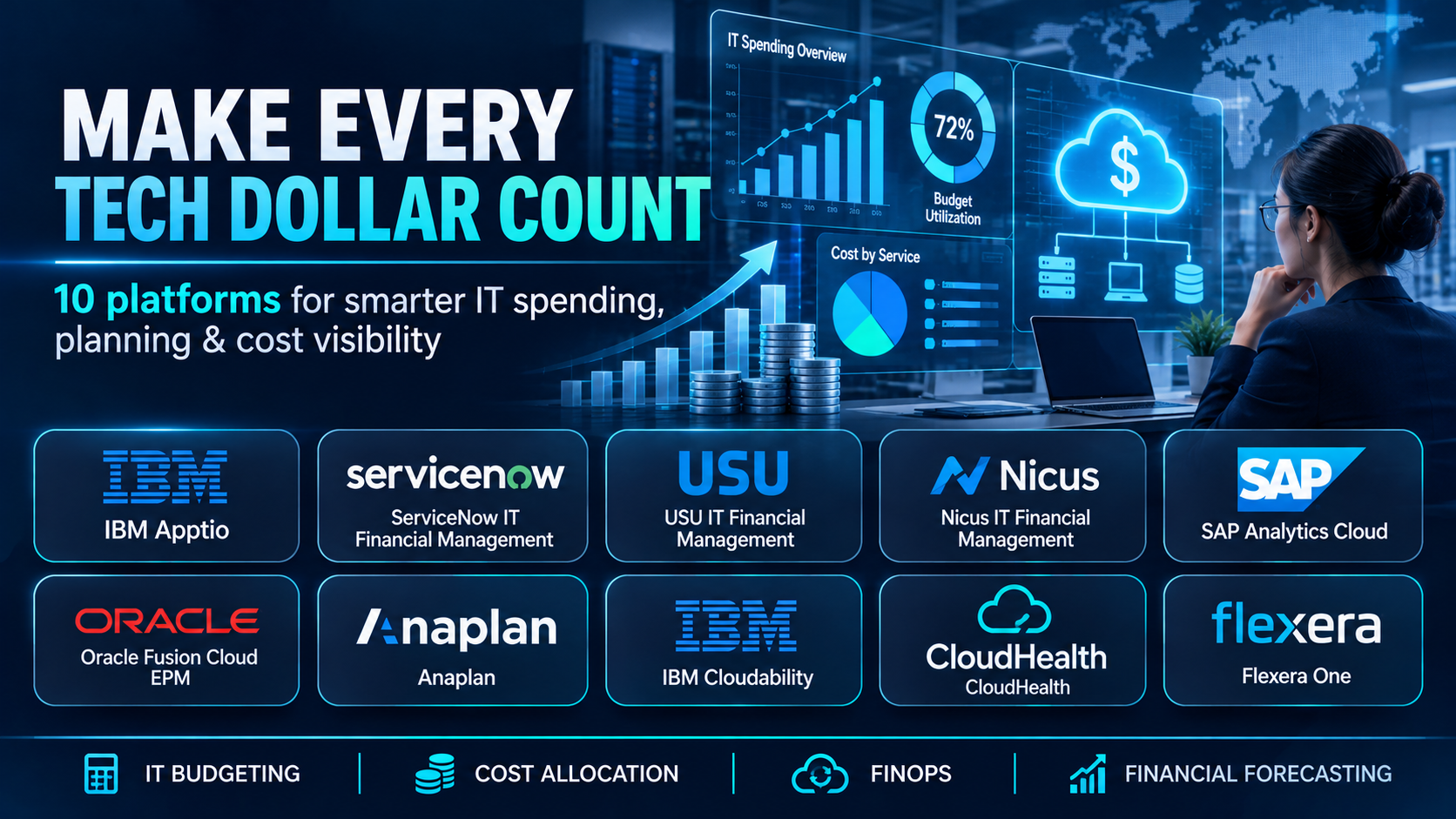
This guide examines ten IT financial management tools, including their features, benefits, advantages, limitations, and practical applications. It also provides comparison tables, software selection recommendations, an implementation workflow, common mistakes, and frequently asked questions.
What Are IT Financial Management Tools?
IT financial management tools are software applications that help organizations understand, control, and plan the financial resources associated with technology operations. They provide centralized visibility into technology budgets, infrastructure expenses, software investments, service delivery costs, and financial commitments.
These platforms collect information from accounting systems, procurement applications, cloud billing services, asset inventories, and other enterprise information sources. Financial administrators use this information to analyze spending patterns, allocate expenses, prepare budgets, and evaluate investment decisions.
For example, an enterprise operating multiple cloud environments and on-premises data centers can use ITFM software to calculate the cost of delivering individual technology services. Business departments can review their allocated technology expenses and identify opportunities to improve resource utilization.
ITFM software also supports Technology Business Management (TBM), a discipline that connects technology expenditure with business capabilities and organizational value. Some platforms additionally support Financial Operations (FinOps), which promotes collaborative financial accountability for technology consumption, particularly cloud services.
Common applications of IT financial management tools include:
- Technology Budgeting: Organizations establish annual and departmental technology budgets. Financial teams can compare planned expenditure with actual spending.
- Cloud Financial Management: Enterprises analyze cloud infrastructure and service consumption expenses. Cost visibility supports resource optimization and financial accountability.
- Software Expense Management: Organizations track software licensing, subscriptions, and contractual commitments. Financial information helps identify unnecessary or underutilized investments.
- Infrastructure Cost Analysis: Technology departments evaluate data center, networking, computing, and storage expenses. Detailed cost models support infrastructure investment decisions.
- IT Service Costing: Organizations calculate the expenses associated with delivering technology services. Service costing helps communicate financial requirements to business stakeholders.
- Financial Forecasting: Administrators estimate future technology expenditure using historical information and business assumptions. Forecasting supports proactive financial planning.
- Cost Allocation: Shared technology expenses are distributed among relevant business departments. Consistent allocation methodologies improve financial accountability.
- Technology Investment Planning: Organizations evaluate proposed technology projects and investment alternatives. Financial analysis helps prioritize initiatives according to strategic objectives.
Top 10 IT Financial Management Tools in 2026
The following selection includes dedicated technology business management platforms, enterprise financial planning applications, and cloud financial management solutions. The numbering is intended for comparison rather than an independently tested performance ranking.
1. IBM Apptio
Short Description
IBM Apptio is a technology business management platform that helps organizations understand technology costs, financial performance, and investment priorities. It provides capabilities for connecting technology expenditure with business services and organizational outcomes.
The platform is suitable for large enterprises, financial institutions, technology departments, and organizations managing complex infrastructure portfolios. Financial administrators can analyze expenditure across multiple technology categories.
Its technical strength is structured technology cost modeling combined with financial allocation and business-oriented reporting. Organizations can establish relationships between infrastructure expenses, applications, services, and business units.
IBM Apptio supports integration with compatible enterprise financial systems and technology information sources. Available capabilities depend on the selected Apptio products and licensing arrangements.
Key Features
- Technology Cost Modeling: Administrators establish structured models connecting technology expenses with business services. These models support consistent financial analysis.
- Budget Management: Financial teams create and monitor technology budgets. Actual expenditure can be compared with approved financial plans.
- Cost Allocation: Shared infrastructure expenses can be distributed using configurable allocation rules. Organizations can establish methodologies reflecting resource consumption.
- Financial Forecasting: Supported planning capabilities estimate future technology expenditure. Forecasts can incorporate historical costs and organizational assumptions.
- Service Costing: Administrators calculate the expenses associated with delivering technology services. Business stakeholders gain visibility into service-related financial requirements.
- Financial Reporting: Configurable reports summarize technology expenditure and financial performance. Reports support executive reviews and departmental planning.
- Investment Analysis: Available capabilities help evaluate technology investment alternatives. Organizations can compare proposed expenditure with strategic priorities.
- Data Integration: Supported connectors and interfaces import information from compatible enterprise systems. Integration helps consolidate financial and operational information.
- Technology Benchmarking: Applicable capabilities support comparisons using available technology cost benchmarks. Organizations should evaluate benchmark relevance and data consistency.
Benefits
- Improves technology spending transparency.
- Supports structured financial planning.
- Enables business-oriented cost allocation.
- Enhances technology investment analysis.
- Reduces fragmented financial reporting.
- Supports executive financial accountability.
- Improves technology service cost visibility.
Pros
- Dedicated technology business management functionality.
- Comprehensive cost modeling capabilities.
- Enterprise financial reporting.
- Configurable allocation methodologies.
- Supported enterprise integrations.
- Suitable for complex technology portfolios.
Cons
- Commercial licensing costs can be substantial.
- Implementation requires financial modeling expertise.
- Accurate source information is essential.
- Advanced functionality may require multiple products.
- Smaller organizations may find implementation excessive.
Use Cases
- Enterprise Technology Budgeting: Coordinate annual technology financial plans.
- Business Service Costing: Calculate the expenses associated with technology services.
- Departmental Cost Allocation: Distribute shared infrastructure expenditure.
- Technology Investment Analysis: Evaluate proposed infrastructure investments.
- Executive Financial Reporting: Communicate technology expenditure to leadership.
- Financial Transformation: Establish standardized technology financial management processes.
Best For
- Large enterprises.
- Chief Information Officer offices.
- Technology finance departments.
- TBM practitioners.
- Financial institutions.
- Enterprise technology investment managers.
2. ServiceNow IT Financial Management
Short Description
ServiceNow provides technology financial management capabilities through applicable platform products, including Strategic Portfolio Management (SPM) and financial planning workflows. These capabilities help organizations connect technology expenditure with projects, services, and business priorities.
The platform is suitable for enterprise technology departments, portfolio management offices, and organizations using ServiceNow for operational workflows. Administrators can coordinate financial information with broader technology management activities.
Its technical advantage is integration between financial planning, service management, demand management, and portfolio governance. Organizations can evaluate technology investments alongside operational requirements.
ServiceNow provides cloud-based administration and configurable enterprise workflows. Buyers should verify current product packaging rather than assume that IT Financial Management is available as a standalone product.
Key Features
- Financial Planning: Supported capabilities document planned technology expenditure. Administrators can coordinate financial requirements across projects and portfolios.
- Cost Tracking: Available records associate expenses with supported organizational activities. Financial teams can evaluate actual expenditure against plans.
- Portfolio Financial Management: Administrators review financial information across technology initiatives. This supports investment prioritization.
- Demand Management: Configurable workflows capture proposed technology requirements. Financial estimates help evaluate competing investment requests.
- Service Management Integration: Compatible platform capabilities connect financial information with technology services. This improves operational and financial coordination.
- Resource Planning: Supported resource management functions estimate personnel requirements and associated costs. Administrators can evaluate resource availability.
- Approval Workflows: Configurable processes coordinate financial approvals. Structured workflows support organizational accountability.
- Reporting and Dashboards: Available reports summarize financial and portfolio information. Management teams can review investment performance.
- Enterprise Integration: Supported interfaces connect compatible financial and procurement systems. Integration reduces repetitive information entry.
Benefits
- Connects technology finance with operational workflows.
- Supports portfolio investment planning.
- Improves financial approval coordination.
- Enhances technology expenditure visibility.
- Supports centralized reporting.
- Reduces fragmented planning processes.
- Improves project financial accountability.
Pros
- Integrated enterprise workflow ecosystem.
- Strong portfolio management relevance.
- Configurable financial processes.
- Supported service management integration.
- Enterprise reporting capabilities.
- Cloud-based administration.
Cons
- Commercial licensing can be expensive.
- Financial capabilities depend on selected products.
- Implementation requires platform expertise.
- Advanced cost modeling may require additional tools.
- Integration with accounting systems requires planning.
Use Cases
- Technology Portfolio Planning: Evaluate financial requirements across proposed initiatives.
- Project Cost Tracking: Monitor expenditure associated with technology projects.
- Investment Approval: Coordinate financial reviews and approval processes.
- Service Financial Management: Connect supported service information with financial records.
- Resource Cost Planning: Estimate personnel expenses across technology initiatives.
- Executive Portfolio Reporting: Communicate investment performance to stakeholders.
Best For
- ServiceNow customers.
- Enterprise IT departments.
- Technology portfolio managers.
- Project management offices.
- Digital transformation teams.
- Technology governance professionals.
3. USU IT Financial Management
Short Description
USU IT Financial Management provides capabilities for managing technology costs, service pricing, budgeting, and financial allocation. It is associated with USU’s technology management software portfolio.
The platform is suitable for enterprises, internal technology service providers, and organizations requiring structured technology financial governance. Administrators can evaluate expenditure across infrastructure and service categories.
Its technical strength is service-oriented cost modeling and financial transparency. Organizations can establish relationships between technology resources, service consumption, and departmental expenses.
USU supports configurable financial processes and compatible enterprise integrations. Organizations should evaluate current product availability and deployment arrangements during procurement.
Key Features
- Technology Cost Transparency: Centralized financial information provides visibility into technology expenditure. Administrators can analyze costs across supported categories.
- Service Cost Calculation: Configurable models calculate the costs of delivering technology services. These calculations support service pricing decisions.
- Budget Planning: Financial teams establish planned expenditure across organizational departments. Budget records support ongoing financial monitoring.
- Cost Allocation: Supported allocation methodologies distribute shared technology expenses. Organizations can define rules reflecting operational requirements.
- Service Charging: Available capabilities support internal technology service charging processes. Financial administrators can establish consistent charging methodologies.
- Financial Forecasting: Supported planning functions estimate future expenditure. Forecasts help identify potential budget deviations.
- Variance Analysis: Financial reports compare actual costs with planned expenditure. Administrators can investigate significant differences.
- Management Reporting: Configurable reports summarize technology financial information. Stakeholders can evaluate spending patterns.
- Enterprise Integration: Supported interfaces import information from compatible financial systems. Integration supports consistent financial records.
Benefits
- Improves technology cost transparency.
- Supports internal service charging.
- Enables structured financial allocation.
- Enhances budget management.
- Supports service-oriented financial planning.
- Improves expenditure reporting.
- Reduces manual financial calculations.
Pros
- Dedicated IT financial management relevance.
- Structured service costing capabilities.
- Configurable allocation rules.
- Enterprise financial reporting.
- Supported budgeting functionality.
- Suitable for internal service providers.
Cons
- Commercial licensing costs apply.
- Implementation requires financial process expertise.
- Accurate service consumption information is necessary.
- Advanced integrations require configuration.
- Current product packaging requires verification.
Use Cases
- Internal Service Costing: Calculate technology service delivery expenses.
- Departmental Chargeback: Allocate approved technology charges to departments.
- Technology Budgeting: Establish and monitor technology financial plans.
- Service Pricing: Evaluate appropriate internal service prices.
- Financial Variance Analysis: Investigate differences between actual and planned expenditure.
- Technology Financial Governance: Standardize financial management methodologies.
Best For
- Enterprise technology finance teams.
- Internal service providers.
- IT controllers.
- Shared service organizations.
- Financial governance departments.
- Technology service managers.
4. Nicus IT Financial Management
Short Description
Nicus IT Financial Management is a specialized software platform for technology budgeting, cost modeling, financial planning, and business-oriented reporting. It helps organizations understand how technology resources contribute to business expenses.
The platform is suitable for enterprise technology finance departments and organizations implementing technology business management practices. Administrators can consolidate financial information from compatible enterprise sources.
Its technical advantage is the combination of technology-specific financial planning and configurable cost allocation. Organizations can establish financial models aligned with internal service delivery arrangements.
Nicus provides capabilities for financial reporting, planning, and technology cost transparency. Current deployment options and individual product capabilities should be evaluated during procurement.
Key Features
- Technology Budgeting: Administrators establish financial plans for technology departments. Budget information supports ongoing expenditure reviews.
- Cost Modeling: Configurable models associate technology expenses with relevant business activities. Structured models improve financial consistency.
- Financial Forecasting: Supported forecasting functions estimate future technology expenditure. Financial teams can incorporate changing business assumptions.
- Cost Allocation: Available capabilities distribute shared technology costs. Allocation rules can reflect approved consumption methodologies.
- Service Costing: Administrators calculate expenses associated with technology services. This supports business-oriented financial reporting.
- Variance Reporting: Reports compare planned expenditure with actual financial results. Administrators can investigate significant deviations.
- Showback Reporting: Supported reporting communicates allocated costs to business departments without necessarily posting financial charges. This promotes spending awareness.
- Financial Dashboards: Configurable visualizations summarize technology expenditure. Management teams can review financial performance.
- Data Integration: Compatible interfaces import financial and operational information. Integration helps consolidate technology cost records.
Benefits
- Improves technology budget visibility.
- Supports structured cost modeling.
- Enhances financial forecasting.
- Enables departmental cost transparency.
- Reduces spreadsheet-based financial processes.
- Supports technology service costing.
- Improves business financial communication.
Pros
- Technology-specific financial functionality.
- Configurable cost allocation.
- Supported budgeting and forecasting.
- Business-oriented financial reporting.
- Suitable for TBM initiatives.
- Enterprise integration capabilities.
Cons
- Commercial licensing costs apply.
- Implementation requires financial expertise.
- Cost models require ongoing maintenance.
- Integration complexity varies by organization.
- Smaller teams may need simpler functionality.
Use Cases
- Technology Budget Preparation: Establish departmental financial plans.
- Shared Cost Allocation: Distribute infrastructure expenses using approved methodologies.
- Financial Forecasting: Estimate future technology expenditure.
- Departmental Showback: Communicate allocated technology costs.
- Service Cost Analysis: Evaluate technology service delivery expenses.
- Management Reporting: Present financial performance to organizational leadership.
Best For
- IT finance professionals.
- Technology controllers.
- TBM teams.
- Enterprise financial planners.
- Shared service departments.
- Technology governance managers.
5. SAP Analytics Cloud
Short Description
SAP Analytics Cloud is an enterprise analytics and planning platform developed by SAP. It combines business intelligence, financial planning, and supported predictive capabilities.
The platform is suitable for enterprises using SAP financial systems and organizations requiring integrated financial planning. Technology finance teams can configure planning models for infrastructure expenditure and technology investments.
Its technical strength is integration between enterprise analytics, financial planning, and compatible SAP business information. Organizations can analyze technology expenses alongside broader organizational financial performance.
SAP Analytics Cloud is not exclusively an ITFM platform. Technology-specific cost allocation and service costing generally require appropriate data models and configuration.
Key Features
- Financial Planning: Configurable planning models support technology budget preparation. Administrators can establish financial assumptions and planning structures.
- Budget Forecasting: Supported forecasting functions estimate future expenditure. Financial teams can evaluate changing business conditions.
- Scenario Modeling: Organizations create alternative financial scenarios. Comparative analysis supports investment decisions.
- Data Visualization: Interactive reports present financial information through supported charts and tables. Stakeholders can review expenditure patterns.
- SAP Integration: Compatible connections provide access to supported SAP information sources. Integration helps coordinate enterprise financial analysis.
- Collaborative Planning: Available workflows support participation from authorized planning teams. Organizations can coordinate departmental financial contributions.
- Allocation Modeling: Configurable planning calculations distribute expenses using defined methodologies. Technology-specific models require implementation.
- Variance Analysis: Reports compare financial plans with actual expenditure. Administrators can investigate deviations.
- Predictive Planning: Supported analytical capabilities assist with selected forecasting activities. Results depend on data quality and model suitability.
Benefits
- Supports integrated enterprise financial planning.
- Improves technology budget analysis.
- Enables financial scenario comparison.
- Enhances management reporting.
- Supports collaborative planning.
- Reduces fragmented analytical processes.
- Improves financial decision-making.
Pros
- Strong SAP ecosystem relevance.
- Integrated analytics and planning.
- Configurable financial models.
- Supported collaborative workflows.
- Enterprise visualization capabilities.
- Cloud-based deployment.
Cons
- Not a dedicated ITFM platform.
- Technology cost models require configuration.
- Commercial licensing costs apply.
- Implementation requires planning expertise.
- Complex integrations may require additional resources.
Use Cases
- Technology Budget Modeling: Establish financial plans for technology departments.
- Investment Scenario Analysis: Compare proposed technology investments.
- Enterprise Financial Reporting: Consolidate technology expenditure with broader financial information.
- Financial Forecasting: Estimate future infrastructure expenses.
- Departmental Planning: Coordinate financial contributions from business units.
- Budget Variance Analysis: Investigate differences between financial plans and actual results.
Best For
- SAP customers.
- Enterprise financial planners.
- Technology finance analysts.
- Business intelligence teams.
- Corporate finance departments.
- Organizations requiring integrated analytics.
6. Oracle Fusion Cloud EPM
Short Description
Oracle Fusion Cloud Enterprise Performance Management (EPM) is an enterprise financial planning and performance management platform developed by Oracle. It provides capabilities for budgeting, forecasting, financial modeling, and management reporting.
The platform is suitable for large enterprises, corporate finance departments, and organizations using compatible Oracle business applications. Technology finance teams can establish dedicated planning models for infrastructure and digital investment expenditure.
Its technical advantage is comprehensive enterprise financial planning combined with profitability and cost management capabilities. Organizations can configure allocation methodologies supporting technology financial analysis.
Oracle Fusion Cloud EPM provides cloud-based administration and multiple financial management business processes. Technology-specific financial management requires appropriate configuration and product selection.
Key Features
- Enterprise Planning: Configurable models support technology financial planning. Administrators can coordinate expenditure across organizational departments.
- Financial Forecasting: Supported forecasting functions estimate future costs. Financial teams can incorporate business assumptions and historical information.
- Profitability and Cost Management: Applicable capabilities support structured cost allocation models. Organizations can distribute shared expenses according to defined methodologies.
- Scenario Analysis: Financial teams compare alternative expenditure assumptions. Scenario modeling supports investment planning.
- Management Reporting: Available reports summarize financial performance. Stakeholders can review technology expenditure alongside enterprise financial results.
- Financial Integration: Compatible connections import information from enterprise financial systems. Integration helps maintain consistent planning information.
- Approval Workflows: Supported processes coordinate financial plan reviews. Administrators can establish organizational approval responsibilities.
- Collaborative Budgeting: Authorized departments contribute information to financial plans. This supports coordinated enterprise budgeting.
- Variance Analysis: Financial reports compare actual and planned expenditure. Administrators can investigate significant deviations.
Benefits
- Supports comprehensive enterprise financial planning.
- Improves technology expenditure forecasting.
- Enables configurable cost allocation.
- Enhances financial reporting.
- Supports investment scenario analysis.
- Improves departmental planning coordination.
- Strengthens financial governance.
Pros
- Comprehensive enterprise financial capabilities.
- Supported profitability and cost management.
- Strong Oracle ecosystem integration.
- Configurable financial planning models.
- Enterprise reporting functionality.
- Cloud-based administration.
Cons
- Not exclusively designed for ITFM.
- Technology-specific models require configuration.
- Commercial subscription costs apply.
- Implementation requires financial expertise.
- Multiple business processes may require additional licensing.
Use Cases
- Technology Financial Planning: Establish annual infrastructure and software budgets.
- Shared Cost Modeling: Allocate technology expenses among business departments.
- Investment Forecasting: Estimate future digital transformation costs.
- Enterprise Financial Consolidation: Incorporate technology financial information into corporate reporting.
- Scenario Planning: Compare alternative infrastructure investment strategies.
- Financial Governance: Coordinate budget approvals and expenditure reviews.
Best For
- Oracle customers.
- Corporate finance departments.
- Large enterprises.
- Technology financial planners.
- Cost management specialists.
- Enterprise performance management teams.
7. Anaplan
Short Description
Anaplan is a connected planning platform that supports enterprise financial, operational, and strategic planning. Organizations can configure its planning models to address technology budgets, workforce costs, infrastructure investments, and expenditure forecasts.
The platform is suitable for enterprises requiring collaborative planning across multiple business departments. Technology finance teams can connect financial assumptions with broader organizational operational requirements.
Its technical strength is multidimensional financial modeling and connected planning. Organizations can evaluate relationships between technology expenditure, workforce requirements, business growth, and investment decisions.
Anaplan provides cloud-based administration and configurable planning applications. It requires suitable technology-specific models to function as an IT financial management solution.
Key Features
- Connected Planning: Configurable models connect financial and operational assumptions. Organizations can coordinate technology budgets with business plans.
- Multidimensional Modeling: Administrators create financial models across departments, periods, and expense categories. This supports detailed expenditure analysis.
- Scenario Planning: Financial teams compare alternative investment assumptions. Scenario models help evaluate potential business outcomes.
- Budget Management: Organizations establish and monitor technology financial plans. Administrators can coordinate departmental contributions.
- Financial Forecasting: Supported models estimate future expenditure. Forecasts can incorporate changing operational assumptions.
- Cost Allocation Modeling: Configurable calculations distribute shared expenses. Organizations define allocation methodologies according to financial requirements.
- Collaborative Workflows: Authorized teams participate in planning activities. Structured collaboration supports consistent financial assumptions.
- Data Integration: Supported interfaces import information from compatible systems. Integration helps consolidate planning information.
- Management Reporting: Configurable dashboards summarize financial plans and performance. Stakeholders can review investment requirements.
Benefits
- Connects technology planning with business operations.
- Supports flexible financial modeling.
- Improves expenditure forecasting.
- Enables collaborative budget preparation.
- Supports investment scenario analysis.
- Enhances financial transparency.
- Reduces fragmented planning activities.
Pros
- Flexible connected planning architecture.
- Multidimensional modeling capabilities.
- Collaborative enterprise planning.
- Configurable scenario analysis.
- Cloud-based administration.
- Suitable for complex financial models.
Cons
- Technology-specific models require development.
- Commercial licensing costs apply.
- Implementation requires modeling expertise.
- Dedicated ITFM functionality is not automatic.
- Complex models require ongoing governance.
Use Cases
- Technology Budget Planning: Coordinate financial plans across technology departments.
- Workforce Cost Modeling: Estimate personnel expenses associated with technology operations.
- Infrastructure Investment Planning: Compare alternative technology investment strategies.
- Financial Scenario Analysis: Evaluate expenditure under different business assumptions.
- Departmental Cost Allocation: Model shared technology expenses.
- Connected Enterprise Planning: Align technology expenditure with corporate objectives.
Best For
- Enterprise financial planners.
- Technology investment managers.
- Corporate finance departments.
- Connected planning teams.
- Financial modeling specialists.
- Organizations requiring scenario analysis.
8. IBM Cloudability
Short Description
IBM Cloudability is a cloud financial management platform within the Apptio portfolio. It helps organizations analyze cloud expenditure, establish financial accountability, and identify resource optimization opportunities.
The platform is suitable for enterprises operating public cloud infrastructure and organizations implementing FinOps practices. Administrators can evaluate cloud spending across supported accounts and business dimensions.
Its technical strength is detailed cloud cost allocation combined with financial reporting and supported optimization recommendations. Organizations can connect cloud expenditure with operational ownership.
IBM Cloudability supports compatible cloud billing information and enterprise financial workflows. Its primary focus is cloud expenditure rather than comprehensive financial management of every technology asset.
Key Features
- Cloud Cost Visibility: Centralized reports summarize supported cloud expenditure. Administrators can analyze spending across accounts and services.
- Cost Allocation: Configurable business mappings associate cloud expenses with organizational departments. This supports financial accountability.
- Budget Management: Supported capabilities establish cloud expenditure budgets. Financial teams can monitor spending against approved plans.
- Cloud Forecasting: Available forecasts estimate future cloud expenditure. Administrators can evaluate potential budget deviations.
- Optimization Recommendations: Supported analysis identifies potential resource efficiency opportunities. Recommendations require operational validation.
- Commitment Management: Applicable capabilities support analysis of cloud pricing commitments. Organizations can evaluate potential savings and utilization.
- Container Cost Analysis: Supported integrations provide visibility into selected container infrastructure expenses. Allocation accuracy depends on available information.
- Financial Reporting: Configurable reports communicate cloud expenditure to stakeholders. Teams can review spending according to business requirements.
- Anomaly Visibility: Supported analytical capabilities help identify unusual spending patterns. Administrators can investigate unexpected cost changes.
Benefits
- Improves cloud expenditure transparency.
- Supports cloud financial accountability.
- Helps identify resource optimization opportunities.
- Enhances cloud budget forecasting.
- Enables departmental cost allocation.
- Supports FinOps collaboration.
- Improves cloud investment decisions.
Pros
- Dedicated cloud financial management.
- Detailed cloud cost analysis.
- Supported optimization recommendations.
- Configurable business mappings.
- Enterprise reporting capabilities.
- Multi-cloud management relevance.
Cons
- Commercial licensing costs apply.
- Primarily focused on cloud expenditure.
- Accurate allocation requires suitable billing information.
- Optimization recommendations require validation.
- Comprehensive ITFM may require complementary platforms.
Use Cases
- Cloud Budget Management: Monitor expenditure across supported cloud environments.
- Departmental Cloud Allocation: Associate cloud expenses with business ownership.
- Resource Optimization: Investigate potential infrastructure savings.
- Cloud Forecasting: Estimate future consumption expenses.
- FinOps Reporting: Communicate cloud financial performance to stakeholders.
- Cloud Commitment Analysis: Evaluate supported pricing commitment opportunities.
Best For
- FinOps teams.
- Cloud infrastructure managers.
- Enterprise cloud finance departments.
- Multi-cloud organizations.
- Technology cost analysts.
- Cloud optimization specialists.
9. CloudHealth
Short Description
CloudHealth is a cloud financial management and governance platform historically associated with VMware and Broadcom. It provides capabilities for analyzing cloud expenditure, resource utilization, and supported optimization opportunities.
The platform is suitable for enterprises, managed service providers, and organizations operating complex cloud environments. Financial administrators can establish business-oriented views of supported cloud costs.
Its technical advantage is cloud expenditure analysis combined with configurable governance policies and resource optimization insights. Organizations can monitor financial performance across supported infrastructure environments.
CloudHealth is primarily a cloud financial management solution rather than a complete enterprise ITFM suite. Current branding, ownership, licensing, and provider coverage should be verified before procurement.
Key Features
- Cloud Cost Reporting: Supported billing information provides visibility into cloud expenditure. Administrators can analyze costs across accounts and services.
- Business Grouping: Configurable perspectives organize resources according to business dimensions. This supports departmental financial analysis.
- Budget Monitoring: Available capabilities compare cloud expenditure with defined budgets. Administrators can investigate potential deviations.
- Resource Optimization: Supported recommendations identify potential resource efficiency opportunities. Engineering teams should validate proposed changes.
- Governance Policies: Configurable policies evaluate selected resource and financial conditions. Organizations can establish operational governance workflows.
- Commitment Analysis: Available analytical capabilities evaluate supported cloud pricing commitments. Financial teams can investigate utilization and coverage.
- Historical Reporting: Reports summarize expenditure and resource trends over time. Administrators can evaluate changing consumption patterns.
- Multi-Cloud Visibility: Supported integrations consolidate information from compatible cloud providers. Coverage depends on current product capabilities.
- Management Dashboards: Configurable visualizations communicate financial information to stakeholders. Teams can review cloud expenditure and operational metrics.
Benefits
- Improves cloud cost visibility.
- Supports cloud financial governance.
- Helps identify inefficient resource utilization.
- Enables business-oriented cost analysis.
- Supports budget monitoring.
- Enhances cloud optimization planning.
- Improves financial accountability.
Pros
- Established cloud management functionality.
- Configurable business grouping.
- Supported governance policies.
- Cloud resource optimization insights.
- Enterprise reporting capabilities.
- Managed service provider relevance.
Cons
- Commercial licensing costs apply.
- Primarily focused on cloud infrastructure.
- Current product arrangements require verification.
- Accurate grouping requires configuration.
- Comprehensive enterprise financial planning may require additional tools.
Use Cases
- Multi-Cloud Cost Analysis: Review expenditure across supported cloud providers.
- Cloud Governance: Establish financial and resource governance policies.
- Resource Efficiency Reviews: Investigate underutilized infrastructure.
- Departmental Reporting: Communicate cloud expenses to business units.
- Budget Monitoring: Identify potential cloud budget deviations.
- Managed Cloud Services: Analyze customer infrastructure expenditure.
Best For
- Cloud finance teams.
- Managed service providers.
- Enterprise cloud administrators.
- FinOps practitioners.
- Cloud governance teams.
- Multi-cloud organizations.
10. Flexera One
Short Description
Flexera One is a technology asset management and cloud financial management platform developed by Flexera. It provides capabilities for understanding technology inventories, software expenditure, licensing obligations, and cloud costs.
The platform is suitable for enterprises managing extensive software portfolios, hybrid infrastructure, and public cloud environments. Administrators can evaluate technology consumption alongside financial and contractual information.
Its technical strength is the combination of technology asset intelligence, software licensing analysis, and supported FinOps capabilities. Organizations can identify opportunities to improve technology expenditure management across multiple resource categories.
Flexera One provides multiple technology management capabilities through applicable products and modules. Comprehensive budgeting and enterprise financial planning may require integration with dedicated financial systems.
Key Features
- Technology Asset Visibility: Supported discovery and inventory information identifies technology resources. Administrators can evaluate assets across compatible environments.
- Software Asset Management: Available capabilities analyze software installations and licensing information. Organizations can investigate licensing discrepancies.
- Cloud Cost Management: Supported billing integrations provide visibility into cloud expenditure. Financial teams can analyze costs across business dimensions.
- License Optimization: Analytical capabilities identify potential software licensing optimization opportunities. Recommendations require contractual validation.
- Technology Cost Allocation: Supported mappings associate selected expenses with organizational ownership. This helps improve financial accountability.
- Cloud Optimization: Available recommendations identify potential resource efficiency opportunities. Technical teams should validate operational effects.
- Contract Visibility: Applicable capabilities document relevant software agreements and financial commitments. Administrators can evaluate renewal requirements.
- Financial Reporting: Configurable reports summarize technology costs and asset information. Management teams can review spending patterns.
- Enterprise Integration: Supported interfaces connect compatible operational and financial systems. Integration supports consolidated technology information.
Benefits
- Improves technology expenditure visibility.
- Supports software licensing governance.
- Helps identify cloud optimization opportunities.
- Enhances technology asset intelligence.
- Supports contractual expense analysis.
- Improves technology financial accountability.
- Reduces fragmented asset and cost information.
Pros
- Broad technology asset management capabilities.
- Supported software licensing analysis.
- Cloud financial management relevance.
- Enterprise reporting functionality.
- Hybrid infrastructure visibility.
- Configurable technology governance.
Cons
- Commercial licensing costs apply.
- Product selection can be complex.
- Accurate inventory information is essential.
- Comprehensive financial planning may require additional tools.
- Implementation requires technology asset expertise.
Use Cases
- Software Expense Optimization: Evaluate software licensing and subscription expenditure.
- Cloud Financial Management: Analyze supported cloud infrastructure costs.
- Technology Asset Governance: Maintain visibility into enterprise technology resources.
- Contract Renewal Planning: Review relevant software financial commitments.
- Hybrid Infrastructure Analysis: Evaluate technology expenditure across different environments.
- Technology Investment Reviews: Identify potential opportunities to improve resource utilization.
Best For
- Enterprise technology asset managers.
- Software licensing specialists.
- FinOps teams.
- Hybrid infrastructure operators.
- Technology procurement departments.
- Enterprise cost optimization teams.
Comparison Table: Top 10 IT Financial Management Tools
| Tool Name | Best For | Platform(s) | Standout Feature | Pricing |
|---|---|---|---|---|
| IBM Apptio | Enterprise technology business management | Cloud-based enterprise platform | Technology cost modeling | Commercial licensing |
| ServiceNow IT Financial Management | Integrated technology workflows | ServiceNow platform | Portfolio financial management | Commercial licensing |
| USU IT Financial Management | Internal service costing | Supported enterprise deployments | Service pricing and cost allocation | Commercial licensing |
| Nicus IT Financial Management | Technology financial planning | Supported enterprise deployments | IT-specific budgeting and allocation | Commercial licensing |
| SAP Analytics Cloud | Integrated enterprise planning | Cloud, web | Financial analytics and planning | Paid subscription |
| Oracle Fusion Cloud EPM | Enterprise financial management | Oracle Cloud | Profitability and cost management | Paid subscription |
| Anaplan | Connected financial planning | Cloud, web | Multidimensional financial modeling | Commercial subscription |
| IBM Cloudability | Cloud financial management | Cloud, web | Cloud cost allocation and optimization | Commercial licensing |
| CloudHealth | Cloud financial governance | Cloud, web | Business-oriented cloud cost reporting | Commercial licensing |
| Flexera One | Technology asset and cost optimization | Cloud, supported collectors | Software licensing and cloud cost intelligence | Commercial licensing |
Note: Pricing, licensing, supported platforms, and available features can change. Check the official vendor websites for current plans, educational access, and regional availability.
Which IT Financial Management Tool Is Right for You?
Different organizations require different combinations of technology budgeting, financial forecasting, cost allocation, cloud optimization, and investment planning. A cloud-focused technology department may require detailed consumption analysis, whereas a multinational enterprise may need comprehensive financial modeling.
Selection should consider technology infrastructure complexity, financial reporting requirements, integration needs, organizational resources, and total operating costs. Organizations should distinguish between dedicated ITFM platforms, general financial planning applications, and specialized cloud financial management tools.
For Beginners: IBM Cloudability and Nicus
IBM Cloudability provides focused cloud expenditure visibility and supported financial reporting. Its capabilities can suit teams beginning structured cloud financial management.
Nicus provides technology-specific budgeting and cost allocation capabilities. Its functionality is relevant to organizations establishing broader technology financial processes.
Choose Cloudability if cloud expenditure is your primary concern. Choose Nicus if technology-wide budgeting and financial allocation are more important.
For Large Enterprises: IBM Apptio and Oracle Fusion Cloud EPM
IBM Apptio provides dedicated technology business management and structured cost modeling. Its capabilities help organizations connect technology expenditure with business services.
Oracle Fusion Cloud EPM provides comprehensive enterprise financial planning and configurable allocation models. It can suit organizations requiring integrated corporate financial management.
Choose IBM Apptio if technology-specific cost transparency is essential. Choose Oracle Fusion Cloud EPM if broader enterprise financial planning is your priority.
For ServiceNow Customers: ServiceNow and IBM Apptio
ServiceNow provides financial planning capabilities within applicable enterprise portfolio and workflow products. Organizations can connect technology investments with operational activities.
IBM Apptio provides specialized technology financial modeling and service costing. Its capabilities can complement operational management platforms.
Choose ServiceNow if integrated technology workflows are important. Choose IBM Apptio if comprehensive technology cost modeling is required.
For Internal Technology Service Providers: USU and Nicus
USU provides service-oriented financial management and supported internal charging capabilities. These functions are relevant to organizations delivering shared technology services.
Nicus provides technology budgeting, financial allocation, and showback reporting. Organizations can establish financial transparency across departments.
Choose USU if service pricing and internal charging are essential. Choose Nicus if technology budgeting and cost allocation are your main objectives.
For SAP Environments: SAP Analytics Cloud and Anaplan
SAP Analytics Cloud provides financial planning and analytics with compatible SAP integrations. It can support organizations maintaining established SAP financial infrastructure.
Anaplan provides configurable connected planning across multiple operational and financial dimensions. Its models can accommodate complex technology planning requirements.
Choose SAP Analytics Cloud if SAP integration is a priority. Choose Anaplan if flexible connected planning better matches your requirements.
For FinOps Teams: IBM Cloudability and CloudHealth
IBM Cloudability provides cloud expenditure analysis, allocation, forecasting, and supported optimization recommendations. Its capabilities support collaborative cloud financial management.
CloudHealth provides cloud cost reporting, business grouping, and configurable governance policies. It can support organizations requiring financial and operational cloud governance.
Choose Cloudability if detailed cloud financial management is your priority. Choose CloudHealth if cloud governance and business-oriented reporting are particularly important.
For Software Expense Management: Flexera One and IBM Apptio
Flexera One provides software asset intelligence, licensing analysis, and supported cloud financial management. Organizations can investigate technology expenditure optimization opportunities.
IBM Apptio provides structured financial modeling across technology expense categories. Its capabilities support broader technology financial governance.
Choose Flexera One if software licensing optimization is essential. Choose IBM Apptio if comprehensive technology financial modeling is more important.
For Financial Scenario Planning: Anaplan and Oracle Fusion Cloud EPM
Anaplan provides multidimensional connected planning and configurable financial scenarios. Organizations can evaluate technology investments under different operational assumptions.
Oracle Fusion Cloud EPM provides enterprise planning, forecasting, and profitability management capabilities. Its functionality supports comprehensive corporate financial processes.
Choose Anaplan if flexible connected modeling is your priority. Choose Oracle Fusion Cloud EPM if integrated enterprise performance management is required.
Best IT Financial Management Tools for Different Users
| User Type | Recommended Software | Why? |
|---|---|---|
| Chief Information Officer | IBM Apptio | Business-oriented technology cost transparency |
| Technology portfolio manager | ServiceNow | Financial planning integrated with portfolio workflows |
| Internal service provider | USU IT Financial Management | Service costing and internal charging |
| Technology finance controller | Nicus | Technology-specific budgeting and allocation |
| SAP financial analyst | SAP Analytics Cloud | Integrated analytics and financial planning |
| Corporate finance manager | Oracle Fusion Cloud EPM | Enterprise financial modeling |
| Strategic financial planner | Anaplan | Connected planning and scenario analysis |
| FinOps practitioner | IBM Cloudability | Cloud financial accountability |
| Cloud governance manager | CloudHealth | Cloud cost reporting and governance |
| Software asset manager | Flexera One | Licensing and technology cost optimization |
Practical Example: Implementing IT Financial Management Across an Enterprise
Consider a financial services organization operating multiple data centers, public cloud environments, enterprise applications, and software subscriptions. Its annual technology budget is $20 million, but financial information is distributed across accounting applications, procurement systems, and cloud billing platforms.
The organization wants to improve expenditure visibility, establish departmental cost allocation, and prepare reliable technology financial forecasts. IBM Apptio, Nicus, and IBM Cloudability are potential solutions depending on the required financial management scope.
The organization establishes a phased implementation workflow covering financial assessment, platform selection, information integration, cost modeling, budgeting, pilot testing, and continuous optimization. Implementation prioritizes financial accuracy, consistent allocation methodologies, and measurable business outcomes.
Step 1: Assess Existing Technology Expenditure
Document current technology expense categories, financial information sources, departmental budgets, and contractual commitments. Identify expenditure associated with infrastructure, cloud services, software licensing, personnel, and external technology services.
Review historical financial records and establish baseline measurements. Identify inconsistencies between accounting information, procurement records, and operational consumption reports.
Assessment checklist:
- Infrastructure expenditure.
- Cloud service expenses.
- Software licensing costs.
- Technology personnel expenses.
- External service contracts.
- Departmental technology budgets.
- Planned technology investments.
- Existing financial allocation methodologies.
Step 2: Select the IT Financial Management Platform
Compare shortlisted platforms according to budgeting functionality, financial forecasting, cost allocation, reporting, and integration requirements. Determine whether dedicated cloud financial management or software licensing analysis is also necessary.
Establish financial data ownership responsibilities and appropriate access controls. Enable Multi-Factor Authentication (MFA), which requires multiple verification factors, where supported.
Define standardized expense categories, business unit identifiers, service classifications, and financial reporting periods. Consistent financial structures help maintain reliable expenditure analysis.
Step 3: Integrate Financial and Operational Information
Connect compatible accounting systems, procurement applications, cloud billing sources, and technology asset inventories. Import historical financial information using supported integration mechanisms.
Validate imported information against approved accounting records. Resolve duplicate transactions, inconsistent currency conversions, missing expense categories, and incorrect organizational assignments.
Integration checklist:
- General ledger information.
- Procurement records.
- Cloud billing information.
- Software contract details.
- Technology asset inventories.
- Personnel expense records.
- Business unit classifications.
- Historical financial budgets.
Step 4: Establish Technology Cost Models
Create structured models connecting technology expenditure with infrastructure resources, applications, services, and business departments. Distinguish directly attributable expenses from shared technology costs.
Define approved allocation rules based on measurable consumption, employee counts, service usage, or other appropriate financial drivers. Document assumptions and obtain approval from relevant financial stakeholders.
For example, the organization incurs $120,000 in monthly shared infrastructure expenses. An approved allocation methodology distributes these expenses according to measured departmental consumption.
| Department | Consumption Share | Monthly Allocated Cost |
|---|---|---|
| Banking Operations | 40% | $48,000 |
| Digital Services | 30% | $36,000 |
| Risk Management | 20% | $24,000 |
| Corporate Services | 10% | $12,000 |
| Total | 100% | $120,000 |
This illustrative allocation demonstrates how shared infrastructure expenses can be distributed transparently. Actual allocation methodologies should reflect approved organizational accounting policies and reliable consumption information.
Step 5: Configure Budgeting and Forecasting
Establish technology budgets across organizational departments and expense categories. Configure forecasting models using historical expenditure, planned infrastructure changes, contractual commitments, and business growth assumptions.
Define financial monitoring thresholds and budget review procedures. Establish responsibilities for investigating significant expenditure deviations.
Recommended financial planning areas:
- Annual technology budgets.
- Monthly expenditure forecasts.
- Cloud consumption estimates.
- Software renewal commitments.
- Infrastructure replacement plans.
- Technology workforce expenses.
- Digital transformation investments.
Step 6: Conduct Pilot Testing and Expand Deployment
Select representative business departments for controlled pilot testing. Validate financial reports, allocation calculations, budget comparisons, and integration accuracy.
Resolve identified discrepancies before expanding the platform across the organization. Train technology finance personnel, infrastructure managers, procurement teams, and authorized business stakeholders.
Expected implementation outputs:
- Consolidated technology expense records.
- Validated financial allocation models.
- Departmental showback reports.
- Technology budget dashboards.
- Financial forecasts.
- Service cost reports.
- Investment planning documentation.
Step 7: Monitor and Optimize Technology Financial Performance
Compare post-deployment financial measurements with the original operational baseline. Evaluate budget variance, forecast accuracy, cost allocation coverage, reporting efficiency, and technology resource utilization.
Review potential optimization opportunities involving unused software subscriptions, underutilized cloud resources, and unnecessary infrastructure expenditure. Validate proposed changes with technical teams and financial stakeholders before implementation.
Periodically update cost models, financial assumptions, organizational classifications, and allocation methodologies. Financial management processes should evolve as technology infrastructure and business requirements change.
This workflow establishes a structured approach to technology financial management and business accountability. Accurate financial information and consistent cost models help organizations make informed technology investment decisions.
Eight Common IT Financial Management Implementation Mistakes
- Using Inaccurate Financial Information: Inconsistent accounting and billing records can undermine financial reporting. Reconcile imported information against approved financial sources.
- Ignoring Shared Infrastructure Costs: Unallocated technology expenses can obscure departmental consumption. Establish documented allocation methodologies using appropriate financial drivers.
- Selecting an Unsuitable Platform: Cloud cost management applications may not provide comprehensive enterprise financial planning. Match software functionality to documented organizational requirements.
- Creating Excessively Complex Cost Models: Unnecessarily detailed allocation structures can increase administrative effort. Establish practical models that provide meaningful financial transparency.
- Neglecting Financial Ownership: Unclear responsibilities can result in outdated budgets and unresolved financial discrepancies. Assign ownership for financial records, cost models, and reporting activities.
- Overlooking Contractual Commitments: Financial forecasts may become inaccurate when software renewals and cloud commitments are excluded. Incorporate approved contractual obligations into planning processes.
- Confusing Showback with Chargeback: Financial visibility reports do not necessarily represent actual accounting charges. Establish clear policies governing departmental reporting and financial transactions.
- Failing to Measure Outcomes: Software implementation without baseline measurements makes financial improvements difficult to evaluate. Define relevant performance indicators before deployment and review them consistently.
Frequently Asked Questions (FAQs)
1. What are IT financial management tools?
IT financial management tools help organizations plan, monitor, allocate, and analyze technology expenditure. They support budgeting, forecasting, financial reporting, and investment decisions.
Available capabilities vary according to platform architecture and organizational requirements. Some products specialize in cloud expenditure, while others provide comprehensive technology business management.
2. Which IT financial management tool is suitable for beginners?
IBM Cloudability can suit teams beginning structured cloud financial management. Nicus provides technology-specific financial planning and cost allocation capabilities.
The appropriate choice depends on financial management scope and available expertise. Organizations should evaluate usability through representative financial scenarios.
3. Are free IT financial management tools available?
Some cloud providers offer native cost management capabilities without separate software licensing charges. Open-source cloud cost tools can also support selected expenditure analysis requirements.
Comprehensive enterprise ITFM platforms generally require commercial licensing. Organizations should consider implementation, integration, hosting, and support expenses.
4. How does ITFM differ from spreadsheet-based financial management?
Spreadsheets provide flexible financial modeling but require substantial manual maintenance. Disconnected records can create inconsistent calculations and reporting difficulties.
ITFM platforms provide structured financial models, supported integrations, and configurable workflows. These capabilities improve financial consistency and operational transparency.
5. Which ITFM tools are suitable for large enterprises?
IBM Apptio, Nicus, USU, and applicable ServiceNow products provide technology financial management capabilities relevant to enterprises. Oracle Fusion Cloud EPM and Anaplan can support broader financial planning.
Organizations should evaluate scalability, financial modeling requirements, integration compatibility, and support arrangements. Controlled pilot testing helps establish product suitability.
6. Which ITFM tools are suitable for cloud computing?
IBM Cloudability, CloudHealth, and Flexera One provide cloud financial management capabilities. They help organizations evaluate supported cloud expenditure and resource utilization.
Cloud-focused teams should assess provider coverage, billing integration, cost allocation, forecasting, and optimization functionality. Comprehensive technology financial planning may require complementary tools.
7. Can ITFM tools integrate with accounting systems?
Many commercial ITFM platforms support integrations with compatible accounting, procurement, and enterprise financial systems. Available integration methods depend on product selection.
Organizations should validate financial information synchronization and reconciliation processes. Appropriate access permissions and audit controls remain important.
8. What is the difference between ITFM, TBM, and FinOps?
ITFM concerns financial planning and management of technology expenditure. TBM connects technology costs with business capabilities, services, and organizational value.
FinOps emphasizes collaborative financial accountability for technology consumption and business value. These disciplines can complement one another within enterprise technology financial governance.
9. How does IT cost allocation work?
IT cost allocation distributes technology expenses among relevant business units, services, or organizational activities. Allocation methodologies may use measured consumption, employee counts, or other approved financial drivers.
Effective allocation requires accurate financial information and documented calculation rules. Organizations should review allocation methodologies periodically.
10. What is the difference between showback and chargeback?
Showback communicates allocated technology expenses to business departments without necessarily creating accounting charges. It helps stakeholders understand resource consumption and associated costs.
Chargeback involves assigning actual financial charges according to approved accounting policies. Organizations should clearly distinguish informational reporting from financial transactions.
11. Which ITFM tools support software expense optimization?
Flexera One provides software asset management and licensing analysis capabilities. IBM Apptio can incorporate software expenditure into broader technology financial models.
Organizations should validate optimization recommendations against contractual licensing terms. Software usage information and renewal commitments should be included in financial reviews.
12. Can ITFM tools be used across different industries?
ITFM is applicable to financial services, healthcare, manufacturing, government, telecommunications, and technology organizations. Any organization managing substantial technology expenditure can evaluate its benefits.
Industry-specific requirements influence financial reporting, information governance, and procurement processes. Platform configuration should reflect these requirements.
13. What are the system requirements for ITFM software?
Cloud-based platforms generally require compatible browsers, reliable connectivity, and supported integration arrangements. Financial information collection may require additional connectors or data processing infrastructure.
Self-managed deployments require suitable computing and database resources. Requirements depend on financial data volumes, reporting complexity, and user activity.
14. How should organizations select ITFM software?
Begin by documenting technology expense categories, financial processes, reporting requirements, integration needs, and available budget. Identify essential financial management capabilities.
Compare shortlisted platforms using representative financial scenarios. Evaluate implementation effort, scalability, support arrangements, and total operating costs.
15. What is the difference between ITFM and ERP?
Enterprise Resource Planning systems coordinate broad organizational processes, including accounting, procurement, inventory, and financial management. They provide foundational enterprise financial records.
ITFM focuses specifically on technology expenditure, service costing, financial allocation, and technology investment planning. ITFM platforms frequently integrate with ERP systems.
16. Which ITFM tools are suitable for production-scale enterprise environments?
IBM Apptio, Oracle Fusion Cloud EPM, Nicus, and Anaplan provide capabilities relevant to complex enterprise financial environments. ServiceNow and USU can address specific technology financial management requirements.
Organizations should validate financial calculation accuracy, reporting performance, security controls, and integration reliability. Selection should reflect actual operational requirements.
17. What is technology service costing?
Technology service costing calculates the expenses associated with delivering a technology service. Relevant expenses may include infrastructure, software, personnel, maintenance, and shared operational resources.
Accurate service costing requires documented allocation methodologies. Organizations can use these calculations to evaluate service efficiency and financial requirements.
18. How does ITFM support financial forecasting?
ITFM platforms use historical expenditure, financial assumptions, and planned investments to estimate future technology costs. Forecasting helps identify potential budget deviations.
Forecast accuracy depends on information quality and the reliability of underlying assumptions. Financial teams should update forecasts as business conditions change.
19. Can ITFM software reduce technology costs?
ITFM software can help identify unnecessary subscriptions, inefficient infrastructure utilization, and unexpected expenditure patterns. These insights support informed cost optimization decisions.
Actual savings depend on organizational actions and technical feasibility. Software implementation alone does not guarantee expenditure reductions.
20. What is technology Total Cost of Ownership?
Technology Total Cost of Ownership represents the relevant expenses associated with acquiring, operating, maintaining, and retiring technology resources. These expenses may include licensing, infrastructure, personnel, energy, and support.
ITFM platforms provide information supporting TCO calculations. Organizations should use consistent financial assumptions when comparing investment alternatives.
21. How does ITFM support technology investment decisions?
ITFM platforms provide visibility into current expenditure, projected costs, and available financial resources. Organizations can compare proposed investments using structured financial models.
Investment decisions should also consider operational benefits, security requirements, business risks, and strategic objectives. Financial analysis represents one component of comprehensive investment evaluation.
22. What is budget variance analysis?
Budget variance analysis compares actual expenditure with approved financial plans. Differences help organizations identify unexpected costs or changes in resource consumption.
Financial administrators investigate significant deviations and update forecasts where necessary. Consistent reporting periods and expense classifications improve analytical accuracy.
23. How long does ITFM implementation take?
Implementation duration depends on financial information quality, integration complexity, organizational size, and cost modeling requirements. Focused cloud cost management deployments may require less effort than enterprise-wide financial transformations.
Organizations should establish realistic milestones following an initial assessment. Financial reconciliation, pilot testing, and employee training should be included in implementation plans.
24. What security controls should ITFM software include?
Organizations should evaluate authentication, role-based access, audit logging, encrypted communication, and secure financial integrations. Appropriate controls depend on financial information sensitivity and deployment architecture.
Administrative permissions should follow the principle of least privilege. Financial information access should reflect organizational responsibilities and approved governance policies.
25. Is ITFM software necessary for small businesses?
Small businesses can benefit from technology budgeting, subscription tracking, and cloud expenditure monitoring. Comprehensive enterprise ITFM platforms may exceed their financial management requirements.
Native cloud cost tools and general financial planning applications can provide suitable starting points. Selection should balance financial visibility against implementation and operating costs.
Final Thoughts
IT financial management tools help organizations improve technology expenditure transparency, financial accountability, budgeting, and investment planning. Effective implementation requires accurate financial information, appropriate cost allocation methodologies, reliable integrations, and continuous financial review.
IBM Apptio provides dedicated technology business management, ServiceNow connects financial planning with enterprise technology workflows, and USU supports service-oriented financial management. Nicus provides technology-specific budgeting, forecasting, and financial allocation capabilities.
SAP Analytics Cloud supports integrated financial analytics, Oracle Fusion Cloud EPM provides comprehensive enterprise financial planning, and Anaplan enables flexible connected planning. These platforms address different organizational financial modeling and investment planning requirements.
IBM Cloudability provides cloud financial management, CloudHealth supports cloud expenditure analysis and governance, and Flexera One combines technology asset intelligence with supported cost optimization capabilities. Organizations can integrate complementary platforms when a single solution does not address every technology financial requirement.
Before selecting ITFM software, evaluate financial management scope, technology infrastructure complexity, reporting requirements, integration compatibility, technical expertise, and total operating costs. Use controlled pilot deployments and reconciled financial information to assess operational suitability before making a long-term commitment.
