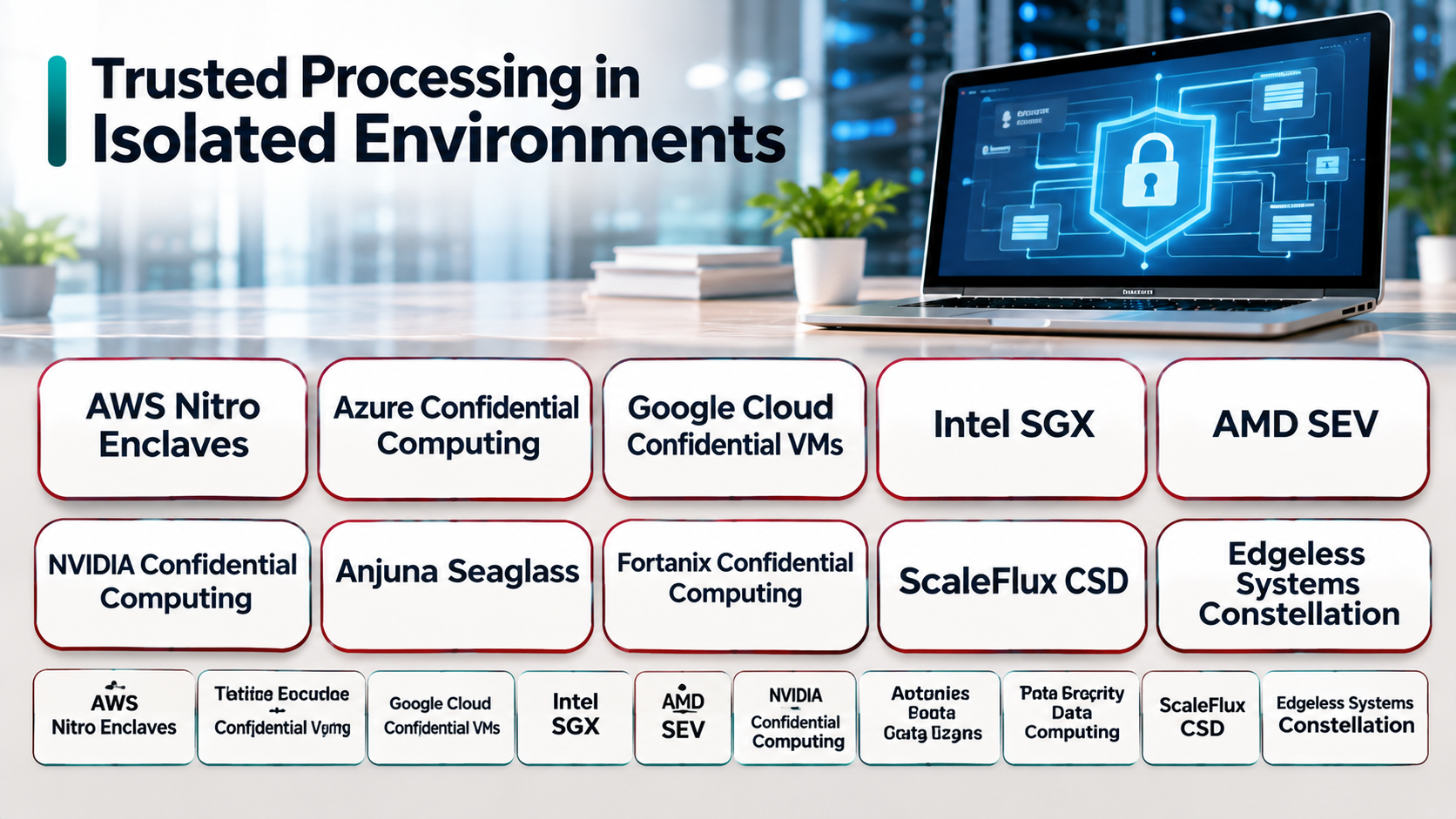
Introduction
Secure data enclaves provide controlled computing environments in which organizations can process sensitive information while reducing unauthorized access and exposure. These environments combine isolation, access restrictions, cryptographic protection, and information governance according to their underlying architecture.
Organizations increasingly manage confidential information across cloud infrastructure, research platforms, financial applications, and artificial intelligence (AI) systems. Conventional encryption protects information at rest and in transit but may not adequately address every risk associated with information processing.
Secure data enclaves can provide additional protection through hardware-backed isolation, confidential virtual machines, restricted execution environments, or controlled research workspaces. Different enclave architectures address different security requirements and threat models.
Modern secure enclave technologies support capabilities such as remote attestation, protected memory, confidential workload execution, and controlled information access. These mechanisms can help organizations establish greater confidence in sensitive computing environments.
Healthcare providers, financial institutions, government agencies, research organizations, and technology companies can benefit from appropriately implemented secure data enclaves. Their suitability depends on workload requirements, infrastructure compatibility, regulatory obligations, and available technical expertise.
This guide examines ten secure data enclave technologies and platforms, including their features, benefits, advantages, limitations, and practical applications. It also provides comparison tables, selection guidance, implementation recommendations, security considerations, and frequently asked questions.
What Are Secure Data Enclaves?
Secure data enclaves are isolated environments designed to protect sensitive information and restrict unauthorized interaction with confidential workloads. They establish defined security boundaries around information processing activities.
Hardware-backed enclaves commonly use a Trusted Execution Environment (TEE) to isolate selected application code and data. Depending on the architecture, these mechanisms can reduce exposure to privileged software operating outside the protected environment.
Confidential virtual machines (VMs) provide protection at the virtual machine level rather than isolating individual application components. They can support existing workloads with fewer application modifications than some application-level enclave architectures.
Secure research environments represent another form of controlled data enclave. These environments combine restricted information access, approved analytical tools, monitoring, and controlled output release procedures.
Remote attestation enables compatible systems to evaluate evidence about a protected computing environment before establishing trust or releasing sensitive information. Attestation effectiveness depends on trusted verification mechanisms, appropriate policies, and the underlying security architecture.
Secure enclaves do not eliminate every cybersecurity or privacy risk. Organizations must continue to address application vulnerabilities, authorized misuse, information leakage, supply chain risks, and operational security requirements.
How Do Secure Data Enclaves Work?
- Identify sensitive workloads and information sources.
- Establish an appropriate threat model.
- Select a compatible enclave architecture.
- Configure trusted computing infrastructure.
- Define workload isolation boundaries.
- Prepare approved application code and dependencies.
- Establish encryption and key management requirements.
- Initialize the protected execution environment.
- Generate attestation evidence where supported.
- Verify evidence against approved security policies.
- Release authorized information and cryptographic material.
- Execute approved workloads within the protected environment.
- Restrict and validate information outputs.
- Monitor security events and maintain infrastructure.
Traditional Computing vs. Secure Data Enclaves
| Evaluation Area | Traditional Computing | Secure Data Enclaves |
|---|---|---|
| Workload isolation | Operating system and virtualization controls | Additional protected execution boundaries |
| Data at rest | Storage encryption | Storage encryption remains necessary |
| Data in transit | Network encryption | Network encryption remains necessary |
| Data in use | Conventional memory processing | Architecture-dependent protection |
| Privileged access | Administrator-dependent | Additional restrictions in supported architectures |
| Workload verification | Conventional integrity checks | Attestation where supported |
| Key release | Standard access policies | Can depend on verified workload identity |
| Research access | Conventional workspace permissions | Restricted analytical environments |
| Application portability | Generally broad | Architecture-dependent |
| Infrastructure requirements | Standard computing resources | Specialized hardware or controlled infrastructure |
| Threat model | Conventional infrastructure risks | Additional isolation-related considerations |
| Operational complexity | Established administration | Additional verification and security requirements |
Common Applications of Secure Data Enclaves
- Confidential financial transaction processing.
- Sensitive healthcare information analysis.
- Protected artificial intelligence inference.
- Confidential machine learning workloads.
- Secure cryptographic key processing.
- Government information protection.
- Restricted research data access.
- Privacy-oriented cross-organization collaboration.
- Confidential cloud computing.
- Protected digital asset operations.
- Sensitive intellectual property processing.
- Controlled enterprise analytics.
Key Components of Secure Data Enclaves
| Component | Primary Function |
|---|---|
| Trusted execution environment | Establishes protected execution boundaries |
| Hardware root of trust | Provides foundational hardware trust mechanisms |
| Memory protection | Protects selected workload memory |
| Attestation service | Generates or verifies environment evidence |
| Measurement mechanism | Identifies relevant workload characteristics |
| Key management system | Protects cryptographic material |
| Secret provisioning service | Releases authorized credentials and secrets |
| Workload runtime | Executes approved applications |
| Isolation boundary | Restricts interaction with external components |
| Identity management | Controls authorized workload and user identities |
| Network security | Protects approved communication pathways |
| Policy engine | Evaluates applicable security requirements |
| Data ingress controls | Restricts information entering the environment |
| Output controls | Governs information leaving the environment |
| Audit repository | Records authorized security and operational events |
| Monitoring system | Identifies relevant infrastructure and workload issues |
Types of Secure Data Enclaves
Hardware-Backed Application Enclaves
Hardware-backed application enclaves isolate selected application components and associated information. These architectures can provide granular protection but may require specialized application development.
Confidential Virtual Machines
Confidential virtual machines protect supported guest environments through hardware-assisted isolation and memory protection. They are particularly relevant to organizations migrating existing workloads into confidential computing infrastructure.
Managed Cloud Enclaves
Managed cloud enclaves provide protected execution capabilities through compatible cloud infrastructure. Organizations can use these services without independently managing every underlying hardware component.
Confidential Container Environments
Confidential container environments combine container-based application deployment with compatible trusted execution technologies. They can support cloud-native workloads requiring additional isolation and attestation capabilities.
Trusted Research Environments
Trusted research environments provide controlled access to sensitive datasets and approved analytical applications. Their security architecture may rely on administrative, network, identity, and output controls rather than hardware-backed memory isolation.
Key Features of Secure Data Enclaves
- Protected workload execution.
- Hardware-assisted isolation.
- Memory encryption where supported.
- Remote attestation.
- Workload integrity verification.
- Controlled secret provisioning.
- Cryptographic key management integration.
- Restricted administrative access.
- Confidential virtual machine deployment.
- Protected application communication.
- Information access governance.
- Security monitoring and audit reporting.
Top 10 Secure Data Enclave Technologies and Platforms
The following selection includes hardware-backed enclave technologies, managed confidential computing services, confidential virtual machine platforms, and secure workload development frameworks. The numbering organizes the comparison rather than representing an independently benchmarked security ranking.
1. AWS Nitro Enclaves
Short Description
AWS Nitro Enclaves provides isolated computing environments associated with compatible Amazon Elastic Compute Cloud (EC2) instances. It enables organizations to separate selected sensitive processing activities from the parent instance.
Nitro Enclaves uses the AWS Nitro System to establish isolation boundaries around enclave workloads. Enclaves operate without conventional persistent storage or direct external network connectivity.
The technology supports attestation capabilities that can be integrated with AWS Key Management Service (KMS). Compatible policies can restrict cryptographic operations according to verified enclave measurements.
AWS Nitro Enclaves is particularly suitable for organizations operating sensitive applications within AWS infrastructure. Application architecture must accommodate enclave communication and resource restrictions.
How AWS Nitro Enclaves Works
- Provision a compatible EC2 parent instance.
- Enable Nitro Enclaves functionality.
- Prepare an enclave image.
- Allocate appropriate computing resources.
- Initialize the enclave and verify attestation evidence.
- Execute sensitive operations through approved communication channels.
Key Features
- Isolated execution: Separates selected workloads from the parent instance.
- Hardware-assisted protection: Uses the AWS Nitro architecture.
- Cryptographic attestation: Provides evidence about enclave characteristics.
- AWS KMS integration: Supports attestation-based cryptographic authorization.
- Restricted networking: Limits conventional external communication.
- Resource allocation: Assigns memory and processing resources.
- Enclave image tooling: Supports compatible application packaging.
- Local communication: Uses virtual socket communication with the parent.
- AWS integration: Complements compatible EC2 infrastructure.
Benefits
- Reduces exposure of selected sensitive workloads.
- Supports controlled cryptographic operations.
- Facilitates attestation-based authorization.
- Helps isolate confidential application components.
- Complements AWS security architecture.
- Supports privacy-oriented application development.
- Reduces reliance on conventional parent-instance isolation alone.
Pros
- AWS-native enclave architecture.
- Dedicated attestation capabilities.
- KMS integration.
- Strongly restricted execution environment.
- Developer-oriented tooling.
- Suitable for sensitive cloud applications.
Cons
- Requires compatible EC2 instances.
- Application integration may require modifications.
- No direct conventional network access.
- No conventional persistent enclave storage.
- Security depends on application design and attestation policies.
Use Cases
- Confidential payment processing.
- Protected cryptographic operations.
- Sensitive identity verification.
- Secure transaction authorization.
- Confidential application processing.
- Controlled secret handling.
Best For
- AWS customers.
- Cloud security architects.
- Financial technology developers.
- Cryptographic application teams.
- Privacy engineers.
- Organizations requiring application-level isolation.
Pricing and Deployment
AWS Nitro Enclaves has historically been available without a separate enclave service charge, while underlying EC2 resources and associated services incur applicable expenses. Organizations should verify current instance compatibility, pricing, and operational requirements.
2. Azure Confidential Computing
Short Description
Azure Confidential Computing provides cloud infrastructure capabilities designed to protect supported workloads during execution. Its offerings include confidential virtual machines and applicable enclave-enabled computing environments.
The platform uses compatible hardware-backed technologies to establish additional workload protection boundaries. Available security properties depend on the selected processor technology, virtual machine type, and deployment architecture.
Azure provides complementary attestation, identity management, encryption, and key management services. Organizations can integrate these capabilities into approved confidential computing workflows.
Azure Confidential Computing is particularly relevant to enterprises operating sensitive applications within Microsoft Azure. Supported regions, workload types, hardware technologies, and service configurations should be verified.
How Azure Confidential Computing Works
- Establish workload security requirements.
- Select compatible confidential computing infrastructure.
- Configure the protected environment.
- Establish identity and key management policies.
- Verify applicable attestation evidence.
- Deploy and monitor approved workloads.
Key Features
- Confidential virtual machines: Protect supported guest environments.
- Hardware-assisted isolation: Uses compatible processor security technologies.
- Memory protection: Supports architecture-dependent memory encryption.
- Azure Attestation: Provides applicable environment verification capabilities.
- Key management integration: Connects compatible Azure security services.
- Confidential containers: Supports applicable protected container workloads.
- Cloud integration: Complements Azure infrastructure services.
- Identity management: Supports controlled workload authorization.
- Enterprise deployment: Enables compatible confidential cloud architectures.
Benefits
- Supports confidential cloud workload execution.
- Reduces selected infrastructure-level exposure risks.
- Facilitates protected virtual machine deployment.
- Complements enterprise Azure security services.
- Supports attestation-based trust decisions.
- Enables privacy-oriented application architectures.
- Helps organizations protect sensitive processing activities.
Pros
- Broad confidential computing ecosystem.
- Managed cloud infrastructure.
- Multiple hardware technology options.
- Attestation service integration.
- Enterprise security capabilities.
- Suitable for existing Azure environments.
Cons
- Availability varies by region and configuration.
- Confidential computing instances may incur additional costs.
- Attestation configuration requires expertise.
- Not every workload is supported.
- Application-level vulnerabilities remain possible.
Use Cases
- Confidential financial analytics.
- Healthcare information processing.
- Protected enterprise applications.
- Confidential AI workloads.
- Secure cloud migration.
- Privacy-oriented information collaboration.
Best For
- Microsoft Azure customers.
- Enterprise cloud architects.
- Regulated organizations.
- Healthcare technology teams.
- Financial institutions.
- Confidential application developers.
Pricing and Deployment
Azure Confidential Computing uses applicable cloud infrastructure and service pricing. Organizations should verify current virtual machine rates, regional availability, attestation requirements, and associated security service expenses.
3. Google Cloud Confidential Computing
Short Description
Google Cloud Confidential Computing provides infrastructure capabilities for protecting supported workloads and information during execution. Its offerings include confidential virtual machines and other applicable confidential computing services.
The platform uses compatible hardware security technologies to establish protected workload environments. Available protection mechanisms depend on the selected machine configuration and processor architecture.
Google Cloud provides complementary identity, encryption, key management, and workload verification capabilities. These services can support confidential computing deployments within broader enterprise cloud architectures.
The platform is particularly suitable for organizations operating sensitive applications and analytical workloads within Google Cloud. Hardware compatibility, regional availability, and service-specific restrictions require evaluation.
How Google Cloud Confidential Computing Works
- Identify confidential workload requirements.
- Select supported computing infrastructure.
- Configure confidential workload protection.
- Establish identity and cryptographic policies.
- Evaluate applicable attestation mechanisms.
- Deploy and monitor protected applications.
Key Features
- Confidential VMs: Supports protected virtual machine workloads.
- Memory encryption: Provides compatible hardware-assisted protection.
- Confidential workload options: Supports applicable computing architectures.
- Attestation capabilities: Enables supported environment verification.
- Cloud integration: Complements Google Cloud infrastructure.
- Identity management: Supports workload access administration.
- Key management integration: Connects compatible cryptographic services.
- Container workload relevance: Supports applicable confidential container environments.
- Operational monitoring: Complements cloud security administration.
Benefits
- Supports confidential cloud processing.
- Reduces selected workload exposure risks.
- Facilitates protected application deployment.
- Complements Google Cloud security infrastructure.
- Supports sensitive analytics workloads.
- Enables architecture-dependent environment verification.
- Encourages data-centric cloud security.
Pros
- Managed cloud computing infrastructure.
- Confidential virtual machine capabilities.
- Google Cloud ecosystem integration.
- Hardware-assisted protection.
- Relevant container deployment options.
- Suitable for enterprise cloud workloads.
Cons
- Supported machine types vary.
- Regional availability requires confirmation.
- Infrastructure expenses may increase.
- Security properties differ by hardware architecture.
- Attestation and key release policies require careful configuration.
Use Cases
- Confidential cloud analytics.
- Protected financial applications.
- Healthcare information processing.
- Sensitive machine learning workloads.
- Secure enterprise applications.
- Confidential information collaboration.
Best For
- Google Cloud customers.
- Cloud infrastructure teams.
- Enterprise security architects.
- Data engineering departments.
- Research organizations.
- Businesses processing sensitive cloud workloads.
Pricing and Deployment
Google Cloud Confidential Computing uses applicable cloud infrastructure pricing arrangements. Organizations should verify current machine types, confidential computing charges, regional availability, and associated operational expenses.
4. Intel Software Guard Extensions (SGX)
Short Description
Intel Software Guard Extensions (SGX) is a hardware security technology designed to establish protected application-level execution environments. It enables compatible applications to isolate selected code and information within enclaves.
SGX provides hardware-assisted protection for enclave memory against selected external software access risks. Its security properties depend on processor capabilities, platform configuration, and the applicable threat model.
The technology supports attestation mechanisms that can help external systems evaluate enclave identity and security characteristics. Developers can integrate these capabilities into controlled information and secret provisioning workflows.
Intel SGX is particularly suitable for applications requiring granular protection of sensitive processing components. Supported processors, software development tools, platform security updates, and deployment requirements should be verified.
How Intel SGX Works
- Select compatible Intel hardware.
- Identify sensitive application components.
- Develop or adapt enclave-compatible code.
- Initialize the protected enclave.
- Verify applicable attestation evidence.
- Execute approved sensitive operations.
Key Features
- Application-level enclaves: Isolates selected code and data.
- Protected memory: Provides hardware-assisted enclave memory protection.
- Remote attestation: Supports external environment verification.
- Local attestation: Supports compatible local trust mechanisms.
- Sealing capabilities: Enables applicable protected data persistence.
- Software development tooling: Supports enclave application development.
- Granular isolation: Protects selected application components.
- Hardware-backed execution: Uses compatible Intel processor features.
- Framework integration: Supports relevant enclave development frameworks.
Benefits
- Supports granular workload isolation.
- Reduces selected privileged software exposure risks.
- Enables protected application components.
- Facilitates attestation-based trust.
- Supports confidential cryptographic operations.
- Complements privacy-oriented application architectures.
- Enables specialized secure computing workflows.
Pros
- Dedicated hardware enclave technology.
- Application-level protection.
- Attestation capabilities.
- Established development ecosystem.
- Granular security boundaries.
- Suitable for specialized confidential applications.
Cons
- Requires compatible hardware.
- Application modifications may be substantial.
- Enclave resource limitations require consideration.
- Side-channel risks require evaluation.
- Platform lifecycle and security updates require monitoring.
Use Cases
- Confidential cryptographic services.
- Sensitive financial processing.
- Protected identity verification.
- Confidential application components.
- Privacy-oriented analytics.
- Secure intellectual property processing.
Best For
- Security software developers.
- Cryptographic engineers.
- Confidential computing researchers.
- Financial technology teams.
- Enterprise application architects.
- Organizations requiring granular enclave protection.
Pricing and Deployment
Intel SGX is a hardware technology rather than a standalone commercial software subscription. Costs depend on compatible hardware, cloud infrastructure, development resources, and ongoing security maintenance.
5. AMD Secure Encrypted Virtualization (SEV-SNP)
Short Description
AMD Secure Encrypted Virtualization with Secure Nested Paging (SEV-SNP) is a hardware security technology designed to protect compatible virtual machine environments. It extends earlier SEV capabilities with additional memory integrity and isolation protections.
SEV-SNP helps reduce selected risks associated with untrusted or compromised hypervisor software. Its architecture provides protection at the virtual machine level rather than isolating individual application functions.
The technology supports attestation mechanisms that enable compatible systems to evaluate guest environment characteristics. Organizations can incorporate attestation into approved secret provisioning and workload authorization workflows.
AMD SEV-SNP is particularly relevant to confidential cloud infrastructure and organizations seeking virtual machine-level protection. Supported processor generations, firmware versions, hypervisors, and operating systems require verification.
How AMD SEV-SNP Works
- Provision compatible AMD computing infrastructure.
- Configure supported firmware and virtualization components.
- Prepare a compatible guest operating system.
- Launch the protected virtual machine.
- Verify applicable attestation evidence.
- Execute approved confidential workloads.
Key Features
- Confidential virtual machines: Protects supported guest environments.
- Memory encryption: Provides hardware-assisted memory confidentiality.
- Memory integrity protection: Addresses selected unauthorized memory modification risks.
- Guest isolation: Reduces selected hypervisor access risks.
- Remote attestation: Supports guest environment verification.
- Hardware-backed security: Uses compatible AMD processor capabilities.
- Virtualization integration: Supports compatible hypervisors.
- Operating system compatibility: Enables supported guest workloads.
- Cloud deployment relevance: Supports applicable confidential cloud services.
Benefits
- Supports confidential virtual machine deployment.
- Reduces selected infrastructure-level exposure risks.
- Facilitates migration of compatible existing applications.
- Supports hardware-backed memory protection.
- Enables attestation-based authorization.
- Complements cloud security architectures.
- Reduces application restructuring requirements compared with some granular enclave designs.
Pros
- Virtual machine-level protection.
- Hardware-assisted memory security.
- Attestation support.
- Relevant cloud infrastructure adoption.
- Compatible existing workload deployment.
- Additional memory integrity protections.
Cons
- Requires supported AMD hardware.
- Firmware and hypervisor compatibility must be maintained.
- Does not independently protect against guest application vulnerabilities.
- Input and output security requires complementary controls.
- Security properties depend on platform configuration.
Use Cases
- Confidential enterprise virtual machines.
- Protected cloud applications.
- Financial information processing.
- Healthcare analytics.
- Confidential application migration.
- Sensitive research workloads.
Best For
- Virtualization administrators.
- Cloud infrastructure providers.
- Enterprise security architects.
- Regulated organizations.
- Data center operators.
- Businesses requiring virtual machine-level confidentiality.
Pricing and Deployment
AMD SEV-SNP is a hardware security capability rather than a standalone software subscription. Expenses depend on compatible processors, cloud infrastructure, virtualization software, and implementation resources.
6. Intel Trust Domain Extensions (TDX)
Short Description
Intel Trust Domain Extensions (TDX) is a hardware-assisted confidential computing technology designed to protect supported virtual machine environments. It establishes isolated virtual machines known as trust domains.
TDX provides mechanisms intended to reduce selected risks associated with external infrastructure software accessing confidential guest information. Its protection scope differs from the application-level isolation provided by Intel SGX.
The technology supports attestation capabilities that can help external systems evaluate trust domain characteristics. These capabilities can complement controlled workload authorization and secret provisioning.
Intel TDX is particularly suitable for organizations requiring confidential virtual machine deployment on compatible Intel infrastructure. Hardware, firmware, operating system, and hypervisor requirements should be independently verified.
How Intel TDX Works
- Provision compatible Intel hardware.
- Configure supported virtualization infrastructure.
- Prepare a compatible guest environment.
- Initialize a trust domain.
- Verify applicable attestation evidence.
- Execute approved confidential workloads.
Key Features
- Trust domains: Establishes protected virtual machine environments.
- Hardware-assisted isolation: Restricts selected external software access.
- Memory protection: Provides compatible guest memory protection.
- Attestation mechanisms: Supports trust domain verification.
- Virtualization compatibility: Connects supported infrastructure components.
- Guest operating system support: Enables compatible workloads.
- Cloud infrastructure relevance: Supports applicable confidential cloud deployments.
- Protected execution: Supports sensitive application processing.
- Security measurement: Provides applicable workload integrity evidence.
Benefits
- Supports confidential virtual machine architectures.
- Reduces selected infrastructure-level information exposure risks.
- Facilitates compatible application deployment.
- Enables hardware-backed workload protection.
- Supports attestation-based trust decisions.
- Complements enterprise cloud security.
- Encourages confidential computing adoption.
Pros
- Virtual machine-oriented security architecture.
- Hardware-assisted isolation.
- Attestation capabilities.
- Relevant enterprise infrastructure support.
- Compatible existing workload deployment.
- Suitable for confidential cloud environments.
Cons
- Requires compatible Intel hardware.
- Platform compatibility varies.
- Firmware and software maintenance remain necessary.
- Does not eliminate guest application vulnerabilities.
- Deployment requires confidential computing expertise.
Use Cases
- Confidential cloud virtual machines.
- Protected enterprise applications.
- Financial analytics.
- Sensitive research processing.
- Confidential AI infrastructure.
- Secure application migration.
Best For
- Intel infrastructure customers.
- Cloud service providers.
- Virtualization administrators.
- Enterprise security teams.
- Confidential computing engineers.
- Organizations requiring protected virtual machines.
Pricing and Deployment
Intel TDX is a hardware security technology available through compatible computing platforms. Costs depend on infrastructure selection, cloud service pricing, software compatibility, and implementation requirements.
7. Fortanix Confidential Computing Manager
Short Description
Fortanix Confidential Computing Manager provides management capabilities for compatible confidential computing workloads. It helps organizations coordinate protected application deployment, attestation, and relevant workload security requirements.
The platform is designed to simplify selected operational aspects of confidential computing. Organizations can use compatible tooling to prepare and manage protected applications across supported environments.
Fortanix provides complementary data security and cryptographic management capabilities through its broader product ecosystem. Integration can support controlled secret handling and enterprise information protection requirements.
The platform is particularly relevant to organizations seeking centralized confidential workload management. Current product packaging, supported trusted execution environments, and deployment capabilities should be verified.
How Fortanix Confidential Computing Manager Works
- Identify applications requiring confidential execution.
- Configure supported confidential infrastructure.
- Prepare compatible workload packages.
- Establish attestation and security policies.
- Deploy authorized confidential applications.
- Monitor workload status and relevant security information.
Key Features
- Confidential workload management: Coordinates supported protected applications.
- Attestation management: Supports applicable environment verification.
- Application packaging: Enables compatible workload preparation.
- Centralized administration: Coordinates confidential computing operations.
- Security policy management: Supports configurable workload requirements.
- Cryptographic integration: Complements relevant Fortanix security services.
- Cloud deployment support: Connects compatible infrastructure.
- Workload monitoring: Provides applicable operational visibility.
- Enterprise integration: Supports broader information protection architectures.
Benefits
- Simplifies selected confidential computing operations.
- Supports centralized workload administration.
- Facilitates protected application deployment.
- Complements enterprise cryptographic infrastructure.
- Reduces repetitive configuration activities.
- Supports attestation-oriented trust workflows.
- Encourages consistent confidential computing policies.
Pros
- Dedicated confidential computing management orientation.
- Enterprise security ecosystem.
- Workload deployment capabilities.
- Attestation management relevance.
- Centralized operational administration.
- Suitable for complex confidential computing projects.
Cons
- Commercial licensing requires evaluation.
- Supported hardware technologies vary.
- Application compatibility requires testing.
- Infrastructure dependencies remain necessary.
- Current product availability requires verification.
Use Cases
- Enterprise confidential workload management.
- Protected application deployment.
- Confidential analytics.
- Cryptographic application integration.
- Attestation policy administration.
- Confidential cloud infrastructure management.
Best For
- Enterprise security architects.
- Confidential computing engineers.
- Cloud infrastructure teams.
- Financial institutions.
- Regulated organizations.
- Businesses requiring centralized workload management.
Pricing and Deployment
Fortanix provides commercial enterprise security offerings. Organizations should confirm current Confidential Computing Manager availability, licensing, supported infrastructure, and integration requirements.
8. Anjuna Confidential Computing
Short Description
Anjuna provides confidential computing technology designed to help organizations deploy applications within supported protected execution environments. Its offerings focus on reducing the complexity associated with adapting applications for confidential computing.
The platform supports compatible workload protection architectures and application deployment mechanisms. Available functionality depends on the selected product and underlying trusted execution technology.
Anjuna is relevant to organizations seeking to protect existing applications without extensive application restructuring. Actual compatibility and modification requirements should be evaluated through representative pilot deployments.
The platform is particularly suitable for enterprise teams exploring confidential application deployment across supported cloud infrastructure. Current product naming, supported hardware, and commercial arrangements require confirmation.
How Anjuna Confidential Computing Works
- Identify sensitive application workloads.
- Select supported confidential infrastructure.
- Configure compatible application protection mechanisms.
- Establish workload security policies.
- Deploy the protected application.
- Validate and monitor confidential execution.
Key Features
- Confidential application deployment: Supports compatible protected workloads.
- Application compatibility: Helps adapt supported existing applications.
- Trusted execution integration: Connects applicable enclave technologies.
- Workload isolation: Establishes architecture-dependent protection.
- Cloud deployment support: Enables compatible infrastructure environments.
- Attestation relevance: Supports applicable trust verification workflows.
- Application protection policies: Establishes configurable security requirements.
- Operational integration: Complements existing deployment workflows.
- Enterprise security architecture: Supports sensitive application processing.
Benefits
- Reduces selected confidential application development requirements.
- Supports protected workload deployment.
- Facilitates migration of compatible existing applications.
- Complements enterprise security infrastructure.
- Helps reduce unnecessary sensitive workload exposure.
- Supports privacy-oriented cloud architectures.
- Encourages confidential computing adoption.
Pros
- Application-oriented confidential computing approach.
- Existing workload compatibility focus.
- Cloud deployment relevance.
- Enterprise security specialization.
- Reduced application modification potential.
- Suitable for sensitive business applications.
Cons
- Commercial pricing requires confirmation.
- Compatibility varies by workload.
- Supported hardware and services require verification.
- Deployment may introduce operational complexity.
- Application security evaluation remains necessary.
Use Cases
- Confidential enterprise applications.
- Protected financial workloads.
- Sensitive cloud application migration.
- Confidential analytics.
- Privacy-oriented software deployment.
- Secure intellectual property processing.
Best For
- Enterprise application architects.
- Cloud security departments.
- Financial technology companies.
- Confidential computing engineers.
- Regulated organizations.
- Businesses protecting existing applications.
Pricing and Deployment
Anjuna provides commercial confidential computing offerings. Organizations should verify current product availability, supported deployment options, licensing, and infrastructure requirements.
9. Gramine
Short Description
Gramine is an open-source library operating system designed to support application execution within compatible protected environments. It is particularly associated with Intel SGX application deployment.
The framework helps compatible Linux applications operate within enclaves by providing relevant operating system functionality. This approach can reduce application modification requirements for supported workloads.
Gramine supports configurable application manifests and applicable attestation-related mechanisms. Developers can use these capabilities to establish protected application execution and controlled information handling.
The framework is particularly suitable for technical teams developing or adapting applications for SGX-based environments. Application compatibility, trusted computing base size, and security configuration require independent evaluation.
How Gramine Works
- Provision compatible computing infrastructure.
- Install the Gramine framework.
- Prepare a supported Linux application.
- Configure the application manifest.
- Initialize the protected execution environment.
- Verify and monitor approved workload execution.
Key Features
- Library operating system: Provides compatible application runtime functionality.
- Intel SGX support: Enables supported enclave execution.
- Linux application compatibility: Supports applicable existing workloads.
- Manifest configuration: Defines application execution requirements.
- Attestation support: Provides applicable verification mechanisms.
- Protected file capabilities: Supports compatible protected information handling.
- Open-source availability: Enables source code inspection.
- Developer tooling: Supports application preparation and deployment.
- Configurable security architecture: Enables workload-specific configurations.
Benefits
- Reduces selected enclave application adaptation requirements.
- Supports protected Linux application execution.
- Enables configurable confidential workloads.
- Facilitates source-level security evaluation.
- Supports research and development activities.
- Reduces conventional software licensing requirements.
- Complements hardware-backed enclave technologies.
Pros
- Open-source availability.
- Established SGX-oriented development approach.
- Linux application compatibility.
- Configurable execution manifests.
- Attestation-related functionality.
- Suitable for technical confidential computing projects.
Cons
- Requires technical expertise.
- Supported hardware remains necessary.
- Not every Linux application is compatible.
- Security configuration requires careful review.
- Infrastructure maintenance remains the organization’s responsibility.
Use Cases
- Protected Linux application deployment.
- Confidential computing research.
- Sensitive analytics applications.
- Secure application prototyping.
- Confidential cryptographic processing.
- Existing application adaptation.
Best For
- Linux developers.
- Confidential computing researchers.
- Security software engineers.
- Open-source infrastructure teams.
- Enterprise application developers.
- Organizations requiring customizable enclave execution.
Pricing and Deployment
Gramine is available as open-source software. Organizations should account for compatible hardware, cloud infrastructure, development resources, security evaluation, and ongoing maintenance.
10. Confidential Containers (CoCo)
Short Description
Confidential Containers (CoCo) is an open-source project designed to support confidential container workloads through compatible trusted execution technologies. It brings confidential computing concepts into cloud-native application environments.
The project combines protected execution infrastructure with container-oriented deployment mechanisms. Its architecture can support workload attestation and controlled access to sensitive application resources.
Confidential Containers is relevant to organizations operating Kubernetes-based applications that require additional workload isolation. Supported hardware, runtime components, and infrastructure configurations vary.
The project is particularly suitable for technical teams developing confidential cloud-native architectures. Production deployment requires careful evaluation of platform maturity, security boundaries, and operational dependencies.
How Confidential Containers Works
- Provision compatible confidential computing infrastructure.
- Configure supported Kubernetes and runtime components.
- Prepare approved container workloads.
- Establish attestation and resource access policies.
- Launch protected container environments.
- Verify and monitor confidential workload execution.
Key Features
- Confidential container execution: Supports protected cloud-native workloads.
- Kubernetes integration: Enables compatible container orchestration.
- Trusted execution support: Connects supported hardware security technologies.
- Attestation services: Supports applicable workload verification.
- Protected resource provisioning: Enables controlled secret and resource access.
- Container runtime integration: Connects compatible runtime components.
- Open-source architecture: Enables source code inspection.
- Workload isolation: Establishes architecture-dependent protection.
- Cloud-native deployment: Supports compatible application delivery workflows.
Benefits
- Supports confidential cloud-native applications.
- Facilitates protected container deployment.
- Complements Kubernetes security architecture.
- Enables attestation-oriented resource access.
- Supports customizable confidential computing environments.
- Encourages interoperable workload architectures.
- Reduces conventional software licensing requirements.
Pros
- Open-source availability.
- Cloud-native application orientation.
- Kubernetes ecosystem relevance.
- Multiple compatible trusted execution technologies.
- Attestation-based architecture.
- Suitable for confidential container research and development.
Cons
- Requires specialized technical expertise.
- Infrastructure compatibility must be verified.
- Deployment can involve multiple components.
- Production maturity varies by configuration.
- Operational maintenance remains necessary.
Use Cases
- Confidential Kubernetes applications.
- Protected containerized analytics.
- Sensitive cloud-native services.
- Confidential AI application deployment.
- Secure multi-tenant workload research.
- Attestation-based secret provisioning.
Best For
- Kubernetes administrators.
- Platform engineering teams.
- Confidential computing researchers.
- Cloud-native developers.
- Enterprise infrastructure architects.
- Organizations requiring customizable confidential containers.
Pricing and Deployment
Confidential Containers is available as open-source software. Organizations should account for compatible computing infrastructure, Kubernetes administration, integration, independent security evaluation, and maintenance expenses.
Comparison Table: Top 10 Secure Data Enclaves
| Technology or Platform | Primary Capability | Best For | Deployment | Pricing Model |
|---|---|---|---|---|
| AWS Nitro Enclaves | Isolated application processing | AWS workloads | AWS EC2 | Infrastructure-based |
| Azure Confidential Computing | Confidential cloud infrastructure | Azure enterprises | Managed cloud | Usage-based |
| Google Cloud Confidential Computing | Confidential cloud workloads | Google Cloud applications | Managed cloud | Usage-based |
| Intel SGX | Application-level hardware enclaves | Granular application protection | Compatible hardware | Infrastructure-based |
| AMD SEV-SNP | Confidential virtual machines | Protected guest workloads | Compatible hardware | Infrastructure-based |
| Intel TDX | Protected trust domains | Confidential virtual machines | Compatible hardware | Infrastructure-based |
| Fortanix Confidential Computing Manager | Confidential workload management | Enterprise administration | Offering-dependent | Commercial |
| Anjuna Confidential Computing | Confidential application deployment | Existing applications | Offering-dependent | Commercial |
| Gramine | Enclave application runtime | Linux applications | Self-managed | Open source |
| Confidential Containers | Protected container workloads | Kubernetes applications | Self-managed or integrated | Open source |
Functional Comparison
| Technology | Application Enclaves | Confidential VMs | Attestation | Container Relevance |
|---|---|---|---|---|
| AWS Nitro Enclaves | Specialized | Not primary | Supported | Image-based enclave packaging |
| Azure Confidential Computing | Offering-dependent | Supported | Supported | Supported offerings |
| Google Cloud Confidential Computing | Offering-dependent | Supported | Supported | Supported offerings |
| Intel SGX | Specialized | Not primary | Supported | Framework-dependent |
| AMD SEV-SNP | Not primary | Specialized | Supported | Runtime-dependent |
| Intel TDX | Not primary | Specialized | Supported | Runtime-dependent |
| Fortanix | Offering-dependent | Verify offering | Supported workflows | Offering-dependent |
| Anjuna | Offering-dependent | Offering-dependent | Offering-dependent | Offering-dependent |
| Gramine | Specialized | Not primary | Supported | Integration-dependent |
| Confidential Containers | Backend-dependent | Runtime-dependent | Supported | Specialized |
Technical Comparison
| Technology | Main Integration | Protection Boundary | Infrastructure Dependency |
|---|---|---|---|
| AWS Nitro Enclaves | EC2 and virtual sockets | Isolated enclave | AWS Nitro |
| Azure Confidential Computing | Azure services | Offering-dependent | Supported hardware |
| Google Cloud Confidential Computing | Google Cloud services | Offering-dependent | Supported hardware |
| Intel SGX | Application development interfaces | Application enclave | Compatible Intel processors |
| AMD SEV-SNP | Virtualization infrastructure | Guest virtual machine | Compatible AMD processors |
| Intel TDX | Virtualization infrastructure | Trust domain | Compatible Intel processors |
| Fortanix | Management interfaces | Underlying TEE | Supported infrastructure |
| Anjuna | Application deployment tooling | Underlying TEE | Supported infrastructure |
| Gramine | Linux runtime and manifests | SGX enclave | Compatible Intel processors |
| Confidential Containers | Kubernetes and container runtimes | Runtime-dependent | Supported confidential infrastructure |
Business Suitability Comparison
| Technology | Small Organizations | Midmarket | Large Enterprises |
|---|---|---|---|
| AWS Nitro Enclaves | Suitable with expertise | Suitable | Suitable |
| Azure Confidential Computing | Workload-dependent | Suitable | Suitable |
| Google Cloud Confidential Computing | Workload-dependent | Suitable | Suitable |
| Intel SGX | Specialist projects | Specialist projects | Suitable for specialized workloads |
| AMD SEV-SNP | Infrastructure-dependent | Suitable | Suitable |
| Intel TDX | Infrastructure-dependent | Suitable | Suitable |
| Fortanix | Budget-dependent | Evaluate offering | Suitable |
| Anjuna | Budget-dependent | Evaluate offering | Suitable |
| Gramine | Technical teams | Technical teams | Suitable with engineering resources |
| Confidential Containers | Specialist teams | Suitable with expertise | Suitable with platform engineering |
Pricing and Ownership Comparison
| Technology | Main Cost Consideration | Additional Ownership Costs |
|---|---|---|
| AWS Nitro Enclaves | Compatible EC2 resources | Development and AWS services |
| Azure Confidential Computing | Confidential infrastructure usage | Security services and integration |
| Google Cloud Confidential Computing | Confidential infrastructure usage | Cloud services and integration |
| Intel SGX | Compatible hardware | Application engineering |
| AMD SEV-SNP | Compatible infrastructure | Virtualization administration |
| Intel TDX | Compatible infrastructure | Virtualization administration |
| Fortanix | Commercial licensing | Deployment and integration |
| Anjuna | Commercial licensing | Application integration |
| Gramine | Open-source software | Engineering and infrastructure |
| Confidential Containers | Open-source software | Kubernetes and security administration |
These comparisons describe general technology positioning rather than independently verified security performance. Hardware technologies, managed cloud services, and software frameworks are complementary architectural layers rather than directly interchangeable products.
How to Choose the Best Secure Data Enclave
1. Establish a Threat Model
Identify the adversaries and unauthorized access scenarios the organization intends to address. Distinguish infrastructure-level risks from application vulnerabilities and authorized user misuse.
2. Determine Workload Isolation Requirements
Decide whether individual application components or entire virtual machines require protection. Granular application enclaves and confidential virtual machines provide different security boundaries.
3. Evaluate Hardware Compatibility
Identify supported processors, firmware versions, and computing infrastructure. Confidential computing capabilities may be unavailable on conventional or older hardware.
4. Assess Application Compatibility
Evaluate whether existing applications can operate within the selected protected environment. Some enclave architectures require application modifications or specialized communication mechanisms.
5. Review Attestation Capabilities
Determine whether the platform provides appropriate evidence about workload identity and security characteristics. Establish independent verification policies before releasing sensitive information.
6. Evaluate Cryptographic Key Management
Identify how encryption keys and application secrets are generated, stored, released, and revoked. Integrate appropriate key management controls with verified workload identities.
7. Consider Memory Protection
Evaluate the specific confidentiality and integrity protections provided by the underlying hardware. Memory encryption alone does not necessarily address every memory access or modification risk.
8. Review Network and Storage Requirements
Protected workloads may have restricted network connectivity or persistent storage capabilities. Design approved communication and information persistence mechanisms according to the selected architecture.
9. Assess Workload Performance
Measure application latency, processing throughput, memory consumption, and startup performance. Confidential computing overhead varies by workload and protection mechanism.
10. Evaluate Side-Channel Risks
Hardware isolation does not automatically eliminate information leakage through observable system behavior. Evaluate relevant side-channel threats and applicable mitigation requirements.
11. Consider Cloud and Infrastructure Portability
Determine whether workloads must operate across multiple infrastructure providers. Hardware dependencies and service-specific integrations can influence portability.
12. Review Regulatory Requirements
Evaluate applicable privacy, security, contractual, and information residency requirements. Secure enclave adoption does not independently establish regulatory compliance.
13. Assess Operational Expertise
Confidential computing deployments may require specialized application development, cryptographic administration, and infrastructure skills. Select an architecture that the organization can maintain responsibly.
14. Compare Total Ownership Costs
Evaluate infrastructure, software licensing, application integration, security testing, and ongoing administration expenses. Open-source frameworks may still require substantial engineering resources.
15. Conduct Independent Security Validation
Test shortlisted technologies against representative workloads and the established threat model. Verify attestation, secret provisioning, application behavior, and information release controls before production deployment.
Best Secure Data Enclaves by User Type
| User Type | Recommended Technology | Primary Reason |
|---|---|---|
| AWS application developers | AWS Nitro Enclaves | AWS-native isolated execution |
| Azure enterprise teams | Azure Confidential Computing | Managed confidential infrastructure |
| Google Cloud developers | Google Cloud Confidential Computing | Google Cloud workload integration |
| Cryptographic application engineers | Intel SGX | Granular application enclaves |
| AMD infrastructure administrators | AMD SEV-SNP | Confidential virtual machine protection |
| Intel virtualization teams | Intel TDX | Protected trust domains |
| Enterprise security administrators | Fortanix Confidential Computing Manager | Centralized workload management |
| Application modernization teams | Anjuna Confidential Computing | Existing application protection |
| Linux application developers | Gramine | Configurable enclave runtime |
| Kubernetes platform engineers | Confidential Containers | Cloud-native confidential workloads |
| Confidential computing researchers | Gramine and Confidential Containers | Open-source experimentation |
| Regulated cloud organizations | Azure, AWS, or Google Cloud | Infrastructure-specific managed options |
Weighted Technology Selection Scorecard
| Selection Criterion | Weight |
|---|---|
| Threat model alignment | 20% |
| Workload isolation effectiveness | 15% |
| Attestation capabilities | 15% |
| Application compatibility | 12% |
| Key management and secret provisioning | 10% |
| Infrastructure compatibility | 8% |
| Performance and scalability | 8% |
| Operational manageability | 7% |
| Total ownership costs | 5% |
| Total | 100% |
Organizations can assign consistent evaluation scores to shortlisted technologies based on representative workload requirements. Weighted results should complement independent security testing and qualified architectural review.
Questions to Ask Before Selecting a Secure Data Enclave
- What threats does the architecture explicitly address?
- Which threats remain outside the security boundary?
- Which processors and firmware versions are supported?
- What application modifications are required?
- How is attestation evidence generated and verified?
- Can secret release depend on verified workload measurements?
- How are cryptographic keys rotated and revoked?
- What network and storage restrictions apply?
- Which side-channel mitigations are supported?
- How are security updates distributed?
- What operational monitoring is available?
- What information residency restrictions apply?
- What workload performance overhead should be evaluated?
- How are recovery and disaster recovery procedures implemented?
- What are the complete licensing and infrastructure costs?
Practical Example: Confidential Healthcare Analytics
Consider a hypothetical healthcare research organization that needs to analyze sensitive clinical records within cloud infrastructure. The organization wants to reduce selected infrastructure-level exposure risks while maintaining controlled research access.
The organization selects Azure Confidential Computing with a compatible confidential virtual machine architecture. It combines this infrastructure with independent identity management, information minimization, approved research workflows, and controlled output validation.
Step 1: Establish Research Objectives
Identify approved analytical activities and determine which clinical information is necessary. Avoid processing unnecessary personal information.
Step 2: Obtain Appropriate Authorization
Confirm that the proposed information processing is authorized under applicable governance and privacy requirements. Establish documented research access permissions.
Step 3: Develop a Threat Model
Identify infrastructure-level access risks, application vulnerabilities, unauthorized researchers, and potential information leakage. Determine which risks confidential computing can address and which require additional controls.
Step 4: Select Confidential Infrastructure
Choose a compatible confidential virtual machine configuration. Verify supported hardware, operating systems, and deployment regions.
Step 5: Establish Trusted Workload Images
Prepare approved operating system and application images. Review dependencies and apply appropriate software security controls.
Step 6: Configure Attestation Verification
Establish verification policies for supported workload attestation evidence. Define which environment characteristics must be verified before sensitive information is released.
Step 7: Configure Cryptographic Key Management
Establish approved encryption keys and secret provisioning procedures. Restrict access to authorized workloads and administrators.
Step 8: Protect Information Transfer
Use appropriate network encryption and authenticated communication channels. Validate information ingress procedures before processing clinical records.
Step 9: Configure Research Access
Establish role-based access restrictions for authorized researchers. Limit available applications and administrative permissions according to approved research requirements.
Step 10: Deploy Analytical Workloads
Deploy approved statistical and machine learning applications within the confidential environment. Validate workload compatibility and operational performance.
Step 11: Establish Output Controls
Restrict unauthorized extraction of original clinical information. Apply appropriate review procedures to analytical outputs that could expose individual records.
Step 12: Conduct Independent Security Testing
Evaluate the deployed environment against the established threat model. Confirm that attestation, access restrictions, and secret provisioning operate according to approved requirements.
Step 13: Monitor Operational Activities
Track workload health, authorized access, attestation outcomes, and relevant security events. Protect monitoring records from unnecessary sensitive information exposure.
Step 14: Establish Incident Response
Define procedures for responding to suspicious activity, failed attestation, and compromised workload components. Include appropriate credential revocation and information protection actions.
Step 15: Maintain the Environment
Apply approved firmware, operating system, and application security updates. Reevaluate attestation policies when trusted workload measurements change.
Illustrative Implementation Results
| Performance Indicator | Before | After |
|---|---|---|
| Eligible workloads using confidential infrastructure | 0% | 95% |
| Verified workload launches | 0% | 98% |
| Sensitive workload preparation time | 10 hours | 4 hours |
| Manual security verification effort | 160 hours/month | 70 hours/month |
| Documented research access coverage | 75% | 99% |
| Approved output review coverage | 60% | 98% |
| Monthly operational expenditure | $42,000 | $34,000 |
| Average workload startup time | 2 minutes | 3 minutes |
| Representative analytical job duration | 40 minutes | 43 minutes |
These figures are hypothetical and do not represent independently verified Azure Confidential Computing performance. Actual results depend on workload characteristics, hardware architecture, governance procedures, and implementation quality.
The illustrative deployment reduces monthly operating expenses by approximately 19% while increasing representative analytical job duration by 7.5%. This demonstrates how organizations may experience operational improvements alongside additional confidential computing overhead.
Illustrative Return on Investment
| Financial Measure | Amount |
|---|---|
| Initial implementation investment | $72,000 |
| Previous monthly operating cost | $42,000 |
| New monthly operating cost | $34,000 |
| Net monthly savings | $8,000 |
| Annual operating savings | $96,000 |
| First-year net benefit | $24,000 |
| First-year return on investment | 33.3% |
| Estimated payback period | 9 months |
The calculation assumes consistent monthly operating costs and includes hypothetical savings from consolidated infrastructure and automated security verification. It does not assume that confidential computing alone produces these savings or eliminates information security incidents.
Important Secure Data Enclave Performance Metrics
| Metric | Purpose |
|---|---|
| Confidential workload coverage | Measures eligible workloads using protected infrastructure |
| Attestation verification success rate | Tracks accepted workload evidence |
| Attestation failure rate | Identifies rejected or unsuccessful verification |
| Secret provisioning success rate | Measures authorized resource release |
| Unauthorized secret requests | Tracks suspicious access attempts |
| Workload startup latency | Measures protected environment initialization |
| Application processing latency | Evaluates workload performance |
| Processing throughput | Measures confidential computing capacity |
| Memory overhead | Tracks additional resource requirements |
| Infrastructure availability | Measures operational reliability |
| Security update coverage | Tracks approved infrastructure maintenance |
| Workload integrity violations | Identifies relevant integrity failures |
| Audit documentation coverage | Measures recorded operational evidence |
| Output review coverage | Tracks controlled information release |
| Cost per confidential workload | Measures operational expenditure |
Industry Applications of Secure Data Enclaves
Healthcare
Healthcare organizations can use confidential computing environments to protect supported clinical analytics and sensitive application workloads. Appropriate implementations must also address authorized access, research governance, and potential re-identification risks.
Financial Services
Financial institutions can use secure enclaves to isolate selected cryptographic operations, sensitive transaction processing, and confidential analytical workloads. Attestation can support controlled release of sensitive information to verified environments.
Government
Government agencies can use protected computing environments for selected sensitive information processing activities. Infrastructure selection must reflect applicable security classifications, procurement requirements, and information handling restrictions.
Research and Education
Research organizations can combine confidential computing infrastructure with trusted research environments to support controlled analysis of sensitive datasets. Appropriate output review remains necessary to prevent unauthorized information disclosure.
Artificial Intelligence
AI developers can use compatible confidential computing technologies to protect sensitive model inference, proprietary model components, and selected training workloads. Confidential execution does not independently prevent model memorization or inappropriate generated outputs.
Telecommunications
Telecommunications providers can use secure enclaves to protect selected subscriber information processing, authentication operations, and cryptographic services. Deployment requirements depend on infrastructure architecture and operational performance constraints.
Secure Data Enclave Implementation Roadmap
| Stage | Implementation Activity | Expected Deliverable |
|---|---|---|
| 1 | Inventory sensitive workloads | Approved workload inventory |
| 2 | Establish threat model | Documented security requirements |
| 3 | Evaluate infrastructure | Compatibility assessment |
| 4 | Select enclave architecture | Approved technical design |
| 5 | Prepare workload images | Reviewed application packages |
| 6 | Configure protected infrastructure | Pilot execution environment |
| 7 | Establish attestation policies | Verification requirements |
| 8 | Configure key management | Controlled secret provisioning |
| 9 | Establish access controls | Authorized identity policies |
| 10 | Configure network and storage | Protected communication architecture |
| 11 | Validate workload compatibility | Application test results |
| 12 | Conduct security testing | Independent security assessment |
| 13 | Establish monitoring | Operational security reporting |
| 14 | Configure recovery procedures | Incident and recovery plans |
| 15 | Review and optimize | Continuous improvement program |
Security and Governance Considerations
Secure data enclaves establish additional security boundaries but remain dependent on trusted hardware, firmware, software, and verification mechanisms. Organizations should understand the specific trusted computing base associated with their selected architecture.
Attestation evidence must be evaluated against appropriate security policies rather than accepted without verification. Workload measurements, trusted endorsements, security versions, and evidence freshness may all influence trust decisions.
Sensitive information can still be exposed through authorized application outputs, insecure communication channels, application vulnerabilities, or inappropriate operational logging. Organizations should maintain complementary information protection mechanisms throughout the workload lifecycle.
Applicable requirements may include the General Data Protection Regulation (GDPR), Health Insurance Portability and Accountability Act (HIPAA), Payment Card Industry Data Security Standard (PCI DSS), and India’s Digital Personal Data Protection (DPDP) Act. Compliance assessments must reflect actual information processing activities and applicable legal obligations.
Security and Governance Checklist
- Establish an explicit workload threat model.
- Identify trusted computing base components.
- Verify supported hardware and firmware.
- Maintain approved workload images.
- Validate attestation evidence independently.
- Restrict cryptographic key release.
- Establish least-privilege access policies.
- Protect workload communication channels.
- Evaluate persistent storage protection.
- Review relevant side-channel risks.
- Validate application input and output handling.
- Protect security and operational logs.
- Maintain security update procedures.
- Establish incident response and recovery plans.
- Conduct periodic independent security assessments.
Understanding the Total Cost of Ownership
Secure data enclave expenses extend beyond computing infrastructure and software licensing. Organizations should account for application adaptation, attestation integration, cryptographic administration, security testing, and ongoing operational maintenance.
Managed confidential computing services can reduce selected infrastructure administration requirements. Self-managed hardware and open-source frameworks may provide greater customization but require specialist technical resources.
| Cost Category | Main Consideration |
|---|---|
| Computing infrastructure | Compatible processors and virtual machines |
| Software licensing | Commercial platform subscriptions |
| Application development | Workload adaptation and integration |
| Attestation infrastructure | Evidence generation and verification |
| Key management | Cryptographic services |
| Protected storage | Secure information persistence |
| Network infrastructure | Approved communication channels |
| Security testing | Independent architecture evaluation |
| Operational monitoring | Workload and security reporting |
| Employee training | Confidential computing expertise |
| Maintenance | Firmware and software updates |
| Recovery infrastructure | Business continuity requirements |
Common Challenges in Secure Data Enclave Implementation
- Limited hardware compatibility.
- Complex application adaptation requirements.
- Attestation verification complexity.
- Cryptographic key management.
- Protected workload performance overhead.
- Restricted networking and storage capabilities.
- Hardware and firmware security dependencies.
- Side-channel information leakage risks.
- Cloud infrastructure portability limitations.
- Maintaining trusted workload measurements.
- Protecting application inputs and outputs.
- Developing specialist operational expertise.
Common Mistakes to Avoid
1. Assuming Every Enclave Provides Identical Protection
Application enclaves, confidential virtual machines, and controlled research workspaces establish different security boundaries. Evaluate the actual architecture against the organization’s threat model.
2. Ignoring Attestation Verification
Generating attestation evidence does not independently establish trust. Organizations must verify evidence against approved security policies before releasing sensitive information.
3. Providing Unrestricted Secret Access
Confidential workloads may still expose sensitive information if cryptographic material is released without appropriate authorization. Restrict secret provisioning according to verified workload identity and business requirements.
4. Neglecting Application Security
Hardware-backed isolation does not automatically prevent vulnerabilities within protected applications. Maintain secure software development, dependency management, and application testing practices.
5. Ignoring Information Output Risks
Confidential applications can produce outputs that disclose sensitive information. Establish appropriate output validation, access restrictions, and information minimization requirements.
6. Overlooking Hardware and Firmware Updates
Confidential computing technologies depend on supported hardware and trusted firmware components. Maintain appropriate security updates and reassess attestation policies following significant changes.
7. Assuming Confidential Computing Eliminates Side Channels
Protected execution environments may remain vulnerable to certain observable behavior and information leakage mechanisms. Evaluate applicable side-channel threats and architecture-specific mitigations.
8. Deploying Without Performance Testing
Confidential computing may introduce workload-specific processing and memory overhead. Conduct representative performance testing before committing to production infrastructure.
Troubleshooting Common Secure Enclave Problems
| Problem | Possible Cause | Recommended Action |
|---|---|---|
| Enclave fails to initialize | Incompatible infrastructure | Verify hardware and runtime requirements |
| Attestation verification fails | Unapproved measurements or security versions | Review evidence and approved policies |
| Secret provisioning fails | Authorization or verification mismatch | Validate workload identity and key policies |
| Application crashes | Unsupported runtime behavior | Review application compatibility |
| High processing latency | Resource constraints or workload overhead | Evaluate representative performance |
| Network communication fails | Restricted enclave connectivity | Review approved communication architecture |
| Persistent data unavailable | Unsupported storage configuration | Configure approved protected persistence |
| Workload fails after updates | Changed trusted measurements | Review and authorize updated workload identity |
| Excessive memory usage | Inadequate resource allocation | Evaluate protected memory requirements |
| Sensitive output exposure | Inadequate application controls | Strengthen output validation and authorization |
Best Practices for Secure Data Enclaves
- Establish explicit threat models before implementation.
- Select architecture-specific protection mechanisms.
- Verify hardware and firmware compatibility.
- Maintain approved workload measurements.
- Validate attestation evidence independently.
- Restrict secret provisioning to authorized workloads.
- Protect application communication channels.
- Apply appropriate information minimization.
- Maintain secure application development practices.
- Evaluate side-channel risks.
- Conduct representative performance testing.
- Monitor relevant security and operational events.
- Maintain firmware and software security updates.
- Establish controlled output release procedures.
- Conduct periodic independent security assessments.
Future Trends in Secure Data Enclaves
Confidential Artificial Intelligence
Confidential computing may become more widely integrated into AI training and inference infrastructure. Hardware support for protected accelerator workloads could expand the range of applications that process sensitive information within confidential environments.
Cloud-Native Confidential Computing
Container-oriented confidential computing frameworks may become more closely integrated with cloud-native orchestration systems. These developments could simplify selected protected workload deployment processes.
Automated Attestation Management
Organizations may adopt more automated mechanisms for generating, verifying, and managing attestation evidence. Appropriate verification policies will remain necessary to establish trustworthy workload identities.
Confidential Multi-Party Collaboration
Secure enclaves may increasingly support collaborative analytical workloads involving multiple organizations. Participants must evaluate shared trust assumptions, information access policies, and output disclosure risks.
Improved Hardware Security Architectures
Future processor technologies may introduce additional isolation, memory protection, and workload verification capabilities. Organizations should evaluate actual security properties rather than assuming that newer hardware eliminates existing threats.
Confidential Computing Portability
Standardized interfaces and interoperable attestation mechanisms may improve portability across supported confidential computing environments. Hardware-specific dependencies and differing threat models may continue to influence migration requirements.
Integrated Cryptographic Governance
Confidential computing platforms may become more closely integrated with enterprise key management and workload identity systems. These integrations can support more consistent authorization and secret provisioning workflows.
Continuous Confidential Workload Verification
Organizations may increasingly evaluate workload integrity and security characteristics throughout application lifecycles. Continuous verification can complement conventional startup attestation and infrastructure security monitoring.
Frequently Asked Questions (FAQs)
1. What is a secure data enclave?
A secure data enclave is an isolated environment designed to protect sensitive information and restrict unauthorized interaction with confidential workloads. Its protection mechanisms depend on the underlying hardware, software, and governance architecture.
2. What is a Trusted Execution Environment?
A Trusted Execution Environment is a protected execution environment designed to isolate selected code and information from specified external threats. Different TEE technologies provide different security boundaries and protection properties.
3. What is AWS Nitro Enclaves?
AWS Nitro Enclaves provides isolated computing environments associated with compatible EC2 instances. It supports protected application processing and attestation-based integration with relevant AWS security services.
4. What is Azure Confidential Computing?
Azure Confidential Computing provides infrastructure capabilities for protecting supported workloads during execution. Its offerings include confidential virtual machines and applicable enclave-enabled computing services.
5. What is Google Cloud Confidential Computing?
Google Cloud Confidential Computing provides protected cloud workload capabilities using compatible hardware security technologies. Available services and security properties depend on the selected infrastructure configuration.
6. What is Intel SGX?
Intel Software Guard Extensions is a hardware security technology that enables compatible applications to isolate selected code and information within protected enclaves. It supports applicable attestation and protected execution mechanisms.
7. What is AMD SEV-SNP?
AMD Secure Encrypted Virtualization with Secure Nested Paging provides hardware-assisted protection for compatible virtual machine environments. It includes memory encryption and additional protections addressing selected memory integrity and hypervisor-related risks.
8. What is Intel TDX?
Intel Trust Domain Extensions is a hardware security technology that establishes protected virtual machine environments known as trust domains. It supports applicable isolation, memory protection, and attestation mechanisms.
9. What is Fortanix Confidential Computing Manager?
Fortanix Confidential Computing Manager provides capabilities for managing compatible confidential computing workloads. Organizations should verify current product availability, supported infrastructure, and management functionality.
10. What is Anjuna Confidential Computing?
Anjuna provides confidential computing technology focused on protecting compatible applications within supported trusted execution environments. Its offerings can help reduce selected application adaptation requirements.
11. What is Gramine?
Gramine is an open-source library operating system that supports compatible application execution within protected environments, particularly Intel SGX enclaves. It helps developers adapt selected Linux applications for confidential execution.
12. What is Confidential Containers?
Confidential Containers is an open-source project that supports confidential container workloads through compatible trusted execution technologies. It is particularly relevant to Kubernetes-based cloud-native application environments.
13. What is remote attestation?
Remote attestation enables an external verifier to evaluate evidence about a protected computing environment. Verification can support trust decisions and controlled release of sensitive information.
14. What is a hardware root of trust?
A hardware root of trust provides foundational trusted hardware mechanisms used by compatible security architectures. Its specific role depends on the platform’s design and trust model.
15. What is the difference between an enclave and a confidential virtual machine?
Application enclaves typically isolate selected code and information within an application-oriented security boundary. Confidential virtual machines protect a broader guest environment through compatible hardware-assisted mechanisms.
16. Can secure enclaves protect data in use?
Compatible hardware-backed enclaves can protect selected information during processing according to their architecture. They do not necessarily prevent every form of information leakage or unauthorized application behavior.
17. Do secure enclaves replace encryption at rest?
No, secure enclave protection does not eliminate the need for appropriate storage encryption. Organizations should maintain information protection throughout storage, transmission, and processing activities.
18. Can secure enclaves protect AI applications?
Compatible enclave technologies can protect selected AI workloads, model components, and sensitive input processing. Additional controls remain necessary to address model behavior, unauthorized outputs, and application vulnerabilities.
19. Are secure enclaves completely secure?
No computing architecture can guarantee protection against every possible threat. Secure enclaves must be evaluated according to their specific threat models, implementation quality, and residual security risks.
20. What is a trusted computing base?
A trusted computing base includes the components whose correct operation is necessary to maintain specified security properties. Its composition varies according to the enclave architecture and workload design.
21. Do secure enclaves affect application performance?
Confidential computing can introduce additional processing, memory, communication, or initialization overhead. Actual performance effects depend on hardware, application behavior, and deployment architecture.
22. Are open-source enclave frameworks free?
Open-source frameworks such as Gramine and Confidential Containers are available without conventional commercial software subscription charges. Compatible infrastructure, engineering, security evaluation, and maintenance still create operational expenses.
23. Can secure enclaves support regulatory compliance?
Secure enclaves can contribute to appropriate information protection controls within regulated environments. They do not independently guarantee compliance with applicable legal or regulatory requirements.
24. What is a trusted research environment?
A trusted research environment provides controlled access to sensitive information and approved analytical resources. It may use hardware-backed confidential computing alongside administrative, network, access, and output controls.
25. Which secure data enclave is best?
The most suitable technology depends on the organization’s threat model, workload architecture, infrastructure compatibility, and operational resources. Representative pilot deployments and independent security evaluations can help identify an appropriate solution.
Conclusion
Secure data enclaves help organizations protect sensitive information and confidential workloads through additional execution boundaries and controlled information processing. Their capabilities include hardware-assisted isolation, protected memory, attestation, and restricted access mechanisms.
AWS Nitro Enclaves, Azure Confidential Computing, and Google Cloud Confidential Computing provide cloud-oriented approaches to protected workload execution. Organizations should evaluate their existing infrastructure, application compatibility, and applicable service restrictions.
Intel SGX, AMD SEV-SNP, and Intel TDX provide hardware-backed security technologies with different workload isolation boundaries. Their suitability depends on whether organizations require granular application protection or confidential virtual machine architectures.
Fortanix Confidential Computing Manager and Anjuna Confidential Computing provide approaches to confidential workload management and application deployment. Gramine and Confidential Containers provide open-source frameworks for compatible protected application and cloud-native environments.
Successful secure enclave implementation requires explicit threat modeling, independent attestation verification, appropriate key management, secure application development, and controlled information release. Organizations must continue to address threats that remain outside the selected enclave security boundary.
By combining suitable secure data enclave technologies with responsible information governance and continuous security evaluation, organizations can reduce selected confidential workload exposure risks. Appropriate architecture selection remains essential for balancing security, operational performance, application compatibility, and ownership costs.
