Introduction
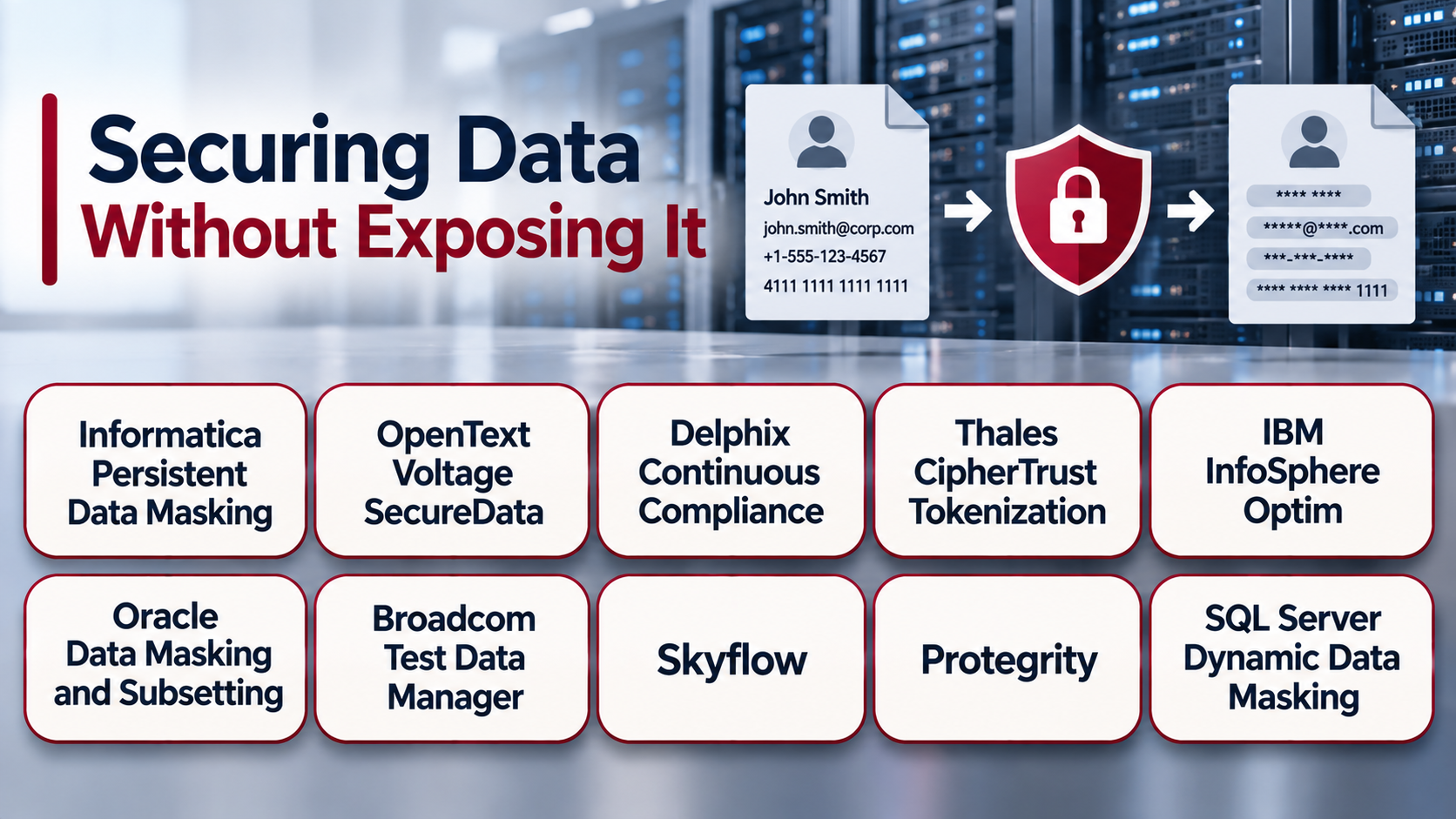
Data masking and tokenization tools help organizations protect sensitive information while maintaining its usefulness within authorized business applications. These solutions replace, obscure, or transform confidential values to reduce unnecessary exposure during information processing.
Organizations manage increasing volumes of personal information, payment details, healthcare records, financial transactions, and confidential business data. Protecting this information requires appropriate security mechanisms throughout development, testing, analytics, and production environments.
Traditional information protection methods may restrict access to entire datasets, making legitimate business activities more difficult. Data masking and tokenization provide alternative approaches that enable controlled information usage without unnecessarily exposing original sensitive values.
Modern data protection platforms support static masking, dynamic masking, format-preserving transformations, tokenization, and configurable information protection policies. Available functionality depends on the selected software, supported data sources, and implementation architecture.
Financial institutions, healthcare providers, government agencies, retailers, and software development organizations can benefit from appropriate masking and tokenization solutions. These technologies can support privacy governance, cybersecurity, regulatory compliance, and secure application development.
This guide examines ten data masking and tokenization tools, including their features, benefits, advantages, limitations, and practical applications. It also provides comparison tables, software selection guidance, implementation recommendations, security considerations, and frequently asked questions.
What Are Data Masking & Tokenization Tools?
Data masking and tokenization tools are software solutions designed to protect sensitive information by replacing or obscuring original values. They help organizations maintain controlled access to useful information while reducing exposure of confidential data.
Data masking modifies sensitive information to produce an alternative representation suitable for approved processing. Masking techniques may include character substitution, partial concealment, shuffling, randomization, and deterministic replacement.
Tokenization replaces sensitive information with substitute values known as tokens. Depending on the architecture, authorized systems may retrieve original information through a protected token vault or another controlled mechanism.
Static data masking creates a transformed copy of an original dataset, commonly for development, testing, or analytics. Dynamic data masking modifies information displayed to users without necessarily changing the underlying stored values.
Format-preserving protection mechanisms maintain selected structural characteristics of original information. This capability can help organizations support legacy applications and validation requirements while protecting sensitive values.
Data masking and tokenization do not automatically guarantee anonymity or regulatory compliance. Organizations must evaluate residual identification risks, access permissions, token security, transformation quality, and applicable information protection requirements.
How Do Data Masking & Tokenization Tools Work?
- Identify approved information sources.
- Discover sensitive information categories.
- Classify protected database fields and records.
- Establish information protection policies.
- Select suitable masking or tokenization mechanisms.
- Configure transformation rules.
- Apply transformations to authorized information.
- Preserve required data relationships where appropriate.
- Restrict access to original information.
- Validate transformed datasets and application compatibility.
- Record authorized processing and security events.
- Monitor policy effectiveness and operational performance.
- Update protection configurations as requirements evolve.
Traditional Data Protection vs. Data Masking & Tokenization
| Evaluation Area | Traditional Protection | Masking and Tokenization |
|---|---|---|
| Primary approach | Restrict original data access | Transform sensitive values |
| Development data | May contain original records | Uses protected representations |
| Application compatibility | May require access exceptions | Can preserve required formats |
| Sensitive data exposure | Access-dependent | Reduced through transformation |
| Information sharing | Restricted distribution | Controlled protected datasets |
| Data relationships | Original relationships retained | Configurable relationship preservation |
| Reversibility | Depends on security mechanism | Depends on transformation architecture |
| Policy enforcement | Access permissions | Access and transformation policies |
| Analytics | May require original information | Can use suitable protected values |
| Payment protection | Encryption and access controls | Token-based payment references |
| Testing environments | Potential production data exposure | Masked test data |
| Auditability | Access records | Transformation and access records |
Common Applications of Data Masking & Tokenization Tools
- Secure software development environments.
- Database testing and quality assurance.
- Payment card information protection.
- Healthcare record protection.
- Customer database masking.
- Financial information security.
- Privacy-oriented analytics.
- Secure cloud migration.
- Enterprise data sharing.
- Application programming interface (API) protection.
- Artificial intelligence (AI) dataset preparation.
- Regulatory compliance support.
Key Components of Data Masking & Tokenization Tools
| Component | Primary Function |
|---|---|
| Data discovery engine | Identifies supported sensitive information |
| Classification engine | Categorizes protected data |
| Data connector | Connects approved information sources |
| Policy engine | Applies transformation requirements |
| Static masking engine | Creates protected dataset copies |
| Dynamic masking engine | Controls displayed sensitive values |
| Tokenization engine | Generates substitute information values |
| Token vault | Maintains protected token mappings where applicable |
| Key management | Protects cryptographic keys |
| Format-preserving engine | Maintains selected information structures |
| Referential integrity mechanism | Preserves required data relationships |
| Access control | Restricts authorized information usage |
| Detokenization service | Enables controlled original value retrieval |
| Validation engine | Evaluates transformed information |
| Audit repository | Records authorized processing events |
| Reporting interface | Summarizes protection activities |
Types of Data Masking & Tokenization Tools
Static Data Masking
Static masking creates protected copies of original datasets by replacing selected sensitive values. It is commonly used to prepare development, testing, training, and analytics environments.
Dynamic Data Masking
Dynamic masking controls how sensitive information appears to particular users or applications. The underlying information may remain unchanged, making independent access controls essential.
Vault-Based Tokenization
Vault-based tokenization maintains protected mappings between tokens and original sensitive values. Authorized detokenization processes can retrieve original information when business requirements permit.
Vaultless Tokenization
Vaultless tokenization uses alternative transformation architectures that do not require a conventional centralized token mapping database. Security properties and reversibility depend on the particular implementation.
Format-Preserving Protection
Format-preserving techniques maintain selected characteristics such as length, character sets, or structural requirements. Format-preserving encryption and tokenization are distinct mechanisms that should be evaluated according to their actual security properties.
Key Features of Data Masking & Tokenization Tools
- Automated sensitive information discovery.
- Configurable static data masking.
- Dynamic information masking.
- Sensitive data tokenization.
- Format-preserving transformations.
- Referential integrity preservation.
- Role-based information protection.
- Custom transformation rules.
- Secure token management.
- Database and application integration.
- Processing and audit reporting.
- Enterprise privacy policy administration.
Top 10 Data Masking & Tokenization Tools
The following selection includes enterprise masking platforms, dedicated tokenization services, test data management tools, and database-native masking capabilities. The numbering organizes the comparison rather than representing an independently benchmarked ranking.
1. Informatica Persistent Data Masking
Short Description
Informatica Persistent Data Masking provides capabilities for protecting sensitive information within supported enterprise data environments. It is particularly relevant to organizations preparing protected datasets for development, testing, and other authorized non-production activities.
The software supports configurable masking techniques that replace sensitive information while maintaining selected characteristics of original datasets. Organizations can establish transformation requirements according to information categories and application dependencies.
Informatica’s broader data management ecosystem provides complementary capabilities involving information integration, governance, and data quality. These capabilities can support coordinated enterprise information protection programs.
The platform is particularly suitable for organizations managing complex database environments and established Informatica infrastructure. Current product packaging, supported connectors, and deployment options should be verified.
How Informatica Persistent Data Masking Works
- Connect approved enterprise data sources.
- Identify sensitive information fields.
- Establish masking requirements.
- Configure appropriate transformation rules.
- Generate protected datasets.
- Validate information relationships and application compatibility.
Key Features
- Persistent masking: Creates transformed copies of sensitive information.
- Sensitive data discovery: Supports applicable information identification workflows.
- Masking algorithms: Provides configurable information transformation techniques.
- Referential integrity: Supports preservation of required data relationships.
- Database integration: Connects compatible enterprise data sources.
- Policy configuration: Enables organization-specific masking requirements.
- Repeatable processing: Supports recurring dataset preparation.
- Data management integration: Complements Informatica information workflows.
- Operational reporting: Provides relevant processing information.
Benefits
- Reduces sensitive information exposure in non-production environments.
- Supports secure application testing.
- Facilitates reusable masking policies.
- Helps preserve required data relationships.
- Supports enterprise information governance.
- Reduces repetitive dataset preparation.
- Improves consistency across protected environments.
Pros
- Enterprise data management specialization.
- Configurable masking mechanisms.
- Database integration capabilities.
- Referential integrity support.
- Established enterprise ecosystem.
- Suitable for complex information environments.
Cons
- Commercial licensing requires evaluation.
- Implementation may require specialist resources.
- Product packaging can change.
- Complex masking rules require maintenance.
- Tokenization may require complementary capabilities.
Use Cases
- Development database masking.
- Enterprise test data preparation.
- Customer information protection.
- Financial dataset transformation.
- Secure database migration.
- Non-production environment provisioning.
Best For
- Large enterprises.
- Informatica customers.
- Data engineering departments.
- Software testing teams.
- Enterprise privacy architects.
- Organizations managing complex database environments.
Pricing and Deployment
Informatica provides commercial enterprise data management offerings. Organizations should confirm current masking product availability, licensing, supported connectors, and implementation expenses.
2. Delphix Continuous Compliance
Short Description
Delphix Continuous Compliance, associated with the Delphix portfolio within Perforce, provides automated sensitive data masking capabilities. It helps organizations prepare protected information for development, testing, analytics, and other approved activities.
The platform supports configurable masking algorithms and automated processing workflows. Organizations can use these capabilities to reduce sensitive information exposure across supported non-production environments.
Delphix can complement broader data provisioning and DevOps workflows through its associated product ecosystem. This approach can help organizations distribute protected datasets more efficiently.
The platform is particularly suitable for enterprises requiring repeatable data masking across complex application environments. Supported databases, automation interfaces, and commercial packaging should be confirmed.
How Delphix Continuous Compliance Works
- Identify approved information sources.
- Profile supported datasets.
- Configure sensitive information classifications.
- Establish masking algorithms.
- Execute automated masking workflows.
- Validate and distribute protected information.
Key Features
- Sensitive data profiling: Identifies applicable protected information fields.
- Automated masking: Applies configured information transformations.
- Masking algorithms: Supports multiple protection techniques.
- Referential consistency: Maintains selected relationships across datasets.
- Workflow automation: Supports repeatable masking operations.
- Database connectivity: Connects compatible information environments.
- API integration: Enables automated processing workflows.
- DevOps integration: Complements development data provisioning.
- Compliance reporting: Provides relevant masking activity information.
Benefits
- Supports secure development data preparation.
- Reduces manual masking activities.
- Facilitates repeatable information protection.
- Improves non-production data security.
- Supports application testing requirements.
- Complements automated delivery workflows.
- Encourages consistent privacy configurations.
Pros
- Dedicated enterprise masking capabilities.
- Automation-oriented architecture.
- DevOps workflow relevance.
- Configurable masking algorithms.
- Referential consistency support.
- Suitable for large-scale environments.
Cons
- Commercial pricing requires confirmation.
- Deployment may require technical coordination.
- Supported database coverage varies.
- Complex transformations require planning.
- Dedicated tokenization may require additional tools.
Use Cases
- Automated test data masking.
- DevOps data provisioning.
- Enterprise database protection.
- Application modernization.
- Secure development environments.
- Repeatable privacy processing.
Best For
- Enterprise DevOps teams.
- Software quality assurance departments.
- Database administrators.
- Data security architects.
- Regulated organizations.
- Enterprises requiring automated masking.
Pricing and Deployment
Delphix provides commercial enterprise offerings through its associated product portfolio. Organizations should verify current licensing, supported deployment environments, database integrations, and related provisioning expenses.
3. IBM InfoSphere Optim
Short Description
IBM InfoSphere Optim provides enterprise data management capabilities relevant to test data preparation, information lifecycle management, and sensitive data masking. Its applicable components help organizations protect confidential information within supported environments.
Optim supports configurable transformation techniques for preparing protected datasets. These capabilities can help preserve required business relationships while replacing selected sensitive information.
The platform is relevant to enterprises operating complex relational databases and established business applications. Its broader data management functionality can complement information archiving and test data management requirements.
IBM InfoSphere Optim is particularly suitable for organizations requiring structured enterprise data protection. Current product lifecycle status, licensing, and supported database versions should be verified before procurement.
How IBM InfoSphere Optim Works
- Identify relevant application datasets.
- Connect supported database environments.
- Define sensitive information fields.
- Configure masking and transformation rules.
- Generate protected test datasets.
- Validate data relationships and business requirements.
Key Features
- Test data management: Supports controlled dataset preparation.
- Data masking: Applies configurable sensitive value transformations.
- Data subsetting: Creates selected portions of approved datasets.
- Referential integrity: Supports preservation of database relationships.
- Database integration: Connects compatible enterprise systems.
- Application data management: Supports relevant business data workflows.
- Transformation rules: Enables configurable information replacement.
- Data lifecycle capabilities: Complements broader information management.
- Processing automation: Supports repeatable dataset operations.
Benefits
- Reduces production information exposure.
- Supports secure application testing.
- Facilitates protected dataset preparation.
- Helps maintain required business relationships.
- Supports complex database environments.
- Complements enterprise information lifecycle management.
- Encourages consistent data protection.
Pros
- Established enterprise data management technology.
- Test data management capabilities.
- Referential integrity support.
- Configurable masking mechanisms.
- Enterprise database relevance.
- Suitable for complex business applications.
Cons
- Current product lifecycle requires verification.
- Commercial licensing can be complex.
- Deployment may require specialist expertise.
- Modern cloud integration coverage varies.
- Dedicated tokenization may require complementary tools.
Use Cases
- Enterprise application testing.
- Relational database masking.
- Protected test data subsetting.
- Financial application development.
- Legacy system modernization.
- Information lifecycle management.
Best For
- IBM enterprise customers.
- Database administrators.
- Application testing departments.
- Large financial institutions.
- Enterprise information architects.
- Organizations managing complex relational data.
Pricing and Deployment
IBM InfoSphere Optim is associated with commercial enterprise licensing. Organizations should verify current product availability, support lifecycle, licensing arrangements, and compatible deployment environments.
4. Oracle Data Masking and Subsetting
Short Description
Oracle Data Masking and Subsetting provides capabilities for protecting sensitive information within supported database environments. It is designed to help organizations prepare protected data for development, testing, and other authorized activities.
The software supports configurable masking formats and data subsetting workflows. Organizations can use these capabilities to create smaller, protected datasets that retain relevant application characteristics.
Oracle’s enterprise management ecosystem provides complementary database administration and operational capabilities. Masking workflows can be incorporated into compatible database management processes.
The platform is particularly suitable for organizations operating Oracle databases and enterprise applications. Supported non-Oracle sources, licensing requirements, and deployment options should be confirmed.
How Oracle Data Masking and Subsetting Works
- Identify approved database environments.
- Discover relevant sensitive information.
- Establish application data relationships.
- Configure masking formats and subsetting rules.
- Generate protected database copies.
- Validate transformed information.
Key Features
- Static data masking: Replaces selected sensitive database values.
- Data subsetting: Produces smaller approved datasets.
- Masking formats: Supports configurable transformation patterns.
- Sensitive data discovery: Identifies applicable protected information.
- Application data modeling: Supports relevant data relationships.
- Referential integrity: Maintains configured relational dependencies.
- Database integration: Connects supported database environments.
- Repeatable masking: Supports recurring dataset preparation.
- Enterprise management integration: Complements Oracle administration workflows.
Benefits
- Supports secure Oracle database testing.
- Reduces unnecessary production data exposure.
- Facilitates protected dataset distribution.
- Helps reduce non-production storage requirements.
- Supports configurable masking policies.
- Maintains relevant application relationships.
- Complements enterprise database administration.
Pros
- Oracle database specialization.
- Integrated masking and subsetting.
- Configurable masking formats.
- Enterprise management relevance.
- Referential integrity support.
- Suitable for established Oracle environments.
Cons
- Commercial licensing requires evaluation.
- Database compatibility must be verified.
- Implementation requires database expertise.
- Not primarily a dedicated tokenization platform.
- Complex applications require careful validation.
Use Cases
- Oracle database masking.
- Enterprise application testing.
- Non-production database provisioning.
- Secure application development.
- Protected data subsetting.
- Database migration preparation.
Best For
- Oracle database administrators.
- Enterprise application teams.
- Software testing departments.
- Financial institutions.
- Oracle infrastructure customers.
- Organizations requiring database-centric masking.
Pricing and Deployment
Oracle Data Masking and Subsetting is associated with commercial database management licensing. Organizations should verify applicable management pack requirements, supported database editions, and current licensing terms.
5. Broadcom Test Data Manager
Short Description
Broadcom Test Data Manager provides test data management capabilities designed to support software development and quality assurance. Its functionality includes applicable sensitive data discovery, masking, subsetting, and synthetic data generation.
The platform helps organizations prepare information suitable for authorized application testing without unnecessarily exposing production records. Configurable transformation mechanisms can support realistic testing requirements.
Broadcom Test Data Manager can complement automated testing and software delivery workflows. Organizations can use compatible capabilities to establish repeatable test data preparation processes.
The platform is particularly suitable for enterprises requiring comprehensive test data management rather than standalone payment tokenization. Current product availability, integrations, and licensing should be verified.
How Broadcom Test Data Manager Works
- Identify application testing requirements.
- Connect supported data sources.
- Discover relevant sensitive information.
- Configure masking and data generation rules.
- Prepare protected test datasets.
- Distribute and validate approved testing information.
Key Features
- Test data masking: Protects selected sensitive test information.
- Data discovery: Identifies applicable sensitive fields.
- Synthetic data generation: Creates configured artificial test records.
- Data subsetting: Produces selected dataset portions.
- Data provisioning: Supports approved test data distribution.
- Transformation rules: Enables configurable value replacement.
- Database integration: Connects supported information sources.
- Workflow automation: Supports repeatable testing processes.
- Test data management: Coordinates relevant testing information requirements.
Benefits
- Supports secure software testing.
- Reduces dependence on original production information.
- Facilitates realistic test dataset preparation.
- Improves test data availability.
- Supports repeatable quality assurance workflows.
- Reduces manual dataset preparation.
- Complements enterprise software delivery.
Pros
- Comprehensive test data management orientation.
- Masking and synthetic data capabilities.
- Configurable test data preparation.
- Enterprise integration relevance.
- Data subsetting functionality.
- Suitable for complex testing environments.
Cons
- Commercial licensing requires confirmation.
- Deployment may require specialist resources.
- Dedicated payment tokenization is not its primary purpose.
- Complex configurations require maintenance.
- Supported integrations vary by offering.
Use Cases
- Enterprise application testing.
- Automated quality assurance.
- Protected database preparation.
- Synthetic test data generation.
- Secure software development.
- Continuous testing workflows.
Best For
- Software testing departments.
- Quality assurance engineers.
- Enterprise DevOps teams.
- Application development departments.
- Regulated businesses.
- Organizations requiring comprehensive test data management.
Pricing and Deployment
Broadcom Test Data Manager uses commercial enterprise licensing arrangements. Organizations should confirm current product packaging, supported integrations, deployment options, and implementation costs.
6. OpenText Voltage SecureData
Short Description
OpenText Voltage SecureData provides enterprise data protection capabilities involving encryption, tokenization, and format-preserving protection mechanisms. Its functionality is relevant to organizations processing sensitive information across distributed environments.
The platform supports applicable protection techniques designed to maintain selected characteristics of original information. These capabilities can help organizations integrate protected values into existing applications and information processing workflows.
Voltage SecureData addresses enterprise information security requirements involving payment information, customer records, and confidential business data. Its tokenization and encryption mechanisms should be evaluated according to their distinct security properties.
The platform is particularly suitable for organizations requiring enterprise-scale data-centric protection. Current product components, supported transformation methods, and integration requirements should be verified.
How OpenText Voltage SecureData Works
- Identify sensitive information requiring protection.
- Establish approved transformation requirements.
- Configure applicable cryptographic or tokenization services.
- Integrate supported applications.
- Protect sensitive values during authorized processing.
- Restrict and monitor authorized recovery operations.
Key Features
- Tokenization: Replaces sensitive information with protected substitute values.
- Format-preserving encryption: Maintains selected information format characteristics.
- Data-centric security: Protects information across supported workflows.
- Key management integration: Supports applicable cryptographic administration.
- Application integration: Connects compatible enterprise systems.
- Policy configuration: Establishes information protection requirements.
- Controlled recovery: Supports authorized original value retrieval where applicable.
- Enterprise deployment: Supports compatible distributed environments.
- Security reporting: Provides relevant protection activity information.
Benefits
- Reduces unnecessary sensitive information exposure.
- Supports protected enterprise information processing.
- Facilitates application compatibility.
- Complements payment information security.
- Supports centralized protection requirements.
- Helps protect information across distributed environments.
- Encourages consistent data-centric security.
Pros
- Dedicated enterprise data protection capabilities.
- Tokenization and encryption functionality.
- Format-preserving protection relevance.
- Enterprise application integration.
- Suitable for regulated industries.
- Broad data-centric security orientation.
Cons
- Commercial pricing requires evaluation.
- Cryptographic configuration requires expertise.
- Integration may be complex.
- Product capabilities vary by component.
- Key and access management remain critical.
Use Cases
- Payment information tokenization.
- Financial application protection.
- Customer identifier protection.
- Enterprise data-centric security.
- Secure analytics workflows.
- Legacy application information protection.
Best For
- Financial institutions.
- Payment processing organizations.
- Enterprise security architects.
- Privacy engineering departments.
- Regulated businesses.
- Organizations requiring format-preserving protection.
Pricing and Deployment
OpenText Voltage SecureData provides commercial enterprise offerings. Organizations should verify current licensing, supported protection methods, deployment arrangements, and cryptographic infrastructure expenses.
7. Thales CipherTrust Tokenization
Short Description
Thales CipherTrust Tokenization provides sensitive information protection capabilities within the broader CipherTrust data security ecosystem. It supports applicable tokenization workflows designed to reduce exposure of original confidential values.
The platform enables organizations to integrate protected substitute values into supported applications and information processing environments. Available tokenization mechanisms depend on the selected product configuration.
CipherTrust can complement broader enterprise encryption, key management, and access administration requirements. These capabilities help organizations coordinate information protection across distributed infrastructure.
The platform is particularly suitable for enterprises requiring centralized cryptographic and tokenization management. Supported tokenization architectures, integration methods, and commercial terms should be verified.
How Thales CipherTrust Tokenization Works
- Identify approved sensitive information categories.
- Configure applicable CipherTrust components.
- Establish tokenization requirements.
- Integrate supported application interfaces.
- Generate and distribute protected tokens.
- Control and monitor authorized recovery operations.
Key Features
- Sensitive data tokenization: Generates protected substitute values.
- Format-preserving options: Supports applicable structural requirements.
- Centralized administration: Coordinates supported protection configurations.
- Key management integration: Complements enterprise cryptographic services.
- Access control: Restricts authorized protection operations.
- Application integration: Connects compatible business systems.
- Policy management: Applies configurable security requirements.
- Controlled detokenization: Supports authorized original value retrieval.
- Audit capabilities: Records relevant security operations.
Benefits
- Reduces sensitive information exposure.
- Supports centralized tokenization management.
- Facilitates protected application workflows.
- Complements enterprise cryptographic infrastructure.
- Supports payment and customer information security.
- Encourages consistent access policies.
- Improves visibility into protection operations.
Pros
- Enterprise cryptographic security specialization.
- Dedicated tokenization capabilities.
- Key management ecosystem integration.
- Configurable information protection.
- Enterprise deployment relevance.
- Suitable for regulated organizations.
Cons
- Commercial licensing requires confirmation.
- Deployment may require specialist resources.
- Product configuration can be complex.
- Supported application interfaces vary.
- Tokenization does not eliminate all privacy risks.
Use Cases
- Payment information protection.
- Customer identifier tokenization.
- Enterprise application security.
- Financial information processing.
- Centralized cryptographic administration.
- Protected cloud information workflows.
Best For
- Enterprise cybersecurity teams.
- Financial institutions.
- Payment service providers.
- Cryptographic infrastructure administrators.
- Thales customers.
- Organizations requiring centralized tokenization.
Pricing and Deployment
Thales CipherTrust Tokenization is associated with commercial enterprise licensing. Organizations should confirm current product components, deployment options, supported integrations, and infrastructure requirements.
8. Skyflow
Short Description
Skyflow provides a data privacy vault designed to help organizations isolate, protect, and manage sensitive information. Its tokenization capabilities enable compatible applications to use protected references instead of directly handling original confidential values.
The platform supports configurable information access and controlled retrieval mechanisms. Organizations can establish application workflows that limit unnecessary exposure of personal information.
Skyflow is particularly relevant to cloud-native applications, financial technology businesses, healthcare technology organizations, and other services processing sensitive records. Its architecture can help separate sensitive information from broader application infrastructure.
The platform combines tokenization with privacy-oriented data storage and access management. Organizations should evaluate current regional availability, integration options, data residency requirements, and commercial terms.
How Skyflow Works
- Establish sensitive information storage requirements.
- Configure an appropriate privacy vault.
- Define access and information handling policies.
- Integrate supported application interfaces.
- Store protected information and generate tokens.
- Enable authorized information retrieval where required.
Key Features
- Data privacy vault: Isolates supported sensitive information.
- Tokenization: Provides substitute references for protected values.
- Access policies: Controls authorized information usage.
- Detokenization: Supports approved original value retrieval.
- Data masking: Provides applicable information display protections.
- API integration: Connects compatible applications.
- Privacy-oriented storage: Supports controlled sensitive information management.
- Data residency options: Supports applicable regional requirements.
- Audit logging: Records relevant information access activities.
Benefits
- Reduces direct application exposure to sensitive information.
- Supports centralized privacy architecture.
- Facilitates controlled information retrieval.
- Simplifies selected tokenization integrations.
- Supports cloud-native application development.
- Complements privacy governance requirements.
- Encourages information minimization.
Pros
- Dedicated privacy vault architecture.
- Tokenization and controlled access capabilities.
- Developer-oriented interfaces.
- Cloud-native application relevance.
- Configurable privacy policies.
- Suitable for sensitive information workflows.
Cons
- Commercial pricing requires evaluation.
- Integration requires application architecture changes.
- External service dependencies require assessment.
- Regional availability must be verified.
- Privacy effectiveness depends on access configuration.
Use Cases
- Customer information tokenization.
- Payment application privacy.
- Healthcare information isolation.
- Financial technology development.
- Generative AI privacy architecture.
- Secure application data sharing.
Best For
- Cloud-native application developers.
- Financial technology companies.
- Healthcare technology providers.
- Privacy engineers.
- Enterprise application architects.
- Organizations requiring privacy vaults.
Pricing and Deployment
Skyflow provides commercial data privacy infrastructure offerings. Organizations should verify current subscription arrangements, tokenization usage charges, supported regions, and applicable information processing requirements.
9. Protegrity Data Protection Platform
Short Description
Protegrity provides enterprise data protection capabilities involving sensitive information tokenization, encryption, and configurable access policies. Its functionality is relevant to organizations protecting information across databases, analytics environments, and distributed applications.
The platform supports applicable transformation mechanisms that enable approved processing without unnecessarily exposing original sensitive values. Organizations can establish protection policies according to information classifications and business requirements.
Protegrity is particularly relevant to enterprises operating large-scale data platforms and regulated information environments. Its architecture can complement existing information governance and cybersecurity infrastructure.
The platform should be evaluated according to supported tokenization methods, application compatibility, deployment requirements, and operational performance. Current commercial packaging and available integrations require confirmation.
How Protegrity Works
- Identify relevant sensitive information sources.
- Define information protection policies.
- Configure applicable transformation services.
- Connect supported applications and data platforms.
- Protect sensitive information during approved processing.
- Monitor authorized access and recovery activities.
Key Features
- Data tokenization: Replaces supported sensitive information values.
- Data encryption: Provides applicable cryptographic protection.
- Policy management: Coordinates information protection requirements.
- Data-centric security: Supports protection across compatible workflows.
- Analytics integration: Connects supported information processing platforms.
- Access control: Restricts authorized information operations.
- Format-preserving capabilities: Supports applicable structural requirements.
- Enterprise integration: Connects compatible data environments.
- Audit reporting: Provides relevant protection activity information.
Benefits
- Supports enterprise sensitive information protection.
- Reduces unnecessary exposure across data platforms.
- Facilitates controlled analytics processing.
- Supports centralized protection policies.
- Complements regulated information environments.
- Encourages consistent data-centric security.
- Supports distributed application architectures.
Pros
- Enterprise data protection specialization.
- Tokenization and encryption capabilities.
- Analytics platform relevance.
- Centralized policy administration.
- Configurable protection mechanisms.
- Suitable for complex information environments.
Cons
- Commercial pricing requires confirmation.
- Implementation may require specialist expertise.
- Integration coverage varies.
- Protection operations can introduce processing overhead.
- Complex policies require ongoing administration.
Use Cases
- Enterprise analytics data protection.
- Financial information tokenization.
- Customer record security.
- Cloud data platform protection.
- Secure information sharing.
- Regulated data processing.
Best For
- Large enterprises.
- Data security architects.
- Financial institutions.
- Enterprise analytics departments.
- Privacy engineering teams.
- Organizations managing distributed data platforms.
Pricing and Deployment
Protegrity provides commercial enterprise data protection offerings. Organizations should verify current licensing, supported connectors, deployment options, and processing infrastructure expenses.
10. Microsoft SQL Server Dynamic Data Masking
Short Description
Microsoft SQL Server Dynamic Data Masking provides database-native functionality for restricting how selected sensitive values appear to users. It enables administrators to configure masking rules without necessarily modifying the original stored information.
The feature supports applicable masking functions for information such as email addresses, numeric values, and selected character sequences. Users with appropriate permissions may retain access to original information.
Dynamic Data Masking is particularly relevant to organizations requiring controlled database information display. It can complement broader database security mechanisms involving access permissions, encryption, and auditing.
The feature is not equivalent to permanent redaction, static masking, or dedicated tokenization. Organizations must account for potential information inference and ensure that users cannot access sensitive values through unrestricted query privileges.
How SQL Server Dynamic Data Masking Works
- Identify sensitive database columns.
- Define appropriate masking requirements.
- Configure supported masking functions.
- Establish database user permissions.
- Apply masked information display to relevant queries.
- Validate access restrictions and information exposure risks.
Key Features
- Dynamic masking: Obscures selected query output values.
- Default masking: Applies supported standard masking behavior.
- Email masking: Protects selected portions of email addresses.
- Partial masking: Configures visible and concealed character ranges.
- Random masking: Supports applicable numeric masking functions.
- Permission-based access: Controls authorized unmasked information visibility.
- Database-native configuration: Integrates with supported SQL Server environments.
- Original data preservation: Retains underlying stored information.
- Azure SQL relevance: Supports applicable Microsoft database services.
Benefits
- Reduces unnecessary sensitive value display.
- Supports controlled database access.
- Simplifies selected masking requirements.
- Preserves original stored information.
- Complements database security policies.
- Reduces custom application display logic.
- Supports role-oriented information presentation.
Pros
- Native Microsoft database functionality.
- Relatively straightforward configuration.
- No separate masking platform required for supported deployments.
- Multiple masking functions.
- Permission-based visibility.
- Relevant to SQL Server and Azure SQL environments.
Cons
- Does not permanently transform stored information.
- Not a tokenization mechanism.
- Privileged users may access original values.
- Information inference risks require consideration.
- Not suitable as a standalone security boundary.
Use Cases
- Customer service database access.
- Restricted administrative reporting.
- Partial contact information display.
- Internal database privacy controls.
- Role-based information presentation.
- Microsoft database security enhancement.
Best For
- SQL Server administrators.
- Microsoft Azure database teams.
- Enterprise database developers.
- Internal application departments.
- Database security engineers.
- Organizations requiring basic dynamic masking.
Pricing and Deployment
Dynamic Data Masking is a feature of supported Microsoft SQL Server and Azure SQL offerings. Organizations should verify database licensing, service tiers, version compatibility, and complementary security requirements.
Comparison Table: Top 10 Data Masking & Tokenization Tools
| Tool | Primary Capability | Best For | Deployment | Pricing Model |
|---|---|---|---|---|
| Informatica Persistent Data Masking | Enterprise static masking | Data engineering teams | Offering-dependent | Commercial |
| Delphix Continuous Compliance | Automated data masking | DevOps environments | Offering-dependent | Commercial |
| IBM InfoSphere Optim | Test data management | Enterprise databases | Offering-dependent | Commercial |
| Oracle Data Masking and Subsetting | Database masking | Oracle environments | Enterprise infrastructure | Commercial |
| Broadcom Test Data Manager | Protected test data | Software testing | Offering-dependent | Commercial |
| OpenText Voltage SecureData | Tokenization and encryption | Enterprise data security | Offering-dependent | Commercial |
| Thales CipherTrust Tokenization | Centralized tokenization | Regulated organizations | Offering-dependent | Commercial |
| Skyflow | Data privacy vault | Cloud-native applications | Managed infrastructure | Commercial |
| Protegrity | Data-centric protection | Enterprise analytics | Offering-dependent | Commercial |
| SQL Server Dynamic Data Masking | Dynamic query masking | Microsoft databases | Database-native | Database licensing |
Functional Comparison
| Tool | Static Masking | Dynamic Protection | Tokenization | Test Data Management |
|---|---|---|---|---|
| Informatica | Specialized | Separate capabilities | Offering-dependent | Supported workflows |
| Delphix | Specialized | Not primary | Not primary | Portfolio integration |
| IBM Optim | Supported | Not primary | Verify offering | Specialized |
| Oracle | Specialized | Separate capabilities | Not primary | Supported |
| Broadcom | Supported | Not primary | Not primary | Specialized |
| OpenText Voltage | Offering-dependent | Supported workflows | Specialized | Not primary |
| Thales CipherTrust | Offering-dependent | Configuration-dependent | Specialized | Not primary |
| Skyflow | Not primary | Supported access workflows | Specialized | Not primary |
| Protegrity | Configuration-dependent | Supported workflows | Supported | Not primary |
| SQL Server | Not supported by this feature | Specialized | Not supported | Not primary |
Technical Comparison
| Tool | Main Integration | Customization | Primary Architecture |
|---|---|---|---|
| Informatica | Enterprise data connectors | Rule-based | Data transformation |
| Delphix | Database connectors and APIs | Algorithm-based | Automated masking |
| IBM Optim | Enterprise database integrations | Rule-based | Test data management |
| Oracle | Database management interfaces | Format-based | Database transformation |
| Broadcom | Testing and data integrations | Rule-based | Test data provisioning |
| OpenText Voltage | Application integrations | Policy-based | Data-centric security |
| Thales CipherTrust | Security APIs and integrations | Policy-based | Tokenization infrastructure |
| Skyflow | Application APIs | Access policy-based | Privacy vault |
| Protegrity | Data platform integrations | Policy-based | Data-centric protection |
| SQL Server | Database configuration | Function-based | Query output masking |
Business Suitability Comparison
| Tool | Small Businesses | Midmarket | Large Enterprises |
|---|---|---|---|
| Informatica | Budget-dependent | Suitable | Suitable |
| Delphix | Budget-dependent | Suitable | Suitable |
| IBM Optim | Limited suitability | Evaluate offering | Suitable |
| Oracle | Oracle-dependent | Suitable | Suitable |
| Broadcom | Budget-dependent | Suitable | Suitable |
| OpenText Voltage | Budget-dependent | Suitable | Suitable |
| Thales CipherTrust | Budget-dependent | Suitable | Suitable |
| Skyflow | Usage-dependent | Suitable | Suitable |
| Protegrity | Budget-dependent | Suitable | Suitable |
| SQL Server | Suitable for supported databases | Suitable | Suitable as a complementary control |
Pricing and Ownership Comparison
| Tool | Main Licensing Consideration | Additional Ownership Costs |
|---|---|---|
| Informatica | Enterprise software licensing | Integration and administration |
| Delphix | Commercial platform licensing | Infrastructure and automation |
| IBM Optim | Enterprise product licensing | Specialist implementation |
| Oracle | Applicable management pack licensing | Database infrastructure |
| Broadcom | Test data management licensing | Testing integrations |
| OpenText Voltage | Enterprise security licensing | Cryptographic infrastructure |
| Thales CipherTrust | Tokenization component licensing | Key management and integration |
| Skyflow | Commercial service arrangements | Application integration and usage |
| Protegrity | Enterprise protection licensing | Data platform integration |
| SQL Server | Supported database licensing | Administration and additional controls |
These comparisons describe general product positioning rather than independently measured security performance. Organizations should verify actual functionality, current product availability, and applicable licensing before procurement.
How to Choose the Best Data Masking & Tokenization Tool
1. Define Information Protection Objectives
Determine whether the organization requires protected test datasets, controlled information display, or secure token-based processing. Different transformation mechanisms address different operational and privacy requirements.
2. Identify Sensitive Information Categories
Establish which information categories require protection, including personal identifiers, financial details, credentials, and confidential business information. Classification requirements should reflect actual information sensitivity and authorized usage.
3. Evaluate Static Masking Requirements
Organizations preparing development and testing environments may require permanently transformed dataset copies. Select tools that preserve necessary application characteristics without retaining unnecessary original information.
4. Assess Dynamic Masking Requirements
Dynamic masking can support controlled information display within production applications. Organizations should evaluate whether underlying access permissions adequately prevent unauthorized retrieval or inference.
5. Review Tokenization Architecture
Determine whether the organization requires vault-based or alternative tokenization mechanisms. Evaluate token security, recovery controls, operational dependencies, and information processing requirements.
6. Evaluate Referential Integrity
Related database records may require consistent transformations to remain useful for application testing. Verify that masking mechanisms preserve necessary relationships without creating unacceptable identification risks.
7. Assess Format Preservation
Legacy applications may require specific lengths, character sets, or validation structures. Select appropriate transformation mechanisms that preserve required formats without unnecessarily weakening protection.
8. Consider Database Compatibility
Identify current database engines, application environments, and planned infrastructure changes. Verify supported connectors and database versions before selecting enterprise masking software.
9. Review Information Recovery Requirements
Determine whether original information must remain recoverable for authorized business operations. Establish appropriate recovery restrictions and avoid reversible mechanisms when permanent removal is required.
10. Evaluate Key and Token Management
Cryptographic keys and token mappings may represent critical security assets. Assess access restrictions, lifecycle management, monitoring, and recovery procedures.
11. Assess Deployment Architecture
Organizations may require self-managed infrastructure, managed services, or hybrid environments. Deployment decisions should reflect information sensitivity, data residency requirements, and available technical resources.
12. Evaluate Processing Performance
Large-scale masking and tokenization workloads can introduce infrastructure demands and application latency. Measure representative processing performance before production deployment.
13. Review Security and Compliance Requirements
Information protection tools should support applicable organizational and regulatory requirements. Independent governance and qualified legal assessments remain necessary.
14. Compare Total Ownership Costs
Evaluate software licensing, infrastructure, application integration, processing expenses, and ongoing administration. Lower initial licensing costs may not result in lower long-term ownership expenses.
15. Conduct Independent Validation
Test shortlisted tools using representative datasets and approved information protection requirements. Validate both security effectiveness and downstream application compatibility before deployment.
Best Data Masking & Tokenization Tools by User Type
| User Type | Recommended Tool | Primary Reason |
|---|---|---|
| Enterprise data engineering teams | Informatica Persistent Data Masking | Configurable enterprise masking |
| DevOps departments | Delphix Continuous Compliance | Automated masking workflows |
| Enterprise database teams | IBM InfoSphere Optim | Test data management |
| Oracle database administrators | Oracle Data Masking and Subsetting | Oracle-oriented database protection |
| Software testing teams | Broadcom Test Data Manager | Comprehensive test data preparation |
| Financial security architects | OpenText Voltage SecureData | Tokenization and format-preserving protection |
| Cryptographic infrastructure teams | Thales CipherTrust Tokenization | Centralized tokenization |
| Cloud-native application developers | Skyflow | Privacy vault architecture |
| Enterprise analytics departments | Protegrity | Data-centric information protection |
| Microsoft database administrators | SQL Server Dynamic Data Masking | Native dynamic masking |
Weighted Software Selection Scorecard
| Selection Criterion | Weight |
|---|---|
| Information protection effectiveness | 20% |
| Transformation capabilities | 15% |
| Database and application compatibility | 15% |
| Security architecture | 15% |
| Referential integrity and data usability | 10% |
| Automation and scalability | 8% |
| Deployment flexibility | 7% |
| Total ownership costs | 5% |
| Monitoring and reporting | 5% |
| Total | 100% |
Organizations can assign consistent evaluation scores to shortlisted tools based on representative business requirements. Weighted results should complement independent security testing and qualified architecture reviews.
Practical Example: Protecting Banking Test Data
Consider a hypothetical financial institution operating multiple customer-facing banking applications. Its development and quality assurance teams require realistic datasets, but copying original production records into testing environments creates unnecessary information exposure.
The organization selects Delphix Continuous Compliance for automated masking and Thales CipherTrust Tokenization for separate application-level tokenization requirements. These tools address different information protection objectives within a coordinated security architecture.
Step 1: Inventory Production Data
Identify approved databases, customer records, account information, and relevant application dependencies. Document which information categories require protection before non-production distribution.
Step 2: Establish Data Classification
Classify sensitive fields according to organizational privacy and security requirements. Identify direct identifiers, confidential financial information, and attributes that could contribute to re-identification.
Step 3: Define Transformation Requirements
Determine which fields require irreversible masking and which production application workflows require recoverable tokens. Avoid retaining original values in testing environments unless explicitly justified and authorized.
Step 4: Configure Masking Infrastructure
Deploy the selected masking components within an approved environment. Restrict access to original production information and establish secure processing procedures.
Step 5: Configure Masking Algorithms
Establish appropriate transformations for customer names, account references, contact information, and other protected fields. Preserve only the relationships and structural characteristics necessary for authorized testing.
Step 6: Establish Referential Consistency
Identify relationships between customer records, account tables, and transaction datasets. Configure transformations that preserve necessary relationships across approved test data sources.
Step 7: Implement Production Tokenization
Integrate the selected tokenization service into compatible production application workflows. Establish appropriate permissions for token generation and authorized original value retrieval.
Step 8: Validate Protected Datasets
Evaluate transformed records for residual sensitive information and application compatibility. Conduct independent privacy assessments before distributing datasets to development teams.
Step 9: Automate Dataset Provisioning
Establish repeatable workflows for generating approved masked datasets. Ensure that automation does not bypass required validation and release procedures.
Step 10: Monitor Protection Effectiveness
Track masking coverage, information exposure findings, processing performance, and authorized token recovery operations. Review protection configurations following significant application or database changes.
Illustrative Implementation Results
| Performance Indicator | Before | After |
|---|---|---|
| Non-production masking coverage | 25% | 98% |
| Average test dataset preparation time | 48 hours | 8 hours |
| Manual data preparation effort | 400 hours/month | 120 hours/month |
| Validated application test compatibility | 90% | 97% |
| Sensitive values found in sampled test records | 1,200 | 35 |
| Monthly data preparation expenses | $40,000 | $25,000 |
| Automated dataset provisioning coverage | 20% | 90% |
| Documented transformation coverage | 35% | 98% |
| Approved production tokenization coverage | 15% | 95% |
These figures are hypothetical and do not represent independently verified performance from Delphix, Thales, or any other vendor. Actual results depend on information characteristics, transformation configurations, application architecture, and operational requirements.
The illustrative implementation reduces monthly data preparation expenses by 37.5% and average dataset preparation time by approximately 83.3%. Remaining sensitive values identified during validation require investigation and remediation before affected datasets are approved for release.
Illustrative Return on Investment
| Financial Measure | Amount |
|---|---|
| Initial implementation investment | $90,000 |
| Previous monthly operating cost | $40,000 |
| New monthly operating cost | $25,000 |
| Net monthly savings | $15,000 |
| Annual operating savings | $180,000 |
| First-year net benefit | $90,000 |
| First-year return on investment | 100% |
| Estimated payback period | 6 months |
The calculation assumes consistent monthly operating expenses and information processing requirements throughout the first year. It excludes taxes, potential incident avoidance benefits, and changes in future licensing costs.
Important Data Masking & Tokenization Performance Metrics
| Metric | Purpose |
|---|---|
| Sensitive data discovery coverage | Measures approved sources evaluated |
| Masking coverage | Tracks sensitive fields protected |
| Transformation success rate | Measures completed protection operations |
| Residual sensitive data rate | Identifies protected output weaknesses |
| Referential integrity pass rate | Evaluates required relationship preservation |
| Application compatibility rate | Measures downstream application usability |
| Token generation throughput | Tracks tokenization processing capacity |
| Detokenization latency | Measures authorized recovery performance |
| Unauthorized recovery attempts | Tracks suspicious information access |
| Processing failure rate | Identifies unsuccessful transformation operations |
| Cost per protected record | Measures operational expenditure |
| Dataset preparation time | Evaluates provisioning efficiency |
| Audit documentation coverage | Measures recorded protection evidence |
| Re-identification risk | Evaluates residual privacy exposure |
| Policy compliance coverage | Tracks adherence to configured requirements |
Industry Applications of Data Masking & Tokenization
Financial Services
Financial institutions can use masking and tokenization to protect customer identifiers, account information, and confidential transaction records. These mechanisms can support controlled application development and authorized financial processing.
Healthcare
Healthcare organizations can transform selected sensitive information before approved research, testing, and analytics activities. Appropriate protection requires consideration of residual identification risks and applicable health information privacy requirements.
Retail and E-commerce
Retailers can use tokenization to reduce unnecessary exposure of payment information within supported application workflows. Static masking can also help protect customer information used in software development and testing.
Government
Government agencies can use masking tools to prepare protected datasets for authorized analysis and system development. Information handling requirements should reflect applicable security classifications and privacy obligations.
Telecommunications
Telecommunications companies can protect subscriber identifiers, billing information, and confidential service records through appropriate transformation mechanisms. Referential consistency may be important for testing complex billing and service management applications.
Technology and Software Development
Software companies can use masking and synthetic data generation to prepare realistic testing environments without unnecessarily exposing production information. Tokenization can complement application architectures that require controlled handling of sensitive values.
Data Masking & Tokenization Implementation Roadmap
| Stage | Implementation Activity | Expected Deliverable |
|---|---|---|
| 1 | Inventory information sources | Approved data inventory |
| 2 | Assess sensitive information risks | Risk classification |
| 3 | Define protection objectives | Information protection requirements |
| 4 | Classify sensitive fields | Classification framework |
| 5 | Select appropriate tools | Software shortlist |
| 6 | Establish transformation policies | Approved masking and tokenization rules |
| 7 | Deploy pilot infrastructure | Controlled processing environment |
| 8 | Configure masking mechanisms | Validated transformation settings |
| 9 | Establish tokenization controls | Protected token architecture |
| 10 | Validate data relationships | Application compatibility findings |
| 11 | Conduct privacy assessments | Residual risk evaluation |
| 12 | Automate approved workflows | Repeatable processing procedures |
| 13 | Configure operational monitoring | Security reporting |
| 14 | Review and optimize | Continuous improvement program |
Security and Governance Considerations
Masking and tokenization systems may process original sensitive information and maintain critical transformation configurations. Organizations should protect processing infrastructure, cryptographic keys, token mappings, administrative interfaces, and relevant operational logs.
Tokenization can reduce exposure of original values but does not automatically eliminate information security obligations. Organizations should evaluate whether protected tokens remain sensitive because of their relationships, permitted recovery mechanisms, or associated information.
Applicable requirements may include the Payment Card Industry Data Security Standard (PCI DSS), General Data Protection Regulation (GDPR), Health Insurance Portability and Accountability Act (HIPAA), and India’s Digital Personal Data Protection (DPDP) Act. Appropriate compliance assessments depend on actual information processing activities and applicable legal requirements.
Security and Governance Checklist
- Maintain an approved sensitive information inventory.
- Define authorized information processing purposes.
- Establish appropriate masking and tokenization policies.
- Protect original sensitive information.
- Restrict access to token mappings.
- Establish cryptographic key management procedures.
- Validate transformed datasets independently.
- Evaluate residual re-identification risks.
- Restrict authorized detokenization operations.
- Monitor suspicious information access.
- Protect processing logs and audit records.
- Review third-party processing arrangements.
- Reassess protection following significant application changes.
Understanding the Total Cost of Ownership
Data masking and tokenization expenses extend beyond software licensing and initial implementation. Organizations should account for infrastructure, application integration, cryptographic administration, information validation, and ongoing operational maintenance.
Managed tokenization services can reduce infrastructure administration while introducing recurring service expenses. Self-managed enterprise platforms may provide greater operational control but require specialist technical resources.
| Cost Category | Main Consideration |
|---|---|
| Software licensing | Commercial platform subscriptions |
| Infrastructure | Computing and storage resources |
| Tokenization processing | Protected value generation and recovery |
| Masking processing | Dataset transformation workloads |
| Key management | Cryptographic infrastructure |
| Token storage | Protected mapping repositories where applicable |
| Application integration | Development and configuration |
| Information validation | Independent security testing |
| Policy administration | Ongoing governance activities |
| Employee training | Technical and privacy skills |
| Maintenance | Software and configuration updates |
| Security monitoring | Operational protection controls |
Common Challenges in Data Masking & Tokenization
- Incomplete sensitive information discovery.
- Complex database relationships.
- Inconsistent transformation configurations.
- Legacy application compatibility requirements.
- Residual re-identification risks.
- Token vault security requirements.
- Cryptographic key management.
- Large-scale processing workloads.
- Unauthorized detokenization attempts.
- Sensitive information exposure through logs.
- Maintaining realistic protected test datasets.
- Integration across distributed information environments.
Common Mistakes to Avoid
1. Treating Masking and Tokenization as Identical
Masking and tokenization serve different information protection objectives. Select transformation mechanisms according to reversibility, application requirements, and privacy risks.
2. Ignoring Referential Integrity
Inconsistent transformations can break relationships between database records and applications. Validate required dependencies before releasing protected datasets.
3. Assuming Dynamic Masking Is a Complete Security Boundary
Dynamic masking controls displayed information but may leave original values accessible through other authorized or inadequately restricted mechanisms. Implement independent database access restrictions and evaluate inference risks.
4. Providing Excessive Detokenization Permissions
Unnecessary recovery permissions can undermine the benefits of tokenization. Restrict original value retrieval to explicitly authorized applications and business purposes.
5. Neglecting Token Vault Security
A token vault may contain sensitive mappings that require significant protection. Establish appropriate encryption, access restrictions, monitoring, and recovery procedures.
6. Using Production Data in Testing Without Validation
Automated masking can overlook sensitive fields or produce incomplete transformations. Independently validate protected datasets before distributing them to non-production environments.
7. Ignoring Residual Identification Risks
Replacing direct identifiers does not necessarily make information anonymous. Evaluate remaining attributes and relationships that could enable re-identification.
8. Overlooking Application Compatibility
Protected values may fail application validation or business logic requirements. Conduct representative application testing before implementing transformation mechanisms at scale.
Troubleshooting Common Data Masking Problems
| Problem | Possible Cause | Recommended Action |
|---|---|---|
| Broken database relationships | Inconsistent masking | Configure appropriate deterministic transformations |
| Invalid application values | Incorrect output formats | Review format and validation requirements |
| Sensitive information remains | Incomplete field discovery | Expand approved discovery and validation coverage |
| Token recovery failures | Incorrect access or service configuration | Review authorized recovery settings |
| Excessive processing latency | Resource-intensive transformations | Evaluate processing architecture |
| Duplicate protected identifiers | Inadequate uniqueness handling | Validate identifier generation requirements |
| Unauthorized original value access | Excessive permissions | Strengthen independent access controls |
| Inconsistent test datasets | Uncontrolled transformation rules | Maintain versioned masking configurations |
| Sensitive information in logs | Inappropriate logging settings | Apply approved information minimization |
| Application testing failures | Inadequate dataset compatibility | Conduct representative regression testing |
Best Practices for Data Masking & Tokenization
- Establish clear information protection objectives.
- Maintain accurate sensitive information classifications.
- Select purpose-appropriate transformation mechanisms.
- Preserve necessary data relationships.
- Validate protected information independently.
- Restrict access to original sensitive values.
- Protect token mappings and cryptographic keys.
- Establish least-privilege recovery permissions.
- Minimize unnecessary processing logs.
- Evaluate residual re-identification risks.
- Maintain versioned transformation policies.
- Conduct representative application testing.
- Monitor tokenization and masking performance.
- Establish documented incident response procedures.
- Reassess protection following significant infrastructure changes.
Future Trends in Data Masking & Tokenization
Automated Sensitive Data Discovery
Masking platforms may increasingly incorporate contextual classification to identify sensitive information across complex environments. Improved discovery capabilities could reduce manual classification requirements when independently validated.
Cloud-Native Tokenization
Organizations may increasingly adopt managed tokenization infrastructure for distributed applications. These architectures can support centralized protection while introducing service availability and information residency considerations.
Privacy Vault Architectures
Privacy vaults may become more widely integrated into application architectures that isolate sensitive information from general business processing. Appropriate access management will remain essential for controlling authorized information retrieval.
AI-Assisted Data Masking
Artificial intelligence may help organizations identify suitable transformation rules and sensitive information relationships. Automated recommendations should remain subject to qualified review and independent validation.
Synthetic Data Integration
Test data management platforms may increasingly combine masking with synthetic data generation. These approaches can reduce reliance on production records while supporting representative application testing.
Real-Time Information Protection
Tokenization and dynamic masking may become more closely integrated with application processing pipelines. Organizations should evaluate processing latency, security coverage, and operational reliability.
Centralized Privacy Policy Management
Enterprise platforms may increasingly coordinate masking, tokenization, encryption, and access requirements through unified policy systems. Integration can improve consistency across distributed information environments.
Continuous Privacy Risk Assessment
Organizations may adopt more frequent evaluations of residual information exposure and re-identification risks. Continuous assessment can help identify protection weaknesses following application, dataset, or policy changes.
Frequently Asked Questions (FAQs)
1. What are data masking and tokenization tools?
Data masking and tokenization tools protect sensitive information by obscuring or replacing original values. They support controlled information processing, application development, analytics, and enterprise privacy requirements.
2. What is data masking?
Data masking transforms sensitive information into an alternative representation suitable for authorized usage. It can involve substitution, partial concealment, randomization, or other configured transformation techniques.
3. What is Informatica Persistent Data Masking?
Informatica Persistent Data Masking provides enterprise capabilities for creating protected copies of supported sensitive datasets. It is particularly relevant to development, testing, and non-production information processing.
4. What is Delphix Continuous Compliance?
Delphix Continuous Compliance provides automated sensitive data masking capabilities. It can complement enterprise data provisioning and DevOps workflows.
5. What is IBM InfoSphere Optim?
IBM InfoSphere Optim provides enterprise data management capabilities relevant to test data preparation and sensitive information masking. Organizations should verify current product availability and support lifecycle before procurement.
6. What is Oracle Data Masking and Subsetting?
Oracle Data Masking and Subsetting helps organizations prepare protected database copies and selected dataset portions. It is particularly relevant to supported Oracle enterprise database environments.
7. What is Broadcom Test Data Manager?
Broadcom Test Data Manager provides test data preparation capabilities involving applicable masking, subsetting, and synthetic data generation. It supports enterprise application development and quality assurance workflows.
8. What is OpenText Voltage SecureData?
OpenText Voltage SecureData provides enterprise data protection capabilities involving tokenization, encryption, and format-preserving protection. Available functionality depends on the selected product components.
9. What is Thales CipherTrust Tokenization?
Thales CipherTrust Tokenization provides enterprise sensitive information tokenization capabilities. It can complement centralized cryptographic key management and information protection policies.
10. What is Skyflow?
Skyflow provides a data privacy vault architecture with tokenization and controlled information access capabilities. It helps compatible applications reduce direct exposure to original sensitive values.
11. What is Protegrity?
Protegrity provides enterprise data-centric protection capabilities involving tokenization, encryption, and configurable security policies. It is relevant to distributed data platforms and enterprise analytics environments.
12. What is SQL Server Dynamic Data Masking?
SQL Server Dynamic Data Masking is a database-native feature that obscures selected information displayed to users. It does not permanently transform underlying stored values or provide dedicated tokenization.
13. What is the difference between masking and tokenization?
Masking obscures or transforms sensitive information according to configured requirements. Tokenization replaces sensitive values with substitute references that may support controlled original value retrieval.
14. What is the difference between static and dynamic masking?
Static masking creates a transformed copy of original information. Dynamic masking changes information presentation without necessarily modifying underlying stored values.
15. Is tokenization reversible?
Some tokenization architectures support authorized recovery of original values, while others use different transformation properties. Organizations should verify the actual reversibility and security characteristics of their selected mechanism.
16. What is a token vault?
A token vault is a protected repository that maintains mappings between tokens and original sensitive values in applicable tokenization architectures. It requires appropriate security controls because unauthorized access could expose protected information.
17. What is format-preserving encryption?
Format-preserving encryption is a cryptographic technique that maintains specified structural characteristics of protected values. It differs from tokenization and should be evaluated according to its cryptographic security properties.
18. Can data masking protect development environments?
Static data masking can reduce exposure of original production information within development and testing environments. Protected datasets should be independently validated before distribution.
19. Can tokenization protect payment card information?
Appropriately implemented tokenization can reduce exposure of original payment card values in supported workflows. Its effect on PCI DSS scope depends on the actual architecture and applicable compliance requirements.
20. What is referential integrity in data masking?
Referential integrity concerns maintaining required relationships between related database records. Consistent transformations can help preserve these relationships within approved protected datasets.
21. Can masked information still identify individuals?
Yes, masked datasets may retain attributes or relationships that enable re-identification. Organizations should evaluate residual privacy risks rather than assuming that masking guarantees anonymity.
22. Can dynamic masking replace database access controls?
Dynamic masking should not replace independent database access controls. Organizations must restrict unauthorized queries, privileged access, and other mechanisms that could expose original information.
23. How much do masking and tokenization tools cost?
Costs depend on software licensing, information processing volumes, infrastructure, application integration, and operational requirements. Organizations should compare total ownership costs rather than subscription prices alone.
24. Can masking and tokenization guarantee regulatory compliance?
No masking or tokenization platform can independently guarantee regulatory compliance. Organizations must maintain appropriate governance, security controls, qualified oversight, and applicable legal assessments.
25. Which data masking and tokenization tool is best?
The most suitable tool depends on whether the organization requires static masking, test data management, dynamic information display, or dedicated tokenization. Representative pilot deployments and independent security evaluations can help identify an appropriate solution.
Conclusion
Data masking and tokenization tools help organizations protect sensitive information while supporting authorized application processing and information usage. Their capabilities include configurable transformations, protected dataset preparation, token management, and controlled information display.
Informatica Persistent Data Masking, Delphix Continuous Compliance, IBM InfoSphere Optim, Oracle Data Masking and Subsetting, and Broadcom Test Data Manager provide capabilities relevant to enterprise masking and protected test data preparation. Organizations should evaluate their database compatibility, automation functionality, and current commercial availability.
OpenText Voltage SecureData, Thales CipherTrust Tokenization, Skyflow, and Protegrity provide approaches to enterprise tokenization and data-centric information protection. Their suitability depends on security architecture, recovery requirements, application integrations, and information processing objectives.
Microsoft SQL Server Dynamic Data Masking provides database-native functionality for controlling selected sensitive information displayed to users. It should complement independent database security mechanisms rather than being treated as permanent redaction or dedicated tokenization.
Successful implementation requires appropriate information classification, validated transformation policies, secure token and key management, independent access restrictions, and representative application testing. Organizations must evaluate residual privacy risks and operational performance alongside information protection effectiveness.
By combining suitable data masking and tokenization tools with responsible information governance, organizations can reduce unnecessary sensitive information exposure and support secure business operations. Continuous evaluation remains essential as applications, information environments, and privacy requirements evolve.
