Introduction
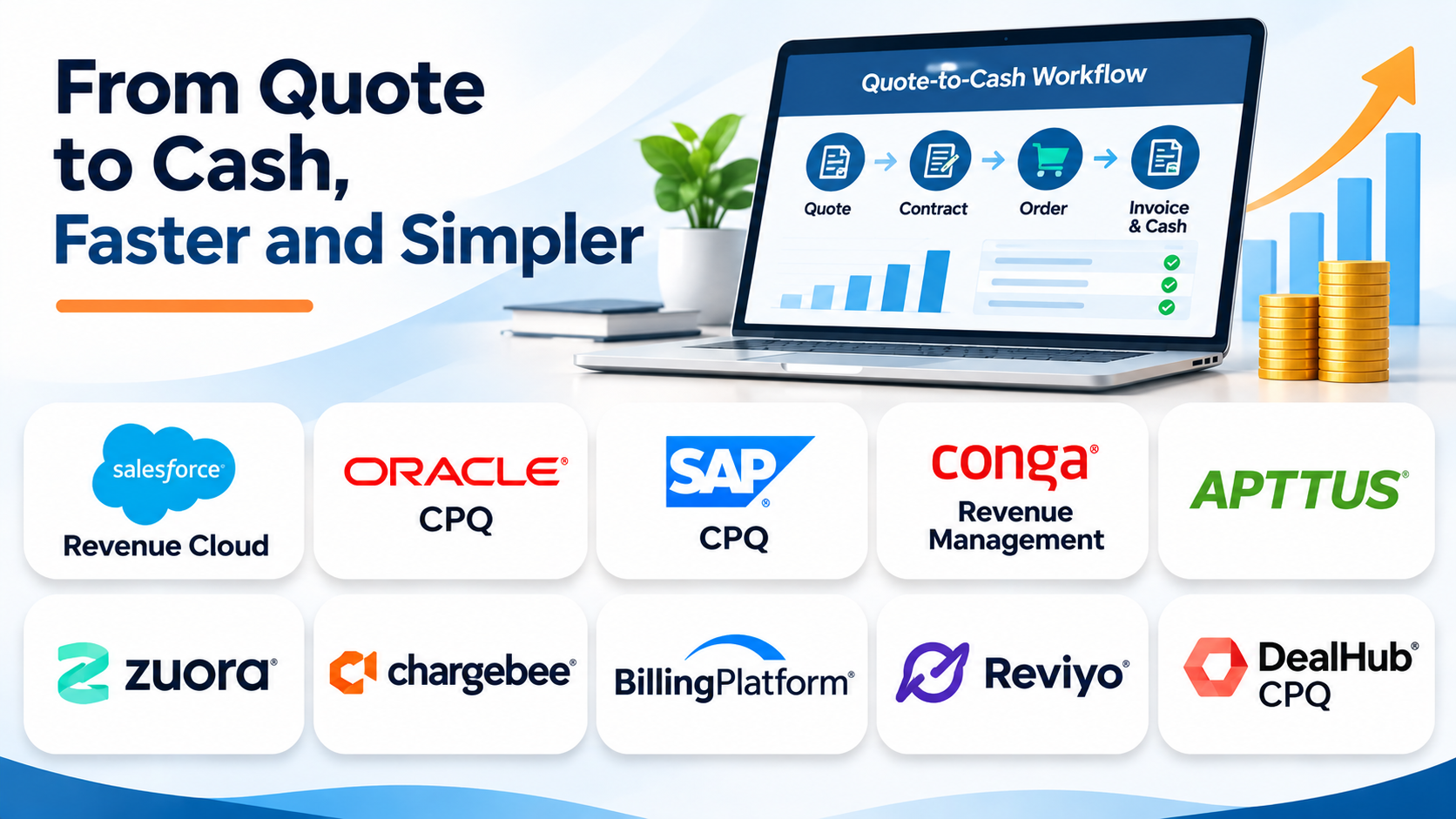
Quote-to-Cash (QTC) platforms help organizations manage commercial transactions from initial quotation preparation through customer payment collection. These platforms connect sales, pricing, contracting, order management, billing, and financial operations within coordinated digital workflows.
Traditional commercial processes frequently rely on disconnected applications, spreadsheets, and manual information transfers. These methods can introduce pricing errors, billing discrepancies, approval delays, and unnecessary administrative workloads.
Modern quote-to-cash platforms combine product configuration, pricing automation, quotation generation, contract management, subscription billing, and revenue-related capabilities. These integrated processes help organizations maintain consistent commercial information throughout the customer transaction lifecycle.
Businesses operating with subscription services, usage-based pricing, complex product portfolios, and multinational commercial arrangements frequently require sophisticated quote-to-cash capabilities. Automated workflows help these organizations manage commercial complexity while maintaining appropriate financial controls.
Different quote-to-cash platforms address the requirements of technology companies, manufacturers, telecommunications providers, distributors, and professional service organizations. Selecting appropriate software requires evaluating pricing models, integration requirements, financial processes, scalability, and total ownership costs.
This guide examines ten quote-to-cash platforms, including their features, benefits, advantages, limitations, and practical applications. It also provides comparison tables, selection recommendations, implementation examples, financial considerations, and frequently asked questions.
What Are Quote-to-Cash Platforms?
Quote-to-cash platforms are software applications that coordinate commercial processes beginning with quotation preparation and continuing through customer payment collection. They help businesses connect sales activities with contractual commitments, operational transactions, and financial records.
These platforms frequently combine Configure, Price, Quote (CPQ), Contract Lifecycle Management (CLM), order management, billing, accounts receivable, and revenue management capabilities. Individual platforms may provide these functions directly or through integrations with complementary applications.
Quote-to-cash differs from Order-to-Cash (OTC) because it includes commercial activities occurring before an order is finalized. These additional activities include product configuration, pricing calculations, quotation preparation, commercial negotiations, and deal approvals.
Effective quote-to-cash management requires accurate product information, standardized pricing policies, reliable integrations, and documented financial controls. Organizations should establish consistent commercial processes before introducing extensive transaction automation.
How Quote-to-Cash Platforms Work
- Opportunity identification: Retrieve relevant customer and sales opportunity information.
- Product configuration: Identify valid product and service combinations.
- Pricing calculation: Apply approved pricing rules, discounts, and commercial conditions.
- Quotation generation: Prepare structured commercial proposals.
- Commercial approvals: Route pricing and contractual exceptions to authorized reviewers.
- Contract execution: Finalize commercial agreements and obtain required signatures.
- Order creation: Convert approved commercial commitments into operational orders.
- Order fulfillment: Coordinate product delivery or service activation.
- Billing and invoicing: Generate customer invoices according to approved commercial terms.
- Payment collection: Process customer payments and manage outstanding balances.
- Financial reconciliation: Match transactions with appropriate financial records.
- Revenue recognition: Record revenue according to applicable accounting requirements.
Common Applications of Quote-to-Cash Platforms
- Enterprise quotation management.
- Subscription billing automation.
- Usage-based pricing administration.
- Complex product configuration.
- Commercial approval workflows.
- Contract management.
- Customer order processing.
- Automated invoice generation.
- Accounts receivable management.
- Payment collection.
- Revenue recognition.
- Subscription renewals and amendments.
- Commercial revenue forecasting.
- Financial reconciliation.
Traditional Quote-to-Cash vs Automated Quote-to-Cash
| Factor | Traditional Processes | Automated QTC Platforms |
|---|---|---|
| Product configuration | Manual product selection | Configured product rules |
| Pricing calculations | Spreadsheet-based calculations | Automated pricing engines |
| Quotation preparation | Manual document creation | Structured quotation generation |
| Commercial approvals | Email-based communication | Configurable approval workflows |
| Contract management | Disconnected documents | Integrated agreement workflows |
| Order creation | Manual information entry | Automated transaction conversion |
| Billing | Separate financial processes | Connected billing workflows |
| Payment tracking | Manual reconciliation | Integrated payment records |
| Revenue reporting | Periodic consolidation | Centralized financial information |
| Scalability | Additional administrative resources | Automated transaction processing |
Essential Components of Quote-to-Cash Platforms
| Component | Purpose |
|---|---|
| Product catalog | Maintains commercial product information |
| CPQ engine | Supports configuration, pricing, and quoting |
| Pricing management | Applies approved commercial pricing policies |
| Approval workflows | Routes commercial exceptions |
| Contract management | Coordinates agreement preparation and execution |
| Order management | Processes approved commercial orders |
| Subscription management | Supports recurring customer arrangements |
| Billing engine | Generates customer invoices |
| Payment management | Coordinates customer payment activities |
| Accounts receivable | Tracks outstanding customer balances |
| Revenue recognition | Supports appropriate accounting treatment |
| Financial integration | Connects transaction and accounting information |
| Analytics | Measures commercial and financial performance |
| Audit logging | Records important transaction activities |
Top 10 Quote-to-Cash Platforms
The following platforms provide different combinations of quotation management, commercial automation, billing, subscription management, and revenue operations capabilities. Some require complementary applications to support the complete quote-to-cash lifecycle, and their numbering does not represent an independently tested ranking.
1. Salesforce Revenue Cloud
Short Description
Salesforce Revenue Cloud provides revenue lifecycle management capabilities designed to connect product configuration, pricing, quotation generation, contracting, and related commercial processes. Its integration with the Salesforce Customer Relationship Management (CRM) ecosystem helps organizations coordinate sales opportunities with revenue-related transactions.
Businesses can establish configured product catalogs, pricing rules, commercial approval workflows, and customer lifecycle processes. These capabilities support complex commercial arrangements involving subscriptions, product bundles, and customer-specific pricing.
Organizations already using Salesforce can evaluate Revenue Cloud as part of a broader commercial architecture. Buyers should distinguish newer revenue management offerings from legacy Salesforce CPQ and billing implementations when assessing functionality and migration requirements.
Key Features
- Product catalog management: Organizes commercial products and services.
- Product configuration: Supports valid product combinations.
- Pricing management: Applies configured commercial pricing policies.
- Quotation automation: Produces structured customer proposals.
- Commercial approvals: Routes pricing exceptions for authorized review.
- Order management: Supports relevant commercial transaction workflows.
- Subscription management: Coordinates applicable recurring customer arrangements.
- Billing capabilities: Supports relevant invoicing and financial processes.
- CRM integration: Connects commercial transactions with customer information.
Benefits
- Connects sales and revenue information.
- Improves commercial pricing consistency.
- Reduces repetitive quotation activities.
- Supports complex customer transactions.
- Facilitates structured commercial approvals.
- Improves revenue lifecycle visibility.
- Strengthens commercial governance.
Pros
- Established enterprise CRM ecosystem.
- Broad revenue management capabilities.
- Relevant complex pricing functionality.
- Extensive integration opportunities.
- Configurable commercial workflows.
- Supports enterprise commercial operations.
Cons
- Implementation may require specialist expertise.
- Commercial licensing can be complex.
- Legacy product migration requires planning.
- Custom configurations require maintenance.
- Comprehensive deployments can require substantial investment.
Use Cases
- Enterprise quote-to-cash automation.
- Subscription quotation management.
- Complex commercial approvals.
- Multi-product sales transactions.
- Customer lifecycle management.
- CRM-connected revenue operations.
Best For
- Large enterprises.
- Salesforce customers.
- Subscription software companies.
- Enterprise revenue operations teams.
- Complex sales organizations.
- Businesses managing sophisticated pricing models.
2. Conga Revenue Lifecycle Management
Short Description
Conga provides revenue lifecycle management technology covering commercial configuration, pricing, quotation generation, contract management, and related revenue processes. Its portfolio helps organizations coordinate commercial activities involving complex products and contractual arrangements.
Businesses can combine compatible Conga capabilities to manage commercial proposals, agreement approvals, order-related activities, and customer lifecycle transactions. Structured workflows help maintain consistency between approved quotations and contractual commitments.
Conga is particularly relevant to organizations requiring advanced commercial configuration and contract management. Buyers should evaluate which portfolio components and external financial integrations are necessary for their complete quote-to-cash requirements.
Key Features
- Product configuration: Supports complex commercial product combinations.
- Pricing management: Applies configured commercial pricing rules.
- Quotation generation: Produces structured sales proposals.
- Contract management: Coordinates commercial agreement workflows.
- Approval automation: Routes transaction exceptions.
- Document generation: Creates approved commercial documents.
- Order-related workflows: Supports relevant commercial transaction processes.
- Revenue lifecycle management: Coordinates customer lifecycle activities.
- Enterprise integrations: Connects compatible operational applications.
Benefits
- Improves quotation accuracy.
- Connects commercial and contractual information.
- Supports complex product sales.
- Reduces repetitive administrative activities.
- Strengthens commercial approval controls.
- Improves transaction visibility.
- Supports standardized revenue workflows.
Pros
- Established enterprise CPQ capabilities.
- Relevant contract lifecycle management functionality.
- Supports complex product configurations.
- Configurable commercial workflows.
- Broad revenue lifecycle portfolio.
- Suitable for sophisticated commercial organizations.
Cons
- Implementation may require specialist resources.
- Portfolio licensing requires evaluation.
- Complex configurations require maintenance.
- Billing and payment integrations may be necessary.
- Comprehensive deployments require process planning.
Use Cases
- Enterprise quotation automation.
- Complex commercial contract management.
- Multi-product sales transactions.
- Pricing exception administration.
- Commercial agreement execution.
- Revenue lifecycle coordination.
Best For
- Large enterprises.
- Industrial manufacturers.
- Technology vendors.
- Enterprise contract management teams.
- Complex commercial organizations.
- Businesses requiring integrated CPQ and CLM capabilities.
3. Oracle Fusion Cloud Applications
Short Description
Oracle Fusion Cloud Applications provides an enterprise application portfolio covering sales, commercial configuration, order management, financial operations, and related business processes. Compatible Oracle products can be combined to support comprehensive quote-to-cash workflows.
Organizations can connect Oracle CPQ with order management, subscription management, receivables, and financial applications. These integrations help maintain consistent commercial information throughout quotation, fulfillment, invoicing, and financial reconciliation.
Oracle is particularly relevant to multinational enterprises managing complex operational and financial requirements. A complete implementation requires careful evaluation of product licensing, integration architecture, and responsibilities across business departments.
Key Features
- Oracle CPQ: Supports commercial configuration, pricing, and quoting.
- Order management: Coordinates approved commercial orders.
- Subscription management: Supports recurring customer arrangements.
- Receivables management: Tracks customer financial obligations.
- Billing workflows: Supports relevant invoice generation processes.
- Financial management: Connects commercial and accounting records.
- Revenue management: Supports applicable revenue accounting processes.
- Enterprise analytics: Provides operational and financial visibility.
- Integration capabilities: Connects compatible enterprise applications.
Benefits
- Connects commercial and financial processes.
- Supports complex enterprise transactions.
- Improves operational information consistency.
- Facilitates multinational business operations.
- Strengthens financial governance.
- Supports scalable transaction processing.
- Reduces fragmented enterprise records.
Pros
- Comprehensive enterprise application portfolio.
- Relevant complex product configuration capabilities.
- Strong financial management functionality.
- Supports multinational organizations.
- Broad enterprise integration opportunities.
- Suitable for sophisticated operational requirements.
Cons
- Implementation can require substantial resources.
- Commercial licensing may be complex.
- Specialist technical expertise may be necessary.
- Multiple products may be required.
- Smaller organizations may need simpler alternatives.
Use Cases
- Enterprise quote-to-cash transformation.
- Industrial product sales.
- Global order management.
- Subscription financial operations.
- Complex receivables management.
- Integrated commercial and accounting workflows.
Best For
- Multinational enterprises.
- Oracle application customers.
- Large manufacturers.
- Enterprise finance departments.
- Global distributors.
- Complex operational organizations.
4. SAP Quote-to-Cash Solutions
Short Description
SAP provides a portfolio of commercial and financial applications that can support quote-to-cash processes across complex enterprise environments. Relevant capabilities include SAP CPQ, subscription billing, order management, and financial applications within the broader SAP ecosystem.
Organizations can configure commercial workflows connecting quotation preparation with approved orders, billing activities, and accounting processes. These connections are particularly relevant to manufacturers and distributors managing extensive operational requirements.
SAP quote-to-cash functionality should be evaluated as an integrated solution architecture rather than a single universal application. Buyers should identify the specific SAP products, integration services, and implementation resources necessary for their commercial requirements.
Key Features
- SAP CPQ: Supports product configuration and quotation generation.
- Pricing management: Applies configured commercial pricing policies.
- Commercial approvals: Coordinates transaction exception reviews.
- Order management: Supports approved operational transactions.
- Subscription billing: Manages supported recurring billing arrangements.
- Financial integration: Connects commercial and accounting information.
- Revenue accounting: Supports applicable revenue management requirements.
- Enterprise analytics: Provides operational performance visibility.
- Application integration: Connects compatible SAP products.
Benefits
- Connects sales and enterprise operations.
- Supports complex product portfolios.
- Improves commercial information consistency.
- Facilitates structured order processing.
- Strengthens financial process governance.
- Supports multinational business requirements.
- Reduces disconnected commercial activities.
Pros
- Established enterprise application ecosystem.
- Relevant manufacturing and distribution capabilities.
- Strong financial application portfolio.
- Supports complex commercial transactions.
- Broad SAP integration opportunities.
- Suitable for multinational organizations.
Cons
- Comprehensive implementations can be resource-intensive.
- Multiple products may require separate licensing.
- Specialist integration expertise may be necessary.
- Custom commercial workflows require maintenance.
- Smaller businesses may require simpler solutions.
Use Cases
- Manufacturing quote-to-cash automation.
- Enterprise subscription billing.
- Complex product quotation management.
- Integrated order processing.
- Commercial financial reconciliation.
- SAP-connected revenue operations.
Best For
- SAP enterprise customers.
- Global manufacturers.
- Industrial distributors.
- Enterprise financial operations teams.
- Multinational commercial organizations.
- Businesses requiring integrated enterprise workflows.
5. DealHub
Short Description
DealHub provides commercial revenue workflow technology designed to support complex business-to-business sales transactions. Its capabilities cover configuration, pricing, quotation generation, commercial collaboration, and related revenue lifecycle activities.
Sales teams can prepare quotations using configured pricing rules while routing commercial exceptions through structured approval workflows. Customer-facing DealRoom functionality supports organized communication and commercial document collaboration.
DealHub is particularly relevant to subscription software businesses and growing revenue operations teams. Organizations should verify available billing capabilities, payment integrations, and financial application compatibility when evaluating end-to-end quote-to-cash requirements.
Key Features
- Guided selling: Supports structured commercial product selection.
- Pricing configuration: Applies approved pricing policies.
- Quotation management: Produces commercial proposals.
- Approval workflows: Coordinates pricing exception reviews.
- DealRoom: Supports customer-facing commercial collaboration.
- Subscription management: Supports recurring commercial arrangements.
- Document automation: Generates relevant commercial documents.
- Revenue workflows: Coordinates supported lifecycle transactions.
- CRM integrations: Connects sales and customer information.
Benefits
- Reduces manual quotation preparation.
- Improves commercial pricing consistency.
- Supports structured approval processes.
- Facilitates customer collaboration.
- Improves commercial transaction visibility.
- Supports subscription sales operations.
- Reduces fragmented revenue workflows.
Pros
- Dedicated commercial workflow orientation.
- Relevant subscription pricing capabilities.
- Integrated customer-facing collaboration.
- Configurable commercial approvals.
- Supports guided selling.
- Suitable for growing software organizations.
Cons
- Complex configurations require planning.
- Commercial pricing requires consultation.
- Financial integration requirements need evaluation.
- Specialized manufacturing requirements may require complementary tools.
- Full lifecycle capabilities depend on selected offerings.
Use Cases
- SaaS quote-to-cash workflows.
- Enterprise commercial approvals.
- Multi-year subscription proposals.
- Customer expansion transactions.
- Commercial document collaboration.
- Revenue operations automation.
Best For
- Software as a Service (SaaS) companies.
- Business-to-business technology vendors.
- Revenue operations managers.
- Deal desk professionals.
- Subscription sales teams.
- Growing enterprise software organizations.
6. Nue
Short Description
Nue provides revenue management technology designed for businesses operating with flexible subscription and usage-based pricing models. Its capabilities connect commercial quotation workflows with billing and customer lifecycle management.
Organizations can manage commercial arrangements involving recurring subscriptions, consumption-based charges, and customer account changes. Connected workflows help maintain consistency between commercial commitments and subsequent billing activities.
Nue is particularly relevant to technology companies developing hybrid monetization strategies. Buyers should evaluate supported pricing models, financial integrations, and customer lifecycle requirements before implementing the platform.
Key Features
- Product catalog: Organizes commercial offerings.
- Flexible pricing: Supports relevant subscription and usage-based models.
- Quotation management: Creates structured commercial proposals.
- Commercial approvals: Coordinates configured exception reviews.
- Subscription management: Supports recurring customer arrangements.
- Billing capabilities: Processes supported billing transactions.
- Lifecycle management: Coordinates amendments and renewals.
- Revenue visibility: Provides commercial transaction insights.
- CRM connectivity: Connects relevant customer and opportunity records.
Benefits
- Supports flexible monetization models.
- Connects commercial and billing information.
- Improves quotation consistency.
- Facilitates customer lifecycle management.
- Reduces repetitive commercial administration.
- Supports complex recurring revenue arrangements.
- Improves revenue information accessibility.
Pros
- Modern subscription revenue orientation.
- Relevant usage-based pricing functionality.
- Connected quotation and billing capabilities.
- Supports customer lifecycle transactions.
- Suitable for evolving software business models.
- Configurable commercial workflows.
Cons
- Specialized manufacturing requirements need evaluation.
- Complex pricing models require configuration.
- Existing billing migrations require preparation.
- Commercial pricing requires consultation.
- Advanced legal workflows may require complementary applications.
Use Cases
- Usage-based software monetization.
- Subscription quotation management.
- Hybrid commercial pricing.
- Customer expansion transactions.
- Renewal billing workflows.
- Connected revenue operations.
Best For
- SaaS companies.
- Usage-based technology businesses.
- Subscription revenue teams.
- Growing software vendors.
- Revenue operations professionals.
- Businesses introducing flexible pricing models.
7. Zuora
Short Description
Zuora provides monetization and subscription management technology supporting recurring revenue businesses. Its portfolio includes billing, subscription lifecycle management, payment-related capabilities, revenue recognition, and quotation-related functionality.
Organizations can manage recurring customer arrangements involving subscriptions, usage-based charges, amendments, renewals, and commercial account changes. Integrated financial capabilities help connect customer transactions with billing and revenue accounting processes.
Zuora is particularly relevant to established subscription businesses requiring sophisticated monetization capabilities. Buyers should evaluate available quoting products, CRM integrations, payment configurations, and accounting requirements.
Key Features
- Subscription management: Coordinates recurring customer arrangements.
- Billing automation: Generates invoices according to configured rules.
- Usage-based billing: Supports applicable consumption-based pricing.
- Quotation capabilities: Supports relevant subscription quoting workflows.
- Payment management: Coordinates supported payment processes.
- Subscription amendments: Manages customer contract changes.
- Revenue recognition: Supports applicable accounting workflows.
- Financial analytics: Provides recurring revenue visibility.
- Enterprise integrations: Connects compatible business applications.
Benefits
- Supports complex recurring revenue models.
- Improves subscription billing consistency.
- Facilitates customer lifecycle management.
- Reduces manual financial administration.
- Supports revenue accounting workflows.
- Improves recurring revenue visibility.
- Facilitates scalable monetization strategies.
Pros
- Established subscription management specialization.
- Broad recurring billing capabilities.
- Relevant revenue recognition functionality.
- Supports sophisticated pricing models.
- Suitable for large subscription businesses.
- Broad financial integration opportunities.
Cons
- Implementation can require substantial preparation.
- Commercial licensing requires evaluation.
- Complex billing configurations require maintenance.
- Traditional physical product configuration may require separate CPQ.
- Financial migrations can be resource-intensive.
Use Cases
- Enterprise subscription billing.
- Usage-based monetization.
- Customer renewal management.
- Subscription amendments.
- Revenue recognition workflows.
- Recurring payment administration.
Best For
- Established SaaS companies.
- Subscription service providers.
- Digital media businesses.
- Telecommunications organizations.
- Recurring revenue finance teams.
- Enterprises with complex monetization requirements.
8. Chargebee
Short Description
Chargebee provides subscription management and recurring revenue technology supporting billing, payment coordination, revenue recovery, and related financial workflows. Its capabilities help businesses manage customer subscriptions throughout their commercial lifecycle.
Organizations can configure recurring pricing arrangements, billing schedules, subscription changes, and payment recovery procedures. Relevant quotation capabilities and integrations can connect commercial sales activities with downstream billing processes.
Chargebee is particularly relevant to growing subscription businesses seeking structured billing and customer lifecycle management. Complex enterprise product configuration and contract negotiation requirements may require complementary applications.
Key Features
- Subscription billing: Generates recurring customer invoices.
- Pricing management: Supports configured subscription pricing models.
- Quotation capabilities: Supports applicable commercial proposals.
- Subscription lifecycle management: Coordinates customer account changes.
- Payment integrations: Connects supported payment providers.
- Dunning management: Supports overdue and failed payment recovery.
- Revenue reporting: Provides recurring revenue insights.
- Revenue recognition capabilities: Supports applicable financial workflows.
- Application integrations: Connects CRM and accounting systems.
Benefits
- Simplifies recurring billing administration.
- Supports subscription lifecycle management.
- Improves payment process visibility.
- Facilitates revenue recovery workflows.
- Reduces repetitive billing activities.
- Supports flexible commercial pricing.
- Improves recurring revenue reporting.
Pros
- Dedicated subscription billing specialization.
- Relevant payment integration capabilities.
- Supports recurring customer arrangements.
- Suitable for growing subscription businesses.
- Broad commercial application integrations.
- Relevant revenue recovery functionality.
Cons
- Complex product configuration may require separate software.
- Advanced functionality depends on selected offerings.
- Billing migrations require careful preparation.
- Payment provider availability varies by region.
- Sophisticated legal workflows require complementary applications.
Use Cases
- SaaS subscription billing.
- Recurring invoice automation.
- Subscription customer onboarding.
- Failed payment recovery.
- Customer renewal management.
- Subscription revenue reporting.
Best For
- Growing SaaS businesses.
- Subscription commerce organizations.
- Recurring service providers.
- Finance operations teams.
- Subscription billing administrators.
- Businesses prioritizing payment recovery.
9. Subskribe
Short Description
Subskribe provides quote-to-revenue technology designed to connect subscription quoting, billing, and revenue-related financial processes. Its approach helps software businesses coordinate commercial transactions involving complex recurring revenue arrangements.
Organizations can manage subscription proposals, customer amendments, multi-year agreements, and related billing activities through connected workflows. Consistent commercial information helps reduce discrepancies between approved customer commitments and financial transactions.
Subskribe is particularly relevant to subscription software companies seeking an integrated commercial and financial architecture. Buyers should confirm current product availability, supported integrations, and commercial packaging before implementation.
Key Features
- Subscription quoting: Produces recurring revenue proposals.
- Pricing configuration: Supports configured commercial pricing models.
- Approval workflows: Coordinates relevant transaction reviews.
- Subscription billing: Processes supported recurring charges.
- Customer amendments: Manages subscription changes.
- Renewal management: Supports recurring commercial transactions.
- Revenue capabilities: Connects relevant financial processes.
- Commercial reporting: Provides transaction visibility.
- CRM integration: Connects customer and opportunity records.
Benefits
- Connects subscription quoting and billing.
- Improves commercial information consistency.
- Supports complex recurring transactions.
- Reduces manual financial reconciliation.
- Facilitates customer lifecycle management.
- Supports structured revenue workflows.
- Improves commercial and financial visibility.
Pros
- Dedicated subscription business orientation.
- Connected quote-to-revenue capabilities.
- Relevant customer amendment functionality.
- Supports complex recurring arrangements.
- Reduces certain disconnected application requirements.
- Suitable for software revenue operations.
Cons
- Current commercial packaging requires verification.
- Non-subscription requirements need evaluation.
- Financial migrations require preparation.
- Specialized legal workflows may require integrations.
- Commercial pricing requires consultation.
Use Cases
- Multi-year software agreements.
- Subscription quotation automation.
- Customer expansion transactions.
- Recurring billing coordination.
- Renewal revenue management.
- Commercial financial reconciliation.
Best For
- SaaS companies.
- Subscription finance departments.
- Revenue operations teams.
- Recurring revenue businesses.
- Commercial billing administrators.
- Organizations consolidating quotation and billing workflows.
10. NetSuite
Short Description
Oracle NetSuite provides cloud-based Enterprise Resource Planning (ERP) technology covering financial management, customer relationships, order processing, billing, and related operational activities. Compatible NetSuite products can support commercial workflows from quotation preparation through payment collection.
Organizations can connect estimates, sales orders, fulfillment records, invoices, and customer payments within an integrated operational environment. Relevant subscription billing and revenue management capabilities support businesses with recurring commercial arrangements.
NetSuite is particularly relevant to growing and mid-sized organizations seeking integrated commercial and financial operations. Advanced product configuration, specialized contract management, and sophisticated pricing requirements may require additional NetSuite modules or external applications.
Key Features
- Estimate management: Supports commercial quotation preparation.
- CRM capabilities: Maintains relevant customer and sales information.
- Order management: Coordinates approved sales transactions.
- Fulfillment management: Connects operational delivery activities.
- Billing management: Generates customer invoices.
- SuiteBilling: Supports applicable subscription billing arrangements.
- Accounts receivable: Tracks outstanding customer balances.
- Revenue management: Supports applicable revenue accounting workflows.
- Financial reporting: Provides operational and accounting visibility.
Benefits
- Connects commercial and financial records.
- Reduces duplicate transaction entry.
- Supports integrated order processing.
- Improves billing information consistency.
- Facilitates customer payment tracking.
- Supports growing business operations.
- Strengthens financial process governance.
Pros
- Integrated cloud ERP architecture.
- Relevant financial management capabilities.
- Supports order and billing workflows.
- Suitable for growing commercial organizations.
- Configurable business processes.
- Broad application integration ecosystem.
Cons
- Advanced CPQ may require additional products.
- Subscription billing capabilities depend on selected modules.
- Implementation requires business process planning.
- Commercial licensing can become complex.
- Specialized enterprise configurations require expertise.
Use Cases
- Mid-market quote-to-cash automation.
- Wholesale distribution transactions.
- Integrated sales order processing.
- Customer invoicing and collections.
- Subscription billing coordination.
- Commercial financial reporting.
Best For
- Growing enterprises.
- Mid-sized manufacturers.
- Wholesale distributors.
- NetSuite customers.
- Finance operations departments.
- Businesses seeking integrated commercial ERP workflows.
Comparison Table: Top 10 Quote-to-Cash Platforms
| Platform | Primary Strength | Best For | Deployment | Pricing Approach |
|---|---|---|---|---|
| Salesforce Revenue Cloud | CRM-connected revenue management | Enterprise Salesforce customers | Cloud | Commercial licensing |
| Conga Revenue Lifecycle Management | Complex quoting and contracts | Enterprise commercial teams | Cloud | Vendor quotation |
| Oracle Fusion Cloud Applications | Integrated enterprise operations | Multinational enterprises | Cloud | Modular licensing |
| SAP Quote-to-Cash Solutions | Enterprise commercial integration | SAP manufacturers | Cloud and hybrid architecture | Modular licensing |
| DealHub | Commercial workflow automation | SaaS sales organizations | Cloud | Vendor quotation |
| Nue | Flexible subscription monetization | Usage-based software businesses | Cloud | Vendor quotation |
| Zuora | Subscription monetization | Established recurring revenue businesses | Cloud | Commercial licensing |
| Chargebee | Recurring billing and payments | Growing subscription companies | Cloud | Plan-dependent |
| Subskribe | Subscription quote-to-revenue | SaaS revenue teams | Cloud | Vendor quotation |
| NetSuite | Integrated commercial ERP | Mid-sized businesses | Cloud | Modular licensing |
Functional Comparison
| Platform | CPQ | Billing | Revenue Recognition | Payment Collection |
|---|---|---|---|---|
| Salesforce Revenue Cloud | Core focus | Offering-dependent | Integration-dependent | Integration-dependent |
| Conga | Core focus | Offering-dependent | Integration-dependent | Integration-dependent |
| Oracle Fusion Cloud | Available through Oracle CPQ | Available | Available | Available through financial products |
| SAP | Available through SAP CPQ | Available through relevant products | Available | Available through financial products |
| DealHub | Core focus | Offering-dependent | Integration-dependent | Integration-dependent |
| Nue | Core focus | Available | Offering-dependent | Configuration-dependent |
| Zuora | Available | Core focus | Available | Available |
| Chargebee | Selected quoting capabilities | Core focus | Available through relevant products | Available |
| Subskribe | Core focus | Available | Relevant capabilities | Configuration-dependent |
| NetSuite | Basic quoting and optional CPQ | Available | Available | Available |
How to Choose the Best Quote-to-Cash Platform
Evaluate Commercial Pricing Complexity
Identify product combinations, customer-specific pricing, recurring charges, usage-based pricing, and commercial discounts. Businesses managing sophisticated product portfolios may require advanced CPQ capabilities.
Review Subscription Management Requirements
Determine whether the platform supports recurring billing, customer amendments, renewals, and expansion transactions. Subscription businesses should test representative lifecycle scenarios before selecting software.
Assess Contract Management Capabilities
Review commercial agreement preparation, approval routing, contractual exception management, and electronic signature integrations. Organizations with complex legal requirements may need dedicated CLM applications.
Examine Billing and Payment Workflows
Evaluate invoice generation, billing schedules, payment provider integrations, credit adjustments, and overdue payment management. Financial workflows should accommodate applicable regional and customer-specific requirements.
Review Revenue Recognition Requirements
Determine whether the platform supports relevant accounting standards and commercial transaction structures. Finance professionals should validate revenue recognition configurations and accounting outputs.
Evaluate Enterprise Integrations
Assess compatibility with existing CRM, ERP, accounting, payment, and operational applications. Reliable integrations help prevent inconsistencies between commercial commitments and financial transactions.
Consider Scalability
Evaluate expected transaction volumes, customer growth, geographical expansion, and future product offerings. Representative performance testing can help identify potential operational limitations.
Calculate Total Cost of Ownership
Consider software licensing, implementation, integrations, data migration, training, and continuing administration. Compare expected costs against measurable commercial and financial improvements.
Best Quote-to-Cash Platforms by User Type
| User Type | Relevant Platform |
|---|---|
| Enterprise Salesforce revenue operations manager | Salesforce Revenue Cloud |
| Complex commercial contract manager | Conga |
| Multinational enterprise finance director | Oracle Fusion Cloud Applications |
| SAP-connected manufacturing manager | SAP Quote-to-Cash Solutions |
| SaaS deal desk manager | DealHub |
| Usage-based monetization specialist | Nue |
| Enterprise subscription revenue manager | Zuora |
| Growing subscription billing administrator | Chargebee |
| SaaS quote-to-revenue manager | Subskribe |
| Mid-market financial operations manager | NetSuite |
Industry Applications of Quote-to-Cash Platforms
Software as a Service
SaaS companies frequently manage recurring subscriptions, usage-based pricing, customer expansions, and multi-year agreements. Quote-to-cash platforms help maintain consistency between commercial proposals, subscription arrangements, and billing transactions.
Manufacturing
Manufacturers can use quote-to-cash technology to configure complex products, calculate commercial prices, and coordinate order fulfillment. Integrated financial workflows help connect delivered products with invoicing and customer payments.
Telecommunications
Telecommunications providers frequently manage recurring service packages, usage-based charges, and contractual commitments. Quote-to-cash platforms help coordinate complex commercial arrangements with billing and revenue management.
Wholesale Distribution
Distributors can manage negotiated pricing, volume discounts, customer orders, and payment collection through connected commercial workflows. Integration with inventory and financial applications helps maintain consistent transaction information.
Professional Services
Consulting and professional service organizations can use quote-to-cash platforms to coordinate project proposals, service agreements, milestone billing, and customer payments. Specialized project accounting capabilities may require complementary applications.
Digital Media
Digital media businesses can use subscription management and billing technology to coordinate recurring customer access and commercial monetization. Automated payment recovery workflows can support continuing subscription operations.
Practical Example: Implementing Quote-to-Cash Software
Consider a hypothetical subscription software company processing 800 commercial transactions monthly across multiple geographical markets. Its sales, billing, and finance departments currently use disconnected applications and manually transfer approved commercial information.
Management introduces a quote-to-cash platform to improve quotation accuracy, billing consistency, and financial process efficiency. The following implementation process and financial figures are illustrative rather than verified software outcomes.
Implementation Process
- Document existing commercial and financial workflows.
- Identify common transaction errors and operational delays.
- Consolidate product catalog information.
- Standardize commercial pricing policies.
- Define quotation approval responsibilities.
- Configure commercial product rules.
- Integrate existing CRM applications.
- Establish approved quotation templates.
- Configure subscription lifecycle workflows.
- Connect contract management applications.
- Establish automated order creation procedures.
- Configure customer billing schedules.
- Integrate payment processing applications.
- Validate revenue accounting configurations.
- Establish financial reconciliation procedures.
- Conduct representative transaction testing.
- Train sales, finance, and operational employees.
- Launch a controlled pilot and monitor performance.
Illustrative Performance Improvements
| Performance Indicator | Before | After |
|---|---|---|
| Average quotation preparation | 50 minutes | 15 minutes |
| Commercial approval turnaround | 32 hours | 7 hours |
| Invoice correction rate | 10% | 2% |
| Monthly transaction administration | 620 hours | 280 hours |
| Contract-to-invoice processing | 5 days | 1 day |
| Days Sales Outstanding | 58 days | 43 days |
| Pricing policy compliance | 80% | 97% |
| Monthly financial closing period | 9 days | 5 days |
Time Savings and Financial Analysis
Assume monthly transaction administration decreases from 620 employee hours to 280 hours following implementation. This improvement releases 340 employee hours monthly, equivalent to 4,080 hours annually.
At an illustrative labor cost of $40 per hour, the released capacity represents $163,200 in annual labor value. This amount does not automatically represent cash savings unless actual expenditure decreases or additional recruitment is avoided.
Suppose separately verified reductions in operating expenditure, billing losses, and additional contribution margin produce $260,000 in annual financial benefits. With recurring software and operating costs of $100,000, the annual net financial benefit would be $160,000.
An initial implementation investment of $200,000 would produce a simple payback period of approximately 15 months. Actual financial outcomes depend on implementation effectiveness, commercial adoption, realized operational improvements, and continuing software costs.
Working Capital Improvement
Days Sales Outstanding (DSO) measures the average time required to collect customer receivables. Reducing DSO can release working capital without necessarily increasing accounting profit.
Assuming annual credit sales of $12 million, a reduction of 15 days in DSO represents approximately $493,151 in potentially released working capital under stable sales conditions. This estimate should remain separate from annual profit improvements and recurring operating savings.
Important Quote-to-Cash Performance Indicators
| Performance Indicator | Measurement Purpose |
|---|---|
| Quotation preparation time | Measures commercial workflow efficiency |
| Commercial approval turnaround | Evaluates transaction review speed |
| Quote conversion rate | Measures commercial effectiveness |
| Pricing policy compliance | Evaluates adherence to approved pricing |
| Order processing time | Measures operational transaction efficiency |
| Invoice accuracy | Evaluates billing information quality |
| Billing exception rate | Tracks financial transaction problems |
| Days Sales Outstanding | Measures receivables collection efficiency |
| Payment failure rate | Evaluates payment process reliability |
| Revenue leakage | Identifies avoidable commercial losses |
| Subscription renewal rate | Measures recurring customer retention |
| Gross profit margin | Evaluates commercial profitability |
| Financial closing duration | Measures accounting process efficiency |
| Cost per transaction | Evaluates operational expenditure |
| Revenue recognition accuracy | Measures accounting process quality |
Security and Governance Considerations
Quote-to-cash platforms contain confidential customer information, commercial pricing, contractual commitments, and financial records. Organizations should implement appropriate authentication, encryption, access permissions, and audit logging.
Financial responsibilities should be separated appropriately to prevent unauthorized transaction creation, approval, and payment adjustments. Configured commercial controls should reflect documented organizational policies and applicable financial requirements.
Businesses processing payment card information should evaluate applicable Payment Card Industry Data Security Standard (PCI DSS) responsibilities. Using external payment providers can reduce certain direct payment data handling requirements, but organizations should verify their remaining obligations.
Revenue recognition configurations should reflect applicable accounting standards, including International Financial Reporting Standard 15 (IFRS 15) or Accounting Standards Codification Topic 606 (ASC 606), where relevant. Qualified accounting professionals should validate financial configurations rather than relying exclusively on software automation.
Security and Governance Checklist
| Control | Recommended Consideration |
|---|---|
| Multi-factor authentication | Protect commercial and financial accounts |
| Role-based permissions | Restrict unauthorized activities |
| Segregation of duties | Separate transaction and approval responsibilities |
| Encryption | Protect confidential commercial information |
| Audit logging | Record important transaction activities |
| Payment security | Address applicable payment protection requirements |
| Financial approval controls | Prevent unauthorized adjustments |
| Revenue accounting validation | Verify accounting configurations |
| Integration monitoring | Identify transaction synchronization errors |
| Backup procedures | Support information recovery |
Total Cost of Ownership
Quote-to-cash platform costs extend beyond recurring software subscriptions. Organizations should evaluate implementation expenses, financial integrations, product catalog preparation, transaction migration, and continuing operational responsibilities.
A comprehensive financial assessment should distinguish initial investments, recurring expenditure, released employee capacity, and working capital improvements. These categories should remain separate to prevent double counting of financial benefits.
| Cost Component | Description |
|---|---|
| Software licensing | Recurring platform access charges |
| Implementation | Configuration and deployment expenses |
| Product data preparation | Catalog and pricing standardization |
| Data migration | Commercial and financial record preparation |
| Integration | Connections with existing business applications |
| Customization | Specialized commercial workflow development |
| Payment processing | Applicable transaction and provider fees |
| Training | Employee education and process adoption |
| Administration | Continuing platform management |
| Maintenance | Technical support and configuration updates |
Challenges and Limitations
Quote-to-cash implementation can become complex when organizations maintain inconsistent product identifiers, pricing arrangements, customer records, and financial policies. Reliable information governance is essential before automating commercial and accounting processes.
Integration difficulties may arise when CRM, order management, billing, and accounting applications use different transaction structures. Representative testing should cover subscription changes, partial fulfillment, credit adjustments, and failed synchronization scenarios.
Complex commercial pricing models may require extensive configuration and continuing maintenance. Organizations should avoid introducing unnecessary pricing complexity when simpler commercial arrangements satisfy business requirements.
Financial automation also cannot eliminate the need for professional accounting oversight. Complex revenue recognition decisions, contractual exceptions, and financial adjustments may require individualized review by qualified personnel.
Common Quote-to-Cash Implementation Mistakes
- Selecting software without defining commercial objectives.
- Maintaining inaccurate product catalogs.
- Automating inconsistent pricing policies.
- Overlooking subscription amendment requirements.
- Failing to establish commercial approval responsibilities.
- Underestimating financial integration complexity.
- Neglecting customer data migration.
- Introducing inadequate billing validation procedures.
- Overlooking payment provider requirements.
- Failing to validate revenue accounting configurations.
- Ignoring commercial and financial user feedback.
- Underestimating software ownership costs.
- Treating working capital improvements as recurring profit.
- Confusing released employee capacity with cash savings.
- Failing to establish continuing process ownership.
Best Practices for Quote-to-Cash Management
- Establish measurable commercial and financial objectives.
- Maintain accurate product and customer information.
- Standardize commercial pricing policies.
- Configure appropriate transaction approval workflows.
- Establish reliable quotation and contract templates.
- Integrate relevant commercial and financial applications.
- Validate subscription lifecycle transactions.
- Implement appropriate billing verification controls.
- Maintain documented revenue accounting policies.
- Establish reliable financial reconciliation procedures.
- Monitor payment collection performance.
- Conduct regular security and access reviews.
- Train sales, finance, and operational employees.
- Test representative commercial exception scenarios.
- Improve workflows using verified performance information.
Future Trends in Quote-to-Cash Platforms
Artificial Intelligence in Revenue Operations
Artificial Intelligence (AI) may increasingly support commercial quotation preparation, transaction exception classification, pricing recommendations, and financial forecasting. Organizations should maintain appropriate oversight when automated recommendations influence commercial commitments or accounting decisions.
Flexible Monetization Models
Businesses are developing commercial offerings that combine subscriptions, consumption-based charges, and traditional product sales. Quote-to-cash platforms may provide stronger support for these hybrid monetization requirements.
Connected Revenue Lifecycle Management
Commercial platforms may become more closely integrated with customer success, renewal management, financial planning, and revenue accounting applications. These connections can help organizations maintain consistent information throughout customer relationships.
Automated Financial Reconciliation
Advanced automation may improve transaction matching, billing exception identification, and financial reconciliation workflows. Appropriate validation procedures will remain necessary to prevent incorrect accounting entries.
Composable Revenue Architectures
Organizations may increasingly combine independently selected commercial, billing, payment, and financial applications. Reliable integrations and consistent information governance will remain essential for maintaining effective quote-to-cash processes.
Frequently Asked Questions
1. What are quote-to-cash platforms?
Quote-to-cash platforms help organizations coordinate commercial transactions from quotation preparation through customer payment collection. They connect pricing, contracting, order management, billing, and financial operations.
2. What does QTC stand for?
QTC stands for Quote-to-Cash. It describes the commercial and financial processes involved in converting customer quotations into collected payments.
3. What is Salesforce Revenue Cloud?
Salesforce Revenue Cloud provides revenue lifecycle management capabilities connected to the Salesforce ecosystem. Its functionality supports relevant commercial configuration, pricing, quotation, and revenue processes.
4. What is Conga Revenue Lifecycle Management?
Conga provides commercial and revenue lifecycle management technology covering quotation, pricing, contracts, and related transaction processes. Its portfolio supports complex enterprise commercial workflows.
5. What is Oracle Fusion Cloud?
Oracle Fusion Cloud provides an enterprise application portfolio covering commercial, operational, and financial processes. Compatible Oracle products can be combined to support comprehensive quote-to-cash workflows.
6. What are SAP Quote-to-Cash Solutions?
SAP provides commercial and financial applications that can support integrated quote-to-cash processes. These solutions may combine CPQ, order management, billing, and financial applications.
7. What is DealHub?
DealHub provides commercial revenue workflow technology supporting quotation generation, pricing configuration, approvals, and customer-facing collaboration. Its capabilities are particularly relevant to business-to-business software sales.
8. What is Nue?
Nue provides revenue management technology supporting flexible subscription and usage-based commercial models. Its capabilities connect relevant quotation, billing, and customer lifecycle activities.
9. What is Zuora?
Zuora provides monetization and subscription management technology. Its portfolio supports recurring billing, subscription lifecycle management, payment-related workflows, and revenue recognition.
10. What is Chargebee?
Chargebee provides subscription management and recurring billing technology. Its capabilities support customer lifecycle management, payment coordination, and revenue recovery workflows.
11. What is Subskribe?
Subskribe provides quote-to-revenue technology focused on subscription businesses. Its capabilities connect commercial quoting, recurring billing, and revenue-related financial processes.
12. What is NetSuite?
NetSuite provides cloud-based ERP technology covering financial management, sales, order processing, and billing. Compatible modules can support integrated quote-to-cash workflows.
13. What is the difference between quote-to-cash and order-to-cash?
Quote-to-cash begins with commercial quotation preparation and includes pricing and contract activities. Order-to-cash generally begins after a customer order has been established.
14. What is the difference between CPQ and quote-to-cash?
CPQ focuses on product configuration, pricing, and quotation generation. Quote-to-cash covers a broader lifecycle that includes contracting, order management, billing, and payment collection.
15. Can quote-to-cash platforms manage subscription billing?
Many quote-to-cash platforms provide subscription billing capabilities or integrations with dedicated billing applications. Supported pricing models and lifecycle transactions depend on the selected software.
16. What is revenue recognition?
Revenue recognition determines when and how commercial revenue should be recorded in financial statements. Organizations should apply relevant accounting standards and validate software configurations appropriately.
17. Can quote-to-cash software reduce billing errors?
Connected commercial and billing workflows can help reduce discrepancies caused by manual information transfers. Actual improvements depend on accurate data, appropriate configurations, and reliable integrations.
18. What is revenue leakage?
Revenue leakage refers to avoidable commercial losses arising from pricing errors, billing omissions, unauthorized discounts, or related transaction problems. Quote-to-cash controls can help identify and reduce certain sources of leakage.
19. Can quote-to-cash software integrate with CRM applications?
Many quote-to-cash platforms provide CRM integrations or application interfaces. Organizations should verify compatibility with existing customer and opportunity management systems.
20. Are quote-to-cash platforms suitable for small businesses?
Small businesses can use appropriately scoped quote-to-cash applications to coordinate commercial and financial processes. Simpler subscription billing or ERP platforms may satisfy their requirements.
21. How much does quote-to-cash software cost?
Costs depend on functionality, transaction volumes, user licensing, integrations, and implementation requirements. Organizations should request detailed commercial quotations before purchasing.
22. Can quote-to-cash platforms support usage-based pricing?
Several platforms provide capabilities for usage-based billing and hybrid commercial pricing. Organizations should verify consumption measurement, billing calculation, and financial integration requirements.
23. What is Days Sales Outstanding?
Days Sales Outstanding measures the average time required to collect customer receivables. Lower DSO can improve working capital availability under otherwise comparable business conditions.
24. Can quote-to-cash software automate payment collection?
Some platforms provide payment processing, recurring payment, and overdue payment management capabilities. Available functionality depends on supported payment providers, regional requirements, and software configuration.
25. Which quote-to-cash platform is best?
The appropriate platform depends on commercial complexity, pricing models, financial requirements, existing enterprise applications, and available resources. Organizations should evaluate representative transactions throughout the complete commercial lifecycle before selecting software.
Conclusion
Quote-to-cash platforms help organizations connect commercial quotations, pricing, contracts, order processing, billing, and customer payment activities. These capabilities support consistent transaction information and coordinated commercial and financial operations.
Salesforce Revenue Cloud and Conga provide relevant approaches to complex commercial and revenue lifecycle management. Oracle Fusion Cloud Applications and SAP offer broader enterprise architectures supporting sophisticated operational and financial requirements.
DealHub, Nue, and Subskribe provide capabilities particularly relevant to subscription software businesses and modern revenue operations. Zuora and Chargebee specialize in recurring revenue, subscription billing, and customer monetization workflows.
NetSuite provides integrated commercial and financial capabilities suitable for growing and mid-sized organizations. Businesses should evaluate whether additional products or integrations are required to support their complete quote-to-cash processes.
Successful implementation requires accurate commercial information, transparent pricing policies, reliable enterprise integrations, and appropriate financial controls. An effective quote-to-cash strategy combines suitable technology with standardized processes, professional oversight, and continuing performance assessments.
