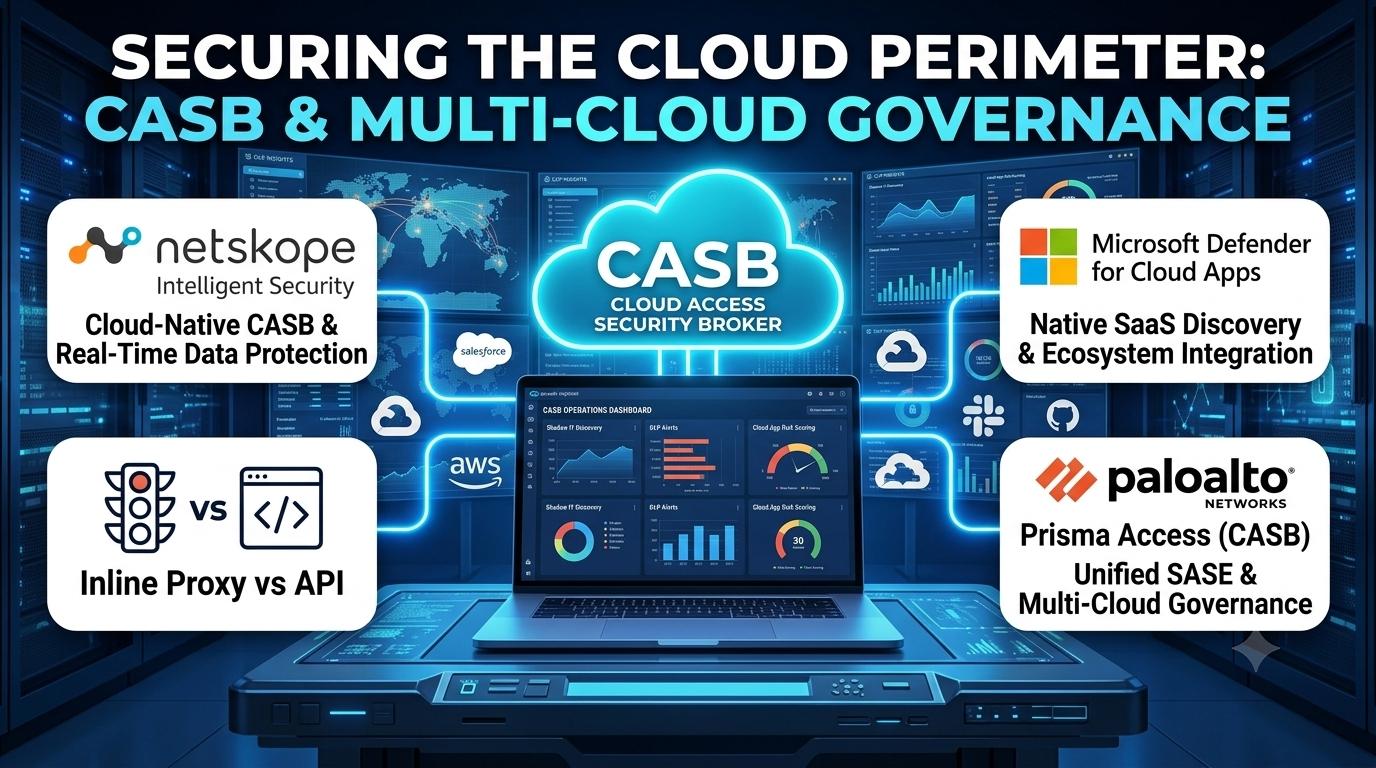
Enterprise employees rapidly adopt cloud services, SaaS applications, and unauthorized shadow IT tools to optimize daily workflows, often bypassing internal IT approval channels entirely. When teams freely upload proprietary source code to personal cloud storage, share sensitive customer lists via unmanaged collaboration apps, or connect consumer-grade productivity plugins to corporate email tenants, traditional perimeter firewalls offer zero visibility or control.
Cloud Access Security Brokers (CASBs) bridge this visibility gap by enforcing security policies, monitoring data access, and identifying shadow IT across cloud service providers. Understanding how CASB architectures operate helps security leaders govern multi-cloud environments effectively without stifling business agility.
Understanding the Scope of Cloud Access Security Brokers
A Cloud Access Security Broker is a security software solution—deployed either on-premises or in the cloud—that sits between enterprise users and cloud service providers. It acts as a gatekeeper, ensuring that network traffic complying with corporate security policies passes freely while unauthorized or risky interactions are blocked or flagged.
A comprehensive CASB platform typically governs four primary pillars:
- Shadow IT Discovery: Automatically identifying every cloud service and SaaS application being utilized across the enterprise, assessing their risk levels, and categorizing unauthorized usage.
- Compliance and Posture Management: Auditing cloud configurations against regulatory standards (such as HIPAA, GDPR, or PCI-DSS) to prevent data exposure.
- Data Security and DLP: Inspecting files stored in or transferred to cloud apps to detect sensitive data, enforce encryption, and prevent data exfiltration.
- Threat Protection: Analyzing user behavior, detecting compromised credentials, and blocking malware originating from cloud-based repositories.
The core objective is to extend corporate security perimeters directly into third-party cloud applications where traditional network controls cannot reach.
Key Evaluation Criteria for CASB Solutions
Selecting an effective CASB platform requires examining deployment flexibility, inline versus out-of-band visibility, and integration depth.
Inline Proxy versus API-Driven Architecture
CASBs generally operate through two distinct methods. Inline proxies (forward or reverse) intercept traffic in real time, enabling immediate blocking of data uploads or unauthorized app access. API-driven connectors scan existing data at rest within SaaS repositories, providing deep visibility into historical files and user permissions without impacting user latency. Leading platforms combine both approaches.
User Behavior Analytics (UEBA)
Advanced CASB tools incorporate behavioral analytics to establish a baseline of normal user activity. If an employee suddenly downloads thousands of customer records at an unusual hour from an unverified geographic location, the platform triggers an immediate alert or revokes session access.
Integration with SASE and Secure Web Gateways
Modern CASBs rarely function as standalone point products. The most valuable platforms integrate seamlessly into broader Secure Access Service Edge (SASE) frameworks, sharing threat intelligence with Secure Web Gateways (SWGs) and Zero Trust Network Access (ZTNA) controls.
Leading CASB Platforms and Approaches
The CASB market features dedicated cloud security innovators alongside comprehensive enterprise SASE suites.
Netskope Intelligent Security
Netskope pioneered modern cloud-native security, offering robust CASB capabilities integrated deeply with advanced Data Loss Prevention and zero-trust web access.
- Primary Focus: Cloud-native CASB governance, real-time data protection, and secure web access.
- Deployment Model: Cloud-delivered SaaS service routed via inline proxies or forwarding agents.
- Significant Advantage: Exceptional visibility into granular user activities and deep inspection of enterprise SaaS traffic without introducing latency.
- Important Limitation: Initial policy tuning and architecture planning require specialized administrator expertise.
Microsoft Defender for Cloud Apps
Microsoft provides native CASB capabilities embedded directly into the Microsoft 365 and Azure ecosystem, offering seamless governance for organizations standardized on Microsoft software.
- Primary Focus: Native SaaS discovery, cloud app governance, and Microsoft ecosystem integration.
- Deployment Model: Cloud-native API connectors and proxy integration with Azure AD.
- Significant Advantage: Deep, frictionless integration with existing Microsoft security tooling, Windows endpoints, and identity management.
- Important Limitation: Optimized primarily for organizations deeply embedded in the Microsoft enterprise software stack.
Palo Alto Networks Prisma Access (CASB)
Palo Alto integrates advanced CASB controls into its unified Prisma SASE platform, combining cloud app visibility with industry-leading threat intelligence.
- Primary Focus: Enterprise-scale SASE integration and comprehensive multi-cloud governance.
- Deployment Model: Cloud-native SaaS platform with hybrid edge connectors.
- Significant Advantage: Unified policy enforcement across traditional network firewalls, cloud workloads, and SaaS applications.
- Important Limitation: Enterprise licensing structures and deployment complexity cater primarily to large organizations.
Platform Comparison Overview
| Product | Primary Focus | Deployment Model | Significant Advantage | Important Limitation |
| Netskope | Cloud-native CASB and deep SaaS traffic inspection | Cloud SaaS Edge | Superior inline data protection and granular cloud app visibility | Requires dedicated administrator expertise for complex policies |
| Microsoft Defender for Cloud Apps | Native Microsoft 365 and Azure SaaS governance | Cloud API / Proxy | Seamless integration with existing Microsoft security ecosystems | Best optimized for organizations standardized on Microsoft software |
| Prisma Access CASB | Unified enterprise SASE and multi-cloud security | Cloud SaaS / Hybrid | Robust threat intelligence and unified firewall-to-cloud policies | Geared primarily toward large enterprise budgets and architectures |
Operational Risks and Common Pitfalls
Implementing a CASB solution introduces specific organizational and technical challenges that security teams must navigate carefully.
Overly Restrictive App Blocking Causing Shadow IT Workarounds
Blocking entire categories of collaboration tools or developer platforms (like specific code-sharing repositories) without offering secure alternatives often drives employees to adopt unmonitored shadow IT channels.
Performance Latency from Inline Proxy Inspection
Routing all cloud traffic through poorly optimized proxy architectures can introduce noticeable browsing latency, triggering user frustration and complaints. Leveraging globally distributed edge points mitigates this issue.
Treating CASB as a Set-It-and-Forget-It Deployment
Cloud application ecosystems evolve continuously as vendors release new features and employees integrate third-party plugins. Continuous policy review and threat monitoring are essential.
Questions to Guide Vendor Selection
Before procuring a CASB platform, security architects and IT leaders should address several critical operational questions:
- Does the vendor support both API-driven scanning for data at rest and inline proxy inspection for data in transit?
- How comprehensive is the vendor’s cloud app catalog? Can it automatically discover and assess obscure, niche SaaS tools used by internal departments?
- How effectively does the platform minimize false positives when inspecting sensitive data like PII or proprietary source code?
- Does the CASB integrate natively into a broader SASE or SSE framework, or will it require managing a standalone security console?
Making the Final Decision
Choosing a Cloud Access Security Broker depends heavily on an organization’s cloud migration strategy, software ecosystem, and compliance mandates.
Organizations heavily standardized on Microsoft collaboration tools often achieve rapid visibility and seamless integration using Microsoft Defender for Cloud Apps. Conversely, enterprises seeking advanced, cloud-native inline inspection across diverse multi-cloud and SaaS environments frequently choose specialized platforms like Netskope or comprehensive SASE suites like Palo Alto Prisma Access.
Ultimately, Cloud Access Security Brokers restore visibility and control to modern cloud estates, ensuring that business productivity thrives without compromising enterprise data security.
