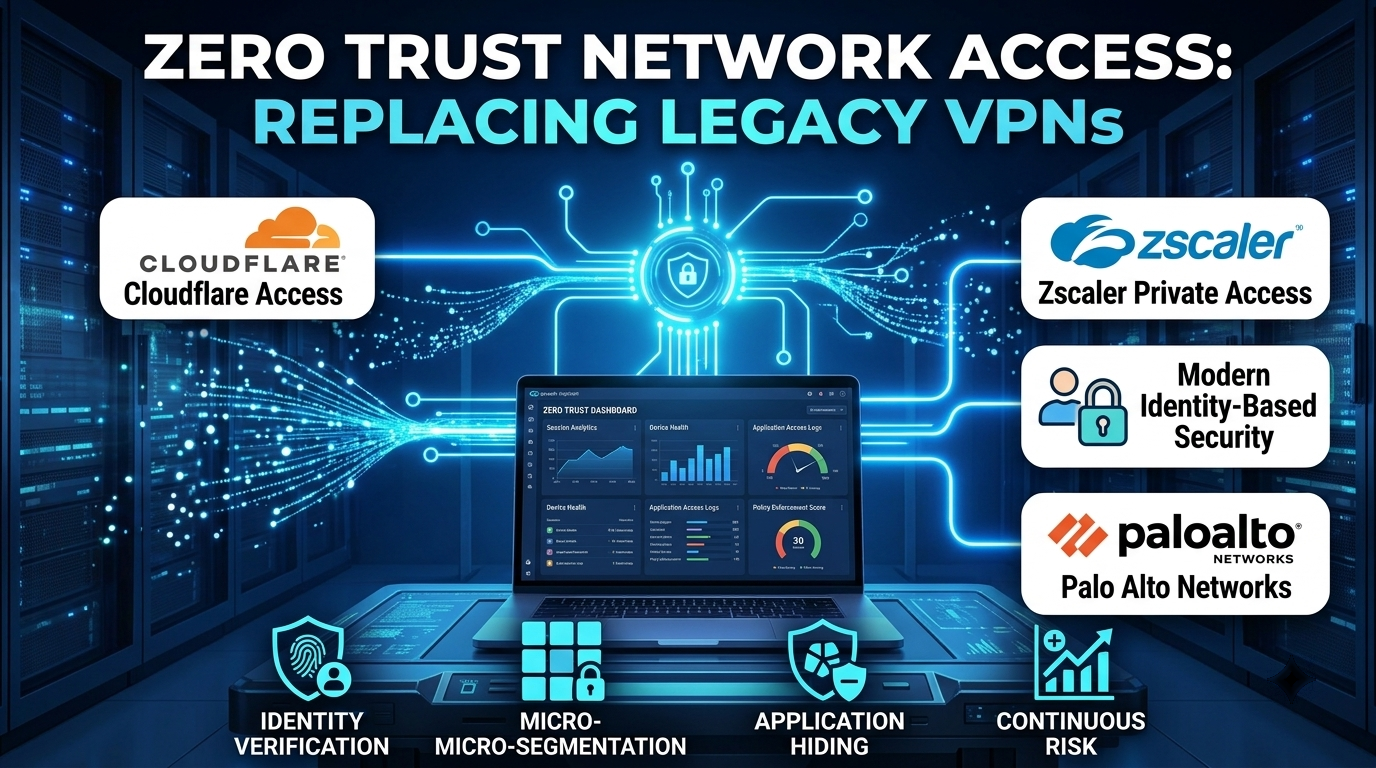
Organizations spent decades securing internal networks by building strong perimeter walls, assuming that once a user or device authenticated successfully via a Virtual Private Network (VPN), they could be trusted entirely. That implicit trust model has become a primary vulnerability. When an attacker compromises a single employee credential, traditional VPN architectures grant lateral access to the entire corporate network, allowing malware or threat actors to roam freely across internal servers, databases, and sensitive applications.
Zero Trust Network Access (ZTNA) eliminates implicit trust entirely. By operating on the core principle of “never trust, always verify,” ZTNA grants users access only to specific, authorized applications rather than exposing the underlying network. Understanding how ZTNA architectures operate helps security leaders transition away from legacy remote access bottlenecks safely and effectively.
Understanding the Shift from VPNs to Zero Trust
Zero Trust Network Access is a security solution that creates secure, policy-based connections between individual users and specific enterprise applications without placing those users directly on the corporate network.
Legacy VPNs connect remote workers directly to the internal network layer, effectively making a home laptop or coffee shop device an extension of the corporate data center. Once connected, users can often scan ports, discover adjacent servers, and access applications they have no business need to touch.
A comprehensive modern ZTNA framework operates around several core tenets:
- Identity and Context Verification: Authenticating every user and inspecting device health, location, and risk posture before granting access to any resource.
- Micro-Segmentation and Least-Privilege Access: Restricting access strictly to individual applications rather than entire network subnets, ensuring that even compromised credentials cannot pivot laterally.
- Application Hiding: Keeping internal applications completely invisible to public internet scanning and direct IP discovery by hiding infrastructure behind a cloud enforcement broker.
- Continuous Risk Evaluation: Monitoring active sessions continuously to revoke access immediately if user behavior or device compliance changes.
The fundamental objective is to decouple remote access from network connectivity, ensuring that applications remain secure regardless of where the user is located.
Key Evaluation Criteria for ZTNA Solutions
Selecting an effective Zero Trust Network Access platform requires examining architectural deployment, user experience, and context-aware policy engines.
Service-Initiated versus Endpoint-Initiated Architecture
ZTNA solutions generally fall into two architectural categories. Service-initiated (cloud-hosted) brokers connect users to applications via a cloud edge without requiring inbound firewall rules on private data centers. Endpoint-initiated (client-based) solutions rely on software agents installed on user laptops to establish encrypted tunnels to internal gateways. Cloud-hosted architectures generally offer superior scalability and easier maintenance.
Context-Aware Policy Granularity
A robust ZTNA solution must evaluate more than just a username and password. Effective policy engines factor in device posture (such as EDR status, disk encryption, and OS patch levels) and user context to dynamically adjust access permissions.
Integration with Secure Access Service Edge (SASE)
Modern ZTNA rarely operates in isolation. The most capable platforms form a core pillar of a broader SASE or Security Service Edge (SSE) architecture, sharing threat telemetry seamlessly with Secure Web Gateways (SWGs) and Cloud Access Security Brokers (CASBs).
Leading ZTNA Platforms and Approaches
The ZTNA market features dedicated cloud security innovators as well as established networking giants delivering comprehensive SASE platforms.
Cloudflare Access (Cloudflare One)
Cloudflare leverages its massive global Anycast network to deliver fast, edge-native Zero Trust Network Access, integrating authentication, web filtering, and browser isolation into a single platform.
- Primary Focus: Edge-native ZTNA, fast identity-based access control, and secure web filtering.
- Deployment Model: Cloud-delivered SaaS service routed via Cloudflare’s global edge network.
- Significant Advantage: Exceptional speed, global scale, and straightforward deployment without managing complex physical appliances.
- Important Limitation: Advanced enterprise network micro-segmentation features require careful integration with internal tunneling connectors.
Zscaler Private Access (ZPA)
Zscaler pioneered cloud-delivered ZTNA, securely connecting users directly to private applications without ever placing them on the corporate network or exposing internal IP addresses.
- Primary Focus: Cloud-native ZTNA, legacy app modernization, and micro-segmentation.
- Deployment Model: SaaS cloud broker utilizing lightweight internal app connectors.
- Significant Advantage: Unmatched scalability and proven ability to replace legacy VPNs securely across massive distributed enterprise workforces.
- Important Limitation: Granular policy configuration requires dedicated administrative expertise.
Palo Alto Networks Prisma Access (ZTNA)
Palo Alto integrates advanced ZTNA controls into its unified Prisma SASE platform, combining private app access with industry-leading threat prevention and firewall governance.
- Primary Focus: Comprehensive enterprise SASE architecture and advanced threat prevention.
- Deployment Model: Cloud-native SaaS platform with hybrid edge connectors.
- Significant Advantage: Unified policy enforcement across traditional network firewalls, cloud workloads, and remote user connections.
- Important Limitation: Enterprise licensing structures and deployment complexity cater primarily to large organizations.
Platform Comparison Overview
| Product | Primary Focus | Deployment Model | Significant Advantage | Important Limitation |
| Cloudflare Access | Fast global edge ZTNA and identity-based security | Cloud SaaS Edge | Superior global speed, low latency, and easy deployment | Advanced micro-segmentation requires careful connector setup |
| Zscaler Private Access | Cloud-native ZTNA and complete VPN replacement | Cloud SaaS Broker | Unmatched scalability and proven enterprise-grade private app security | Requires specialized administrator training for complex policies |
| Prisma Access ZTNA | Unified enterprise SASE and multi-cloud security | Cloud SaaS / Hybrid | Robust threat intelligence and unified firewall-to-app policies | Geared primarily toward large enterprise budgets and architectures |
Operational Risks and Common Pitfalls
Deploying a Zero Trust Network Access architecture introduces specific organizational and technical challenges that security teams must navigate carefully.
Overlooking Legacy Applications and Protocols
Many older enterprise applications rely on legacy protocols, thick client architectures, or specific IP bindings that do not map cleanly to modern web-based ZTNA models, requiring careful configuration of internal connectors.
User Friction from Aggressive Re-Authentication Policies
If security policies enforce multi-factor authentication re-prompts or device posture checks too frequently, users experience severe friction and may seek unauthorized shadow IT workarounds.
Treating ZTNA as a Set-It-and-Forget-It Migration
Migrating from a legacy VPN to Zero Trust requires rethinking internal network topologies and application access rights. Treating ZTNA as a simple software swap without mapping user workflows leads to operational disruption.
Questions to Guide Vendor Selection
Before procuring a ZTNA platform, security architects and network leaders should address several critical operational questions:
- How does the platform handle legacy non-web applications (such as SSH, RDP, or custom client-server apps)?
- Does the solution evaluate device posture and health in real time before granting application access?
- Where are the vendor’s enforcement points located relative to the organization’s user base and private data centers to minimize latency?
- Does the ZTNA tool integrate natively into a broader SASE or SSE framework, or will it require managing a standalone security console?
Making the Final Decision
Choosing a Zero Trust Network Access platform depends heavily on an organization’s network infrastructure, cloud maturity, and user distribution.
Organizations seeking rapid deployment, elastic scalability, and lightning-fast user experience frequently adopt cloud-edge platforms like Cloudflare Access or Zscaler Private Access. Conversely, enterprises deeply committed to comprehensive vendor ecosystems requiring unified firewall, ZTNA, and secure web gateway policy management often select robust SASE platforms like Palo Alto Prisma Access.
Ultimately, Zero Trust Network Access replaces fragile legacy perimeters with dynamic, identity-driven security, ensuring that remote workforces connect to applications securely and efficiently.
