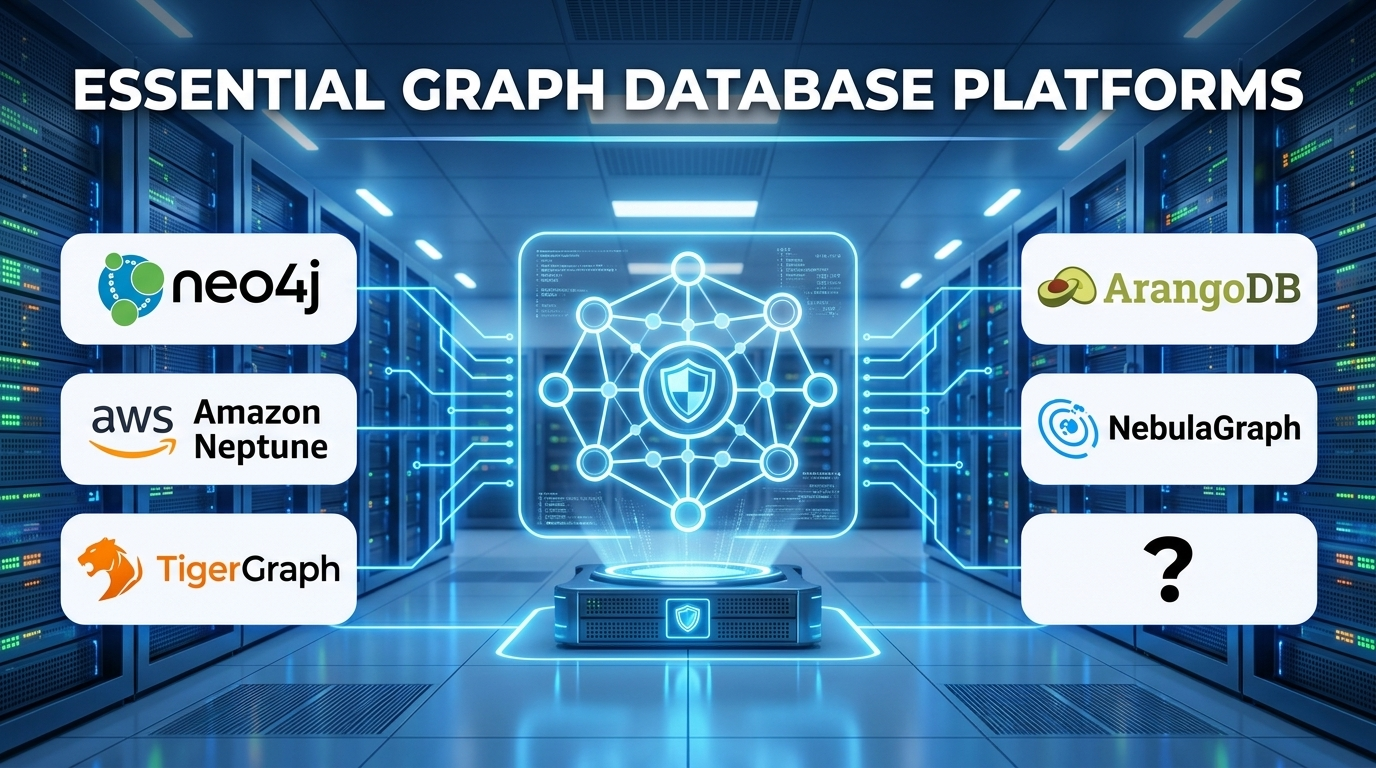
Software engineers and data architects building modern applications—such as real-time fraud detection networks, recommendation engines, identity and access management (IAM) systems, and supply chain tracking platforms—frequently hit a brick wall when using traditional relational databases. When an application’s core value relies on navigating complex, multi-hop relationships between entities (such as finding connections between a user, a shared IP address, a compromised device, and a fraudulent bank account), executing multiple deep JOIN operations across relational tables causes query performance to plummet exponentially.
Graph Database Platforms are engineered specifically to eliminate this relational bottleneck by storing and querying data as interconnected networks of nodes, edges, and properties. Navigating the modern graph database landscape requires understanding how platforms differentiate across storage architectures, query languages, and distributed scalability.
Understanding the Architecture of Connected Data
A graph database is a specialized database management system that uses graph structures for semantic queries, consisting of nodes (entities like people, accounts, or products), edges (relationships connecting nodes), and properties (attributes describing nodes or edges).
Unlike relational databases that compute relationships dynamically at query time using foreign keys and expensive table joins, graph databases utilize index-free adjacency. This means every node physically points directly to its adjacent nodes in memory, allowing traversal queries to execute in constant time regardless of the total size of the dataset.
A professional graph database architecture typically governs several critical operational capabilities:
- Graph Traversal and Pathfinding: Navigating multiple hops across relationships instantly to uncover hidden connections, shortest paths, or network clusters.
- Declarative Graph Query Languages: Utilizing expressive languages like Cypher, Gremlin, or GQL to query network topologies intuitively without writing complex SQL joins.
- Property Graphs versus RDF Triplestores: Choosing between Property Graphs (optimized for operational application workloads with rich property attributes on edges) and RDF Triplestores (optimized for semantic web standards and strict knowledge graphs).
- Real-Time Network Analysis: Executing graph algorithms (such as PageRank, community detection, and centrality scores) directly on transactional data.
The fundamental objective is to make relationship-heavy data processing as fast and straightforward as a simple primary key lookup.
Key Evaluation Criteria for Graph Database Solutions
Selecting an enterprise-grade graph database platform requires examining traversal depth performance, query language standardization, and distributed scaling capabilities.
Index-Free Adjacency and Traversal Speed
The defining benchmark of a graph database is how efficiently it handles deep multi-hop queries. An effective graph platform must execute three-to-five-hop relationship traversals in milliseconds without suffering latency degradation as traversal depth increases.
Query Language and Ecosystem Interoperability
Query languages dictate developer adoption. Platforms supporting standardized languages like open Cypher or Gremlin allow engineering teams to build applications with lower friction and avoid vendor lock-in.
Distributed Clustering versus Scale-Up Architecture
Many early graph databases were restricted to a single physical server. Modern enterprise workloads require distributed graph databases that can partition massive network graphs across multiple cluster nodes while maintaining ACID consistency across graph transactions.
Leading Graph Database Platforms and Solutions
The graph database market features pioneering enterprise graph suites alongside high-performance open-source engines and multi-model platforms.
Neo4j
Neo4j is the pioneer and undisputed market leader in graph database technology, renowned for its native graph storage engine, powerful Cypher query language, and extensive enterprise ecosystem.
- Primary Focus: Native graph storage, real-time fraud detection, master data management, and recommendation engines.
- Deployment Model: Self-hosted enterprise server or AuraDB fully managed cloud service.
- Significant Advantage: Mature, native graph storage engine delivering unmatched multi-hop traversal performance, backed by the industry-standard Cypher query language.
- Important Limitation: Massive horizontal write scaling across distributed clusters requires careful enterprise architecture planning compared to masterless NoSQL databases.
Amazon Neptune
Amazon Neptune is a fully managed, high-performance graph database service built specifically for cloud-native applications requiring connected datasets within AWS.
- Primary Focus: Fully managed cloud graph database supporting both Property Graph (Gremlin) and RDF (SPARQL) models.
- Deployment Model: Fully managed cloud service native to AWS.
- Significant Advantage: Complete elimination of server infrastructure management, automatic multi-AZ replication, and seamless integration with the AWS ecosystem.
- Important Limitation: Tightly coupled to Amazon Web Services, making multi-cloud or hybrid on-premises deployments more complex.
TigerGraph
TigerGraph is a massively parallel, distributed graph database designed for deep-link analytics, real-time fraud prevention, and massive enterprise graph processing at scale.
- Primary Focus: Enterprise-scale distributed graph analytics, parallel graph traversal, and GQL-based graph programming.
- Deployment Model: Self-hosted distributed cluster or managed cloud service.
- Significant Advantage: Superior parallel processing architecture capable of executing deep graph analytics and complex algorithms across billions of vertices and edges with extreme speed.
- Important Limitation: Steeper learning curve for developers accustomed to traditional SQL due to its advanced parallel programming syntax (GSQL).
ArangoDB
ArangoDB is a native multi-model database that unifies document, key-value, and graph data models under a single database engine with a unified query language (AQL).
- Primary Focus: Multi-model data storage combining documents and graphs within a single platform.
- Deployment Model: Self-hosted open-source/Enterprise or managed Oasis cloud service.
- Significant Advantage: Allows developers to store data as JSON documents while traversing relationships like a graph without managing separate database silos.
- Important Limitation: Specialized graph traversal performance under extreme multi-hop depth can occasionally lag behind pure native graph engines like Neo4j.
NebulaGraph
NebulaGraph is an open-source, distributed graph database engineered from the ground up to handle ultra-large-scale graphs with trillions of edges and sub-millisecond latency.
- Primary Focus: Ultra-large-scale distributed graph storage, open-source community, and massive horizontal scaling.
- Deployment Model: Self-hosted distributed cluster or cloud deployment.
- Significant Advantage: True distributed storage architecture capable of scaling horizontally to manage massive enterprise graphs containing trillions of edges.
- Important Limitation: Requires advanced distributed systems engineering expertise to deploy, tune, and manage in production.
Platform Comparison Overview
| Product | Primary Focus | Deployment Model | Significant Advantage | Important Limitation |
|---|---|---|---|---|
| Neo4j | Native graph storage and mature enterprise Cypher tooling | Self-Hosted / AuraDB Cloud | Industry-standard native engine with exceptional multi-hop traversal speed | Massive write-heavy horizontal sharding requires careful design |
| Amazon Neptune | Fully managed cloud graph database supporting Gremlin/SPARQL | Managed AWS Cloud | Zero server administration with native multi-AZ AWS integration | Tightly bound to the Amazon Web Services ecosystem |
| TigerGraph | Massively parallel distributed graph analytics at scale | Self-Hosted / Cloud | Unmatched parallel processing speed for deep enterprise graph analytics | Steeper developer learning curve with GSQL programming syntax |
| ArangoDB | Multi-model database combining documents and graphs | Self-Hosted / Oasis Cloud | Unified storage for JSON documents and graph relationships | Pure multi-hop traversal depth can lag behind native graph engines |
| NebulaGraph | Open-source distributed graph storage for trillion-edge scales | Self-Hosted Cluster | True distributed architecture designed to scale to trillions of edges | Requires advanced distributed systems administration expertise |
Operational Risks and Common Pitfalls
Implementing graph database platforms without proper architectural planning introduces severe performance and modeling hurdles.
Treating Graphs Like Relational Tables
Designing graph schemas by forcing relational normalization principles onto nodes and edges creates fragmented graphs that ruin traversal efficiency.
Unbounded Graph Traversals (Supernodes)
Allowing queries to traverse a “supernode”—a single node connected to millions of other entities (such as a celebrity Twitter account or a central corporate hub)—without pagination or depth limits will exhaust system memory and crash queries.
Neglecting Hardware Memory Requirements
Because graph databases rely on keeping active network topology in memory for index-free adjacency, underprovisioning RAM will force disk swapping and degrade traversal speeds.
Questions to Guide Vendor Selection
Before procuring a graph database platform, software architects and engineering leaders should address several critical operational questions:
- What is the expected scale of our graph—millions of nodes or trillions of edges—and does the platform require horizontal distributed sharding?
- Does the platform utilize a native graph storage engine with index-free adjacency, or does it simulate graphs on top of relational or document tables?
- Which query language does the team prefer (Cypher, Gremlin, GQL, or GSQL), and what is the learning curve?
- What are our deployment requirements—do we need a fully managed serverless cloud service, or an on-premises distributed cluster?
Making the Final Decision
Choosing a graph database platform depends heavily on an organization’s network scale, data model complexity, and infrastructure strategy.
Organizations seeking the most mature native graph ecosystem with powerful Cypher tooling and rich enterprise integrations frequently choose Neo4j. Teams building strictly within the AWS cloud ecosystem achieve seamless infrastructure management using Amazon Neptune, while enterprises tackling massive, trillion-edge analytical workloads leverage TigerGraph or NebulaGraph. For engineering teams looking to combine document storage and graph traversals within a single engine, ArangoDB offers an ideal multi-model compromise.
Ultimately, modern graph database platforms transform complex, siloed data points into intelligent connected networks, powering the next generation of contextual enterprise applications.
