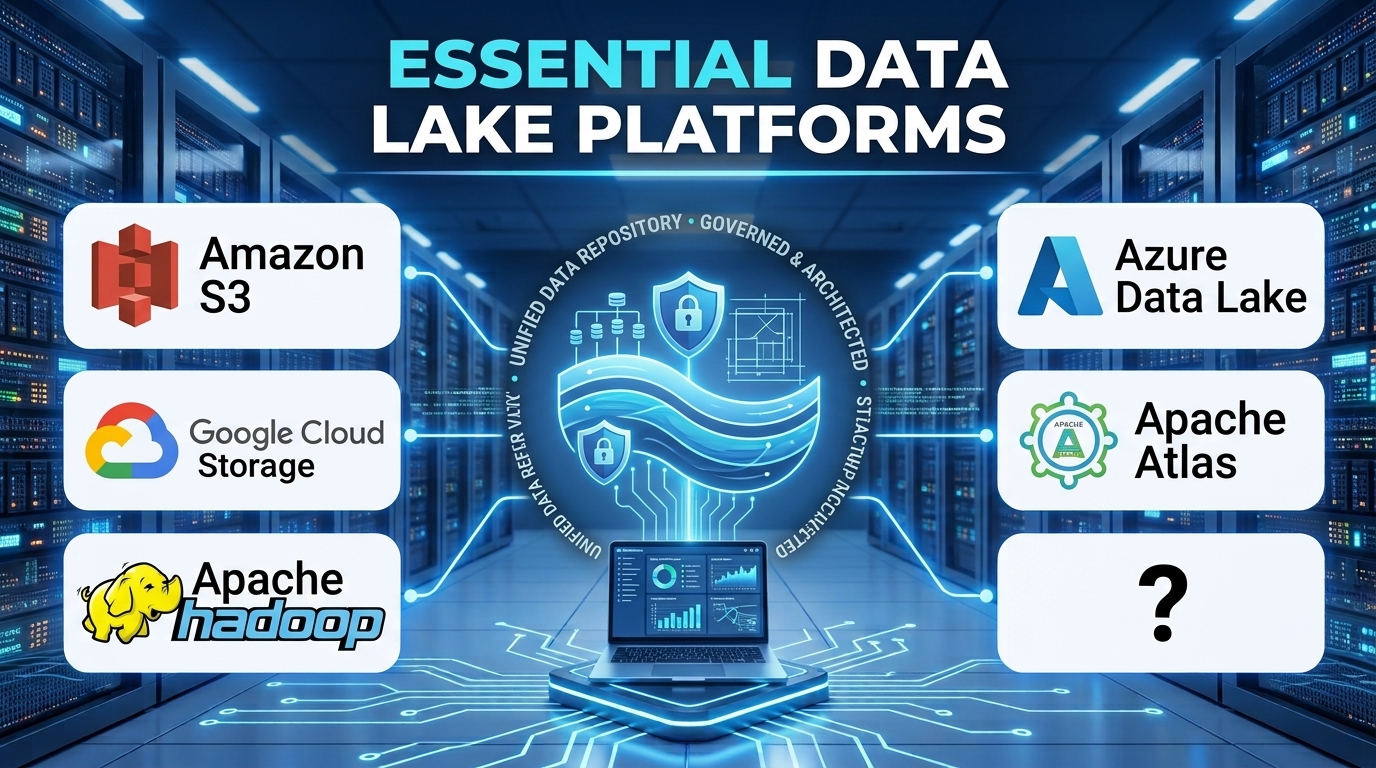
Organizations historically embraced data lakes as the ultimate antidote to rigid data silos, dumping petabytes of raw, unstructured, and semi-structured data into cheap cloud storage buckets with the promise of future analytical discovery. Without upfront schema enforcement, rigorous governance, or structured organization, those promising data repositories rapidly devolved into unmanageable “data swamps”—costly storage vaults where finding trusted data was nearly impossible, compliance audits failed, and downstream machine learning models trained on corrupted information.
Data Lake Platforms have evolved far beyond basic cloud storage repositories into sophisticated, governed analytics engines that balance raw ingestion flexibility with enterprise-grade cataloging, security, and query performance. Navigating the modern data lake software landscape requires understanding how platforms differentiate across storage formats, cataloging governance, and serverless compute integration.
Understanding the Architecture of Enterprise Data Lakes
A data lake is a centralized repository that allows organizations to store all their structured and unstructured data at any scale, exactly as it is, without requiring prior modeling or schema transformation.
Unlike traditional data warehouses that mandate rigid tabular structures before ingestion, data lakes prioritize high-speed, low-cost raw data capture.
A professional data lake architecture typically governs several critical operational layers:
- Multi-Tier Storage Zones: Organizing data into raw (bronze/landing), cleaned (silver/refined), and curated (gold/production) storage zones to maintain data quality progression.
- Cataloging and Metadata Management: Indexing files across distributed storage using automated schema discovery, data lineage trackers, and searchable business glossaries.
- Open Storage Formats: Utilizing standardized columnar file formats like Apache Parquet and ORC to optimize query performance and storage compression.
- Fine-Grained Security and Governance: Enforcing column-level and row-level access controls, encryption, and compliance tagging across multi-tenant user groups.
The fundamental objective is to provide an infinitely scalable foundation for data science, machine learning, and big data engineering without sacrificing security or operational order.
Key Evaluation Criteria for Data Lake Solutions
Selecting an enterprise-grade data lake platform requires examining metadata cataloging capabilities, query engine integration, and storage cost-optimization tools.
Automated Metadata Cataloging and Lineage
As data volumes scale to petabytes, manually tracking what data exists and where it originated is impossible. Leading data lake platforms provide automated crawlers that discover schema changes, track data lineage across pipelines, and update enterprise catalogs instantly.
Compute Engine Agnostic Interoperability
A modern data lake should never lock an organization into a single query engine. The best platforms allow multiple tools—such as serverless SQL engines, Apache Spark clusters, and business intelligence reporting software—to query the underlying data storage securely and concurrently.
Lifecycle Management and Tiered Storage Economics
Because storing massive data volumes indefinitely in high-performance storage can become cost-prohibitive, enterprise data lakes must offer automated lifecycle policies that transition infrequently accessed historical data to low-cost archival storage tiers.
Leading Data Lake Platforms and Ecosystem Tools
The data lake software market features cloud-native hyperscaler data ecosystems alongside open-source management tools and unified governance platforms.
Amazon S3 and AWS Data Lake Ecosystem
Amazon S3 is the foundational cloud object storage standard that underpins the vast majority of enterprise data lakes, combined with comprehensive AWS services like Glue, Athena, and Lake Formation.
- Primary Focus: Cloud object storage, serverless data cataloging, and AWS-native big data analytics.
- Deployment Model: Fully managed cloud service on Amazon Web Services.
- Significant Advantage: Industry-leading durability (eleven nines), infinite scalability, and seamless integration with the entire AWS analytics and machine learning portfolio.
- Important Limitation: Cross-region data transfer costs and egress fees can accumulate quickly for organizations moving massive datasets out of AWS.
Azure Data Lake Storage (ADLS Gen2) and Microsoft Purview
Microsoft Azure provides an enterprise-grade data lake storage solution built directly on Azure Blob Storage, integrated tightly with Microsoft Purview for governance and Azure Synapse for analytics.
- Primary Focus: Enterprise data lakes, hierarchical file system namespaces, and unified data governance.
- Deployment Model: Fully managed cloud service on Microsoft Azure.
- Significant Advantage: Native hierarchical namespace support that organizes object storage into directories for faster analytical file processing, paired with robust Active Directory integration.
- Important Limitation: Best optimized for enterprises standardized on the Microsoft Azure cloud infrastructure and enterprise security stack.
Google Cloud Storage (GCS) and BigLake
Google Cloud Platform offers high-performance object storage combined with BigLake, a storage engine abstraction that unifies data lakes and data warehouses under consistent security governance.
- Primary Focus: High-performance cloud storage, multi-cloud data access, and unified lakehouse governance.
- Deployment Model: Fully managed cloud service on Google Cloud Platform.
- Significant Advantage: Exceptional global network performance, flat namespace pricing without performance penalties for directory depth, and BigLake security virtualization.
- Important Limitation: Ecosystem market share for standalone data engineering tooling is smaller compared to AWS.
Apache Hadoop (HDFS and Hive Metastore)
While largely superseded by cloud object storage in modern greenfield projects, Apache Hadoop remains a foundational open-source framework for on-premises distributed storage and batch processing.
- Primary Focus: On-premises distributed data storage, MapReduce processing, and legacy big data workloads.
- Deployment Model: Self-hosted on-premises or private cloud infrastructure clusters.
- Significant Advantage: Complete on-premises data sovereignty for organizations prohibited from storing sensitive data in public cloud environments.
- Important Limitation: High hardware maintenance costs, complex cluster administration, and lack of elastic scaling compared to cloud-native storage.
Apache Atlas
Apache Atlas is an open-source metadata governance and lineage framework designed to help enterprises build a comprehensive catalog of all data assets across Hadoop and cloud data environments.
- Primary Focus: Open-source data governance, metadata management, and automated lineage tracking.
- Deployment Model: Self-hosted open-source framework integrated with big data clusters.
- Significant Advantage: Comprehensive open-source metadata governance model with rich APIs for tracking data movement and compliance tagging.
- Important Limitation: Requires dedicated administrative setup and integration effort compared to fully managed commercial governance SaaS suites.
Platform Comparison Overview
| Product | Primary Focus | Deployment Model | Significant Advantage | Important Limitation |
| Amazon S3 / AWS Lake | Cloud object storage and serverless analytics infrastructure | Managed AWS Cloud | Industry standard reliability with massive third-party integration ecosystem | Egress and cross-region data transfer fees can escalate |
| Azure Data Lake (ADLS) | Enterprise object storage with hierarchical namespaces | Managed Azure Cloud | Native hierarchical file structure and seamless Microsoft Entra ID security | Best optimized for Azure-centric enterprise environments |
| Google Cloud Storage | High-performance storage with BigLake security bridging | Managed GCP Cloud | Flat namespace performance and unified BigLake security governance | Smaller standalone third-party data engineering adoption than AWS |
| Apache Hadoop (HDFS) | On-premises distributed storage and legacy batch processing | On-Premises Cluster | Complete data sovereignty for organizations restricted from public clouds | Expensive hardware maintenance and complex operational overhead |
| Apache Atlas | Open-source metadata cataloging and data lineage tracking | Self-Hosted Framework | Rich open-source metadata governance model with robust API extensibility | Demands significant technical configuration and maintenance effort |
Operational Risks and Common Pitfalls
Implementing data lake platforms without structured data modeling and governance turns repositories into unmanageable data swamps.
Allowing the “Data Swamp” Phenomenon
Ingesting raw data continuously without enforcing naming conventions, documenting schemas, or establishing metadata catalogs results in an unusable repository where data discovery is impossible.
Ignoring Storage Lifecycle Policies
Failing to implement automated lifecycle rules that transition stale raw files to cheaper archival tiers leads to runaway cloud storage utility bills.
Neglecting Data Privacy and Compliance Risks
Storing unmasked customer PII, financial records, or healthcare data in raw data lakes without proper encryption and access controls violates regulations like GDPR and HIPAA.
Questions to Guide Vendor Selection
Before procuring a data lake platform or storage service, data engineering leads and enterprise architects should address several critical operational questions:
- Will the data lake be deployed on public cloud object storage (AWS/Azure/GCP), or do compliance mandates require self-hosted on-premises infrastructure?
- How does the platform handle automated cataloging, schema discovery, and data lineage tracking?
- What fine-grained access controls (column-level and row-level security) are available to protect sensitive enterprise data?
- How easily can external query engines (such as Trino, Spark, or data warehouses) connect to and query the data lake storage?
Making the Final Decision
Choosing a data lake platform depends heavily on an organization’s cloud infrastructure strategy, data governance requirements, and budget constraints.
Organizations heavily invested in the Amazon Web Services ecosystem naturally build their data lakes around Amazon S3 and AWS Lake Formation, while Microsoft-centric enterprises achieve seamless governance using Azure Data Lake Storage and Microsoft Purview. Teams prioritizing Google Cloud’s high-performance global network leverage Google Cloud Storage and BigLake. Conversely, organizations operating under strict regulatory restrictions that prohibit public cloud storage rely on self-hosted Apache Hadoop clusters.
Ultimately, modern enterprise data lake platforms provide the scalable storage foundation required to ingest, govern, and analyze the massive volumes of data driving modern business intelligence and artificial intelligence.
Headline: Beyond the Data Swamp: Why Modern Enterprise Data Lake Platforms Require Rigorous Governance and Architecture
Tags: Data Lake, Amazon S3, Azure Data Lake, Google Cloud Storage, Hadoop, Data Governance, Big Data, Cloud Storage, Metadata Management, Data Architecture
Anchors:
- Understanding the Architecture of Enterprise Data Lakes
- Key Evaluation Criteria for Data Lake Solutions
- Leading Data Lake Platforms and Ecosystem Tools
- Platform Comparison Overview
- Operational Risks and Common Pitfalls
- Questions to Guide Vendor Selection
- Making the Final Decision
