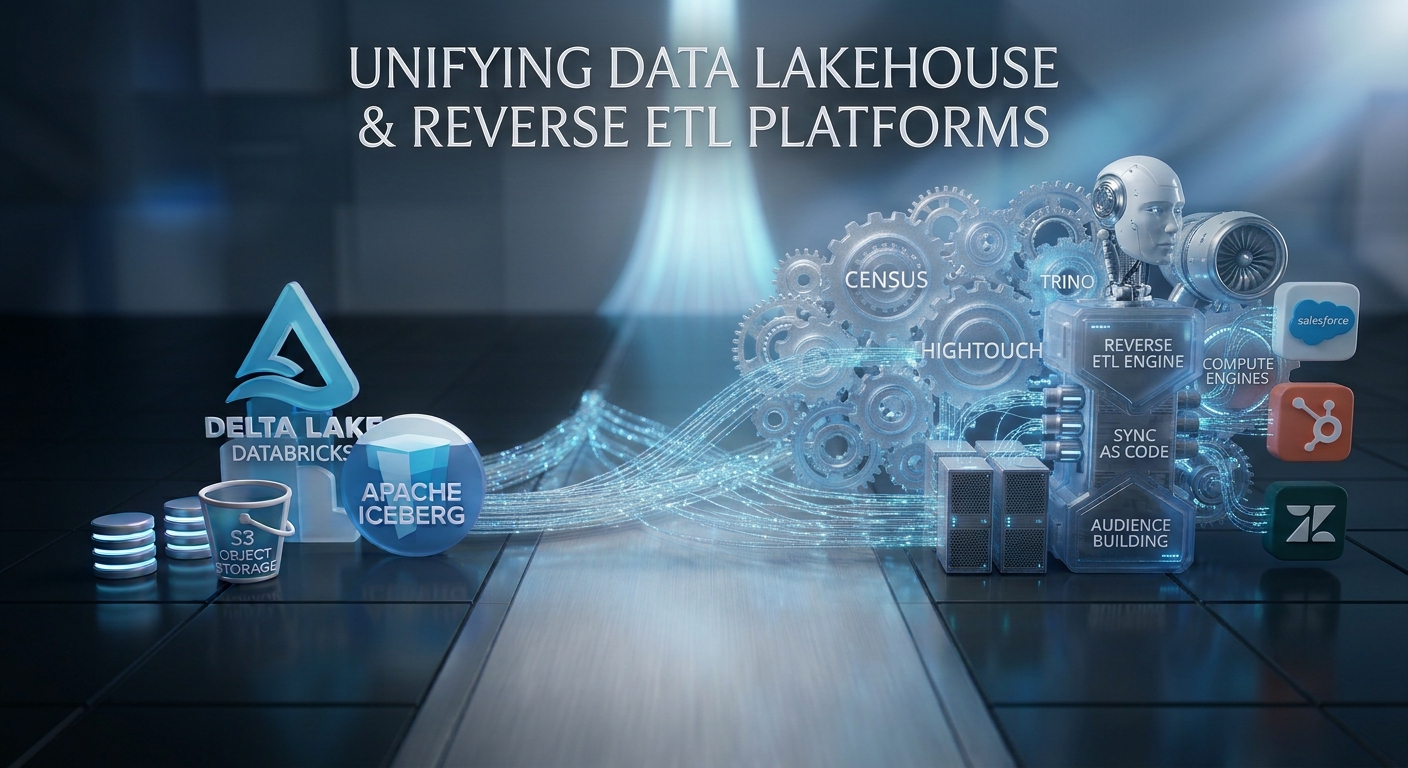
Organizations invested heavily in the modern data stack over the past decade, centralizing customer data, product usage metrics, and financial transactions into powerful cloud data warehouses like Snowflake, BigQuery, and Databricks. Yet, a persistent operational friction remained: data teams spent weeks building clean customer segmentation models, predictive churn scores, and lifetime value (LTV) calculations in the data warehouse, but customer success managers, marketing teams, and sales representatives could not access those insights inside their day-to-day business tools. Customer data sat trapped in analytical silos while operational teams relied on guesswork in Salesforce, HubSpot, and Zendesk.
Reverse ETL tools solve this disconnect by operationalizing data warehouse insights, sinking cleaned, modeled data back into operational SaaS applications and customer-facing tools. Navigating the modern reverse ETL software market requires understanding how platforms differentiate across sync frequencies, schema management, and enterprise data governance.
Understanding the Operational Shift to Reverse ETL
Reverse ETL is the process of copying data from a central data warehouse or lakehouse and syncing it into operational destination systems, such as CRM platforms, marketing automation tools, customer support systems, and internal databases.
Traditional ETL moves data into the warehouse for analysis; Reverse ETL moves processed data out of the warehouse to drive business action.
A professional reverse ETL architecture typically governs several critical operational stages:
- Warehouse Model Connection: Querying transformed dbt models, tables, or materialized views directly inside the cloud data warehouse.
- Identity Resolution and Mapping: Matching warehouse entity records (such as user IDs or company domains) with operational object IDs in downstream SaaS applications.
- Scheduled or Event-Driven Syncing: Executing incremental or full data syncs on scheduled intervals or real-time event triggers.
- Error Handling and Alerting: Managing API rate limits, schema validation errors, and alerting data engineers immediately when a sync fails.
The fundamental objective is to bridge the gap between data engineering and business operations, ensuring that every operational team acts on the exact same trusted customer data.
Key Evaluation Criteria for Reverse ETL Solutions
Selecting an enterprise-grade reverse ETL platform requires examining connector reliability, sync frequency flexibility, and version-control integration.
Sync Frequency: Batch versus Real-Time Streaming
Different operational use cases demand different data freshness. While marketing email campaigns can tolerate hourly batch syncs, fraud detection, real-time personalization, and customer support alerts require sub-minute or event-driven streaming syncs.
Version Control and Git Integration for Data Teams
Modern data engineering relies heavily on analytics engineering tools like dbt and Git version control. Leading reverse ETL platforms allow data teams to define sync configurations as code, integrating directly into CI/CD deployment pipelines.
Destination Coverage and Custom API Support
An effective reverse ETL tool must offer robust, maintained connectors for standard enterprise SaaS tools while providing flexible webhook or custom API actions for proprietary internal applications.
Leading Reverse ETL Tools and Platforms
The reverse ETL software market features dedicated data activation pioneers alongside established enterprise integration suites.
Census
Census is a leading data activation and reverse ETL platform built specifically to help data teams sync warehouse models seamlessly into hundreds of business tools with robust developer tooling.
- Primary Focus: Operational analytics, reverse ETL syncing, and Git-integrated data activation.
- Deployment Model: Cloud SaaS platform.
- Significant Advantage: Exceptional developer experience, robust dbt integration, and powerful version-controlled sync configurations (“Sync as Code”).
- Important Limitation: Advanced custom payload transformations for niche APIs require familiarity with data manipulation logic.
Hightouch
Hightouch is a premier data activation platform that empowers organizations to sync customer data from warehouses into operational tools, featuring an intuitive visual builder and powerful audience segmentation.
- Primary Focus: Reverse ETL, audience audience building, and marketing activation.
- Deployment Model: Cloud SaaS platform.
- Significant Advantage: Intuitive visual audience builder (“Audiences”) that allows non-technical marketing teams to build targeted segments directly on top of warehouse data.
- Important Limitation: Pricing models based on sync volume and destination counts can scale as enterprise data usage grows.
RudderStack (Profiles and Reverse ETL)
RudderStack provides a developer-first customer data platform (CDP) that combines event streaming with robust reverse ETL capabilities, unifying product telemetry and warehouse data.
- Primary Focus: Customer data pipelines, event streaming, and identity resolution.
- Deployment Model: Cloud SaaS or self-hosted deployment options.
- Significant Advantage: Unifies real-time customer event streaming with batch warehouse reverse ETL into a single developer toolkit, reducing tool sprawl.
- Important Limitation: Requires a higher level of technical data engineering expertise to configure compared to pure-play visual marketing tools.
Etleap
Etleap offers enterprise data pipelines that support both traditional ingestion and reverse ETL synchronization, focusing heavily on automated pipeline reliability and security.
- Primary Focus: Enterprise data integration, pipeline automation, and bidirectional data movement.
- Deployment Model: Managed cloud service.
- Significant Advantage: Strong focus on automated pipeline monitoring and robust enterprise data governance controls.
- Important Limitation: Geared primarily toward traditional enterprise data integration rather than marketer-facing audience activation.
Platform Comparison Overview
| Product | Primary Focus | Deployment Model | Significant Advantage | Important Limitation |
| Census | Developer-first data activation and “Sync as Code” | Cloud SaaS | Exceptional dbt integration and Git-backed version control | Advanced custom API payloads require data manipulation logic |
| Hightouch | Reverse ETL and visual marketing audience segmentation | Cloud SaaS | Intuitive audience builder enabling non-technical marketers | Pricing scales with sync volume and destination tiers |
| RudderStack | Combined customer event streaming and reverse ETL | Cloud / Self-Hosted | Unifies real-time event telemetry with warehouse reverse ETL | Requires higher technical engineering knowledge to configure |
| Etleap | Enterprise data pipeline automation and governance | Managed Cloud | Robust pipeline monitoring and heavy enterprise security controls | Geared toward IT engineering over marketer-facing activation |
Operational Risks and Common Pitfalls
Implementing reverse ETL tools without structured governance introduces severe operational hazards.
Overwriting Operational Data in SaaS Tools
Syncing misconfigured or unvalidated warehouse models into production CRM systems can overwrite clean customer phone numbers, names, or account statuses with null values, disrupting sales teams.
Unmonitored API Rate Limit Failures
Failing to configure proper alerting for downstream SaaS API rate limits can cause silent sync failures, leaving business teams operating on outdated data.
Creating Data Loops
Accidentally syncing customer data from the warehouse back into a SaaS tool, which then triggers an event stream back into the data warehouse, creating an infinite data loop that inflates cloud storage and API costs.
Questions to Guide Vendor Selection
Before procuring a reverse ETL platform, data engineering leads and operational stakeholders should address several critical operational questions:
- Do business teams require a visual audience builder (like Hightouch), or do data engineers prefer managing syncs as code via dbt and Git (like Census)?
- What sync frequency do our operational workflows require—real-time streaming, hourly batch updates, or daily syncs?
- How does the platform handle schema drift, validation errors, and API rate limits from downstream SaaS tools?
- Can the platform deploy within our secure cloud environment if compliance mandates prohibit third-party SaaS data access?
Making the Final Decision
Choosing a reverse ETL tool depends heavily on an organization’s internal user personas, data maturity, and operational requirements.
Organizations where data engineers and analysts manage pipelines via dbt and Git frequently choose Census for its superior developer workflow. Enterprises seeking an intuitive visual interface that empowers marketing teams to build operational segments directly on warehouse data lean toward Hightouch. Teams looking to unify real-time customer event streaming with batch reverse ETL choose RudderStack, while legacy enterprises prioritizing rigid governance rely on Etleap.
Ultimately, modern reverse ETL tools successfully operationalize the cloud data warehouse, transforming static analytical reports into active, revenue-generating business actions.
