Organizations historically struggled with a frustrating architectural divide in their data infrastructure: data lakes built on cheap cloud storage offered exceptional capacity for raw data ingestion and machine learning, but suffered from poor performance, no ACID transactions, and a complete lack of standard SQL support. Meanwhile, enterprise data warehouses provided lightning-fast business intelligence (BI) reporting and strict transactional integrity, but were prohibitively expensive, proprietary, and incapable of supporting unstructured data or advanced machine learning workflows.
Data lakehouse platforms bridge this divide, combining the cost-effective, flexible storage of data lakes with the ACID transactions, reliability, and structured performance of data warehouses. Navigating the modern lakehouse software market requires understanding how platforms differentiate across open table formats, compute engine performance, and governance frameworks.
Understanding the Architecture of the Modern Lakehouse
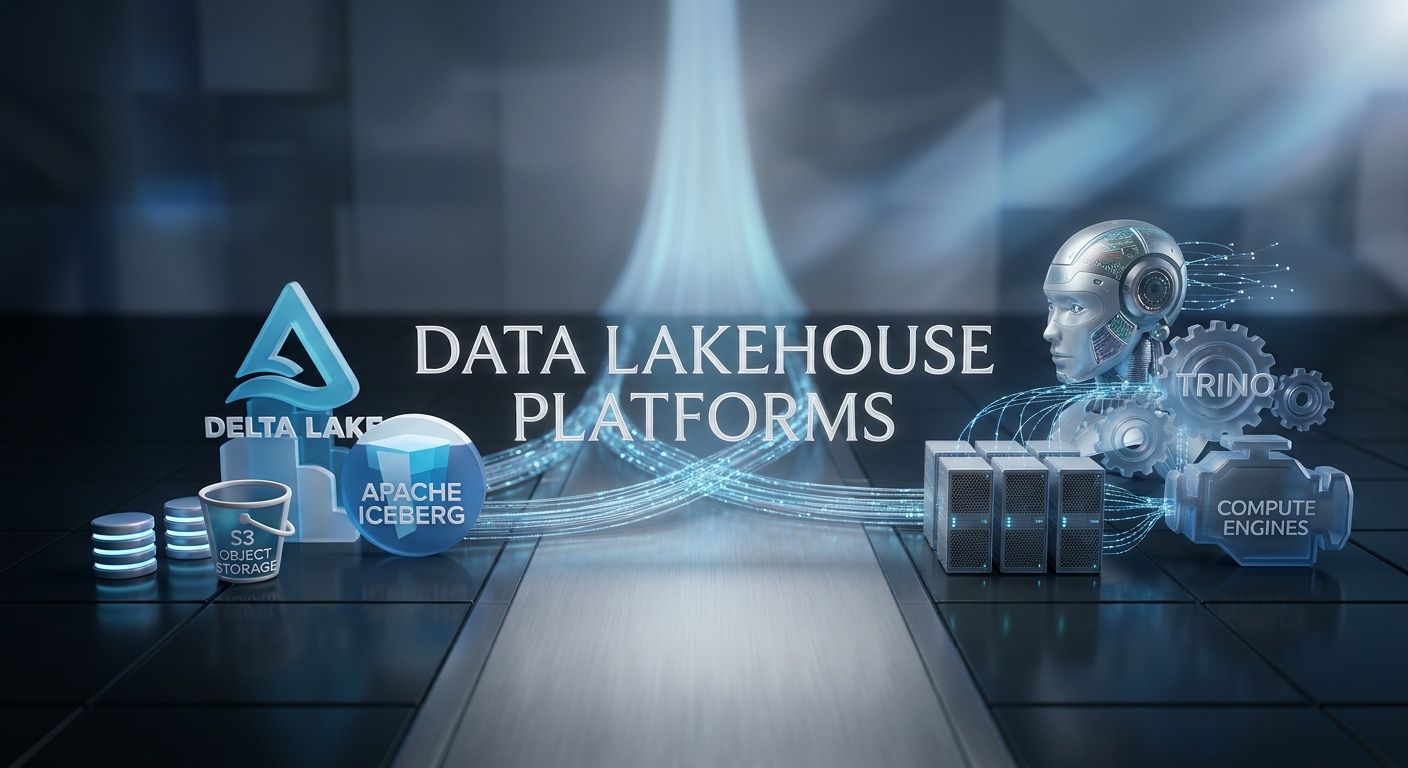
A data lakehouse is an open, unified data platform built on top of low-cost cloud object storage that implements a transactional storage layer using open table formats like Delta Lake, Apache Iceberg, or Apache Hudi. This layer brings reliability and high-performance SQL analytics directly to raw data files.
Unlike traditional data architectures that required maintaining separate pipelines between data lakes and proprietary data warehouses, a lakehouse architecture operates across several foundational layers:
- Cloud Object Storage Foundation: Storing raw, semi-structured, and unstructured data cost-effectively in cloud storage buckets.
- Open Transactional Table Formats: Adding metadata layers that introduce ACID transactions, time travel, schema enforcement, and row-level mutations to object storage.
- Decoupled Compute Engines: Utilizing powerful distributed engines to process analytical queries and machine learning workloads concurrently.
- Unified Governance and Security: Enforcing centralized access control, auditing, and data lineage across both BI reporting tools and AI model training pipelines.
The fundamental objective is to eliminate data duplication and synchronization friction, allowing data engineers, BI analysts, and data scientists to collaborate on a single, trusted source of truth.
Key Evaluation Criteria for Lakehouse Solutions
Selecting an enterprise-grade lakehouse platform requires examining open table format support, concurrency scaling, and data governance integration.
Open Table Format Interoperability
Vendor lock-in is a primary concern for modern data architectures. Leading lakehouse platforms are built on open table formats such as Apache Iceberg or Delta Lake, ensuring that data stored in cloud object storage can be queried by multiple external engines without proprietary restrictions.
Concurrency and Workload Isolation
When data scientists train intensive machine learning models at the exact moment business analysts run heavy monthly financial reports, compute resources can contend aggressively. Robust lakehouse platforms provide dynamic workload isolation and instant auto-scaling compute clusters to prevent resource starvation.
Unified Governance and Cataloging
Managing tables, permissions, and metadata across multi-cloud environments requires rigorous governance. An effective lakehouse platform integrates with open or enterprise catalog services to maintain automated data lineage, compliance tracking, and fine-grained access control.
Leading Lakehouse Platforms and Ecosystem Tools
The lakehouse software market features pioneering data platforms alongside major cloud provider offerings and open-source storage layers.
Databricks (Data Intelligence Platform)
Databricks is the creator of the lakehouse concept and the primary developer of Delta Lake, offering an industry-leading cloud platform that unifies data engineering, data warehousing, and generative artificial intelligence.
- Primary Focus: Unified data engineering, machine learning, AI model training, and high-performance lakehouse analytics.
- Deployment Model: Cloud SaaS platform across AWS, Azure, and Google Cloud Platform.
- Significant Advantage: Unmatched integration between data pipelining, Delta Lake storage, MLflow for machine learning, and generative AI capabilities.
- Important Limitation: Proprietary managed control plane and software licensing costs can scale rapidly for high-volume enterprise users.
Snowflake (with Apache Iceberg Integration)
While traditionally known as a cloud data warehouse, Snowflake has evolved into a formidable lakehouse contender through deep native support for external tables and open table formats like Apache Iceberg.
- Primary Focus: Enterprise business intelligence, secure data sharing, and hybrid lakehouse analytics over Iceberg tables.
- Deployment Model: Fully managed SaaS across AWS, Azure, and GCP.
- Significant Advantage: Industry-leading ease of use, exceptional SQL performance, and robust data-sharing capabilities combined with open storage flexibility.
- Important Limitation: Querying raw data stored in external cloud buckets can incur higher performance latency compared to native internal storage unless carefully optimized.
Apache Iceberg
Apache Iceberg is the rapidly growing open-source table format designed for massive analytic datasets, providing high-performance table management without vendor lock-in.
- Primary Focus: Open-source transactional table format for high-performance data lakes.
- Deployment Model: Open-source software integrated across various query engines.
- Significant Advantage: Complete independence from specific vendor ecosystems, allowing organizations to maintain full ownership of their data lake storage layer.
- Important Limitation: Requires assembling and maintaining a custom stack of query engines, catalogs, and orchestration tools rather than using an all-in-one SaaS platform.
Starburst (Trino-Based Lakehouse Analytics)
Starburst provides a fully managed enterprise analytics platform powered by Trino, enabling high-speed distributed SQL queries directly across distributed lakehouse storage without data migration.
- Primary Focus: Federated query engine, fast distributed SQL analytics, and data virtualization across multi-cloud lakes.
- Deployment Model: Self-hosted or managed Starburst Enterprise.
- Significant Advantage: Blistering query speed across disparate data sources and open table formats without requiring data to be copied into a centralized repository.
- Important Limitation: Specialized focus on distributed SQL querying means it relies on external tools for heavy data engineering pipelines and machine learning training.
AWS Lake Formation and Amazon Athena
AWS provides a native lakehouse ecosystem centered around AWS Lake Formation for centralized governance and Amazon Athena for serverless SQL querying over S3 data lakes.
- Primary Focus: AWS-native data lake governance, security, and serverless analytics.
- Deployment Model: Fully managed services native to Amazon Web Services.
- Significant Advantage: Frictionless integration with the broader AWS security and storage ecosystem, offering granular column- and row-level access controls.
- Important Limitation: Tightly coupled to Amazon Web Services, making multi-cloud hybrid deployments more complex.
Platform Comparison Overview
| Product | Primary Focus | Deployment Model | Significant Advantage | Important Limitation |
| Databricks | Unified data engineering, ML, AI, and lakehouse analytics | Cloud SaaS (Multi-Cloud) | Comprehensive ecosystem unifying data science, BI, and generative AI | Managed platform costs can scale significantly with heavy compute |
| Snowflake | Enterprise BI and hybrid lakehouse querying via Iceberg | Fully Managed SaaS | Exceptional SQL performance and industry-leading secure data sharing | External table queries can experience latency without optimization |
| Apache Iceberg | Open-source transactional table format for data lakes | Open-Source Storage Layer | Complete vendor independence and open community standard | Requires manual integration across custom query and catalog tools |
| Starburst | High-speed distributed SQL analytics and data federation | Self-Hosted / Managed Cloud | Fast federated querying across disparate lakes without data copying | Focused primarily on querying rather than data engineering or ML |
| AWS Lake Formation | AWS-native data governance and serverless analytics | Managed AWS Cloud | Seamless security and governance integration within the AWS ecosystem | Tightly bound to the Amazon Web Services cloud infrastructure |
Operational Risks and Common Pitfalls
Implementing lakehouse platforms without structured data management and cost governance introduces severe operational hurdles.
Neglecting File Maintenance (Compaction and Small Files)
Streaming data ingestion into cloud object storage frequently generates millions of tiny files, destroying query performance. Failing to run regular table maintenance routines degrades lakehouse efficiency.
Uncontrolled Storage and Compute Costs
Assuming that cheap cloud storage translates to low operating costs without monitoring compute cluster sizing, shuffle operations, and query execution efficiency can lead to unexpected budget overruns.
Complex Data Lineage and Governance Blind Spots
Allowing multiple engineering teams to write unvalidated data into raw storage zones without a centralized metadata catalog turns the lakehouse into an unmanageable data swamp.
Questions to Guide Vendor Selection
Before procuring a lakehouse platform or storage format, data engineering leads and enterprise architects should address several critical operational questions:
- Are we committed to an all-in-one managed SaaS platform, or do we prefer an open-source storage format managed across custom query engines?
- How does the platform handle data governance, schema enforcement, and access control across multi-cloud environments?
- What computational workloads will dominate the platform—heavy business intelligence reporting, data engineering pipelines, or artificial intelligence model training?
- How easily does the platform integrate with existing data ingestion tools and orchestration frameworks?
Making the Final Decision
Choosing a lakehouse platform depends heavily on an organization’s existing cloud strategy, analytical use cases, and architectural philosophy.
Organizations seeking a comprehensive, all-in-one cloud platform that seamlessly unifies data engineering, business intelligence, and generative AI frequently choose Databricks. Enterprises heavily invested in Snowflake achieve powerful hybrid lakehouse analytics through native Apache Iceberg integration. Organizations prioritizing strict vendor neutrality and open-source flexibility build their data architecture directly around Apache Iceberg, while AWS-centric enterprises leverage AWS Lake Formation and Athena.
Ultimately, modern lakehouse platforms successfully bridge the historical divide between data lakes and data warehouses, providing a unified, cost-effective foundation for enterprise intelligence.
Headline: Beyond the Data Swamp: Why Enterprise Lakehouse Platforms are Unifying Business Intelligence and Artificial Intelligence
Tags: Data Lakehouse, Databricks, Snowflake, Apache Iceberg, Delta Lake, Starburst, Data Architecture, Cloud Storage, Big Data, Analytics
Anchors:
- Understanding the Architecture of the Modern Lakehouse
- Key Evaluation Criteria for Lakehouse Solutions
- Leading Lakehouse Platforms and Ecosystem Tools
- Platform Comparison Overview
- Operational Risks and Common Pitfalls
- Questions to Guide Vendor Selection
- Making the Final Decision
