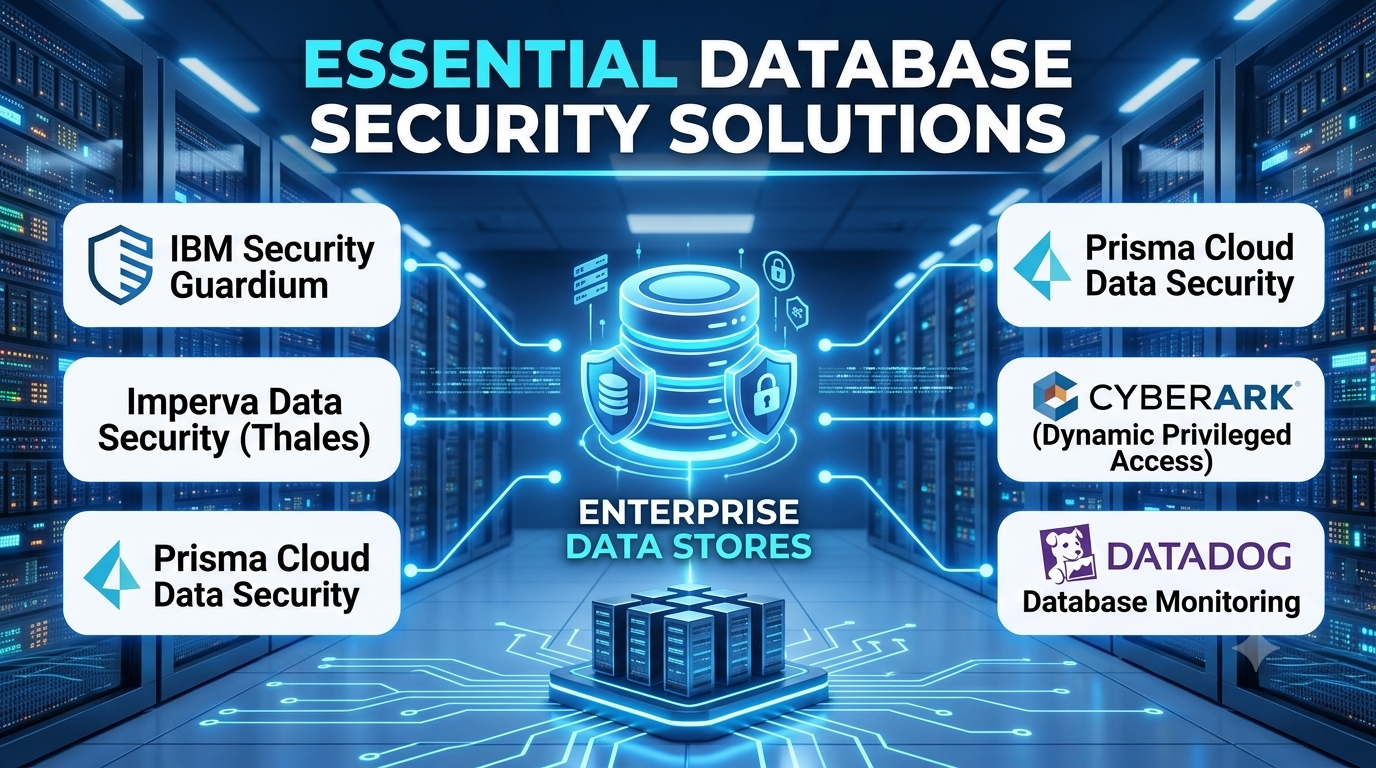
Organizations spend millions of dollars reinforcing network perimeters, deploying intrusion detection systems, and enforcing strict identity controls, operating under the assumption that keeping unauthorized users out of the corporate network is enough to protect critical assets. Yet, cybercriminals and malicious insiders rarely target the outer network walls; they go straight for the crown jewels: the databases housing customer records, proprietary source code, financial ledgers, and healthcare data. If an attacker compromises a privileged database account or exploits an unpatched SQL injection vulnerability, network firewalls offer zero protection against data exfiltration.
Database Security Tools (DSTs) provide specialized defense-in-depth capabilities designed to monitor queries, mask sensitive columns, encrypt stored records, and detect anomalous data access patterns in real time. Navigating the modern database security landscape requires understanding how platforms differentiate across activity monitoring, vulnerability assessment, and runtime data protection.
Understanding the Layers of Database Security
Database security encompasses the hardware, software, and administrative procedures designed to protect databases against malicious attacks, unauthorized access, and accidental corruption. Unlike general-purpose server security, database security requires inspecting granular SQL queries, understanding relational data structures, and protecting structured data tables directly.
A comprehensive database security architecture typically governs several critical operational layers:
- Vulnerability Assessment and Configuration Auditing: Scanning database engines continuously for missing patches, weak passwords, misconfigured permissions, and risky administrative privileges.
- Database Activity Monitoring (DAM) and Auditing: Logging every query, login attempt, and schema modification in real time to maintain forensic audit trails and satisfy compliance mandates.
- Data Masking and Tokenization: Obfuscating sensitive data (such as credit card numbers or Social Security numbers) in non-production environments to prevent developer exposure during testing.
- Transparent Data Encryption (TDE) and Column-Level Encryption: Cryptographically securing data at rest within storage tables so that even if storage volumes are stolen, the underlying data remains unreadable.
The fundamental objective is to ensure that databases remain resilient against external exploitation and internal abuse without degrading query performance.
Key Evaluation Criteria for Database Security Solutions
Selecting an enterprise-grade database security tool requires examining query inspection performance, multi-platform database support, and real-time threat alerting.
Low-Impact Query Monitoring and Performance
Database administrators are often reluctant to install security agents because poorly optimized monitoring tools can introduce query latency and slow down high-throughput transactional databases. Leading solutions utilize out-of-band network sniffing or lightweight kernel-level drivers to inspect traffic without impacting database performance.
Support for Relational and NoSQL Environments
Modern applications distribute data across traditional relational databases (PostgreSQL, Oracle, MySQL, SQL Server) as well as NoSQL document stores and cloud data lakes (MongoDB, Cassandra, Snowflake). A robust database security tool must provide unified coverage across heterogeneous data architectures.
Automated Anomaly Detection and UEBA
Signature-based rules alone cannot catch subtle insider threats, such as a legitimate user slowly downloading customer records outside normal business hours. Advanced tools incorporate User and Entity Behavior Analytics (UEBA) to flag anomalous query volumes and unusual data access patterns automatically.
Leading Database Security Tools and Platforms
The database security market features established enterprise compliance auditing suites alongside modern cloud-native data protection platforms.
Imperva Data Security (Thales)
Imperva is an industry-leading database security platform renowned for its robust Database Activity Monitoring (DAM), vulnerability management, and automated discovery of sensitive data across hybrid environments.
- Primary Focus: Database activity monitoring, audit compliance, and real-time threat protection.
- Deployment Model: On-premises appliances, virtual agents, and cloud-managed services.
- Significant Advantage: Unmatched depth in compliance reporting and real-time blocking of unauthorized SQL injection attacks across complex enterprise database fleets.
- Important Limitation: High commercial cost and complex deployment overhead cater primarily to large corporate enterprises.
IBM Security Guardium
IBM Guardium provides a comprehensive data protection and compliance platform that discovers, classifies, masks, and monitors sensitive data across relational databases, mainframes, and cloud stores.
- Primary Focus: Enterprise data discovery, classification, and continuous compliance auditing.
- Deployment Model: On-premises, hybrid, and cloud-native deployment options.
- Significant Advantage: Exceptional enterprise scalability and rigorous compliance auditing capabilities designed for highly regulated financial and government institutions.
- Important Limitation: Steep learning curve and resource-intensive administration require dedicated database security specialists.
Datadog Database Monitoring (DBM) & Security
Datadog integrates robust database performance monitoring with security visibility, offering deep insights into query execution, slow queries, and database user access patterns.
- Primary Focus: Cloud database performance optimization, query auditing, and security posture visibility.
- Deployment Model: Cloud-native SaaS platform with lightweight agent integrations.
- Significant Advantage: Seamlessly unifies database performance metrics with security and logging data in a single, developer-friendly dashboard.
- Important Limitation: Specialized focus on cloud monitoring means advanced deep database firewalling and heavy enterprise compliance controls are less extensive than legacy DAM tools.
CyberArk Dynamic Privileged Access Management (for Databases)
CyberArk specializes in securing database access by eliminating hardcoded credentials, enforcing just-in-time (JIT) privileged access, and recording database administrative sessions.
- Primary Focus: Privileged access management, credential vaulting, and session recording for database administrators.
- Deployment Model: Cloud SaaS or self-hosted enterprise vault.
- Significant Advantage: Eliminates the risk of stolen static database administrator passwords by issuing dynamic, short-lived credentials for database tasks.
- Important Limitation: Focuses strictly on access governance and credential management, requiring supplementary tools for deep SQL query monitoring and data masking.
Prisma Cloud Data Security (Palo Alto Networks)
Palo Alto integrates cloud database posture management and sensitive data discovery directly into its broader cloud-native application protection platform (CNAPP).
- Primary Focus: Cloud database misconfiguration detection, compliance posture management, and data discovery.
- Deployment Model: Cloud-native SaaS platform.
- Significant Advantage: Exceptional visibility into multi-cloud database assets (AWS RDS, Azure SQL, Google Cloud SQL) and automated posture checks.
- Important Limitation: Optimized specifically for cloud-hosted databases, making it less suitable for traditional on-premises enterprise data centers.
Platform Comparison Overview
| Product | Primary Focus | Deployment Model | Significant Advantage | Important Limitation |
| Imperva Data Security | Database activity monitoring and SQL injection defense | On-Prem / Virtual / Cloud | Industry-leading audit reporting and real-time threat blocking | High enterprise licensing cost and complex setup |
| IBM Guardium | Enterprise data discovery and compliance auditing | On-Prem / Hybrid / Cloud | Exceptional scale and rigorous compliance controls for regulated sectors | Steep learning curve and heavy administrative overhead |
| Datadog Database Security | Cloud database performance and security visibility | Cloud SaaS | Unified dashboard combining query performance and security telemetry | Lacks deep enterprise database firewalling and native data masking |
| CyberArk | Database privileged access control and session recording | Cloud / Self-Hosted | Robust just-in-time credential vaulting and session auditing | Focused on access governance rather than deep SQL activity auditing |
| Prisma Cloud | Cloud database posture management and discovery | Cloud SaaS | Superior multi-cloud database misconfiguration and risk visibility | Optimized primarily for cloud environments over on-prem mainframes |
Operational Risks and Common Pitfalls
Implementing database security tools without structured planning introduces significant operational hurdles.
Neglecting Non-Production and Test Environments
Organizations frequently secure production databases while leaving development and staging databases unencrypted and populated with unmasked production data, creating massive internal breach risks.
Overlooking Unstructured Data Stores and Data Lakes
Focusing database security exclusively on traditional relational SQL databases while ignoring NoSQL document stores, cloud object storage, and data lakes leaves critical data exposed.
Creating Severe Query Latency
Configuring overly aggressive auditing rules or poorly optimized inline proxies can degrade database transaction speeds, triggering immediate pushback from application engineering teams.
Questions to Guide Vendor Selection
Before procuring a database security platform, security architects and database administrators should address several critical operational questions:
- How does the tool monitor database traffic? Does it utilize out-of-band network sniffing, proxy routing, or kernel-level agents, and what is its performance impact?
- Does the platform support our entire database inventory, including traditional relational engines, NoSQL stores, and cloud-native databases?
- What capabilities are provided for data masking and tokenization in non-production testing environments?
- How easily do security alerts and audit logs integrate with our existing Security Information and Event Management (SIEM) workflows?
Making the Final Decision
Choosing a database security tool depends heavily on an organization’s database infrastructure, regulatory mandates, and operational staffing.
Organizations managing complex, hybrid enterprise database fleets requiring rigorous audit compliance frequently choose dedicated platforms like Imperva or IBM Guardium. Cloud-native engineering teams seeking unified visibility into cloud database performance and security posture often benefit from Datadog or Palo Alto Prisma Cloud, while enterprises seeking to secure privileged database administrator access rely on CyberArk.
Ultimately, modern database security tools ensure that enterprise data stores remain protected against external exploits and internal misuse, safeguarding the core information assets of the organization.
