Enterprise data teams historically struggled with fragmented analytics architectures, spending countless engineering hours extracting, transforming, and loading (ETL) data from transactional databases into cumbersome, on-premises data warehouses. When multiple departments attempted to run heavy analytical queries simultaneously against rigid hardware servers, query performance plummeted, pipelines broke, and business intelligence reports fell hopelessly out of sync.
Cloud Data Warehouse Platforms revolutionized enterprise analytics by decoupling storage from compute, enabling organizations to scale processing power and data capacity independently across multi-cloud environments. Navigating the modern data warehouse software landscape requires understanding how platforms differentiate across concurrency scaling, semi-structured data handling, and open table format support.
Understanding the Evolution of Modern Cloud Analytics
A cloud data warehouse is a centralized, columnar data storage and processing system engineered specifically for enterprise analytics, business intelligence (BI), and machine learning workloads. Unlike traditional transactional databases (OLTP) optimized for fast row-level inserts and updates, data warehouses (OLAP) are optimized for complex, large-scale aggregations across massive historical datasets.
A professional cloud data warehouse architecture typically governs several critical operational layers:
- Decoupled Storage and Compute: Separating physical storage (housed in cost-effective cloud object stores) from compute clusters, allowing teams to spin up dedicated virtual warehouses for different departments without resource contention.
- Columnar Storage and Compression: Storing data by columns rather than rows, enabling lightning-fast analytical scans and extreme data compression ratios.
- Semi-Structured Data Handling: Native support for JSON, Parquet, and Avro formats, allowing direct querying of nested data without rigid upfront schema migrations.
- Data Sharing and Collaboration: Securely sharing live, zero-copy datasets across external organizations and business partners instantly.
The fundamental objective is to provide a single, highly performant source of truth that empowers every analyst, data scientist, and business leader to derive actionable insights instantly.
Key Evaluation Criteria for Data Warehouse Platforms
Selecting an enterprise-grade cloud data warehouse requires examining concurrency performance, cloud infrastructure portability, and workload isolation capabilities.
Concurrency Scaling and Workload Isolation
When dozens of business analysts run heavy reporting queries at the exact moment automated data pipelines ingest terabytes of streaming data, standard systems lock up. Leading data warehouses provide instant auto-scaling and workload isolation so that high-priority queries never starve due to background ingestion jobs.
Multi-Cloud and Cross-Region Portability
Enterprise procurement strategies increasingly demand flexibility across AWS, Microsoft Azure, and Google Cloud Platform. Evaluating a data warehouse involves assessing whether the platform operates natively across multiple cloud providers or locks the organization into a single proprietary ecosystem.
Support for Open Table Formats (Apache Iceberg and Delta Lake)
Modern data architectures are shifting toward open storage standards. A future-proof data warehouse must support open table formats like Apache Iceberg, allowing organizations to query data directly in cloud object storage without vendor lock-in.
Leading Data Warehouse Platforms and Solutions
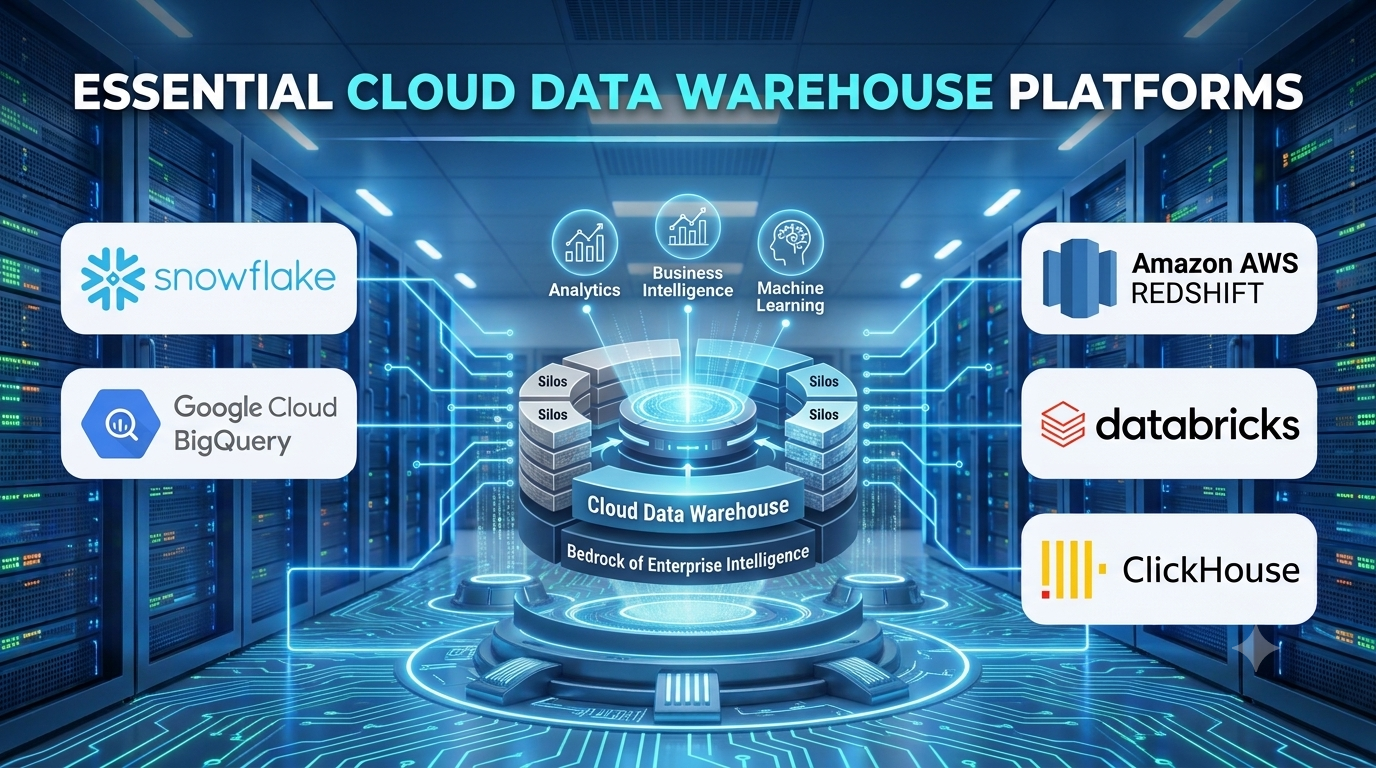
The cloud data warehouse market features powerhouse SaaS solutions alongside open-source analytic engines and native cloud provider offerings.
Snowflake
Snowflake is the pioneer of the decoupled storage-and-compute cloud data warehouse architecture, offering a fully managed SaaS platform that spans AWS, Azure, and Google Cloud.
- Primary Focus: Multi-cloud enterprise analytics, secure data sharing, and zero-management cloud data warehousing.
- Deployment Model: Fully managed SaaS across AWS, Azure, and GCP.
- Significant Advantage: Seamless multi-cloud portability, instant auto-scaling virtual warehouses, and industry-leading secure data sharing capabilities.
- Important Limitation: Compute costs can escalate rapidly if queries are poorly optimized and virtual warehouses are left running unattended.
Google BigQuery
Google BigQuery is a fully managed, serverless enterprise data warehouse designed to analyze petabytes of data rapidly using ANSI SQL without provisioning server infrastructure.
- Primary Focus: Serverless petabyte-scale analytics, real-time streaming ingestion, and deep Google Cloud AI integration.
- Deployment Model: Fully managed serverless cloud service on GCP.
- Significant Advantage: True serverless architecture with zero cluster management, combined with blistering query speeds over massive datasets.
- Important Limitation: On-demand pricing can be unpredictable for heavy query workloads, making reserved slot pricing necessary for cost control.
Amazon Redshift
Amazon Redshift is a fast, scalable cloud data warehouse service optimized for high-performance enterprise business intelligence and massive data warehousing workloads within AWS.
- Primary Focus: AWS-native enterprise analytics, columnar storage, and deep integration with AWS data lakes.
- Deployment Model: Managed cloud infrastructure on AWS.
- Significant Advantage: Deep integration with the broader AWS ecosystem (S3, Glue, Kinesis) and advanced concurrency scaling features.
- Important Limitation: Requires more manual cluster provisioning and node sizing compared to serverless or decoupled alternatives.
Databricks (Lakehouse Platform)
Databricks combines data engineering, machine learning, and data warehousing into a single unified “Lakehouse” platform built on top of open storage standards like Delta Lake and Apache Iceberg.
- Primary Focus: Unified data engineering, machine learning, and high-performance SQL analytics.
- Deployment Model: Cloud SaaS platform across AWS, Azure, and GCP.
- Significant Advantage: Eliminates data silos by unifying data lakes and data warehouses into a single open-format storage layer optimized for both BI and AI workloads.
- Important Limitation: Steeper learning curve for traditional BI analysts who are accustomed to standard database environments rather than Spark-based architectures.
ClickHouse
ClickHouse is an extremely fast, open-source columnar column-oriented database management system engineered specifically for real-time online analytical processing (OLAP) at massive scale.
- Primary Focus: Real-time analytics, high-speed log processing, and open-source columnar storage.
- Deployment Model: Self-hosted open-source or managed ClickHouse Cloud.
- Significant Advantage: Blistering query execution speeds and exceptional hardware efficiency, often outperforming traditional warehouses on pure analytical benchmarks.
- Important Limitation: Less out-of-the-box enterprise governance, user management, and ecosystem integrations compared to Snowflake or BigQuery.
Platform Comparison Overview
| Product | Primary Focus | Deployment Model | Significant Advantage | Important Limitation |
| Snowflake | Multi-cloud enterprise analytics and secure data sharing | Fully Managed SaaS (AWS, Azure, GCP) | True multi-cloud portability and instant virtual warehouse isolation | Compute costs require active monitoring to prevent budget overruns |
| Google BigQuery | Serverless petabyte-scale analytics and rapid querying | Managed Serverless (GCP) | Zero infrastructure management with instant serverless scalability | On-demand query costs can become unpredictable without reserved slots |
| Amazon Redshift | AWS-native high-performance data warehousing | Managed Cloud (AWS) | Deep integration with AWS data engineering and storage services | Requires manual cluster sizing and capacity planning |
| Databricks | Unified Lakehouse for BI, data engineering, and AI | Cloud SaaS (Multi-Cloud) | Unifies data lakes and warehouses using open storage formats | Steeper technical learning curve for traditional BI analysts |
| ClickHouse | Ultra-fast real-time columnar OLAP analytics | Self-Hosted / Cloud | Incredible query speeds and high hardware processing efficiency | Lacks deep out-of-the-box enterprise governance suites |
Operational Risks and Common Pitfalls
Implementing cloud data warehouse platforms without rigorous governance and cost control introduces severe financial and operational hazards.
Uncontrolled Compute Costs from Runaway Queries
Failing to set strict warehouse auto-suspend timeouts, neglecting query cost limits, or allowing users to run unoptimized full-table scans can lead to massive, unexpected cloud infrastructure bills.
Creating Data Swamps Through Poor Modeling
Dumping raw, unorganized data into a cloud warehouse without establishing a structured semantic layer or silver/gold transformation tiers turns the warehouse into an unsearchable data swamp.
Ignoring Data Governance and Access Controls
Failing to implement column-level and row-level security policies exposes sensitive customer PII and financial records across broad internal user groups.
Questions to Guide Vendor Selection
Before procuring a cloud data warehouse platform, data engineering leads and enterprise architects should address several critical operational questions:
- Will the warehouse operate within a single cloud provider (AWS/GCP), or do we require multi-cloud portability across environments?
- How does the platform handle concurrency scaling and workload isolation during peak analytical traffic hours?
- Does the architecture support open table formats (Apache Iceberg) to prevent vendor lock-in and simplify data lake integration?
- What cost-management and query-budgeting tools are provided to prevent runaway cloud compute spending?
Making the Final Decision
Choosing a cloud data warehouse platform depends heavily on an organization’s cloud infrastructure strategy, data team skill set, and budget priorities.
Organizations seeking a seamless, multi-cloud SaaS experience with unmatched data-sharing capabilities frequently choose Snowflake. Teams deeply embedded in the Google Cloud ecosystem leverage the serverless agility of BigQuery, while AWS-centric enterprises optimize their analytics around Amazon Redshift. Organizations looking to unify data engineering, machine learning, and BI into a single open-format architecture adopt Databricks, whereas high-speed real-time log analytics teams lean toward ClickHouse.
Ultimately, modern cloud data warehouse platforms form the indispensable bedrock of enterprise intelligence, turning raw operational data into rapid, reliable strategic insights.
