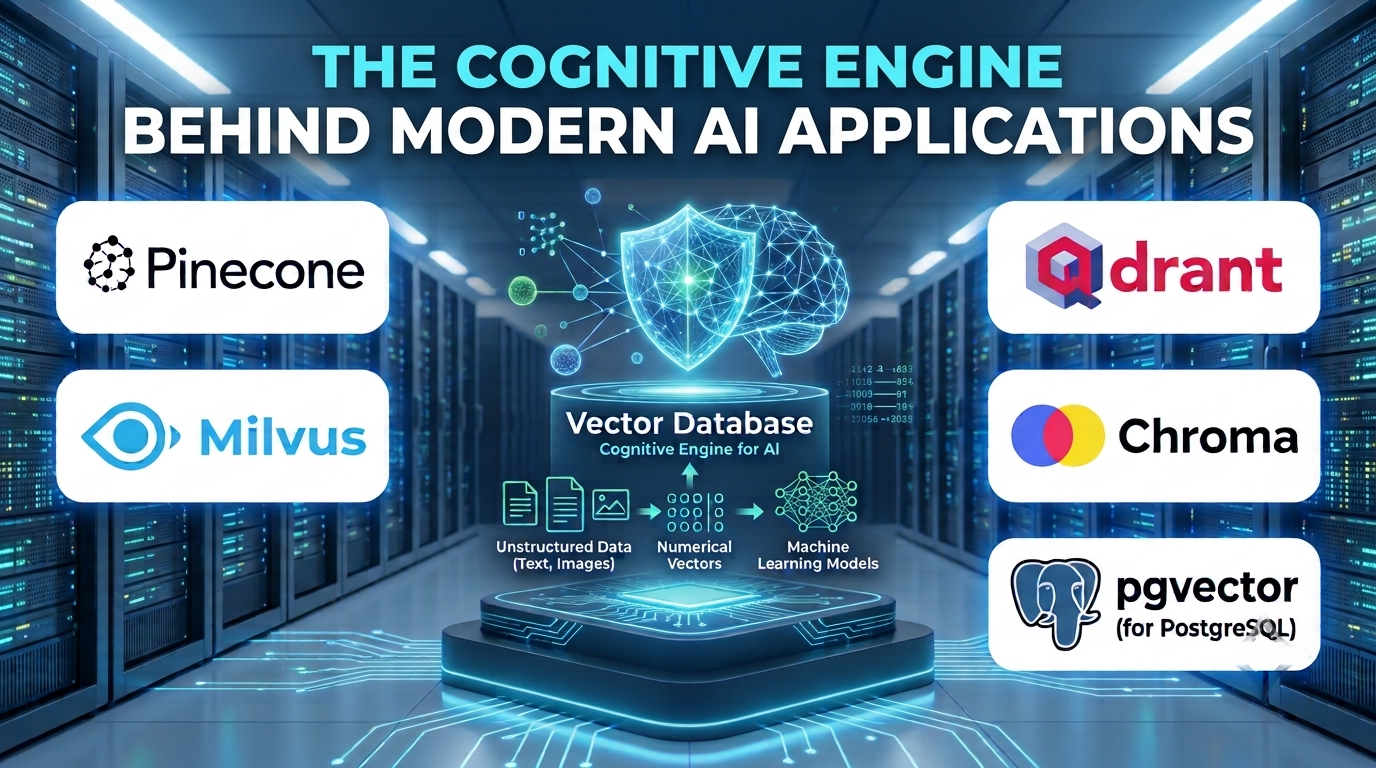
Software engineers and enterprise architects building generative artificial intelligence applications, semantic search engines, and recommendation systems quickly discover a fundamental architectural mismatch: traditional relational databases and keyword-based search engines (like standard SQL or Elasticsearch) are fundamentally blind to meaning. When an application needs to feed relevant context to a Large Language Model (Retrieval-Augmented Generation or RAG), match similar images, or recommend products based on conceptual user behavior, exact keyword matching fails.
Vector database platforms solve this limitation by storing, indexing, and querying high-dimensional vectors generated by machine learning embedding models. Navigating the modern vector database landscape requires understanding how platforms differentiate across indexing algorithms, hybrid search capabilities, and distributed cloud scalability.
Understanding Vector Embeddings and Similarity Search
Vector databases are specialized data stores designed to manage numerical arrays (vectors) that represent unstructured data—such as text, images, audio, and video—generated by artificial intelligence embedding models.
Unlike traditional databases that query data using exact matches or boolean logic, vector databases utilize approximate nearest neighbor (ANN) search algorithms to find items that are conceptually or semantically similar.
A professional vector database architecture typically governs several critical operational stages:
- Embedding Generation and Ingestion: Converting raw unstructured data into high-dimensional numerical vectors (often ranging from 384 to over 3,072 dimensions) using machine learning models.
- Indexing Algorithms (HNSW and IVF): Organizing high-dimensional space using Hierarchical Navigable Small World (HNSW) graphs or Inverted File (IVF) indexes to enable lightning-fast similarity searches without scanning every stored vector.
- Distance Metrics: Calculating mathematical proximity between vectors using Euclidean distance, Cosine similarity, or Dot product.
- Hybrid Search Integration: Combining traditional keyword search (BM25) with semantic vector search to ensure both exact keyword precision and conceptual relevance.
The fundamental objective is to provide sub-millisecond retrieval of semantically relevant context, serving as the long-term memory layer for modern AI systems.
Key Evaluation Criteria for Vector Platforms
Selecting an enterprise-grade vector database requires examining recall accuracy, indexing speed, and hybrid metadata filtering capabilities.
Search Recall Accuracy and Latency
The primary metric for a vector database is recall—the percentage of true nearest neighbors successfully retrieved during a query—balanced against query latency. Leading platforms maintain high recall (>99%) even under massive concurrent search loads.
Metadata Filtering and Hybrid Search
In real-world applications, semantic search must be combined with traditional structured filters (such as returning similar documents only within a specific date range or author). A robust vector database supports high-performance scalar filtering alongside vector indexing.
Scalability and Memory Management
High-dimensional vectors consume immense RAM, making memory efficiency a critical architectural concern. Enterprise vector databases offer quantization techniques (such as Product Quantization or Scalar Quantization) to compress vectors and reduce memory footprints without destroying search accuracy.
Leading Vector Database Platforms and Solutions
The vector database market features dedicated, purpose-built vector search engines alongside established relational and document databases that have integrated native vector indexing.
Pinecone
Pinecone is a fully managed, cloud-native vector database built from the ground up to handle massive-scale semantic search and RAG workloads with zero infrastructure management.
- Primary Focus: Fully managed serverless vector search, enterprise reliability, and effortless scaling.
- Deployment Model: Fully managed cloud service (SaaS).
- Significant Advantage: Complete elimination of infrastructure maintenance, automatic scaling, and ultra-low latency for demanding production AI applications.
- Important Limitation: Proprietary cloud service model means it cannot be self-hosted on-premises or deployed in air-gapped environments.
Milvus
Milvus is a powerful, open-source distributed vector database designed for massive-scale machine learning applications and enterprise-grade AI datasets.
- Primary Focus: Massive-scale distributed vector storage, high-throughput similarity search, and open-source flexibility.
- Deployment Model: Self-hosted distributed cluster or managed cloud service (Zilliz Cloud).
- Significant Advantage: Exceptional horizontal scalability capable of handling billions of vectors across distributed nodes with robust enterprise partitioning.
- Important Limitation: Managing a self-hosted distributed Milvus cluster requires significant DevOps expertise and infrastructure planning.
Qdrant
Qdrant is a high-performance, open-source vector database written in Rust, renowned for its rich metadata filtering capabilities and developer-friendly API ergonomics.
- Primary Focus: Advanced metadata filtering, payload-based vector search, and high-performance Rust architecture.
- Deployment Model: Self-hosted or managed Qdrant Cloud.
- Significant Advantage: Superior payload filtering integration, allowing complex scalar conditions to be evaluated simultaneously with vector similarity search.
- Important Limitation: While scaling capabilities are robust, massive multi-billion-vector clusters require careful memory and hardware tuning.
Chroma
Chroma is a lightweight, open-source embedding database designed specifically to make it easy for developers to build AI applications with Python and JavaScript.
- Primary Focus: Local developer prototyping, lightweight AI applications, and simple in-memory embedding storage.
- Deployment Model: Embedded library or lightweight server.
- Significant Advantage: Extremely simple setup and native integration with popular AI frameworks like LangChain and LlamaIndex, making it ideal for local development.
- Important Limitation: Less suited for massive multi-terabyte production enterprise workloads compared to dedicated distributed engines.
pgvector (PostgreSQL Extension)
pgvector is an open-source extension that adds vector data types and similarity search capabilities directly into the world’s most popular open-source relational database, PostgreSQL.
- Primary Focus: Adding vector search capabilities directly into existing PostgreSQL relational databases.
- Deployment Model: PostgreSQL extension hosted wherever Postgres runs.
- Significant Advantage: Eliminates the need to introduce a standalone database by storing relational data, application state, and vector embeddings in a single unified database.
- Important Limitation: Can experience performance bottlenecks when scaling to tens of millions of high-dimensional vectors compared to purpose-built vector engines.
Platform Comparison Overview
| Product | Primary Focus | Deployment Model | Significant Advantage | Important Limitation |
| Pinecone | Fully managed serverless vector search and RAG | Managed Cloud (SaaS) | Zero infrastructure overhead with automatic enterprise scaling | Proprietary cloud service; cannot be self-hosted locally |
| Milvus | Massive-scale distributed vector storage and search | Self-Hosted / Zilliz Cloud | Unmatched horizontal scalability for billion-scale datasets | Self-hosting requires advanced DevOps cluster management |
| Qdrant | Advanced metadata filtering and Rust-based speed | Self-Hosted / Qdrant Cloud | Exceptional payload filtering combined with vector proximity search | Massive enterprise clusters require careful hardware tuning |
| Chroma | Lightweight developer prototyping and local AI apps | Embedded / Local Server | Extremely easy setup and seamless Python/JS framework integration | Not designed for massive multi-terabyte production scaling |
| pgvector | Relational database integration via Postgres extension | Postgres Extension | Unifies relational data and vector embeddings in a single database | Can lag behind dedicated engines at massive billion-scale volumes |
Operational Risks and Common Pitfalls
Implementing vector databases without understanding embedding mechanics and indexing trade-offs introduces severe performance bottlenecks.
Selecting Incorrect Distance Metrics
Choosing an inappropriate distance metric (such as using Euclidean distance instead of Cosine similarity for normalized vectors) can degrade search recall accuracy significantly.
Ignoring Dimensionality and Memory Costs
Storing hundreds of thousands of high-dimensional vectors (such as 3,072-dimensional embeddings) without utilizing quantization exhausts system RAM rapidly.
Overlooking Hybrid Search Requirements
Relying entirely on pure vector similarity search while ignoring exact keyword matching leads to poor retrieval performance when users search for specific part numbers, proper nouns, or ID codes.
Questions to Guide Vendor Selection
Before procuring a vector database platform, AI engineers and enterprise architects should address several critical operational questions:
- What is the expected scale of our vector dataset—millions or billions of vectors—and how does the platform handle horizontal scaling?
- Does the solution require a fully managed serverless cloud service, or do compliance mandates require self-hosted on-premises deployment?
- How efficiently does the database handle complex metadata filtering alongside vector similarity search?
- What integration options exist with our existing AI orchestration frameworks (such as LangChain, LlamaIndex, and LLM providers)?
Making the Final Decision
Choosing a vector database platform depends heavily on an organization’s deployment constraints, dataset scale, and existing technology stack.
Teams seeking a zero-maintenance, fully managed cloud service for production RAG applications frequently choose Pinecone. Organizations managing massive, billion-scale datasets with strict self-hosting requirements lean toward Milvus, while developers prioritizing advanced metadata filtering choose Qdrant. For engineering teams already heavily invested in PostgreSQL, adding pgvector offers a unified data architecture without introducing a new standalone database, whereas Chroma remains the ideal choice for lightweight local prototyping.
Ultimately, modern vector database platforms serve as the indispensable cognitive memory layer for artificial intelligence, turning unstructured data into actionable, semantically searchable intelligence.
