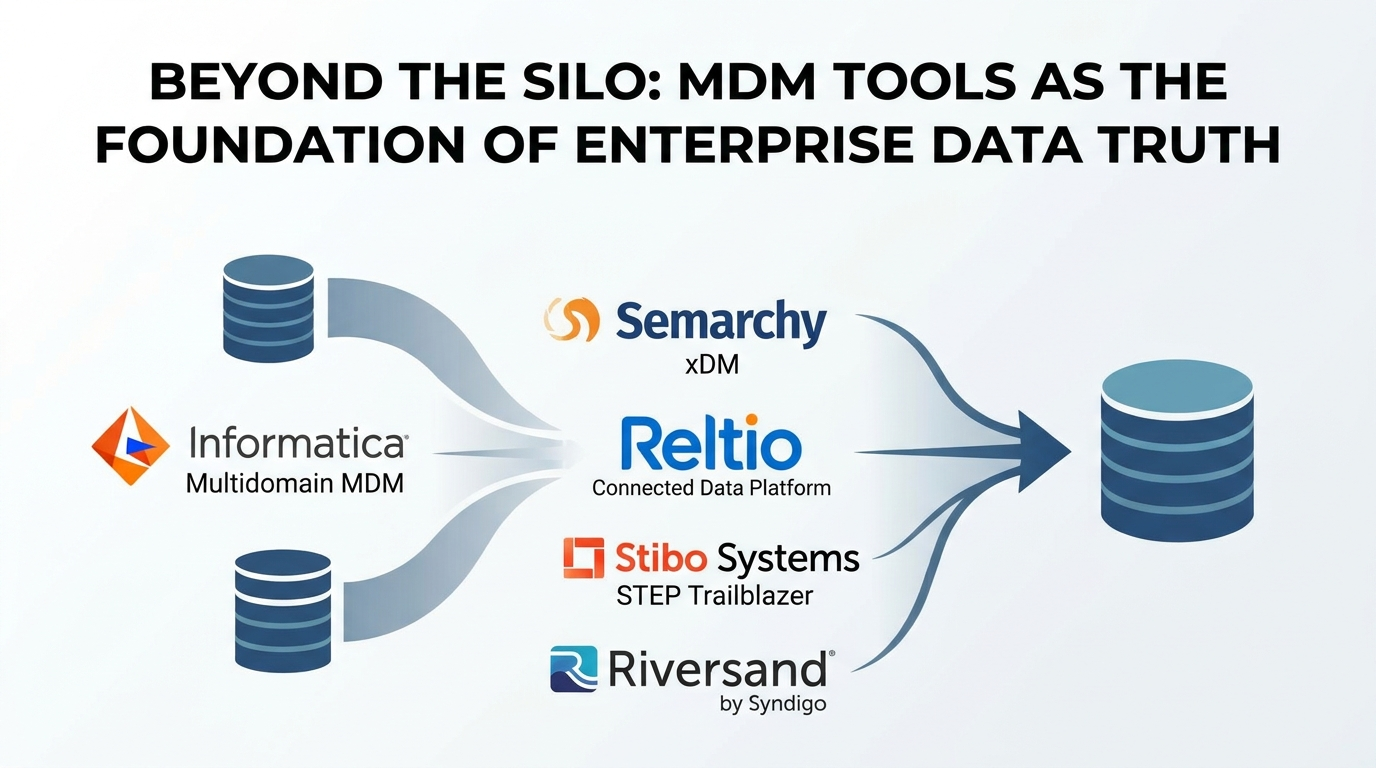
Organizations expanding across international markets, scaling digital operations, and acquiring subsidiary businesses quickly encounter a frustrating operational dilemma: disparate business units store overlapping, contradictory information about the exact same entities. The customer service department recognizes a key corporate client by one name, the sales CRM lists a different billing address, the legacy billing system uses a separate customer ID, and the e-commerce platform tracks yet another contact profile. When enterprise systems cannot agree on basic foundational entities—such as customers, products, suppliers, or assets—business intelligence reports miscalculate, marketing campaigns cross wires, and regulatory compliance audits fail.
Master Data Management (MDM) tools provide centralized platforms designed to ingest data from across the enterprise, reconcile discrepancies, eliminate duplicate records, and establish a single, authoritative “golden record” for core business entities. Navigating the modern MDM software landscape requires understanding how platforms differentiate across domain coverage, entity resolution algorithms, and deployment flexibility.
Understanding the Core Architecture of Master Data Management
Master data management encompasses the technology, governance processes, and tools used to create and maintain a consistent, accurate, and unified view of an organization’s critical business data.
Unlike transactional data (which records ephemeral operational events like invoices or log entries) or analytical data (which aggregates historical metrics), master data represents the core nouns of a business—customers, products, locations, hierarchies, and assets.
A professional MDM architecture typically governs several critical operational capabilities:
- Multi-Source Data Ingestion: Consolidating raw entity records continuously from disparate operational systems, ERPs, CRMs, and external data feeds.
- Deterministic and Probabilistic Entity Resolution: Using fuzzy matching algorithms, survivorship rules, and machine learning models to identify that “Acme Corp Ltd” in London and “Acme Corporation” in New York represent the exact same enterprise customer.
- Golden Record Creation: Merging conflicting attributes into a single, verified golden record while preserving an immutable audit trail of underlying source records.
- Master Data Distribution (Syndication): Synchronizing validated golden records back out to operational systems and analytics platforms so every department operates on identical data.
The fundamental objective is to eliminate data fragmentation, ensuring that business applications share an unambiguous, synchronized understanding of enterprise entities.
Key Evaluation Criteria for MDM Solutions
Selecting an enterprise-grade Master Data Management platform requires examining domain flexibility, entity matching sophistication, and data governance integration.
Multi-Domain versus Single-Domain Capability
Some organizations require MDM exclusively for customer data (Customer MDM), while others need to manage products (Product Information Management / PIM), suppliers, or financial assets simultaneously. Evaluating whether a platform offers native multi-domain architecture or specialized single-domain depth is critical.
Match-Merge Engine Sophistication
The core of any MDM tool is its entity resolution engine. Leading platforms combine rigid deterministic rules (exact Tax ID matches) with probabilistic machine learning models to accurately link messy, misspelled, or incomplete records without generating false positives.
Workflow Automation and Data Stewardship
Resolving ambiguous duplicate records requires human oversight. An effective MDM tool provides intuitive data stewardship workflows, exception queues, and role-based permissions that allow business users to review and approve master data merges easily.
Leading Master Data Management Platforms and Solutions
The MDM software market features enterprise-grade multi-domain governance suites alongside specialized customer and product data platforms.
Informatica Multidomain MDM
Informatica is an industry-leading enterprise data management platform renowned for its robust multi-domain capabilities, advanced data governance integration, and comprehensive data quality tooling.
- Primary Focus: Enterprise multi-domain MDM, complex data governance, and data quality management.
- Deployment Model: Cloud-native SaaS (Informatica Intelligent Data Management Cloud) or hybrid deployment.
- Significant Advantage: Unmatched enterprise capability in managing complex multi-domain master data models alongside automated data cleansing and compliance workflows.
- Important Limitation: Steep learning curve, heavy implementation overhead, and high software licensing costs cater primarily to large multinational enterprises.
Semarchy xDM
Semarchy xDM is an agile, master data management and data governance platform built on an intelligent data hub architecture, designed for rapid deployment and business-user adoption.
- Primary Focus: Agile multi-domain MDM, collaborative data governance, and rapid application development.
- Deployment Model: Cloud SaaS, containerized on-premises, or managed cloud deployment.
- Significant Advantage: Exceptionally fast time-to-value with model-driven architecture, making it much faster to implement and adapt compared to legacy MDM suites.
- Important Limitation: Highly customized enterprise workflows involving millions of complex unstructured entities require careful tuning.
Reltio Connected Data Platform
Reltio is a modern, cloud-native multi-domain MDM platform built on a graph-based data architecture, offering real-time data ingestion and multi-tenant scalability.
- Primary Focus: Cloud-native multi-domain MDM, real-time identity resolution, and graph-based relationship mapping.
- Deployment Model: Fully managed cloud SaaS platform.
- Significant Advantage: Native cloud architecture with built-in graph capabilities that map complex relationships between customers, accounts, and products in real time.
- Important Limitation: As a cloud-native SaaS platform, organizations with strict on-premises data residency mandates may face deployment restrictions.
Stibo Systems STEP Trailblazer
Stibo Systems provides a powerful, highly configurable multi-domain master data management platform, with particular historical renown in product information management (PIM) and supply chain master data.
- Primary Focus: Product information management (PIM), multi-domain enterprise MDM, and supply chain governance.
- Deployment Model: Cloud-managed enterprise software or hybrid deployment.
- Significant Advantage: Exceptional strength in handling complex product catalogs, multi-language hierarchies, and intricate supplier data networks.
- Important Limitation: User interface and configuration workflows can feel traditional and complex compared to agile, modern SaaS MDM platforms.
Riversand (by Syndigo)
Riversand is a cloud-native master data management and product information management platform designed to unify multi-domain data streams and deliver robust syndication capabilities.
- Primary Focus: Cloud-native multi-domain MDM, PIM, and digital shelf analytics.
- Deployment Model: Fully managed cloud SaaS platform.
- Significant Advantage: Strong modern cloud architecture combined with robust syndication features for pushing product data directly to e-commerce marketplaces and retail channels.
- Important Limitation: Ecosystem community and enterprise integration support are smaller compared to legacy giants like Informatica.
Platform Comparison Overview
| Product | Primary Focus | Deployment Model | Significant Advantage | Important Limitation |
| Informatica | Enterprise multi-domain MDM and governance | Cloud IDMC / Hybrid | Industry-standard multi-domain depth and robust data quality rules | High licensing costs and complex implementation overhead |
| Semarchy xDM | Agile multi-domain MDM and model-driven hubs | Cloud / On-Prem Container | Rapid deployment and faster time-to-value compared to legacy suites | Complex custom workflows with massive datasets require tuning |
| Reltio | Cloud-native multi-domain MDM with graph relationships | Cloud SaaS (Multi-Tenant) | Real-time graph-based entity resolution and seamless cloud scale | Cloud-native SaaS model presents challenges for strict on-prem mandates |
| Stibo Systems | Complex product information and enterprise multi-domain MDM | Cloud-Managed / Hybrid | Superior handling of intricate product catalogs and supplier hierarchies | Configuration and user interfaces can feel traditional and heavy |
| Riversand | Cloud-native MDM and digital marketplace syndication | Cloud SaaS | Modern cloud architecture with powerful e-commerce syndication tools | Smaller integration ecosystem footprint compared to legacy market leaders |
Operational Risks and Common Pitfalls
Implementing master data management tools without structured business alignment introduces severe operational hurdles.
Treating MDM Solely as an IT Project
Purchasing an MDM software license as a technical database consolidation project without securing active business ownership and data stewardship from operational departments, resulting in low organizational adoption.
Over-Engineering the Master Data Model
Attempting to capture every possible attribute across every enterprise system on day one, creating an overly complex data model that stalls implementation and overwhelms business users.
Neglecting Downstream Source System Remediation
Using MDM merely as a band-aid to clean dirty data downstream while allowing operational source systems (like messy CRM entry forms) to continue generating unvalidated, duplicative data.
Questions to Guide Vendor Selection
Before procuring a master data management platform, data engineering leads and enterprise architects should address several critical operational questions:
- Which master data domains do we need to manage immediately—customer, product, supplier, or financial assets—and does the vendor specialize in those domains?
- Do we require a cloud-native SaaS platform (like Reltio) or a hybrid enterprise deployment with strict on-premises control (like Informatica or Semarchy)?
- How sophisticated is our entity matching requirement—does it require complex probabilistic machine learning models, or deterministic rule matching?
- What level of business-user tooling is provided for data stewards to review merge exceptions and manage data governance workflows?
Making The Final Decision
Choosing a Master Data Management tool depends heavily on an organization’s data domain complexity, deployment constraints, and organizational readiness.
Large multinational enterprises managing vast, complex multi-domain estates requiring deep governance integration frequently choose Informatica. Organizations seeking a modern, agile deployment with rapid time-to-value lean toward Semarchy xDM, while enterprises prioritizing cloud-native multi-tenant scalability and real-time graph resolution adopt Reltio. Companies heavily focused on complex product catalogs and supply chain hierarchies find exceptional value in Stibo Systems or Riversand.
Ultimately, modern Master Data Management tools break down enterprise data silos, transforming contradictory information across disparate systems into a single, trusted source of truth that drives accurate analytics and confident business decisions.
