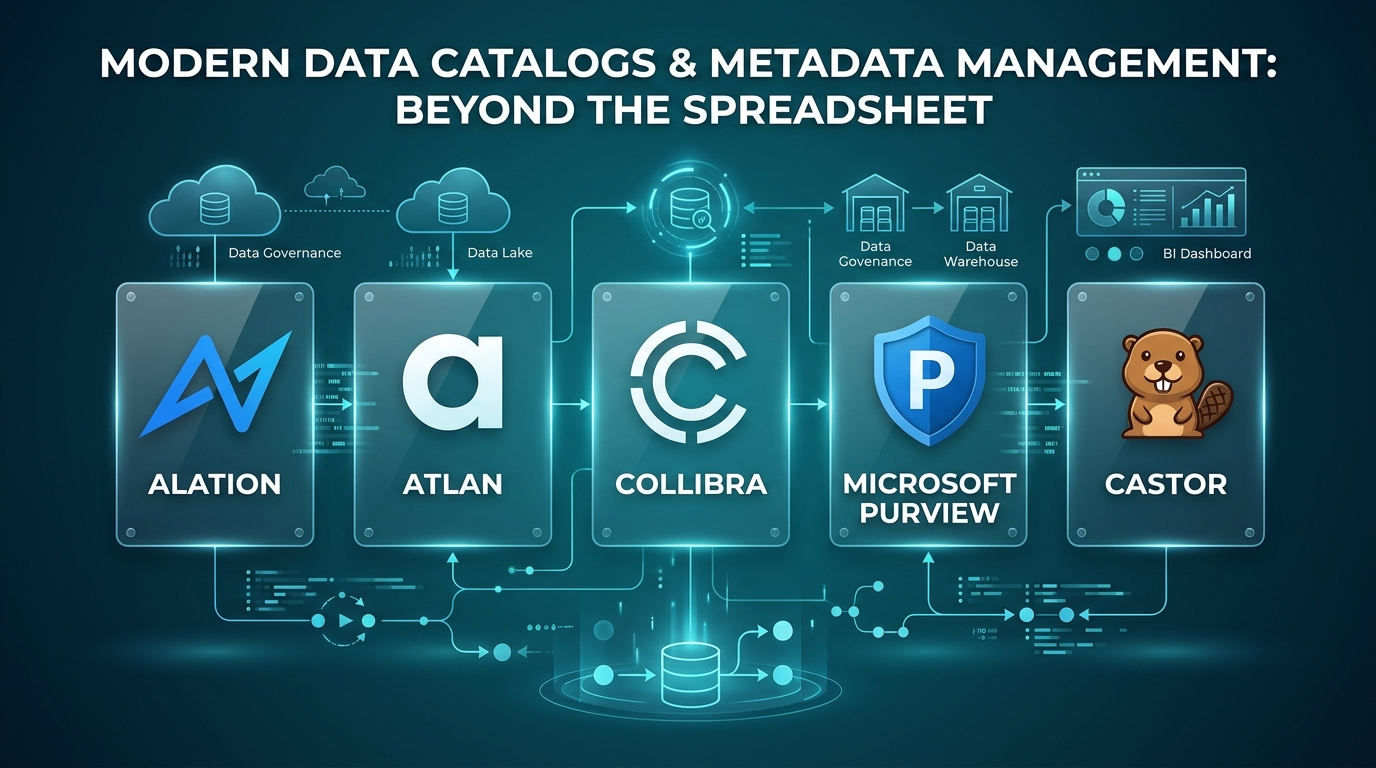
Organizations scaling their modern data stacks frequently encounter a frustrating paradox: despite storing petabytes of valuable information across cloud data warehouses, data lakes, and SaaS applications, data analysts, data scientists, and business stakeholders spend hours searching for the right tables, trying to understand what columns mean, and wondering whether a specific dashboard is built on trustworthy data. When data lineage is invisible and tribal knowledge is locked in the heads of departing engineers, data teams waste countless hours reinventing existing data models and risking regulatory compliance breaches by mismanaging sensitive customer information.
Data Catalog and Metadata Management Tools provide centralized, automated platforms designed to discover, inventory, catalog, and govern data assets across complex multi-cloud architectures. Navigating the modern metadata management landscape requires understanding how platforms differentiate across automated harvesting, data lineage tracking, and active data governance.
Understanding the Core Architecture of Modern Data Catalogs
A data catalog is an organized inventory of data assets across an organization, powered by metadata (data about data). Unlike legacy static spreadsheets or manual data dictionaries that became outdated the moment they were published, modern active data catalogs connect directly to data sources to harvest technical, operational, and business metadata automatically.
A professional metadata management architecture typically governs several critical operational areas:
- Automated Discovery and Harvesting: Continuously scanning cloud data warehouses, object storage lakes, BI reporting tools, and ETL pipelines to catalog new tables, columns, and file schemas automatically.
- End-to-End Data Lineage: Tracing how data flows from source systems through intermediate transformation models (such as dbt) all the way to final business intelligence dashboards.
- Collaborative Business Glossaries: Allowing business and technical teams to attach definitions, ownership tags, and classification labels to specific data assets.
- Active Governance and Policy Enforcement: Monitoring data usage, tagging sensitive Personally Identifiable Information (PII), and enforcing compliance policies across enterprise data estates.
The fundamental objective is to transform an unsearchable data swamp into a transparent, trusted, and easily discoverable marketplace of enterprise data assets.
Key Evaluation Criteria for Metadata Platforms
Selecting an enterprise-grade data catalog and metadata management tool requires examining automated lineage extraction depth, collaboration features, and integration flexibility.
Automated Lineage Extraction and Parsing
Manual lineage mapping is impossible in fast-moving data environments. Leading data catalogs parse SQL queries from data warehouses, integration tools, and transformation codebases automatically to build accurate, multi-hop data lineage graphs.
Active Metadata and Operational Insights
Traditional catalogs served as passive documentation libraries. Modern active catalogs ingest operational metadata—such as query frequency, user popularity, error rates, and cost attribution—allowing teams to identify deprecated tables and optimize expensive data pipelines.
User Experience for Technical and Business Personas
An effective metadata tool must bridge the gap between technical data engineers who need granular schema definitions and non-technical business analysts who need clear definitions, verified badges, and easy data discovery.
Leading Data Catalog and Metadata Management Platforms
The metadata management software market features modern active data discovery platforms alongside comprehensive enterprise governance suites.
Alation
Alation is an enterprise-grade data catalog and governance platform renowned for its strong focus on collaboration, crowdsourced data stewardship, and behavioral analysis.
- Primary Focus: Collaborative data discovery, data governance, and behavioral metadata analytics.
- Deployment Model: Cloud SaaS or hybrid enterprise deployment.
- Significant Advantage: Exceptional focus on user collaboration and machine-learning-driven recommendations that suggest trusted data experts and certified datasets to users.
- Important Limitation: Implementation requires active organizational change management and data stewardship engagement to build robust business glossaries.
Atlan
Atlan is a modern, collaborative active metadata platform built specifically for the modern data stack, offering a developer-friendly user experience and deep integrations with cloud warehouses and transformation tools.
- Primary Focus: Active metadata management, agile data governance, and seamless stack integration.
- Deployment Model: Cloud SaaS platform.
- Significant Advantage: Outstanding modern user interface, developer APIs, and deep integrations with tools like Snowflake, dbt, Airflow, and Looker.
- Important Limitation: Advanced, highly customized enterprise compliance workflows require careful configuration during onboarding.
Collibra Data Intelligence Cloud
Collibra is the undisputed enterprise heavyweight in data governance, data privacy, and comprehensive metadata management, trusted by heavily regulated global financial and healthcare institutions.
- Primary Focus: Enterprise data governance, privacy management, policy enforcement, and compliance tracking.
- Deployment Model: Cloud SaaS platform.
- Significant Advantage: Unmatched depth in regulatory compliance, policy workflows, master data governance, and enterprise-grade security controls.
- Important Limitation: Complex architecture and heavier enterprise licensing make it less agile for rapid, startup-style cloud data teams.
Purview (Microsoft)
Microsoft Purview is a unified data governance and map service designed to manage data across on-premises, multi-cloud, and SaaS environments, deeply integrated into the Microsoft ecosystem.
- Primary Focus: Microsoft-native data governance, sensitive data classification, and multi-cloud cataloging.
- Deployment Model: Fully managed cloud service on Azure.
- Significant Advantage: Frictionless integration with Microsoft 365 security, Azure SQL, Power BI, and enterprise Active Directory compliance policies.
- Important Limitation: Best optimized for enterprises standardized on the Microsoft technology ecosystem.
Castor Data Catalog
Castor is a lightweight, agile data catalog designed specifically for mid-market and cloud-native data teams seeking rapid setup and intuitive search capabilities.
- Primary Focus: Fast setup data discovery, agile metadata search, and team documentation.
- Deployment Model: Cloud SaaS platform.
- Significant Advantage: Exceptionally fast time-to-value with automated setup that catalogs cloud warehouses and BI tools in minutes rather than months.
- Important Limitation: Advanced multi-department enterprise governance and complex compliance workflows are lighter compared to heavy platforms like Collibra.
Platform Comparison Overview
| Product | Primary Focus | Deployment Model | Significant Advantage | Important Limitation |
| Alation | Collaborative data discovery and crowdsourced stewardship | Cloud / Hybrid | Strong focus on user collaboration and intelligent dataset recommendations | Requires active data stewardship and organizational adoption |
| Atlan | Active metadata and modern data stack integration | Cloud SaaS | Exceptional modern UI with deep native integrations (Snowflake, dbt) | Advanced custom compliance workflows require careful setup |
| Collibra | Enterprise data governance and regulatory compliance | Cloud SaaS | Unmatched enterprise governance, privacy tracking, and policy workflows | Complex architecture can feel heavy for agile cloud data teams |
| Microsoft Purview | Multi-cloud data governance and Microsoft ecosystem mapping | Managed Azure | Seamless security integration with Microsoft 365, Azure, and Power BI | Best optimized for organizations standardized on Microsoft tech |
| Castor | Agile, fast-setup data discovery for mid-market teams | Cloud SaaS | Rapid deployment and intuitive search providing fast time-to-value | Lacks deep multi-department enterprise compliance suites |
Operational Risks and Common Pitfalls
Implementing data catalog and metadata management tools without structured stewardship introduces severe adoption hurdles.
Treating the Catalog as a One-Time IT Project
Purchasing a data catalog software license without assigning clear data ownership and stewardship roles, resulting in an empty, unmaintained inventory that teams abandon.
Ingestion Fatigue from Unfiltered Metadata
Allowing automated crawlers to ingest millions of temporary staging tables, log files, and obsolete schemas without curation, cluttering the catalog with unusable noise.
Neglecting Data Lineage Validation
Failing to verify that automated SQL lineage parsers accurately capture complex multi-step transformations, leading to broken dependency graphs in downstream reports.
Questions to Guide Vendor Selection
Before procuring a data catalog and metadata management platform, data engineering leads and governance officers should address several critical operational questions:
- Who are the primary users—data engineers who need technical lineage, or business analysts who need clean business glossaries and certified datasets?
- Does the platform offer automated SQL parsing and lineage integration with our existing transformation tools (such as dbt)?
- What are our compliance and governance requirements—do we need lightweight discovery (Castor/Atlan) or heavy regulatory compliance workflows (Collibra)?
- How easily does the catalog integrate with our existing data warehouse, BI tools, and communication apps (like Slack)?
Making the Final Decision
Choosing a data catalog and metadata management platform depends heavily on an organization’s regulatory maturity, team size, and architectural stack.
Organizations seeking a modern, agile active metadata platform with exceptional integrations across the modern data stack frequently choose Atlan. Enterprises prioritizing crowdsourced data stewardship and collaborative discovery lean toward Alation, while heavily regulated financial and healthcare institutions rely on the rigorous governance depth of Collibra. Organizations embedded in the Microsoft ecosystem achieve seamless security mapping using Purview, whereas mid-market cloud teams seeking rapid deployment choose Castor.
Ultimately, modern data catalogs transform scattered, untrusted data stores into transparent, searchable, and governed enterprise assets, empowering every team to make data-driven decisions with absolute confidence.
