Engineering and data science teams race to adopt large language models (LLMs), retrieval-augmented generation (RAG) pipelines, and fine-tuned machine learning models, connecting internal repositories directly to vector databases and AI training clusters. Organizations quickly discover a severe security blind spot: traditional data security tools protect files at rest in cloud storage, but they cannot inspect what happens when proprietary source code, unmasked customer records, and sensitive intellectual property are ingested into training datasets, cached in vector embeddings, or inadvertently leaked through model inference outputs.
Data Security Posture Management (DSPM) for AI platforms addresses this unique intersection of data governance and artificial intelligence. By discovering, classifying, and monitoring sensitive data specifically within AI training pipelines, vector databases, and model artifacts, this specialized security discipline ensures that innovation does not outpace data privacy.
Understanding the Unique Data Risks in AI Workflows
Securing artificial intelligence pipelines requires looking far beyond traditional storage buckets and database tables. Machine learning workflows introduce entirely new data states and risk vectors that conventional data security tools fail to capture.
A comprehensive AI-focused data security lifecycle typically covers several distinct operational domains:
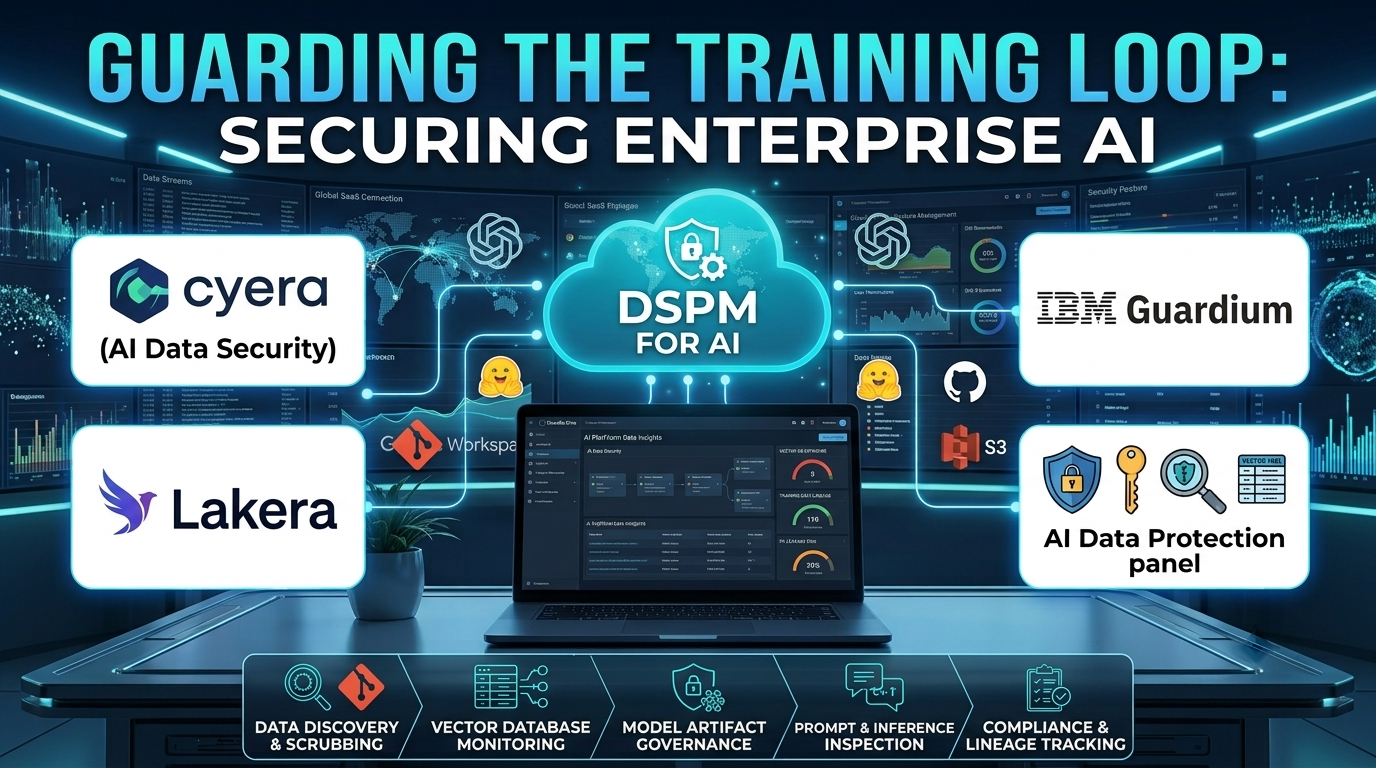
- Training Data Discovery and Scrubbing: Scanning unstructured document stores, Git repositories, and data lakes before ingestion to ensure Personally Identifiable Information (PII), API keys, and trade secrets are stripped out before fine-tuning.
- Vector Database Posture Monitoring: Inspecting vector embeddings and semantic search indexes to ensure that unauthorized users cannot query vector stores and reconstruct sensitive source text through clever prompt engineering.
- Model Artifact and Weights Governance: Auditing where trained model weights, checkpoints, and serialized pickle files are stored, ensuring that intellectual property cannot be exfiltrated or tampered with.
- Prompt and Inference Logging Inspection: Monitoring real-time inference inputs and outputs to prevent users from feeding sensitive internal data into public or third-party LLM endpoints.
The core objective is to prevent data leakage, model poisoning, and regulatory non-compliance without creating bottlenecks that slow down data science experimentation.
Key Evaluation Criteria for AI DSPM Solutions
Selecting an effective Data Security Posture Management platform built for AI environments requires analyzing specialized classification capabilities, vector store support, and integration flexibility.
Vector Database and Embedding Inspection
An effective AI DSPM tool must understand and scan modern vector databases (such as Pinecone, Milvus, Qdrant, or PGvector). It must evaluate how semantic indexes store sensitive source text and whether access controls properly restrict who can query specific vector namespaces.
Training Pipeline Integration and Git Scanning
Data scientists frequently pull datasets from Hugging Face, internal S3 buckets, and GitHub repositories. Security platforms must integrate directly into data ingestion pipelines and MLOps workflows to scan training corpora before models ever begin training epochs.
Regulatory Compliance and Data Lineage Tracking
With regulations like the European Union Artificial Intelligence Act enforcing strict data governance on high-risk AI systems, enterprises need automated data lineage reporting that proves exactly what datasets were used to train a specific model version.
Leading Platforms and Approaches in AI Data Security
The security market features specialized AI posture management startups alongside established cloud data security vendors expanding their classification engines to cover LLM workflows.
Cyera (AI Data Security Extensions)
Cyera has expanded its agentless multi-cloud DSPM capabilities to discover and classify sensitive data specifically within AI training pipelines and vector storage repositories.
- Primary Focus: Agentless multi-cloud discovery of AI training data and vector database exposure.
- Deployment Model: SaaS platform connecting via read-only cloud APIs.
- Significant Advantage: Rapid discovery of shadow AI datasets scattered across unmanaged cloud object storage and development environments.
- Important Limitation: Specialized focus on static data posture means real-time prompt injection blocking requires complementary LLM firewall tools.
IBM Guardium / Specialized MLOps Governance Tools
Enterprise data governance leaders provide robust compliance tracking and data lineage tools tailored for heavily regulated machine learning environments.
- Primary Focus: Enterprise-scale data lineage tracking, compliance reporting, and model governance.
- Deployment Model: Hybrid deployment options including SaaS and on-premises collectors.
- Significant Advantage: Exceptional audit-ready compliance reporting tailored for financial institutions and healthcare providers deploying AI.
- Important Limitation: Enterprise architecture can be complex to deploy across agile, fast-moving data science developer teams.
Lakera / Specialized AI Guardrails and Posture Tools
Platforms focusing explicitly on LLM security, prompt defense, and training data vulnerability assessment provide deep inspection of model inputs and outputs.
- Primary Focus: LLM vulnerability assessment, prompt security, and training data leakage prevention.
- Deployment Model: API-based integration and proxy gateways.
- Significant Advantage: Exceptional protection against prompt injection, data extraction attacks, and toxic training data ingestion.
- Important Limitation: Concentrates heavily on runtime LLM interactions rather than broad multi-cloud data repository posture management.
Platform Comparison Overview
| Product | Primary Focus | Deployment Model | Significant Advantage | Important Limitation |
| Cyera (AI DSPM) | Multi-cloud discovery of AI training sets and vector stores | SaaS API Connector | Rapid agentless identification of hidden shadow AI data repositories | Focused primarily on data posture rather than active inference blocking |
| Lakera | LLM security, prompt defense, and data leakage prevention | API Proxy / Gateway | Superior real-time defense against prompt injection and data extraction | Specialized for runtime LLM interactions over broad cloud data hygiene |
| IBM Guardium | Enterprise data lineage, compliance, and governance | Hybrid / SaaS | Robust audit frameworks for highly regulated AI deployments | Geared toward heavy enterprise compliance structures |
Operational Risks and Common Pitfalls
Deploying machine learning infrastructure without dedicated AI data posture management introduces significant operational vulnerabilities.
The Illusion of Anonymization in Vector Embeddings
Data science teams often assume that converting sensitive text into vector embeddings removes privacy risks. In reality, modern inversion techniques can often reconstruct original text from embeddings, making unsecured vector databases a major data leakage vector.
Shadow AI and Uncontrolled Model Fine-Tuning
Developers frequently spin up open-source models on rented cloud GPUs, feeding unvetted internal customer databases into fine-tuning scripts without security oversight.
Treating AI Security as an Afterthought
Attempting to bolt security onto a finished production LLM application is rarely effective. Data hygiene and posture management must begin at the dataset collection phase.
Questions to Guide Vendor Selection
Before procuring a Data Security Posture Management platform for AI, security architects and machine learning leaders should address several critical operational questions:
- How effectively does the platform scan and classify data inside vector databases and semantic search indexes?
- Can the tool trace complete data lineage—proving exactly which training datasets and source files were used to build a specific model version?
- How smoothly does the solution integrate into MLOps pipelines and Git repositories without slowing down data science iteration speed?
- Does the platform distinguish between public training benchmarks and proprietary corporate intellectual property?
Making the Final Decision
Choosing a DSPM solution for AI platforms depends heavily on an organization’s primary AI risk profile.
Organizations deploying custom RAG architectures and vector databases across multi-cloud environments benefit greatly from data-centric posture platforms like Cyera to secure underlying training sets and embeddings. Conversely, enterprises exposing customer-facing LLM chatbots prioritize runtime guardrail and prompt security tools like Lakera to prevent data exfiltration in real time.
Ultimately, Data Security Posture Management for AI ensures that enterprises can harness the transformative power of generative intelligence without sacrificing data privacy or regulatory compliance.
