Organizations migrating applications and databases to multi-cloud environments invest heavily in perimeter firewalls, identity providers, and infrastructure posture scanners, operating under the assumption that securing the underlying servers automatically secures the files, databases, and intellectual property stored within them. However, data leaks rarely stem from broken hypervisors; they happen because sensitive customer records, financial tables, and proprietary source code end up in unencrypted cloud buckets, misconfigured database replicas, or overly permissive data lakes accessible to anyone with a valid token.
Traditional Data Loss Prevention (DLP) tools and legacy file integrity monitors struggle in modern cloud-native environments where data is constantly created, copied, and shared across distributed object storage and managed databases. Data Security Posture Management (DSPM) addresses this critical visibility gap by focusing explicitly on where sensitive data lives, who can access it, and how it is exposed across the entire enterprise digital estate.
Understanding the Scope of Data Security Posture Management
Data Security Posture Management encompasses automated technologies designed to discover, classify, map, and remediate security risks specifically targeting data stores across cloud infrastructure, SaaS repositories, and hybrid environments.
Unlike infrastructure-focused posture tools that check if a cloud storage bucket is public, DSPM inspects the actual contents of the storage bucket or database to determine if it contains personally identifiable information (PII), protected health information (PHI), intellectual property, or financial records.
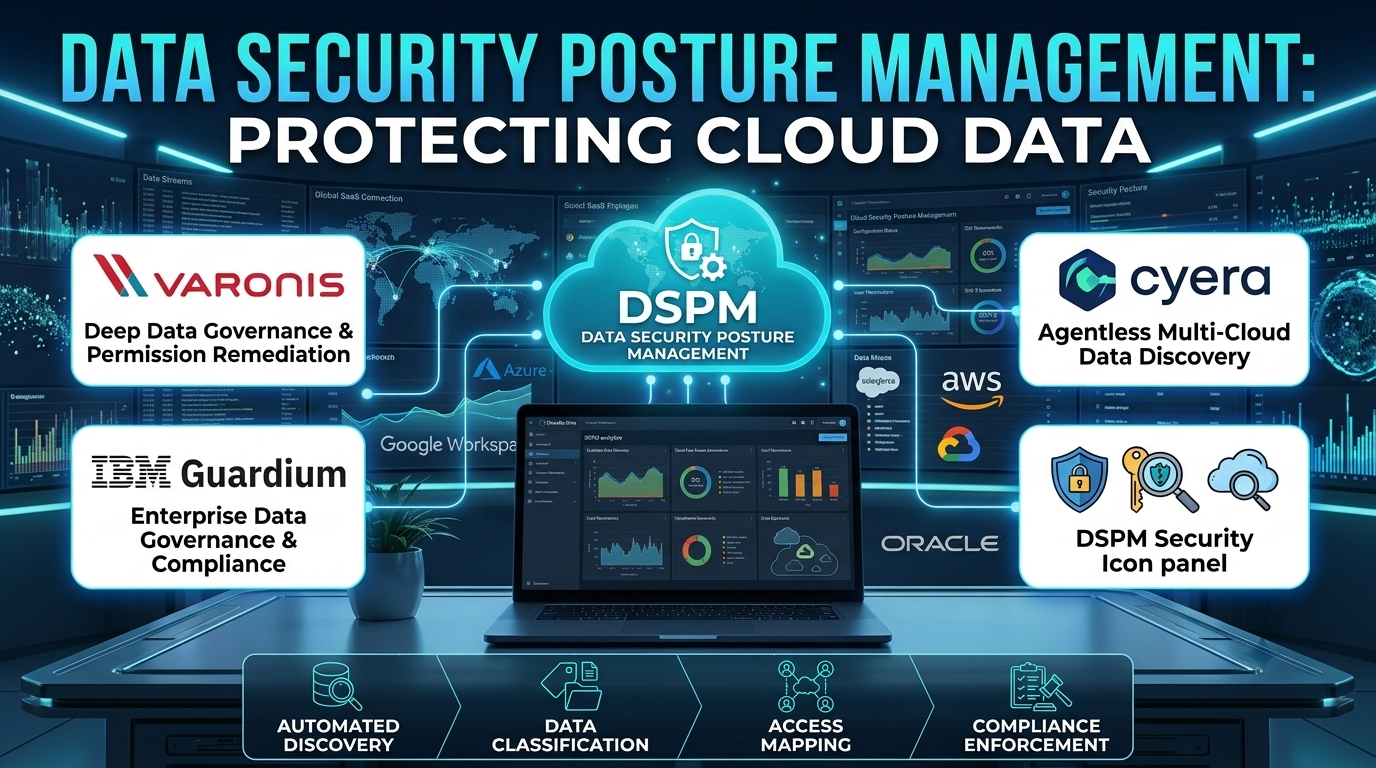
A comprehensive DSPM framework typically manages several core operational pillars:
- Automated Discovery and Classification: Scanning multi-cloud object storage (such as AWS S3 or Azure Blob), managed relational databases, NoSQL databases, and data warehouses to identify where sensitive data resides without relying on manual tagging.
- Data Flow and Access Mapping: Tracing who has access to specific datasets—including external users, third-party applications, and over-privileged service accounts—to reveal actual exposure paths.
- Risk Prioritization and Vulnerability Correlation: Evaluating whether sensitive datasets are encrypted at rest, exposed to public networks, or associated with weak access controls.
- Remediation and Compliance Enforcement: Providing actionable guidance or automated fixes to revoke unsafe permissions, apply encryption, or relocate misclassified data to secure repositories.
The core objective is to shift data protection from reactive compliance reporting to proactive discovery and risk reduction.
Key Evaluation Criteria for DSPM Solutions
Selecting an effective Data Security Posture Management platform requires analyzing classification accuracy, multi-cloud depth, and scalability.
Classification Engine Accuracy and AI Integration
An effective DSPM tool must accurately distinguish between generic text and highly regulated data using advanced machine learning models and pattern matching. High false-positive rates quickly overwhelm security teams and disrupt engineering operations.
Multi-Cloud and Hybrid Storage Coverage
Modern enterprises store data across multiple hyperscalers, on-premises network-attached storage (NAS), and SaaS collaboration platforms. A robust DSPM solution must provide unified visibility across AWS, Azure, Google Cloud, and private data repositories from a single pane of glass.
Contextual Access Analysis versus Static Scanning
Knowing that a database contains sensitive records is only half the battle. Leading DSPM platforms map the complete context—combining data sensitivity, user access privileges, and network exposure—to calculate real-world risk rather than just reporting static file counts.
Leading Data Security Posture Management Platforms
The DSPM market features specialized data security innovators alongside major enterprise cloud security platform vendors.
Varonis Data Security Platform
Varonis brings decades of data governance and security expertise to the cloud, providing deep discovery, classification, and automated remediation across cloud storage and hybrid data stores.
- Primary Focus: Deep data classification, insider threat detection, and automated remediation of over-shared data.
- Deployment Model: SaaS-delivered cloud platform with hybrid collector nodes.
- Significant Advantage: Exceptional granularity in identifying user behavior anomalies and cleaning up stale, over-exposed data permissions.
- Important Limitation: Initial deployment and permission analysis across massive unstructured data repositories require careful administrative tuning.
Cyera
Cyera delivers an agentless, cloud-native DSPM platform designed to discover and classify sensitive data across multi-cloud infrastructure and SaaS applications rapidly.
- Primary Focus: Agentless multi-cloud data discovery, classification, and posture management.
- Deployment Model: SaaS platform connecting via read-only cloud APIs.
- Significant Advantage: Fast, frictionless agentless onboarding that maps data landscapes and exposure risks within minutes of deployment.
- Important Limitation: Focuses primarily on data posture discovery and risk scoring, requiring integration with other tools for active inline data protection.
IBM Guardium Data Security Center
IBM provides comprehensive data security and posture management capabilities, helping organizations govern sensitive data flows across complex hybrid enterprise architectures.
- Primary Focus: Enterprise-scale data security governance, compliance reporting, and posture management.
- Deployment Model: Hybrid deployment options including SaaS and on-premises appliances.
- Significant Advantage: Robust compliance reporting frameworks tailored for heavily regulated financial and healthcare institutions.
- Important Limitation: Enterprise architecture and deployment complexity cater primarily to large organizations with mature compliance teams.
Platform Comparison Overview
| Product | Primary Focus | Deployment Model | Significant Advantage | Important Limitation |
| Varonis | Deep data governance and permission remediation | SaaS / Hybrid Collectors | Superior handling of unstructured data permissions and access hygiene | Initial permission mapping across large repositories takes time |
| Cyera | Agentless multi-cloud data discovery and posture | SaaS API Connector | Rapid agentless deployment and instant data asset visibility | Primarily focused on posture assessment rather than inline blocking |
| IBM Guardium | Enterprise data security and regulatory compliance | Hybrid / SaaS | Exceptional compliance reporting for highly regulated sectors | Geared toward enterprise budgets and specialized operational teams |
Operational Risks and Common Pitfalls
Deploying a DSPM program introduces specific organizational and technical challenges that security leaders must navigate carefully.
Uncovering an Overwhelming Volume of Sensitive Data
Initial DSPM scans frequently reveal that sensitive customer or employee data is scattered across hundreds of unmanaged development buckets and forgotten test databases. Without clear data ownership policies, security teams become overwhelmed by remediation tasks.
Performance Impact of Deep Content Scanning
Scanned datasets must be analyzed for regex patterns and machine learning classifiers. Poorly configured scanning schedules can increase cloud storage API costs or consume unnecessary network bandwidth if not optimized properly.
Treating DSPM as a Purely Compliance Checkbox
Deploying DSPM solely to pass annual regulatory audits without establishing ongoing data hygiene workflows and engineering remediation SLAs leaves organizations vulnerable to continuous data drift.
Questions to Guide Vendor Selection
Before procuring a DSPM platform, security architects and data protection officers should address several critical operational questions:
- How does the platform discover data? Does it require installing resource-heavy agents on every server, or does it operate via agentless, read-only cloud APIs?
- What machine learning models or classification techniques are used to minimize false positives when scanning proprietary or custom data formats?
- How effectively does the platform map who actually has access to sensitive files, distinguishing between internal employees, third-party contractors, and public links?
- What automated remediation options are available to revoke dangerous permissions or encrypt unencrypted buckets without breaking business workflows?
Making the Final Decision
Choosing a Data Security Posture Management platform depends heavily on an organization’s data architecture, regulatory environment, and security maturity.
Organizations seeking rapid, frictionless visibility across multi-cloud object storage and SaaS repositories frequently favor agentless platforms like Cyera. Conversely, enterprises managing complex hybrid environments with extensive unstructured file shares and strict insider threat concerns often benefit from comprehensive governance platforms like Varonis.
Ultimately, Data Security Posture Management ensures that organizations know precisely where their most valuable data lives, who can access it, and how well it is protected against modern cloud threats.
