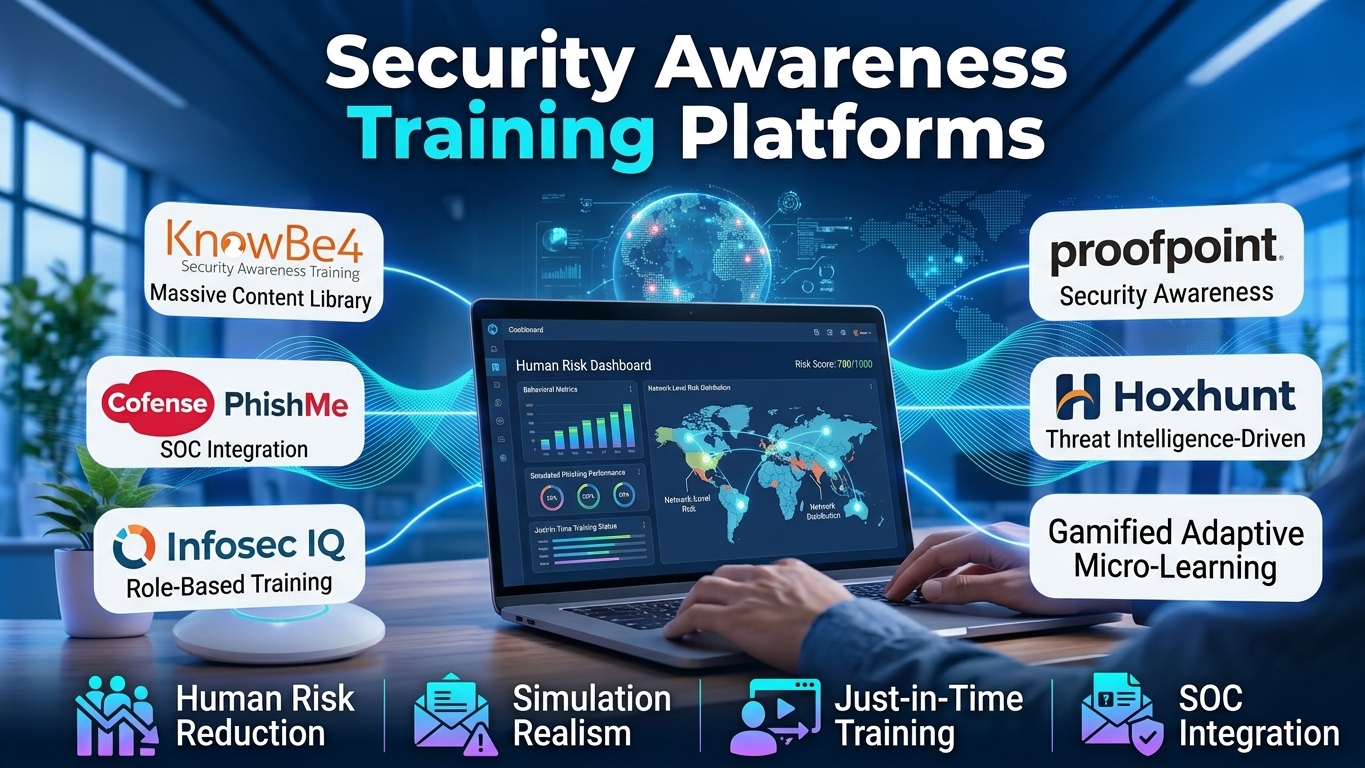
Organizations invest heavily in advanced perimeter firewalls, endpoint detection and response (EDR) agents, zero-trust architectures, and encrypted cloud environments, yet cybercriminals continue to breach enterprises through the easiest vulnerability available: human error. A single employee clicking a convincing phishing link, approving a fraudulent multi-factor authentication (MFA) push notification, or misconfiguring a cloud permission can bypass millions of dollars in perimeter security controls.
Traditional security awareness training—consisting of an annual, generic slide deck and a superficial quiz that employees clicked through blindly—failed to alter corporate culture or reduce actual risk. Modern Security Awareness Training Platforms (SATP) have evolved into data-driven human risk management (HRM) engines that utilize behavioral analytics, automated phishing simulations, and micro-learning to measure and reduce human vulnerability. Selecting the right training platform requires understanding how modern solutions differentiate in behavioral tracking, simulation realism, and risk quantification.
Understanding the Shift to Human Risk Management
Security awareness training platforms are enterprise software solutions designed to educate employees on cyber threats, test their susceptibility to social engineering, and measure behavioral change over time.
The security industry has shifted away from viewing user training as a compliance checkbox and toward treating employees as the final, critical line of defense in an integrated risk mitigation strategy.
A professional security awareness platform typically manages several core operational workflows:
- Automated Phishing Simulations: Deploying realistic, randomized phishing campaigns (via email, SMS, and collaboration apps) to test employee vigilance and identify high-risk individuals or departments.
- Targeted Micro-Learning Modules: Delivering short, engaging, scenario-based video training modules precisely when an employee fails a phishing simulation or exhibits risky behavior.
- Behavioral Analytics and Risk Scoring: Aggregating data across simulation performance, reporting habits, and security incidents to calculate a continuous human risk score for every user.
- Integration with Security Operations: Allowing employees to report suspicious emails with a single click, automatically feeding verified phishing attempts directly into security incident response queues.
The core objective is to replace rigid compliance training with adaptive education that fosters a proactive, security-conscious corporate culture.
Key Evaluation Criteria for Security Awareness Platforms
Selecting an enterprise security training platform requires examining content quality, phishing simulation sophistication, and risk quantification analytics.
Phishing Simulation Realism and Customization
Attackers leverage current events, generative AI, and sophisticated impersonation tactics. An effective SATP must provide a massive, continuously updated library of localized phishing templates alongside easy tools for security teams to build customized campaigns reflecting real-world organizational threats.
Behavioral Metrics versus Completion Rates
Measuring success solely by whether an employee finished a training video is an outdated metric. Leading platforms track true behavioral change—such as whether a repeated “clicker” learns to report suspicious emails and reduces their overall risk score over time.
Automated Remediation and Just-in-Time Training
When an employee interacts with a simulated phishing email, waiting months for the next scheduled training session is ineffective. Exceptional platforms trigger automated, instant “just-in-time” micro-learning moments right at the moment of failure to reinforce positive habits immediately.
Leading Security Awareness Training Platforms
The security awareness training market features established industry heavyweights alongside specialized behavioral analytics and human risk management innovators.
KnowBe4 Security Awareness Training
KnowBe4 is the undisputed global market leader in security awareness training, renowned for its massive content library, automated phishing simulation engine, and robust reporting dashboards.
- Primary Focus: Comprehensive security awareness training, extensive content library, and automated phishing simulations.
- Deployment Model: Cloud-native SaaS platform with flexible licensing tiers.
- Significant Advantage: Unmatched content catalog featuring thousands of modules, compliance courses, and localized templates translated into dozens of languages.
- Important Limitation: Massive content volume can occasionally require careful curation to avoid overwhelming administrators and employees with repetitive courses.
Proofpoint Security Awareness (formerly Wombat Security)
Proofpoint delivers enterprise-grade security awareness training backed by world-class threat intelligence derived from actual malicious email traffic intercepted across global enterprise gateways.
- Primary Focus: Threat-intelligence-driven training, targeted attack simulation, and risk reduction analytics.
- Deployment Model: Cloud SaaS platform integrated with enterprise email security tools.
- Significant Advantage: Training scenarios directly mirror live threats intercepted by Proofpoint’s enterprise email gateways, ensuring employees train on authentic, active attack campaigns.
- Important Limitation: Enterprise licensing structure and administrative reporting suite are optimized primarily for large, mature security organizations.
Infosec IQ (by Skillsoft)
Infosec IQ provides highly customizable, engaging training modules paired with robust role-based learning paths tailored for both general employees and technical IT professionals.
- Primary Focus: Role-based cybersecurity education, developer training, and flexible phishing simulations.
- Deployment Model: Cloud SaaS platform.
- Significant Advantage: Excellent distinction between general employee awareness and specialized technical training paths for developers and IT administrators.
- Important Limitation: Broad Skillsoft ecosystem integration can introduce additional platform complexity for smaller teams.
Cofense PhishMe
Cofense pioneered automated phishing simulation and rapid employee incident reporting, focusing heavily on turning employees into active human sensors for the security operations center.
- Primary Focus: Phishing simulation, automated reporting workflows, and human-verified threat intelligence.
- Deployment Model: Cloud-native SaaS platform with dedicated email reporting plugins.
- Significant Advantage: Exceptional employee reporting workflows that enable security teams to triage real-world phishing attacks verified by internal staff.
- Important Limitation: Content library for general cybersecurity compliance is more focused on phishing defense rather than broad regulatory training modules.
Hoxhunt
Hoxhunt utilizes gamification, behavioral psychology, and adaptive machine learning to deliver a highly personalized, automated security training experience tailored to each individual employee.
- Primary Focus: Gamified, behavior-driven security awareness and automated adaptive training paths.
- Deployment Model: Cloud SaaS platform integrated natively into Microsoft 365 and Google Workspace.
- Significant Advantage: Exceptional employee engagement rates driven by gamified design and adaptive difficulty that scales with individual user proficiency.
- Important Limitation: Highly automated approach offers less manual administrative control for organizations preferring rigid, compliance-mandated curriculum structures.
Platform Comparison Overview
| Product | Primary Focus | Deployment Model | Significant Advantage | Important Limitation |
| KnowBe4 | Massive content catalog and automated phishing simulation | Cloud SaaS | Industry-leading content library and global language support | Massive catalog requires careful administrative curation |
| Proofpoint Security Awareness | Threat-intelligence-driven training and simulation | Cloud SaaS | Training content powered by real-world enterprise email threat data | Geared primarily toward mature enterprise security structures |
| Infosec IQ | Role-based education for general staff and IT pros | Cloud SaaS | Excellent distinction between general user and technical developer training | Ecosystem integration can add setup complexity for small teams |
| Cofense PhishMe | Phishing simulation and employee incident reporting | Cloud SaaS | Superior employee reporting plugins and SOC triage workflows | Content focus centers tightly on phishing over broad compliance |
| Hoxhunt | Gamified, behavior-driven adaptive micro-learning | Cloud SaaS | Exceptional user engagement through gamification and adaptive difficulty | Automated approach provides less manual administrative control |
Operational Risks and Common Pitfalls
Implementing a security awareness training platform without thoughtful change management can backfire on corporate culture.
Punitive Phishing Campaigns Creating Resentment
Using overly deceptive, trick-based phishing simulations designed to humiliate employees who fail creates an atmosphere of fear and distrust, driving employees to hide mistakes rather than reporting them.
Treating Training as a Replacement for Technical Controls
Relying on user training to compensate for unpatched software, weak email gateway filters, or missing MFA is a flawed strategy. Training supports security; it does not replace technical defenses.
Training Fatigue from Over-Testing
Bombarding employees with weekly phishing tests and lengthy video modules causes “training fatigue,” leading users to click through materials mindlessly without absorbing critical security lessons.
Questions to Guide Vendor Selection
Before procuring a security awareness training platform, CISOs and security operations leaders should address several critical operational questions:
- How realistic and adaptable is the phishing simulation engine? Can it dynamically adjust difficulty based on individual employee performance?
- What behavioral analytics are provided? Does the platform calculate an actionable human risk score rather than just tracking training completion percentages?
- How frictionless is the employee reporting mechanism? Is there a one-click button that feeds reported phishing emails directly into incident response workflows?
- Does the platform offer localized content and training modules in the languages spoken across our global office locations?
Making the Final Decision
Choosing a security awareness training platform depends heavily on an organization’s corporate culture, security maturity, and training objectives.
Organizations seeking an expansive, highly configurable content catalog with global language support frequently choose industry standards like KnowBe4. Enterprises prioritizing threat-intelligence alignment leverage Proofpoint, while organizations looking to maximize employee engagement through gamification and behavioral psychology often choose Hoxhunt.
Ultimately, modern security awareness training platforms transform employees from the weakest link in the corporate security chain into vigilant, active defenders of the enterprise.
