Introduction
Ontology management tools help organizations define, organize, maintain, and govern formal representations of knowledge across different business and technical domains. These tools establish meaningful relationships between concepts, entities, classifications, attributes, and information resources.
Modern organizations frequently maintain information across databases, enterprise applications, document repositories, research platforms, and analytical environments. Differences in terminology, information structures, and business definitions can create significant challenges when integrating and interpreting distributed information.
Ontology management platforms provide capabilities for semantic modeling, vocabulary development, relationship management, knowledge representation, and ontology validation. These functionalities help organizations establish consistent information definitions and improve interoperability between heterogeneous technology environments.
Advanced ontology management tools support semantic reasoning, collaborative knowledge engineering, automated classification, version management, and knowledge graph integration. These capabilities are particularly relevant to enterprise knowledge management, scientific research, regulatory compliance, and Artificial Intelligence (AI) applications.
Different ontology management tools address varying semantic modeling requirements, collaboration preferences, governance objectives, and technical architectures. Selecting appropriate software requires evaluating supported ontology standards, reasoning capabilities, usability, integration options, scalability, security, and total ownership expenses.
This guide examines ten ontology management tools, including their features, benefits, advantages, limitations, and practical applications. It also provides comparison tables, implementation recommendations, performance indicators, security considerations, and frequently asked questions.
What Are Ontology Management Tools?
Ontology management tools are software systems designed to create, edit, organize, validate, publish, and maintain formal knowledge models. These models describe concepts, classifications, properties, relationships, and logical rules within specific domains.
Ontologies provide structured representations of knowledge that allow people and compatible computer systems to interpret information consistently. They can define relationships between concepts, establish classification hierarchies, and support logical conclusions through appropriate semantic reasoning mechanisms.
Ontology management tools frequently support standards such as the Resource Description Framework (RDF), RDF Schema (RDFS), Web Ontology Language (OWL), and Simple Knowledge Organization System (SKOS). These standards address different aspects of knowledge representation, semantic interoperability, vocabulary management, and formal ontology development.
Effective ontology management requires domain expertise, consistent modeling practices, reliable validation procedures, and appropriate governance policies. Ontology management platforms support these requirements through graphical editing interfaces, collaborative development capabilities, semantic validation, and integration with knowledge graph technologies.
How Ontology Management Tools Work
- Identify domain knowledge requirements and organizational objectives.
- Define important concepts, entities, classifications, and terminology.
- Select appropriate semantic modeling standards.
- Develop ontology classes, properties, and relationships.
- Establish logical restrictions and semantic rules where required.
- Import existing ontologies and reusable knowledge vocabularies.
- Validate ontology structures and evaluate semantic consistency.
- Coordinate collaborative review and controlled ontology changes.
- Publish approved ontologies to compatible applications and knowledge graphs.
- Monitor ontology usage, quality, governance, and continuing maintenance requirements.
Common Applications of Ontology Management Tools
- Enterprise knowledge management.
- Semantic information integration.
- Knowledge graph development.
- Scientific knowledge representation.
- Biomedical terminology management.
- Pharmaceutical research.
- Healthcare information interoperability.
- Regulatory compliance classification.
- Enterprise information governance.
- Product information classification.
- Intelligent recommendation systems.
- Semantic search applications.
- Digital asset organization.
- Linked data publishing.
- Artificial intelligence knowledge grounding.
- Financial information standardization.
- Industrial asset classification.
- Academic research knowledge modeling.
Essential Components of Ontology Management Tools
| Component | Purpose |
|---|---|
| Ontology editor | Creates and modifies formal knowledge models |
| Class hierarchy | Organizes concepts into structured classifications |
| Property manager | Defines attributes and relationships between concepts |
| Semantic reasoner | Derives supported logical conclusions |
| Validation framework | Evaluates ontology consistency and modeling requirements |
| Vocabulary manager | Maintains standardized terminology |
| Version management | Tracks changes to ontology structures |
| Collaboration framework | Supports coordinated ontology development |
| Metadata repository | Maintains contextual information about knowledge models |
| Import and export interfaces | Exchange ontologies between compatible systems |
| Visualization tools | Display semantic relationships and concept hierarchies |
| Governance framework | Establishes ownership and approval responsibilities |
| Publishing mechanisms | Deliver approved ontologies to downstream applications |
| Security administration | Protects ontology resources and development activities |
Top 10 Ontology Management Tools
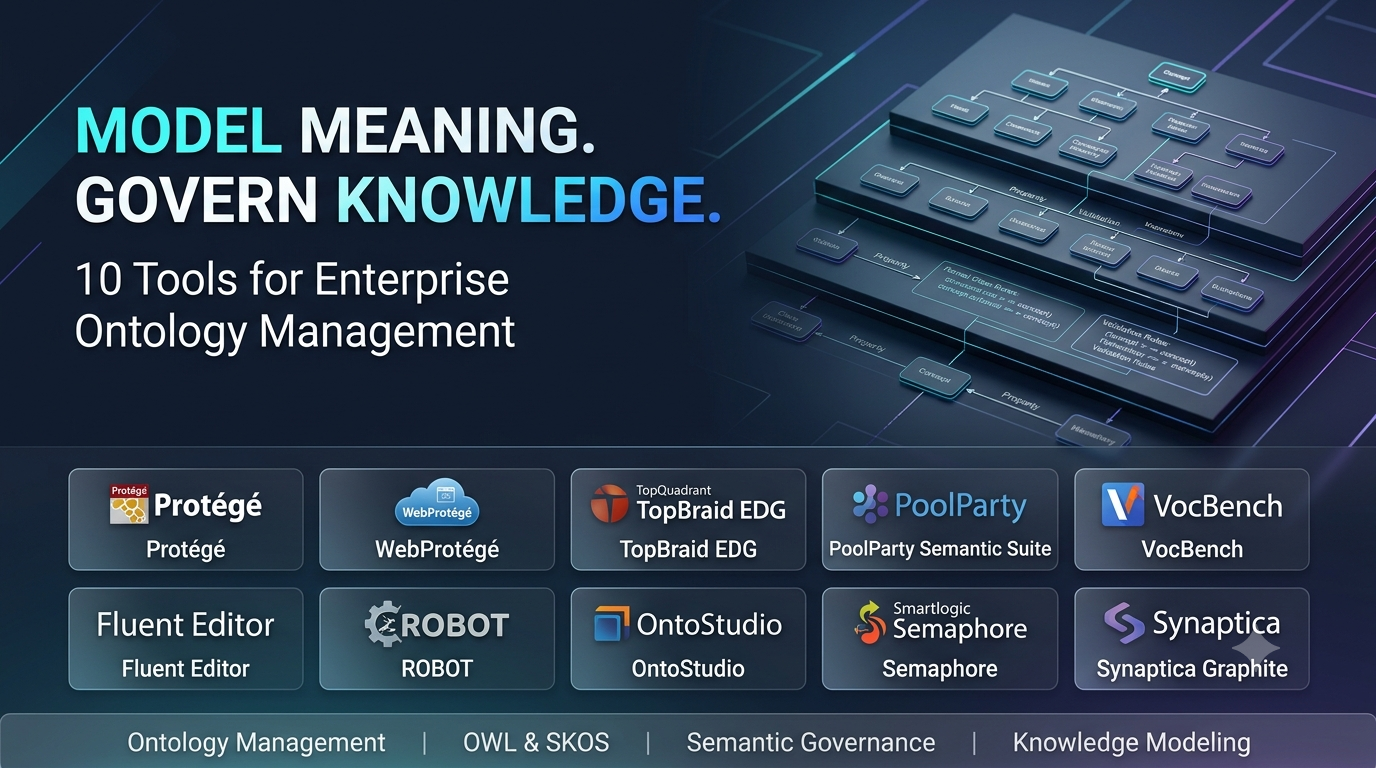
The following tools include dedicated ontology editors, collaborative semantic modeling platforms, vocabulary management systems, and enterprise knowledge engineering environments. Their numbering represents presentation order rather than an independently tested performance ranking.
1. Protégé
Short Description
Protégé is an open-source ontology editor developed through Stanford University’s biomedical informatics research community. It provides graphical tools for creating, editing, and maintaining formal ontologies using established semantic web standards.
The platform supports OWL ontology development, class hierarchy management, property definition, and integration with compatible semantic reasoners. Its extensible architecture allows developers and researchers to incorporate additional functionality through supported plugins.
Protégé provides interfaces for defining ontology classes, object properties, data properties, individuals, and logical restrictions. These capabilities help knowledge engineers establish formal representations of domain-specific concepts and relationships.
The desktop application is particularly relevant to academic research, semantic web development, biomedical knowledge modeling, and independent ontology engineering projects. Collaborative enterprise governance may require complementary technologies or the separate WebProtégé environment.
Key Features
- Graphical OWL ontology editing.
- RDF and RDFS compatibility.
- Class hierarchy development.
- Object and data property management.
- Individual entity management.
- Semantic reasoner integration.
- Ontology import and export.
- Extensible plugin architecture.
- Logical restriction modeling.
Benefits
- Reduces ontology development licensing expenses.
- Supports formal knowledge representation.
- Facilitates standardized semantic modeling.
- Enables ontology consistency evaluation.
- Supports reusable knowledge structures.
- Improves domain concept organization.
- Facilitates academic and research applications.
Pros
- Open-source software availability.
- Established ontology development ecosystem.
- Extensive academic documentation.
- Supports formal semantic standards.
- Compatible with multiple reasoners.
- Flexible plugin architecture.
Cons
- Advanced ontology modeling requires specialist expertise.
- Desktop collaboration capabilities are limited.
- Enterprise governance requires complementary tools.
- Large ontologies may require substantial computing resources.
- User interface complexity can affect beginners.
Use Cases: Biomedical ontology development, academic research, semantic web applications, domain knowledge modeling, knowledge graph preparation, and formal vocabulary development.
Best For: Knowledge engineers, ontology developers, academic researchers, semantic web specialists, university students, and open-source technology teams.
2. WebProtégé
Short Description
WebProtégé is a browser-based collaborative ontology development environment associated with the Protégé ecosystem. It enables distributed teams to create, review, and maintain OWL ontologies through shared online workspaces.
The platform provides collaborative editing, change tracking, discussion capabilities, and configurable project access. These features help organizations coordinate ontology development activities involving multiple domain experts and knowledge engineers.
WebProtégé supports class hierarchy development, entity editing, property management, and ontology documentation. Its browser-based architecture reduces the need for individual desktop ontology editing installations.
The platform is particularly relevant to research collaborations and distributed ontology development teams. Organizations requiring advanced reasoning, enterprise publishing, or specialized governance workflows may need complementary technologies.
Key Features
- Browser-based ontology editing.
- Collaborative ontology development.
- OWL ontology support.
- Shared project workspaces.
- Ontology change history.
- Entity discussion capabilities.
- Configurable project permissions.
- Class and property management.
- Ontology import and export.
Benefits
- Facilitates distributed knowledge engineering.
- Reduces isolated ontology development activities.
- Improves collaboration between domain experts.
- Supports transparent ontology changes.
- Enables centralized knowledge model development.
- Facilitates ontology review processes.
- Reduces desktop software deployment requirements.
Pros
- Open-source collaborative environment.
- Accessible browser-based interface.
- Supports shared ontology projects.
- Integrated change tracking.
- Relevant discussion functionality.
- Established semantic modeling foundation.
Cons
- Advanced desktop editing functionality may differ.
- Hosting and administration require planning.
- Enterprise governance may require additional tools.
- Complex ontologies require specialist expertise.
- Reasoning capabilities depend on deployment and integrations.
Use Cases: Collaborative ontology development, scientific research projects, distributed terminology management, academic knowledge engineering, ontology review, and shared semantic modeling.
Best For: Distributed research teams, universities, collaborative knowledge engineers, academic institutions, ontology review teams, and open-source semantic projects.
3. TopBraid EDG
Short Description
TopBraid Enterprise Data Governance (EDG) provides enterprise semantic information management, ontology development, and governance capabilities. It helps organizations establish controlled knowledge models, business vocabularies, taxonomies, and interconnected information assets.
The platform supports RDF, OWL, SKOS, and Shapes Constraint Language (SHACL) technologies for semantic modeling and validation. Its architecture combines knowledge graph management with configurable enterprise governance workflows.
TopBraid EDG enables organizations to develop reusable semantic models and coordinate changes through appropriate approval processes. Its capabilities support collaboration between technical specialists, business stakeholders, and information governance teams.
The platform is particularly relevant to large enterprises requiring formal semantic modeling alongside accountable information management practices. Commercial implementation generally requires architectural planning, appropriate licensing, and continuing administrative resources.
Key Features
- Enterprise ontology development.
- RDF and OWL modeling.
- SKOS vocabulary management.
- SHACL-based validation.
- Collaborative knowledge engineering.
- Configurable governance workflows.
- Knowledge graph management.
- Ontology versioning capabilities.
- Enterprise information stewardship.
Benefits
- Strengthens enterprise ontology governance.
- Supports standardized knowledge representation.
- Improves semantic information consistency.
- Facilitates controlled ontology changes.
- Enables collaborative knowledge management.
- Supports reusable enterprise vocabularies.
- Improves semantic validation practices.
Pros
- Comprehensive enterprise semantic capabilities.
- Strong standards-based architecture.
- Integrated governance workflows.
- Relevant ontology validation functionality.
- Supports multiple knowledge asset types.
- Suitable for complex enterprise environments.
Cons
- Commercial licensing requires consultation.
- Enterprise implementation can be complex.
- Advanced semantic modeling requires expertise.
- Governance workflows require configuration.
- Smaller projects may not require its full capabilities.
Use Cases: Enterprise ontology governance, business glossary development, knowledge graph management, regulatory terminology management, semantic data integration, and enterprise information modeling.
Best For: Large enterprises, information governance teams, semantic architects, knowledge engineers, regulated organizations, and enterprise information stewards.
4. PoolParty Semantic Suite
Short Description
PoolParty Semantic Suite provides enterprise semantic information management capabilities involving taxonomy development, ontology modeling, knowledge graphs, and contextual information enrichment. It helps organizations establish standardized knowledge structures across distributed information environments.
The platform supports semantic vocabulary management and relationships between business concepts using established semantic web technologies. Compatible text analysis and entity extraction capabilities can help organizations connect unstructured information with controlled knowledge models.
PoolParty provides collaborative knowledge organization interfaces designed to support taxonomy specialists, information managers, and semantic developers. Its capabilities can improve information classification, contextual discovery, and enterprise search applications.
The platform is particularly relevant to organizations seeking to combine controlled vocabularies with semantic information enrichment. Formal ontology reasoning requirements should be evaluated against the selected PoolParty components and deployment architecture.
Key Features
- Enterprise taxonomy management.
- Ontology modeling capabilities.
- SKOS-based vocabulary development.
- Semantic relationship management.
- Knowledge graph integration.
- Multilingual terminology management.
- Supported entity extraction.
- Semantic information enrichment.
- Collaborative knowledge management.
Benefits
- Improves enterprise terminology consistency.
- Supports contextual information discovery.
- Facilitates reusable semantic vocabularies.
- Strengthens content classification.
- Enables knowledge graph development.
- Supports semantic search applications.
- Reduces repetitive information organization activities.
Pros
- Strong taxonomy and semantic management capabilities.
- Relevant enterprise knowledge graph functionality.
- Supports multilingual knowledge structures.
- Integrated semantic enrichment opportunities.
- Accessible knowledge organization interfaces.
- Suitable for enterprise information discovery.
Cons
- Commercial licensing requires evaluation.
- Advanced ontology requirements require specialist expertise.
- Automated classification requires validation.
- Product capabilities depend on selected components.
- Complex integrations require implementation planning.
Use Cases: Enterprise taxonomy development, semantic search, content classification, knowledge graph construction, multilingual vocabulary management, and contextual information enrichment.
Best For: Taxonomy managers, knowledge management teams, enterprise information architects, content management specialists, semantic developers, and large organizations.
5. VocBench
Short Description
VocBench is an open-source collaborative platform for developing and managing semantic vocabularies, thesauri, and ontologies. It supports standardized knowledge organization technologies and coordinated development across multiple users.
The platform provides browser-based editing capabilities for SKOS, SKOS-XL, OWL, and compatible RDF knowledge structures. Its collaborative architecture supports controlled editing, validation, multilingual terminology, and configurable user roles.
VocBench helps organizations maintain reusable semantic resources that can be shared across applications and information environments. Its support for lexical and conceptual knowledge structures is particularly relevant to public information systems and multilingual terminology projects.
The platform is used in environments requiring standards-based vocabulary management and collaborative semantic development. Production deployment requires appropriate hosting, technical administration, and governance configuration.
Key Features
- Collaborative semantic vocabulary management.
- SKOS and SKOS-XL support.
- OWL ontology editing.
- RDF knowledge representation.
- Multilingual terminology management.
- Configurable validation workflows.
- User role administration.
- Semantic resource import and export.
- Linked data management capabilities.
Benefits
- Supports collaborative knowledge development.
- Reduces proprietary licensing dependencies.
- Improves terminology consistency.
- Facilitates multilingual vocabulary management.
- Enables standards-based information exchange.
- Supports controlled semantic resource publication.
- Strengthens knowledge management accountability.
Pros
- Open-source software availability.
- Strong semantic vocabulary management.
- Supports multiple semantic standards.
- Relevant multilingual capabilities.
- Collaborative development architecture.
- Suitable for public information environments.
Cons
- Deployment requires technical administration.
- Advanced semantic modeling requires expertise.
- Enterprise support arrangements require evaluation.
- Complex reasoning may require complementary tools.
- Infrastructure maintenance remains an organizational responsibility.
Use Cases: Multilingual thesaurus development, public sector vocabulary management, academic ontologies, linked data publishing, semantic terminology standardization, and collaborative knowledge engineering.
Best For: Public institutions, academic researchers, terminology specialists, knowledge engineers, multilingual information teams, and open-source semantic projects.
6. Fluent Editor
Short Description
Fluent Editor provides ontology development capabilities using a controlled natural language approach. It helps users express formal knowledge through structured statements that resemble readable English while retaining semantic modeling precision.
The platform supports ontology creation and editing using compatible OWL and RDF technologies. Its controlled language approach can help bridge communication between domain specialists and technical knowledge engineers.
Fluent Editor enables users to define concepts, relationships, classifications, and logical statements through supported language constructs. Compatible reasoning and validation capabilities help users examine relationships within formal knowledge models.
The platform is particularly relevant to organizations seeking readable ontology representations for domain experts who may not be familiar with traditional ontology syntax. Current distribution, licensing, and maintenance arrangements should be verified before adoption.
Key Features
- Controlled natural language ontology editing.
- OWL ontology representation.
- Semantic concept development.
- Relationship modeling.
- Logical statement development.
- Compatible semantic reasoning.
- Ontology visualization capabilities.
- Supported ontology import and export.
- Formal knowledge documentation.
Benefits
- Improves readability of formal knowledge models.
- Facilitates collaboration with domain specialists.
- Supports standardized semantic representation.
- Reduces dependence on direct ontology syntax editing.
- Enables structured knowledge documentation.
- Supports formal relationship development.
- Facilitates ontology learning activities.
Pros
- Distinct controlled language approach.
- Relevant formal semantic modeling capabilities.
- Supports readable knowledge statements.
- Useful for domain expert collaboration.
- Compatible ontology exchange mechanisms.
- Suitable for selected knowledge engineering projects.
Cons
- Current product availability requires verification.
- Controlled language rules require learning.
- Enterprise governance may require complementary tools.
- Integration ecosystem requires evaluation.
- Complex ontologies still require specialist expertise.
Use Cases: Domain knowledge formalization, readable ontology development, semantic rule documentation, educational knowledge modeling, business concept representation, and domain expert collaboration.
Best For: Domain specialists, knowledge engineers, academic researchers, business analysts, semantic modeling students, and organizations requiring readable ontology representations.
7. ROBOT
Short Description
ROBOT is an open-source command-line tool designed to automate ontology development and maintenance workflows. It is particularly relevant to OWL ontology projects requiring repeatable processing, validation, reasoning, and publication activities.
The tool provides configurable commands for ontology merging, extraction, conversion, reasoning, reporting, and other knowledge engineering operations. It can be integrated into automated software development and Continuous Integration (CI) environments.
ROBOT helps ontology development teams establish reproducible processes for validating and publishing knowledge models. Its capabilities are especially useful for large scientific ontology projects involving frequent updates and multiple reusable ontology modules.
Unlike graphical ontology editors, ROBOT primarily provides automation and command-line processing functionality. Organizations generally combine it with ontology editing environments, version control systems, and appropriate review procedures.
Key Features
- Command-line ontology processing.
- OWL ontology automation.
- Ontology merging and extraction.
- Semantic reasoning operations.
- Ontology format conversion.
- Automated quality reporting.
- Ontology template processing.
- Configurable validation operations.
- Continuous integration compatibility.
Benefits
- Reduces repetitive ontology maintenance activities.
- Supports reproducible ontology processing.
- Facilitates automated quality validation.
- Improves ontology publication consistency.
- Enables reusable development workflows.
- Supports version-controlled knowledge engineering.
- Reduces manual processing errors.
Pros
- Open-source software availability.
- Strong ontology automation capabilities.
- Suitable for reproducible workflows.
- Supports established OWL technologies.
- Relevant scientific ontology ecosystem.
- Compatible with automated development pipelines.
Cons
- Command-line expertise is required.
- Does not provide a complete graphical editor.
- Enterprise governance requires complementary tools.
- Complex automation workflows require development.
- Reasoning workloads may consume substantial resources.
Use Cases: Scientific ontology automation, ontology quality assurance, automated release preparation, reusable ontology module development, ontology format conversion, and continuous integration workflows.
Best For: Ontology engineers, scientific researchers, bioinformatics teams, semantic developers, automation specialists, and version-controlled ontology projects.
8. OntoStudio
Short Description
OntoStudio is a semantic modeling environment historically associated with the Ontoprise knowledge engineering ecosystem. It provides ontology development and rule-oriented knowledge modeling capabilities for compatible semantic applications.
The platform has supported graphical development of knowledge structures, semantic relationships, and formal rules. Its architecture addresses knowledge-intensive applications requiring structured domain models and semantic information integration.
OntoStudio is relevant to organizations maintaining established ontology development environments or evaluating historical semantic modeling technologies. Its capabilities have included ontology editing, knowledge base development, and integration with compatible reasoning technologies.
Because OntoStudio is an older product, organizations should verify current availability, vendor support, compatibility, and maintenance status before considering a new implementation. It should not be assumed to offer the same contemporary support arrangements as actively maintained enterprise platforms.
Key Features
- Graphical semantic modeling.
- Ontology class development.
- Semantic relationship management.
- Rule-oriented knowledge modeling.
- Compatible ontology exchange.
- Knowledge base development.
- Supported reasoning integrations.
- Domain concept representation.
- Semantic application development.
Benefits
- Supports structured domain knowledge representation.
- Facilitates formal concept development.
- Enables rule-oriented semantic modeling.
- Supports established knowledge engineering workflows.
- Improves semantic relationship organization.
- Facilitates selected legacy ontology projects.
- Supports evaluation of historical semantic architectures.
Pros
- Established historical knowledge engineering capabilities.
- Graphical ontology development approach.
- Relevant rule-based modeling functionality.
- Supports structured semantic representations.
- Suitable for selected existing deployments.
- Provides historical semantic technology context.
Cons
- Current availability and support are uncertain.
- Modern technology compatibility requires verification.
- Legacy deployment dependencies may exist.
- Enterprise governance capabilities require assessment.
- Not a preferred default for new production deployments without verification.
Use Cases: Legacy ontology maintenance, historical semantic technology research, rule-oriented knowledge modeling, established knowledge base development, semantic application migration, and ontology architecture evaluation.
Best For: Existing OntoStudio users, legacy knowledge engineers, semantic technology researchers, migration specialists, academic historians of semantic technology, and teams maintaining older ontology environments.
9. Semaphore by Progress
Short Description
Semaphore provides enterprise semantic information management capabilities involving knowledge modeling, taxonomy development, classification, and contextual information enrichment. It helps organizations establish controlled semantic structures that connect business concepts with enterprise information assets.
The platform supports knowledge model development and terminology management across compatible enterprise content and information environments. Its classification capabilities can use semantic knowledge structures to support automated information categorization.
Semaphore enables organizations to maintain business vocabularies, concept relationships, and semantic classifications that improve information discovery. These capabilities are relevant to content-intensive organizations managing substantial volumes of structured and unstructured information.
The platform is particularly suitable for enterprise knowledge organization and semantic classification applications. Formal OWL reasoning requirements should be evaluated separately from its taxonomy, knowledge modeling, and classification capabilities.
Key Features
- Enterprise knowledge model management.
- Taxonomy development.
- Controlled vocabulary management.
- Semantic relationship modeling.
- Automated content classification.
- Multilingual knowledge structures.
- Collaborative knowledge management.
- Semantic information enrichment.
- Enterprise content integrations.
Benefits
- Improves enterprise information classification.
- Supports consistent business terminology.
- Facilitates contextual information discovery.
- Reduces repetitive content tagging activities.
- Enables reusable knowledge models.
- Supports enterprise search applications.
- Improves semantic information organization.
Pros
- Strong enterprise knowledge organization capabilities.
- Relevant semantic classification functionality.
- Supports controlled vocabulary development.
- Suitable for content-intensive organizations.
- Integrated knowledge modeling capabilities.
- Supports enterprise information enrichment.
Cons
- Commercial licensing requires consultation.
- Formal reasoning requirements require evaluation.
- Automated classification requires validation.
- Enterprise integrations require planning.
- Advanced knowledge modeling requires specialist expertise.
Use Cases: Enterprise taxonomy management, semantic content classification, knowledge model development, regulatory document organization, intelligent enterprise search, and multilingual terminology management.
Best For: Enterprise knowledge managers, taxonomy specialists, content management teams, information architects, publishing organizations, and regulated enterprises.
10. Synaptica Graphite
Short Description
Synaptica Graphite provides enterprise knowledge organization and semantic modeling capabilities designed to manage taxonomies, ontologies, and interconnected knowledge structures. It helps organizations develop controlled vocabularies and reusable semantic resources.
The platform supports graphical knowledge modeling and collaborative management of concepts, relationships, and terminology. Its architecture is relevant to organizations seeking consistent knowledge representation across content management, search, and enterprise information systems.
Graphite provides capabilities for organizing knowledge assets and maintaining semantic relationships through configurable modeling environments. Compatible semantic standards and information exchange interfaces can support integration with broader knowledge graph architectures.
The platform is particularly relevant to information-intensive organizations requiring coordinated terminology and semantic knowledge management. Current product packaging, supported ontology constructs, and integration capabilities should be evaluated before implementation.
Key Features
- Enterprise taxonomy management.
- Ontology modeling capabilities.
- Graphical knowledge representation.
- Controlled vocabulary development.
- Semantic relationship management.
- Collaborative editing capabilities.
- Multilingual terminology support.
- Compatible RDF and SKOS technologies.
- Semantic information exchange.
Benefits
- Improves enterprise terminology consistency.
- Supports reusable knowledge structures.
- Facilitates collaborative semantic modeling.
- Strengthens information organization.
- Enables contextual information discovery.
- Supports enterprise knowledge graph development.
- Facilitates semantic interoperability.
Pros
- Strong knowledge organization orientation.
- Relevant taxonomy and ontology capabilities.
- Supports graphical semantic modeling.
- Collaborative development functionality.
- Suitable for information-intensive environments.
- Supports reusable semantic resources.
Cons
- Commercial licensing requires evaluation.
- Advanced reasoning requirements require assessment.
- Complex enterprise integrations require planning.
- Current product packaging requires verification.
- Specialist knowledge engineering expertise may be necessary.
Use Cases: Enterprise ontology management, taxonomy development, controlled vocabulary management, knowledge graph preparation, semantic content organization, and enterprise information discovery.
Best For: Knowledge managers, taxonomy specialists, semantic architects, information scientists, publishing organizations, and enterprise content management teams.
Comparison Table: Top 10 Ontology Management Tools
| Platform | Primary Strength | Best For | Pricing Approach |
|---|---|---|---|
| Protégé | Formal OWL ontology development | Academic and technical ontology engineering | Open-source |
| WebProtégé | Collaborative ontology development | Distributed knowledge engineering teams | Open-source; hosting costs may apply |
| TopBraid EDG | Enterprise semantic governance | Complex enterprise ontology management | Commercial licensing |
| PoolParty Semantic Suite | Taxonomy and semantic enrichment | Enterprise knowledge organization | Commercial licensing |
| VocBench | Collaborative semantic vocabularies | Multilingual and public sector projects | Open-source |
| Fluent Editor | Controlled natural language modeling | Readable formal knowledge development | Current availability requires verification |
| ROBOT | Automated ontology processing | Reproducible ontology workflows | Open-source |
| OntoStudio | Historical rule-oriented modeling | Legacy ontology environments | Current availability requires verification |
| Semaphore | Semantic classification and knowledge models | Enterprise content organization | Commercial licensing |
| Synaptica Graphite | Graphical semantic knowledge modeling | Enterprise vocabulary and ontology management | Commercial licensing |
Functional Comparison
| Platform | Primary Modeling Approach | Collaboration | Reasoning or Validation |
|---|---|---|---|
| Protégé | Formal OWL modeling | Primarily desktop-based | Compatible reasoners |
| WebProtégé | Collaborative OWL editing | Shared online projects | Deployment-dependent |
| TopBraid EDG | RDF, OWL, SKOS, and SHACL | Enterprise workflows | Integrated validation and compatible inference |
| PoolParty | Taxonomies and semantic models | Supported | Component-dependent |
| VocBench | RDF, SKOS, and OWL | Collaborative editing | Configurable validation |
| Fluent Editor | Controlled natural language | Deployment-dependent | Compatible reasoning |
| ROBOT | Automated OWL processing | External version control | Automated reasoning and reporting |
| OntoStudio | Graphical and rule-oriented modeling | Legacy-dependent | Historical reasoning integrations |
| Semaphore | Semantic knowledge organization | Supported | Classification-oriented capabilities |
| Synaptica Graphite | Graphical semantic modeling | Supported | Modeling and deployment-dependent |
How to Choose the Best Ontology Management Tool
Evaluate Semantic Standards
Determine whether the organization requires OWL, RDF, RDFS, SKOS, SHACL, or other compatible knowledge representation standards. Selecting appropriate standards helps ensure semantic interoperability and reduces unnecessary information conversion requirements.
Assess Ontology Complexity
Identify whether knowledge models require simple concept hierarchies, controlled vocabularies, formal logical restrictions, or advanced semantic reasoning. Different ontology management tools specialize in different levels of knowledge representation complexity.
Review Collaboration Requirements
Evaluate whether ontology development involves individual knowledge engineers, distributed research teams, enterprise stakeholders, or external domain specialists. Collaborative editing, change tracking, approval workflows, and access controls become increasingly important as participation expands.
Examine Validation and Reasoning Capabilities
Determine whether the platform supports ontology consistency checking, logical inference, structural validation, and automated quality reporting. Organizations should evaluate supported reasoning profiles and validation mechanisms against actual domain requirements.
Consider Knowledge Graph Integration
Assess compatibility with existing knowledge graph databases, semantic query engines, enterprise information catalogs, and analytical applications. Appropriate integration capabilities help organizations publish reusable ontologies and maintain consistent knowledge representations across systems.
Evaluate Governance and Security
Review support for ontology ownership, version management, access administration, approval workflows, and administrative audit logging. Controlled ontology development is particularly important when knowledge models influence regulated information processing or consequential business decisions.
Assess Total Ownership Costs
Consider software licensing, infrastructure, ontology development, domain expert participation, integration development, training, and continuing maintenance. Open-source tools can reduce licensing expenses while still requiring substantial technical and organizational resources.
Best Ontology Management Tools by User Type
| User Type | Relevant Platform |
|---|---|
| Academic ontology developer | Protégé |
| Distributed research team | WebProtégé |
| Enterprise semantic governance architect | TopBraid EDG |
| Enterprise taxonomy specialist | PoolParty Semantic Suite |
| Multilingual vocabulary manager | VocBench |
| Domain expert requiring readable models | Fluent Editor |
| Ontology automation engineer | ROBOT |
| Legacy ontology maintenance specialist | OntoStudio |
| Enterprise content classification manager | Semaphore |
| Graphical knowledge modeling specialist | Synaptica Graphite |
Practical Example: Implementing Enterprise Ontology Management
Consider a hypothetical multinational healthcare research organization maintaining scientific information across 60 databases, research repositories, clinical terminology systems, and departmental applications. Its researchers frequently encounter inconsistent disease classifications, conflicting terminology, duplicate concept definitions, and difficulties connecting related scientific information.
Management introduces a centralized ontology management architecture to improve semantic consistency, strengthen knowledge governance, and reduce repetitive terminology maintenance activities. The following outcomes represent illustrative assumptions rather than verified vendor performance.
Implementation Steps
- Inventory existing terminology systems, ontologies, and research information sources.
- Identify critical domain concepts, classifications, and semantic relationships.
- Select ontology management technologies compatible with existing knowledge standards.
- Develop reusable ontology modules and standardized concept identifiers.
- Establish collaborative review, reasoning, validation, and approval procedures.
- Integrate approved ontologies with knowledge graphs and research applications.
- Monitor ontology quality, semantic consistency, adoption, and operational performance.
Illustrative Performance Improvements
| Performance Indicator | Before | After |
|---|---|---|
| Average terminology discovery time | 90 minutes | 10 minutes |
| Monthly manual terminology maintenance | 1,000 hours | 300 hours |
| Standardized concept coverage | 38% | 96% |
| Duplicate concept rate | 20% | 3% |
| Average ontology update approval time | 18 days | 5 days |
| Documented concept ownership | 35% | 95% |
| Semantic validation pass rate | 75% | 98% |
| Monthly terminology-related incidents | 160 | 35 |
| Reusable ontology module coverage | 25% | 90% |
| Cross-system terminology consistency | 62% | 97% |
Financial Analysis
Reducing monthly manual terminology maintenance workloads by 700 hours releases 8,400 employee hours annually. At an illustrative labor cost of $55 per hour, this represents $462,000 in released annual labor capacity rather than guaranteed cash savings.
Suppose the organization eliminates $150,000 in annual expenses associated with redundant terminology management services. Additional realized annual savings of $330,000 from retired infrastructure, reduced external support, and avoidable information reconciliation activities would produce total gross cash savings of $480,000.
After recurring ontology management platform and maintenance expenses of $160,000, annual net cash savings would equal $320,000. An initial implementation investment of $480,000 would therefore produce a simple payback period of 18 months.
This calculation excludes financing costs, taxes, discounting, and the separately estimated value of released employee capacity. Actual financial outcomes would depend on ontology complexity, integration requirements, licensing arrangements, and the organization’s ability to eliminate existing operating expenses.
Important Ontology Management Performance Indicators
| Indicator | Measurement Purpose |
|---|---|
| Ontology consistency rate | Measures knowledge models passing logical consistency checks |
| Concept coverage | Evaluates representation of required domain concepts |
| Duplicate concept rate | Tracks redundant concept definitions |
| Relationship validation rate | Measures relationships satisfying defined requirements |
| Ontology update frequency | Tracks changes to maintained knowledge models |
| Ontology approval time | Measures duration of review and approval processes |
| Semantic reasoning duration | Tracks supported inference processing time |
| Vocabulary adoption rate | Measures usage of approved semantic resources |
| Ontology reuse rate | Evaluates reuse of existing ontology modules |
| Metadata completeness | Measures availability of required concept documentation |
| Concept ownership coverage | Tracks concepts with assigned ownership responsibilities |
| Cross-system semantic consistency | Evaluates alignment of terminology across applications |
| Ontology integration success rate | Measures successful downstream ontology integrations |
| Version control coverage | Tracks knowledge models with documented change histories |
| Automated validation coverage | Measures ontology components evaluated automatically |
| Ontology maintenance workload | Tracks continuing manual knowledge engineering effort |
| Semantic search relevance | Evaluates usefulness of ontology-supported search results |
| Knowledge model availability | Measures accessibility of published ontology resources |
| Cost per maintained ontology | Evaluates continuing ontology management expenses |
Security and Governance Considerations
Ontology management platforms can contain confidential business definitions, proprietary research concepts, organizational classifications, and sensitive information relationships. Organizations should implement appropriate authentication mechanisms, access controls, encryption, and administrative audit logging.
Ontology development permissions should follow least-privilege principles and approved knowledge governance policies. Administrators should establish appropriate distinctions between users authorized to view, propose, modify, approve, and publish semantic knowledge models.
Organizations should assign documented responsibilities for ontology ownership, concept stewardship, semantic validation, and release management. Changes to critical classifications and logical relationships should undergo appropriate review because they may affect multiple downstream applications.
Semantic knowledge models can reveal sensitive organizational relationships even when they do not contain complete operational datasets. Organizations should evaluate the confidentiality of ontology definitions, proprietary classifications, business rules, and associated metadata.
AI-generated ontology concepts and relationships should undergo appropriate validation before inclusion in authoritative knowledge models. Automated knowledge extraction can introduce incorrect classifications, unsupported semantic relationships, and inconsistent terminology that require expert review.
Published ontologies should maintain appropriate version identifiers, change documentation, and compatibility information. These practices help downstream application teams evaluate the consequences of ontology changes and coordinate controlled updates.
Challenges and Limitations
Ontology development requires substantial domain expertise because formal knowledge models must accurately represent concepts, relationships, classifications, and contextual requirements. Poorly defined concepts can introduce inconsistent information interpretation and unreliable downstream application behavior.
Different departments may use conflicting terminology or assign different meanings to identical business concepts. Ontology management technology cannot automatically resolve these disagreements without coordinated stakeholder participation and appropriate governance decisions.
Large ontologies containing complex logical restrictions and extensive relationships may introduce substantial reasoning and validation requirements. Organizations should evaluate ontology modularization, supported reasoning profiles, and available computing resources.
Maintaining compatibility between ontology versions can become difficult when downstream applications depend on existing identifiers, classifications, and relationships. Controlled release procedures and documented deprecation policies help reduce unintended application disruptions.
Different ontology management tools provide varying levels of support for formal reasoning, vocabulary management, collaborative development, and enterprise governance. Organizations may need multiple complementary technologies to establish complete knowledge engineering environments.
Automated ontology construction and semantic classification mechanisms can introduce inaccurate or unsupported knowledge structures. Human review remains important when formal knowledge models influence scientific research, regulatory compliance, healthcare applications, or consequential business decisions.
Best Practices for Ontology Management
- Establish clearly defined ontology development objectives.
- Identify important domain concepts and relationships.
- Select appropriate semantic representation standards.
- Develop consistent concept identification policies.
- Maintain documented class hierarchies.
- Define meaningful semantic relationships.
- Reuse established ontologies where appropriate.
- Maintain standardized terminology and definitions.
- Assign ontology ownership responsibilities.
- Establish collaborative review procedures.
- Validate ontology structures before publication.
- Configure appropriate semantic reasoning mechanisms.
- Maintain version-controlled ontology resources.
- Document ontology changes and release information.
- Establish controlled concept deprecation policies.
- Protect confidential knowledge models.
- Implement least-privilege access permissions.
- Maintain reusable ontology modules.
- Validate AI-generated knowledge representations.
- Monitor downstream ontology integration performance.
- Review ontology quality and governance regularly.
Future Trends in Ontology Management Tools
AI-Assisted Ontology Development
AI technologies may increasingly help knowledge engineers identify domain concepts, recommend semantic relationships, and generate preliminary ontology structures. Automatically generated knowledge models should undergo expert review and formal validation before production adoption.
Automated Ontology Alignment
Ontology management platforms may increasingly use machine learning and semantic matching techniques to identify relationships between independently developed knowledge models. These capabilities can support interoperability while requiring validation of suggested concept mappings.
Knowledge Graph Integration
Ontology management tools may increasingly integrate with graph databases, semantic query engines, and enterprise knowledge graph platforms. These integrations can improve consistency between formal knowledge models and operational graph information environments.
Collaborative Knowledge Engineering
Organizations may increasingly adopt browser-based ontology development environments supporting distributed teams, configurable review workflows, and centralized knowledge governance. These capabilities can improve collaboration between technical specialists and domain experts.
Ontology-Driven Generative AI
Formal ontologies may increasingly provide structured domain context for generative AI applications and retrieval systems. These knowledge structures can help applications interpret terminology and relationships more consistently without guaranteeing factual accuracy.
Automated Semantic Validation
Ontology management platforms may increasingly incorporate automated consistency checking, constraint validation, and quality reporting within development workflows. These capabilities can help organizations identify modeling problems before publishing knowledge resources.
Modular Ontology Architectures
Organizations may increasingly develop reusable ontology modules representing specific business domains, scientific disciplines, and application requirements. Modular architectures can improve knowledge model maintainability while requiring consistent integration and version management practices.
Enterprise Semantic Interoperability
Ontology management technologies may increasingly support standardized semantic information exchange between enterprise applications, analytical platforms, and distributed knowledge environments. These practices can reduce duplicated modeling activities and improve information portability.
Ontology Operations Automation
Ontology development teams may increasingly adopt automated testing, version control, continuous integration, and controlled publishing practices. These approaches can improve reproducibility and reduce manual maintenance requirements across complex knowledge engineering projects.
Frequently Asked Questions
1. What are ontology management tools?
Ontology management tools help organizations create, edit, validate, publish, and maintain formal knowledge models. They support concepts, classifications, relationships, semantic rules, and standardized knowledge representations.
2. Why is ontology management important?
Ontology management helps organizations establish consistent terminology and meaningful relationships across distributed information environments. It supports semantic interoperability, knowledge discovery, information integration, and intelligent applications.
3. What is Protégé?
Protégé is an open-source ontology editor developed through Stanford University’s research community. It supports OWL ontology development, class hierarchy management, property definition, and compatible semantic reasoning.
4. What is WebProtégé?
WebProtégé is a browser-based collaborative ontology development environment. It supports shared ontology projects, collaborative editing, change tracking, and configurable project access.
5. What is TopBraid EDG?
TopBraid Enterprise Data Governance provides enterprise ontology development, semantic modeling, vocabulary management, and governance capabilities. It supports standardized semantic technologies and configurable enterprise knowledge management workflows.
6. What is PoolParty Semantic Suite?
PoolParty Semantic Suite provides enterprise taxonomy management, ontology modeling, knowledge graph integration, and semantic information enrichment capabilities. It helps organizations establish reusable knowledge structures and improve contextual information discovery.
7. What is VocBench?
VocBench is an open-source collaborative platform for managing semantic vocabularies, thesauri, and ontologies. It supports RDF, SKOS, OWL, multilingual terminology, and controlled semantic development workflows.
8. What is Fluent Editor?
Fluent Editor provides ontology development capabilities using controlled natural language. Its approach allows users to express formal knowledge through structured, readable statements, although current product availability should be verified.
9. What is ROBOT?
ROBOT is an open-source command-line tool for automating ontology development and maintenance activities. It supports ontology processing, reasoning, conversion, quality reporting, and reproducible release workflows.
10. What is OntoStudio?
OntoStudio is a historical semantic modeling environment associated with graphical ontology development and rule-oriented knowledge engineering. Organizations should verify its current availability, maintenance status, and compatibility before considering implementation.
11. What is Semaphore?
Semaphore provides enterprise semantic knowledge modeling, taxonomy management, and information classification capabilities. It helps organizations connect controlled knowledge structures with enterprise content and information resources.
12. What is Synaptica Graphite?
Synaptica Graphite provides graphical knowledge organization, taxonomy development, and semantic modeling capabilities. It supports collaborative management of concepts, terminology, and semantic relationships.
13. What is the difference between an ontology and a taxonomy?
A taxonomy primarily organizes concepts into classification hierarchies. An ontology can represent broader semantic relationships, properties, logical restrictions, and formal knowledge structures.
14. What is the difference between an ontology and a knowledge graph?
An ontology defines concepts, relationships, classifications, and logical structures within a domain. A knowledge graph represents interconnected entities and factual statements that may follow an ontology.
15. What is OWL?
Web Ontology Language is a standardized language for representing formal ontologies. It supports concept definitions, semantic relationships, logical restrictions, and compatible reasoning operations.
16. What is RDF?
Resource Description Framework is a standardized model for representing information through subject, predicate, and object statements. It provides a foundation for linked data, semantic information exchange, and RDF knowledge graphs.
17. What is SKOS?
Simple Knowledge Organization System is a standardized semantic framework for representing controlled vocabularies, thesauri, and classification schemes. It supports concepts, labels, hierarchical relationships, and related semantic associations.
18. What is SHACL?
Shapes Constraint Language is a standardized language for validating RDF graphs against defined constraints. It helps organizations evaluate whether graph information conforms to specified structural and semantic requirements.
19. What is semantic reasoning?
Semantic reasoning derives additional statements or classifications from explicitly represented knowledge using supported logical rules. Its capabilities depend on the ontology language, reasoning profile, software implementation, and configuration.
20. What is ontology alignment?
Ontology alignment identifies corresponding concepts and relationships between independently developed ontologies. It helps organizations establish semantic interoperability across different knowledge models and information environments.
21. What is ontology versioning?
Ontology versioning tracks changes to concepts, relationships, properties, and logical structures over time. It helps organizations coordinate knowledge model updates and maintain compatibility with downstream applications.
22. Can ontology management tools support artificial intelligence?
Ontology management tools can provide structured domain knowledge, consistent terminology, and semantic relationships for AI applications. Effective implementation requires reliable knowledge models, appropriate integration mechanisms, and continuing validation.
23. Are open-source ontology management tools available?
Protégé, WebProtégé, VocBench, and ROBOT provide relevant open-source ontology management capabilities. Production implementations may still require hosting, technical expertise, integration development, and continuing maintenance.
24. How much do ontology management tools cost?
Costs depend on software licensing, infrastructure, ontology complexity, domain expert participation, integration requirements, and administrative resources. Organizations should evaluate complete knowledge engineering expenses rather than software subscription prices alone.
25. Which ontology management tool is best?
The appropriate tool depends on semantic standards, ontology complexity, collaboration requirements, governance objectives, reasoning capabilities, and available technical expertise. Representative knowledge modeling and validation exercises help organizations identify suitable ontology management technologies.
Conclusion
Ontology management tools help organizations establish formal knowledge representations through concepts, classifications, relationships, properties, and logical structures. Their capabilities support semantic information integration, enterprise knowledge management, scientific research, knowledge graph development, and intelligent applications.
Protégé and WebProtégé provide established ontology development capabilities for individual knowledge engineers and collaborative research teams. VocBench and ROBOT provide complementary open-source capabilities for semantic vocabulary management and automated ontology processing.
TopBraid EDG, PoolParty Semantic Suite, Semaphore, and Synaptica Graphite provide enterprise knowledge organization and semantic management capabilities. Fluent Editor offers a controlled natural language modeling approach, while OntoStudio is primarily relevant to historical or established semantic environments subject to current availability verification.
Successful ontology management requires meaningful domain models, accurate concept definitions, reliable semantic relationships, controlled development workflows, and continuous validation. Organizations should evaluate ontology quality alongside interoperability, collaboration effectiveness, governance requirements, and total ownership expenses.
An effective ontology management strategy combines appropriate technology with responsible knowledge engineering, domain expertise, and continuous improvement. These practices help organizations strengthen semantic consistency, improve contextual information discovery, reduce fragmented knowledge management activities, and establish reliable foundations for future enterprise and intelligent applications.
