Introduction
Semantic search platforms help organizations retrieve relevant information by interpreting the meaning, context, and intent behind search queries. Unlike conventional keyword-based search systems, these platforms can identify conceptual relationships between user requests and available information.
Modern organizations maintain substantial volumes of information across websites, enterprise applications, document repositories, product catalogs, and knowledge management systems. Traditional search methods can struggle to retrieve relevant results when users employ different terminology, synonyms, or natural language expressions.
Semantic search technologies combine Natural Language Processing (NLP), machine learning, vector embeddings, knowledge representation, and information retrieval techniques. These capabilities help applications understand conceptual similarities and deliver results that align more closely with user requirements.
Advanced semantic search platforms support hybrid retrieval, contextual ranking, multilingual information discovery, and Artificial Intelligence (AI) applications. Their capabilities are particularly relevant to enterprise search, electronic commerce, customer support, research, and Retrieval-Augmented Generation (RAG).
Different semantic search platforms address varying information volumes, retrieval requirements, integration architectures, and organizational objectives. Selecting appropriate software requires evaluating search relevance, indexing capabilities, scalability, query performance, security, customization, and total ownership expenses.
This guide examines ten semantic search platforms, including their features, benefits, advantages, limitations, and practical applications. It also provides comparison tables, implementation recommendations, performance indicators, security considerations, and frequently asked questions.
What Are Semantic Search Platforms?
Semantic search platforms are software systems designed to retrieve information based on conceptual meaning, contextual relationships, and user intent. They extend conventional information retrieval techniques by incorporating semantic representations of search queries and indexed content.
Many semantic search systems use vector embeddings, which represent text, images, or other information through numerical representations. These embeddings enable search engines to identify similarities between information assets even when they do not contain identical words.
Semantic search platforms may also incorporate knowledge graphs, synonym dictionaries, language models, metadata filters, and contextual ranking algorithms. Hybrid search combines semantic retrieval with conventional keyword-based techniques to improve relevance across different query types.
Effective semantic search implementation requires reliable information preparation, appropriate embedding models, accurate indexing, representative relevance evaluation, and secure information access. Search quality depends on both the selected platform and the organization’s underlying information management practices.
How Semantic Search Platforms Work
- Identify information sources and search application requirements.
- Extract content from supported documents, databases, and applications.
- Clean, normalize, and segment information into searchable units.
- Generate semantic embeddings using compatible machine learning models.
- Store embeddings, text, and associated metadata within search indexes.
- Interpret incoming search queries using compatible language processing techniques.
- Retrieve relevant information through vector, keyword, or hybrid search.
- Apply metadata filtering, ranking, and optional reranking mechanisms.
- Deliver authorized search results to users or connected applications.
- Monitor search relevance, response times, user interactions, and indexing performance.
Common Applications of Semantic Search Platforms
- Enterprise information discovery.
- Intelligent website search.
- Electronic commerce product discovery.
- Customer support knowledge retrieval.
- Research document discovery.
- Legal information search.
- Healthcare knowledge retrieval.
- Digital asset management.
- Multilingual information discovery.
- Personalized recommendation systems.
- Enterprise knowledge management.
- Retrieval-augmented generation applications.
- AI-powered conversational assistants.
- Technical documentation search.
- Financial research platforms.
- Educational content discovery.
- Regulatory information retrieval.
- Internal employee knowledge portals.
Essential Components of Semantic Search Platforms
| Component | Purpose |
|---|---|
| Information ingestion engine | Collects content from supported information sources |
| Content processing framework | Cleans and prepares information for indexing |
| Embedding model | Converts information into numerical semantic representations |
| Vector index | Stores and retrieves semantically similar representations |
| Keyword index | Supports conventional lexical information retrieval |
| Query processing engine | Interprets and processes incoming search requests |
| Hybrid retrieval engine | Combines semantic and keyword search techniques |
| Ranking algorithm | Orders retrieved information according to relevance |
| Reranking model | Refines the ordering of candidate search results |
| Metadata filters | Restricts results according to specified attributes |
| Search analytics | Measures search behavior and operational performance |
| Security administration | Protects indexed information and search operations |
| Application interfaces | Connects search capabilities with external applications |
| Monitoring framework | Tracks search availability, latency, and indexing performance |
Top 10 Semantic Search Platforms
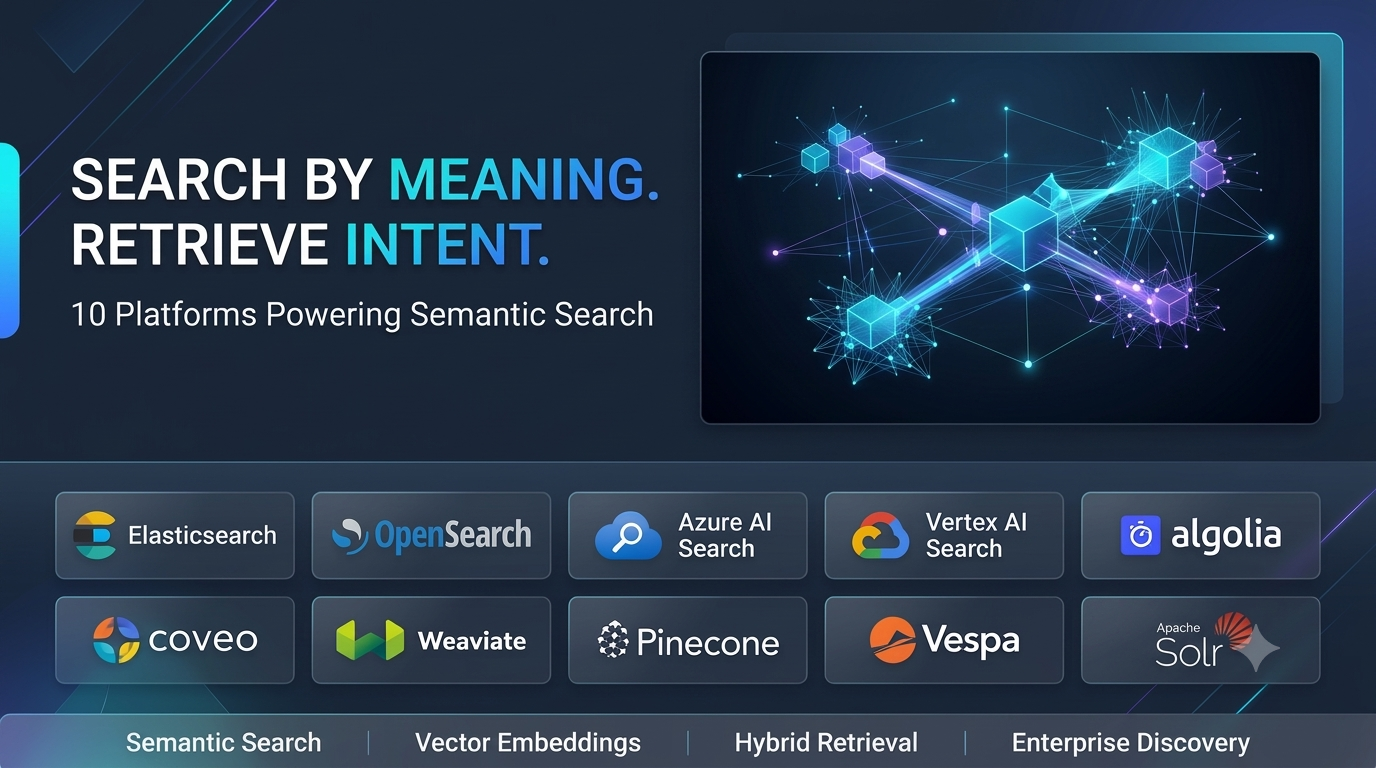
The following platforms include enterprise search engines, managed search services, vector-native retrieval systems, and intelligent information discovery technologies. Their numbering represents presentation order rather than an independently tested performance ranking.
1. Elasticsearch
Short Description
Elasticsearch is a distributed search and analytics engine developed by Elastic that supports full-text search, vector retrieval, and hybrid information discovery. It provides flexible indexing and querying capabilities for structured and unstructured information.
The platform supports semantic retrieval through dense vector representations and compatible machine learning models, including Elastic Learned Sparse Encoder (ELSER). These capabilities enable organizations to combine conventional lexical search with meaning-based information retrieval.
Elasticsearch provides configurable relevance scoring, metadata filtering, aggregations, and supported reranking mechanisms. Its architecture allows developers to build customized search applications across enterprise information repositories, websites, and analytical environments.
The platform supports managed cloud and self-managed deployment approaches. Organizations should evaluate licensing, infrastructure requirements, embedding model compatibility, and operational complexity according to their intended workloads.
Key Features
- Distributed full-text search.
- Dense vector indexing.
- Sparse semantic retrieval.
- Hybrid search capabilities.
- Configurable relevance scoring.
- Metadata filtering and aggregations.
- Compatible machine learning integrations.
- Search performance monitoring.
- Managed and self-managed deployments.
Benefits
- Improves contextual information discovery.
- Supports large-scale search applications.
- Combines keyword and semantic retrieval.
- Enables flexible relevance optimization.
- Facilitates enterprise information indexing.
- Supports AI-powered retrieval applications.
- Provides adaptable deployment architectures.
Pros
- Established search technology ecosystem.
- Comprehensive information retrieval capabilities.
- Flexible query configuration.
- Strong indexing and filtering functionality.
- Relevant semantic search integrations.
- Suitable for diverse enterprise workloads.
Cons
- Advanced configurations require technical expertise.
- Infrastructure expenses require monitoring.
- Some capabilities depend on licensing.
- Large indexes require resource planning.
- Search relevance requires continuing optimization.
Use Cases: Enterprise search, website information discovery, customer support retrieval, document search, electronic commerce search, and RAG applications.
Best For: Search engineers, enterprise developers, data architects, AI application developers, large organizations, and search infrastructure administrators.
2. OpenSearch
Short Description
OpenSearch is an open-source search and analytics platform that supports distributed indexing, full-text search, vector retrieval, and analytical workloads. It provides flexible search capabilities for organizations developing customized information discovery applications.
The platform supports vector similarity search through its k-nearest neighbor (k-NN) functionality and compatible neural search components. Developers can configure hybrid retrieval pipelines that combine lexical and semantic search results.
OpenSearch provides metadata filtering, relevance configuration, distributed search processing, and operational monitoring capabilities. Its extensible architecture supports integration with compatible machine learning models and external application environments.
Organizations can deploy OpenSearch independently or use compatible managed services, including Amazon OpenSearch Service. Available functionality and configuration options may differ between self-managed distributions and managed service offerings.
Key Features
- Open-source distributed search engine.
- Full-text information retrieval.
- Vector similarity search.
- Neural search capabilities.
- Hybrid retrieval pipelines.
- Configurable search relevance.
- Metadata filtering.
- Search analytics and monitoring.
- Extensible plugin architecture.
Benefits
- Reduces proprietary licensing dependencies.
- Supports customizable search architectures.
- Enables semantic information discovery.
- Facilitates hybrid search implementation.
- Supports scalable information indexing.
- Provides flexible deployment options.
- Enables AI application retrieval workflows.
Pros
- Open-source software availability.
- Strong distributed search foundation.
- Relevant vector search capabilities.
- Flexible infrastructure deployment.
- Extensible search architecture.
- Suitable for customized enterprise applications.
Cons
- Self-managed infrastructure requires administration.
- Advanced search pipelines require expertise.
- Model hosting may introduce additional expenses.
- Managed service capabilities can vary.
- Search relevance requires ongoing evaluation.
Use Cases: Enterprise document search, open-source semantic retrieval, technical knowledge discovery, website search, AI application retrieval, and distributed information indexing.
Best For: Open-source technology teams, search engineers, cloud architects, enterprise developers, AI engineers, and infrastructure administrators.
3. Azure AI Search
Short Description
Azure AI Search is a managed cloud search service within Microsoft Azure that supports information indexing, semantic ranking, vector retrieval, and hybrid search. It helps organizations develop intelligent search applications across compatible enterprise information sources.
The platform provides configurable search indexes, text retrieval, vector queries, and semantic ranking capabilities. Compatible Azure AI integrations can support document processing, embedding generation, and information enrichment.
Azure AI Search can combine keyword and vector retrieval to identify relevant information before applying supported ranking mechanisms. These capabilities are particularly useful for enterprise knowledge discovery and AI applications requiring contextual information retrieval.
Its managed architecture reduces selected infrastructure administration activities while integrating with compatible Azure security and networking services. Organizations should evaluate service tiers, search capacity, regional availability, and feature-specific expenses.
Key Features
- Managed cloud search infrastructure.
- Full-text information retrieval.
- Vector similarity search.
- Hybrid search capabilities.
- Semantic ranking.
- Integrated vectorization options.
- Configurable information indexing.
- Compatible AI enrichment pipelines.
- Azure security integrations.
Benefits
- Reduces search infrastructure administration.
- Supports intelligent enterprise information discovery.
- Facilitates AI application development.
- Enables hybrid information retrieval.
- Supports contextual result ranking.
- Integrates with Microsoft cloud services.
- Improves enterprise document accessibility.
Pros
- Managed cloud architecture.
- Strong Microsoft ecosystem integration.
- Relevant semantic ranking functionality.
- Supports vector and lexical retrieval.
- Compatible document enrichment capabilities.
- Suitable for enterprise RAG applications.
Cons
- Primarily oriented toward Azure infrastructure.
- Service tier expenses require monitoring.
- Semantic ranking may introduce additional costs.
- Advanced indexing requires configuration.
- Feature availability can vary by region and tier.
Use Cases: Enterprise knowledge search, document discovery, internal employee assistants, customer support applications, intelligent portals, and Azure-based RAG systems.
Best For: Microsoft Azure customers, enterprise AI developers, cloud architects, knowledge management teams, search engineers, and Microsoft-oriented organizations.
4. Google Vertex AI Search
Short Description
Google Vertex AI Search provides managed intelligent search capabilities for websites, enterprise documents, and supported information repositories. It uses compatible Google Cloud technologies to support natural language information discovery and contextual search experiences.
The platform provides configurable information stores, semantic retrieval, relevance ranking, and supported generative search capabilities. Organizations can use these features to develop applications that retrieve information from indexed content and present relevant results.
Vertex AI Search supports selected structured and unstructured information sources through compatible connectors and ingestion mechanisms. Its capabilities can reduce the amount of custom search infrastructure required for enterprise information discovery applications.
The platform is particularly relevant to organizations operating within Google Cloud environments. Product naming, supported connectors, generative features, and commercial packaging should be verified before implementation.
Key Features
- Managed semantic search capabilities.
- Natural language query processing.
- Structured and unstructured information indexing.
- Contextual relevance ranking.
- Supported generative search experiences.
- Configurable information stores.
- Compatible enterprise information connectors.
- Search application development interfaces.
- Google Cloud security integrations.
Benefits
- Simplifies intelligent search development.
- Improves contextual information discovery.
- Reduces selected infrastructure maintenance.
- Supports enterprise knowledge retrieval.
- Enables natural language search experiences.
- Facilitates AI-powered information applications.
- Integrates with Google Cloud infrastructure.
Pros
- Managed search architecture.
- Relevant language processing capabilities.
- Supports enterprise document search.
- Compatible generative AI functionality.
- Reduces selected custom development requirements.
- Strong Google Cloud ecosystem integration.
Cons
- Cloud ecosystem dependency requires consideration.
- Usage expenses require monitoring.
- Advanced customization may be constrained.
- Connector availability requires verification.
- Generated responses require appropriate validation.
Use Cases: Enterprise document search, intelligent website search, customer support discovery, research information retrieval, internal knowledge assistants, and generative search applications.
Best For: Google Cloud customers, enterprise AI developers, knowledge management teams, cloud architects, website administrators, and customer support organizations.
5. Algolia
Short Description
Algolia provides managed search and discovery capabilities designed for websites, mobile applications, electronic commerce platforms, and digital information experiences. It supports fast information retrieval, configurable ranking, filtering, and compatible semantic search functionality.
The platform provides search application interfaces and configurable relevance mechanisms that help developers create responsive search experiences. Its neural and hybrid search offerings can combine semantic information retrieval with established keyword-based ranking techniques.
Algolia supports product discovery, autocomplete, search analytics, merchandising controls, and personalized discovery capabilities depending on the selected offering. These features are particularly relevant to customer-facing applications requiring responsive information retrieval.
Organizations should evaluate semantic search availability, indexing limits, query volumes, and commercial licensing arrangements. Large electronic commerce environments may also require continuing relevance optimization and search merchandising administration.
Key Features
- Managed search infrastructure.
- Neural search capabilities.
- Hybrid information retrieval.
- Configurable relevance ranking.
- Search autocomplete.
- Faceted information filtering.
- Search analytics.
- Compatible personalization functionality.
- Electronic commerce discovery integrations.
Benefits
- Improves customer-facing search experiences.
- Supports relevant product discovery.
- Reduces custom search infrastructure development.
- Enables configurable search ranking.
- Facilitates responsive website search.
- Supports search behavior analysis.
- Improves digital information accessibility.
Pros
- Strong digital search and discovery orientation.
- Managed infrastructure architecture.
- Relevant electronic commerce capabilities.
- Flexible search application interfaces.
- Integrated search analytics.
- Suitable for customer-facing applications.
Cons
- Search usage expenses require monitoring.
- Advanced capabilities depend on selected plans.
- Enterprise customization requires development.
- Search ranking requires ongoing optimization.
- Large indexing workloads require cost evaluation.
Use Cases: Electronic commerce product discovery, website search, mobile application search, digital catalog discovery, content recommendations, and customer-facing information retrieval.
Best For: Electronic commerce businesses, website developers, digital product teams, search merchandising specialists, mobile application developers, and online retailers.
6. Coveo
Short Description
Coveo provides enterprise AI-powered search, relevance, and recommendation capabilities for digital experiences and organizational information environments. It helps organizations retrieve relevant information across compatible enterprise applications and content repositories.
The platform incorporates machine learning-based relevance optimization, contextual search, information indexing, and supported semantic retrieval capabilities. Its architecture addresses enterprise knowledge discovery, customer support, electronic commerce, and employee information accessibility.
Coveo provides compatible connectors for integrating enterprise information sources while supporting configurable search interfaces and relevance management. Search analytics can help organizations evaluate user behavior and identify information discovery challenges.
The platform is particularly relevant to organizations seeking managed enterprise search with relevance optimization and business-oriented integrations. Implementation requirements depend on information sources, access permissions, customization needs, and selected commercial offerings.
Key Features
- Enterprise AI-powered search.
- Semantic information retrieval.
- Machine learning-based ranking.
- Compatible enterprise information connectors.
- Contextual search capabilities.
- Search behavior analytics.
- Recommendation functionality.
- Configurable search interfaces.
- Supported security-aware information retrieval.
Benefits
- Improves enterprise information accessibility.
- Supports contextual knowledge discovery.
- Facilitates customer support self-service.
- Enables relevant product recommendations.
- Reduces repetitive information discovery activities.
- Supports search performance evaluation.
- Improves digital information experiences.
Pros
- Strong enterprise relevance orientation.
- Relevant customer support integrations.
- Integrated search analytics.
- Supports multiple enterprise search applications.
- Compatible machine learning capabilities.
- Suitable for complex information environments.
Cons
- Commercial licensing requires consultation.
- Enterprise integrations require planning.
- Relevance optimization requires representative data.
- Advanced customization may require specialists.
- Information access configurations require validation.
Use Cases: Enterprise knowledge discovery, customer support portals, electronic commerce search, employee information retrieval, digital recommendations, and enterprise self-service applications.
Best For: Large enterprises, customer support organizations, electronic commerce businesses, knowledge management teams, digital experience specialists, and enterprise search administrators.
7. Weaviate
Short Description
Weaviate is a vector database and semantic retrieval platform designed to store and search information using numerical embeddings. It supports applications requiring conceptual similarity search, hybrid retrieval, and contextual information discovery.
The platform provides vector indexing, metadata filtering, keyword retrieval, and hybrid search capabilities. Compatible model integrations allow developers to generate embeddings through supported vectorization services or supply externally generated vectors.
Weaviate supports configurable collections, information properties, and relationship references between stored objects. These capabilities help developers build semantic retrieval applications involving documents, products, knowledge resources, and other information assets.
The platform offers open-source software and managed cloud deployment options. Organizations should evaluate embedding model requirements, vector storage expenses, infrastructure configuration, and search quality before production adoption.
Key Features
- Vector-oriented information storage.
- Semantic similarity search.
- Hybrid keyword and vector retrieval.
- Metadata filtering.
- Compatible embedding model integrations.
- Configurable information collections.
- Supported reranking integrations.
- Multi-tenancy capabilities.
- Managed and self-managed deployment options.
Benefits
- Supports meaning-based information retrieval.
- Enables flexible AI search applications.
- Facilitates contextual document discovery.
- Supports reusable embedding architectures.
- Enables hybrid retrieval implementation.
- Improves semantic information accessibility.
- Supports scalable vector search environments.
Pros
- Open-source software availability.
- Strong vector-native architecture.
- Relevant hybrid search capabilities.
- Flexible model integration options.
- Supports managed deployment alternatives.
- Suitable for modern AI applications.
Cons
- Requires appropriate embedding model selection.
- Vector storage expenses require monitoring.
- Enterprise connectors may require development.
- Search relevance requires evaluation.
- Self-managed deployments require technical administration.
Use Cases: Semantic document search, RAG applications, product similarity discovery, intelligent recommendations, contextual knowledge retrieval, and AI-powered information applications.
Best For: AI engineers, machine learning developers, semantic search specialists, enterprise developers, data architects, and open-source technology teams.
8. Pinecone
Short Description
Pinecone provides managed vector database and retrieval capabilities for semantic search, recommendation systems, and AI-powered applications. It enables developers to store numerical embeddings and retrieve information according to supported similarity measures.
The platform supports dense vector retrieval, sparse retrieval, metadata filtering, and compatible hybrid search approaches. These capabilities allow organizations to develop search applications that combine semantic similarity with lexical information signals.
Pinecone provides managed indexing infrastructure and application interfaces that reduce selected vector database administration requirements. Compatible embedding and reranking services can support integrated information retrieval workflows.
The platform is particularly relevant to AI application developers seeking managed vector retrieval infrastructure. Organizations should evaluate query volumes, storage requirements, model expenses, deployment options, and supported retrieval functionality.
Key Features
- Managed vector database infrastructure.
- Dense vector similarity search.
- Sparse vector retrieval.
- Supported hybrid search approaches.
- Metadata filtering.
- Configurable index management.
- Compatible embedding integrations.
- Supported reranking capabilities.
- Application development interfaces.
Benefits
- Simplifies vector search infrastructure management.
- Supports scalable semantic retrieval.
- Enables contextual AI applications.
- Facilitates document similarity discovery.
- Supports flexible retrieval architectures.
- Reduces selected database administration activities.
- Enables managed RAG information retrieval.
Pros
- Managed vector-native architecture.
- Relevant semantic retrieval capabilities.
- Flexible application interfaces.
- Supports metadata-based filtering.
- Compatible modern AI development workflows.
- Reduces infrastructure maintenance requirements.
Cons
- Managed service dependency requires consideration.
- Usage-based expenses require monitoring.
- Embedding quality affects search relevance.
- Enterprise information connectors may require development.
- Complete search applications require complementary components.
Use Cases: RAG applications, semantic document discovery, recommendation systems, AI assistants, product similarity search, and contextual information retrieval.
Best For: AI application developers, machine learning engineers, startup technology teams, enterprise AI architects, semantic search developers, and cloud-native organizations.
9. Vespa
Short Description
Vespa is an open-source search, recommendation, and information serving engine designed for applications requiring customizable retrieval and ranking. It supports text search, vector retrieval, structured information filtering, and machine learning-based ranking.
The platform provides configurable ranking profiles that allow developers to combine multiple relevance signals during information retrieval. These capabilities are useful for applications requiring specialized ranking strategies across complex information environments.
Vespa supports distributed information serving, approximate nearest neighbor search, and compatible machine learning model execution. Its architecture enables developers to build search and recommendation systems with substantial control over retrieval and ranking behavior.
Organizations can deploy Vespa independently or evaluate compatible managed cloud offerings. Advanced implementations generally require technical expertise in search architecture, ranking models, information schemas, and infrastructure administration.
Key Features
- Distributed information serving.
- Full-text search capabilities.
- Vector similarity retrieval.
- Hybrid search architecture.
- Configurable ranking profiles.
- Machine learning-based ranking.
- Structured information filtering.
- Multi-stage ranking capabilities.
- Open-source and managed deployment options.
Benefits
- Supports highly customized search experiences.
- Enables advanced relevance optimization.
- Facilitates large-scale information retrieval.
- Supports hybrid search architectures.
- Enables specialized recommendation systems.
- Provides flexible ranking configurations.
- Supports complex machine learning applications.
Pros
- Open-source software availability.
- Strong ranking customization capabilities.
- Supports text and vector retrieval.
- Relevant distributed processing architecture.
- Suitable for complex search workloads.
- Flexible machine learning integrations.
Cons
- Advanced configurations require specialist expertise.
- Search schema development can be complex.
- Self-managed infrastructure requires administration.
- Smaller applications may not require its flexibility.
- Ranking model development requires continuing evaluation.
Use Cases: Large-scale semantic search, recommendation engines, customized information ranking, intelligent content discovery, electronic commerce search, and advanced retrieval applications.
Best For: Search engineers, machine learning specialists, large-scale application developers, recommendation system teams, enterprise architects, and advanced information retrieval organizations.
10. Apache Solr
Short Description
Apache Solr is an open-source enterprise search platform built on Apache Lucene that supports full-text retrieval, distributed indexing, filtering, and analytical search capabilities. It provides configurable search infrastructure for organizations developing customized information discovery applications.
Modern Solr releases support dense vector fields and nearest neighbor search capabilities. Developers can combine vector retrieval with conventional lexical queries and configurable ranking approaches to establish semantic or hybrid search applications.
Solr provides faceted search, configurable relevance scoring, query processing, and distributed deployment capabilities through SolrCloud. These features make it relevant to enterprise document repositories, digital catalogs, and large information discovery environments.
Unlike fully managed semantic search services, Solr generally requires organizations to configure embedding generation, indexing workflows, relevance evaluation, and operational infrastructure. Supported semantic functionality should be evaluated against the selected software release.
Key Features
- Open-source enterprise search engine.
- Apache Lucene search foundation.
- Full-text information retrieval.
- Dense vector indexing.
- Nearest neighbor search.
- Configurable relevance scoring.
- Faceted information filtering.
- Distributed SolrCloud architecture.
- Extensible query processing.
Benefits
- Reduces proprietary licensing dependencies.
- Supports customizable enterprise search.
- Enables semantic retrieval development.
- Facilitates large-scale information indexing.
- Supports flexible search configurations.
- Provides mature lexical search capabilities.
- Enables integration with external AI models.
Pros
- Open-source software availability.
- Established enterprise search ecosystem.
- Strong lexical retrieval capabilities.
- Supports distributed search infrastructure.
- Relevant vector search functionality.
- Flexible indexing and filtering configurations.
Cons
- Semantic search requires additional configuration.
- Embedding generation may require external services.
- Infrastructure administration requires expertise.
- Advanced relevance optimization requires development.
- Enterprise support arrangements require evaluation.
Use Cases: Enterprise document search, digital catalog discovery, open-source semantic search, research information retrieval, website search, and customized hybrid search applications.
Best For: Open-source search engineers, enterprise developers, information retrieval specialists, infrastructure administrators, research organizations, and existing Solr users.
Comparison Table: Top 10 Semantic Search Platforms
| Platform | Primary Strength | Best For | Pricing Approach |
|---|---|---|---|
| Elasticsearch | Comprehensive hybrid search | Enterprise search applications | Free and commercial offerings |
| OpenSearch | Open-source distributed retrieval | Custom search infrastructure | Open-source; managed service costs apply |
| Azure AI Search | Managed semantic ranking | Microsoft Azure environments | Service tier and usage-based |
| Google Vertex AI Search | Intelligent managed search | Google Cloud AI applications | Usage-based |
| Algolia | Digital search and product discovery | Electronic commerce and websites | Subscription and usage-based |
| Coveo | Enterprise relevance optimization | Enterprise knowledge and customer support | Commercial licensing |
| Weaviate | Vector-native hybrid retrieval | Semantic AI applications | Open-source and managed offerings |
| Pinecone | Managed vector retrieval | RAG and AI applications | Usage-based |
| Vespa | Advanced ranking customization | Complex search and recommendations | Open-source and managed offerings |
| Apache Solr | Customizable open-source search | Enterprise search infrastructure | Open-source |
Functional Comparison
| Platform | Vector Search | Keyword Search | Hybrid Retrieval | Primary Architecture |
|---|---|---|---|---|
| Elasticsearch | Supported | Supported | Supported | Distributed search engine |
| OpenSearch | Supported | Supported | Supported | Open-source search engine |
| Azure AI Search | Supported | Supported | Supported | Managed cloud search |
| Google Vertex AI Search | Managed semantic retrieval | Supported | Managed retrieval | Intelligent search service |
| Algolia | Offering-dependent | Supported | Offering-dependent | Managed search and discovery |
| Coveo | Offering-dependent | Supported | Offering-dependent | Enterprise relevance platform |
| Weaviate | Supported | Supported | Supported | Vector database |
| Pinecone | Supported | Sparse retrieval | Supported approaches | Managed vector database |
| Vespa | Supported | Supported | Supported | Search and information serving engine |
| Apache Solr | Supported | Supported | Configurable | Open-source enterprise search |
How to Choose the Best Semantic Search Platform
Evaluate Information Retrieval Requirements
Determine whether the organization requires document discovery, product search, enterprise knowledge retrieval, recommendations, or AI application support. Different search applications require different relevance strategies, indexing architectures, and information processing capabilities.
Assess Embedding Model Compatibility
Evaluate whether the platform supports appropriate embedding models for the organization’s languages, information types, and domain terminology. Specialized scientific, financial, or technical content may require different models from general-purpose text retrieval applications.
Review Hybrid Search Capabilities
Determine whether the platform can combine keyword retrieval with vector-based semantic search. Hybrid retrieval is particularly useful when applications must recognize both conceptual meaning and exact identifiers, product codes, technical terms, or document references.
Examine Ranking and Reranking Functionality
Assess configurable relevance scoring, machine learning-based ranking, and supported reranking mechanisms. Organizations should evaluate whether these capabilities improve search results using representative queries and independently defined relevance judgments.
Consider Scalability and Performance
Identify expected document volumes, vector dimensions, concurrent query workloads, information update frequencies, and response time requirements. Search platforms should undergo representative workload testing before organizations commit to production infrastructure.
Evaluate Information Integration
Review compatibility with existing document repositories, databases, enterprise applications, websites, and information processing pipelines. Appropriate integration mechanisms help organizations maintain accurate, current, and accessible search indexes.
Assess Security and Governance
Examine authentication, authorization, document-level permissions, encryption, audit logging, and information retention capabilities. Enterprise search applications must prevent unauthorized information exposure through retrieved content, metadata, snippets, or generated responses.
Evaluate Total Ownership Costs
Consider software licensing, computing infrastructure, vector storage, embedding generation, reranking services, information ingestion, and administrative staffing. Organizations should also account for continuing search relevance evaluation and information quality management.
Best Semantic Search Platforms by User Type
| User Type | Relevant Platform |
|---|---|
| Enterprise search engineer | Elasticsearch |
| Open-source search infrastructure administrator | OpenSearch |
| Microsoft Azure AI developer | Azure AI Search |
| Google Cloud application developer | Google Vertex AI Search |
| Electronic commerce search specialist | Algolia |
| Enterprise knowledge management administrator | Coveo |
| Vector-native AI application developer | Weaviate |
| Managed RAG infrastructure developer | Pinecone |
| Advanced search ranking engineer | Vespa |
| Open-source enterprise search developer | Apache Solr |
Practical Example: Implementing an Enterprise Semantic Search Platform
Consider a hypothetical multinational technology organization maintaining approximately two million documents across technical repositories, customer support systems, product documentation portals, and internal knowledge bases. Employees frequently encounter irrelevant search results, inconsistent terminology, duplicated information, and difficulties locating appropriate technical resources.
Management introduces a semantic search architecture to improve information discovery, strengthen customer support self-service, and reduce repetitive knowledge retrieval activities. The following outcomes represent illustrative assumptions rather than verified vendor performance.
Implementation Steps
- Inventory enterprise information sources and identify common search requirements.
- Collect representative search queries and establish baseline relevance measurements.
- Select a semantic search platform and compatible embedding models.
- Configure document ingestion, information segmentation, metadata extraction, and indexing.
- Implement hybrid retrieval, metadata filtering, and appropriate ranking mechanisms.
- Integrate search interfaces with enterprise access controls and knowledge applications.
- Evaluate search relevance, user adoption, operational performance, and information security.
Illustrative Performance Improvements
| Performance Indicator | Before | After |
|---|---|---|
| Average information discovery time | 18 minutes | 4 minutes |
| Monthly manual knowledge retrieval workload | 1,500 hours | 500 hours |
| Search success rate | 58% | 92% |
| Zero-result query rate | 22% | 5% |
| Precision among the first five results | 48% | 86% |
| Search result click-through rate | 35% | 68% |
| Monthly repetitive support requests | 1,200 | 450 |
| Indexed enterprise document coverage | 60% | 97% |
| Average document indexing delay | 24 hours | 2 hours |
| Employee search satisfaction | 55% | 91% |
Financial Analysis
Reducing monthly manual knowledge retrieval workloads by 1,000 hours releases 12,000 employee hours annually. At an illustrative labor cost of $45 per hour, this represents $540,000 in released annual labor capacity rather than guaranteed cash savings.
Suppose the organization eliminates $120,000 in annual expenses associated with redundant search infrastructure. Additional realized annual savings of $240,000 from avoidable external support and information processing expenses would produce total gross cash savings of $360,000.
After recurring semantic search platform, model, infrastructure, and maintenance expenses of $120,000, annual net cash savings would equal $240,000. An initial implementation investment of $360,000 would therefore produce a simple payback period of 18 months.
This calculation excludes taxes, financing costs, discounting, and the separately estimated value of released employee capacity. Actual financial outcomes would depend on information volumes, model expenses, implementation complexity, licensing arrangements, and the organization’s ability to eliminate existing operating costs.
Important Semantic Search Performance Indicators
| Indicator | Measurement Purpose |
|---|---|
| Search success rate | Measures queries satisfying defined user information needs |
| Precision at K | Measures relevant results among the first K retrieved items |
| Recall at K | Measures the proportion of known relevant items retrieved within K results |
| Mean Reciprocal Rank (MRR) | Evaluates the ranking position of the first relevant result |
| Normalized Discounted Cumulative Gain (NDCG) | Evaluates ranking quality using graded relevance judgments |
| Mean Average Precision (MAP) | Measures average retrieval precision across evaluated queries |
| Zero-result query rate | Tracks queries returning no search results |
| Search abandonment rate | Measures searches abandoned without successful engagement |
| Click-through rate | Tracks user interaction with displayed search results |
| Query response time | Measures search request processing duration |
| Search throughput | Tracks completed search requests within a defined period |
| Indexing throughput | Measures information indexed within a defined period |
| Information freshness | Evaluates recency of indexed information |
| Embedding generation time | Tracks semantic representation processing duration |
| Vector index recall | Measures approximate retrieval quality against reference results |
| Search availability | Measures operational accessibility of search services |
| Cost per search query | Evaluates average information retrieval expenses |
| User satisfaction | Measures perceived usefulness of search experiences |
| Unauthorized retrieval rate | Tracks restricted information exposure during security testing |
| Reranking latency | Measures additional processing time introduced by reranking |
Security and Governance Considerations
Semantic search platforms frequently index confidential business documents, customer records, financial information, proprietary research, and sensitive operational knowledge. Organizations should implement appropriate authentication mechanisms, encryption, access controls, and administrative audit logging.
Search applications should preserve relevant source-level information permissions throughout ingestion, indexing, retrieval, ranking, and result presentation. Administrators should verify that restricted documents cannot be exposed through semantic similarity searches, metadata filters, result snippets, or generated summaries.
Vector embeddings should not automatically be treated as anonymous or non-sensitive information. Depending on the model and architecture, embeddings can retain information about underlying content and may require security protections comparable to other derived information assets.
Organizations should establish appropriate information retention, deletion, and synchronization procedures across source repositories and search indexes. Deleted or restricted documents should not remain accessible through outdated embeddings, cached results, or associated retrieval environments.
AI-powered search applications should distinguish retrieved source information from generated responses and unsupported conclusions. Appropriate provenance records, source references, response validation, and human oversight can help reduce misleading information presentation.
External embedding and reranking services should undergo appropriate privacy, contractual, and security assessments. Organizations must evaluate whether confidential information is transmitted outside approved infrastructure and whether associated processing arrangements satisfy applicable requirements.
Challenges and Limitations
Semantic search quality depends substantially on the selected embedding models, indexed information, retrieval architecture, and relevance configuration. Poorly selected models may fail to represent specialized terminology, domain-specific relationships, or multilingual information accurately.
Vector-based search can struggle with exact identifiers, uncommon product codes, numerical values, and highly specific technical expressions. Hybrid search can address some of these limitations by combining semantic similarity with conventional keyword retrieval.
Large vector indexes can introduce substantial memory, storage, computing, and infrastructure expenses. Organizations should evaluate vector dimensions, index configurations, compression approaches, and expected retrieval workloads when planning deployments.
Search relevance can be difficult to measure when user intent is ambiguous or multiple results satisfy the same information requirement. Representative evaluation datasets and human relevance judgments remain important for comparing retrieval strategies.
Maintaining current search indexes can become challenging when source information changes frequently or originates from numerous heterogeneous applications. Reliable incremental indexing, deletion synchronization, and information quality monitoring are necessary for maintaining trustworthy search results.
Semantic search does not automatically establish factual correctness or guarantee that retrieved information is authoritative. Organizations should evaluate source reliability, information provenance, ranking quality, and appropriate safeguards for consequential applications.
Best Practices for Semantic Search Implementation
- Establish clearly defined search application objectives.
- Identify important information sources and user requirements.
- Collect representative natural language search queries.
- Develop independently reviewed relevance evaluation datasets.
- Select appropriate domain-specific embedding models.
- Maintain consistent document preprocessing procedures.
- Configure appropriate information segmentation strategies.
- Preserve meaningful document metadata.
- Combine keyword and semantic retrieval where appropriate.
- Evaluate multiple retrieval and ranking configurations.
- Implement appropriate metadata filtering.
- Validate reranking models against representative queries.
- Maintain accurate information provenance records.
- Preserve source-level information access permissions.
- Protect confidential content and vector embeddings.
- Establish reliable incremental indexing procedures.
- Synchronize document deletions and permission changes.
- Monitor query response times and search availability.
- Evaluate search relevance continuously.
- Track embedding, storage, and computing expenses.
- Maintain documented search configuration changes.
- Validate AI-generated responses against retrieved information.
Future Trends in Semantic Search Platforms
Advanced Hybrid Search Architectures
Semantic search platforms may increasingly combine dense vector retrieval, sparse retrieval, conventional keyword search, and structured information filtering. These approaches can improve search flexibility by incorporating complementary relevance signals.
Multimodal Semantic Search
Search platforms may increasingly support unified information discovery across text, images, audio, video, and other information types. Multimodal embedding models can help applications retrieve related information across different content formats.
Retrieval-Augmented Generation Integration
Semantic search platforms may increasingly provide integrated retrieval capabilities for generative AI applications. These architectures can improve access to relevant source information while requiring appropriate validation, provenance management, and security controls.
AI-Assisted Query Understanding
Advanced search systems may increasingly use language models to interpret complex queries, identify user intent, and generate alternative search expressions. These capabilities can improve retrieval for ambiguous requests while introducing additional processing expenses and validation requirements.
Personalized Semantic Retrieval
Search platforms may increasingly incorporate authorized user preferences, interaction patterns, and contextual information into relevance calculations. Organizations should balance personalization objectives with privacy requirements, transparency, and appropriate user controls.
Knowledge Graph-Enhanced Search
Semantic search architectures may increasingly combine vector retrieval with knowledge graphs and formal semantic relationships. These approaches can improve contextual information discovery by incorporating explicit relationships alongside numerical similarity representations.
Automated Search Relevance Optimization
Machine learning technologies may increasingly assist with ranking configuration, relevance evaluation, and search quality monitoring. Automated optimization should remain subject to representative evaluation and appropriate human oversight.
Efficient Vector Indexing
Search platforms may increasingly incorporate vector compression, quantization, optimized indexing algorithms, and hardware-aware retrieval mechanisms. These technologies can reduce selected infrastructure expenses while requiring evaluation of their effects on retrieval accuracy.
Agentic Information Retrieval
AI applications may increasingly coordinate multiple search queries, information sources, and retrieval strategies to address complex information requirements. These architectures require appropriate query limits, access controls, source validation, and operational monitoring.
Explainable Semantic Search
Organizations may increasingly require search platforms to provide understandable information about why particular results were retrieved or ranked prominently. Relevant metadata, source provenance, ranking signals, and evaluation reports can improve transparency without fully explaining every model decision.
Frequently Asked Questions
1. What are semantic search platforms?
Semantic search platforms retrieve information based on conceptual meaning, contextual relationships, and user intent. They use technologies such as vector embeddings, language processing, keyword retrieval, and relevance ranking.
2. Why is semantic search important?
Semantic search helps users discover relevant information even when their queries use terminology that differs from indexed content. It supports enterprise knowledge discovery, customer support, electronic commerce, research, and intelligent applications.
3. What is Elasticsearch?
Elasticsearch is a distributed search and analytics engine supporting full-text retrieval, vector search, and hybrid information discovery. It provides configurable indexing, relevance scoring, filtering, and compatible machine learning integrations.
4. What is OpenSearch?
OpenSearch is an open-source distributed search and analytics platform. It supports lexical retrieval, vector similarity search, neural search, hybrid retrieval, and customizable search infrastructure.
5. What is Azure AI Search?
Azure AI Search is a managed Microsoft Azure search service supporting text retrieval, vector search, semantic ranking, and hybrid search. It helps organizations develop enterprise information discovery and AI-powered retrieval applications.
6. What is Google Vertex AI Search?
Google Vertex AI Search provides managed intelligent search capabilities for supported websites, documents, and enterprise information repositories. It supports contextual information retrieval and compatible generative search experiences.
7. What is Algolia?
Algolia provides managed search and discovery capabilities for websites, mobile applications, and electronic commerce environments. Its compatible offerings support keyword search, neural retrieval, configurable ranking, and product discovery.
8. What is Coveo?
Coveo provides enterprise AI-powered search, relevance optimization, and recommendation capabilities. It supports customer-facing search experiences, employee knowledge discovery, and compatible enterprise information integrations.
9. What is Weaviate?
Weaviate is a vector database and semantic retrieval platform supporting vector similarity search, keyword retrieval, metadata filtering, and hybrid search. It is relevant to AI applications requiring contextual information discovery.
10. What is Pinecone?
Pinecone provides managed vector database and retrieval capabilities for semantic search and AI applications. It supports dense and sparse retrieval, metadata filtering, and compatible hybrid search approaches.
11. What is Vespa?
Vespa is a search, recommendation, and information serving engine supporting text retrieval, vector search, and customizable ranking. It is particularly relevant to applications requiring advanced relevance optimization.
12. What is Apache Solr?
Apache Solr is an open-source enterprise search platform built on Apache Lucene. Modern releases support conventional text retrieval, dense vector indexing, nearest neighbor search, and configurable hybrid retrieval approaches.
13. What is the difference between semantic search and keyword search?
Keyword search primarily retrieves information using matching terms and lexical relevance signals. Semantic search attempts to identify conceptual meaning and contextual similarity even when exact terminology differs.
14. What is a vector embedding?
A vector embedding is a numerical representation of information generated by a compatible machine learning model. Embeddings can represent text, images, or other information in ways that support similarity comparisons.
15. What is vector similarity search?
Vector similarity search retrieves numerical representations that are close according to a selected similarity or distance measure. Common approaches include cosine similarity, dot product, and Euclidean distance.
16. What is hybrid search?
Hybrid search combines multiple information retrieval approaches, commonly keyword search and vector-based semantic retrieval. It can improve search relevance by incorporating both exact terminology and conceptual similarity.
17. What is semantic ranking?
Semantic ranking evaluates and orders search results using contextual relevance signals. Some platforms apply semantic ranking after initial retrieval to improve the ordering of candidate results.
18. What is reranking?
Reranking is a secondary ranking process that evaluates an initial set of retrieved results using additional relevance mechanisms. It can improve result ordering while introducing additional processing latency and expenses.
19. What is approximate nearest neighbor search?
Approximate Nearest Neighbor (ANN) search retrieves vectors that are likely to be among the closest matches without exhaustively comparing every stored vector. It can improve retrieval efficiency while introducing a configurable trade-off between speed and recall.
20. What is retrieval-augmented generation?
Retrieval-Augmented Generation combines information retrieval with generative AI models to provide relevant source material during response generation. Its effectiveness depends on retrieval quality, information accuracy, model behavior, and appropriate validation.
21. Can semantic search support multilingual information retrieval?
Compatible multilingual embedding models and search architectures can support information retrieval across multiple languages. Actual search quality depends on model coverage, language characteristics, domain terminology, and representative evaluation.
22. Can semantic search replace traditional search engines?
Semantic search can improve or replace conventional retrieval for selected meaning-based information discovery applications. Traditional lexical retrieval remains valuable for exact identifiers, specific terminology, and applications requiring precise keyword matching.
23. Are open-source semantic search platforms available?
OpenSearch, Weaviate, Vespa, and Apache Solr provide relevant open-source semantic retrieval capabilities. Production implementations may still require computing infrastructure, embedding models, technical expertise, and continuing administration.
24. How much do semantic search platforms cost?
Costs depend on software licensing, indexed information volumes, vector storage, search request volumes, embedding generation, reranking services, and administrative resources. Organizations should evaluate complete retrieval infrastructure expenses rather than subscription prices alone.
25. Which semantic search platform is best?
The appropriate platform depends on information retrieval requirements, relevance objectives, integration architecture, scalability, security, customization needs, and available technical expertise. Representative search evaluation and workload testing help organizations identify suitable semantic search technologies.
Conclusion
Semantic search platforms help organizations retrieve relevant information by incorporating conceptual meaning, contextual relationships, and user intent into information discovery processes. Their capabilities support enterprise knowledge management, customer support, electronic commerce, research, recommendation systems, and intelligent applications.
Elasticsearch, OpenSearch, and Apache Solr provide flexible search infrastructure combining established lexical retrieval capabilities with supported semantic search technologies. Azure AI Search and Google Vertex AI Search provide managed cloud search environments that can simplify selected intelligent information retrieval activities.
Algolia and Coveo provide specialized search and relevance capabilities for digital experiences, product discovery, customer support, and enterprise knowledge management. Weaviate and Pinecone support vector-oriented retrieval applications, while Vespa provides advanced customization for complex search and ranking requirements.
Successful semantic search implementation requires appropriate embedding models, reliable information preparation, accurate indexing, effective relevance evaluation, secure access configurations, and continuous operational monitoring. Organizations should evaluate retrieval quality alongside response times, information freshness, infrastructure scalability, governance requirements, and total ownership expenses.
An effective semantic search strategy combines appropriate technology with responsible information management, representative evaluation, and continuous improvement. These practices help organizations improve contextual information discovery, strengthen knowledge accessibility, reduce repetitive retrieval activities, and establish reliable foundations for future AI-powered applications.
