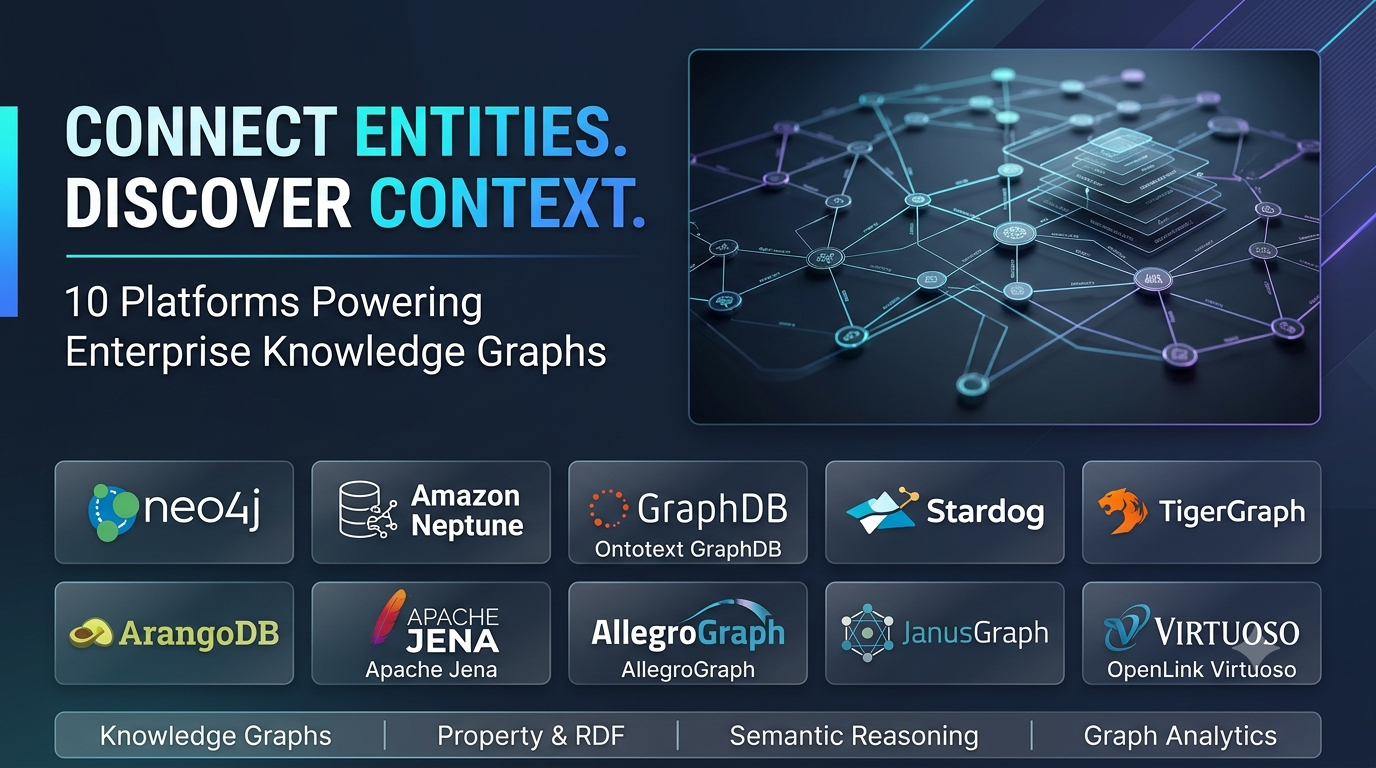
Introduction
Knowledge graph databases help organizations store, connect, organize, and analyze information through meaningful relationships between entities. These databases enable applications to understand connections between people, products, locations, documents, business concepts, and other information assets.
Traditional relational databases organize information primarily through tables, rows, columns, and predefined relationships. Although these structures support numerous enterprise applications, analyzing complex interconnected information can require extensive joins, specialized queries, and additional processing.
Knowledge graph databases represent information through graph-oriented structures that emphasize entities, relationships, attributes, and semantic context. These capabilities support applications involving information discovery, recommendation systems, fraud detection, enterprise search, scientific research, and intelligent decision-making.
Advanced knowledge graph technologies support semantic reasoning, ontology integration, distributed graph processing, graph analytics, and Artificial Intelligence (AI) applications. Organizations can use these capabilities to establish contextual information environments that connect previously isolated datasets.
Different knowledge graph databases address varying information models, analytical workloads, scalability requirements, and organizational objectives. Selecting appropriate software requires evaluating graph architecture, query languages, semantic capabilities, reasoning support, integration options, security, and total ownership expenses.
This guide examines ten knowledge graph databases, including their features, benefits, advantages, limitations, and practical applications. It also provides comparison tables, implementation recommendations, performance indicators, security considerations, and frequently asked questions.
What Are Knowledge Graph Databases?
Knowledge graph databases are specialized information management systems that store and retrieve interconnected information through graph-based representations. They enable organizations to model entities, relationships, attributes, classifications, and contextual information within flexible data structures.
Knowledge graphs commonly use either labeled property graph models or Resource Description Framework (RDF) models. Property graphs represent information through nodes, edges, labels, and properties, while RDF represents statements through subject, predicate, and object triples.
Semantic knowledge graph databases may incorporate ontologies, formal vocabularies, inference rules, and standardized query languages. These capabilities allow applications to interpret relationships and, where supported, derive additional information from explicitly defined facts and logical rules.
Effective knowledge graph implementation requires accurate entity identification, meaningful relationship definitions, reliable information integration, and appropriate governance policies. Graph databases provide the storage and query foundation, while additional technologies may support entity resolution, ontology management, and knowledge extraction.
How Knowledge Graph Databases Work
- Identify information sources and knowledge management requirements.
- Define relevant entities, attributes, relationships, and business concepts.
- Select an appropriate property graph or RDF information model.
- Develop graph schemas, vocabularies, or ontologies.
- Extract information from supported databases, documents, and applications.
- Resolve duplicate entities and establish consistent identifiers.
- Store entities and relationships within the graph database.
- Execute graph queries, traversals, and supported reasoning operations.
- Deliver contextual information to analytical and operational applications.
- Monitor information quality, graph performance, and governance compliance.
Common Applications of Knowledge Graph Databases
- Enterprise knowledge management.
- Semantic information discovery.
- Intelligent recommendation systems.
- Financial fraud detection.
- Customer relationship analysis.
- Biomedical research.
- Drug discovery and development.
- Supply chain relationship mapping.
- Enterprise data cataloging.
- Cybersecurity relationship analysis.
- Regulatory compliance management.
- Product information management.
- Digital asset discovery.
- Graph-based AI applications.
- Scientific knowledge integration.
- Graph Retrieval-Augmented Generation (GraphRAG).
Essential Components of Knowledge Graph Databases
| Component | Purpose |
|---|---|
| Entities | Represent identifiable objects, people, concepts, or events |
| Relationships | Describe meaningful connections between entities |
| Properties | Store descriptive attributes associated with graph elements |
| Graph schema | Defines expected entity and relationship structures |
| Ontology | Establishes formal concepts, classifications, and semantic relationships |
| Graph storage engine | Stores and manages interconnected information |
| Query engine | Retrieves information through graph-oriented queries |
| Reasoning engine | Derives additional facts using supported logical rules |
| Entity resolution | Identifies records representing the same real-world entity |
| Graph indexes | Accelerate supported information retrieval operations |
| Metadata management | Maintains contextual information about graph assets |
| Security administration | Controls access to graph information and operations |
Top 10 Knowledge Graph Databases
The following tools include property graph databases, RDF triple stores, semantic knowledge graph platforms, and distributed graph database systems. Their numbering represents presentation order rather than an independently tested performance ranking.
1. Neo4j
Short Description
Neo4j is a graph database platform designed to store and query interconnected information through a labeled property graph model. It represents entities as nodes and connections as relationships, with properties providing additional contextual information.
The platform uses the Cypher query language to support graph pattern matching, relationship traversal, and information retrieval. Compatible graph analytics, visualization, and vector search capabilities make Neo4j relevant to enterprise knowledge graphs and graph-based AI applications.
Key Features
- Labeled property graph architecture.
- Cypher graph query language.
- Graph pattern matching.
- Node and relationship properties.
- Graph indexing and constraints.
- Transactional graph operations.
- Compatible graph data science capabilities.
- Vector indexing and similarity search.
- Managed and self-managed deployment options.
Benefits
- Simplifies interconnected information modeling.
- Supports flexible relationship analysis.
- Improves contextual information discovery.
- Enables graph-based recommendation systems.
- Facilitates enterprise knowledge integration.
- Supports graph-based AI applications.
- Reduces complexity for selected relationship-intensive queries.
Pros
- Established graph database ecosystem.
- Expressive graph query language.
- Extensive developer resources.
- Relevant graph analytics capabilities.
- Flexible deployment options.
- Strong enterprise knowledge graph applicability.
Cons
- Enterprise functionality may require commercial licensing.
- Large graph deployments require resource planning.
- Advanced graph modeling requires technical expertise.
- Native RDF reasoning is not its primary architecture.
- Complex graph traversals require optimization.
Use Cases: Enterprise knowledge graphs, fraud detection, recommendation engines, GraphRAG applications, customer relationship analysis, and network dependency mapping.
Best For: Graph developers, enterprise data architects, AI engineers, financial institutions, recommendation system developers, and knowledge management teams.
2. Amazon Neptune
Short Description
Amazon Neptune is a managed graph database service within Amazon Web Services (AWS). It supports property graph and RDF information models, allowing organizations to develop graph applications using compatible graph query languages.
The service supports Apache TinkerPop Gremlin, openCypher, and SPARQL according to the selected graph model. Its managed architecture reduces selected database administration requirements while integrating with compatible AWS security, networking, and analytical services.
Key Features
- Managed graph database infrastructure.
- Property graph support.
- RDF graph support.
- Gremlin query language compatibility.
- openCypher query support.
- SPARQL query support.
- Graph replication capabilities.
- AWS security integrations.
- Compatible graph analytics integrations.
Benefits
- Reduces database infrastructure administration.
- Supports multiple graph information models.
- Facilitates cloud knowledge graph development.
- Enables interconnected information analysis.
- Supports enterprise graph applications.
- Integrates with AWS infrastructure.
- Facilitates scalable graph database deployments.
Pros
- Managed cloud database architecture.
- Supports property graphs and RDF.
- Multiple graph query language options.
- Strong AWS ecosystem integration.
- Compatible high-availability configurations.
- Suitable for enterprise graph workloads.
Cons
- Primarily oriented toward AWS infrastructure.
- Computing and storage expenses require monitoring.
- Graph model interoperability requires planning.
- Advanced semantic reasoning may require complementary technologies.
- Large-scale graph queries require performance testing.
Use Cases: Cloud knowledge graphs, fraud detection, identity graphs, recommendation engines, enterprise relationship analysis, and connected information applications.
Best For: AWS customers, cloud architects, graph application developers, enterprise data engineers, financial organizations, and cloud-native AI teams.
3. GraphDB by Ontotext
Short Description
GraphDB by Ontotext is an RDF-oriented graph database designed for semantic information management and knowledge graph applications. It supports standardized semantic technologies that allow organizations to represent interconnected information through formal relationships and vocabularies.
The platform provides SPARQL querying, configurable semantic reasoning, ontology integration, and knowledge graph exploration capabilities. Its architecture is particularly relevant to organizations requiring semantic interoperability, formal knowledge representation, and inference-based information discovery.
Key Features
- RDF triple storage.
- SPARQL query processing.
- Ontology integration.
- Configurable semantic reasoning.
- RDF Schema support.
- Compatible Web Ontology Language capabilities.
- Graph exploration interfaces.
- Semantic information integration.
- Supported text and graph search integrations.
Benefits
- Supports formal knowledge representation.
- Improves semantic information discovery.
- Enables rule-based information inference.
- Facilitates standardized information interoperability.
- Supports reusable knowledge models.
- Improves contextual information integration.
- Enables semantic enterprise applications.
Pros
- Strong semantic knowledge graph orientation.
- Established RDF technology support.
- Integrated reasoning capabilities.
- Relevant ontology management integrations.
- Standards-based query processing.
- Suitable for complex semantic information environments.
Cons
- Commercial editions require licensing evaluation.
- Ontology development requires specialist expertise.
- Reasoning workloads may increase processing requirements.
- Complex SPARQL queries require optimization.
- Property graph applications may require different modeling approaches.
Use Cases: Semantic enterprise search, biomedical knowledge graphs, scientific research, linked data publishing, ontology-driven applications, and regulatory information management.
Best For: Knowledge engineers, semantic web developers, ontology specialists, research institutions, pharmaceutical organizations, and enterprise knowledge architects.
4. Stardog
Short Description
Stardog provides enterprise knowledge graph and semantic information integration capabilities designed to connect distributed information assets. It supports RDF-based knowledge representation, ontology-driven modeling, semantic reasoning, and logical information access.
The platform combines graph storage with virtualization capabilities that can provide access to compatible external information sources. Organizations can use Stardog to establish semantic information layers without necessarily importing every source dataset into graph storage.
Key Features
- Enterprise RDF knowledge graph storage.
- SPARQL query processing.
- Semantic reasoning capabilities.
- Ontology-driven information modeling.
- Virtual graph functionality.
- Supported external source connectivity.
- Semantic information integration.
- Graph exploration capabilities.
- Enterprise access administration.
Benefits
- Improves enterprise knowledge accessibility.
- Supports formal business concept modeling.
- Reduces selected information replication requirements.
- Enables contextual information discovery.
- Facilitates semantic information integration.
- Supports governed enterprise knowledge access.
- Enables knowledge graph-based AI applications.
Pros
- Strong enterprise semantic architecture.
- Integrated reasoning functionality.
- Relevant graph virtualization capabilities.
- Supports standardized semantic technologies.
- Suitable for distributed information environments.
- Supports reusable enterprise knowledge models.
Cons
- Commercial licensing requires consultation.
- Advanced semantic modeling requires expertise.
- Virtual graph performance depends on underlying sources.
- Reasoning complexity requires resource planning.
- Enterprise implementation requires coordinated governance.
Use Cases: Enterprise knowledge integration, semantic information access, regulatory knowledge management, intelligent search, virtual knowledge graphs, and AI information grounding.
Best For: Enterprise knowledge architects, semantic data engineers, information governance teams, regulated organizations, AI developers, and enterprise integration specialists.
5. TigerGraph
Short Description
TigerGraph provides a distributed graph database architecture designed for interconnected information processing and graph analytics. It supports property graph modeling and analytical operations involving complex relationships across large datasets.
The platform uses the GSQL query language to define graph structures and execute graph-oriented processing operations. Its distributed architecture is relevant to organizations requiring relationship-intensive analytics, graph algorithms, and scalable graph processing.
Key Features
- Distributed property graph architecture.
- GSQL graph query language.
- Parallel graph processing.
- Multi-hop relationship traversal.
- Graph analytics capabilities.
- Graph algorithm library.
- Configurable graph schemas.
- Graph visualization capabilities.
- Compatible enterprise integration interfaces.
Benefits
- Supports large-scale relationship analysis.
- Facilitates complex graph analytical workloads.
- Enables graph-based risk assessment.
- Improves interconnected information discovery.
- Supports recommendation system development.
- Enables graph algorithm execution.
- Facilitates enterprise graph application development.
Pros
- Strong distributed graph processing orientation.
- Relevant graph analytics capabilities.
- Supports complex relationship traversal.
- Suitable for large interconnected datasets.
- Integrated graph algorithm functionality.
- Supports enterprise graph applications.
Cons
- GSQL requires specialized learning.
- Commercial licensing requires evaluation.
- Distributed infrastructure requires resource planning.
- RDF reasoning is not its primary architecture.
- Complex deployments require technical expertise.
Use Cases: Financial fraud detection, supply chain relationship analysis, recommendation systems, customer intelligence, network analytics, and graph-based risk management.
Best For: Enterprise graph engineers, financial institutions, distributed computing specialists, analytical infrastructure teams, recommendation system developers, and large enterprises.
6. ArangoDB
Short Description
ArangoDB is a multi-model database that supports graph and document-oriented information management within a unified database environment. It enables organizations to store interconnected information alongside flexible document structures.
The platform uses ArangoDB Query Language (AQL) to support graph traversals, document queries, filtering, and analytical operations. Its multi-model architecture is relevant to applications requiring both relationship-oriented and document-oriented information access.
Key Features
- Multi-model database architecture.
- Property graph information modeling.
- Document-oriented storage.
- AQL query language.
- Graph traversal capabilities.
- Graph pattern matching.
- Supported full-text search capabilities.
- Distributed deployment options.
- Configurable indexing mechanisms.
Benefits
- Supports multiple information models.
- Reduces selected database integration requirements.
- Facilitates flexible application development.
- Enables interconnected document analysis.
- Supports contextual information discovery.
- Simplifies selected graph and document queries.
- Provides flexible information storage architectures.
Pros
- Integrated graph and document capabilities.
- Flexible information modeling.
- Unified query language.
- Relevant graph traversal functionality.
- Supports distributed deployments.
- Suitable for diverse application requirements.
Cons
- Advanced functionality depends on selected licensing.
- AQL requires additional learning.
- Distributed deployment requires technical expertise.
- Formal semantic reasoning requires complementary technologies.
- Complex multi-model workloads require optimization.
Use Cases: Enterprise knowledge graphs, document relationship analysis, content management, recommendation systems, connected application information, and contextual search.
Best For: Application developers, database architects, full-stack engineers, knowledge management teams, multi-model database administrators, and organizations with diverse information structures.
7. Apache Jena
Short Description
Apache Jena is an open-source Java framework for developing semantic web and linked data applications. Its TDB2 storage component and Fuseki SPARQL server provide capabilities relevant to RDF knowledge graph database implementations.
The framework supports RDF processing, ontology handling, SPARQL querying, and configurable reasoning mechanisms. Organizations can use its components to build customized semantic knowledge graph environments without relying exclusively on commercial database platforms.
Key Features
- Open-source semantic web framework.
- RDF information processing.
- TDB2 persistent triple storage.
- Fuseki SPARQL server.
- SPARQL query execution.
- Ontology processing capabilities.
- Configurable reasoning mechanisms.
- Java development interfaces.
- Linked data application support.
Benefits
- Supports customized semantic applications.
- Reduces proprietary software licensing dependencies.
- Enables standardized RDF information representation.
- Facilitates ontology-driven development.
- Supports linked data integration.
- Provides flexible semantic processing components.
- Enables research-oriented knowledge graph implementations.
Pros
- Open-source software availability.
- Established semantic web technology foundation.
- Standards-based RDF and SPARQL support.
- Flexible Java development ecosystem.
- Supports configurable reasoning.
- Suitable for customized knowledge graph applications.
Cons
- Requires technical development expertise.
- Production infrastructure requires administration.
- Enterprise governance requires complementary tools.
- Distributed scalability requires architectural evaluation.
- Commercial support is not inherently included.
Use Cases: Academic knowledge graphs, linked data publishing, semantic web applications, ontology-driven research, customized RDF databases, and scientific information integration.
Best For: Java developers, semantic web engineers, academic researchers, open-source technology teams, ontology specialists, and research institutions.
8. AllegroGraph
Short Description
AllegroGraph is a semantic graph database designed for RDF-based knowledge representation and interconnected information processing. It supports standardized semantic technologies alongside specialized graph query and analytical capabilities.
The platform provides SPARQL querying, semantic reasoning, graph traversal, and supported geospatial and temporal information processing. These capabilities make it relevant to knowledge-intensive applications involving complex contextual relationships and formal information models.
Key Features
- RDF graph storage.
- SPARQL query processing.
- Semantic reasoning capabilities.
- Ontology integration.
- Graph traversal functionality.
- Geospatial information querying.
- Temporal information processing.
- Compatible graph visualization tools.
- Supported text and vector search capabilities.
Benefits
- Supports contextual knowledge representation.
- Enables semantic information inference.
- Facilitates complex relationship analysis.
- Supports location-aware knowledge graphs.
- Enables time-oriented information queries.
- Improves interconnected information discovery.
- Supports knowledge-intensive analytical applications.
Pros
- Strong semantic graph architecture.
- Relevant reasoning functionality.
- Supports standardized RDF technologies.
- Specialized contextual query capabilities.
- Suitable for knowledge-intensive applications.
- Compatible semantic development integrations.
Cons
- Commercial licensing requires evaluation.
- Advanced semantic features require expertise.
- Specialized query workloads require optimization.
- Infrastructure requirements vary by deployment.
- Smaller projects may not require its full capabilities.
Use Cases: Biomedical research, scientific knowledge management, semantic enterprise applications, contextual information discovery, geospatial knowledge graphs, and intelligent information integration.
Best For: Knowledge engineers, scientific researchers, pharmaceutical organizations, semantic application developers, enterprise architects, and research-intensive organizations.
9. JanusGraph
Short Description
JanusGraph is an open-source distributed graph database designed to support scalable property graph storage and processing. It integrates with compatible storage backends and indexing technologies to manage large interconnected datasets.
The platform uses Apache TinkerPop and the Gremlin graph traversal language for graph-oriented information retrieval. Its modular architecture allows organizations to select supporting infrastructure according to scalability, availability, and operational requirements.
Key Features
- Open-source property graph database.
- Distributed graph storage architecture.
- Apache TinkerPop integration.
- Gremlin graph traversal language.
- Configurable storage backends.
- Compatible indexing backends.
- Graph schema management.
- Distributed graph traversal.
- Supported transactional graph operations.
Benefits
- Supports flexible graph infrastructure.
- Enables large-scale relationship modeling.
- Reduces proprietary database licensing dependencies.
- Facilitates distributed graph application development.
- Supports customizable storage architectures.
- Enables interconnected information analysis.
- Provides flexible graph deployment options.
Pros
- Open-source software availability.
- Modular storage architecture.
- Established graph traversal technology.
- Supports distributed graph environments.
- Flexible infrastructure selection.
- Suitable for customized graph deployments.
Cons
- Infrastructure administration can be complex.
- Multiple backend components require maintenance.
- Advanced configuration requires technical expertise.
- Semantic reasoning requires complementary technologies.
- Production performance depends on backend selection.
Use Cases: Large-scale knowledge graphs, distributed relationship analysis, network topology modeling, recommendation systems, enterprise entity graphs, and open-source graph infrastructure.
Best For: Distributed systems engineers, open-source technology teams, graph database administrators, enterprise data architects, infrastructure developers, and large-scale graph application teams.
10. OpenLink Virtuoso
Short Description
OpenLink Virtuoso provides a multi-model database platform with RDF storage, semantic query processing, and linked data management capabilities. It supports applications requiring integration between relational information environments and semantic knowledge representations.
The platform provides SPARQL and Structured Query Language (SQL) capabilities within compatible deployment configurations. Its RDF functionality is relevant to linked data publishing, semantic information integration, enterprise knowledge graphs, and research-oriented information environments.
Key Features
- RDF triple storage.
- SPARQL query processing.
- Relational database capabilities.
- SQL query support.
- Linked data publishing.
- Compatible semantic reasoning mechanisms.
- RDF information integration.
- Graph indexing capabilities.
- Supported information virtualization functionality.
Benefits
- Supports semantic information integration.
- Facilitates linked data publishing.
- Enables standardized knowledge representation.
- Supports relational and graph information access.
- Improves contextual information discovery.
- Enables reusable semantic datasets.
- Supports heterogeneous information architectures.
Pros
- Established RDF database technology.
- Supports relational and semantic information models.
- Standards-based SPARQL processing.
- Relevant linked data capabilities.
- Open-source and commercial editions are available.
- Suitable for research and enterprise semantic applications.
Cons
- Advanced administration requires technical expertise.
- Product capabilities vary by edition.
- Complex semantic workloads require optimization.
- Enterprise implementation requires architectural planning.
- Modern application integrations require compatibility evaluation.
Use Cases: Linked data publishing, semantic enterprise integration, scientific knowledge graphs, public information portals, relational-to-RDF integration, and ontology-driven information discovery.
Best For: Semantic web developers, research institutions, knowledge engineers, database administrators, linked data specialists, and enterprise information integration teams.
Comparison Table: Top 10 Knowledge Graph Databases
| Database | Primary Strength | Best For | Pricing Approach |
|---|---|---|---|
| Neo4j | Property graph modeling and analytics | Enterprise graph applications | Community, commercial, and managed offerings |
| Amazon Neptune | Managed graph database infrastructure | AWS knowledge graph environments | Usage-based |
| GraphDB | RDF storage and semantic reasoning | Semantic knowledge graphs | Free and commercial editions |
| Stardog | Semantic integration and virtualization | Enterprise knowledge integration | Commercial licensing |
| TigerGraph | Distributed graph analytics | Large-scale relationship analysis | Edition and deployment-dependent |
| ArangoDB | Multi-model graph and document storage | Flexible application architectures | Edition and deployment-dependent |
| Apache Jena | Open-source semantic web development | Customized RDF knowledge graphs | Open-source |
| AllegroGraph | Semantic and contextual graph processing | Knowledge-intensive applications | Free and commercial offerings |
| JanusGraph | Distributed property graph infrastructure | Customized scalable graph deployments | Open-source |
| OpenLink Virtuoso | RDF and relational information integration | Linked data and semantic applications | Open-source and commercial editions |
Functional Comparison
| Database | Graph Model | Primary Query Language | Semantic Reasoning |
|---|---|---|---|
| Neo4j | Property graph | Cypher | Requires complementary approaches |
| Amazon Neptune | Property graph and RDF | Gremlin, openCypher, SPARQL | Generally requires complementary technologies |
| GraphDB | RDF | SPARQL | Built-in configurable reasoning |
| Stardog | RDF | SPARQL | Built-in semantic reasoning |
| TigerGraph | Property graph | GSQL | Application-defined logic |
| ArangoDB | Property graph and documents | AQL | Requires complementary technologies |
| Apache Jena | RDF | SPARQL | Configurable reasoning framework |
| AllegroGraph | RDF | SPARQL | Supported semantic reasoning |
| JanusGraph | Property graph | Gremlin | Requires complementary technologies |
| OpenLink Virtuoso | RDF and relational | SPARQL and SQL | Supported inference mechanisms |
How to Choose the Best Knowledge Graph Database
Evaluate Graph Information Models
Determine whether the organization requires a property graph, RDF graph, or multi-model database architecture. Property graphs are often suitable for relationship-intensive application queries, while RDF graphs are particularly relevant to standardized semantic knowledge representation.
Assess Semantic Reasoning Requirements
Identify whether applications require formal ontologies, classification hierarchies, inference rules, or logical knowledge discovery. Organizations requiring standardized semantic reasoning should evaluate RDF-oriented platforms and their supported reasoning profiles.
Review Query Language Compatibility
Evaluate supported graph query languages, including Cypher, SPARQL, Gremlin, GSQL, and AQL. The selected query language should align with application requirements, developer expertise, interoperability objectives, and long-term maintenance considerations.
Examine Scalability and Performance
Determine expected entity counts, relationship volumes, query complexity, concurrent workloads, and information ingestion rates. Representative performance testing should include realistic graph structures rather than relying exclusively on generalized vendor benchmarks.
Consider Information Integration
Assess compatibility with existing databases, document repositories, enterprise applications, information pipelines, and analytical platforms. Knowledge graph databases should support reliable information ingestion and appropriate mechanisms for maintaining consistent entity identifiers.
Evaluate Security and Governance
Review authentication, authorization, encryption, administrative audit logging, backup procedures, and information retention capabilities. Knowledge graphs may reveal sensitive relationships that are not immediately apparent when individual source records are examined independently.
Assess Total Ownership Costs
Consider software licensing, computing infrastructure, storage, indexing, ontology development, information integration, and administrative staffing. Open-source graph technologies can reduce licensing expenses while still requiring substantial implementation and maintenance resources.
Best Knowledge Graph Databases by User Type
| User Type | Relevant Database |
|---|---|
| Enterprise property graph developer | Neo4j |
| AWS cloud graph architect | Amazon Neptune |
| Semantic knowledge engineer | GraphDB |
| Enterprise semantic integration architect | Stardog |
| Large-scale graph analytics engineer | TigerGraph |
| Multi-model application developer | ArangoDB |
| Open-source semantic web developer | Apache Jena |
| Scientific knowledge graph specialist | AllegroGraph |
| Distributed graph infrastructure engineer | JanusGraph |
| Linked data publishing specialist | OpenLink Virtuoso |
Practical Example: Implementing an Enterprise Knowledge Graph
Consider a hypothetical pharmaceutical research organization maintaining information across 45 scientific databases, research documents, clinical repositories, and laboratory information systems. Its researchers frequently encounter difficulties identifying relationships between compounds, biological targets, diseases, scientific publications, and experimental findings.
Management introduces a knowledge graph architecture to improve contextual information discovery, connect research assets, and reduce repetitive information integration activities. The following outcomes represent illustrative assumptions rather than verified vendor performance.
Implementation Steps
- Inventory scientific information sources and existing research applications.
- Identify important entities, relationships, and research information requirements.
- Develop a domain ontology and standardized entity identification policies.
- Select a knowledge graph database compatible with semantic and analytical requirements.
- Integrate research datasets and configure entity resolution procedures.
- Establish graph queries, information discovery interfaces, and access controls.
- Validate graph information quality and expand successful research applications.
Illustrative Performance Improvements
| Performance Indicator | Before | After |
|---|---|---|
| Average research information discovery time | 120 minutes | 15 minutes |
| Monthly manual information integration workload | 1,100 hours | 350 hours |
| Connected research information coverage | 30% | 94% |
| Duplicate entity record rate | 18% | 4% |
| Average new dataset onboarding time | 20 days | 6 days |
| Documented information provenance | 42% | 96% |
| Information relationship validation rate | 72% | 97% |
| Monthly integration-related incidents | 150 | 35 |
| Research information retrieval success rate | 68% | 95% |
| Average information issue recovery time | 180 minutes | 45 minutes |
Financial Analysis
Reducing monthly manual information integration workloads by 750 hours releases 9,000 employee hours annually. At an illustrative labor cost of $60 per hour, this represents $540,000 in released annual labor capacity rather than guaranteed cash savings.
Suppose the organization eliminates $180,000 in annual expenses associated with redundant information integration services. Additional realized annual savings of $360,000 from retired infrastructure, reduced external support, and avoidable processing activities would produce total gross cash savings of $540,000.
After recurring knowledge graph platform, infrastructure, and maintenance expenses of $180,000, annual net cash savings would equal $360,000. An initial implementation investment of $540,000 would therefore produce a simple payback period of 18 months.
This calculation excludes taxes, financing costs, discounting, and the separately estimated value of released employee capacity. Actual financial outcomes would depend on implementation complexity, infrastructure expenses, information quality, licensing arrangements, and the organization’s ability to eliminate existing operating costs.
Important Knowledge Graph Database Performance Indicators
| Indicator | Measurement Purpose |
|---|---|
| Graph query response time | Measures graph query completion duration |
| Graph query throughput | Tracks completed graph queries within a defined period |
| Entity count | Measures the number of represented graph entities |
| Relationship count | Measures the number of stored graph relationships |
| Information ingestion rate | Tracks information added to the graph over time |
| Entity resolution accuracy | Evaluates correctness of entity matching |
| Duplicate entity rate | Measures redundant entity representations |
| Relationship validation rate | Evaluates adherence to relationship quality requirements |
| Ontology coverage | Measures representation of relevant domain concepts |
| Reasoning execution time | Tracks duration of supported inference operations |
| Information freshness | Evaluates recency of graph information |
| Provenance coverage | Measures graph statements with documented origins |
| Graph storage utilization | Tracks storage consumption |
| Concurrent query capacity | Evaluates support for simultaneous graph requests |
| Query success rate | Measures successfully completed graph queries |
| Mean Time to Detect (MTTD) | Measures average operational issue detection duration |
| Mean Time to Recover (MTTR) | Measures average operational recovery duration |
| Cost per graph query | Evaluates graph information retrieval expenses |
Security and Governance Considerations
Knowledge graph databases frequently contain confidential customer information, scientific research, proprietary business relationships, and sensitive operational records. Organizations should implement appropriate authentication mechanisms, access controls, encryption, and administrative audit logging.
Graph relationships can expose sensitive contextual information even when individual entity attributes appear non-sensitive. Administrators should evaluate whether authorized graph traversals could reveal restricted associations, confidential business relationships, or personally identifiable information.
Knowledge graph implementations should maintain appropriate information provenance records describing the origins, collection methods, transformation history, and reliability of stored statements. Provenance helps users distinguish verified facts from inferred relationships, uncertain associations, and externally supplied information.
Organizations should establish documented responsibilities for ontology management, entity resolution, graph schema development, and information quality validation. Changes to important semantic definitions should undergo appropriate review because they can affect numerous downstream applications.
AI-generated entities and relationships should undergo validation before being treated as authoritative knowledge. Automated information extraction systems can introduce inaccurate relationships, incorrect entity matches, and unsupported statements that require controlled correction procedures.
Information retention and deletion policies should account for graph relationships, derived statements, indexes, caches, and associated application environments. Removing an entity may require additional processing to prevent restricted information from remaining accessible through related graph structures.
Challenges and Limitations
Knowledge graph development requires meaningful definitions of entities, relationships, attributes, and domain concepts. Poorly designed information models can introduce ambiguous relationships, inconsistent query results, and unnecessary graph complexity.
Entity resolution represents a significant challenge when information originates from heterogeneous systems containing inconsistent identifiers, incomplete records, and conflicting naming conventions. Incorrect entity matching can create misleading relationships that affect analytical applications and automated decision-making.
Large graph workloads can introduce substantial computing, memory, storage, and indexing requirements. Complex multi-hop traversals, high-degree nodes, and unrestricted graph queries may require workload management and specialized optimization.
Semantic reasoning can increase processing requirements when knowledge graphs contain extensive ontologies and complex inference rules. Organizations should evaluate supported reasoning profiles and determine whether inference should occur during information ingestion, query execution, or scheduled processing.
Different graph database technologies support different information models, query languages, and operational capabilities. Migrating between property graph and RDF architectures may require substantial information transformation and application redevelopment.
Knowledge graphs do not automatically guarantee accurate information or reliable conclusions. Organizations must maintain information quality, validate relationships, document uncertainty, and establish appropriate human oversight for consequential applications.
Best Practices for Knowledge Graph Database Implementation
- Establish clearly defined knowledge graph objectives.
- Identify high-value entities and relationships.
- Select an appropriate graph information model.
- Develop standardized entity identifiers.
- Maintain documented graph schemas and ontologies.
- Establish consistent information classification policies.
- Implement reliable entity resolution procedures.
- Validate relationships before production deployment.
- Maintain appropriate information provenance records.
- Distinguish explicit facts from inferred statements.
- Document uncertain and conflicting information.
- Configure appropriate graph indexes.
- Optimize frequently executed graph queries.
- Establish graph query resource limits.
- Implement least-privilege access controls.
- Protect sensitive entities and relationships.
- Maintain appropriate backup and recovery procedures.
- Validate automated knowledge extraction mechanisms.
- Monitor graph infrastructure and processing expenses.
- Review knowledge graph quality and governance regularly.
Future Trends in Knowledge Graph Databases
Graph Retrieval-Augmented Generation
Graph Retrieval-Augmented Generation (GraphRAG) combines graph-oriented information retrieval with generative AI applications. These architectures can help language models access contextual relationships and relevant information, although retrieved statements and generated responses still require appropriate validation.
Hybrid Graph and Vector Search
Knowledge graph databases may increasingly combine relationship-oriented queries with vector similarity search. These capabilities can support applications that require both semantic similarity and explicit relationship-based information retrieval.
AI-Assisted Knowledge Graph Construction
AI technologies may increasingly support entity extraction, relationship identification, ontology recommendations, and information enrichment. Organizations should validate automatically generated knowledge before incorporating it into authoritative enterprise information environments.
Automated Ontology Management
Knowledge graph platforms may increasingly provide assistance with ontology development, concept classification, and semantic relationship maintenance. These capabilities can reduce selected manual activities while requiring domain expertise and appropriate governance.
Distributed Knowledge Graph Architectures
Organizations may increasingly develop knowledge graphs that connect information across multiple cloud providers, enterprise applications, and locally managed infrastructure. These architectures can improve information accessibility while introducing additional networking, security, and interoperability requirements.
Temporal Knowledge Graphs
Temporal knowledge graphs represent how entities and relationships change over time. These capabilities can support historical analysis, scientific research, financial investigations, and applications requiring contextual information about past events.
Explainable Artificial Intelligence
Knowledge graphs may increasingly support explainable AI applications by providing explicit relationships, information provenance, and contextual knowledge structures. These capabilities can improve the transparency of selected information retrieval processes without automatically guaranteeing accurate AI explanations.
Enterprise Semantic Interoperability
Organizations may increasingly adopt standardized vocabularies, ontologies, and semantic interfaces to connect knowledge graphs across different business domains. These practices can improve information portability and reduce duplicated knowledge modeling activities.
Frequently Asked Questions
1. What are knowledge graph databases?
Knowledge graph databases store and retrieve interconnected information through graph-oriented representations. They support entities, relationships, attributes, contextual information, and compatible semantic processing capabilities.
2. Why are knowledge graph databases important?
Knowledge graph databases help organizations understand relationships between information assets that may be difficult to analyze independently. They support contextual discovery, recommendation systems, enterprise knowledge management, and intelligent applications.
3. What is Neo4j?
Neo4j is a graph database platform based on a labeled property graph model. It supports Cypher queries, relationship traversal, graph analytics, and compatible enterprise graph applications.
4. What is Amazon Neptune?
Amazon Neptune is a managed graph database service within Amazon Web Services. It supports property graph and RDF information models through compatible graph query languages.
5. What is GraphDB?
GraphDB is an RDF-oriented graph database developed by Ontotext. It supports SPARQL queries, ontology integration, semantic reasoning, and knowledge graph applications.
6. What is Stardog?
Stardog provides enterprise knowledge graph and semantic information integration capabilities. It supports RDF storage, semantic reasoning, virtual graphs, and ontology-driven information access.
7. What is TigerGraph?
TigerGraph provides distributed graph database and analytical processing capabilities. It supports property graph modeling, GSQL queries, relationship traversal, and graph algorithms.
8. What is ArangoDB?
ArangoDB is a multi-model database supporting graph and document-oriented information management. It uses AQL to execute graph traversals, document queries, and compatible analytical operations.
9. What is Apache Jena?
Apache Jena is an open-source Java framework for semantic web and linked data applications. Its TDB2 and Fuseki components support persistent RDF storage and SPARQL-based knowledge graph implementations.
10. What is AllegroGraph?
AllegroGraph is a semantic graph database supporting RDF storage, SPARQL queries, and semantic reasoning. It also provides specialized capabilities relevant to contextual, temporal, and geospatial information processing.
11. What is JanusGraph?
JanusGraph is an open-source distributed property graph database. It supports Gremlin graph traversals and integrates with compatible storage and indexing backends.
12. What is OpenLink Virtuoso?
OpenLink Virtuoso provides relational and RDF-oriented information management capabilities. It supports SQL, SPARQL, linked data publishing, and semantic information integration.
13. What is the difference between a graph database and a knowledge graph?
A graph database is a technology designed to store and query graph-oriented information. A knowledge graph is an interconnected representation of entities, relationships, and contextual knowledge that may be implemented using a graph database.
14. What is the difference between RDF and property graphs?
RDF represents information through subject, predicate, and object triples using standardized semantic technologies. Property graphs represent information through nodes, relationships, labels, and associated properties.
15. What is an RDF triple?
An RDF triple is a statement consisting of a subject, predicate, and object. These components describe a relationship or attribute associated with an identifiable resource.
16. What is SPARQL?
SPARQL is a standardized query language for RDF information. It supports pattern matching, filtering, aggregation, and other operations involving semantic graph datasets.
17. What is Cypher?
Cypher is a declarative graph query language designed for property graph information models. It allows developers to express graph patterns, relationship traversals, and supported information modification operations.
18. What is an ontology in a knowledge graph?
An ontology formally defines concepts, classifications, properties, relationships, and supported logical constraints within a particular domain. It helps establish consistent knowledge representation and may support semantic reasoning.
19. What is semantic reasoning?
Semantic reasoning derives additional statements or classifications from explicitly represented information using supported logical rules. Its capabilities depend on the database, ontology language, reasoning profile, and configuration.
20. What is entity resolution?
Entity resolution identifies records that represent the same real-world entity across different information sources. Accurate entity resolution helps reduce duplicate graph nodes and improve relationship consistency.
21. What is GraphRAG?
Graph Retrieval-Augmented Generation is an approach that uses graph-oriented information retrieval to provide contextual knowledge to generative AI applications. Its effectiveness depends on graph quality, retrieval design, information governance, and response validation.
22. Can knowledge graph databases replace relational databases?
Knowledge graph databases can replace relational storage for selected relationship-intensive applications. Relational databases may remain more appropriate for structured transactional processing, conventional reporting, and applications requiring established relational constraints.
23. Are open-source knowledge graph databases available?
Apache Jena, JanusGraph, and the open-source edition of OpenLink Virtuoso provide relevant knowledge graph database capabilities. Production implementations still require appropriate infrastructure, technical expertise, security configuration, and maintenance.
24. How much do knowledge graph databases cost?
Costs depend on software licensing, graph size, computing infrastructure, storage, query volumes, reasoning workloads, and administrative resources. Organizations should also consider ontology development, information integration, and continuing graph quality management expenses.
25. Which knowledge graph database is best?
The appropriate database depends on graph information models, semantic reasoning requirements, query workloads, scalability objectives, integration needs, and available technical expertise. Representative graph modeling and workload testing help organizations identify suitable technologies.
Conclusion
Knowledge graph databases help organizations represent interconnected information through entities, relationships, attributes, and contextual knowledge. Their capabilities support semantic information discovery, relationship analysis, enterprise knowledge management, recommendation systems, scientific research, and intelligent applications.
Neo4j, TigerGraph, ArangoDB, and JanusGraph provide graph-oriented capabilities relevant to property graph applications and interconnected information analysis. Amazon Neptune supports both property graph and RDF information models within a managed cloud database environment.
GraphDB, Stardog, AllegroGraph, Apache Jena, and OpenLink Virtuoso provide capabilities relevant to RDF-based knowledge representation and semantic information processing. These technologies address different combinations of graph storage, ontology integration, reasoning, linked data publishing, and enterprise knowledge management.
Successful knowledge graph implementation requires meaningful information models, reliable entity resolution, accurate relationships, appropriate provenance records, secure access configurations, and continuous operational monitoring. Organizations should evaluate graph performance alongside information quality, semantic consistency, governance requirements, and total ownership expenses.
An effective knowledge graph strategy combines appropriate database technology with responsible knowledge engineering, information governance, and continuous improvement. These practices help organizations improve contextual information discovery, strengthen analytical capabilities, reduce fragmented knowledge management activities, and establish reliable information foundations for future intelligent applications.
