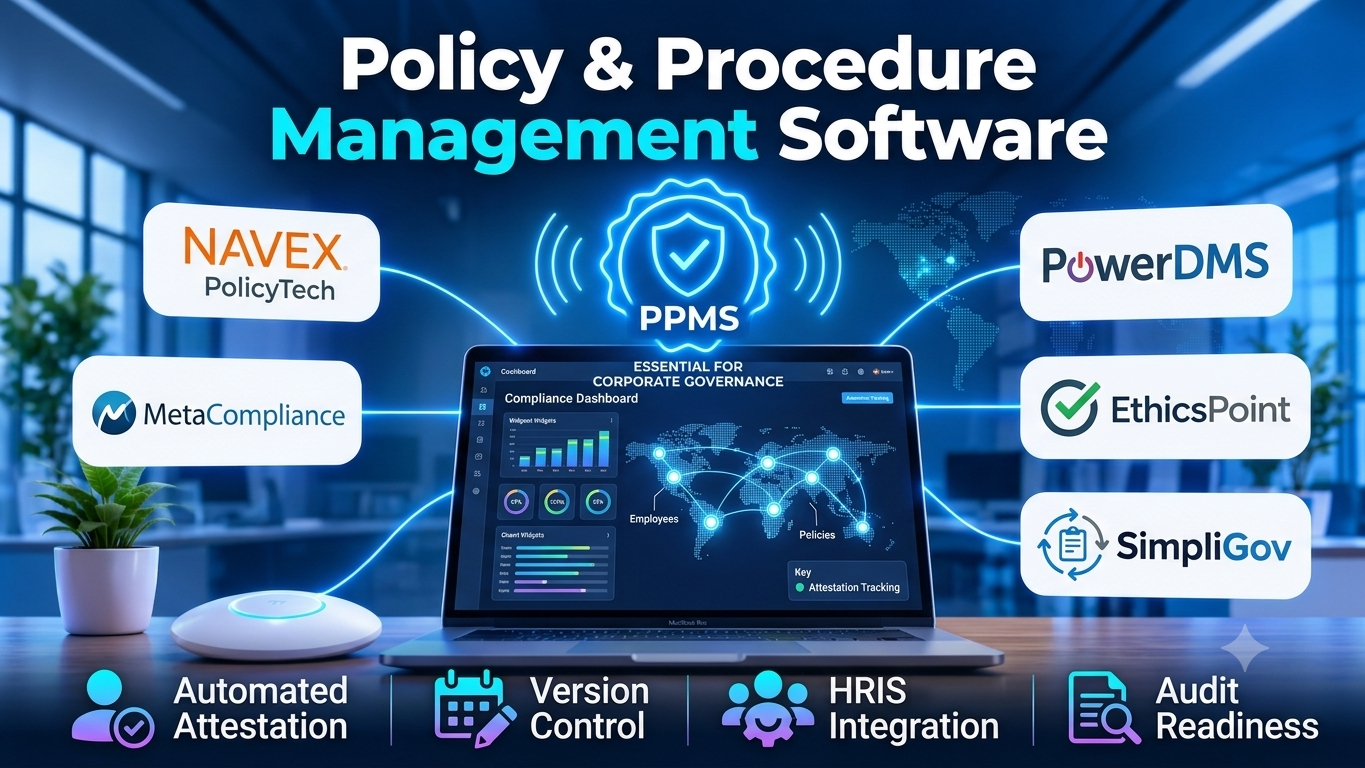
Organizations historically managed internal policies, employee handbooks, and standard operating procedures (SOPs) through local shared network drives, chaotic intranet wikis, and static PDF documents scattered across departmental folders. When regulatory audits occur or operational incidents happen, organizations quickly discover that managing policies manually is a compliance disaster. Tracking who read a revised information security policy, ensuring obsolete versions are permanently archived, and proving employee attestation during a formal regulatory audit becomes an administrative nightmare.
Policy and Procedure Management Software (PPMS) automates the entire lifecycle of corporate documentation—from authoring and version control to review workflows, employee distribution, and legally binding digital attestations. Selecting the right policy management tool requires evaluating how effectively platforms handle version history, targeted employee acknowledgments, and audit-ready reporting.
Understanding the Corporate Policy Lifecycle
Policy and procedure management software encompasses enterprise applications designed to streamline how organizations create, approve, distribute, update, and track employee compliance with internal policies. Unlike generic document repositories like SharePoint or Google Drive, dedicated policy management platforms are engineered specifically to satisfy legal, regulatory, and accreditation standards.
A professional policy management lifecycle typically involves several critical operational stages:
- Authoring and Collaborative Drafting: Providing structured document editors with built-in templates, version control, and collaborative review workflows for subject matter experts.
- Approval Routing and Governance: Routing policy drafts through designated legal, compliance, and executive approvers before official publication.
- Targeted Distribution and Employee Attestation: Publishing finalized policies to specific departments or global employee groups, requiring digital signatures or read-and-understood attestations.
- Periodic Review and Version Archiving: Automating annual review reminders for policy owners and archiving outdated versions automatically to prevent employees from referencing obsolete rules.
The core objective is to replace passive document storage with active accountability, ensuring that every employee understands and adheres to current organizational standards.
Key Evaluation Criteria for Policy Management Platforms
Selecting an effective policy management solution requires examining tracking precision, integration flexibility, and ease of employee acknowledgment.
Automated Employee Attestation Tracking
The most critical feature of any policy tool is its ability to prove that employees actually read and agreed to updated policies. Leading platforms provide automated email reminders, mobile-friendly attestation portals, and real-time compliance dashboards that highlight outstanding acknowledgments instantly.
Version Control and Audit Trails
Regulators and auditors demand proof of what policy was active on a specific date in the past. Robust policy software maintains immutable version histories and detailed audit logs showing every edit, approval, and employee signature.
Integration with HRIS and Identity Providers
Manually updating distribution lists when employees join, change departments, or leave the company is inefficient. Enterprise policy tools integrate with Human Resources Information Systems (HRIS) and identity providers (such as Okta or Azure AD) to automate audience targeting and onboarding policy assignments.
Leading Policy and Procedure Management Software Platforms
The policy management software market features specialized compliance compliance vendors alongside comprehensive enterprise governance suites.
PolicyTech (NAVEX)
PolicyTech is an industry-standard, purpose-built policy management solution renowned for its robust review workflows, automated attestation tracking, and regulatory template libraries.
- Primary Focus: End-to-end policy lifecycle management, regulatory change tracking, and employee attestation.
- Deployment Model: Cloud-native SaaS platform.
- Significant Advantage: Exceptional depth in regulatory compliance workflows, automated annual review scheduling, and audit-ready reporting.
- Important Limitation: User interface and administrative setup can feel traditional and structured compared to modern, minimalist tech platforms.
Navex Global / EthicsPoint
While integrated closely with NAVEX’s broader ethics portfolio, their governance solutions provide comprehensive policy oversight combined with incident reporting and whistleblower hotlines.
- Primary Focus: Whistleblower management, ethics training, and policy distribution.
- Deployment Model: Cloud SaaS platform.
- Significant Advantage: Seamlessly connects policy distribution with employee ethics reporting and compliance training modules.
- Important Limitation: Broad ethics suite pricing can be cost-prohibitive for smaller organizations seeking standalone document management.
MetaCompliance
MetaCompliance offers specialized policy and staff compliance software designed to educate employees, automate policy distribution, and measure organizational risk awareness.
- Primary Focus: Policy management, staff compliance training, and simulated phishing awareness.
- Deployment Model: Cloud SaaS platform.
- Significant Advantage: Excellent integration between policy reading assignments and interactive staff compliance training courses.
- Important Limitation: Focuses heavily on staff awareness and training workflows rather than complex enterprise regulatory authoring.
PowerDMS (by 네베스 / Cornerstone)
PowerDMS is a widely adopted policy management platform particularly dominant in high-compliance sectors like healthcare, law enforcement, and government agencies.
- Primary Focus: Accreditation tracking, policy management, and training document compliance.
- Deployment Model: Cloud-native SaaS platform.
- Significant Advantage: Superior support for rigorous accreditation standards (such as CALEA, HIPAA, and accrediting bodies) with built-in testing modules.
- Important Limitation: Industry-specific workflows and terminology may require minor adaptation for corporate commercial enterprises.
SimpliGov
SimpliGov provides workflow automation and form management software that organizations frequently utilize to streamline digital policy approvals and internal government processes.
- Primary Focus: Workflow automation, digital forms, and procedure routing.
- Deployment Model: Cloud SaaS platform.
- Significant Advantage: High flexibility in building custom approval workflows and digital routing forms without heavy coding.
- Important Limitation: Specialized focus on workflow automation means it lacks out-of-the-box regulatory compliance policy libraries.
Platform Comparison Overview
| Product | Primary Focus | Deployment Model | Significant Advantage | Important Limitation |
| PolicyTech | Comprehensive enterprise policy lifecycle and compliance | Cloud SaaS | Industry-leading automated review workflows and audit reporting | Administrative interface can feel traditional and rigid |
| MetaCompliance | Integrated policy management and staff security training | Cloud SaaS | Exceptional pairing of policy attestation with interactive staff training | Lacks complex multi-tier enterprise regulatory authoring |
| PowerDMS | High-compliance accreditation and policy tracking | Cloud SaaS | Superior support for strict healthcare and public sector standards | Specialized terminology may require adaptation for standard commerce |
| SimpliGov | Flexible digital workflow automation and approvals | Cloud SaaS | Highly customizable form routing and internal process automation | Lacks dedicated out-of-the-box regulatory compliance libraries |
Operational Risks and Common Pitfalls
Implementing policy management software without structured internal governance introduces significant administrative hurdles.
Creating an Overwhelming “Policy Glut”
Transitioning to digital software often encourages organizations to digitize every minor guideline, resulting in hundreds of overlapping policies that employees ignore. Quality and clarity matter more than sheer document volume.
Failing to Engage Department Owners Early
If compliance teams draft operational procedures without consulting frontline department heads, policies become unrealistic, leading to widespread non-compliance and pushback.
Neglecting Contract and Third-Party Policy Integration
Limiting policy management exclusively to internal employees while ignoring third-party vendors, contractors, and partners leaves massive compliance blind spots.
Questions to Guide Vendor Selection
Before procuring a policy and procedure management platform, compliance officers and IT leaders should address several critical operational questions:
- How does the platform handle employee attestations? Does it capture legally binding digital signatures and track overdue acknowledgments automatically?
- What integration capabilities exist with HRIS and identity providers to automate user onboarding and role-based policy distribution?
- How intuitive is the document authoring interface for non-technical subject matter experts across different departments?
- What reporting tools are provided to prove compliance immediately during a formal external audit?
Making the Final Decision
Choosing a policy and procedure management platform depends heavily on an organization’s regulatory environment, industry standards, and workforce distribution.
Organizations operating in highly regulated commercial sectors seeking proven audit readiness and robust lifecycle tracking frequently choose established platforms like PolicyTech. Conversely, organizations in specialized sectors like healthcare or public safety benefit greatly from accreditation-focused tools like PowerDMS, while teams seeking to combine policy distribution with staff training often choose MetaCompliance.
Ultimately, modern policy management software transforms static corporate documents into active, trackable governance assets that protect the enterprise and empower employees.
