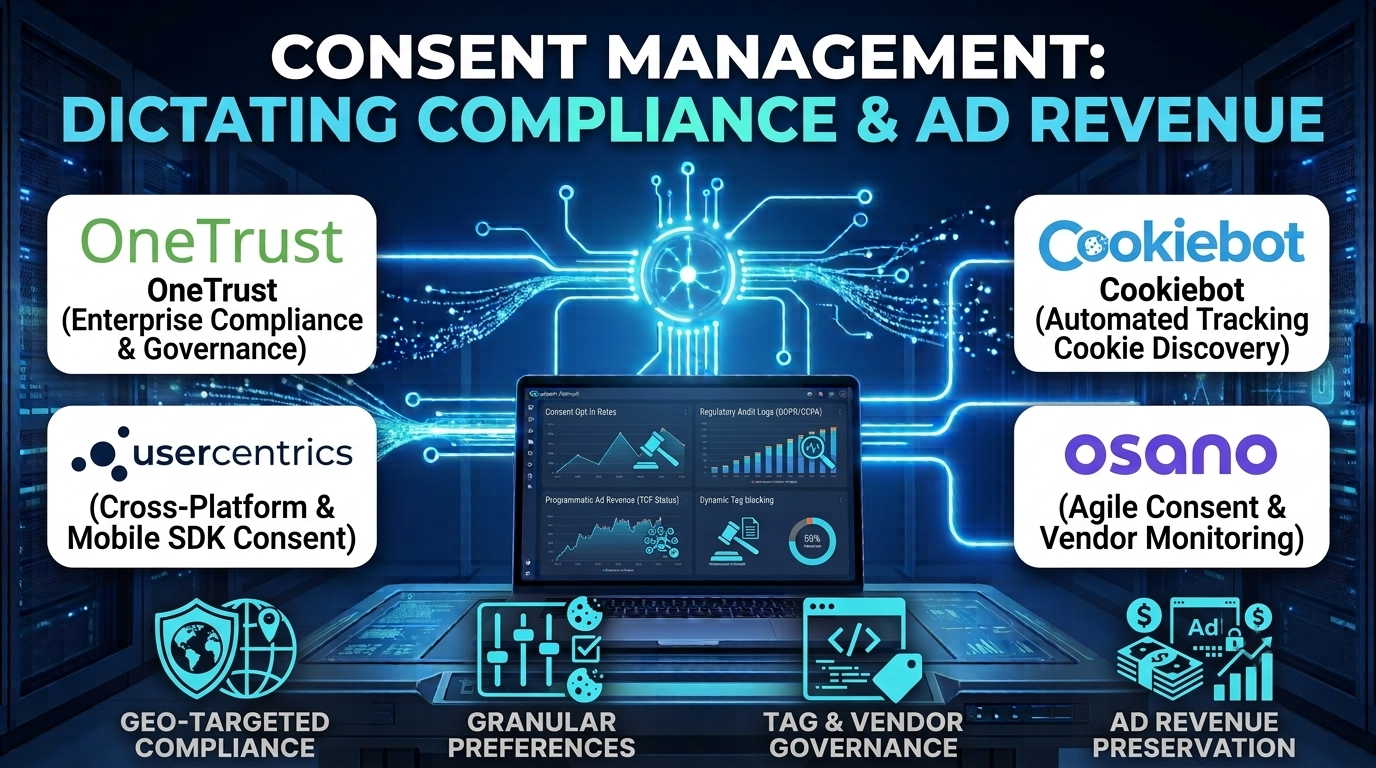
Digital marketing teams and web developers frequently treat cookie banners as an unavoidable nuisance—a simple snippet of code pasted into a website header merely to satisfy the European Union’s General Data Protection Regulation (GDPR) or the California Consumer Privacy Act (CCPA). Yet, a poorly configured consent banner can instantly break marketing attribution tags, block essential analytics pixels, or trigger severe regulatory fines if user preferences are ignored or improperly stored.
As global privacy regulations expand and major advertising networks enforce strict technical protocols like the Transparency and Consent Framework (TCF), basic JavaScript alert boxes no longer suffice. Consent Management Platforms (CMPs) automate the collection, storage, and propagation of user privacy choices across web and mobile applications. Selecting the right CMP requires balancing legal compliance, user experience, and uninterrupted digital advertising revenue.
Understanding the Mechanics of Consent Management Platforms
A Consent Management Platform is a software solution designed to collect, manage, and distribute user consent preferences regarding data tracking, cookies, and targeted advertising across digital properties.
Unlike static privacy notices, a modern CMP actively controls how third-party scripts execute in the browser. When a visitor lands on a website, the CMP renders a customizable notice banner, captures granular choices (such as accepting analytics while rejecting marketing cookies), and communicates those choices downstream to tag managers and advertising partners via standardized APIs.
A professional CMP architecture typically manages several critical operational workflows:
- Multi-Jurisdiction Geo-Targeting: Detecting a user’s geographic location in real time to serve the appropriate legal framework—displaying an opt-in GDPR banner for European visitors while showing a CCPA “Do Not Sell or Share My Info” link for California residents.
- Granular Preference Centers: Allowing users to opt-in or opt-out of specific data processing categories, such as functional cookies, performance analytics, and behavioral advertising.
- Vendor and Tag Governance: Integrating with Tag Management Systems (TMS) like Google Tag Manager to block or fire marketing tags dynamically based on real-time consent states.
- Auditable Consent Logs: Storing immutable, cryptographically verifiable records of user consent to satisfy regulatory audit requirements in the event of a legal inquiry.
The core objective is to respect consumer privacy rights while maintaining clean, compliant data flows that keep advertising and analytics pipelines functional.
Key Evaluation Criteria for CMP Solutions
Selecting an enterprise-grade Consent Management Platform requires examining developer integration friction, advertising framework support, and user interface customization.
Support for Advertising Standards (IAB TCF and Google Additional Consent)
For publishers relying heavily on programmatic advertising, the CMP must support the Interactive Advertising Bureau’s Transparency and Consent Framework (IAB TCF). Without certified TCF integration, programmatic ad exchanges may automatically devalue or block ad inventory originating from European users.
Dynamic Tag Blocking and Performance Speed
A poorly coded CMP can introduce heavy JavaScript libraries that slow down page load speeds and harm Core Web Vitals. Leading CMPs offer lightning-fast script execution and reliable client-side or server-side tag blocking that prevents tracking pixels from firing before explicit consent is granted.
Customization and User Experience (UX) Design
An intrusive or confusing cookie banner drives high bounce rates and frustrates users. Enterprise CMPs provide deep CSS customization and A/B testing capabilities, enabling marketing teams to optimize banner design for higher consent opt-in rates without violating legal compliance thresholds.
Leading Consent Management Platforms and Tools
The consent management market features specialized privacy technology innovators as well as comprehensive compliance suites built for global enterprises.
OneTrust Cookie Compliance
OneTrust is the gold standard in enterprise compliance, offering a robust, globally recognized CMP that integrates seamlessly with broader data governance and privacy operations.
- Primary Focus: Enterprise-scale consent management, multi-jurisdiction compliance, and deep privacy governance integration.
- Deployment Model: Cloud SaaS platform with flexible script embedding and SDKs for mobile apps.
- Significant Advantage: Unmatched global regulatory template coverage and seamless integration with broader enterprise privacy management workflows.
- Important Limitation: Broad enterprise feature sets and complex configurations can introduce steep setup overhead for smaller web properties.
Osano
Osano provides a developer-friendly, streamlined consent management platform designed for organizations seeking rapid deployment and clean user experiences without administrative bloat.
- Primary Focus: Straightforward cookie consent, automated vendor monitoring, and clean website integration.
- Deployment Model: Cloud SaaS platform with simple JavaScript snippet deployment.
- Significant Advantage: Rapid implementation, highly transparent pricing, and an intuitive user interface that minimizes friction.
- Important Limitation: Advanced multi-brand enterprise governance and complex custom workflows are more limited compared to heavy enterprise suites.
Cookiebot (by Usercentrics)
Cookiebot is a widely adopted, fully automated CMP known for its rigorous website scanning engine and reliable compliance across global privacy standards.
- Primary Focus: Automated cookie discovery, IAB TCF compliance, and straightforward banner deployment.
- Deployment Model: Cloud SaaS platform with automated monthly site scanning.
- Significant Advantage: Excellent automated discovery of tracking cookies and website trackers, ensuring banners stay accurate as sites evolve.
- Important Limitation: Customizing banner styles and advanced styling requires familiarity with CSS or higher-tier platform plans.
Usercentrics CMP
Usercentrics offers a highly customizable, developer-centric consent management platform optimized for both web and mobile application environments.
- Primary Focus: Cross-platform consent management for web, mobile apps, connected TV, and IoT devices.
- Deployment Model: Cloud SaaS with robust mobile SDKs (iOS and Android).
- Significant Advantage: Superior mobile application SDK support, making it a top choice for brands with native iOS and Android apps.
- Important Limitation: Initial technical configuration of mobile SDKs demands closer collaboration with software development teams.
Didomi
Didomi provides a user-centric consent and preference management platform focused on helping brands collect compliant consent while maximizing opt-in rates through optimized UX.
- Primary Focus: High-converting preference centers, IAB TCF compliance, and multi-channel consent collection.
- Deployment Model: Cloud SaaS platform with flexible web and mobile SDK integrations.
- Significant Advantage: Exceptional focus on user experience customization and A/B testing to maintain high consent rates.
- Important Limitation: Specialized focus on UX optimization means broader enterprise data mapping features require supplementary tools.
Platform Comparison Overview
| Product | Primary Focus | Deployment Model | Significant Advantage | Important Limitation |
| OneTrust Cookie Compliance | Comprehensive enterprise compliance and governance | Cloud SaaS | Industry-leading global regulatory template coverage | High setup complexity and enterprise pricing overhead |
| Osano | Rapid, streamlined consent and vendor monitoring | Cloud SaaS | Fast deployment, transparent pricing, and clean user experience | Lacks deep multi-brand enterprise workflow customization |
| Cookiebot | Automated cookie discovery and IAB TCF compliance | Cloud SaaS | Excellent automated monthly site scanning and tracker detection | Advanced visual styling requires CSS customization knowledge |
| Usercentrics | Cross-platform web and mobile SDK consent management | Cloud SaaS / SDK | Superior native mobile application (iOS/Android) SDK support | Mobile implementation requires active developer involvement |
| Didomi | High-converting consent UX and preference centers | Cloud SaaS / SDK | Strong focus on UI/UX optimization and consent rate testing | Broader enterprise data governance requires supplementary tools |
Operational Risks and Common Pitfalls
Implementing a Consent Management Platform without rigorous technical testing can introduce severe legal and operational risks.
Pre-Ticked Consent Boxes and Dark Patterns
Under strict regulations like GDPR, pre-ticked consent checkboxes or making it harder to reject cookies than to accept them (“dark patterns”) are explicitly illegal and can invalidate an organization’s entire compliance posture.
Tag Manager Misconfiguration Causing Data Leaks
If marketing tags are configured incorrectly in Google Tag Manager, cookies and tracking pixels may fire before the user interacts with the CMP banner. Continuous tag auditing is mandatory.
Ignoring Mobile Application Consent Requirements
Many organizations focus exclusively on website cookie banners while completely ignoring mobile apps. Mobile apps operating in regulated markets require dedicated software development kit (SDK) integration to capture user consent compliantly.
Questions to Guide Vendor Selection
Before procuring a Consent Management Platform, legal, marketing, and engineering leaders should address several critical operational questions:
- Does the CMP support the latest IAB Transparency and Consent Framework (TCF) standards required by programmatic advertising exchanges?
- How reliably does the platform block tracking tags before user consent is captured? Does it offer server-side blocking capabilities?
- Does the vendor provide robust mobile SDK support for iOS and Android applications, or is it limited strictly to web browsers?
- How frequently does the platform scan websites for newly added trackers and unclassified cookies?
Making the Final Decision
Choosing a Consent Management Platform depends heavily on an organization’s digital footprint, geographic audience distribution, and advertising monetization model.
Enterprises managing complex global websites alongside extensive data governance requirements frequently choose robust compliance platforms like OneTrust. Conversely, organizations seeking rapid deployment, clean user experiences, and straightforward setup frequently select agile platforms like Osano or Cookiebot, while mobile-first app publishers benefit heavily from developer-centric tools like Usercentrics or Didomi.
Ultimately, a modern Consent Management Platform bridges the gap between legal compliance and digital revenue, ensuring that consumer trust is earned and maintained across every digital touchpoint.
