Organizations routinely invest heavily in secure perimeters, endpoint detection, and identity providers like Okta or Azure AD, assuming that once a user authenticates securely, corporate data residing in SaaS applications remains protected. However, enterprise productivity ecosystems have evolved far beyond simple user logins. Employees freely connect third-party OAuth integrations, share sensitive repositories publicly, alter document permission defaults, and accumulate dormant administrative accounts across dozens of cloud-hosted applications.
Identity and Access Management (IAM) tools verify who a user is, but they fail to inspect what those users do inside individual SaaS environments. SaaS Security Posture Management (SSPM) platforms address this critical blind spot by continuously auditing application configurations, user permissions, third-party integrations, and data-sharing behaviors across core enterprise suites.
Understanding the Scope of SaaS Security Posture Management
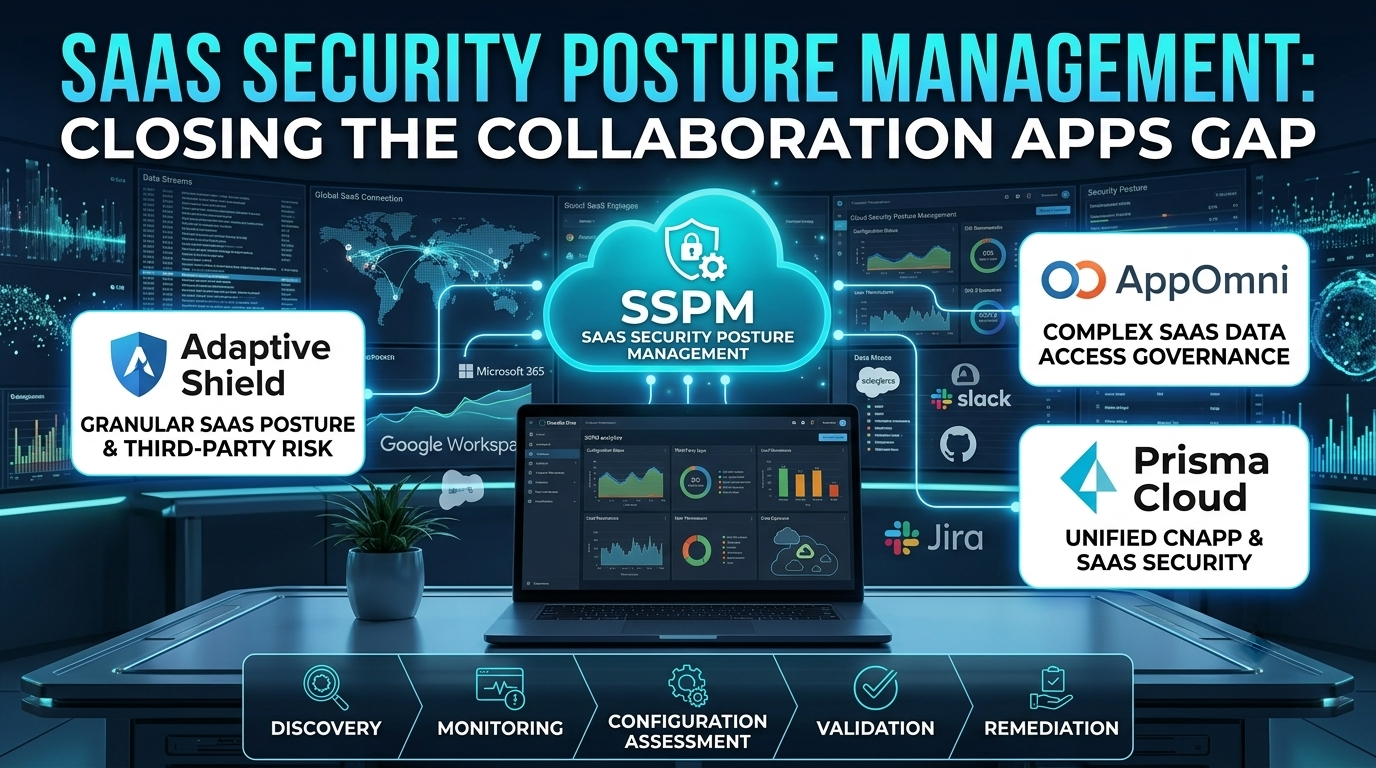
SaaS Security Posture Management encompasses automated solutions designed to discover, monitor, and remediate misconfigurations and security risks across business-critical software-as-a-service applications, including Microsoft 365, Google Workspace, Salesforce, GitHub, Slack, and Jira.
Unlike traditional cloud infrastructure posture management (CSPM) that secures underlying virtual servers and storage buckets, SSPM operates at the application layer, focusing on how users, administrators, and external entities interact with business data.
A comprehensive SSPM framework typically manages several operational domains:
- Continuous Configuration Auditing: Inspecting thousands of granular tenant settings—such as password complexity requirements, guest access privileges, and session timeout policies—against established security benchmarks.
- Third-Party Integration Governance: Identifying every external OAuth application and API integration connected to corporate SaaS tenants, assessing their permission scopes, and flagging overly permissive data access.
- Identity and Permission Hygiene: Detecting dormant accounts, stale administrative privileges, over-provisioned roles, and users with excessive data-sharing rights.
- Data Exposure Monitoring: Scanning for documents shared publicly via links, sensitive records exposed in collaboration channels, and unauthorized data leakage vectors.
The core objective is to prevent accidental data exfiltration and privilege escalation caused by lax application-level defaults rather than direct perimeter breaches.
Key Evaluation Criteria for SSPM Solutions
Selecting an effective SSPM platform requires analyzing breadth of application coverage, remediation depth, and integration flexibility.
Application Coverage and API Depth
An enterprise SSPM tool must support deep API integrations across major business platforms. Surface-level visibility into user counts is insufficient; the platform must inspect granular settings, permission matrices, and audit logs within each specific application ecosystem.
Automated Remediation and One-Click Fixes
Identifying misconfigurations creates significant ticket volume for security teams. Leading SSPM platforms offer automated or one-click remediation playbooks that revert unsafe tenant settings or revoke dangerous OAuth tokens without requiring manual administrative navigation.
False Positive Reduction and Business Context
Security rules that disrupt normal business workflows lead to friction with application owners. Platforms that correlate configuration risk with actual user activity and business criticality help security teams prioritize genuine threats over harmless administrative exceptions.
Leading SaaS Security Posture Management Platforms
The SSPM market features dedicated cloud security pioneers alongside established enterprise security platforms expanding into application-layer governance.
Adaptive Shield
Adaptive Shield provides deep SaaS security posture management, offering comprehensive visibility and governance across dozens of enterprise SaaS applications with advanced third-party risk controls.
- Primary Focus: Granular SaaS configuration auditing, third-party app governance, and identity hygiene.
- Deployment Model: Cloud-native SaaS platform connecting via secure API tokens.
- Significant Advantage: Exceptional depth in uncovering hidden third-party OAuth integrations and risky permission grants across sprawling SaaS estates.
- Important Limitation: Specialized focus means broad infrastructure-level cloud security requires supplementary CSPM tooling.
AppOmni
AppOmni delivers enterprise-grade SaaS security management, focusing heavily on data access governance, posture monitoring, and continuous compliance across complex enterprise applications like Salesforce and Workday.
- Primary Focus: SaaS data access visibility, posture management, and compliance posture tracking.
- Deployment Model: SaaS-delivered cloud platform with advanced data modeling engines.
- Significant Advantage: Superior capability in mapping complex data-sharing permissions and external access rights inside deep business applications.
- Important Limitation: Enterprise pricing and configuration complexity are tailored primarily for large organizations.
Palo Alto Networks Prisma Cloud (SaaS Security)
Palo Alto integrates SaaS security posture management into its broader cloud-native application protection platform (CNAPP), allowing teams to govern SaaS environments alongside infrastructure workloads.
- Primary Focus: Unified cloud security combining infrastructure, workload, and SaaS posture management.
- Deployment Model: SaaS cloud platform with unified administrative controls.
- Significant Advantage: Unifies SaaS governance with multi-cloud infrastructure security under a single administrative pane of glass.
- Important Limitation: Optimized best for organizations already leveraging the broader Prisma Cloud ecosystem.
Platform Comparison Overview
| Product | Primary Focus | Deployment Model | Significant Advantage | Important Limitation |
| Adaptive Shield | Granular SaaS posture and third-party app risk | SaaS Platform | Unmatched depth in discovering hidden OAuth integrations | Focused strictly on SaaS apps, requiring other tools for infrastructure |
| AppOmni | Complex enterprise SaaS data access governance | SaaS Platform | Outstanding visibility into deep data-sharing permissions | Geared primarily toward large enterprise operational budgets |
| Prisma Cloud | Unified cloud-native and SaaS security posture | SaaS Platform | Combines SaaS governance with multi-cloud infrastructure security | Maximized value relies on adopting the broader Prisma suite |
Operational Risks and Common Pitfalls
Deploying an SSPM program introduces specific organizational and technical challenges that security leaders must navigate carefully.
Fragmented Ownership Across Business Units
Unlike traditional IT infrastructure managed exclusively by engineering teams, individual SaaS applications (like Salesforce or HubSpot) are often owned and administered by business departments. Without stakeholder alignment, security teams risk breaking business workflows when modifying tenant configurations.
Alert Fatigue from Unmanaged Third-Party Apps
Employees frequently connect hundreds of consumer-grade productivity plugins and browser extensions to corporate accounts via OAuth. Initial SSPM scans often generate overwhelming alert volumes that require disciplined policy tuning.
Treating SSPM as a One-Time Audit
SaaS environments change constantly as employees create new collaboration channels, invite external partners, and install integrations. Treating SSPM as a periodic compliance audit rather than a continuous monitoring loop leaves organizations vulnerable to configuration drift.
Questions to Guide Vendor Selection
Before procuring an SSPM platform, security architects and risk managers should address several critical operational questions:
- How deeply does the platform inspect individual SaaS applications? Does it audit granular permission settings, or does it track only high-level user logins?
- What discovery mechanisms are used to catch unauthorized third-party OAuth integrations and shadow SaaS adoption across the organization?
- Does the solution offer automated remediation playbooks, or do all identified misconfigurations require manual administrative correction?
- How easily does the platform integrate with existing ticketing systems and Security Information and Event Management (SIEM) tools?
Making the Final Decision
Choosing a SaaS Security Posture Management platform depends heavily on an organization’s SaaS footprint, regulatory compliance requirements, and internal operational structure.
Organizations managing sprawling ecosystems of third-party integrations and collaboration tools often benefit from specialist platforms like Adaptive Shield, where deep application auditing and OAuth governance shine. Conversely, large enterprises with complex business-critical systems like Salesforce and Workday frequently choose robust data governance platforms like AppOmni to secure sensitive data sharing.
Ultimately, SaaS Security Posture Management closes the visibility gap between identity authentication and data usage, ensuring that corporate collaboration apps drive productivity without compromising security.
