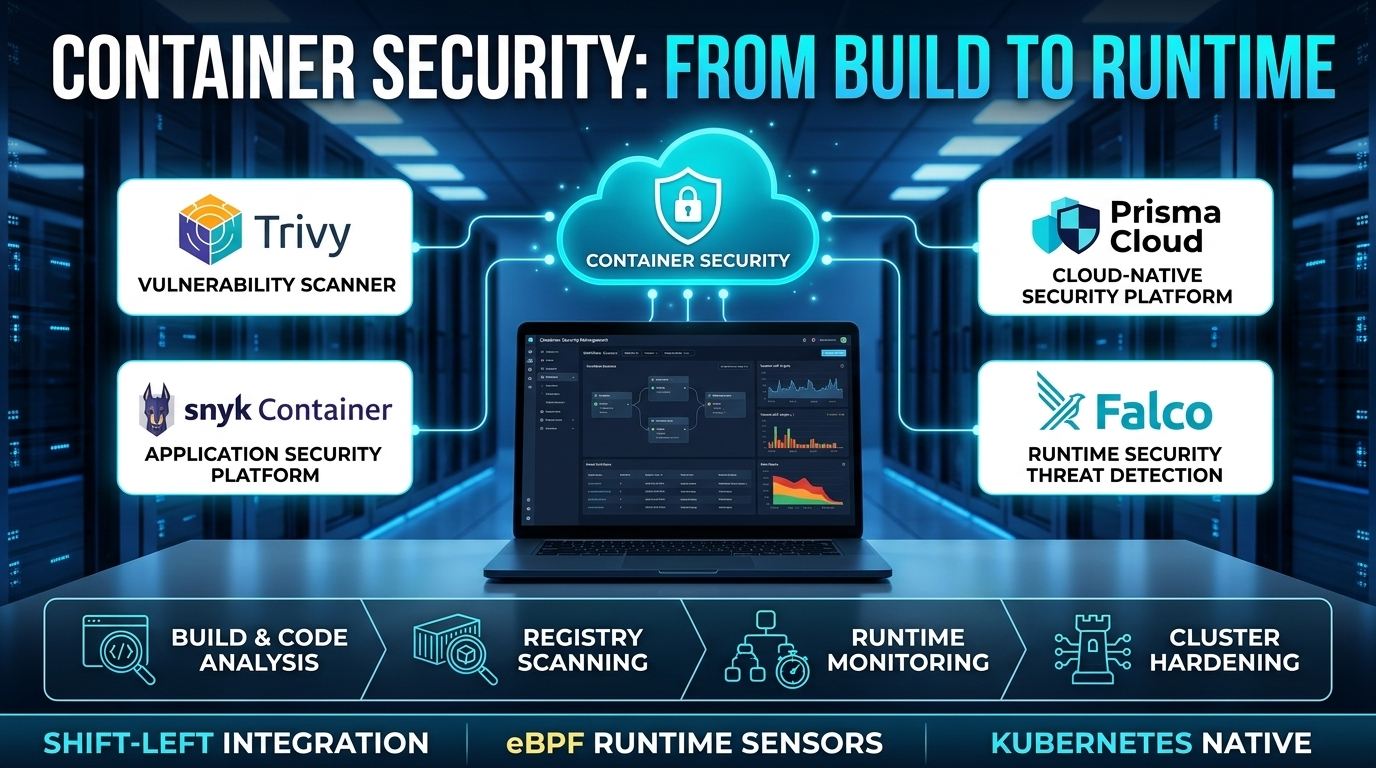
Engineering teams containerize applications to achieve rapid deployment, seamless scalability, and consistent execution across development and production environments. However, wrapping microservices in Docker images and orchestrating them with Kubernetes introduces complex security challenges. A container is only as secure as its base image, its underlying host kernel, and the runtime configurations governing its network access.
Relying solely on perimeter defenses or traditional virtual machine security leaves microservices exposed to vulnerable base image layers, unpatched third-party packages, and malicious container breakouts. Securing modern containerized workflows requires specialized container security tools that span the entire application lifecycle, from code repository scanning to live runtime defense.
Understanding the Container Security Lifecycle
Container security cannot be treated as an afterthought applied just before deployment. Securing containerized infrastructure requires enforcing security gates across distinct operational phases:
- Build and Code Analysis: Inspecting Dockerfiles, Infrastructure-as-Code (IaC) templates, and application dependency manifests for misconfigurations and known vulnerabilities before building images.
- Registry and Image Scanning: Analyzing built container images in private or public registries (such as Docker Hub, Amazon ECR, or Google Artifact Registry) to detect outdated operating system packages and vulnerable CVEs.
- Runtime Monitoring and Enforcement: Using lightweight agents or eBPF sensors to observe live container behavior, inspect inter-pod network traffic, and block unauthorized process executions.
- Cluster and Orchestration Hardening: Auditing Kubernetes manifests, Role-Based Access Control (RBAC) configurations, and API server settings to prevent privilege escalation.
The objective is to catch security flaws as early as possible in the software development lifecycle (SDLC) while maintaining real-time visibility over live production clusters.
Key Evaluation Criteria for Container Security Solutions
Selecting the right container security tools involves analyzing scanning depth, pipeline integration friction, and runtime visibility.
Shift-Left Integration versus Runtime Depth
Effective security tools must integrate smoothly into developer CI/CD pipelines (such as GitHub Actions, GitLab CI, or Jenkins) to scan images during builds without blocking developer velocity. Simultaneously, they must provide deep runtime introspection to detect zero-day exploits or privilege escalation attempts inside active Kubernetes pods.
False Positive Management and Vulnerability Context
Container images notoriously trigger hundreds of low-priority vulnerability alerts due to bundled operating system binaries that may not even be executed by the application. Leading security platforms correlate vulnerabilities with actual runtime execution context to filter out noise.
Kubernetes Native Architecture
Modern container security tools must operate natively within Kubernetes clusters using admission controllers, mutating webhooks, and eBPF sensors rather than relying on legacy host-agent assumptions.
Leading Container Security Tools and Platforms
The container security market includes specialized open-source utilities, developer-focused scanning tools, and comprehensive enterprise cloud-native application protection platforms (CNAPPs).
Trivy (Aqua Security)
Trivy is an extremely popular, open-source vulnerability and misconfiguration scanner designed for containers, file systems, Git repositories, and Kubernetes manifests.
- Primary Focus: Comprehensive open-source vulnerability scanning across artifacts and infrastructure code.
- Deployment Model: Standalone CLI utility, container image, or CI/CD integration action.
- Significant Advantage: Blazing-fast scanning speed, broad artifact support, and zero proprietary licensing barriers.
- Important Limitation: Focuses primarily on static analysis and vulnerability detection rather than deep real-time runtime threat response.
Snyk Container
Snyk helps developer and security teams find and fix vulnerabilities in container base images and application dependencies early in the development lifecycle.
- Primary Focus: Developer-first dependency scanning and automated remediation advice.
- Deployment Model: SaaS platform with deep IDE, Git repository, and CI/CD integrations.
- Significant Advantage: Provides explicit code fixes and upgrade advice directly to developers inside their native workflows.
- Important Limitation: Advanced runtime monitoring and cluster-level threat detection require pairing with complementary platform tools.
Prisma Cloud (Palo Alto Networks)
Prisma Cloud provides enterprise-grade container and Kubernetes security, combining image assurance, vulnerability management, and real-time runtime defense into a unified platform.
- Primary Focus: Full-lifecycle container security and enterprise cloud-native protection.
- Deployment Model: SaaS-managed platform with lightweight cluster defenders and eBPF sensors.
- Significant Advantage: Unmatched depth spanning build-time pipeline security, registry scanning, and live runtime threat mitigation.
- Important Limitation: Enterprise pricing structure and platform complexity are tailored primarily for large organizations.
Falco (Cloud Native Computing Foundation)
Falco is the CNCF-incubating open-source standard for cloud-native runtime security, acting as a security camera for kernel system calls in Kubernetes.
- Primary Focus: Real-time runtime threat detection and behavioral monitoring using eBPF.
- Deployment Model: DaemonSet deployed directly onto Kubernetes clusters.
- Significant Advantage: Exceptional real-time detection of unauthorized container behavior, file modifications, and privilege escalations.
- Important Limitation: Requires operational expertise to write custom detection rules and tune alerts for specific application workloads.
Platform Comparison Overview
| Product | Primary Focus | Deployment Model | Significant Advantage | Important Limitation |
| Trivy | Open-source multi-artifact vulnerability scanning | CLI / CI/CD Action | Fast, comprehensive, and free open-source utility | Lacks advanced enterprise runtime threat response workflows |
| Snyk Container | Developer-first dependency and image scanning | SaaS / Git Integration | Outstanding developer workflow integration and remediation advice | Advanced cluster runtime monitoring requires supplementary tools |
| Prisma Cloud | Full-lifecycle enterprise container security | SaaS Platform | Complete coverage from pipeline build to live runtime defense | Complex enterprise pricing and deployment overhead |
| Falco | Open-source runtime threat detection for Kubernetes | Kubernetes DaemonSet | Superior real-time eBPF kernel-level visibility | Requires dedicated security engineering to tune and manage rules |
Operational Risks and Common Pitfalls
Implementing container security tools without a cohesive strategy introduces distinct organizational and technical challenges.
Overwhelming Developers with Unactionable Alerts
Flooding developers with thousands of low-severity vulnerability alerts from base operating system images creates alert fatigue. Security teams must implement policy thresholds that prioritize vulnerabilities with verified exploits in the wild.
Treating Container Scanning as a One-Time Event
Scanning container images only when they are initially built leaves applications vulnerable to newly disclosed zero-day vulnerabilities discovered weeks later. Continuous registry scanning is essential.
Ignoring Host Kernel Security
Even if container images are thoroughly scanned, vulnerabilities in the underlying host Linux kernel can allow breakout attacks. Securing container nodes and keeping host kernels updated is mandatory.
Questions to Guide Tool Selection
Before procuring or deploying container security tools, engineering leaders and security architects should address several critical operational questions:
- Where in the pipeline do security checks occur? Can the tools block vulnerable builds from reaching production registries automatically?
- Does the runtime security solution rely on legacy kernel modules that risk stability, or does it leverage modern eBPF sensors?
- How effectively does the platform reduce false positives by analyzing whether vulnerable packages are actually loaded into memory at runtime?
- What level of training do development teams need to interpret scanning results and apply recommended dependency fixes?
Making the Final Decision
Choosing the right container security tools depends heavily on an organization’s development velocity, infrastructure maturity, and security operational capacity.
Organizations seeking lightweight, developer-friendly scanning tools for CI/CD pipelines frequently adopt open-source staples like Trivy or developer platforms like Snyk. Conversely, large enterprises running sprawling Kubernetes production environments often deploy comprehensive platforms like Prisma Cloud or open-source runtime monitors like Falco to achieve end-to-end visibility.
Ultimately, robust container security transforms safety from a bottleneck into an automated enabler, ensuring microservices innovate rapidly without compromising production integrity.
