Configuring cloud infrastructure securely prevents external misconfigurations, but it offers zero protection once an attacker exploits a zero-day vulnerability in an application library, executes remote code inside a container, or compromises a live virtual machine instance. While posture management checks what storage buckets are open, runtime workloads remain exposed to fileless malware, memory injection, and unauthorized lateral movement occurring deep inside operating systems and container namespaces.
Cloud Workload Protection Platforms (CWPP) address this operational blind spot by providing continuous runtime visibility, threat detection, and workload hardening across virtual machines, containers, and serverless functions. Deploying effective workload protection requires understanding how CWPP architectures differ from posture management and what engineering teams must evaluate before securing production runtimes.
Understanding the Scope of Cloud Workload Protection Platforms
Cloud Workload Protection Platforms are specialized security solutions designed to detect and prevent threats targeting workloads running across multi-cloud environments, on-premises data centers, and hybrid architectures. Unlike static configuration scanners, CWPP agents or eBPF sensors operate at the kernel and application layer to monitor active processes, network connections, and file modifications in real time.
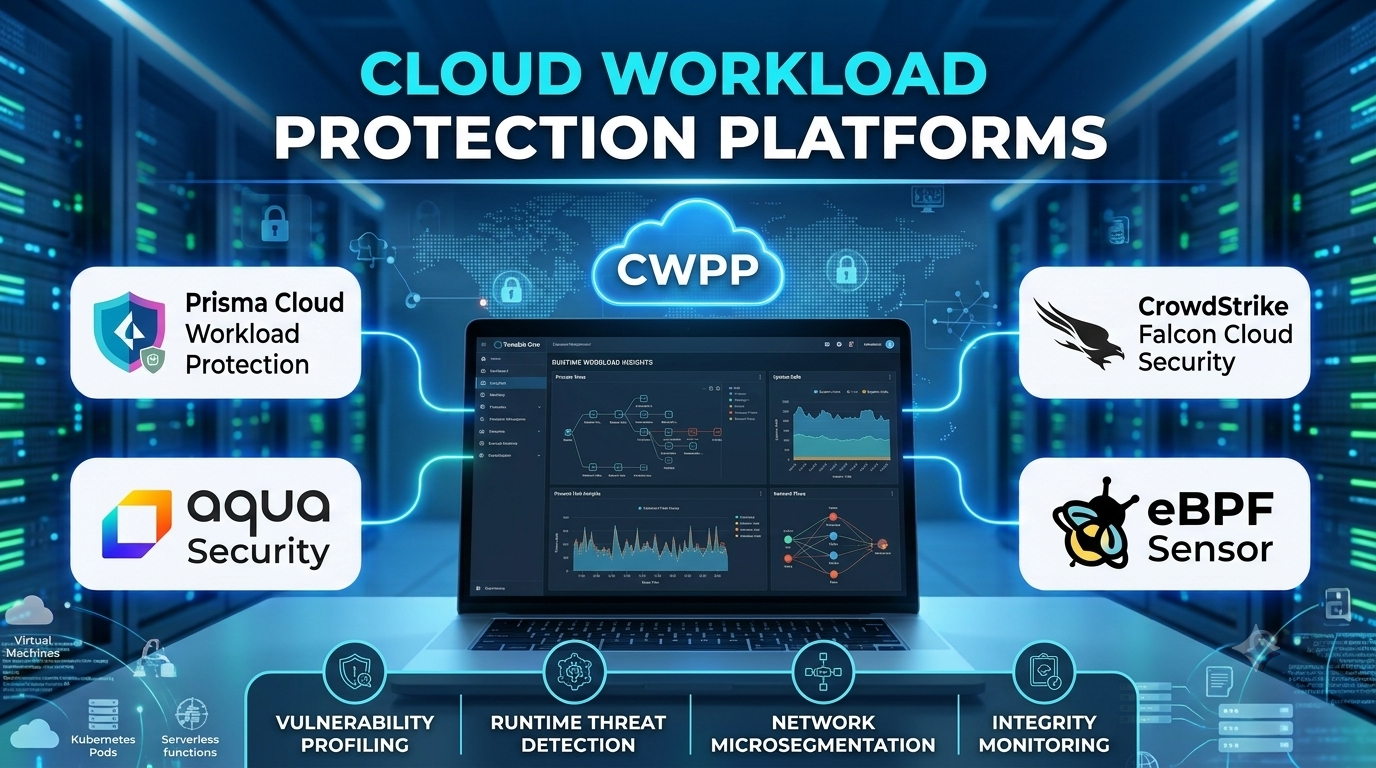
A comprehensive CWPP operational framework typically covers several critical security pillars:
- Vulnerability and Package Profiling: Scanning container images in registries and inspecting running virtual machines for unpatched operating system libraries and vulnerable packages.
- Runtime Threat Detection: Monitoring active memory, system calls, and process trees using eBPF (Extended Berkeley Packet Filter) or lightweight agents to flag anomalous behavior immediately.
- Network Microsegmentation: Enforcing strict communication boundaries between workloads to prevent an attacker who compromises one container from pivoting across the internal network.
- Integrity Monitoring and Hardening: Enforcing file integrity monitoring (FIM) and compliance hardening across Linux and Windows operating systems.
The core objective is to detect active compromise attempts and block malicious execution before attackers can establish persistence or exfiltrate sensitive data.
Key Evaluation Criteria for CWPP Solutions
Selecting a Cloud Workload Protection Platform requires analyzing runtime performance impact, architectural flexibility, and container visibility depth.
Low-Latency Runtime Performance and eBPF Adoption
Traditional security agents that hook deep into kernel operations can introduce high CPU overhead or trigger system instability. Modern CWPP platforms leverage eBPF sensors to observe kernel events securely and efficiently without modifying the kernel or impacting application performance.
Kubernetes and Container Native Visibility
With modern applications deployed across ephemeral Kubernetes pods and microservices, security tools must inspect container namespaces, sidecar injections, and ephemeral storage volumes without relying on traditional virtual machine assumptions.
Alert Precision and Contextual Investigation
Production environments generate massive volumes of system activity. A strong CWPP solution must correlate process execution, network traffic, and user credentials into coherent attack narratives rather than flooding security teams with isolated, low-fidelity alerts.
Multi-Cloud and Hybrid Architecture Support
Organizations rarely operate in a single cloud. A unified workload protection platform must secure workloads spanning AWS, Azure, Google Cloud, and private data centers from a single administrative pane of glass.
Leading Cloud Workload Protection Platforms
The workload protection market features specialized cloud-native security innovators alongside established endpoint protection vendors expanding into server and container security.
Prisma Cloud Workload Protection (Palo Alto Networks)
Prisma Cloud delivers robust runtime protection for virtual machines, Kubernetes clusters, and serverless functions, combining vulnerability management with real-time behavioral monitoring.
- Primary Focus: Comprehensive multi-cloud workload security, host scanning, and runtime defense.
- Deployment Model: SaaS-managed platform with lightweight agents and eBPF sensors.
- Significant Advantage: Exceptional integration across container registries, infrastructure-as-code scanning, and live runtime threat defense.
- Important Limitation: Extensive feature set requires dedicated administrative tuning to manage alert workflows effectively.
CrowdStrike Falcon Cloud Security
CrowdStrike extends its industry-leading Endpoint Detection and Response (EDR) architecture into cloud workloads, providing high-fidelity runtime protection for Linux and Windows instances.
- Primary Focus: Cloud workload runtime security, threat hunting, and incident response.
- Deployment Model: Single lightweight sensor architecture across hosts and containers.
- Significant Advantage: Leverages massive global threat intelligence and proven EDR telemetry to stop sophisticated attacks in progress.
- Important Limitation: Pricing and packaging models scale with cloud asset density, which can require careful budgeting for dynamic environments.
Aqua Security Cloud Native Application Protection Platform (CNAPP)
Aqua Security provides developer-first runtime security tailored specifically for containerized workloads, Kubernetes orchestration, and serverless applications.
- Primary Focus: Native container and Kubernetes runtime security, vulnerability shielding, and compliance.
- Deployment Model: SaaS or self-hosted deployment options with open-source roots.
- Significant Advantage: Deep specialization in container forensics, image assurance, and Kubernetes-native access controls.
- Important Limitation: Focus on container ecosystems means traditional bare-metal or virtual machine monitoring requires additional configuration.
Platform Comparison Overview
| Product | Primary Focus | Deployment Model | Significant Advantage | Important Limitation |
| Prisma Cloud | Full-stack multi-cloud workload protection | SaaS Platform | Unmatched breadth across hosts, containers, and serverless | Requires careful policy tuning to avoid operational noise |
| CrowdStrike Falcon | Threat hunting and runtime EDR for cloud | SaaS Sensor | Outstanding threat intelligence and proven detection pedigree | Asset-based licensing can increase costs in elastic environments |
| Aqua Security | Container and Kubernetes native security | SaaS / Self-Hosted | Superior container forensics and Kubernetes runtime controls | Heavily optimized for container stacks over traditional VMs |
Operational Risks and Common Pitfalls
Deploying workload protection tools across production environments introduces specific technical and organizational challenges.
Performance Degradation on High-Throughput Servers
Installing unoptimized security agents on database servers or high-traffic API gateways can degrade input/output performance. Utilizing modern eBPF-based instrumentation mitigates much of this overhead.
High Volume of False Positives in Custom Applications
Standard behavioral rules often flag legitimate custom enterprise software routines as suspicious activity. Security teams must invest time in baseline tuning to establish normal operational parameters.
Operational Silos Between Security and DevOps
If runtime security alerts are routed solely to security operations without providing actionable context to the development or DevOps teams managing the underlying code, remediation stalls.
Questions to Guide Vendor Selection
Before procuring a CWPP solution, security architects and platform engineering leaders should address several critical operational questions:
- How does the platform collect runtime telemetry? Does it rely on legacy kernel modules that risk system crashes, or does it utilize modern eBPF sensors?
- What is the resource overhead of the agent on production virtual machines and ephemeral container instances under peak load?
- How effectively does the platform distinguish between benign developer administrative activity and malicious process execution inside containers?
- What automated response actions are supported—such as container isolation or process termination—when a confirmed runtime attack occurs?
Making The Final Decision
Selecting a Cloud Workload Protection Platform depends heavily on an organization’s underlying compute architecture and security operational maturity.
Organizations running container-heavy, Kubernetes-centric environments frequently benefit from specialized platforms like Aqua Security or Prisma Cloud, where deep container forensics and image assurance protect ephemeral workloads effectively. Conversely, enterprises seeking to unify server and cloud workload monitoring under proven threat-hunting telemetry often choose established platforms like CrowdStrike Falcon.
Ultimately, Cloud Workload Protection Platforms close the loop between posture visibility and active defense, ensuring that even if an attacker penetrates the perimeter, runtime controls neutralize the threat before damage occurs.
