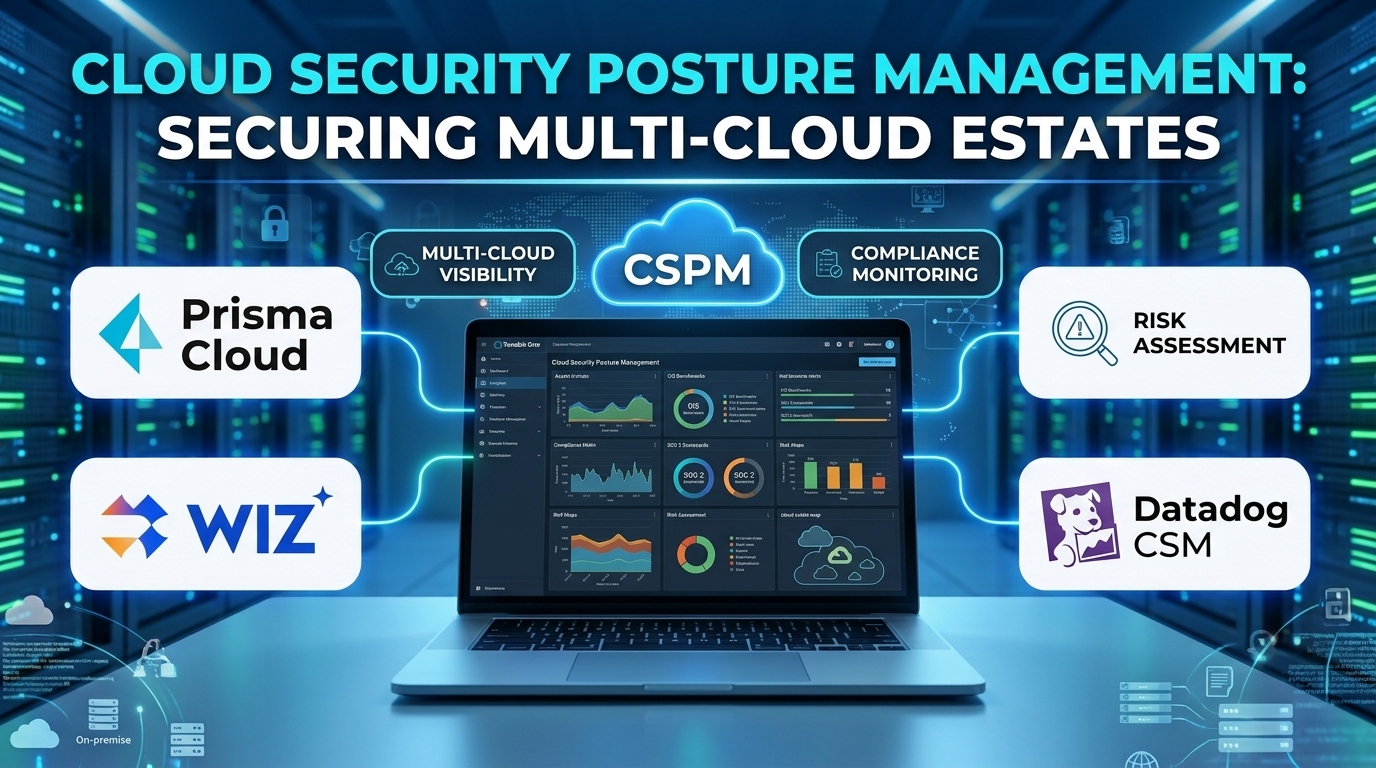
Engineering teams rapidly deploy multi-cloud architectures across Amazon Web Services, Microsoft Azure, and Google Cloud Platform, yet security and compliance teams frequently struggle with a pervasive blind spot: misconfigured storage buckets, overly permissive IAM roles, and dormant access keys accumulating faster than human operators can audit them. Relying solely on native cloud provider dashboards creates fragmented visibility across siloed environments, leaving organizations vulnerable to data exfiltration caused by simple configuration drift.
Cloud Security Posture Management (CSPM) tools automate compliance monitoring, asset discovery, and misconfiguration remediation across multi-cloud estates. Moving past basic checklist auditing requires understanding how modern CSPM platforms operate, how they differ from cloud workload protection, and what criteria engineering leaders must evaluate before deployment.
Understanding the Scope of Cloud Security Posture Management
Cloud Security Posture Management encompasses automated tools designed to identify, monitor, and remediate security risks, compliance violations, and misconfigurations across cloud infrastructure. Unlike traditional network firewalls that inspect packet traffic, CSPM solutions interface directly with cloud control planes using read-only or remediating API connections.
A comprehensive CSPM lifecycle typically involves several core operational stages:
- Continuous Asset Discovery: Automatically cataloging every compute instance, storage bucket, database, IAM policy, and serverless function across all accounts and regions.
- Configuration Assessment: Comparing live cloud resource states against established security benchmarks, such as CIS benchmarks, HIPAA, PCI-DSS, and internal corporate governance rules.
- Risk Prioritization and Graphing: Analyzing how disparate misconfigurations interact—such as an open security group attached to an over-privileged virtual machine—to identify viable attack paths.
- Remediation: Delivering automated or one-click fixes to correct non-compliant resources before attackers exploit them.
The ultimate objective is to maintain a hardened cloud posture without slowing down developer velocity or requiring manual audits of thousands of infrastructure-as-code templates.
Key Evaluation Criteria for CSPM Platforms
Selecting a Cloud Security Posture Management platform requires examining architectural coverage, remediation flexibility, and integration depth.
Multi-Cloud Breadth and Custom Policy Support
An effective CSPM solution must support deep visibility across major hyperscalers as well as Kubernetes clusters and Infrastructure as Code (IaC) repositories. Furthermore, organizations need the flexibility to write custom compliance rules tailored to internal security policies rather than relying solely on out-of-the-box templates.
Agentless versus Agent-Based Discovery
Most CSPM platforms operate agentlessly by querying cloud provider APIs directly. This approach minimizes administrative overhead and performance impact on production workloads, though deeper runtime introspection may require supplementary tooling.
Alert Noise Reduction and Contextual Prioritization
Cloud environments generate thousands of configuration alerts daily. Platforms that lack intelligent prioritization overwhelm security teams. Leading tools correlate misconfigurations with internet exposure and asset criticality to highlight genuine risks immediately.
Developer Workflow Integration
Security guardrails fail if they only live in a security dashboard weeks after code is deployed. Exceptional CSPM tools integrate directly into CI/CD pipelines and developer ticketing systems, catching misconfigurations in Terraform or CloudFormation scripts before resources ever reach production.
Leading Cloud Security Posture Management Platforms
The CSPM market features dedicated cloud security innovators as well as comprehensive enterprise security suites.
Prisma Cloud (Palo Alto Networks)
Prisma Cloud provides comprehensive cloud-native application protection, combining deep CSPM capabilities with infrastructure-as-code scanning and workload protection.
- Primary Focus: Enterprise-scale multi-cloud posture management and cloud-native security orchestration.
- Deployment Model: Cloud-native SaaS platform with automated API connectors.
- Significant Advantage: Exceptional breadth across multi-cloud environments, container registries, and IaC templates.
- Important Limitation: Enterprise pricing and deployment complexity cater primarily to large organizations with dedicated cloud security teams.
Wiz
Wiz pioneered an agentless approach to cloud security, utilizing graph-based asset analysis to scan entire cloud environments in minutes and map toxic combinations of risk.
- Primary Focus: Rapid agentless asset discovery and deep multi-cloud risk visualization.
- Deployment Model: SaaS cloud platform connecting via read-only APIs.
- Significant Advantage: Fast onboarding and intuitive security graph visualization that highlights critical risk paths instantly.
- Important Limitation: Advanced remediation automation and granular governance features require careful policy tuning to prevent operational friction.
Datadog Cloud Security Management
Datadog integrates posture management directly into its observability and monitoring platform, allowing engineering teams to correlate infrastructure health with security posture.
- Primary Focus: Unified observability, monitoring, and cloud security posture management.
- Deployment Model: SaaS platform integrated with existing Datadog agents and API connectors.
- Significant Advantage: Unifies application performance monitoring, logs, and security posture into a single developer-facing pane of glass.
- Important Limitation: Optimized heavily for organizations already utilizing the broader Datadog ecosystem for application monitoring.
Platform Comparison Overview
| Product | Primary Focus | Deployment Model | Significant Advantage | Important Limitation |
| Prisma Cloud | Comprehensive enterprise cloud security | SaaS Platform | Unmatched breadth across multi-cloud and container stacks | Geared primarily toward large enterprise operational structures |
| Wiz | Agentless cloud visibility and risk graphing | SaaS API Connector | Rapid deployment and intuitive attack path visualization | Advanced auto-remediation requires rigorous policy configuration |
| Datadog CSM | Unified observability and security monitoring | SaaS Platform | Combines infrastructure telemetry with posture management | Maximized value relies on using the wider Datadog suite |
Operational Risks and Common Pitfalls
Implementing a CSPM program introduces distinct organizational and technical challenges that engineering leaders must navigate.
Alert Fatigue and Unmanaged Findings
Connecting a CSPM tool to a sprawling multi-cloud environment often triggers tens of thousands of configuration warnings instantly. Without strict triage policies and clear ownership models, security teams become paralyzed by noise.
Treating CSPM as a Substitute for Secure Coding
Relying entirely on runtime posture scanning without integrating security checks into developer workflows means misconfigurations are caught only after hitting production. Shift-left security practices are essential.
Over-Automating Remediation
Enabling fully automated auto-remediation without thorough testing can inadvertently break production applications by modifying critical network policies or security groups unexpectedly.
Questions to Guide Vendor Selection
Before procuring a CSPM platform, security architects and engineering managers should address several critical operational questions:
- How quickly does the platform discover newly provisioned cloud resources, and does it support real-time event-driven scanning?
- Does the platform offer graph-based risk correlation to show how multiple minor misconfigurations combine into a critical exposure?
- How flexible is the policy engine when creating custom compliance rules tailored to internal organizational standards?
- What developer-friendly integrations exist for catching misconfigurations inside Infrastructure as Code (IaC) templates before deployment?
Making the Final Decision
Choosing a Cloud Security Posture Management platform depends heavily on an organization’s multi-cloud footprint, developer culture, and existing security tooling.
Organizations seeking rapid visibility across complex, multi-cloud estates without installing heavyweight agents frequently favor graph-centric platforms like Wiz. Conversely, mature enterprises requiring end-to-end cloud-native application protection spanning posture management, workload security, and runtime defense often select robust suites like Palo Alto Prisma Cloud.
Ultimately, effective cloud security posture management transforms compliance from a reactive, manual audit exercise into a continuous, automated discipline that secures cloud infrastructure without slowing down innovation.
