Security teams often generate thousands of alerts across separate vulnerability scanners, cloud security posture monitors, and external attack surface tools, yet struggle to answer a straightforward question: if an adversary attacks our organization today, which specific pathway poses the highest probability of catastrophic compromise?
Operating siloed security tools creates a fragmented view of risk where vulnerability counts substitute for actual threat context. Continuous Threat Exposure Management (CTEM) shifts the security paradigm from chasing endless vulnerability lists to systematically scoping, discovering, prioritizing, validating, and mobilizing remediation against real-world exposures. Understanding how Exposure Management Platforms operate helps security leaders unify disparate security findings into a cohesive, defensible defense strategy.
Understanding the Core Philosophy of Continuous Threat Exposure Management
Exposure management is an evolution beyond traditional vulnerability assessment. While vulnerability scanners ask what software bugs exist on known assets, exposure management evaluates the entire enterprise digital ecosystem—including misconfigured cloud permissions, exposed identity credentials, shadow IT, and external attack surfaces—through the lens of an active attacker.
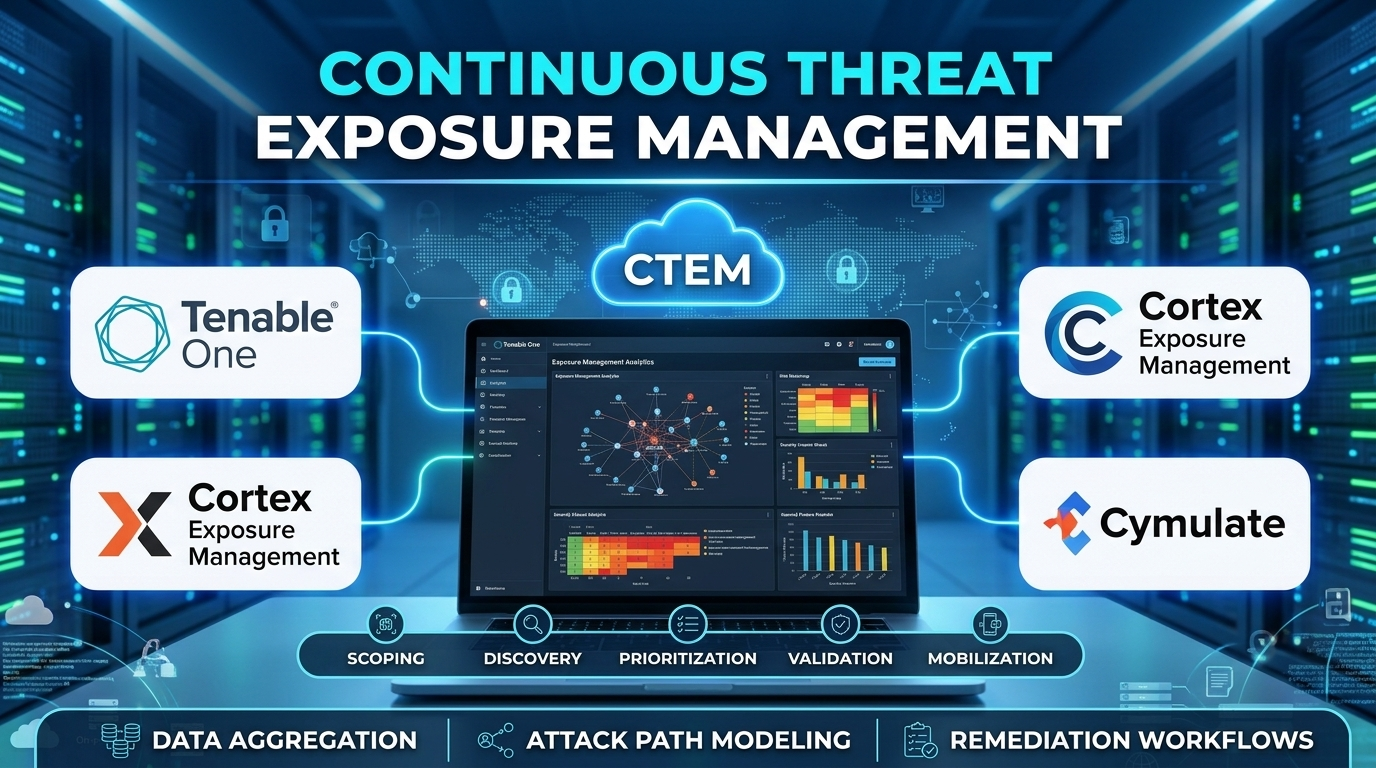
A mature exposure management framework operates in a continuous, cyclical workflow rather than an annual compliance audit:
- Scoping: Defining the business units, critical data flows, and technical assets that matter most to organizational resilience.
- Discovery: Uncovering all internal, external, cloud-native, and third-party exposures that could serve as entry points.
- Prioritization: Analyzing vulnerabilities, threat intelligence, and exploitability to rank exposures by actual business risk rather than generic severity scores.
- Validation: Testing whether security controls actually block simulated attack vectors or if exposures can be successfully exploited.
- Mobilization: Translating prioritized findings into clear remediation tasks for engineering and IT operations teams.
The objective is to focus limited engineering resources on fixing the small percentage of exposures that attackers can actually exploit to achieve their objectives.
Key Evaluation Criteria for Exposure Management Platforms
Selecting an enterprise exposure management platform requires examining how effectively the software consolidates multi-source telemetry and calculates risk.
Data Aggregation and Unified Telemetry
An effective platform must ingest data from traditional vulnerability scanners, endpoint detection and response (EDR) agents, cloud security posture management (CSPM) tools, and external attack surface management (EASM) engines into a single, cohesive data model.
Context-Aware Risk Prioritization
Relying solely on CVSS scores often leads to alert fatigue. Leading exposure platforms factor in live threat intelligence, exploit availability in the wild, asset business criticality, and compensating network controls to calculate a true exposure score.
Automated Validation and Attack Path Modeling
Advanced platforms simulate attacker movement across the network to map out multi-step attack paths, showing security teams how an external misconfiguration combined with a local credential theft can lead to domain controller compromise.
Remediation Tracking and Collaboration Workflows
Discovering risk is only valuable if the insights reach the developers or system administrators responsible for deploying patches. Tight integration with ticketing systems and patch management pipelines is essential.
Leading Exposure Management Platforms
The exposure management market blends established cybersecurity vendors expanding their portfolios with specialized platforms built entirely around continuous threat validation.
Tenable One Exposure Management Platform
Tenable consolidates its industry-standard vulnerability scanning telemetry with cloud security, identity exposure tracking, and external attack surface management into a unified platform.
- Primary Focus: Comprehensive exposure visibility across hybrid infrastructure, active directory, and cloud workloads.
- Deployment Model: Cloud-native SaaS platform with hybrid sensors.
- Significant Advantage: Leverages Tenable’s massive vulnerability plugin library and threat intelligence network for deep asset coverage.
- Important Limitation: Full feature utilization requires adopting Tenable’s broader ecosystem of specialized scanners and agents.
Palo Alto Networks Cortex Exposure Management
Palo Alto integrates its market-leading Cortex Xpanse attack surface management with Prisma Cloud telemetry to provide end-to-end visibility into enterprise risk.
- Primary Focus: Enterprise-scale multi-cloud and external attack surface exposure management.
- Deployment Model: SaaS-delivered cloud platform.
- Significant Advantage: Exceptional automated asset discovery and continuous attacker-perspective mapping across sprawling enterprise networks.
- Important Limitation: Geared primarily toward large organizations with complex cloud deployments and substantial security budgets.
Cymulate / Breach and Attack Simulation Specialists
Platforms focusing heavily on automated validation and continuous security validation allow teams to test their defenses safely using automated attack scripts.
- Primary Focus: Continuous security validation, attack path mapping, and control efficacy testing.
- Deployment Model: SaaS platform with lightweight local assessment agents.
- Significant Advantage: Provides empirical proof of whether security controls block specific adversary techniques.
- Important Limitation: Focuses primarily on validation rather than broad infrastructure asset inventorying, requiring complementary scanning tools.
Platform Comparison Overview
| Product | Primary Focus | Deployment Model | Significant Advantage | Important Limitation |
| Tenable One | Hybrid infrastructure and vulnerability exposure | SaaS Platform | Deep vulnerability coverage and established asset telemetry | Maximized value requires utilizing the broader Tenable suite |
| Cortex Exposure Management | Multi-cloud and external attack surface risk | SaaS Platform | Superior automated discovery of unmanaged cloud footprints | Tailored primarily for mature enterprise environments |
| Cymulate | Automated security validation and testing | SaaS Platform | Empirical validation of active defensive controls | Requires complementary asset discovery and scanning tools |
Operational Risks and Common Pitfalls
Implementing an exposure management program introduces distinct organizational challenges that security leaders must navigate.
Siloed Ownership and Turf Wars
Exposure management bridges IT operations, cloud engineering, and security teams. If vulnerability remediation is viewed solely as a “security problem” rather than an engineering responsibility, remediation SLAs fail.
Tool Sprawl and Data Overload
Ingesting millions of signals from disparate tools without proper asset deduplication and normalization creates an overwhelming data lake that paralyzes operations rather than guiding action.
Chasing Scores Instead of Fixing Root Causes
Fixing high-scoring vulnerabilities without addressing underlying architectural weaknesses—such as excessive administrative privileges or unsegmented network zones—leaves organizations vulnerable to repeated compromise.
Questions to Guide Vendor Selection
Before procuring an exposure management platform, security architects and risk managers should address several key operational questions:
- How effectively does the platform deduplicate and normalize assets discovered across multiple sources like EDR, cloud connectors, and network scanners?
- Does the prioritization engine rely on static vulnerability databases, or does it incorporate real-time threat intelligence and active exploit telemetry?
- How does the platform validate risk? Does it offer safe automated simulation, or is prioritization based purely on theoretical modeling?
- What automated workflows exist for routing prioritized remediation tasks to the specific engineering teams responsible for the affected assets?
Making the Final Decision
Choosing an exposure management platform depends heavily on an organization’s existing security maturity, tool investments, and architectural complexity.
Organizations deeply invested in established vulnerability management and hybrid infrastructures often find natural alignment with comprehensive platforms like Tenable One. Conversely, enterprises operating sprawling, multi-cloud environments with significant shadow IT exposure benefit greatly from platforms emphasizing automated discovery and attack path analysis, such as Palo Alto Cortex.
Ultimately, continuous exposure management transforms security from a reactive checklist into a disciplined, continuous process of risk reduction, ensuring defenses adapt as fast as modern digital infrastructure evolves.
