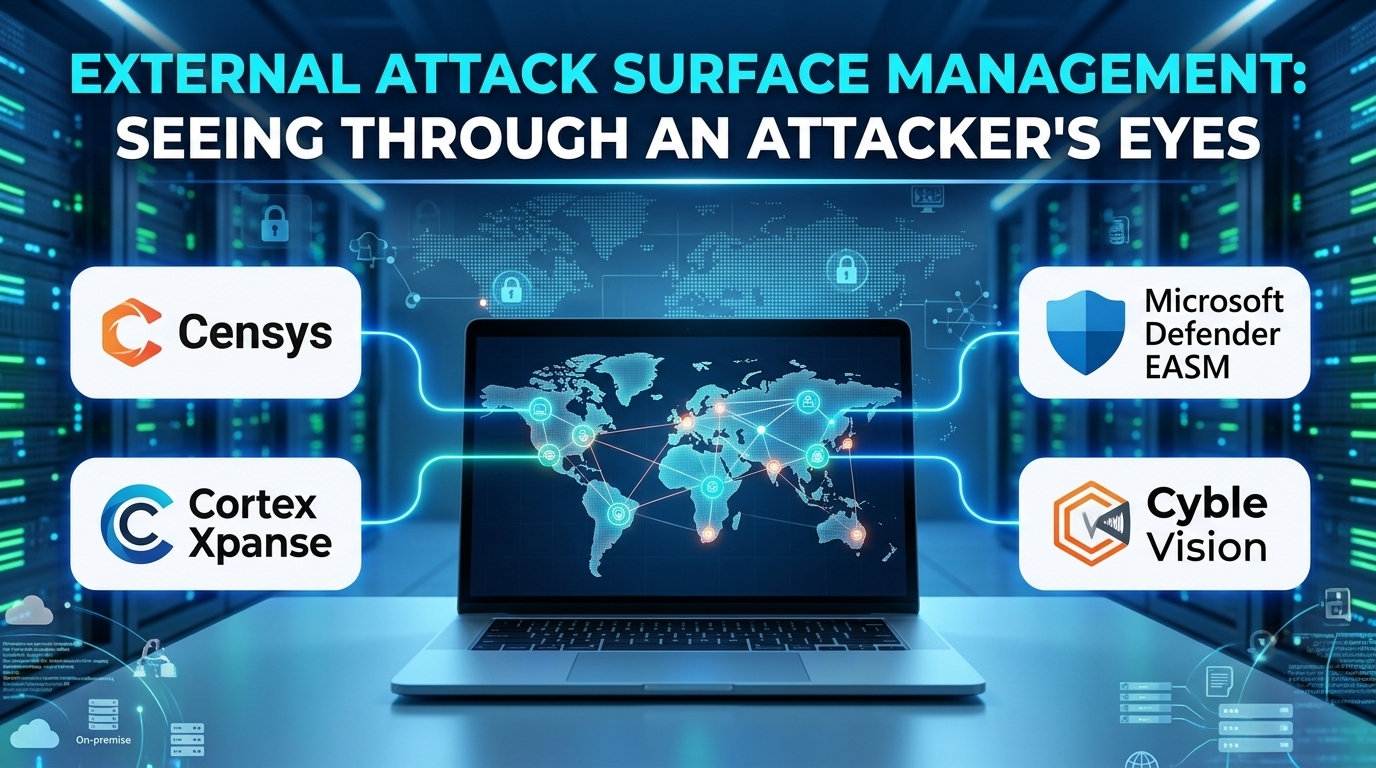
Organizations frequently maintain meticulously organized configuration management databases, cloud inventory spreadsheets, and internal asset inventories, yet security teams remain vulnerable to unexpected breaches originating from forgotten staging servers, misconfigured cloud storage buckets, or acquired subsidiaries. Internal inventories only cover what security teams know exists; they fail to account for shadow IT, third-party vendor exposures, and orphaned digital footprints visible to external adversaries.
Attack Surface Management (ASM) addresses this blind spot by continuously discovering, mapping, and analyzing an organization’s complete digital footprint from an external, attacker-centric perspective. Shifting from periodic point-in-time scanning to continuous external discovery requires understanding how modern ASM platforms differ from traditional asset management and how security leaders can evaluate these solutions effectively.
Understanding the Scope of External Attack Surface Management
Attack Surface Management is the continuous process of identifying, inventorying, classifying, and prioritizing security risks across an organization’s entire digital estate. Unlike traditional vulnerability scanners that require predefined IP ranges or internal agent deployment, ASM platforms leverage autonomous discovery engines—often using techniques similar to search engine crawlers and open-source intelligence (OSINT)—to map everything an external entity can see.
A comprehensive ASM workflow typically encompasses several core operational pillars:
- Continuous Discovery: Scanning global IP space, certificate transparency logs, DNS records, and cloud provider registries to uncover unknown or forgotten assets tied to corporate domains or brand names.
- Asset Attribution and Context: Linking discovered domains, subdomains, APIs, cloud buckets, and open ports to specific business units, subsidiaries, or third-party vendors.
- Vulnerability and Risk Scoring: Assessing exposed assets for missing patches, weak ciphers, expired TLS certificates, or exposed administrative panels.
- Prioritization and Remediation Tracking: Translating raw asset discoveries into contextual risk scores so security operations teams can eliminate high-priority exposures before exploitation occurs.
The fundamental goal is to eliminate the asymmetry between defenders, who must protect everything, and attackers, who need only find a single unmonitored entry point.
Key Evaluation Criteria for ASM Platforms
Selecting an Attack Surface Management platform requires analyzing technical discovery depth, false-positive reduction, and integration flexibility.
Discovery Breadth and Attribution Accuracy
An effective ASM solution must look beyond basic domain name resolution to identify cloud-native serverless functions, SaaS integrations, mobile application backends, and subsidiary infrastructure acquired through mergers and acquisitions. Accurate attribution prevents security teams from wasting hours investigating assets that do not belong to the organization.
Non-Disruptive Scanning and External Perspective
Because ASM platforms operate externally, they must perform discovery without triggering denial-of-service alerts, disrupting production services, or generating excessive noise that overwhelms security analysts.
Actionable Intelligence versus Alert Fatigue
Discovering thousands of exposed IP addresses is counterproductive if the platform cannot differentiate between a properly secured public web server and an unauthenticated administrative database exposed to the public internet. Contextual risk prioritization is vital.
Integration with Existing Security Ecosystems
Discovered assets and vulnerabilities must flow directly into existing ticketing systems (such as Jira or ServiceNow), SIEM platforms, and vulnerability management workflows to ensure rapid remediation.
Leading Attack Surface Management Platforms
The ASM market features dedicated external security specialists alongside comprehensive cybersecurity platform vendors incorporating attack surface visibility into broader suites.
Censys Discovery
Censys provides deep visibility into global internet infrastructure, leveraging its own internet-wide scanning data to map hosts, certificates, and services instantly.
- Primary Focus: Internet-wide asset discovery and exposure management driven by proprietary scanning telemetry.
- Deployment Model: SaaS-delivered cloud platform.
- Significant Advantage: Exceptional speed and depth in identifying obscure internet-facing assets and historical certificate linkages.
- Important Limitation: Focuses heavily on network telemetry, requiring integration with other tools for deep application-layer vulnerability analysis.
Palo Alto Networks (Cortex Xpanse)
Cortex Xpanse delivers enterprise-grade attack surface management designed to discover unmanaged cloud resources, shadow IT, and subsidiary risks across massive corporate networks.
- Primary Focus: Enterprise-scale automated asset discovery and attack surface governance.
- Deployment Model: Cloud-native SaaS platform with automated attribution engines.
- Significant Advantage: Advanced automated attribution capabilities that map sprawling global multi-cloud footprints accurately.
- Important Limitation: Enterprise licensing structures and deployment complexity cater primarily to large organizations with mature security operations.
Microsoft Defender External Attack Surface Management (EASM)
Microsoft EASM helps organizations discover unknown and unmanaged web-based resources, providing continuous visibility from the perspective of an attacker.
- Primary Focus: Comprehensive external exposure tracking integrated within the broader Microsoft Security ecosystem.
- Deployment Model: Cloud service integrated into the Azure / Defender portal.
- Significant Advantage: Seamless integration with Microsoft Defender telemetry and identity security monitoring tools.
- Important Limitation: Optimized primarily for organizations deeply embedded in the Microsoft enterprise software and cloud ecosystem.
Cyble Vision / Specialized Threat Intelligence Platforms
Platforms like Cyble combine external attack surface visibility with dark web monitoring and brand intelligence, helping organizations track exposures alongside active threat actor chatter.
- Primary Focus: Blended external threat intelligence and attack surface monitoring.
- Deployment Model: SaaS-delivered threat intelligence platform.
- Significant Advantage: Connects exposed digital infrastructure directly with real-time threat actor discussions and credential leaks.
- Important Limitation: Broader focus on intelligence means deep technical infrastructure mapping may require fine-tuning.
Platform Comparison Overview
| Product | Primary Focus | Deployment Model | Significant Advantage | Important Limitation |
| Censys Discovery | Global internet telemetry and host mapping | SaaS Cloud Platform | Unmatched visibility into raw internet-wide scan data | Requires supplementary tools for application-layer analysis |
| Cortex Xpanse | Enterprise multi-cloud asset attribution | SaaS Cloud Platform | Exceptional automated discovery across sprawling subsidiaries | Geared toward large enterprise operational budgets |
| Microsoft Defender EASM | External asset tracking and risk scoring | Azure Cloud Service | Deep integration with existing Microsoft security ecosystems | Best optimized for Microsoft-centric environments |
| Cyble Vision | Blended ASM and dark web intelligence | SaaS Platform | Connects external infrastructure flaws with threat actor data | Broader intelligence scope requires focused filtering |
Operational Risks and Common Pitfalls
Deploying an ASM program introduces unique organizational and operational challenges that security leaders must navigate carefully.
Overwhelmed by Shadow IT and Subsidiary Sprawl
Initial ASM scans often reveal an overwhelming volume of forgotten marketing sites, abandoned test environments, and subsidiary servers. Without clear ownership policies and remediation SLAs, security teams experience severe alert fatigue.
Treating ASM as a Static Once-Off Project
Digital footprints change constantly through cloud provisioning, developer deployments, and business acquisitions. Treating ASM as a one-time audit rather than a continuous operational feedback loop defeats its primary purpose.
Neglecting Remediation Accountability
Discovering an exposed database or expired certificate is only half the battle. If security teams cannot route discovered assets to the specific business units or developers responsible for maintaining them, vulnerabilities remain unpatched.
Questions to Guide Vendor Selection
Before procuring an ASM platform, security architects and risk management leaders should evaluate several critical operational questions:
- How frequently does the platform refresh its discovery scans, and can it alert security teams to newly spawned shadow IT assets within hours of deployment?
- How does the system handle asset attribution? Does it automatically link external IP blocks and domains to correct internal business units without manual tagging?
- What level of false-positive filtering is built into the risk scoring engine to prevent operational distraction?
- How easily do discovered assets export into existing ticketing, incident response, and patch management workflows?
Making the Final Decision
Choosing an Attack Surface Management platform depends on an organization’s cloud complexity, operational maturity, and existing security stack.
Organizations operating extensive multi-cloud environments with frequent corporate acquisitions often benefit from enterprise platforms like Cortex Xpanse or Microsoft Defender EASM, where automated asset attribution and ecosystem integration streamline governance. Conversely, security teams seeking raw, unvarnished internet telemetry to investigate obscure exposures frequently turn to specialist platforms like Censys.
Ultimately, Attack Surface Management transforms security from a reactive posture into proactive defense, ensuring organizations understand their digital footprint precisely as attackers see it before an incident occurs.
