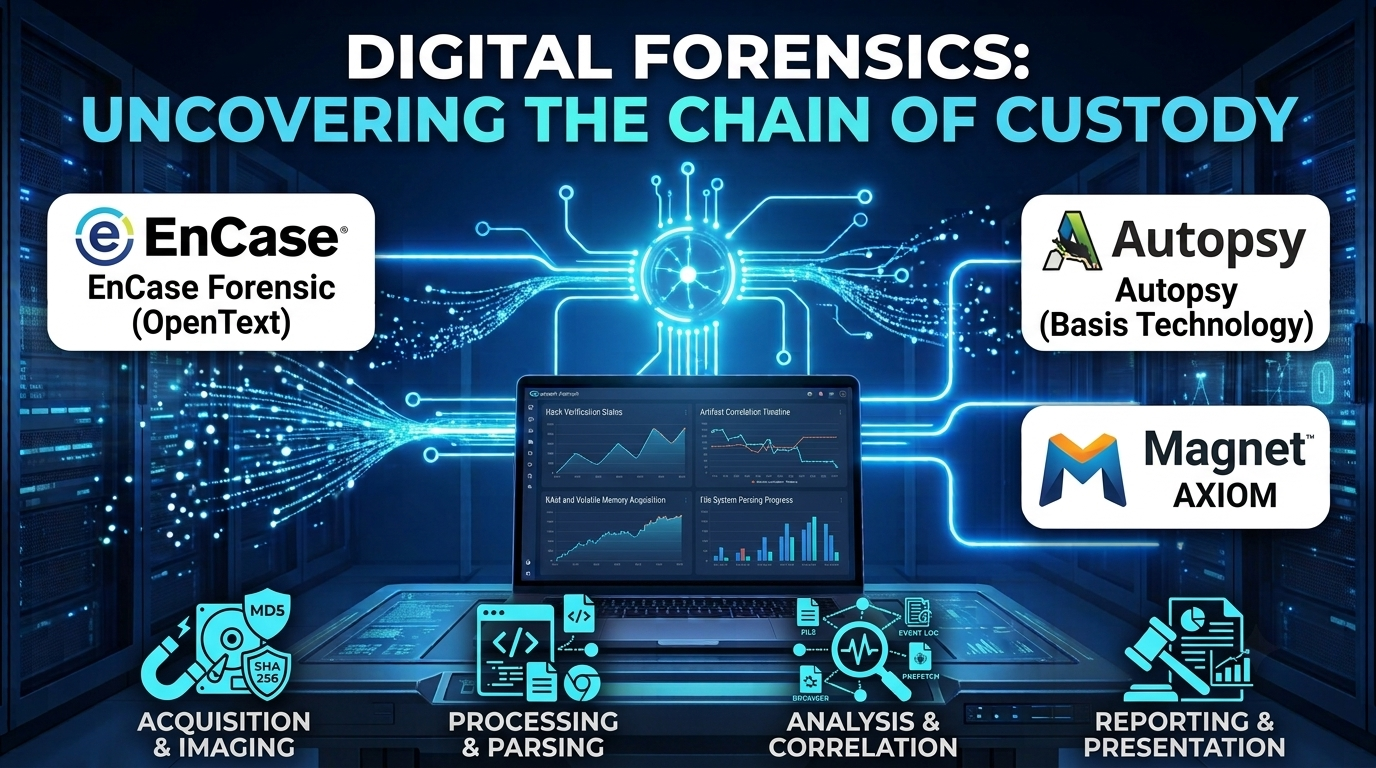
When an enterprise suffers a major security breach, ransomware attack, or insider data theft, incident responders and forensic investigators face an immense challenge: reconstructing exactly how the compromise occurred without contaminating the electronic evidence. Pulling the power cord on a compromised server or casually browsing through suspect log files can destroy critical volatile memory, overwrite deleted file fragments, and invalidate the legal admissibility of the findings.
Digital Forensics and Incident Response (DFIR) tools serve as the bedrock of modern cyber investigations, providing the rigorous acquisition, preservation, and analysis capabilities required to uncover truth in complex digital environments. Choosing the right digital forensics software involves balancing courtroom-grade evidentiary integrity with the high-speed analysis demands of enterprise security operations.
Understanding the Digital Forensics Lifecycle
Digital forensics is the scientific process of preserving, identifying, extracting, documenting, and interpreting digital evidence stored on computer media, mobile devices, cloud storage, or network traffic. Unlike general-purpose system administration tools, forensic software is engineered to maintain an unbroken chain of custody—ensuring that every bit of data analyzed is mathematically proven to be unmodified from its original state.
A professional forensic investigation typically follows a structured, sequential workflow:
- Acquisition and Imaging: Creating bit-stream copies (forensic images) of physical disks, volatile RAM, or cloud snapshots using cryptographic hash verification (such as MD5 or SHA-256) to guarantee integrity.
- Processing and Parsing: Indexing raw forensic images, carving deleted files, extracting registry hives, parsing event logs, and reconstructing web browser histories.
- Analysis and Artifact Examination: Investigating file metadata, execution timelines, user activity artifacts, and lateral movement traces to establish an accurate chronology of events.
- Reporting and Presentation: Translating complex technical findings into defensible, clear reports suitable for legal proceedings, executive boards, or law enforcement agencies.
The primary objective is to extract actionable intelligence and admissible evidence while ensuring that investigative actions leave zero ambiguity regarding data authenticity.
Key Evaluation Criteria for Forensic Toolkits
Selecting the right digital forensics software requires examining evidentiary reliability, file system support, and analysis speed.
Mathematical Hash Verification and Evidence Integrity
The foremost requirement of any forensic tool is its ability to verify that evidence has not been altered. Tools must generate cryptographic hashes upon ingestion and verify them before export. Software that lacks rigorous integrity verification is legally inadmissible in court.
Broad File System and Artifact Support
Modern investigations span Windows NTFS/APFS, Linux ext4, macOS file systems, mobile operating systems, and cloud storage volumes. A robust forensic suite must parse native file structures, shadow copies, unallocated space, and compressed archives effortlessly.
Timeline Analysis and Correlation
An advanced forensic platform does more than list individual files; it correlates timestamps across hundreds of disparate artifacts (such as event logs, shell bags, and prefetch files) into a single, unified timeline that reveals attacker activity step-by-step.
Leading Digital Forensics Tools and Software
The digital forensics market features powerful commercial suites designed for law enforcement and enterprise litigation alongside robust open-source utilities maintained by the global security community.
EnCase Forensic (OpenText)
EnCase is an established gold standard in commercial digital forensics, widely recognized and trusted by law enforcement agencies and corporate legal teams globally.
- Primary Focus: Court-admissible forensic imaging, deep artifact analysis, and enterprise-grade e-discovery.
- Deployment Model: Local desktop application with robust network collection options.
- Significant Advantage: Unmatched legal precedent and credibility in courtrooms worldwide due to rigorous evidence integrity standards.
- Important Limitation: Steep learning curve and expensive licensing models tailored primarily for dedicated forensic specialists.
Autopsy (Basis Technology)
Autopsy is the premier open-source digital forensics platform, providing a graphical user interface built around the powerful Sleuth Kit framework.
- Primary Focus: Open-source file analysis, keyword searching, timeline visualization, and hash filtering.
- Deployment Model: Local desktop application (Windows/Linux).
- Significant Advantage: Zero software licensing fees combined with an extensible plugin architecture that supports custom module development.
- Important Limitation: Processing massive enterprise disk images requires significant local hardware resources and manual performance tuning.
Magnet AXIOM
Magnet AXIOM is a modern, comprehensive digital forensics platform renowned for its ability to recover and automatically artifact-correlate evidence across computers, mobile devices, and cloud sources.
- Primary Focus: Cross-artifact analysis, cloud evidence acquisition, and automated timeline reconstruction.
- Deployment Model: Local desktop workstation with distributed processing options.
- Significant Advantage: Exceptional automation in connecting artifacts across different data sources (such as linking a chat message on a phone to an email on a laptop).
- Important Limitation: High commercial licensing costs and resource-intensive hardware requirements during deep artifact parsing.
Platform Comparison Overview
| Product | Primary Focus | Deployment Model | Significant Advantage | Important Limitation |
| EnCase Forensic | Legal-grade forensic imaging and enterprise e-discovery | Local Desktop / Network | Unrivaled legal precedent and court admissibility standards | Steep learning curve and high commercial licensing cost |
| Autopsy | Open-source disk analysis and modular forensics | Local Desktop | Free, open-source flexibility with strong community plugins | Demands significant hardware tuning for large enterprise cases |
| Magnet AXIOM | Cross-device artifact correlation and cloud forensics | Local Workstation | Superior automated correlation between mobile, cloud, and PC data | Resource-heavy processing and expensive licensing tiers |
Operational Risks and Common Pitfalls
Executing digital forensics investigations without strict adherence to established protocols introduces severe legal and technical risks.
Contaminating Volatile Evidence
Failing to capture volatile RAM before shutting down a compromised machine can destroy critical evidence of fileless malware, active network connections, and unencrypted decryption keys residing exclusively in memory.
Relying Solely on Automated Parsing Tools
Relying entirely on automated tool summaries without manually verifying raw hex data or artifact context can lead investigators to miss sophisticated anti-forensic techniques like timestamp altering or rootkit concealment.
Chain of Custody Failures
Failing to document who accessed a forensic image, when it was copied, and what hash values were recorded renders the entire investigation legally worthless in a court of law.
Questions to Guide Vendor Selection
Before procuring a digital forensics platform, incident response leaders and laboratory managers should address several critical operational questions:
- Is the tool’s evidence acquisition and hashing methodology accepted and respected by legal courts and regulatory authorities?
- How well does the platform handle non-traditional evidence sources, such as cloud storage containers, mobile backups, and encrypted chat applications?
- What level of automation is provided for timeline analysis, and can investigators easily drill down into raw hex data to verify automated findings?
- What is the total cost of ownership, including software licenses, ongoing updates, and specialized hardware workstations required for processing?
Making the Final Decision
Choosing a digital forensics tool depends heavily on an organization’s investigative mandate, regulatory obligations, and internal technical expertise.
Organizations requiring court-admissible evidence for criminal prosecution or formal litigation frequently rely on established commercial standards like EnCase or Magnet AXIOM. Conversely, incident response teams, academic institutions, and budget-conscious security groups frequently leverage open-source powerhouses like Autopsy to build capable, customizable forensics laboratories.
Ultimately, the effectiveness of any digital forensics tool is determined not just by the software’s feature set, but by the methodological rigor and technical competence of the forensic examiner wielding it.
