Introduction
Smart city Internet of Things (IoT) platforms help municipal authorities manage connected infrastructure, monitor public services, and improve urban operations through centralized digital systems. These platforms connect sensors, intelligent equipment, communication networks, and analytical applications across urban environments.
Modern cities face increasing challenges related to traffic congestion, energy consumption, waste collection, environmental pollution, and infrastructure maintenance. Connected technologies help municipal departments collect operational information and make more informed decisions about public resource allocation.
Smart city IoT platforms combine device connectivity, real-time monitoring, data processing, visualization, and workflow automation. These capabilities help municipal authorities coordinate infrastructure management while improving visibility into public service performance.
Advanced platforms support digital twins, geospatial visualization, predictive maintenance, environmental monitoring, and integration with existing government information systems. These capabilities can improve coordination between departments while supporting long-term urban development objectives.
Different smart city IoT platforms address varying infrastructure requirements, communication protocols, municipal budgets, and operational priorities. Selecting appropriate software requires evaluating interoperability, scalability, cybersecurity, data governance, and total ownership expenses.
This guide examines ten smart city IoT platforms, including their features, benefits, advantages, limitations, and practical applications. It also provides comparison tables, implementation recommendations, performance indicators, security considerations, and frequently asked questions.
What Are Smart City IoT Platforms?
Smart city IoT platforms are software systems designed to connect, monitor, and administer intelligent urban infrastructure. They collect information from connected devices and transform it into operational insights that support municipal services.
These platforms frequently integrate with environmental sensors, smart streetlights, traffic monitoring equipment, utility meters, parking sensors, and waste collection infrastructure. Communication technologies may include cellular networks, Long Range Wide Area Network (LoRaWAN), and Message Queuing Telemetry Transport (MQTT).
Smart city platforms can integrate with Geographic Information Systems (GIS), digital twins, municipal management applications, and enterprise analytical tools. These integrations help city departments understand infrastructure conditions and coordinate appropriate operational responses.
Effective smart city management requires reliable connectivity, interoperable devices, accurate information, responsible data governance, and clearly defined public service objectives. IoT platforms support these requirements through centralized monitoring, automation, and integration capabilities.
How Smart City IoT Platforms Work
- Install connected sensors and compatible urban infrastructure.
- Register devices with centralized management systems.
- Establish secure communication networks.
- Collect environmental and operational information.
- Process incoming device telemetry.
- Visualize infrastructure conditions through dashboards and maps.
- Identify operational anomalies and service requirements.
- Generate alerts and coordinate approved responses.
- Integrate information with municipal applications.
- Evaluate public service performance and infrastructure improvements.
Common Applications
- Intelligent traffic management.
- Smart streetlight administration.
- Connected waste collection systems.
- Urban air quality monitoring.
- Smart parking management.
- Water distribution monitoring.
- Municipal energy management.
- Public infrastructure maintenance.
- Flood monitoring and early warning.
- Public transportation monitoring.
- Noise pollution assessment.
- Smart building administration.
- Urban sustainability reporting.
- Emergency infrastructure coordination.
Essential Components of Smart City IoT Platforms
| Component | Purpose |
|---|---|
| Device registry | Maintains connected infrastructure records |
| Communication gateway | Connects sensors and municipal equipment |
| Data ingestion engine | Collects incoming device information |
| Context management | Organizes information about urban entities |
| Analytics engine | Identifies operational patterns and conditions |
| Geospatial visualization | Displays infrastructure across geographical locations |
| Automation engine | Coordinates approved operational workflows |
| Alert management | Notifies departments about significant events |
| Security administration | Protects connected infrastructure and information |
| Integration framework | Connects municipal applications and external services |
Top 10 Smart City IoT Platforms
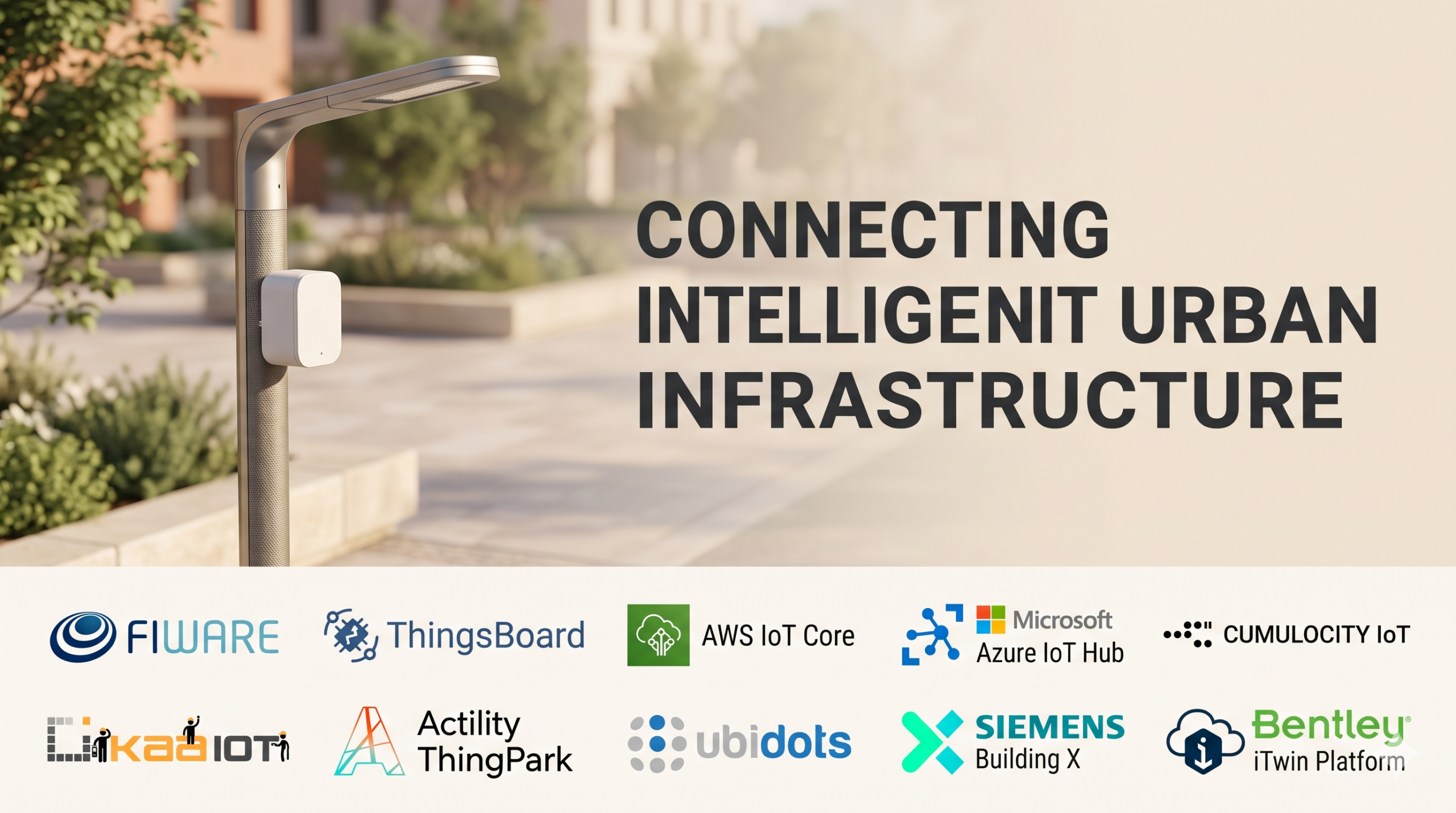
The following platforms include dedicated urban IoT solutions, open-source smart city frameworks, cloud-based IoT infrastructure, and complementary urban digital twin technologies. Their numbering represents presentation order rather than an independently tested performance ranking.
1. FIWARE
Short Description
FIWARE provides an open-source technology ecosystem for developing interoperable smart city applications and data management environments. Its context management components help organizations exchange information about connected infrastructure and urban conditions.
Municipal developers can combine context brokers, IoT agents, and standardized data models to build customized urban applications. This modular architecture supports integration between different departments and technology providers.
Key Features
- Open-source context management.
- Next Generation Service Interfaces Linked Data (NGSI-LD) support through compatible components.
- Standardized smart data models.
- IoT device integration.
- Context information subscriptions.
- Cross-department data exchange.
- Geospatial information support.
- Modular application architecture.
Benefits: Improves interoperability, supports open urban data ecosystems, reduces vendor dependence, and facilitates customized municipal applications.
Pros
- Open-source technology ecosystem.
- Strong standards-based orientation.
- Flexible integration architecture.
- Relevant smart city data models.
Cons
- Requires technical implementation expertise.
- Complete deployments require multiple components.
- Self-managed infrastructure requires maintenance.
Use Cases: Smart city data hubs, environmental monitoring, intelligent parking, municipal information exchange, and urban infrastructure integration.
Best For: Municipal technology departments, smart city developers, public sector organizations, and system integrators.
2. ThingsBoard
Short Description
ThingsBoard provides IoT device management, telemetry processing, visualization, and automation capabilities suitable for connected urban infrastructure. Its open-source and commercial offerings support customized municipal monitoring applications.
Administrators can configure device profiles, collect sensor information, establish rule-based workflows, and create operational dashboards. Municipal departments can use these capabilities to monitor different infrastructure categories within a shared platform.
Key Features
- Connected device registration.
- Real-time telemetry collection.
- Customizable operational dashboards.
- Rule-based automation.
- Geospatial dashboard widgets.
- Device alarm management.
- Remote device configuration.
- Multi-tenant administration.
Benefits: Combines device management with visualization, improves municipal infrastructure visibility, supports operational automation, and facilitates customized deployments.
Pros
- Open-source deployment option.
- Flexible dashboard customization.
- Multiple communication protocol integrations.
- Integrated rule engine.
Cons
- Self-hosted deployments require maintenance.
- Advanced functionality depends on edition.
- Complex municipal integrations require development.
Use Cases: Smart streetlights, environmental sensors, waste collection monitoring, water infrastructure, and smart parking applications.
Best For: Municipal developers, IoT system integrators, research institutions, and organizations requiring customizable platforms.
3. AWS IoT Core
Short Description
AWS IoT Core provides managed cloud connectivity and messaging infrastructure for connected devices. Municipal organizations can use it as a foundation for developing scalable smart city applications within Amazon Web Services (AWS).
The service integrates with complementary AWS storage, analytics, device management, and application development services. Complete municipal solutions require additional components for visualization, operational workflows, and departmental applications.
Key Features
- Secure connected device communication.
- MQTT messaging support.
- Device identity administration.
- Device shadow functionality.
- Rule-based message routing.
- Cloud application integration.
- Scalable telemetry ingestion.
- Certificate-based device authentication.
Benefits: Supports large-scale connected infrastructure, improves cloud integration, facilitates secure device communication, and enables customized municipal applications.
Pros
- Extensive cloud infrastructure ecosystem.
- Scalable messaging architecture.
- Flexible application integrations.
- Relevant device security capabilities.
Cons
- Not a complete standalone smart city application.
- Cloud consumption expenses require monitoring.
- Implementation requires AWS expertise.
Use Cases: Connected municipal sensors, intelligent transportation applications, utility monitoring, and large-scale urban data collection.
Best For: AWS customers, municipal cloud architects, smart city developers, and large infrastructure projects.
4. Microsoft Azure IoT Hub
Short Description
Microsoft Azure IoT Hub provides managed connectivity between connected equipment and cloud-based applications. It supports secure device communication, telemetry ingestion, and remote device state administration.
Municipal organizations can combine IoT Hub with Azure Digital Twins, data analytics services, and visualization applications. These integrations support customized urban infrastructure monitoring and digital representation workflows.
Key Features
- Secure device connectivity.
- Individual device identities.
- Device twin management.
- Cloud-to-device communication.
- Device telemetry ingestion.
- Message routing.
- Automated provisioning integrations.
- Azure analytics and digital twin integrations.
Benefits: Supports connected urban infrastructure, improves device management, facilitates enterprise integrations, and enables scalable municipal applications.
Pros
- Strong Microsoft Azure ecosystem.
- Flexible device state administration.
- Relevant enterprise security capabilities.
- Extensive analytics integration opportunities.
Cons
- Complete smart city solutions require additional services.
- Cloud consumption costs require evaluation.
- Technical integration requires specialist expertise.
Use Cases: Smart buildings, municipal utilities, environmental monitoring, transportation infrastructure, and connected public facilities.
Best For: Microsoft-focused municipalities, Azure developers, enterprise infrastructure teams, and government technology departments.
5. Cumulocity IoT
Short Description
Cumulocity IoT provides connected device administration, operational monitoring, analytics, and application development capabilities. Its platform can support municipal infrastructure and public utility management through centralized connected equipment administration.
Organizations can configure device groups, collect operational information, establish alarms, and coordinate remote maintenance activities. Custom applications can address different municipal service requirements.
Key Features
- Centralized device management.
- Connected asset inventory.
- Real-time telemetry monitoring.
- Operational dashboards.
- Device alarm management.
- Remote device operations.
- Application development capabilities.
- Enterprise system integrations.
Benefits: Improves infrastructure visibility, supports remote maintenance, facilitates operational monitoring, and reduces connected equipment administration complexity.
Pros
- Comprehensive IoT management capabilities.
- Relevant industrial and utility applications.
- Flexible integration opportunities.
- Supports distributed connected infrastructure.
Cons
- Commercial pricing requires consultation.
- Complex deployments require implementation planning.
- Device compatibility must be verified.
Use Cases: Municipal utilities, smart energy infrastructure, connected public equipment, water monitoring, and environmental sensors.
Best For: Utility providers, municipal infrastructure departments, industrial service organizations, and enterprise IoT teams.
6. Kaa IoT Platform
Short Description
Kaa IoT Platform provides device connectivity, telemetry management, and application development capabilities for connected infrastructure. Its modular architecture supports customized IoT solutions across multiple industries, including urban infrastructure management.
Developers can integrate connected sensors, establish device administration workflows, and create operational applications. Municipal organizations can use these capabilities to develop solutions tailored to specific public service requirements.
Key Features
- Connected device registration.
- Device connectivity management.
- Telemetry collection.
- Device configuration administration.
- Data processing capabilities.
- Custom application integrations.
- Device monitoring dashboards.
- Application Programming Interface (API) support.
Benefits: Supports customized urban IoT applications, improves connected infrastructure visibility, facilitates device integration, and enables modular development.
Pros
- Flexible IoT application architecture.
- Relevant device management capabilities.
- Supports customized industry applications.
- Developer-oriented integration interfaces.
Cons
- Municipal applications may require custom development.
- Commercial packaging requires evaluation.
- Implementation requires technical expertise.
Use Cases: Smart parking, environmental monitoring, connected street infrastructure, municipal sensor networks, and utility monitoring.
Best For: IoT developers, smart city startups, municipal system integrators, and customized infrastructure projects.
7. Actility ThingPark
Short Description
Actility ThingPark provides IoT connectivity and network management capabilities, particularly for LoRaWAN-based infrastructure. It helps organizations connect distributed low-power devices across urban and industrial environments.
Municipal authorities can use ThingPark to administer compatible sensors and communication gateways. Application-level analytics, municipal dashboards, and operational workflows generally require complementary platforms.
Key Features
- LoRaWAN network management.
- Connected device provisioning.
- Gateway administration.
- Device connectivity monitoring.
- Secure network communication.
- Application data routing.
- Network operational reporting.
- External IoT application integrations.
Benefits: Supports distributed low-power sensor networks, improves connectivity administration, facilitates urban infrastructure expansion, and enables flexible application integration.
Pros
- Strong LoRaWAN ecosystem orientation.
- Relevant municipal sensor connectivity.
- Supports distributed network infrastructure.
- Flexible integration opportunities.
Cons
- Not a complete municipal operations platform.
- Network coverage requires planning.
- Application-level functionality requires complementary software.
Use Cases: Smart waste bins, parking sensors, water meters, environmental monitoring, and distributed urban sensor networks.
Best For: Municipal connectivity teams, telecommunications providers, utility organizations, and LoRaWAN system integrators.
8. Ubidots
Short Description
Ubidots provides IoT application development, device data visualization, and operational monitoring capabilities. It helps organizations transform connected sensor information into dashboards, alerts, and customized applications.
Municipal teams can configure visualizations and event-based notifications without developing every application component independently. Its capabilities are relevant to departmental monitoring projects and smaller smart city deployments.
Key Features
- IoT device data ingestion.
- Customizable monitoring dashboards.
- Real-time data visualization.
- Event-based notifications.
- Geospatial visualization widgets.
- Device data management.
- API integrations.
- User and organizational administration.
Benefits: Simplifies IoT application development, improves operational visibility, supports automated notifications, and facilitates rapid project implementation.
Pros
- Accessible dashboard development.
- Flexible visualization capabilities.
- Relevant low-code application workflows.
- Supports multiple device integrations.
Cons
- Large municipal deployments require scalability assessment.
- Advanced functionality depends on subscription.
- Specialized operational workflows may require custom development.
Use Cases: Urban air quality monitoring, smart agriculture, public facility monitoring, water sensors, and municipal energy dashboards.
Best For: Smaller municipalities, IoT startups, educational institutions, and departmental monitoring teams.
9. Siemens Building X
Short Description
Siemens Building X provides digital building management capabilities for connected facilities and infrastructure. It helps organizations monitor building operations, energy consumption, equipment conditions, and selected sustainability indicators.
Municipal authorities can use compatible Building X applications to manage public buildings within broader smart city programs. Its primary focus is connected building infrastructure rather than complete citywide IoT administration.
Key Features
- Connected building data integration.
- Building operations monitoring.
- Energy consumption visualization.
- Equipment condition monitoring.
- Sustainability reporting capabilities.
- Centralized building dashboards.
- Supported operational analytics.
- Building system integrations.
Benefits: Improves public building visibility, supports energy management, facilitates infrastructure maintenance, and strengthens facility performance monitoring.
Pros
- Strong building technology orientation.
- Relevant energy management capabilities.
- Supports connected facility environments.
- Useful municipal sustainability applications.
Cons
- Primarily focused on building infrastructure.
- Commercial licensing requires consultation.
- Compatibility with existing building systems requires assessment.
Use Cases: Municipal office buildings, public libraries, educational facilities, healthcare buildings, and public facility energy management.
Best For: Municipal facility managers, building engineers, energy management departments, and public infrastructure administrators.
10. Bentley iTwin Platform
Short Description
Bentley iTwin Platform provides digital twin development and infrastructure data integration capabilities. It helps organizations create digital representations of physical infrastructure and connect engineering information with operational data.
Municipal developers can integrate supported sensor information, infrastructure models, and geospatial datasets into digital twin applications. Dedicated device connectivity and lifecycle management generally require complementary IoT infrastructure.
Key Features
- Infrastructure digital twin development.
- Engineering data integration.
- Geospatial information visualization.
- Infrastructure model management.
- Supported IoT data integrations.
- Infrastructure change tracking.
- Developer APIs.
- Collaborative visualization capabilities.
Benefits: Improves infrastructure understanding, supports engineering coordination, facilitates digital twin applications, and connects physical assets with operational information.
Pros
- Strong infrastructure engineering orientation.
- Relevant digital twin capabilities.
- Supports complex infrastructure models.
- Flexible developer integration opportunities.
Cons
- Not a standalone IoT device management platform.
- Digital twin development requires specialist expertise.
- Commercial licensing and consumption costs require evaluation.
Use Cases: Urban infrastructure digital twins, bridge monitoring, transportation planning, utility infrastructure visualization, and municipal engineering coordination.
Best For: Civil engineers, urban planners, infrastructure authorities, and smart city digital twin developers.
Comparison Table: Top 10 Smart City IoT Platforms
| Platform | Primary Strength | Best For | Pricing Approach |
|---|---|---|---|
| FIWARE | Interoperable urban data ecosystems | Open smart city projects | Open-source components |
| ThingsBoard | Device management and visualization | Customized municipal applications | Open-source and commercial |
| AWS IoT Core | Scalable cloud connectivity | Large cloud-connected projects | Usage-based |
| Azure IoT Hub | Connected infrastructure integration | Microsoft environments | Tiered and usage-based |
| Cumulocity IoT | Connected equipment management | Municipal utilities | Commercial licensing |
| Kaa IoT Platform | Customized IoT applications | Municipal developers | Commercial offerings |
| Actility ThingPark | Low-power sensor connectivity | LoRaWAN networks | Commercial services |
| Ubidots | Accessible monitoring dashboards | Departmental IoT projects | Subscription-based |
| Siemens Building X | Connected building management | Public facilities | Commercial licensing |
| Bentley iTwin Platform | Infrastructure digital twins | Urban engineering teams | Commercial and usage-based offerings |
Functional Comparison
| Platform | Primary Infrastructure | Management Focus |
|---|---|---|
| FIWARE | Interoperable urban data systems | Context management |
| ThingsBoard | Connected municipal devices | Monitoring and automation |
| AWS IoT Core | Cloud-connected sensors | Device communication |
| Azure IoT Hub | Azure-connected infrastructure | Connectivity and device states |
| Cumulocity IoT | Connected equipment and utilities | Device lifecycle management |
| Kaa IoT Platform | Customized IoT environments | Application development |
| Actility ThingPark | LoRaWAN infrastructure | Network connectivity |
| Ubidots | Connected monitoring applications | Visualization and alerts |
| Siemens Building X | Public and commercial buildings | Facility operations |
| Bentley iTwin Platform | Physical infrastructure models | Digital twin development |
How to Choose the Best Smart City IoT Platform
Evaluate Municipal Requirements
Identify the public services and infrastructure categories requiring connected technology. Establish measurable objectives related to energy efficiency, environmental monitoring, transportation, maintenance, or public service reliability.
Assess Interoperability
Review supported communication protocols, data models, integration interfaces, and device compatibility. Standards-based architectures can help municipalities integrate infrastructure from multiple technology providers.
Examine Scalability
Evaluate anticipated sensor volumes, geographical coverage, data processing requirements, and departmental expansion plans. Representative testing helps organizations assess whether the selected infrastructure can accommodate future requirements.
Review Data Governance
Determine how municipal information will be collected, stored, accessed, retained, and shared. Public sector deployments should address applicable privacy requirements, information security policies, and public accountability obligations.
Consider Connectivity Requirements
Evaluate network availability, sensor battery requirements, communication distances, and bandwidth limitations. Different urban applications may require different combinations of cellular, LoRaWAN, wired, and wireless connectivity.
Evaluate Total Ownership Costs
Consider device acquisition, network infrastructure, platform licensing, cloud consumption, integration development, and continuing maintenance. Municipal procurement should evaluate long-term operational sustainability rather than initial acquisition expenses alone.
Best Smart City IoT Platforms by User Type
| User Type | Relevant Platform |
|---|---|
| Municipal open-data architect | FIWARE |
| Smart city application developer | ThingsBoard |
| AWS infrastructure engineer | AWS IoT Core |
| Microsoft cloud administrator | Azure IoT Hub |
| Municipal utility manager | Cumulocity IoT |
| Customized IoT solution developer | Kaa IoT Platform |
| Urban connectivity administrator | Actility ThingPark |
| Departmental monitoring specialist | Ubidots |
| Public facility manager | Siemens Building X |
| Urban digital twin engineer | Bentley iTwin Platform |
Practical Example: Implementing a Smart City IoT Platform
Consider a hypothetical municipality operating 15,000 streetlights, 2,000 connected waste collection containers, and 500 environmental monitoring sensors. Its infrastructure departments rely on separate monitoring systems and frequently perform manual inspections.
Municipal authorities introduce interoperable IoT infrastructure to improve operational visibility, coordinate maintenance activities, and reduce unnecessary resource consumption. The following outcomes represent illustrative assumptions rather than verified vendor performance.
Implementation Steps
- Inventory municipal infrastructure and existing information systems.
- Establish measurable public service improvement objectives.
- Select compatible sensors, communication networks, and IoT platforms.
- Configure secure device registration and information governance policies.
- Conduct pilot deployments within representative urban districts.
- Integrate approved dashboards and maintenance workflows.
- Expand successful implementations and monitor operational outcomes.
Illustrative Performance Improvements
| Performance Indicator | Before | After |
|---|---|---|
| Connected infrastructure visibility | 40% | 98% |
| Annual streetlight energy consumption | 9,000 MWh | 6,750 MWh |
| Average infrastructure fault detection time | 48 hours | 2 hours |
| Monthly unnecessary waste collection visits | 1,200 | 450 |
| Environmental sensor data availability | 72% | 98% |
| Monthly administrative workload | 1,000 hours | 400 hours |
| Average maintenance response time | 36 hours | 12 hours |
| Preventive maintenance coverage | 35% | 85% |
Financial Analysis
Reducing annual streetlight electricity consumption by 2,250 megawatt-hours (MWh) represents a 25% reduction. At an illustrative electricity cost of $120 per MWh, this produces $270,000 in annual electricity savings.
Reducing monthly administrative workloads by 600 hours releases 7,200 employee hours annually. At an illustrative labor cost of $30 per hour, this represents $216,000 in released annual labor capacity rather than guaranteed cash savings.
Suppose additional realized operating savings equal $180,000 annually and recurring platform expenses equal $150,000. An initial implementation investment of $750,000 would produce a simple payback period of 30 months based on annual net cash savings of $300,000.
Important Smart City IoT Performance Indicators
| Indicator | Measurement Purpose |
|---|---|
| Connected infrastructure coverage | Measures connected assets against intended scope |
| Device availability | Evaluates sensor and equipment reliability |
| Energy consumption | Tracks municipal infrastructure electricity usage |
| Fault detection time | Measures infrastructure problem identification speed |
| Maintenance response time | Evaluates service restoration efficiency |
| Data availability | Measures accessibility of expected sensor information |
| Waste collection efficiency | Tracks collection activities against service requirements |
| Water consumption | Evaluates municipal water resource usage |
| Network availability | Measures communication infrastructure reliability |
| Service operating costs | Tracks continuing public service expenses |
| Environmental monitoring coverage | Evaluates geographical sensor coverage |
| Citizen service satisfaction | Measures public perceptions of service performance |
Security and Governance Considerations
Smart city IoT platforms can collect sensitive information about public infrastructure, environmental conditions, and urban activities. Municipal authorities should implement appropriate access controls, encryption, information retention policies, and administrative audit logging.
Connected infrastructure should use secure device identities, approved firmware versions, and appropriately segmented communication networks. Critical municipal systems require documented recovery procedures and protection against unauthorized administrative access.
Municipal authorities should establish clear responsibilities for data ownership, information sharing, and public accountability. Applications involving personal information should follow applicable privacy requirements and minimize unnecessary data collection.
Automated infrastructure control should incorporate appropriate operational safeguards and authorized human oversight. Decisions affecting traffic systems, public utilities, or emergency infrastructure must account for public safety and applicable regulatory requirements.
Challenges and Limitations
Smart city environments frequently contain infrastructure acquired from different technology providers over extended periods. Incompatible communication protocols and proprietary data formats can complicate integration between municipal departments.
Urban connectivity conditions can vary significantly across geographical locations and infrastructure types. Municipal organizations should assess network coverage, signal reliability, and device power requirements before large-scale deployment.
Limited budgets and procurement restrictions can delay infrastructure modernization. Phased implementation can help authorities prioritize projects offering measurable public service improvements.
Incomplete or inaccurate sensor information can reduce the reliability of analytical applications. Municipal departments should maintain documented sensor calibration, data validation, and equipment maintenance procedures.
Best Practices for Smart City IoT Management
- Establish measurable municipal service objectives.
- Maintain accurate connected infrastructure inventories.
- Prioritize interoperable communication protocols.
- Use standardized urban data models where practical.
- Conduct representative pilot deployments.
- Protect connected device authentication credentials.
- Implement appropriate network segmentation.
- Maintain approved device firmware versions.
- Establish transparent data governance policies.
- Minimize unnecessary personal information collection.
- Monitor infrastructure availability continuously.
- Maintain documented emergency recovery procedures.
- Coordinate technology procurement across departments.
- Evaluate long-term infrastructure maintenance costs.
- Measure public service improvements regularly.
Future Trends in Smart City IoT Platforms
Urban Digital Twins
Municipal organizations may increasingly adopt digital representations of buildings, transportation infrastructure, utilities, and public spaces. These technologies can support infrastructure planning, operational monitoring, and scenario evaluation.
AI-Assisted Urban Operations
Artificial Intelligence (AI) may help municipal departments identify infrastructure anomalies, forecast maintenance requirements, and analyze resource consumption patterns. Consequential operational decisions should remain subject to appropriate validation and public accountability.
Edge Computing Integration
Smart city applications may increasingly process selected information closer to connected infrastructure. Local processing can reduce communication delays and unnecessary data transmission when supported by suitable hardware.
Interoperable Urban Data Spaces
Municipal organizations may increasingly adopt standardized data exchange architectures to improve collaboration between departments and service providers. These approaches can support shared applications while maintaining appropriate information access controls.
Sustainable Infrastructure Management
Smart city IoT platforms may increasingly support energy efficiency, water conservation, environmental monitoring, and climate resilience initiatives. Municipal authorities should evaluate these technologies against measurable environmental and public service outcomes.
Frequently Asked Questions
1. What are smart city IoT platforms?
Smart city IoT platforms connect and monitor intelligent urban infrastructure through centralized digital systems. They support device connectivity, operational monitoring, data analysis, and municipal service administration.
2. Why are IoT platforms important for smart cities?
IoT platforms help municipalities understand infrastructure conditions and coordinate public services more efficiently. They can support resource conservation, maintenance planning, and operational improvements.
3. What is FIWARE?
FIWARE provides an open-source ecosystem for interoperable data management and smart applications. Its components support standardized context information exchange across compatible urban systems.
4. What is ThingsBoard?
ThingsBoard provides IoT device management, telemetry processing, visualization, and automation capabilities. Municipal developers can use it to build customized infrastructure monitoring applications.
5. What is AWS IoT Core?
AWS IoT Core provides managed connectivity and messaging infrastructure for connected devices. Municipal organizations can combine it with complementary AWS services to develop smart city applications.
6. What is Microsoft Azure IoT Hub?
Azure IoT Hub provides secure communication between connected equipment and cloud-based applications. It supports device identities, telemetry collection, and remote device state administration.
7. What is Cumulocity IoT?
Cumulocity IoT provides connected device management, monitoring, analytics, and application development capabilities. It can support municipal utilities and distributed urban infrastructure.
8. What is Kaa IoT Platform?
Kaa IoT Platform provides connectivity and application development capabilities for connected devices. It supports customized IoT solutions addressing different municipal requirements.
9. What is Actility ThingPark?
Actility ThingPark provides IoT connectivity and network management capabilities, particularly for LoRaWAN infrastructure. It supports compatible distributed urban sensors and communication gateways.
10. What is Ubidots?
Ubidots provides IoT data visualization, monitoring dashboards, and event-based notifications. It helps organizations develop connected monitoring applications with reduced development complexity.
11. What is Siemens Building X?
Siemens Building X provides digital building management and operational monitoring capabilities. Municipal authorities can use compatible applications to manage public facilities and energy consumption.
12. What is Bentley iTwin Platform?
Bentley iTwin Platform provides infrastructure digital twin development and engineering data integration capabilities. It supports applications connecting physical infrastructure models with compatible operational information.
13. What is a smart city digital twin?
A smart city digital twin is a digital representation of selected urban infrastructure or environments. It can combine engineering models, geographical information, and operational data.
14. What is LoRaWAN?
LoRaWAN is a communication protocol designed for long-range, low-power connected devices. It is commonly used for distributed environmental sensors, utility meters, and municipal monitoring equipment.
15. Can IoT platforms improve traffic management?
IoT platforms can collect traffic information and support compatible transportation monitoring applications. Effective traffic management also requires suitable infrastructure, validated control systems, and authorized operational oversight.
16. How does IoT support smart waste management?
Connected waste containers can report information about fill levels and equipment conditions. Municipal departments can use this information to improve collection scheduling and resource allocation.
17. Can IoT platforms reduce municipal energy consumption?
Connected monitoring and compatible control systems can help municipalities identify inefficient energy usage. Actual reductions depend on equipment capabilities, operational policies, and implementation quality.
18. How does IoT support environmental monitoring?
Connected sensors can collect information about air quality, temperature, noise, water conditions, and other environmental indicators. Centralized platforms help municipal departments visualize and analyze this information.
19. Are open-source smart city IoT platforms available?
FIWARE and ThingsBoard Community Edition provide relevant open-source capabilities. Complete municipal implementations still require infrastructure, integration development, and continuing technical support.
20. Can smart city IoT platforms integrate with GIS?
Many platforms support geospatial visualization or integration with Geographic Information Systems. These capabilities help municipal departments understand infrastructure conditions within geographical contexts.
21. Are smart city IoT platforms secure?
These platforms can support secure communication, device authentication, access controls, and operational monitoring. Overall security depends on implementation quality, infrastructure maintenance, and responsible governance.
22. How can smart cities protect citizen privacy?
Municipal authorities should minimize unnecessary personal information collection and establish transparent data governance policies. Appropriate access controls, retention limits, and applicable privacy safeguards are also important.
23. Can smaller municipalities implement smart city IoT platforms?
Smaller municipalities can implement focused projects addressing specific public service requirements. Phased deployments and appropriately scaled infrastructure can help manage implementation expenses.
24. How much do smart city IoT platforms cost?
Costs depend on device volumes, connectivity infrastructure, software licensing, cloud consumption, and integration requirements. Municipal organizations should evaluate complete lifecycle expenses.
25. Which smart city IoT platform is best?
The appropriate platform depends on municipal objectives, existing infrastructure, interoperability requirements, security policies, and available technical resources. Representative pilot projects help authorities identify suitable solutions.
Conclusion
Smart city IoT platforms help municipal authorities monitor connected infrastructure, improve operational visibility, and coordinate public services. Their capabilities support environmental monitoring, resource management, infrastructure maintenance, and urban development initiatives.
FIWARE, ThingsBoard, and Kaa IoT Platform provide capabilities relevant to customized and interoperable urban applications. AWS IoT Core and Azure IoT Hub offer cloud-connected infrastructure foundations, while Cumulocity supports connected equipment administration.
Actility ThingPark addresses low-power sensor connectivity, and Ubidots provides accessible monitoring and visualization capabilities. Siemens Building X and Bentley iTwin Platform support specialized building management and infrastructure digital twin requirements.
Successful implementation requires measurable public service objectives, compatible connected devices, reliable communication networks, secure infrastructure, and responsible information governance. Municipal organizations should evaluate technology investments alongside operational sustainability, public accountability, and citizen service requirements.
An effective smart city IoT strategy combines appropriate technology with responsible municipal administration and continuous improvement. These practices help cities improve infrastructure reliability, conserve public resources, and develop more efficient and sustainable urban environments.
