Introduction
Relevance evaluation toolkits help organizations measure how effectively search engines, recommendation systems, and intelligent retrieval applications deliver useful information. These technologies provide systematic methods for evaluating retrieval accuracy, ranking quality, contextual relevance, and information discovery performance.
Modern enterprises increasingly depend on search applications to retrieve information from extensive document repositories, product catalogs, knowledge bases, and distributed information systems. Poor search relevance can increase information discovery time, reduce customer satisfaction, and negatively affect operational productivity.
Relevance evaluation technologies combine standardized metrics, representative query datasets, human relevance judgments, statistical analysis, and automated testing mechanisms. These capabilities help organizations identify retrieval problems and compare alternative search configurations using measurable criteria.
Advanced relevance evaluation toolkits support semantic search, vector retrieval, hybrid search, recommendation systems, and Retrieval-Augmented Generation (RAG) applications. Their functionality is particularly relevant to organizations developing Artificial Intelligence (AI) applications that depend on accurate contextual information retrieval.
Different relevance evaluation toolkits address varying evaluation requirements, information retrieval architectures, technical environments, and organizational objectives. Selecting appropriate software requires evaluating supported metrics, dataset compatibility, automation capabilities, reproducibility, integration options, scalability, and implementation expenses.
This guide examines ten relevance evaluation toolkits, including their features, benefits, advantages, limitations, and practical applications. It also provides comparison tables, implementation recommendations, performance indicators, governance considerations, and frequently asked questions.
What Are Relevance Evaluation Toolkits?
Relevance evaluation toolkits are software libraries, frameworks, and platforms designed to measure the effectiveness of information retrieval and ranking systems. They compare retrieved information against defined relevance judgments, expected outcomes, or other evaluation criteria.
Traditional information retrieval evaluation frequently uses query relevance judgments, commonly called qrels, to identify which documents satisfy particular search requests. Evaluation software compares ranked search results with these judgments to calculate standardized retrieval metrics.
Modern relevance evaluation frameworks may also incorporate semantic similarity assessments, AI-assisted evaluation, retrieval diagnostics, and generated response analysis. These capabilities support applications where relevance depends on contextual meaning rather than exact keyword matching.
Effective relevance evaluation requires representative search queries, reliable relevance judgments, appropriate metrics, consistent experimental configurations, and documented evaluation procedures. Organizations should combine automated measurements with human assessments and production user behavior analysis where appropriate.
How Relevance Evaluation Toolkits Work
- Define information retrieval objectives and evaluation requirements.
- Collect representative search queries from approved sources.
- Identify documents or information assets relevant to each query.
- Establish binary or graded relevance judgments.
- Execute queries against the search systems being evaluated.
- Collect ranked search results and associated metadata.
- Calculate standardized retrieval and ranking metrics.
- Compare alternative search configurations and retrieval models.
- Investigate unsuccessful queries and relevance inconsistencies.
- Apply appropriate ranking or retrieval improvements.
- Repeat evaluation using controlled experimental configurations.
- Monitor production search quality and relevance changes.
Common Applications of Relevance Evaluation Toolkits
- Enterprise search evaluation.
- Semantic search quality assessment.
- Vector retrieval benchmarking.
- Hybrid search optimization.
- Electronic commerce search evaluation.
- Recommendation system assessment.
- Retrieval-augmented generation evaluation.
- Search ranking model comparison.
- Customer support knowledge retrieval.
- Scientific literature search evaluation.
- Multilingual retrieval assessment.
- Information retrieval research.
- AI assistant evaluation.
- Search regression testing.
- Document discovery optimization.
- Search algorithm benchmarking.
- Knowledge management system evaluation.
- Automated relevance testing.
Essential Components of Relevance Evaluation Toolkits
| Component | Purpose |
|---|---|
| Evaluation query dataset | Provides representative search requests |
| Relevance judgments | Identifies relevant documents for evaluated queries |
| Ranked retrieval results | Contains ordered documents returned by search systems |
| Metric calculation engine | Computes standardized retrieval measurements |
| Dataset management | Organizes evaluation collections and reference judgments |
| Evaluation runner | Executes repeatable evaluation workflows |
| Statistical analysis | Assesses differences between retrieval configurations |
| Error analysis framework | Identifies unsuccessful or inconsistent retrieval behavior |
| Human assessment interface | Supports manual relevance evaluation where available |
| AI-assisted evaluator | Provides model-based assessments for supported tasks |
| Reporting framework | Presents evaluation measurements and comparisons |
| Experiment configuration | Records retrieval settings and evaluation parameters |
| Automation integration | Supports scheduled or development pipeline evaluations |
| Governance controls | Protects evaluation information and maintains accountability |
Top 10 Relevance Evaluation Toolkits
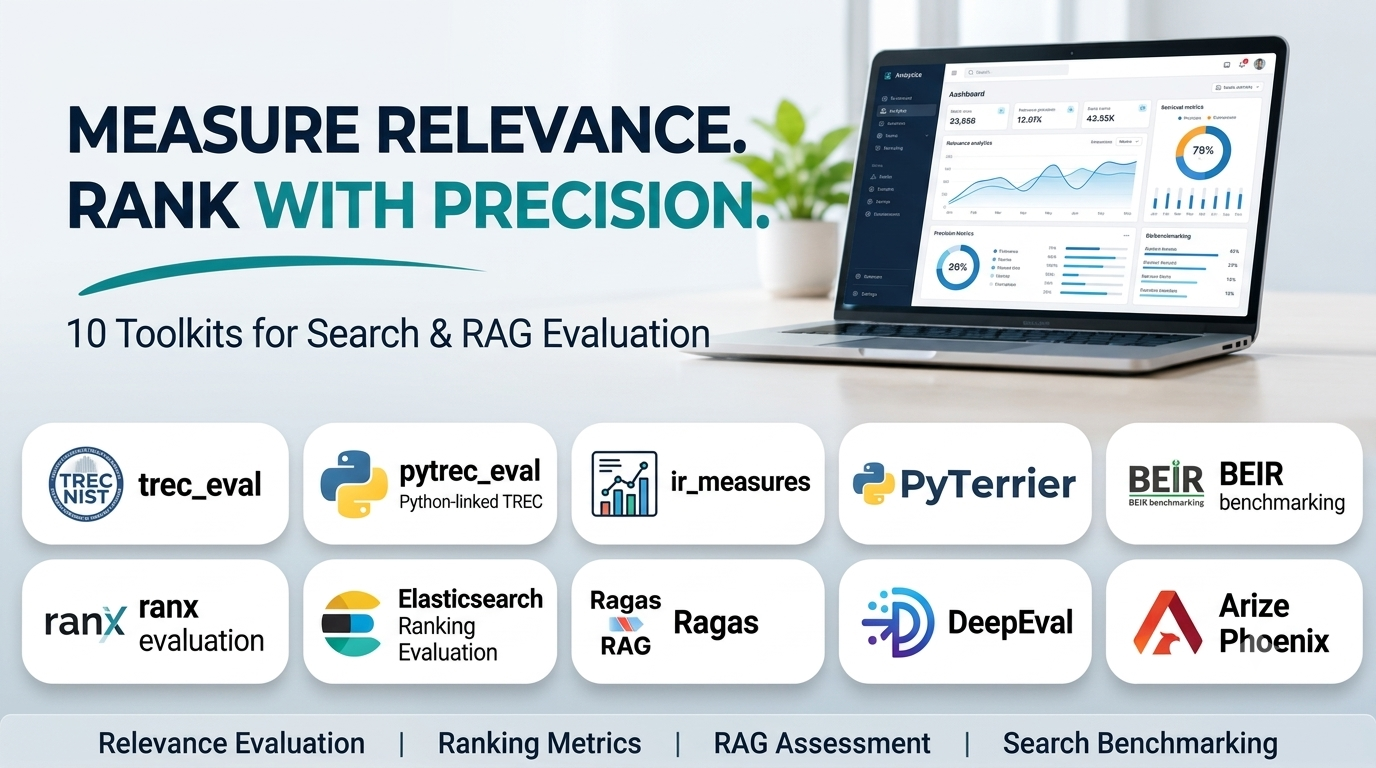
The following tools include traditional information retrieval evaluation libraries, retrieval benchmarking frameworks, search engine evaluation features, and modern AI application assessment platforms. Their numbering represents presentation order rather than an independently tested performance ranking.
1. trec_eval
Short Description
trec_eval is an established information retrieval evaluation program associated with the Text REtrieval Conference (TREC) evaluation methodology. It calculates standardized retrieval metrics by comparing ranked search results against relevance judgment files.
The toolkit supports widely used evaluation measurements, including Mean Average Precision (MAP), precision, recall, Reciprocal Rank (RR), and Normalized Discounted Cumulative Gain (NDCG). These metrics allow researchers and engineers to compare search systems using consistent evaluation procedures.
trec_eval accepts standardized retrieval run files and qrels containing document relevance assessments. Its command-line architecture makes it suitable for automated experiments, research benchmarking, and repeatable search quality assessments.
The toolkit focuses primarily on traditional retrieval evaluation rather than complete experiment management or AI-generated response assessment. Organizations requiring visualization, dataset management, or production monitoring generally need complementary software.
Key Features
- Standardized TREC evaluation methodology.
- Command-line evaluation interface.
- Ranked retrieval result processing.
- Query relevance judgment processing.
- Mean Average Precision calculation.
- Precision and recall measurements.
- Reciprocal Rank calculation.
- NDCG evaluation.
- Per-query and aggregated evaluation results.
Benefits
- Supports reproducible retrieval experiments.
- Enables standardized search system comparisons.
- Reduces custom metric implementation requirements.
- Facilitates information retrieval research.
- Supports automated evaluation workflows.
- Improves ranking performance visibility.
- Enables consistent benchmark measurements.
Pros
- Open-source software availability.
- Established information retrieval evaluation methodology.
- Broad standardized metric support.
- Suitable for automated experiments.
- Relatively lightweight architecture.
- Strong research community recognition.
Cons
- Command-line interface requires technical familiarity.
- Limited built-in visualization.
- Requires prepared relevance judgments.
- Does not directly evaluate generated AI responses.
- Experiment management requires complementary tools.
Use Cases: Search engine benchmarking, academic retrieval research, ranking model comparison, relevance regression testing, document retrieval assessment, and standardized evaluation experiments.
Best For: Information retrieval researchers, search engineers, academic institutions, ranking specialists, machine learning engineers, and technical benchmarking teams.
2. pytrec_eval
Short Description
pytrec_eval is a Python interface to trec_eval that enables developers to calculate standardized information retrieval metrics within Python applications. It reduces the need to execute separate command-line evaluation processes.
The toolkit supports relevance judgments and ranked retrieval results represented through Python data structures. Developers can integrate evaluation calculations directly into machine learning experiments, search development workflows, and automated testing systems.
pytrec_eval provides access to established retrieval measurements, including average precision, reciprocal rank, precision, recall, and NDCG. Its functionality helps organizations maintain consistent evaluation methodologies across Python-based information retrieval projects.
The library is particularly relevant to researchers and developers who require programmatic retrieval evaluation. Installation compatibility, supported metrics, and maintenance status should be assessed against the selected package release.
Key Features
- Python-based retrieval evaluation interface.
- Integration with trec_eval functionality.
- Standardized ranking metrics.
- Query-level evaluation.
- Programmatic relevance judgment processing.
- Ranked result evaluation.
- Configurable metric selection.
- Compatibility with Python experimental workflows.
- Automated evaluation integration.
Benefits
- Simplifies Python-based retrieval evaluation.
- Reduces command-line integration requirements.
- Supports reproducible search experiments.
- Facilitates machine learning model comparison.
- Enables automated relevance regression testing.
- Improves evaluation workflow consistency.
- Supports customizable analytical reporting.
Pros
- Open-source software availability.
- Familiar Python development interface.
- Established metric calculation foundation.
- Suitable for research experiments.
- Integrates with analytical libraries.
- Supports flexible evaluation workflows.
Cons
- Requires Python development expertise.
- Installation may involve native dependencies.
- Limited built-in visualization.
- Requires prepared relevance judgments.
- Production monitoring requires complementary software.
Use Cases: Python search experiments, machine learning retrieval evaluation, semantic search benchmarking, ranking algorithm comparison, automated relevance testing, and research model assessment.
Best For: Python developers, machine learning researchers, search engineers, data scientists, academic institutions, and automated testing specialists.
3. ir_measures
Short Description
ir_measures is an open-source Python library that provides a unified interface for calculating information retrieval evaluation metrics. It helps developers access different evaluation implementations through consistent metric definitions.
The toolkit supports standardized retrieval measurements such as precision, recall, average precision, reciprocal rank, and NDCG. Its configurable metric expressions allow users to specify evaluation cutoffs and other supported parameters.
ir_measures can use compatible underlying metric providers to perform evaluation calculations. This architecture helps researchers compare retrieval systems without independently implementing every evaluation measurement.
The library is particularly relevant to organizations conducting repeatable information retrieval experiments across multiple datasets and ranking configurations. It generally requires complementary tools for experiment visualization, retrieval execution, and production monitoring.
Key Features
- Unified information retrieval evaluation interface.
- Configurable metric expressions.
- Precision and recall calculations.
- Average precision evaluation.
- Reciprocal rank measurements.
- NDCG calculations.
- Compatible evaluation provider integrations.
- Query-level evaluation results.
- Aggregated metric reporting.
Benefits
- Simplifies standardized metric selection.
- Supports consistent retrieval experiments.
- Reduces custom evaluation development.
- Facilitates ranking model comparisons.
- Enables flexible evaluation configurations.
- Improves experimental reproducibility.
- Supports automated retrieval testing.
Pros
- Open-source software availability.
- Flexible metric configuration.
- Consistent Python evaluation interface.
- Supports established retrieval measurements.
- Suitable for academic and commercial experiments.
- Compatible with broader Python research workflows.
Cons
- Requires technical evaluation knowledge.
- Some metrics depend on compatible providers.
- Limited built-in experiment visualization.
- Does not independently execute search applications.
- Requires representative relevance judgments.
Use Cases: Search relevance benchmarking, retrieval metric standardization, semantic search evaluation, ranking model assessment, research experiments, and automated quality testing.
Best For: Information retrieval researchers, Python developers, search relevance engineers, data scientists, academic teams, and machine learning specialists.
4. PyTerrier
Short Description
PyTerrier is an open-source Python framework designed for information retrieval experimentation and search pipeline development. It enables researchers and developers to construct, combine, execute, and evaluate retrieval components.
The framework provides configurable retrieval pipelines that can incorporate indexing, document retrieval, query rewriting, reranking, and result transformation. Compatible integrations support traditional lexical retrieval and modern neural information retrieval approaches.
PyTerrier provides experiment functionality for comparing multiple retrieval pipelines using standardized evaluation metrics. Researchers can evaluate ranking configurations against representative datasets and examine differences in retrieval effectiveness.
The framework is particularly relevant to academic research, search algorithm experimentation, and advanced relevance engineering. Production search deployment may require complementary infrastructure and operational management technologies.
Key Features
- Configurable information retrieval pipelines.
- Python-based experimentation framework.
- Compatible Terrier search integration.
- Query transformation capabilities.
- Document retrieval workflows.
- Supported neural reranking integrations.
- Standardized evaluation metrics.
- Comparative experiment functionality.
- Compatible benchmark dataset integrations.
Benefits
- Simplifies retrieval pipeline experimentation.
- Supports systematic ranking comparisons.
- Facilitates lexical and neural retrieval research.
- Enables reusable evaluation workflows.
- Improves experimental reproducibility.
- Reduces custom benchmarking development.
- Supports advanced relevance optimization.
Pros
- Open-source software availability.
- Strong information retrieval research orientation.
- Flexible pipeline composition.
- Integrated experimentation capabilities.
- Supports multiple retrieval approaches.
- Relevant academic research ecosystem.
Cons
- Requires Python and retrieval expertise.
- Some integrations introduce additional dependencies.
- Large experiments require computing resources.
- Production monitoring requires complementary tools.
- Advanced configurations can have a learning curve.
Use Cases: Search ranking research, neural retrieval benchmarking, hybrid search experimentation, query rewriting assessment, reranking evaluation, and academic information retrieval studies.
Best For: Search researchers, machine learning engineers, academic institutions, information retrieval specialists, ranking developers, and experimental search teams.
5. BEIR
Short Description
Benchmarking Information Retrieval (BEIR) is a heterogeneous benchmark and evaluation framework designed to assess information retrieval models across different datasets and domains. It provides standardized resources for evaluating retrieval generalization.
The framework includes benchmark datasets covering multiple information retrieval tasks, including question answering, scientific information discovery, and other document retrieval applications. These collections help researchers assess model effectiveness beyond a single training domain.
BEIR supports compatible lexical, dense, sparse, and reranking retrieval approaches through its evaluation ecosystem. Standardized metrics enable developers to compare retrieval models across heterogeneous evaluation collections.
The framework is particularly relevant to semantic search research, embedding model assessment, and zero-shot retrieval benchmarking. Organizations should evaluate dataset licensing, domain relevance, benchmark contamination risks, and current framework compatibility.
Key Features
- Heterogeneous retrieval benchmark collections.
- Cross-domain evaluation datasets.
- Standardized retrieval evaluation workflows.
- Compatible dense retrieval evaluation.
- Supported lexical retrieval baselines.
- Compatible reranking evaluation.
- NDCG and recall measurements.
- Zero-shot retrieval assessment.
- Python-based benchmarking interfaces.
Benefits
- Supports cross-domain retrieval evaluation.
- Facilitates embedding model comparison.
- Reduces benchmark dataset preparation requirements.
- Enables standardized semantic search experiments.
- Improves understanding of model generalization.
- Supports retrieval architecture comparisons.
- Facilitates reproducible research workflows.
Pros
- Established retrieval benchmarking framework.
- Diverse evaluation datasets.
- Supports multiple retrieval approaches.
- Relevant semantic search research applications.
- Standardized evaluation methodology.
- Open-source framework availability.
Cons
- Benchmark datasets may differ from production workloads.
- Large experiments require computing resources.
- Dataset licensing varies.
- Benchmark contamination can affect interpretation.
- Production-specific relevance judgments remain necessary.
Use Cases: Embedding model benchmarking, semantic retrieval evaluation, zero-shot search assessment, cross-domain retrieval comparison, reranking research, and information retrieval model development.
Best For: Machine learning researchers, embedding model developers, semantic search engineers, AI research institutions, data scientists, and retrieval benchmarking teams.
6. ranx
Short Description
ranx is an open-source Python library designed for information retrieval evaluation, ranking comparison, and result fusion. It provides standardized mechanisms for representing relevance judgments and ranked retrieval results.
The toolkit supports numerous retrieval metrics and configurable evaluation cutoffs. Developers can compare search runs, calculate aggregated measurements, and examine query-level performance differences.
ranx also provides compatible statistical comparison and ranking fusion capabilities. These features help organizations investigate whether combining multiple retrieval approaches improves measured search relevance.
The library is particularly relevant to search engineers evaluating hybrid retrieval, ranking algorithms, and experimental information retrieval configurations. It generally requires complementary tools for search execution, annotation management, and production monitoring.
Key Features
- Python-based retrieval evaluation.
- Standardized relevance judgment representation.
- Ranked retrieval result management.
- Configurable retrieval metrics.
- Comparative evaluation reports.
- Supported statistical significance testing.
- Ranking fusion algorithms.
- Query-level performance analysis.
- Compatible retrieval experiment workflows.
Benefits
- Simplifies search run comparisons.
- Supports standardized ranking evaluation.
- Facilitates hybrid retrieval experimentation.
- Enables statistical performance assessment.
- Reduces custom metric development.
- Improves experimental reproducibility.
- Supports systematic relevance optimization.
Pros
- Open-source software availability.
- Broad retrieval metric support.
- Relevant ranking fusion capabilities.
- Supports statistical comparison.
- Accessible Python interfaces.
- Suitable for experimental search workflows.
Cons
- Requires prepared retrieval results.
- Does not independently provide a search engine.
- Advanced statistical analysis requires expertise.
- Limited production monitoring functionality.
- Benchmark quality depends on relevance judgments.
Use Cases: Hybrid search evaluation, ranking fusion experiments, search engine comparison, relevance regression testing, retrieval benchmarking, and statistical performance analysis.
Best For: Search relevance engineers, Python developers, machine learning researchers, ranking specialists, data scientists, and information retrieval research teams.
7. Elasticsearch Ranking Evaluation API
Short Description
The Elasticsearch Ranking Evaluation API provides native functionality for measuring search result relevance within Elasticsearch environments. It allows developers to evaluate search requests against manually rated documents.
The interface supports evaluation metrics such as precision, recall, Mean Reciprocal Rank (MRR), Discounted Cumulative Gain (DCG), and Expected Reciprocal Rank (ERR). These measurements help organizations assess whether search configurations produce useful result rankings.
Developers can submit representative search requests together with associated document ratings. Elasticsearch executes the requests and returns evaluation measurements and diagnostic information for the evaluated queries.
The functionality is particularly relevant to organizations already operating Elasticsearch search infrastructure. More extensive experimentation, statistical testing, annotation management, and cross-platform evaluation may require complementary tools.
Key Features
- Native Elasticsearch relevance evaluation.
- Representative search request execution.
- Document relevance rating support.
- Precision and recall measurements.
- Mean Reciprocal Rank evaluation.
- Discounted Cumulative Gain metrics.
- Expected Reciprocal Rank evaluation.
- Query-level diagnostic information.
- Application Programming Interface (API) integration.
Benefits
- Simplifies Elasticsearch relevance assessment.
- Reduces external evaluation integration requirements.
- Supports controlled search configuration comparisons.
- Facilitates ranking optimization.
- Enables repeatable search quality tests.
- Improves visibility into retrieval failures.
- Supports automated relevance regression testing.
Pros
- Native Elasticsearch integration.
- Supports established ranking measurements.
- Executes actual search requests.
- Relevant diagnostic capabilities.
- Suitable for existing Elastic environments.
- Supports programmatic evaluation workflows.
Cons
- Primarily designed for Elasticsearch.
- Requires prepared document ratings.
- Limited cross-platform comparison functionality.
- Advanced statistical analysis requires external tools.
- Comprehensive evaluation management requires additional components.
Use Cases: Elasticsearch relevance testing, query configuration comparison, enterprise search optimization, ranking regression testing, electronic commerce search assessment, and hybrid retrieval evaluation.
Best For: Elasticsearch administrators, Elastic developers, enterprise search engineers, search relevance specialists, application developers, and organizations using Elasticsearch infrastructure.
8. Ragas
Short Description
Ragas is an evaluation framework designed to assess retrieval-augmented generation systems and related AI applications. It provides metrics that examine retrieval effectiveness, contextual information quality, and generated response characteristics.
The framework supports measurements such as context precision, context recall, faithfulness, and response relevance through compatible evaluation configurations. These measurements help developers distinguish retrieval problems from response generation problems.
Ragas supports evaluation datasets, compatible language model integrations, and synthetic test data generation capabilities. Organizations can use these features to establish repeatable assessment workflows for intelligent knowledge applications.
The framework is particularly relevant to AI development teams evaluating systems that combine information retrieval with generative language models. Model-based judgments should undergo human validation because evaluation quality depends on evaluator models, prompts, datasets, and configuration choices.
Key Features
- Retrieval-augmented generation evaluation.
- Context precision assessment.
- Context recall assessment.
- Faithfulness evaluation.
- Response relevance measurement.
- Compatible language model integrations.
- Evaluation dataset support.
- Supported synthetic test generation.
- Customizable evaluation workflows.
Benefits
- Helps identify retrieval and generation failures.
- Supports contextual relevance assessment.
- Facilitates repeatable AI application evaluation.
- Enables systematic RAG optimization.
- Reduces custom evaluation development.
- Improves visibility into response grounding.
- Supports automated AI quality testing.
Pros
- Open-source framework availability.
- Strong RAG evaluation orientation.
- Supports multiple evaluation dimensions.
- Compatible language model integrations.
- Relevant test dataset generation capabilities.
- Suitable for modern AI applications.
Cons
- Model-based evaluation can introduce bias.
- Evaluator model usage may increase expenses.
- Metric behavior depends on configuration.
- Human validation remains necessary.
- Traditional retrieval benchmarking may require complementary tools.
Use Cases: RAG application assessment, contextual retrieval evaluation, AI assistant testing, generated response grounding assessment, enterprise knowledge application evaluation, and retrieval pipeline optimization.
Best For: AI engineers, language model developers, machine learning specialists, enterprise AI teams, RAG application developers, and AI quality assurance professionals.
9. DeepEval
Short Description
DeepEval is an open-source evaluation framework designed to assess Large Language Model (LLM) applications through configurable metrics and automated test cases. It supports evaluation workflows for generated responses, contextual retrieval, and intelligent application behavior.
The framework provides compatible metrics for answer relevance, contextual precision, contextual recall, contextual relevance, and faithfulness. These measurements help developers investigate information retrieval and response generation quality.
DeepEval provides Python-based test development capabilities that can integrate with compatible software testing and Continuous Integration (CI) workflows. Organizations can establish repeatable evaluation tests and identify quality regressions during application development.
The framework is particularly relevant to AI application teams requiring automated quality assessment throughout the development lifecycle. Evaluator reliability, model expenses, metric thresholds, and commercial platform capabilities should be evaluated before production adoption.
Key Features
- Automated LLM application evaluation.
- Contextual relevance metrics.
- Contextual precision and recall assessment.
- Answer relevance evaluation.
- Faithfulness measurement.
- Configurable evaluation test cases.
- Custom evaluation metrics.
- Compatible CI workflow integration.
- Supported model-based evaluation mechanisms.
Benefits
- Supports automated AI quality testing.
- Helps identify contextual retrieval problems.
- Facilitates repeatable evaluation workflows.
- Enables development-stage regression detection.
- Supports configurable application quality requirements.
- Improves visibility into generated response quality.
- Reduces repetitive manual assessment activities.
Pros
- Open-source framework availability.
- Developer-oriented testing architecture.
- Relevant contextual retrieval metrics.
- Supports customizable evaluations.
- Compatible with automated development workflows.
- Suitable for RAG application testing.
Cons
- Model-based evaluation requires validation.
- Evaluator usage may introduce additional expenses.
- Metric thresholds require careful calibration.
- Traditional retrieval benchmarking requires complementary tools.
- Advanced evaluation configurations require technical expertise.
Use Cases: Automated RAG testing, AI assistant quality assurance, contextual relevance assessment, generated response evaluation, development pipeline testing, and AI regression detection.
Best For: AI application developers, quality assurance engineers, machine learning teams, software testing specialists, enterprise AI developers, and organizations implementing automated evaluation.
10. Arize Phoenix
Short Description
Arize Phoenix is an open-source AI observability and evaluation platform designed to help developers investigate and improve intelligent application performance. It provides capabilities for tracing application workflows, evaluating retrieval operations, and assessing generated responses.
The platform supports compatible evaluation mechanisms for retrieval relevance, response quality, and other AI application characteristics. Developers can examine application traces to understand how retrieved context influences downstream model behavior.
Phoenix provides dataset management, experimentation, evaluation, and visualization capabilities within compatible deployments. These features help organizations investigate retrieval failures and compare changes to AI application configurations.
The platform is particularly relevant to teams seeking combined observability and evaluation for RAG applications and language model systems. Organizations should assess deployment architecture, trace information security, evaluator expenses, and current feature availability.
Key Features
- AI application observability.
- Retrieval workflow tracing.
- Supported relevance evaluation.
- Generated response evaluation.
- Evaluation dataset management.
- Experiment comparison capabilities.
- Interactive diagnostic visualization.
- Compatible OpenTelemetry-based integrations.
- Open-source deployment options.
Benefits
- Improves visibility into retrieval workflows.
- Helps identify application quality problems.
- Supports contextual relevance investigation.
- Facilitates repeatable AI experiments.
- Enables trace-based failure analysis.
- Supports evaluation and observability integration.
- Improves intelligent application debugging.
Pros
- Open-source software availability.
- Combines observability and evaluation.
- Relevant retrieval diagnostic capabilities.
- Supports experiment comparison.
- Provides interactive visualization.
- Suitable for modern AI application environments.
Cons
- Instrumentation requires configuration.
- Trace storage can increase infrastructure expenses.
- Model-based judgments require validation.
- Sensitive trace information requires protection.
- Traditional ranking evaluation may require additional libraries.
Use Cases: RAG observability, retrieval relevance debugging, AI application evaluation, contextual information assessment, experiment comparison, and production quality investigation.
Best For: AI infrastructure engineers, machine learning operations teams, RAG developers, enterprise AI specialists, application observability engineers, and AI quality assurance teams.
Comparison Table: Top 10 Relevance Evaluation Toolkits
| Toolkit | Primary Strength | Best For | Pricing Approach |
|---|---|---|---|
| trec_eval | Standardized retrieval metrics | Traditional search benchmarking | Open-source |
| pytrec_eval | Python-based TREC evaluation | Programmatic retrieval assessment | Open-source |
| ir_measures | Unified metric interfaces | Standardized evaluation workflows | Open-source |
| PyTerrier | Retrieval pipeline experimentation | Search research and ranking comparison | Open-source |
| BEIR | Cross-domain retrieval benchmarking | Embedding and retrieval model assessment | Open-source; dataset terms vary |
| ranx | Ranking evaluation and fusion | Comparative retrieval experiments | Open-source |
| Elasticsearch Ranking Evaluation API | Native search relevance testing | Elasticsearch environments | Deployment-dependent |
| Ragas | RAG retrieval and response evaluation | Contextual AI applications | Open-source; model expenses may apply |
| DeepEval | Automated AI application testing | Development-stage quality assurance | Open-source and commercial ecosystem offerings |
| Arize Phoenix | AI observability and evaluation | Retrieval debugging and experimentation | Open-source and hosted offerings |
Functional Comparison
| Toolkit | Traditional Retrieval Metrics | RAG Evaluation | Primary Interface |
|---|---|---|---|
| trec_eval | Extensive | Not directly supported | Command line |
| pytrec_eval | Extensive | Not directly supported | Python |
| ir_measures | Extensive | Requires complementary tools | Python |
| PyTerrier | Extensive | Requires additional integration | Python |
| BEIR | Supported | Not its primary purpose | Python |
| ranx | Extensive | Requires complementary tools | Python |
| Elasticsearch Ranking Evaluation API | Supported | Requires additional integration | REST API |
| Ragas | Context-oriented metrics | Supported | Python |
| DeepEval | Context-oriented metrics | Supported | Python |
| Arize Phoenix | Evaluation-dependent | Supported | Web interface and Python |
Understanding Important Relevance Evaluation Metrics
Precision at K
Precision at K measures the proportion of relevant documents among the first K retrieved results. For example, when four of the first five results are relevant, precision at five equals 80%.
Recall at K
Recall at K measures the proportion of known relevant documents retrieved within the first K results. If ten relevant documents exist and a search system retrieves eight of them within its first twenty results, recall at twenty equals 80%.
Mean Average Precision
Mean Average Precision calculates the mean of average precision values across multiple evaluated queries. It considers the positions of relevant documents and rewards retrieval systems that rank relevant information prominently.
Mean Reciprocal Rank
Mean Reciprocal Rank measures the average reciprocal position of the first relevant result across evaluated queries. A search system receives a higher score when its first relevant result appears closer to the beginning of the ranking.
Normalized Discounted Cumulative Gain
Normalized Discounted Cumulative Gain evaluates ranking quality using graded relevance judgments and position-dependent discounts. It is particularly useful when documents have different relevance levels rather than simple relevant or irrelevant classifications.
Hit Rate
Hit rate measures the proportion of evaluated queries that retrieve at least one relevant document within a specified result cutoff. This metric is useful for applications that require at least one suitable information source to satisfy a request.
Context Precision
Context precision evaluates how effectively a retrieval system selects relevant contextual information for an AI application. Exact calculation methods differ between evaluation frameworks and may incorporate human judgments or model-based assessments.
Context Recall
Context recall evaluates whether retrieved information adequately covers the evidence required to answer a particular request. Its interpretation depends on the selected evaluation methodology and available reference information.
Faithfulness
Faithfulness evaluates whether generated statements are supported by retrieved contextual information. It measures response grounding rather than retrieval ranking quality and does not independently establish that the underlying source information is factually correct.
How to Choose the Best Relevance Evaluation Toolkit
Evaluate Retrieval Architecture
Determine whether the organization uses traditional keyword search, semantic retrieval, vector search, hybrid search, recommendation systems, or RAG applications. Different retrieval architectures require different evaluation methodologies and quality measurements.
Assess Metric Requirements
Identify the metrics that reflect the organization’s information discovery objectives. Precision, recall, NDCG, and MRR address different aspects of retrieval quality and should be selected according to actual application requirements.
Review Dataset Compatibility
Evaluate whether the toolkit supports existing relevance judgments, ranked retrieval files, benchmark collections, and custom evaluation datasets. Representative datasets are essential for measuring search effectiveness under realistic operating conditions.
Examine Automation Capabilities
Determine whether evaluation workflows must integrate with software development pipelines, scheduled experiments, or production quality monitoring. Automated evaluation can help organizations detect search relevance regressions before changes affect users.
Consider Human Evaluation Requirements
Assess whether the organization requires human relevance judgments, expert annotations, or model-based evaluations. Human assessments remain particularly important for specialized domains, ambiguous queries, and consequential information retrieval applications.
Evaluate Statistical Analysis
Review support for paired comparisons, confidence intervals, significance testing, and query-level analysis. Small improvements in aggregated metrics should not automatically be interpreted as meaningful performance gains.
Assess RAG Evaluation Capabilities
Determine whether the toolkit can distinguish contextual retrieval quality from generated response quality. Applications using language models may require separate assessments of retrieval relevance, evidence coverage, faithfulness, and answer usefulness.
Review Integration Requirements
Examine compatibility with existing search engines, vector databases, machine learning frameworks, programming languages, and observability systems. Appropriate integrations help organizations maintain repeatable evaluation workflows without excessive custom development.
Evaluate Total Ownership Costs
Consider software licensing, evaluator model usage, computing infrastructure, dataset preparation, human annotation, and administrative resources. Open-source evaluation libraries can reduce licensing expenses but may still require substantial implementation and maintenance activities.
Best Relevance Evaluation Toolkits by User Type
| User Type | Relevant Toolkit |
|---|---|
| Traditional information retrieval researcher | trec_eval |
| Python retrieval evaluation developer | pytrec_eval |
| Standardized metric specialist | ir_measures |
| Search pipeline researcher | PyTerrier |
| Embedding model benchmarking specialist | BEIR |
| Hybrid retrieval and ranking fusion engineer | ranx |
| Elasticsearch relevance engineer | Elasticsearch Ranking Evaluation API |
| RAG application developer | Ragas |
| AI quality assurance engineer | DeepEval |
| AI observability and debugging specialist | Arize Phoenix |
Practical Example: Implementing Enterprise Search Relevance Evaluation
Consider a hypothetical electronic commerce organization maintaining three million product records, technical documents, customer support articles, and supplier information assets. Its existing search environment frequently returns irrelevant products, ranks useful documents below less relevant information, and provides inconsistent results for natural language queries.
Management introduces a standardized relevance evaluation framework to compare keyword search, vector retrieval, hybrid search, and reranking configurations. The following outcomes represent illustrative assumptions rather than verified vendor performance.
Implementation Steps
- Collect representative customer search queries and enterprise information requests.
- Establish human-reviewed relevance judgments for representative documents and products.
- Define evaluation metrics, acceptance thresholds, and baseline search configurations.
- Execute standardized queries against lexical, semantic, and hybrid retrieval systems.
- Compare retrieval metrics and investigate unsuccessful search requests.
- Optimize ranking configurations, embedding models, filtering, and reranking mechanisms.
- Integrate repeatable evaluation into development workflows and monitor production outcomes.
Illustrative Performance Improvements
| Performance Indicator | Before | After |
|---|---|---|
| Precision at five | 48% | 84% |
| Recall at twenty | 61% | 90% |
| NDCG at ten | 0.52 | 0.83 |
| Mean Reciprocal Rank | 0.46 | 0.81 |
| Search success rate | 59% | 92% |
| Zero-result query rate | 19% | 5% |
| Average product discovery time | 9 minutes | 3 minutes |
| Monthly manual relevance testing workload | 900 hours | 250 hours |
| Search-related customer support requests | 1,400 | 550 |
| Search satisfaction rate | 57% | 91% |
Financial Analysis
Reducing monthly manual relevance testing workloads by 650 hours releases 7,800 employee hours annually. At an illustrative labor cost of $45 per hour, this represents $351,000 in released annual labor capacity rather than guaranteed cash savings.
Suppose the organization eliminates $96,000 in annual expenses associated with redundant testing infrastructure. Additional realized annual savings of $144,000 from avoidable external evaluation contracts and search maintenance services would produce total gross cash savings of $240,000.
After recurring evaluation infrastructure, annotation, model usage, and maintenance expenses of $80,000, annual net cash savings would equal $160,000. An initial implementation investment of $240,000 would therefore produce a simple payback period of 18 months.
This calculation excludes taxes, financing costs, discounting, potential revenue improvements, and the separately estimated value of released employee capacity. Actual financial outcomes would depend on evaluation complexity, dataset preparation requirements, model expenses, and the organization’s ability to eliminate existing operating costs.
Important Relevance Evaluation Performance Indicators
| Indicator | Measurement Purpose |
|---|---|
| Precision at K | Measures relevant results among the first K retrieved items |
| Recall at K | Measures known relevant items retrieved within K results |
| Mean Average Precision | Evaluates average precision across multiple queries |
| Mean Reciprocal Rank | Measures the ranking position of the first relevant result |
| NDCG | Evaluates ranking quality using graded relevance judgments |
| Hit rate | Measures queries retrieving at least one relevant result |
| Context precision | Evaluates relevance of retrieved contextual information |
| Context recall | Measures coverage of required contextual evidence |
| Faithfulness | Evaluates whether generated statements are supported by context |
| Answer relevance | Assesses how directly generated responses address requests |
| Search success rate | Measures queries satisfying defined information needs |
| Zero-result query rate | Tracks searches returning no results |
| Search abandonment rate | Measures unsuccessful or abandoned search interactions |
| Click-through rate | Tracks user interactions with displayed results |
| Inter-annotator agreement | Measures consistency between human relevance judgments |
| Evaluation dataset coverage | Assesses representation of important query categories |
| Regression detection rate | Measures identified quality regressions against known test cases |
| Evaluation execution time | Tracks duration of evaluation workflows |
| Cost per evaluation | Measures average assessment expenses |
| Evaluation reproducibility | Assesses consistency across repeated controlled experiments |
Security and Governance Considerations
Relevance evaluation workflows frequently process enterprise search queries, confidential documents, customer information, and sensitive operational knowledge. Organizations should implement appropriate authentication, encryption, access controls, and information retention policies throughout evaluation environments.
Evaluation datasets should avoid unnecessary exposure of personally identifiable information and confidential business content. Organizations can use appropriately anonymized, redacted, or synthetic evaluation examples when these approaches preserve representative assessment requirements.
Human relevance assessors should receive appropriate evaluation instructions and access only the information necessary for assigned tasks. Organizations should maintain documented annotation policies, review procedures, and mechanisms for resolving inconsistent judgments.
External AI evaluation services should undergo appropriate contractual, privacy, and security assessments. Organizations must evaluate whether confidential queries, retrieved documents, or generated responses are transmitted outside approved infrastructure.
Evaluation configurations should maintain records of dataset versions, metric definitions, model versions, evaluator prompts, retrieval parameters, and experiment dates. These records help organizations reproduce assessments and investigate changes in measured search quality.
Automated relevance judgments should not independently determine the suitability of consequential information retrieval systems. Human oversight, representative validation, source quality assessment, and documented acceptance criteria remain important governance requirements.
Challenges and Limitations
Incomplete Relevance Judgments
Evaluation datasets may not identify every relevant document within a large information collection. Incomplete judgments can affect recall calculations and penalize retrieval systems that discover useful but previously unjudged information.
Subjective Relevance Assessment
Different users may interpret the same query differently or disagree about which documents satisfy an information requirement. Clear annotation instructions, graded relevance scales, and disagreement resolution procedures help improve evaluation consistency.
Unrepresentative Evaluation Datasets
Public benchmarks may differ substantially from enterprise information sources, customer behavior, and specialized domain terminology. Organizations should supplement external benchmarks with representative internal evaluation datasets.
Metric Selection Complexity
Different evaluation metrics reward different retrieval behaviors, and improvements in one measurement may coincide with reductions in another. Organizations should select complementary metrics that reflect actual application requirements.
AI Evaluator Bias
Language model-based evaluators may produce inconsistent judgments, favor particular response styles, or misinterpret specialized information. Organizations should calibrate automated evaluators against independently reviewed human assessments.
Evaluation Expenses
Large evaluation datasets, repeated retrieval experiments, human annotations, and model-based assessments can introduce substantial expenses. Organizations should prioritize representative test coverage and select appropriate evaluation frequencies.
Search Quality Drift
Changes in indexed information, customer terminology, embedding models, and search configurations can alter retrieval effectiveness over time. Continuing evaluation is necessary to identify quality regressions that initial implementation tests may not detect.
Benchmark Contamination
Retrieval models may have encountered benchmark documents or evaluation examples during training. Organizations should investigate potential data contamination and use independent evaluation collections when assessing model generalization.
Best Practices for Relevance Evaluation Implementation
- Establish clearly defined information retrieval objectives.
- Collect representative search queries.
- Include common and uncommon query categories.
- Develop consistent relevance annotation instructions.
- Use independently reviewed relevance judgments.
- Maintain graded relevance assessments where appropriate.
- Select complementary retrieval evaluation metrics.
- Establish measurable search quality baselines.
- Compare lexical, semantic, and hybrid retrieval configurations.
- Evaluate ranking performance at meaningful result cutoffs.
- Investigate query-level retrieval failures.
- Assess statistical significance where appropriate.
- Maintain separate development and final evaluation datasets.
- Document embedding model and ranking configuration versions.
- Validate AI-assisted evaluations against human judgments.
- Protect confidential evaluation information.
- Avoid unnecessary personal information in evaluation datasets.
- Integrate relevance testing into development workflows.
- Establish appropriate regression acceptance thresholds.
- Monitor production search behavior.
- Review evaluator model usage expenses.
- Maintain reproducible experiment configurations.
- Reassess evaluation datasets as user requirements change.
- Review retrieval quality and operational outcomes regularly.
Future Trends in Relevance Evaluation Toolkits
AI-Assisted Relevance Annotation
Relevance evaluation platforms may increasingly use language models to suggest document relevance judgments and identify ambiguous search requests. Human review will remain important for validating automatically generated assessments and specialized domain evaluations.
Multimodal Retrieval Evaluation
Evaluation frameworks may increasingly support search applications involving text, images, audio, video, and other information formats. These applications require assessment methods that recognize contextual relationships across different content types.
Automated Search Regression Testing
Organizations may increasingly integrate relevance evaluation directly into software development and deployment workflows. Automated tests can help identify quality regressions when search configurations, embedding models, or indexed information change.
Advanced RAG Evaluation
Evaluation technologies may increasingly provide specialized assessments of evidence retrieval, contextual completeness, source attribution, response grounding, and generated answer usefulness. These capabilities can help organizations distinguish retrieval failures from language model generation problems.
Domain-Specific Evaluation Frameworks
Organizations may increasingly develop evaluation methodologies tailored to healthcare, financial services, legal information retrieval, scientific research, and technical knowledge management. Specialized evaluation datasets can provide more meaningful measurements than general-purpose benchmarks.
Continuous Production Evaluation
Search platforms may increasingly incorporate ongoing evaluation using approved user interaction signals, sampled queries, and controlled assessment workflows. These approaches require appropriate privacy protections and careful interpretation of behavioral measurements.
Explainable Relevance Diagnostics
Evaluation toolkits may increasingly provide detailed explanations of retrieval failures, ranking inconsistencies, and contextual information gaps. Diagnostic capabilities can help search engineers identify specific improvement opportunities rather than relying exclusively on aggregated scores.
Automated Benchmark Generation
AI technologies may increasingly assist with generating representative queries, identifying relevant evidence, and constructing evaluation datasets. Automatically generated benchmarks should undergo validation to prevent unrealistic queries, incorrect judgments, and evaluation bias.
Unified Retrieval and Generation Evaluation
Evaluation platforms may increasingly combine traditional information retrieval metrics with AI application assessment and observability capabilities. Unified workflows can improve diagnostic visibility while requiring careful separation of retrieval and generation quality measurements.
Cost-Aware Evaluation Strategies
Evaluation systems may increasingly optimize assessment frequency, evaluator model selection, and test dataset sampling according to quality requirements and operational expenses. Organizations should ensure that cost optimization does not remove important evaluation coverage.
Frequently Asked Questions
1. What are relevance evaluation toolkits?
Relevance evaluation toolkits are software libraries, frameworks, and platforms that measure the effectiveness of information retrieval and ranking systems. They compare retrieved results with relevance judgments, expected outcomes, or other defined evaluation criteria.
2. Why is relevance evaluation important?
Relevance evaluation helps organizations determine whether search applications return useful information in appropriate ranking positions. It supports systematic search optimization, retrieval model comparison, regression detection, and improved information discovery.
3. What is trec_eval?
trec_eval is an established information retrieval evaluation program associated with TREC evaluation methodology. It calculates standardized metrics by comparing ranked retrieval results with query relevance judgments.
4. What is pytrec_eval?
pytrec_eval provides a Python interface to trec_eval functionality. It enables developers to calculate standardized retrieval metrics directly within Python experiments and automated evaluation workflows.
5. What is ir_measures?
ir_measures is a Python library that provides a unified interface for calculating information retrieval evaluation metrics. It supports configurable measurements and compatible underlying evaluation providers.
6. What is PyTerrier?
PyTerrier is an information retrieval experimentation framework that supports configurable retrieval pipelines and comparative evaluation. It is particularly relevant to search research, ranking experiments, and neural retrieval assessment.
7. What is BEIR?
BEIR is a heterogeneous retrieval benchmarking framework that provides evaluation datasets across multiple information retrieval domains. It helps researchers compare retrieval models and assess their ability to generalize across different tasks.
8. What is ranx?
ranx is a Python library supporting information retrieval evaluation, ranking comparison, statistical assessment, and result fusion. It helps developers compare search runs and investigate alternative retrieval configurations.
9. What is the Elasticsearch Ranking Evaluation API?
The Elasticsearch Ranking Evaluation API measures search relevance using representative search requests and rated documents. It provides standardized retrieval metrics and diagnostic information within Elasticsearch environments.
10. What is Ragas?
Ragas is an evaluation framework designed for retrieval-augmented generation systems and related AI applications. It supports contextual retrieval assessment, response relevance evaluation, faithfulness measurements, and compatible automated evaluation workflows.
11. What is DeepEval?
DeepEval is an evaluation framework supporting automated assessment of large language model applications. It provides configurable test cases and metrics for contextual retrieval, generated responses, and AI application quality.
12. What is Arize Phoenix?
Arize Phoenix is an AI observability and evaluation platform that supports application tracing, experimentation, and quality assessment. It helps developers investigate retrieval relevance and generated response behavior within intelligent applications.
13. What are relevance judgments?
Relevance judgments identify whether particular documents satisfy specific search queries. They may use binary classifications or graded scales that represent different levels of usefulness.
14. What are qrels?
Qrels are query relevance judgment records used in standardized information retrieval evaluation. They associate queries with document identifiers and relevance ratings that evaluation tools use to assess ranked results.
15. What is precision at K?
Precision at K measures the proportion of relevant documents among the first K retrieved results. It helps organizations evaluate how effectively search systems place useful information within prominent result positions.
16. What is recall at K?
Recall at K measures the proportion of known relevant documents retrieved within the first K results. It helps organizations determine whether retrieval systems discover sufficient relevant information.
17. What is Mean Average Precision?
Mean Average Precision calculates the mean of average precision scores across evaluated queries. It considers the ranking positions of relevant documents and rewards systems that retrieve relevant information prominently.
18. What is Mean Reciprocal Rank?
Mean Reciprocal Rank measures the average reciprocal ranking position of the first relevant result. It is particularly useful for applications where users primarily require one suitable answer or document.
19. What is NDCG?
Normalized Discounted Cumulative Gain measures ranking effectiveness using graded relevance judgments and position-dependent discounts. It rewards search systems that place highly relevant information near the beginning of ranked results.
20. What is retrieval evaluation in RAG?
Retrieval evaluation in RAG assesses whether an application retrieves relevant and sufficiently complete contextual information for response generation. It should be distinguished from evaluation of the generated response itself.
21. Can AI replace human relevance assessors?
AI can assist with relevance assessment, annotation suggestions, and evaluation automation. However, human validation remains important because automated evaluators can introduce bias, inconsistency, and domain-specific interpretation errors.
22. What is search relevance regression testing?
Search relevance regression testing evaluates whether changes to retrieval models, indexing configurations, or ranking mechanisms reduce established search quality measurements. It helps organizations identify performance problems before deploying changes to production environments.
23. Are open-source relevance evaluation toolkits available?
trec_eval, pytrec_eval, ir_measures, PyTerrier, BEIR, ranx, Ragas, DeepEval, and Arize Phoenix provide relevant open-source evaluation capabilities. Implementation may still require computing infrastructure, dataset preparation, technical expertise, and model usage expenses.
24. How much do relevance evaluation toolkits cost?
Costs depend on software licensing, evaluation dataset preparation, human annotation, computing infrastructure, evaluator model usage, and administrative resources. Organizations should assess complete evaluation workflow expenses rather than software subscription prices alone.
25. Which relevance evaluation toolkit is best?
The appropriate toolkit depends on retrieval architecture, evaluation metrics, dataset requirements, automation objectives, technical expertise, and available resources. Traditional search evaluation, cross-domain benchmarking, and RAG assessment may require different or complementary evaluation technologies.
Conclusion
Relevance evaluation toolkits help organizations measure and improve the effectiveness of search engines, semantic retrieval applications, ranking systems, and intelligent information discovery technologies. Their capabilities support enterprise search, electronic commerce, knowledge management, recommendation systems, and retrieval-augmented generation.
trec_eval, pytrec_eval, and ir_measures provide standardized information retrieval evaluation capabilities for different technical workflows. PyTerrier, BEIR, and ranx support retrieval experimentation, cross-domain benchmarking, ranking comparisons, and systematic relevance optimization.
The Elasticsearch Ranking Evaluation API provides native relevance assessment for Elasticsearch search environments. Ragas, DeepEval, and Arize Phoenix address modern AI application evaluation requirements involving contextual retrieval, generated response quality, automated testing, and application observability.
Successful relevance evaluation requires representative query datasets, reliable relevance judgments, appropriate evaluation metrics, reproducible experiments, secure information handling, and continuous performance assessment. Organizations should evaluate retrieval quality alongside operational expenses, user satisfaction, response latency, and application-specific information requirements.
An effective relevance evaluation strategy combines appropriate technology with systematic experimentation, human oversight, measurable quality objectives, and continuous improvement. These practices help organizations strengthen information discovery, identify retrieval weaknesses, improve search ranking effectiveness, and establish reliable foundations for future AI-powered applications.
