Introduction
Problem management tools help organizations identify, investigate, and address the underlying causes of technology incidents. These applications support proactive service improvement by reducing recurring technical failures and unnecessary operational disruptions.
Traditional problem management frequently depends on spreadsheets, disconnected incident records, manual investigations, and informal communication. These practices can contribute to repeated service interruptions, incomplete investigations, and increased operational expenses.
Modern problem management platforms provide centralized problem records, incident correlation, root cause analysis, known error documentation, and corrective action tracking. These capabilities help technical teams investigate recurring problems and coordinate permanent solutions.
Information Technology Infrastructure Library (ITIL) practices distinguish problem management from incident management. Incident management focuses on restoring normal service operations, while problem management addresses actual or potential causes of incidents.
Advanced platforms incorporate Artificial Intelligence (AI), intelligent incident classification, workflow automation, and operational analytics. These capabilities can help organizations identify recurring incident patterns and prioritize investigations.
This guide examines ten problem management tools, including their features, benefits, advantages, limitations, and practical applications. It also provides comparison tables, implementation recommendations, performance indicators, financial examples, and frequently asked questions.
What Are Problem Management Tools?
Problem management tools are software applications designed to support the identification, investigation, documentation, and management of underlying causes of technology incidents. They help organizations reduce the likelihood and impact of recurring service disruptions.
These platforms typically provide problem records, investigation workflows, incident associations, known error documentation, and corrective action management. Technical teams can use these capabilities to coordinate investigations and communicate temporary workarounds.
Problem management platforms frequently integrate with Information Technology Service Management (ITSM), monitoring applications, asset management systems, and Configuration Management Databases (CMDBs). These integrations provide operational context that supports technical investigations.
Effective problem management requires reliable incident information, qualified technical specialists, documented investigation methods, and appropriate change authorization. Software facilitates these activities but cannot independently guarantee accurate root cause identification.
How Problem Management Tools Work
- Identify recurring incidents or potential service problems.
- Create centralized problem records.
- Associate relevant incidents and configuration items.
- Prioritize investigations according to business impact.
- Collect technical evidence and operational information.
- Perform Root Cause Analysis (RCA).
- Document known errors and temporary workarounds.
- Coordinate corrective changes through approved workflows.
- Validate the effectiveness of implemented solutions.
- Monitor incident recurrence and review investigation outcomes.
Common Applications
- Recurring application failure investigations.
- Network connectivity problem analysis.
- Infrastructure reliability improvement.
- Database performance investigations.
- Software defect management.
- Known error documentation.
- Technical workaround management.
- Cloud service reliability investigations.
- Incident trend analysis.
- Corrective action tracking.
- Enterprise service improvement.
- Operational risk reduction.
Incident Management vs Problem Management
| Factor | Incident Management | Problem Management |
|---|---|---|
| Primary objective | Restore normal service | Address incident causes |
| Operational focus | Immediate disruption | Underlying technical problems |
| Typical activities | Troubleshooting and restoration | Investigation and prevention |
| Resolution approach | Service restoration or workaround | Cause removal or impact reduction |
| Documentation | Incident records | Problem and known error records |
| Performance measurement | Restoration time | Recurrence and impact reduction |
| Working approach | Primarily reactive | Reactive and proactive |
Essential Components of Problem Management Tools
| Component | Purpose |
|---|---|
| Problem repository | Maintains centralized problem records |
| Incident correlation | Associates related technical incidents |
| Root cause documentation | Records investigation findings |
| Known error management | Documents analyzed but unresolved problems |
| Workaround management | Provides temporary service assistance |
| CMDB integration | Identifies affected configuration items |
| Change integration | Coordinates authorized corrective modifications |
| Task management | Assigns investigation responsibilities |
| Analytics | Identifies recurring operational patterns |
| Audit logging | Maintains investigation and decision records |
Top 10 Problem Management Tools
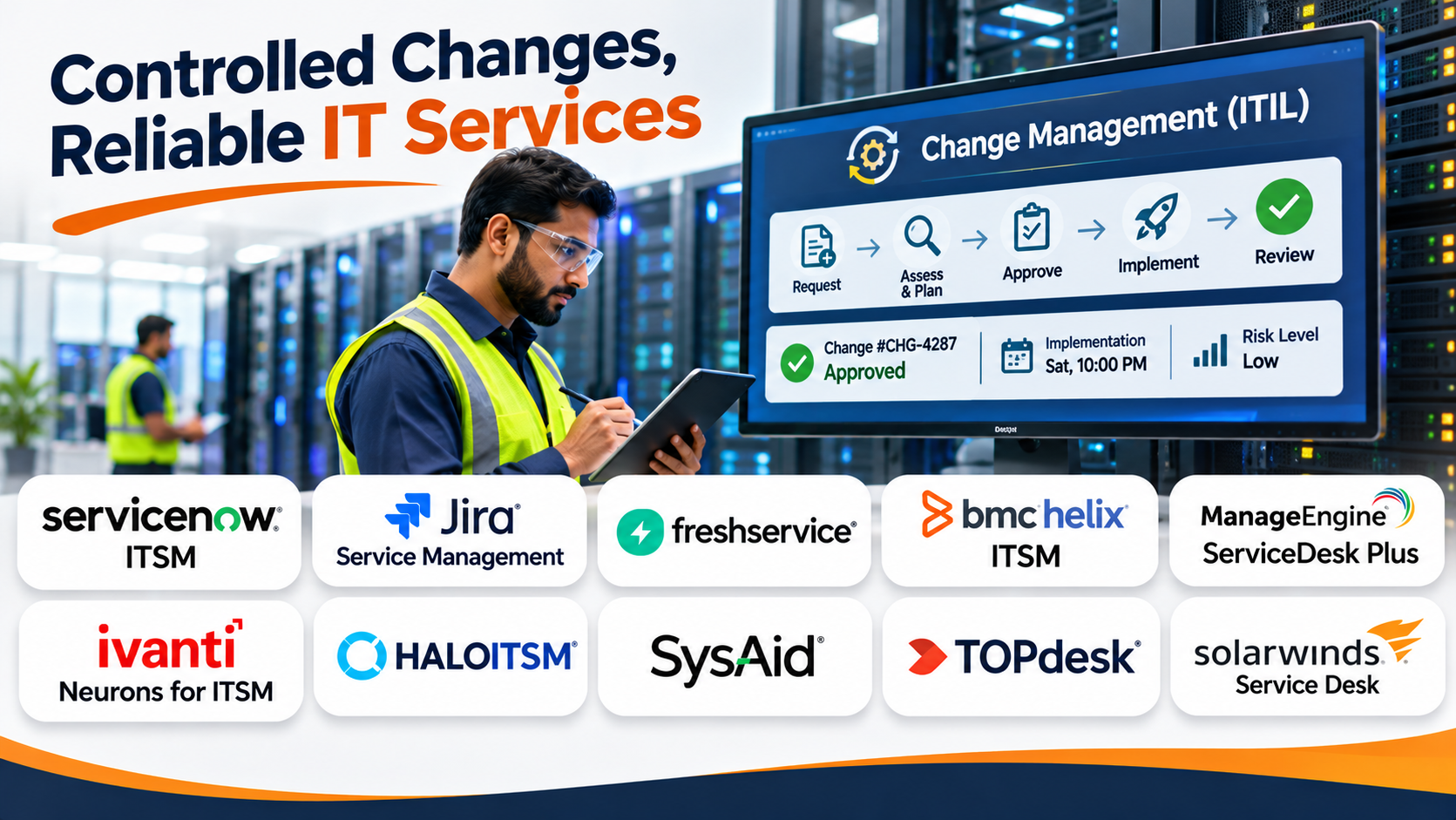
The following platforms provide different combinations of ITIL-oriented problem management, incident correlation, investigation coordination, and service improvement capabilities. Their numbering represents presentation order rather than an independently tested performance ranking.
1. ServiceNow IT Service Management
Short Description
ServiceNow IT Service Management provides enterprise problem management capabilities within its broader digital workflow platform. Organizations can associate recurring incidents with problem records and coordinate technical investigations.
Integration with configuration information, change management, and operational workflows supports investigation and corrective action tracking. Relevant automation capabilities help organizations identify patterns and standardize problem management procedures.
Key Features
- Centralized problem records.
- Incident-to-problem associations.
- Root cause documentation.
- Known error management.
- Workaround documentation.
- CMDB integration.
- Corrective change coordination.
- Problem performance analytics.
Benefits: Improves investigation visibility, supports enterprise service reliability, reduces repetitive administration, and strengthens operational accountability.
Pros
- Comprehensive enterprise ITSM functionality.
- Extensive workflow configuration.
- Strong configuration management integration.
- Supports complex organizational environments.
Cons
- Implementation can be resource-intensive.
- Commercial licensing requires consultation.
- Advanced configuration requires specialist expertise.
Use Cases: Enterprise infrastructure investigations, recurring service failures, application reliability improvement, and known error management.
Best For: Large enterprises, multinational IT departments, ServiceNow customers, and complex service management organizations.
2. Jira Service Management
Short Description
Jira Service Management, developed by Atlassian, provides problem management capabilities connecting technical support teams with engineering departments. Organizations can document recurring incidents and coordinate investigations through configurable workflows.
Integration with Jira allows technical teams to associate problems with software defects and engineering tasks. Relevant knowledge management integrations support workaround documentation and information sharing.
Key Features
- Configurable problem records.
- Related incident tracking.
- Root cause investigation workflows.
- Engineering issue integration.
- Corrective task management.
- Knowledge base integration.
- Workflow automation.
- Operational reporting.
Benefits: Improves engineering collaboration, connects technical problems with software defects, supports investigation tracking, and facilitates service improvement.
Pros
- Strong Atlassian ecosystem integration.
- Flexible investigation workflows.
- Relevant software development capabilities.
- Supports cross-functional collaboration.
Cons
- Advanced features depend on subscription tiers.
- Complex workflows require configuration.
- Specialized diagnostic analysis requires complementary tools.
Use Cases: Software defect investigations, recurring application failures, engineering problem management, and technical service improvement.
Best For: Software companies, Atlassian customers, engineering departments, and Development and Operations (DevOps) teams.
3. Freshservice
Short Description
Freshservice, developed by Freshworks, provides cloud-based ITSM capabilities covering problem management, incident management, change management, and service requests. Organizations can investigate recurring incidents through centralized problem records.
Problem records can include symptoms, investigation findings, underlying causes, workarounds, and permanent solutions. Integrated service management capabilities help teams coordinate corrective changes and monitor operational outcomes.
Key Features
- Centralized problem management.
- Related incident associations.
- Root cause documentation.
- Workaround management.
- Permanent solution documentation.
- Change management integration.
- Investigation task tracking.
- Service performance analytics.
Benefits: Simplifies problem investigations, improves documentation consistency, supports corrective action tracking, and reduces repetitive service activities.
Pros
- Accessible service management interface.
- Integrated ITSM functionality.
- Relevant problem investigation capabilities.
- Suitable for growing organizations.
Cons
- Advanced functionality depends on subscription tiers.
- Specialized integrations require evaluation.
- Complex diagnostic activities require external tools.
Use Cases: Internal IT investigations, recurring employee support issues, application reliability improvement, and corrective change coordination.
Best For: Small and mid-sized IT departments, growing enterprises, Freshworks customers, and internal service desks.
4. BMC Helix ITSM
Short Description
BMC Helix ITSM provides enterprise service management technology supporting problem investigations, incident management, and corrective operational workflows. Its problem management capabilities help organizations investigate underlying causes of complex service failures.
Relevant BMC configuration and operational management capabilities provide additional technical context for investigations. Organizations should confirm the modules required for their intended problem management processes.
Key Features
- Enterprise problem investigation records.
- Incident association capabilities.
- Root cause documentation.
- Known error management.
- Workaround documentation.
- Configuration management integration.
- Corrective change workflows.
- Enterprise performance reporting.
Benefits: Strengthens operational governance, supports complex investigations, improves technical coordination, and facilitates enterprise service reliability.
Pros
- Enterprise-oriented service management.
- Relevant configuration management capabilities.
- Supports complex technical environments.
- Extensive workflow configuration opportunities.
Cons
- Implementation requires specialist resources.
- Commercial pricing requires consultation.
- Smaller organizations may need simpler alternatives.
Use Cases: Data center problem investigations, enterprise application failures, infrastructure reliability management, and global service improvement.
Best For: Large enterprises, BMC customers, global IT departments, and complex technology operations.
5. ManageEngine ServiceDesk Plus
Short Description
ManageEngine ServiceDesk Plus provides IT helpdesk and service management capabilities, including problem management in relevant editions. Organizations can associate recurring incidents with problem records and document investigation findings.
The platform connects problem investigations with incident, change, and asset management activities. Its cloud and on-premises deployment options support different infrastructure and governance requirements.
Key Features
- Centralized problem records.
- Incident association management.
- Root cause documentation.
- Impact and symptom analysis records.
- Workaround documentation.
- Corrective change integration.
- IT asset management connectivity.
- Problem management reporting.
Benefits: Improves investigation organization, reduces repetitive troubleshooting, supports technical accountability, and connects problems with infrastructure information.
Pros
- Broad ITSM functionality.
- Flexible deployment options.
- Relevant asset management integration.
- Configurable investigation workflows.
Cons
- Functionality varies by edition.
- Advanced configurations require training.
- Specialized integrations require verification.
Use Cases: Network problem investigations, hardware failure analysis, recurring technical incidents, and infrastructure service improvement.
Best For: Mid-sized enterprises, internal IT departments, ManageEngine customers, and organizations requiring deployment flexibility.
6. Ivanti Neurons for ITSM
Short Description
Ivanti Neurons for ITSM provides enterprise service management technology supporting incident resolution, problem management, and operational automation. Organizations can configure problem investigation workflows and associate related technical records.
Relevant Ivanti integrations can connect investigations with endpoint, asset, and configuration information. These connections can support analysis of recurring problems across distributed technology environments.
Key Features
- Configurable problem workflows.
- Related incident tracking.
- Root cause documentation.
- Known error records.
- Investigation task management.
- Endpoint and asset information integration.
- Corrective change coordination.
- Operational analytics.
Benefits: Improves technical visibility, supports distributed investigations, facilitates corrective actions, and strengthens service management coordination.
Pros
- Comprehensive ITSM capabilities.
- Relevant endpoint management ecosystem.
- Configurable enterprise workflows.
- Supports distributed technical operations.
Cons
- Licensing arrangements require evaluation.
- Additional products may be necessary.
- Complex implementation requires expertise.
Use Cases: Endpoint reliability investigations, recurring software failures, distributed infrastructure problems, and enterprise technical service improvement.
Best For: Enterprise IT departments, Ivanti customers, endpoint management teams, and distributed organizations.
7. HaloITSM
Short Description
HaloITSM provides configurable service management technology supporting problem investigations, incident resolution, change management, and operational workflows. Organizations can establish structured procedures for identifying and managing recurring technical problems.
Problem records can connect related incidents, investigation tasks, configuration information, and corrective actions. Configurable reporting helps service managers evaluate recurring problems and investigation performance.
Key Features
- Centralized problem management.
- Related incident associations.
- Root cause investigation records.
- Known error documentation.
- Configurable investigation workflows.
- Asset and configuration integration.
- Change management connectivity.
- Problem performance dashboards.
Benefits: Improves investigation coordination, reduces manual administration, supports consistent documentation, and strengthens operational visibility.
Pros
- Flexible service management workflows.
- Integrated problem management capabilities.
- Relevant operational reporting.
- Supports varied service environments.
Cons
- Complex configurations require preparation.
- Commercial pricing should be verified.
- Implementation may require specialist assistance.
Use Cases: Internal IT investigations, recurring service failures, infrastructure problem tracking, and corrective action management.
Best For: Growing IT departments, mid-sized enterprises, service management teams, and organizations modernizing ITSM processes.
8. SysAid
Short Description
SysAid provides IT service management technology covering helpdesk automation, problem management, change management, and asset administration. Its problem management capabilities help organizations document recurring incidents and coordinate technical investigations.
Relevant workflows allow service teams to record investigation findings, assign responsibilities, and track corrective activities. AI-assisted service capabilities may support related information discovery depending on the selected offering.
Key Features
- Problem investigation records.
- Related incident management.
- Root cause documentation.
- Configurable investigation templates.
- Workflow automation.
- IT asset integration.
- Corrective change coordination.
- Service management reporting.
Benefits: Simplifies problem administration, improves technical coordination, supports structured investigations, and facilitates service reliability improvement.
Pros
- Integrated ITSM environment.
- Relevant helpdesk automation.
- Connected asset management capabilities.
- Configurable operational workflows.
Cons
- Advanced functionality may require additional licensing.
- Specialized integrations require evaluation.
- Complex investigations require qualified technical oversight.
Use Cases: Recurring employee support problems, hardware reliability investigations, software issue management, and internal service improvement.
Best For: Mid-sized IT departments, SysAid customers, enterprise helpdesks, and organizations seeking integrated service management.
9. TOPdesk
Short Description
TOPdesk provides service management software supporting IT departments, facilities teams, and other internal service providers. Its problem management capabilities help organizations investigate recurring incidents and coordinate structural solutions.
Service teams can associate related incidents with problem records and document investigation progress. Its broader service management environment supports collaboration across internal departments.
Key Features
- Problem record management.
- Related incident associations.
- Investigation documentation.
- Workaround information management.
- Task and responsibility tracking.
- Change management integration.
- Knowledge sharing capabilities.
- Operational reporting.
Benefits: Improves departmental collaboration, supports structured investigations, strengthens accountability, and reduces repetitive service disruptions.
Pros
- Cross-departmental service management orientation.
- Relevant problem investigation functionality.
- Supports shared service environments.
- Configurable operational processes.
Cons
- Specialized automation requires configuration.
- Advanced integrations need evaluation.
- Commercial pricing depends on organizational requirements.
Use Cases: Recurring internal service problems, technical infrastructure investigations, shared service improvement, and knowledge management.
Best For: Educational institutions, public sector organizations, mid-sized enterprises, and shared service departments.
10. SolarWinds Service Desk
Short Description
SolarWinds Service Desk provides cloud-based ITSM capabilities supporting incident management, problem management, change management, and IT asset administration. Organizations can investigate recurring technical incidents through centralized problem records.
Problem records can connect related incidents with investigation findings, workarounds, and corrective changes. Relevant reporting capabilities help service managers identify operational patterns and prioritize service improvement activities.
Key Features
- Centralized problem management.
- Related incident tracking.
- Root cause documentation.
- Workaround management.
- Change management integration.
- IT asset information connectivity.
- Service management automation.
- Performance reporting.
Benefits: Improves problem documentation, supports structured investigations, facilitates technical coordination, and strengthens operational visibility.
Pros
- Integrated cloud-based ITSM environment.
- Relevant asset management capabilities.
- Configurable service workflows.
- Supports growing technical departments.
Cons
- Advanced functionality depends on subscription tiers.
- Specialized diagnostics require complementary tools.
- Complex integrations may require additional configuration.
Use Cases: Infrastructure problem investigations, recurring software issues, hardware failure analysis, and internal service reliability improvement.
Best For: Mid-sized businesses, internal IT departments, growing enterprises, and organizations seeking cloud-based service management.
Comparison Table: Top 10 Problem Management Tools
| Platform | Primary Strength | Best For | Pricing Approach |
|---|---|---|---|
| ServiceNow ITSM | Enterprise problem governance | Large enterprises | Commercial quotation |
| Jira Service Management | Engineering investigation coordination | DevOps teams | User and plan-based |
| Freshservice | Accessible problem management | Growing IT departments | Tier-based subscriptions |
| BMC Helix ITSM | Complex enterprise investigations | Global organizations | Commercial quotation |
| ManageEngine ServiceDesk Plus | Integrated technical problem management | Mid-sized enterprises | Edition-based licensing |
| Ivanti Neurons for ITSM | Connected endpoint and service operations | Enterprise IT teams | Commercial licensing |
| HaloITSM | Configurable investigation workflows | Growing service departments | Commercial licensing |
| SysAid | Integrated helpdesk problem management | Internal IT teams | Product-dependent |
| TOPdesk | Cross-departmental problem coordination | Shared service teams | Commercial quotation |
| SolarWinds Service Desk | Cloud-based problem management | Mid-sized organizations | Tier-based subscriptions |
How to Choose the Best Problem Management Tool
Evaluate Investigation Requirements
Identify recurring service failures, technical dependencies, and existing investigation procedures. Organizations managing complex infrastructure may require more extensive configuration management and monitoring integrations.
Assess Incident Correlation
Review how each platform associates related incidents with problem records. Effective incident correlation helps technical teams identify recurring patterns without creating unnecessary duplicate investigations.
Examine Root Cause Analysis Support
Evaluate investigation templates, evidence documentation, task management, and corrective action tracking. Distinguish tools that document root cause findings from specialized diagnostic applications that help discover technical causes.
Review Integration Requirements
Assess compatibility with monitoring, configuration management, asset management, software development, and change management applications. Reliable integrations help investigators obtain relevant technical evidence and coordinate corrective actions.
Consider Security and Costs
Evaluate access permissions, audit records, licensing expenses, implementation requirements, and continuing administration costs. Representative testing should include recurring incidents, unresolved known errors, and corrective change scenarios.
Best Problem Management Tools by User Type
| User Type | Relevant Platform |
|---|---|
| Enterprise problem management director | ServiceNow ITSM |
| Software engineering manager | Jira Service Management |
| Growing IT department | Freshservice |
| Global infrastructure manager | BMC Helix ITSM |
| IT asset and service administrator | ManageEngine ServiceDesk Plus |
| Enterprise endpoint manager | Ivanti Neurons for ITSM |
| Investigation workflow administrator | HaloITSM |
| Internal helpdesk manager | SysAid |
| Shared service center manager | TOPdesk |
| Cloud-based IT service administrator | SolarWinds Service Desk |
Practical Example: Implementing Problem Management Software
Consider a hypothetical enterprise receiving 8,000 technology incident reports monthly, including 2,400 incidents associated with recurring technical problems. Its technical departments currently investigate incidents independently without centralized problem documentation.
Management introduces an integrated problem management platform to identify recurring incident patterns and coordinate corrective actions. The following operational and financial results represent illustrative assumptions rather than verified vendor outcomes.
Implementation Steps
- Analyze historical incident records and recurring failure patterns.
- Establish standardized problem classification and prioritization procedures.
- Assign problem ownership and investigation responsibilities.
- Configure problem records, investigation templates, and known error workflows.
- Integrate monitoring, configuration, and change management applications.
- Conduct a controlled pilot involving high-impact recurring problems.
- Monitor incident recurrence and validate corrective action effectiveness.
Illustrative Performance Improvements
| Performance Indicator | Before | After |
|---|---|---|
| Monthly recurring incidents | 2,400 | 1,000 |
| Average investigation duration | 12 days | 6 days |
| Monthly administrative workload | 650 hours | 300 hours |
| Known error documentation coverage | 40% | 90% |
| Corrective action completion rate | 60% | 92% |
| Monthly service downtime | 40 hours | 15 hours |
| Employee satisfaction | 72% | 88% |
Financial Analysis
Reducing monthly administrative workload by 350 hours releases 4,200 employee hours annually. At an illustrative labor cost of $30 per hour, this represents $126,000 in released annual labor capacity rather than guaranteed cash savings.
Suppose separately measured annual disruption-related savings equal $180,000 and recurring software and operating expenses equal $60,000. An initial implementation investment of $150,000 would produce a simple payback period of 15 months.
Important Problem Management Performance Indicators
| Indicator | Measurement Purpose |
|---|---|
| Incident recurrence rate | Measures repeated technical incidents |
| Problem investigation duration | Evaluates investigation efficiency |
| Root cause identification rate | Tracks investigations with established causes |
| Known error documentation coverage | Measures documented analyzed problems |
| Corrective action completion rate | Tracks implementation of agreed actions |
| Problem backlog | Measures unresolved problem records |
| Workaround effectiveness | Evaluates temporary service improvements |
| Service downtime | Measures operational disruption |
| Problem reopening rate | Identifies incomplete investigations |
| Proactive problem identification rate | Tracks problems identified before incidents occur |
Security and Governance Considerations
Problem management platforms may contain confidential infrastructure details, technical vulnerabilities, system logs, and operational information. Organizations should implement authentication, encryption, role-based permissions, and appropriate audit logging.
Investigation evidence should remain accessible only to authorized personnel, particularly when problems involve security vulnerabilities or confidential customer information. Public knowledge articles should not disclose sensitive technical details.
Corrective modifications should follow established change enablement procedures. Problem investigators should document supporting evidence and validate the effectiveness of implemented solutions before closing consequential investigations.
Challenges and Limitations
Incomplete incident records can prevent technical teams from identifying meaningful recurring patterns. Organizations should establish consistent incident classification and documentation standards.
Complex technology failures may involve multiple contributing factors rather than a single identifiable root cause. Investigation procedures should accommodate uncertainty and avoid assigning unsupported conclusions.
Excessive problem backlogs can prevent teams from investigating high-impact operational issues effectively. Risk-based prioritization helps organizations allocate technical resources according to business impact and incident recurrence.
Best Practices for Problem Management
- Maintain accurate incident records.
- Establish standardized investigation templates.
- Prioritize problems according to business impact.
- Assign clear problem ownership.
- Document investigation evidence.
- Maintain accessible known error records.
- Communicate validated workarounds.
- Integrate configuration and monitoring information.
- Coordinate corrective actions through change management.
- Avoid unsupported root cause conclusions.
- Monitor incident recurrence after corrective changes.
- Conduct regular problem backlog reviews.
Future Trends in Problem Management Tools
AI-Assisted Incident Correlation
AI technologies may increasingly help organizations identify similarities across large volumes of incident records. Technical professionals should validate suggested associations before combining investigations.
Predictive Problem Identification
Advanced operational analytics may help organizations identify emerging infrastructure reliability problems before significant service disruptions occur. Reliable monitoring information remains essential for accurate predictions.
Connected Service Observability
Problem management platforms may become more closely integrated with application performance monitoring, infrastructure telemetry, and distributed tracing systems. These connections can provide richer technical evidence for investigations.
Automated Knowledge Discovery
AI-assisted knowledge systems may recommend relevant known errors, previous investigation findings, and documented workarounds. Organizations should validate recommendations and maintain appropriate information access restrictions.
Frequently Asked Questions
1. What are problem management tools?
Problem management tools help organizations investigate underlying causes of technology incidents. They support investigation documentation, workaround management, and corrective action tracking.
2. What is problem management in ITIL?
Problem management is the ITIL practice concerned with reducing the likelihood and impact of incidents. It addresses actual or potential causes and manages workarounds and known errors.
3. What is ServiceNow problem management?
ServiceNow provides enterprise problem management capabilities within its ITSM environment. These capabilities support incident associations, investigations, and corrective workflows.
4. Does Jira Service Management support problem management?
Jira Service Management provides structured problem management workflows. Its engineering integrations help teams coordinate investigations and software defect resolution.
5. What is Freshservice problem management?
Freshservice provides centralized problem records within its cloud-based ITSM platform. Organizations can document underlying causes, workarounds, and permanent solutions.
6. What is BMC Helix problem management?
BMC Helix provides enterprise problem investigation and management capabilities. Its functionality supports complex technology service environments.
7. Does ManageEngine ServiceDesk Plus support problem management?
Relevant ServiceDesk Plus editions provide problem management functionality. Organizations can associate incidents and document investigation findings.
8. What is Ivanti Neurons for ITSM?
Ivanti Neurons for ITSM provides enterprise service management technology. Its capabilities support problem investigations and connected technical workflows.
9. Does HaloITSM provide problem management?
HaloITSM provides configurable problem management capabilities. Organizations can coordinate investigations, related incidents, and corrective actions.
10. Can SysAid manage recurring technical problems?
SysAid provides problem management functionality within relevant ITSM offerings. Its capabilities support investigation documentation and corrective workflows.
11. What is TOPdesk problem management?
TOPdesk provides problem management capabilities for internal service departments. Organizations can investigate recurring incidents and coordinate structural improvements.
12. Does SolarWinds Service Desk support problem management?
SolarWinds Service Desk provides problem management functionality in relevant offerings. These capabilities connect investigations with broader service management activities.
13. What is root cause analysis?
Root cause analysis involves investigating underlying causes and contributing factors associated with a problem. It helps organizations identify appropriate corrective actions.
14. What is a known error?
A known error is a problem that has been analyzed but has not been resolved. Known error documentation can help technical teams manage recurring incidents more effectively.
15. What is a workaround?
A workaround is a temporary solution that reduces or eliminates the impact of an incident or problem. It does not necessarily remove the underlying cause.
16. What is reactive problem management?
Reactive problem management investigates problems associated with incidents that have already occurred. Its objective is to reduce recurrence and future operational impact.
17. What is proactive problem management?
Proactive problem management identifies potential problems before they cause further incidents. It can involve trend analysis, monitoring, and technical risk assessments.
18. What is the Five Whys method?
The Five Whys method involves repeatedly asking why a problem occurred to explore underlying causes. Complex investigations may require additional evidence and analytical techniques.
19. What is a fishbone diagram?
A fishbone diagram organizes potential contributing factors into structured categories. It helps investigators explore possible causes without prematurely selecting a conclusion.
20. What is a Known Error Database?
A Known Error Database (KEDB) stores information about analyzed problems and available workarounds. It helps support employees respond consistently to related incidents.
21. What is incident correlation?
Incident correlation involves identifying relationships between technical incidents. It can help organizations recognize recurring problems and shared contributing factors.
22. Can problem management tools prevent downtime?
Problem management tools can support investigations and corrective actions that reduce avoidable downtime. Actual improvements depend on technical evidence, implementation quality, and operational resources.
23. How does problem management relate to change management?
Problem management identifies causes and recommends corrective actions. Change enablement provides appropriate assessment and authorization for modifications needed to implement those actions.
24. How much does problem management software cost?
Costs depend on licensing, user numbers, integrations, operational complexity, and implementation requirements. Organizations should evaluate complete ownership expenses.
25. Which problem management tool is best?
The appropriate platform depends on investigation requirements, technology infrastructure, existing applications, and available resources. Representative workflow testing helps organizations identify suitable solutions.
Conclusion
Problem management tools help organizations investigate recurring technical incidents and address underlying operational problems. Their capabilities support incident correlation, root cause documentation, workaround management, and corrective action coordination.
ServiceNow ITSM, BMC Helix ITSM, and Ivanti Neurons for ITSM provide capabilities relevant to complex enterprise technology environments. Jira Service Management offers relevant integration opportunities for engineering investigations and software defect management.
Freshservice, ManageEngine ServiceDesk Plus, HaloITSM, SysAid, TOPdesk, and SolarWinds Service Desk address different internal service management requirements. Each platform should be evaluated according to investigation complexity and integration needs.
Successful implementation requires accurate incident information, qualified investigators, reliable technical evidence, and appropriate corrective change procedures. Organizations should measure incident recurrence and service reliability rather than focusing exclusively on problem closure.
An effective problem management strategy combines suitable technology with structured investigations and continuous operational improvement. These practices help organizations reduce recurring disruptions, improve technical accountability, and maintain reliable technology services.
