Introduction
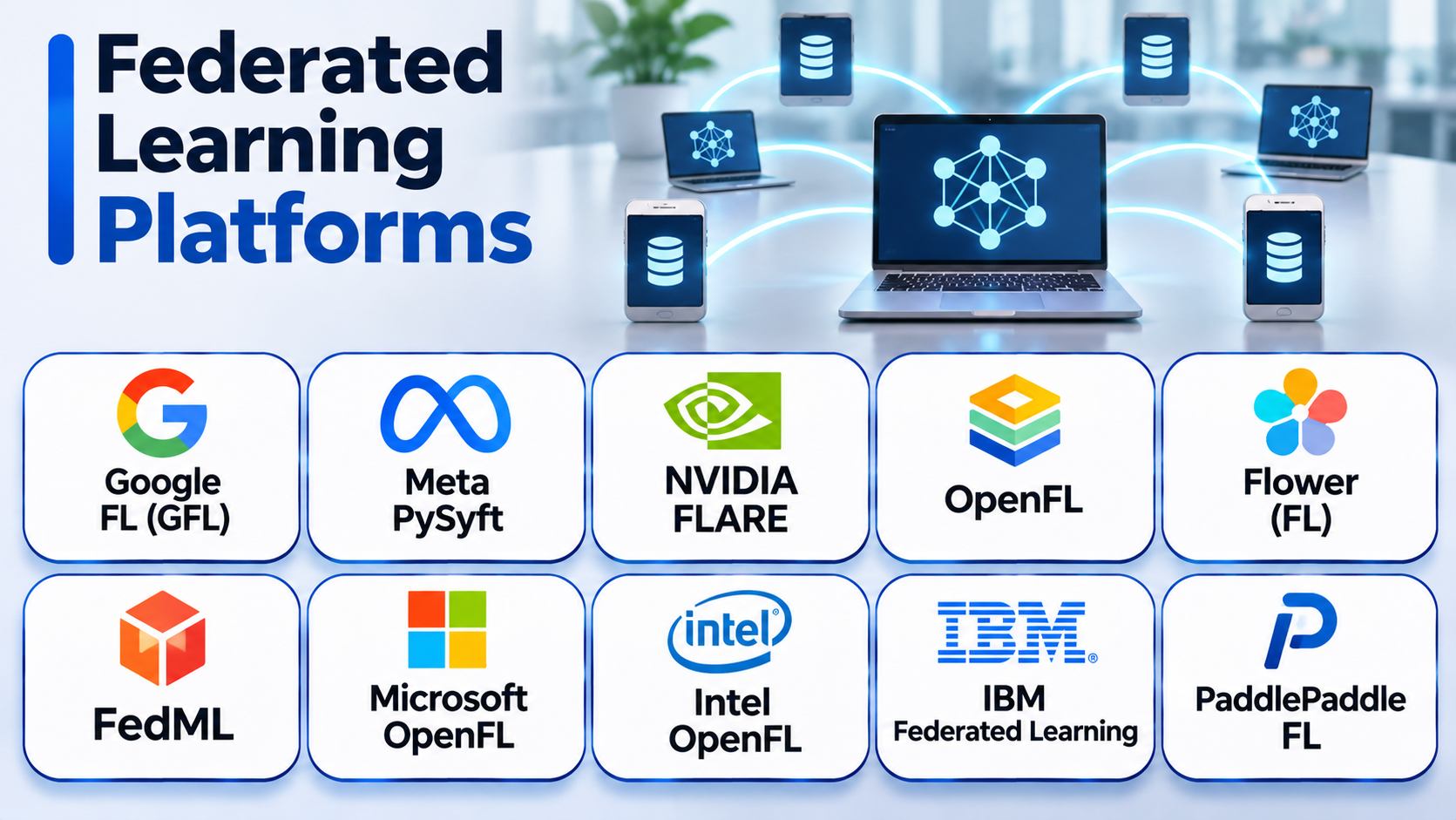
Federated learning platforms enable organizations to train machine learning models across distributed information sources without routinely transferring raw training datasets into a centralized repository. These platforms support collaborative artificial intelligence development while addressing information locality and privacy requirements.
Traditional machine learning workflows frequently require organizations to consolidate information from multiple sources. This approach can introduce information security risks, regulatory challenges, infrastructure expenses, and organizational barriers.
Federated learning provides an alternative architecture in which participating devices, institutions, or computing environments perform local model training. Selected model updates are subsequently aggregated to develop a shared machine learning model.
Modern federated learning platforms provide capabilities such as distributed training orchestration, model aggregation, participant management, secure communication, and privacy-enhancing mechanisms. These capabilities support collaborative machine learning across different operational environments.
Healthcare institutions, financial organizations, telecommunications providers, manufacturing companies, and research institutions can benefit from federated learning. Successful implementation requires careful consideration of information quality, participant trust, computational resources, and model security.
This guide examines ten federated learning platforms and frameworks, including their features, benefits, advantages, limitations, and practical applications. It also provides comparison tables, implementation guidance, selection criteria, practical examples, and frequently asked questions.
What Are Federated Learning Platforms?
Federated learning platforms are software environments designed to coordinate machine learning across multiple distributed information sources. They allow participating organizations or devices to contribute to shared model development without necessarily transferring their raw training information.
A typical federated learning architecture includes a coordination server and multiple participating clients. Each client performs approved computational activities using locally available information and communicates selected model updates or intermediate results.
The coordination environment combines eligible contributions according to an aggregation strategy. The resulting shared model can then be distributed to participating clients for additional training or evaluation.
Federated learning can operate across organizations, individual devices, or distributed computing environments. Different architectures address variations in information distribution, participant availability, infrastructure, and privacy requirements.
Privacy-enhancing technologies such as secure aggregation, differential privacy, and secure multiparty computation can complement federated learning. These mechanisms address additional risks associated with model updates and collaborative computation.
Federated learning does not automatically guarantee confidentiality, regulatory compliance, or protection against malicious participants. Organizations must implement appropriate security controls, privacy mechanisms, participant governance, and model validation.
How Do Federated Learning Platforms Work?
- Define the collaborative machine learning objective.
- Identify participating organizations or devices.
- Establish information governance and participant agreements.
- Configure the federated learning infrastructure.
- Initialize a shared machine learning model.
- Select eligible training participants.
- Distribute model parameters to selected clients.
- Execute local training using authorized information.
- Apply approved privacy and security mechanisms.
- Transmit eligible model updates.
- Aggregate participating client contributions.
- Evaluate the updated shared model.
- Repeat training rounds until approved objectives are achieved.
- Validate and deploy the resulting model.
- Monitor model performance and participant security.
Traditional Machine Learning vs. Federated Learning
| Evaluation Area | Traditional Machine Learning | Federated Learning |
|---|---|---|
| Training information | Frequently centralized | Remains distributed |
| Model training | Central computing environment | Participating client environments |
| Information movement | Raw information often transferred | Model updates typically exchanged |
| Participant coordination | Limited | Essential |
| Privacy architecture | Centralized controls | Distributed and complementary controls |
| Infrastructure | Centralized training resources | Distributed computing resources |
| Communication overhead | Primarily information ingestion | Repeated model communication |
| Information heterogeneity | Central preprocessing | Distributed variation management |
| Model aggregation | Usually unnecessary | Commonly required |
| Participant availability | Less influential | Can affect training |
| Security threats | Centralized infrastructure attacks | Distributed and model-update attacks |
| Governance | Central organizational policies | Collaborative participant policies |
Common Applications of Federated Learning Platforms
- Collaborative healthcare diagnosis models.
- Privacy-oriented financial fraud detection.
- Distributed mobile device intelligence.
- Collaborative medical imaging research.
- Industrial predictive maintenance.
- Telecommunications network optimization.
- Distributed customer behavior analysis.
- Personalized recommendation systems.
- Collaborative cybersecurity detection.
- Automotive intelligence development.
- Cross-institutional scientific research.
- Privacy-oriented natural language processing.
Key Components of Federated Learning Platforms
| Component | Primary Function |
|---|---|
| Coordination server | Manages collaborative training |
| Federated client | Executes local computational activities |
| Global model | Represents shared model parameters |
| Local model | Trains using participant information |
| Aggregation strategy | Combines eligible contributions |
| Participant registry | Maintains participant identities |
| Communication layer | Transfers authorized computational messages |
| Training scheduler | Coordinates training rounds |
| Secure aggregation | Protects individual updates where supported |
| Privacy accountant | Tracks applicable privacy expenditure |
| Model registry | Maintains approved model versions |
| Evaluation engine | Measures model performance |
| Authentication system | Verifies participant identities |
| Monitoring system | Tracks operational performance |
| Checkpoint manager | Supports training recovery |
| Governance framework | Establishes collaborative policies |
Types of Federated Learning
Horizontal Federated Learning
Horizontal federated learning involves participants with similar information features but different records or individuals. This architecture is relevant to institutions maintaining comparable datasets across separate populations.
Vertical Federated Learning
Vertical federated learning involves participants holding different information features associated with overlapping entities. It may require privacy-preserving entity alignment and specialized collaborative computation mechanisms.
Federated Transfer Learning
Federated transfer learning applies transfer learning techniques to collaborative environments with limited overlap in information features or populations. Its implementation can be more complex than conventional horizontal federated learning.
Cross-Silo Federated Learning
Cross-silo federated learning typically involves a relatively small number of organizations or institutional computing environments. Participants may have comparatively stable infrastructure and formal collaboration agreements.
Cross-Device Federated Learning
Cross-device federated learning involves potentially large numbers of distributed devices. Device availability, communication bandwidth, battery consumption, and computational limitations become important design considerations.
Decentralized Federated Learning
Decentralized federated learning distributes coordination responsibilities across participating environments rather than relying exclusively on a central aggregation server. Supported architectures vary according to the selected framework and communication strategy.
Key Capabilities of Federated Learning Platforms
- Distributed training orchestration.
- Configurable model aggregation.
- Participant registration and authentication.
- Local model training.
- Secure communication.
- Privacy-enhancing technology integration.
- Training round scheduling.
- Model checkpoint management.
- Distributed model evaluation.
- Participant availability management.
- Machine learning framework integration.
- Operational monitoring and governance.
Top 10 Federated Learning Platforms
The following platforms include open-source frameworks, enterprise-oriented collaboration environments, simulation libraries, and specialized federated learning technologies. Their numbering is organizational rather than an independently benchmarked performance ranking.
1. Flower
Short Description
Flower is an open-source federated learning framework designed to support collaborative machine learning across distributed computing environments. It provides flexible interfaces for implementing federated training applications and simulations.
The framework supports integration with multiple machine learning ecosystems, including compatible PyTorch, TensorFlow, and other model development workflows. This flexibility allows developers to adapt federated learning to different computational requirements.
Flower provides configurable aggregation strategies, participant coordination, and distributed training capabilities. Developers can customize client behavior and server-side aggregation according to application objectives.
The framework supports experimentation through simulation and deployment-oriented components. Organizations can use simulation to evaluate federated learning strategies before introducing real-world participants.
Flower is particularly suitable for research institutions, machine learning developers, and enterprises requiring flexible federated learning architecture. Production deployment requires appropriate security, infrastructure, and privacy validation.
How Flower Works
- Develop a compatible machine learning model.
- Configure federated client and server applications.
- Establish participant communication.
- Select an aggregation strategy.
- Execute distributed local training.
- Aggregate eligible model updates.
- Evaluate and repeat training rounds.
Key Features
- Framework flexibility: Supports multiple machine learning ecosystems.
- Federated orchestration: Coordinates distributed training activities.
- Custom aggregation: Enables application-specific aggregation strategies.
- Simulation environment: Supports controlled federated learning experiments.
- Client customization: Enables workload-specific participant behavior.
- Distributed deployment: Supports compatible operational environments.
- Model evaluation: Facilitates distributed performance assessment.
- Training configuration: Supports configurable training rounds.
- Privacy extensions: Enables integration with applicable privacy mechanisms.
- Communication interfaces: Coordinates model update exchange.
- Extensible architecture: Supports customized federated applications.
- Open-source availability: Enables source-level technical review.
Benefits
- Supports flexible collaborative model development.
- Reduces raw training information transfers.
- Facilitates federated learning experimentation.
- Supports heterogeneous development ecosystems.
- Enables customized aggregation strategies.
- Encourages reusable training architectures.
- Supports research reproducibility.
- Facilitates distributed model evaluation.
- Reduces selected custom orchestration requirements.
- Enables incremental deployment planning.
Pros
- Flexible machine learning framework support.
- Accessible development interfaces.
- Simulation capabilities.
- Customizable aggregation strategies.
- Open-source availability.
- Suitable for research and deployment.
- Extensible client architecture.
- Broad federated learning applicability.
Cons
- Production infrastructure requires configuration.
- Privacy mechanisms require appropriate implementation.
- Distributed communication introduces overhead.
- Participant heterogeneity can affect performance.
- Advanced customization requires engineering expertise.
- Operational monitoring may require additional tools.
- Compatibility varies across software versions.
Use Cases
- Collaborative healthcare model training.
- Distributed financial fraud detection.
- Federated learning research.
- Mobile intelligence experimentation.
- Industrial machine learning.
- Distributed recommendation systems.
- Cross-institutional scientific research.
- Privacy-oriented model development.
Best For
- Machine learning engineers.
- Federated learning researchers.
- Python developers.
- Healthcare research institutions.
- Enterprise AI departments.
- Distributed computing teams.
- Academic institutions.
- Organizations requiring framework flexibility.
Pricing and Deployment
Flower provides open-source framework components, with additional commercial offerings potentially available. Organizations should verify current licensing, enterprise support, infrastructure requirements, and deployment expenses.
Overall Assessment
Flower is a flexible option for organizations developing federated learning applications across different machine learning ecosystems. Its simulation and customization capabilities make it particularly useful for experimentation and architecture development.
Production suitability depends on security configuration, participant management, communication performance, and privacy requirements. Organizations should validate these capabilities through representative deployment testing.
2. NVIDIA FLARE
Short Description
NVIDIA Federated Learning Application Runtime Environment (FLARE) is an open-source framework designed to support distributed collaborative machine learning. It provides infrastructure for coordinating federated learning across participating computing environments.
The framework supports configurable training workflows, communication mechanisms, participant provisioning, and model aggregation. These capabilities are relevant to cross-institutional and enterprise federated learning deployments.
NVIDIA FLARE supports integration with compatible machine learning frameworks and computing infrastructure. It is particularly relevant to organizations developing computationally demanding artificial intelligence applications.
The framework includes components for authentication, authorization, workflow execution, and applicable privacy-enhancing mechanisms. These controls require appropriate configuration and operational validation.
NVIDIA FLARE is suitable for healthcare institutions, enterprise AI teams, and research organizations requiring configurable federated learning infrastructure. Organizations should assess hardware compatibility, participant governance, and operational complexity.
How NVIDIA FLARE Works
- Configure participating computing environments.
- Provision authorized federated participants.
- Define a collaborative training workflow.
- Distribute approved computational tasks.
- Execute local model training.
- Aggregate eligible participant contributions.
- Evaluate and manage resulting models.
Key Features
- Federated runtime: Coordinates distributed learning applications.
- Participant provisioning: Supports authorized participant configuration.
- Workflow orchestration: Manages collaborative computational tasks.
- Model aggregation: Supports configurable aggregation strategies.
- Authentication: Enables participant identity verification.
- Authorization: Supports controlled operational permissions.
- Secure communication: Provides applicable protected communication mechanisms.
- Framework integration: Supports compatible machine learning environments.
- Simulation capabilities: Facilitates controlled experimentation.
- Privacy extensions: Supports applicable privacy-enhancing components.
- Job management: Coordinates federated application execution.
- Extensible components: Enables customized training workflows.
Benefits
- Supports cross-institutional machine learning.
- Facilitates structured participant provisioning.
- Enables configurable distributed training.
- Supports enterprise-oriented security requirements.
- Reduces unnecessary raw information movement.
- Facilitates collaborative healthcare research.
- Supports computationally demanding AI workloads.
- Encourages reusable operational workflows.
- Enables customized privacy architectures.
- Supports distributed model development.
Pros
- Enterprise-oriented architecture.
- Configurable security mechanisms.
- Flexible workflow management.
- Open-source availability.
- Relevant healthcare research ecosystem.
- Compatible accelerated computing workflows.
- Extensible components.
- Distributed job orchestration.
Cons
- Deployment can be complex.
- Requires specialist engineering expertise.
- Infrastructure administration introduces costs.
- Participant provisioning requires coordination.
- Privacy guarantees depend on implementation.
- Hardware requirements vary by workload.
- Cross-institutional governance remains necessary.
Use Cases
- Collaborative medical imaging.
- Distributed clinical research.
- Enterprise AI collaboration.
- Pharmaceutical research.
- Industrial predictive maintenance.
- Cross-institutional model development.
- Distributed scientific computing.
- Collaborative financial analytics.
Best For
- Enterprise AI engineers.
- Healthcare institutions.
- Medical imaging researchers.
- NVIDIA computing ecosystem users.
- Pharmaceutical organizations.
- Research consortiums.
- Distributed infrastructure teams.
- Organizations requiring configurable security.
Pricing and Deployment
NVIDIA FLARE is available as open-source software. Computing infrastructure, accelerated hardware, engineering, enterprise support, and operational administration may introduce additional costs.
Overall Assessment
NVIDIA FLARE is a strong candidate for structured cross-silo federated learning environments. Its workflow and participant management capabilities are particularly relevant to institutional collaboration.
Organizations should evaluate deployment complexity and infrastructure requirements before production adoption. Independent security and privacy assessments remain important.
3. TensorFlow Federated
Short Description
TensorFlow Federated (TFF) is an open-source framework designed to support research and experimentation involving federated computation and machine learning. It provides abstractions for representing distributed computations across participating environments.
The framework supports the development of federated learning algorithms using compatible TensorFlow models. Researchers can evaluate different aggregation strategies, information distributions, and training configurations.
TensorFlow Federated includes federated computation interfaces and higher-level learning algorithms. These capabilities support experimentation with distributed model training and evaluation.
The framework is especially relevant to simulated federated learning research. It should not be treated as a complete turnkey production device orchestration service.
TensorFlow Federated is suitable for academic institutions, machine learning researchers, and TensorFlow developers investigating federated learning methods. Current framework compatibility and maintenance should be verified.
How TensorFlow Federated Works
- Define a compatible TensorFlow model.
- Prepare distributed or simulated client datasets.
- Configure federated computation.
- Select an applicable learning algorithm.
- Execute simulated or supported federated training.
- Aggregate client contributions.
- Evaluate model performance.
Key Features
- Federated computation: Represents distributed computational operations.
- TensorFlow integration: Supports compatible model development.
- Learning algorithms: Provides applicable federated training methods.
- Simulation support: Enables distributed learning experiments.
- Aggregation customization: Supports configurable aggregation processes.
- Client dataset representation: Models distributed information sources.
- Federated evaluation: Supports distributed performance assessment.
- Research interfaces: Facilitates algorithm development.
- Composable computation: Enables reusable federated operations.
- Privacy integration: Supports applicable privacy-oriented aggregation.
- Experimental configuration: Enables controlled training comparisons.
- Open-source development: Supports technical inspection.
Benefits
- Facilitates federated learning research.
- Supports TensorFlow model experimentation.
- Enables algorithm comparison.
- Encourages reproducible research.
- Supports heterogeneous information simulation.
- Reduces selected custom research development.
- Facilitates aggregation strategy evaluation.
- Supports privacy-oriented experimentation.
- Enables distributed model assessment.
- Encourages collaborative academic research.
Pros
- Strong research orientation.
- TensorFlow compatibility.
- Flexible computational abstractions.
- Simulation capabilities.
- Open-source availability.
- Customizable aggregation.
- Relevant algorithm development interfaces.
- Suitable for controlled experiments.
Cons
- Not a complete production orchestration service.
- Requires TensorFlow expertise.
- Computational abstractions can be complex.
- Version compatibility requires evaluation.
- Large simulations may require substantial resources.
- Production security requires complementary infrastructure.
- Current maintenance status should be verified.
Use Cases
- Federated learning algorithm research.
- Distributed neural network simulation.
- Aggregation strategy comparison.
- Privacy-oriented machine learning experiments.
- Academic distributed computing.
- Mobile learning simulation.
- Information heterogeneity research.
- Federated optimization development.
Best For
- TensorFlow developers.
- AI researchers.
- Academic institutions.
- Graduate students.
- Distributed learning researchers.
- Machine learning algorithm developers.
- Privacy researchers.
- Organizations evaluating federated learning concepts.
Pricing and Deployment
TensorFlow Federated is available as open-source software. Research infrastructure, computing resources, engineering, and production integration may introduce additional expenses.
Overall Assessment
TensorFlow Federated is particularly relevant to algorithm research and controlled federated learning experimentation. Its computational abstractions support detailed investigation of distributed learning methods.
Organizations requiring production participant orchestration should evaluate complementary infrastructure. Research results must also be validated under representative operational conditions.
4. FATE
Short Description
Federated AI Technology Enabler (FATE) is an open-source framework designed to support collaborative machine learning and privacy-oriented computation. It provides components for developing federated applications across separate organizational environments.
FATE supports horizontal and vertical federated learning through applicable algorithms and computational mechanisms. Its vertical learning capabilities are particularly relevant when organizations hold complementary information features.
The framework includes components supporting privacy-preserving computation, entity alignment, and distributed machine learning. Available mechanisms depend on the selected algorithm and deployment configuration.
FATE can support cross-organizational applications involving financial services, research, and collaborative enterprise analytics. Such deployments require formal agreements governing information use and participant responsibilities.
The framework is suitable for organizations requiring specialized federated learning algorithms and privacy-enhancing computation. Infrastructure complexity and cryptographic assumptions should be evaluated before implementation.
How FATE Works
- Establish participating organizational environments.
- Define compatible federated learning requirements.
- Configure approved information alignment procedures.
- Select a supported learning algorithm.
- Execute collaborative computational activities.
- Exchange protected intermediate results.
- Evaluate the resulting federated model.
Key Features
- Horizontal federated learning: Supports compatible distributed datasets.
- Vertical federated learning: Supports complementary information features.
- Private entity alignment: Enables applicable privacy-preserving matching.
- Federated algorithms: Provides supported machine learning methods.
- Cryptographic mechanisms: Supports applicable protected computation.
- Workflow management: Coordinates federated tasks.
- Participant communication: Enables cross-organizational collaboration.
- Model evaluation: Supports applicable performance assessment.
- Distributed computation: Coordinates multiple computing environments.
- Configurable deployment: Supports compatible infrastructure.
- Privacy-oriented architecture: Addresses selected information disclosure risks.
- Open-source availability: Enables technical inspection.
Benefits
- Supports cross-organizational model development.
- Enables vertical federated learning applications.
- Facilitates complementary information analysis.
- Reduces unnecessary raw information exchange.
- Supports privacy-oriented collaborative computation.
- Enables specialized financial analytics.
- Encourages reusable federated workflows.
- Supports distributed model evaluation.
- Facilitates institutional collaboration.
- Provides configurable algorithm selection.
Pros
- Horizontal and vertical learning support.
- Specialized collaborative algorithms.
- Applicable cryptographic mechanisms.
- Open-source availability.
- Cross-organizational orientation.
- Private entity alignment capabilities.
- Distributed computation architecture.
- Relevant financial services applications.
Cons
- Deployment complexity can be substantial.
- Requires specialized privacy expertise.
- Cryptographic computation can introduce overhead.
- Entity alignment requires careful governance.
- Supported algorithms have limitations.
- Operational maintenance requires resources.
- Current component compatibility requires verification.
Use Cases
- Collaborative credit risk modeling.
- Cross-institutional fraud detection.
- Vertical customer analytics.
- Privacy-oriented financial research.
- Collaborative healthcare analytics.
- Distributed enterprise modeling.
- Cross-organizational risk assessment.
- Privacy-preserving information collaboration.
Best For
- Financial institutions.
- Enterprise privacy engineers.
- Cross-organizational research teams.
- Vertical federated learning developers.
- Distributed computing specialists.
- Risk analytics departments.
- Machine learning researchers.
- Organizations holding complementary information features.
Pricing and Deployment
FATE is available as open-source software. Organizations should evaluate infrastructure, cryptographic computation, engineering, deployment administration, and support requirements.
Overall Assessment
FATE is particularly relevant to collaborative machine learning involving complementary information features and cross-organizational computation. Its vertical learning capabilities distinguish it from frameworks focused primarily on horizontal federated learning.
Successful implementation requires careful evaluation of supported algorithms, privacy assumptions, and participant agreements. Organizations should benchmark computational overhead before deployment.
5. OpenFL
Short Description
OpenFL is an open-source federated learning framework designed to support collaborative machine learning across distributed institutions. It provides components for coordinating training while allowing participating organizations to maintain local information environments.
The framework supports configurable federated learning workflows and integration with compatible machine learning libraries. Developers can adapt training and aggregation behavior to application requirements.
OpenFL includes components for participant coordination, task execution, model exchange, and aggregation. Its architecture is particularly relevant to cross-silo federated learning applications.
The framework has been associated with collaborative healthcare research and distributed scientific machine learning. These applications demonstrate its relevance to institutional information locality requirements.
OpenFL is suitable for research organizations, healthcare institutions, and developers requiring configurable federated learning infrastructure. Current project activity, deployment interfaces, and software compatibility should be verified.
How OpenFL Works
- Establish a collaborative learning plan.
- Configure participating computing environments.
- Initialize a compatible machine learning model.
- Distribute approved training tasks.
- Execute local model training.
- Aggregate eligible participant updates.
- Evaluate and distribute updated models.
Key Features
- Collaborative training: Coordinates distributed learning participants.
- Configurable aggregation: Supports application-specific strategies.
- Federated task management: Organizes approved training activities.
- Framework integration: Supports compatible machine learning libraries.
- Participant coordination: Manages distributed collaborators.
- Protected communication: Supports applicable secure communication configuration.
- Model exchange: Transfers eligible model parameters.
- Training evaluation: Facilitates distributed performance assessment.
- Workflow customization: Supports specialized learning applications.
- Cross-silo architecture: Addresses institutional collaboration requirements.
- Extensible interfaces: Enables customized computational components.
- Open-source development: Supports independent technical review.
Benefits
- Facilitates institutional model collaboration.
- Supports local information retention.
- Enables configurable training workflows.
- Reduces selected centralized information requirements.
- Supports healthcare research.
- Encourages reusable distributed architectures.
- Enables collaborative model evaluation.
- Supports specialized research applications.
- Facilitates cross-institutional experimentation.
- Reduces conventional framework licensing expenses.
Pros
- Open-source availability.
- Cross-silo learning orientation.
- Configurable training workflows.
- Compatible machine learning integrations.
- Relevant healthcare applications.
- Customizable aggregation.
- Distributed task coordination.
- Research-oriented flexibility.
Cons
- Infrastructure configuration requires expertise.
- Production governance requires additional planning.
- Participant availability affects training.
- Communication overhead can increase.
- Privacy guarantees require separate assessment.
- Supported interfaces vary by release.
- Maintenance status should be verified.
Use Cases
- Collaborative medical imaging.
- Distributed clinical research.
- Cross-institutional scientific modeling.
- Enterprise machine learning collaboration.
- Federated neural network research.
- Industrial model development.
- Privacy-oriented healthcare analytics.
- Distributed model evaluation.
Best For
- Healthcare research institutions.
- Machine learning engineers.
- Scientific computing teams.
- Academic consortiums.
- Enterprise AI developers.
- Privacy engineering teams.
- Distributed infrastructure specialists.
- Cross-silo learning researchers.
Pricing and Deployment
OpenFL is available as open-source software. Organizations should account for infrastructure, engineering, participant onboarding, security validation, and ongoing maintenance expenses.
Overall Assessment
OpenFL provides configurable federated learning capabilities for institutional collaboration and research applications. Its cross-silo orientation makes it relevant to organizations maintaining separate information environments.
Organizations should validate current software compatibility and operational support before adoption. Deployment security and privacy guarantees depend on the complete implementation.
6. OpenMined PySyft
Short Description
PySyft is an open-source project within the OpenMined ecosystem designed to support privacy-oriented access to distributed information and remote computation. Its capabilities extend beyond conventional federated learning orchestration.
The project provides mechanisms for developing applications in which authorized computational activities can be performed near sensitive information sources. Information owners can retain greater control over approved computational access.
PySyft emphasizes governed information collaboration and privacy-oriented remote data science. Its architecture and supported interfaces have evolved across different software versions.
Federated learning workflows may be developed using compatible remote computation and collaboration capabilities. Organizations should verify whether the current release supports their intended training architecture directly or requires additional components.
PySyft is particularly suitable for privacy researchers, governed information collaboration projects, and organizations exploring privacy-enhancing data science. It is best evaluated as a complementary privacy-oriented computing framework rather than a direct substitute for every federated learning orchestrator.
How PySyft Works
- Establish authorized information environments.
- Configure participant identities and permissions.
- Define approved computational requests.
- Submit compatible remote computational tasks.
- Execute authorized operations near information sources.
- Review and release permitted computational outputs.
- Integrate approved results into collaborative workflows.
Key Features
- Remote computation: Supports compatible distributed analytical tasks.
- Governed information access: Enables controlled computational permissions.
- Participant identities: Supports applicable identity management.
- Information locality: Facilitates computation near sensitive datasets.
- Approval workflows: Supports applicable computational request governance.
- Privacy-oriented collaboration: Addresses controlled information use.
- Python interfaces: Supports data science development.
- Output management: Enables authorized result release.
- Distributed environments: Supports compatible remote information sources.
- Extensible workflows: Enables customized collaboration.
- Research capabilities: Supports privacy-enhancing experimentation.
- Open-source availability: Enables technical review.
Benefits
- Supports governed information collaboration.
- Reduces unnecessary raw information transfers.
- Facilitates privacy-oriented data science.
- Encourages information owner control.
- Supports authorized remote computation.
- Enables collaborative research workflows.
- Facilitates controlled computational access.
- Supports privacy technology experimentation.
- Encourages documented information governance.
- Complements distributed machine learning architectures.
Pros
- Privacy-oriented architecture.
- Open-source availability.
- Remote computation capabilities.
- Governed collaboration orientation.
- Python development ecosystem.
- Relevant sensitive information applications.
- Extensible research workflows.
- Information locality support.
Cons
- Not exclusively a federated learning platform.
- Interfaces have evolved across releases.
- Production integration may require engineering.
- Governance workflows require administration.
- Supported computational activities require evaluation.
- Privacy guarantees depend on implementation.
- Federated aggregation may require complementary components.
Use Cases
- Governed healthcare research.
- Remote sensitive information analysis.
- Privacy-oriented scientific collaboration.
- Federated learning research.
- Controlled enterprise information access.
- Distributed data science.
- Privacy-enhancing technology experimentation.
- Cross-organizational analytical collaboration.
Best For
- Privacy researchers.
- Governed data science teams.
- Healthcare research organizations.
- Python developers.
- Information governance departments.
- Academic institutions.
- Privacy engineering specialists.
- Organizations requiring controlled remote computation.
Pricing and Deployment
PySyft provides open-source software components. Organizations should evaluate infrastructure, engineering, governance administration, commercial support availability, and privacy validation costs.
Overall Assessment
PySyft is relevant to federated learning architectures requiring governed remote computation and controlled information access. Its broader privacy-oriented capabilities distinguish it from dedicated model aggregation frameworks.
Organizations should confirm current federated learning integration requirements before selection. Additional orchestration and aggregation components may be necessary.
7. FedML
Short Description
FedML is a machine learning framework and ecosystem associated with distributed training, federated learning, and broader AI infrastructure. Its federated learning components support research and development involving distributed participants.
The framework provides applicable training orchestration, aggregation algorithms, and simulation capabilities. Developers can evaluate federated learning strategies across different information distributions and computing environments.
FedML has supported cross-silo, cross-device, and simulation-oriented federated learning scenarios through relevant project components. Current availability and support for individual deployment modes should be verified.
The broader commercial ecosystem has evolved toward AI infrastructure and model development offerings associated with TensorOpera. Organizations should distinguish publicly available federated learning components from current commercial products.
FedML is particularly suitable for researchers and engineering teams investigating distributed learning methods. Production adoption requires evaluation of current software maintenance, supported integrations, and operational requirements.
How FedML Works
- Configure a compatible learning application.
- Establish distributed or simulated participants.
- Select a federated learning algorithm.
- Configure training and communication parameters.
- Execute local computational activities.
- Aggregate eligible model updates.
- Evaluate and repeat collaborative training.
Key Features
- Federated training: Supports compatible collaborative learning.
- Algorithm library: Provides applicable federated learning methods.
- Simulation support: Enables controlled distributed experiments.
- Distributed communication: Coordinates participant message exchange.
- Cross-silo workflows: Supports applicable institutional scenarios.
- Cross-device experimentation: Enables compatible device-oriented research.
- Aggregation strategies: Supports configurable model combination.
- Model evaluation: Facilitates performance measurement.
- Framework integration: Supports compatible machine learning libraries.
- Experiment configuration: Enables comparative research.
- Extensible architecture: Supports custom learning algorithms.
- Open-source components: Enable source-level inspection.
Benefits
- Facilitates federated learning research.
- Supports distributed training experimentation.
- Enables algorithm comparison.
- Encourages reusable learning workflows.
- Supports heterogeneous participant evaluation.
- Reduces selected orchestration development.
- Facilitates distributed model assessment.
- Enables cross-silo experimentation.
- Supports collaborative AI development.
- Provides configurable research environments.
Pros
- Multiple federated learning algorithms.
- Research-oriented flexibility.
- Simulation capabilities.
- Open-source components.
- Distributed training support.
- Configurable aggregation.
- Relevant academic ecosystem.
- Extensible development interfaces.
Cons
- Commercial product positioning has evolved.
- Current component maintenance requires verification.
- Deployment modes may vary by release.
- Production security requires validation.
- Infrastructure configuration can be complex.
- Documentation may differ across components.
- Privacy mechanisms require appropriate implementation.
Use Cases
- Federated optimization research.
- Distributed neural network training.
- Cross-silo experimentation.
- Mobile learning research.
- Collaborative enterprise modeling.
- Federated algorithm benchmarking.
- Distributed model evaluation.
- Privacy-oriented AI research.
Best For
- Machine learning researchers.
- Distributed training engineers.
- Academic institutions.
- Federated algorithm developers.
- Enterprise AI research teams.
- Python developers.
- Distributed systems specialists.
- Organizations evaluating collaborative learning strategies.
Pricing and Deployment
FedML provides publicly available software components, while associated commercial offerings may have separate pricing. Organizations should verify current product availability, licensing, support, and infrastructure requirements.
Overall Assessment
FedML is relevant to distributed learning research and configurable federated learning experimentation. Its algorithm-oriented components can help organizations evaluate different collaborative training strategies.
Current commercial positioning and software maintenance should be assessed before production adoption. Organizations should distinguish research functionality from supported enterprise deployment capabilities.
8. PaddleFL
Short Description
PaddleFL is an open-source federated learning framework associated with the PaddlePaddle deep learning ecosystem. It was developed to support collaborative machine learning and privacy-oriented distributed computation.
The framework includes applicable federated training strategies and compatible machine learning development interfaces. Its architecture supports experimentation involving distributed information sources.
PaddleFL has included components for horizontal federated learning and privacy-preserving computational approaches. Available functionality depends on the selected software release and supported dependencies.
The framework is particularly relevant to organizations and researchers using compatible PaddlePaddle development environments. It may require additional integration work when existing applications rely on other machine learning ecosystems.
PaddleFL should be evaluated carefully for current maintenance, dependency compatibility, and production suitability. Its inclusion reflects its established technical relevance rather than a claim of current enterprise support.
How PaddleFL Works
- Prepare a compatible PaddlePaddle model.
- Configure participating training environments.
- Select a supported federated strategy.
- Establish local training configurations.
- Execute distributed computational activities.
- Aggregate eligible model contributions.
- Evaluate resulting model performance.
Key Features
- PaddlePaddle integration: Supports compatible model development.
- Federated training: Enables distributed learning workflows.
- Aggregation strategies: Supports applicable model combination methods.
- Client coordination: Organizes participating training environments.
- Privacy-oriented computation: Supports relevant protected mechanisms.
- Distributed execution: Coordinates local computational activities.
- Training configuration: Enables workload-specific settings.
- Model evaluation: Supports performance assessment.
- Research interfaces: Facilitates algorithm experimentation.
- Customizable workflows: Supports compatible application development.
- Framework components: Provide reusable learning functionality.
- Open-source availability: Enables technical inspection.
Benefits
- Supports PaddlePaddle-oriented federated learning.
- Facilitates distributed model experimentation.
- Enables collaborative machine learning research.
- Reduces unnecessary raw information transfers.
- Supports applicable privacy-oriented workflows.
- Encourages reusable training components.
- Enables aggregation strategy evaluation.
- Supports distributed model assessment.
- Facilitates academic experimentation.
- Reduces conventional software licensing expenses.
Pros
- PaddlePaddle ecosystem integration.
- Open-source availability.
- Federated training capabilities.
- Configurable learning strategies.
- Relevant research applications.
- Distributed computation support.
- Privacy-oriented components.
- Customizable workflows.
Cons
- Current maintenance status requires verification.
- Framework ecosystem compatibility is limited.
- Production deployment may require substantial engineering.
- Supported algorithms vary by release.
- Documentation may be outdated.
- Privacy guarantees require independent validation.
- Commercial support availability is uncertain.
Use Cases
- PaddlePaddle federated learning research.
- Distributed neural network experimentation.
- Privacy-oriented model development.
- Collaborative academic research.
- Federated optimization testing.
- Distributed information analysis.
- Machine learning education.
- Compatible enterprise research projects.
Best For
- PaddlePaddle developers.
- Academic researchers.
- Machine learning students.
- Distributed learning engineers.
- Privacy researchers.
- AI development laboratories.
- Federated algorithm researchers.
- Organizations evaluating PaddlePaddle-based workflows.
Pricing and Deployment
PaddleFL is available through open-source project components. Organizations should account for dependency maintenance, computing resources, engineering, and potential modernization requirements.
Overall Assessment
PaddleFL is a specialized option for federated learning research within compatible PaddlePaddle environments. Its relevance depends heavily on framework compatibility and the condition of available project components.
Organizations should verify active maintenance before selecting it for production. Alternative frameworks may be preferable when ongoing operational support is essential.
9. SecretFlow
Short Description
SecretFlow is an open-source privacy-preserving computing framework designed to support collaborative information analysis and machine learning. It combines applicable federated learning techniques with other privacy-enhancing computational mechanisms.
The framework provides abstractions for executing approved computations across different privacy-oriented computing environments. These capabilities can support collaborative applications involving sensitive information sources.
SecretFlow supports applicable horizontal and vertical federated learning workflows, depending on the selected components. It also provides mechanisms for integrating supported secure computation techniques.
The framework is relevant to organizations requiring more than conventional model aggregation. Financial institutions, research organizations, and enterprise privacy teams may use its broader computational architecture.
SecretFlow requires careful evaluation of cryptographic assumptions, participant trust models, supported algorithms, and infrastructure. Organizations should validate the complete application architecture before handling sensitive information.
How SecretFlow Works
- Define participating information environments.
- Establish the required privacy and trust model.
- Configure compatible computational components.
- Select an approved federated learning workflow.
- Execute local or protected collaborative computations.
- Exchange permitted computational results.
- Evaluate and release approved models or outputs.
Key Features
- Privacy-preserving computation: Supports applicable protected operations.
- Horizontal federated learning: Enables compatible distributed training.
- Vertical federated learning: Supports complementary information features.
- Secure multiparty computation: Provides applicable collaborative mechanisms.
- Private information alignment: Supports compatible entity matching.
- Computational abstractions: Coordinates different execution environments.
- Distributed execution: Supports collaborative computing.
- Machine learning algorithms: Provides applicable learning methods.
- Privacy-oriented workflows: Enables protected analytical applications.
- Configurable architecture: Supports workload-specific designs.
- Python interfaces: Facilitates compatible application development.
- Open-source availability: Enables source-level inspection.
Benefits
- Supports multiple privacy-enhancing technologies.
- Facilitates cross-organizational collaboration.
- Enables vertical federated learning applications.
- Supports protected information computation.
- Reduces unnecessary raw information exchange.
- Encourages configurable privacy architectures.
- Facilitates sensitive financial analytics.
- Supports collaborative research.
- Enables complementary information analysis.
- Provides reusable computational components.
Pros
- Broad privacy-enhancing architecture.
- Horizontal and vertical learning support.
- Applicable secure computation mechanisms.
- Open-source availability.
- Configurable execution environments.
- Relevant cross-organizational applications.
- Specialized collaborative algorithms.
- Python-oriented development.
Cons
- Cryptographic complexity can be substantial.
- Computing overhead varies by mechanism.
- Requires specialist privacy expertise.
- Supported operations have limitations.
- Infrastructure configuration requires planning.
- Participant trust assumptions require validation.
- Production governance remains necessary.
Use Cases
- Collaborative financial risk modeling.
- Privacy-preserving fraud analytics.
- Vertical federated learning.
- Cross-organizational healthcare research.
- Protected customer information analysis.
- Secure collaborative computation.
- Distributed enterprise analytics.
- Privacy-enhancing technology research.
Best For
- Financial institutions.
- Privacy engineers.
- Cryptographic researchers.
- Enterprise data science teams.
- Cross-organizational research consortiums.
- Vertical learning developers.
- Distributed computing specialists.
- Organizations requiring hybrid privacy technologies.
Pricing and Deployment
SecretFlow provides open-source software components. Organizations should evaluate cryptographic computing requirements, infrastructure, specialist engineering, support, and independent privacy assessment expenses.
Overall Assessment
SecretFlow is particularly relevant to collaborative machine learning requiring multiple privacy-enhancing computational techniques. Its broader architecture supports use cases beyond conventional horizontal federated learning.
Organizations should assess supported algorithms and cryptographic assumptions against their specific threat models. Computational performance should be benchmarked before production adoption.
10. FederatedScope
Short Description
FederatedScope is an open-source federated learning framework designed to support research involving heterogeneous distributed learning environments. It provides configurable components for implementing and evaluating federated learning algorithms.
The framework uses an event-driven architecture to coordinate applicable federated learning activities. This approach supports experimentation with participant behavior, communication patterns, and training strategies.
FederatedScope includes components for investigating personalization, distributed optimization, and information heterogeneity. Supported research capabilities vary according to the selected project modules.
The framework is particularly relevant to researchers comparing federated learning algorithms under different experimental conditions. It can help evaluate challenges associated with non-identically distributed participant information.
FederatedScope is primarily a research-oriented framework rather than a complete enterprise governance platform. Organizations should verify current maintenance, software dependencies, and deployment suitability.
How FederatedScope Works
- Define a federated learning experiment.
- Configure distributed participant datasets.
- Select a compatible learning algorithm.
- Establish communication and event configurations.
- Execute local training activities.
- Aggregate or exchange eligible model updates.
- Evaluate global and personalized model performance.
Key Features
- Event-driven architecture: Coordinates applicable distributed activities.
- Federated algorithms: Provides supported learning strategies.
- Personalized learning: Supports relevant participant-specific modeling.
- Information heterogeneity: Enables non-identical distribution experiments.
- Simulation capabilities: Facilitates controlled research.
- Aggregation configuration: Supports customized model combination.
- Participant modeling: Represents distributed learning behavior.
- Experiment management: Coordinates research configurations.
- Model evaluation: Supports comparative performance assessment.
- Extensible components: Enables custom algorithm development.
- Framework integration: Supports compatible machine learning environments.
- Open-source development: Enables technical inspection.
Benefits
- Facilitates federated learning research.
- Supports algorithm comparison.
- Enables participant heterogeneity analysis.
- Encourages reproducible experimentation.
- Supports personalized model research.
- Reduces selected custom simulation development.
- Enables communication strategy evaluation.
- Facilitates distributed model assessment.
- Supports configurable research scenarios.
- Encourages collaborative academic development.
Pros
- Research-oriented flexibility.
- Event-driven architecture.
- Personalization research capabilities.
- Open-source availability.
- Configurable aggregation.
- Heterogeneous information experimentation.
- Extensible algorithms.
- Controlled simulation support.
Cons
- Primarily research-oriented.
- Enterprise governance requires complementary tools.
- Current maintenance should be verified.
- Production deployment requires additional engineering.
- Large experiments may consume substantial resources.
- Privacy mechanisms require separate validation.
- Framework compatibility varies by release.
Use Cases
- Personalized federated learning research.
- Distributed optimization experiments.
- Information heterogeneity analysis.
- Federated algorithm benchmarking.
- Communication strategy evaluation.
- Academic machine learning research.
- Collaborative model experimentation.
- Distributed learning education.
Best For
- Federated learning researchers.
- Academic institutions.
- Machine learning students.
- Distributed optimization specialists.
- AI research laboratories.
- Personalized learning developers.
- Algorithm benchmarking teams.
- Organizations evaluating experimental federated strategies.
Pricing and Deployment
FederatedScope is available as open-source software. Organizations should account for computing resources, research engineering, dependency maintenance, and any required production integration.
Overall Assessment
FederatedScope is particularly relevant to researchers investigating heterogeneous information distributions and personalized federated learning. Its configurable architecture supports comparative algorithm experimentation.
Organizations requiring production-ready collaboration infrastructure should evaluate additional operational capabilities. Current software maintenance and security requirements should be reviewed before deployment.
Comparison Table: Top 10 Federated Learning Platforms
| Platform | Primary Capability | Best For | Main Deployment | Pricing Model |
|---|---|---|---|---|
| Flower | Flexible federated orchestration | General federated development | Distributed and simulation | Open-source components |
| NVIDIA FLARE | Collaborative training runtime | Institutional AI | Distributed infrastructure | Open source |
| TensorFlow Federated | Federated computation research | TensorFlow researchers | Research and simulation | Open source |
| FATE | Horizontal and vertical learning | Cross-organizational analytics | Distributed infrastructure | Open source |
| OpenFL | Cross-silo federated training | Healthcare and research | Institutional infrastructure | Open source |
| PySyft | Governed remote computation | Privacy-oriented collaboration | Distributed environments | Open-source components |
| FedML | Distributed learning research | Algorithm development | Distributed and simulation | Open-source components |
| PaddleFL | PaddlePaddle federated learning | Compatible research teams | Distributed environments | Open source |
| SecretFlow | Privacy-preserving computation | Hybrid privacy architectures | Distributed infrastructure | Open source |
| FederatedScope | Heterogeneous learning research | Academic experimentation | Research and simulation | Open source |
Functional Comparison
| Platform | Horizontal Learning | Vertical Learning | Simulation | Primary Orientation |
|---|---|---|---|---|
| Flower | Supported | Custom implementation | Supported | Flexible orchestration |
| NVIDIA FLARE | Supported | Workflow-dependent | Supported | Cross-silo collaboration |
| TensorFlow Federated | Supported | Not primary | Specialized | Algorithm research |
| FATE | Supported | Specialized | Component-dependent | Collaborative analytics |
| OpenFL | Supported | Not primary | Configuration-dependent | Cross-silo training |
| PySyft | Integration-dependent | Integration-dependent | Workflow-dependent | Governed computation |
| FedML | Supported | Component-dependent | Supported | Distributed learning |
| PaddleFL | Supported | Release-dependent | Configuration-dependent | PaddlePaddle learning |
| SecretFlow | Supported | Supported | Component-dependent | Privacy-enhancing computation |
| FederatedScope | Supported | Component-dependent | Specialized | Experimental research |
Technical Comparison
| Platform | Main Architecture | Integration Complexity | Customization |
|---|---|---|---|
| Flower | Client-server and configurable workflows | Medium | High |
| NVIDIA FLARE | Federated runtime | Medium to high | High |
| TensorFlow Federated | Federated computational abstractions | Medium to high | High |
| FATE | Distributed privacy-oriented computation | High | High |
| OpenFL | Collaborative training framework | Medium to high | High |
| PySyft | Governed remote computation | High | Workflow-dependent |
| FedML | Distributed training framework | Medium to high | High |
| PaddleFL | PaddlePaddle-based framework | Medium to high | Framework-dependent |
| SecretFlow | Privacy-enhancing computing architecture | High | High |
| FederatedScope | Event-driven research framework | Medium to high | High |
Business Suitability Comparison
| Platform | Small Teams | Research Institutions | Large Enterprises |
|---|---|---|---|
| Flower | Suitable | Suitable | Suitable with engineering |
| NVIDIA FLARE | Infrastructure-dependent | Suitable | Highly relevant |
| TensorFlow Federated | Research teams | Highly relevant | Research workloads |
| FATE | Specialist teams | Suitable | Highly relevant |
| OpenFL | Technical teams | Highly relevant | Cross-silo workloads |
| PySyft | Specialist teams | Suitable | Governed collaboration |
| FedML | Research teams | Suitable | Requires evaluation |
| PaddleFL | Compatible teams | Suitable | Maintenance-dependent |
| SecretFlow | Specialist teams | Suitable | Highly relevant |
| FederatedScope | Research teams | Highly relevant | Experimental workloads |
Pricing and Ownership Comparison
| Platform | Primary Cost Driver | Additional Expenses |
|---|---|---|
| Flower | Distributed training infrastructure | Integration and administration |
| NVIDIA FLARE | Computing infrastructure | Security and provisioning |
| TensorFlow Federated | Research computing | Production integration |
| FATE | Distributed and cryptographic computation | Specialist engineering |
| OpenFL | Institutional infrastructure | Participant coordination |
| PySyft | Governed computing environments | Access administration |
| FedML | Distributed training resources | Integration and maintenance |
| PaddleFL | Compatible infrastructure | Dependency modernization |
| SecretFlow | Privacy-enhancing computation | Cryptographic assessment |
| FederatedScope | Research infrastructure | Experiment development |
These comparisons reflect general architectural positioning rather than measured performance results. Organizations should validate current capabilities, software maintenance, security mechanisms, and computational requirements using representative workloads.
How to Choose the Best Federated Learning Platform
1. Define the Collaborative Learning Objective
Determine whether the organization requires collaborative classification, prediction, recommendation, or another machine learning application. Select a platform supporting the intended model architecture and training objective.
2. Identify the Federated Learning Type
Determine whether the application requires horizontal, vertical, cross-silo, or cross-device federated learning. Different frameworks provide different levels of support for these architectures.
3. Evaluate Machine Learning Framework Compatibility
Assess existing TensorFlow, PyTorch, PaddlePaddle, or other machine learning dependencies. Compatible federated learning frameworks can reduce application migration and integration complexity.
4. Assess Information Heterogeneity
Participating organizations may maintain information with different statistical distributions, population characteristics, and quality levels. Evaluate whether the selected platform supports appropriate optimization and personalization strategies.
5. Evaluate Aggregation Algorithms
Different aggregation strategies can produce different results under heterogeneous participant conditions. Select configurable approaches that can be evaluated against representative information distributions.
6. Review Participant Management
Determine how participating clients are registered, authenticated, selected, and monitored. Institutional deployments require clearly defined participant responsibilities and access permissions.
7. Assess Privacy Requirements
Determine whether federated learning alone addresses the intended information locality requirements. Additional mechanisms may be necessary to protect individual model updates or training contributions.
8. Evaluate Secure Aggregation
Secure aggregation can limit access to individual participant updates under defined assumptions. Assess supported mechanisms, participant thresholds, dropout handling, and trust requirements.
9. Review Communication Efficiency
Repeated model exchanges can introduce substantial communication overhead. Evaluate model size, network bandwidth, training frequency, and participant connectivity.
10. Assess Computing Infrastructure
Determine the computational resources available at participating environments. Consider processor capabilities, memory, accelerated computing resources, and local training capacity.
11. Evaluate Model Security
Federated learning can introduce risks involving malicious model updates, poisoning, and information inference. Select appropriate participant validation, robust aggregation, and model monitoring mechanisms.
12. Review Operational Monitoring
Assess whether the framework provides sufficient visibility into training rounds, participant availability, failures, and model performance. Complementary monitoring infrastructure may be required.
13. Evaluate Software Maintenance
Review current software releases, supported dependencies, documentation, and security updates. Established research frameworks may not necessarily provide ongoing production support.
14. Compare Total Ownership Costs
Evaluate computing infrastructure, networking, engineering, participant administration, privacy validation, and ongoing maintenance. Open-source availability does not eliminate these expenses.
15. Conduct Representative Pilot Testing
Evaluate shortlisted platforms using realistic participant environments and information distributions. Measure model performance, communication overhead, privacy requirements, and operational reliability before production deployment.
Best Federated Learning Platforms by User Type
| User Type | Recommended Platform | Primary Reason |
|---|---|---|
| General machine learning developers | Flower | Flexible framework integration |
| Enterprise AI teams | NVIDIA FLARE | Configurable federated runtime |
| TensorFlow researchers | TensorFlow Federated | Federated computation research |
| Financial institutions | FATE | Vertical learning capabilities |
| Healthcare research consortiums | OpenFL | Cross-silo collaboration |
| Information governance teams | PySyft | Governed remote computation |
| Distributed learning researchers | FedML | Algorithm experimentation |
| PaddlePaddle developers | PaddleFL | Compatible framework ecosystem |
| Privacy engineering departments | SecretFlow | Multiple privacy-enhancing mechanisms |
| Academic algorithm researchers | FederatedScope | Heterogeneous learning research |
| Medical imaging developers | NVIDIA FLARE | Institutional training workflows |
| Federated learning students | Flower | Accessible experimentation |
Weighted Platform Selection Scorecard
| Selection Criterion | Weight |
|---|---|
| Federated architecture compatibility | 18% |
| Security and privacy capabilities | 18% |
| Model performance | 15% |
| Framework integration | 12% |
| Participant management | 10% |
| Communication efficiency | 8% |
| Operational reliability | 7% |
| Documentation and maintenance | 7% |
| Total ownership costs | 5% |
| Total | 100% |
Organizations can assign consistent evaluation scores to shortlisted platforms based on approved requirements. Weighted scores should complement representative benchmarking and independent security assessments.
Questions to Ask Before Selecting a Federated Learning Platform
- Which federated learning architectures are supported?
- Which machine learning frameworks are compatible?
- Which aggregation algorithms are available?
- How are participants authenticated?
- How are participant permissions managed?
- Is secure aggregation available?
- Can differential privacy mechanisms be integrated?
- How are malicious model updates detected?
- How does the platform handle participant dropout?
- Which information distributions can be simulated?
- What communication overhead should be expected?
- How are model versions and checkpoints maintained?
- Which monitoring capabilities are available?
- What software maintenance arrangements exist?
- What infrastructure and operational costs should be anticipated?
Federated Learning Architecture and Integration
| Integration Component | Primary Purpose |
|---|---|
| Machine learning framework | Develops and trains compatible models |
| Local information repository | Maintains participant training information |
| Identity management | Authenticates participating entities |
| Secure communication | Protects authorized model exchanges |
| Model registry | Maintains approved model versions |
| Experiment tracking | Records training configurations |
| Monitoring platform | Tracks distributed operational performance |
| Privacy accounting | Evaluates applicable differential privacy expenditure |
| Secure aggregation | Limits visibility of individual updates |
| Container infrastructure | Supports compatible application deployment |
| Computing accelerators | Supports computationally demanding workloads |
| Governance system | Maintains approvals and participant policies |
Practical Example: Collaborative Healthcare Diagnosis
Consider a hypothetical healthcare consortium involving five hospitals that want to develop a shared medical imaging classification model. Each hospital maintains its own authorized clinical imaging dataset and cannot routinely transfer raw patient images into a shared central repository.
The consortium selects NVIDIA FLARE for cross-silo training orchestration and integrates appropriate participant authentication, secure communication, and privacy mechanisms. Its objective is to improve model generalization while maintaining approved information locality requirements.
Step 1: Establish Collaboration Objectives
Define the clinical classification problem and intended research outcomes. Determine the acceptable model performance and information governance requirements.
Step 2: Identify Participating Institutions
Select hospitals with suitable imaging datasets and compatible computing resources. Establish formal responsibilities for each participating organization.
Step 3: Establish Legal and Ethical Governance
Obtain applicable research approvals and establish information processing agreements. Define permitted model development activities and restrictions on computational outputs.
Step 4: Develop a Threat Model
Identify risks involving unauthorized participants, information inference, malicious updates, and model compromise. Establish appropriate security and privacy controls.
Step 5: Evaluate Local Information Quality
Assess imaging quality, annotation consistency, and population characteristics at each hospital. Document relevant differences without unnecessarily transferring sensitive patient information.
Step 6: Standardize Training Requirements
Establish compatible image preprocessing, model architecture, and labeling conventions. Maintain versioned configurations across participating institutions.
Step 7: Configure Federated Infrastructure
Deploy approved coordination and client environments. Verify network connectivity, computing resources, and software compatibility.
Step 8: Provision Authorized Participants
Establish participant identities and applicable authentication credentials. Restrict access to approved training activities.
Step 9: Initialize the Shared Model
Develop or select an appropriate initial medical imaging model. Document its architecture, training assumptions, and permitted use.
Step 10: Configure Privacy Mechanisms
Evaluate secure aggregation and applicable differential privacy requirements. Establish privacy parameters and trust assumptions through qualified assessment.
Step 11: Define the Aggregation Strategy
Select an appropriate model aggregation approach. Evaluate whether participant weighting could introduce unwanted performance differences.
Step 12: Distribute Model Parameters
Transmit the approved initial model to participating hospitals. Verify model integrity before local training begins.
Step 13: Execute Local Training
Each hospital trains the compatible model using authorized local information. Raw patient images remain within approved institutional environments.
Step 14: Exchange Eligible Updates
Transmit approved model updates through protected communication channels. Apply configured privacy mechanisms where required.
Step 15: Aggregate Model Contributions
Combine eligible participant updates according to the approved aggregation strategy. Evaluate suspicious or invalid contributions using appropriate security controls.
Step 16: Evaluate the Shared Model
Assess model performance using approved validation datasets at participating institutions. Measure sensitivity, specificity, calibration, and relevant subgroup performance.
Step 17: Repeat Collaborative Training
Continue approved training rounds until predefined objectives are achieved. Monitor communication overhead, participant availability, and model convergence.
Step 18: Validate and Approve Deployment
Conduct independent clinical, security, privacy, and operational assessments. Deploy the model only for approved purposes after applicable validation and authorization.
Step 19: Monitor Operational Performance
Track model performance, information distribution changes, and potential security incidents. Establish procedures for model updates, rollback, and ongoing clinical review.
Illustrative Implementation Results
| Performance Indicator | Before | After |
|---|---|---|
| Participating hospitals in shared training | 1 | 5 |
| Raw imaging data transferred for collaborative training | 400 GB | 0 GB |
| Average external-site model accuracy | 78% | 87% |
| Average diagnostic sensitivity | 75% | 85% |
| Average diagnostic specificity | 82% | 89% |
| Participant authentication coverage | 60% | 100% |
| Documented model version coverage | 65% | 100% |
| Manual collaboration administration | 180 hours/month | 90 hours/month |
| Monthly operating expenditure | $38,000 | $32,000 |
These figures are hypothetical and do not represent independently verified NVIDIA FLARE performance or clinical outcomes. Actual results depend on dataset quality, model architecture, participant behavior, privacy mechanisms, and clinical validation.
The example illustrates how collaborative training could improve model generalization across participating institutions. Federated learning does not guarantee improved accuracy, and medical models require appropriate independent clinical evaluation before operational use.
Illustrative Return on Investment
| Financial Measure | Amount |
|---|---|
| Initial implementation investment | $72,000 |
| Previous monthly operating cost | $38,000 |
| New monthly operating cost | $32,000 |
| Net monthly savings | $6,000 |
| Annual operating savings | $72,000 |
| First-year net financial benefit | $0 |
| First-year return on investment | 0% |
| Estimated payback period | 12 months |
The hypothetical calculation assumes consistent monthly savings and no additional implementation expenditure beyond the stated investment. Federated learning can also increase computing and networking costs, particularly during early deployment.
Important Federated Learning Performance Metrics
| Metric | Purpose |
|---|---|
| Global model accuracy | Measures shared model performance |
| Local model accuracy | Evaluates participant-specific performance |
| Training round duration | Measures collaborative training efficiency |
| Model convergence rate | Tracks progress toward training objectives |
| Participant availability | Measures eligible client participation |
| Participant dropout rate | Tracks interrupted client involvement |
| Communication volume | Measures transferred computational information |
| Aggregation latency | Evaluates model combination performance |
| Local training duration | Tracks participant computation |
| Model update rejection rate | Measures rejected contributions |
| Privacy budget expenditure | Tracks applicable differential privacy guarantees |
| Secure aggregation success rate | Evaluates protected aggregation reliability |
| Subgroup performance | Assesses model behavior across relevant populations |
| Computing resource utilization | Measures infrastructure efficiency |
| Cost per training round | Evaluates operational expenditure |
| Model recovery time | Measures recovery following training interruptions |
Industry Applications of Federated Learning Platforms
Healthcare
Healthcare institutions can collaborate on medical imaging, disease prediction, and clinical research models while maintaining approved local information environments. Clinical validation, patient privacy, research authorization, and institutional governance remain essential.
Financial Services
Financial organizations can use federated learning for collaborative fraud detection, risk assessment, and compatible credit modeling. Vertical federated learning may be relevant when participating institutions hold complementary information features.
Telecommunications
Telecommunications providers can develop distributed network optimization and service performance models. Participant availability, communication overhead, and infrastructure compatibility are important considerations.
Manufacturing
Manufacturers can collaborate on predictive maintenance and equipment performance models across different facilities. Federated learning can help accommodate information locality requirements and distributed industrial infrastructure.
Automotive and Transportation
Automotive organizations can investigate distributed model development using information generated across compatible vehicles or operational environments. Safety-critical applications require rigorous validation, cybersecurity controls, and regulatory assessment.
Research and Education
Research institutions can use federated learning to investigate distributed optimization, information heterogeneity, and privacy-enhancing technologies. Simulation frameworks support controlled experimentation before operational deployment.
Federated Learning Implementation Roadmap
| Stage | Implementation Activity | Expected Deliverable |
|---|---|---|
| 1 | Define collaborative objectives | Approved learning requirements |
| 2 | Identify participants | Participant inventory |
| 3 | Establish governance | Collaboration agreements |
| 4 | Develop threat model | Security requirements |
| 5 | Assess information quality | Participant information assessment |
| 6 | Select learning architecture | Approved federated design |
| 7 | Evaluate platforms | Technology selection |
| 8 | Configure infrastructure | Federated computing environment |
| 9 | Establish participant identities | Authorized participant registry |
| 10 | Configure privacy mechanisms | Reviewed privacy architecture |
| 11 | Develop pilot application | Federated learning prototype |
| 12 | Evaluate model performance | Model validation report |
| 13 | Benchmark communication | Infrastructure performance report |
| 14 | Conduct security assessment | Security validation results |
| 15 | Approve operational deployment | Governed production environment |
| 16 | Monitor and improve | Continuous improvement program |
Security and Governance Considerations
Federated learning reduces the need to centralize raw training information but does not eliminate information disclosure risks. Model parameters, gradients, and intermediate computational results may reveal sensitive information under certain conditions.
Organizations should establish a threat model covering malicious participants, compromised coordination infrastructure, unauthorized access, model poisoning, and information inference. Appropriate controls depend on the federated architecture and participant trust assumptions.
Secure aggregation can protect individual participant updates from certain observers under defined assumptions. Differential privacy can provide complementary mathematical guarantees when correctly implemented and accounted for.
Applicable requirements may include the General Data Protection Regulation (GDPR), Health Insurance Portability and Accountability Act (HIPAA), and India’s Digital Personal Data Protection (DPDP) Act. Federated learning can support information locality and privacy objectives but does not independently establish regulatory compliance.
Security and Governance Checklist
- Establish formal participant agreements.
- Define authorized information processing purposes.
- Authenticate participating organizations and devices.
- Restrict participant permissions.
- Protect model communication channels.
- Validate model integrity.
- Assess secure aggregation requirements.
- Evaluate differential privacy mechanisms.
- Establish model update validation procedures.
- Monitor potential malicious contributions.
- Maintain approved software dependencies.
- Protect local training environments.
- Document model versions and training configurations.
- Evaluate model performance across participant populations.
- Establish incident response procedures.
- Conduct independent security and privacy assessments.
Understanding the Total Cost of Ownership
Federated learning introduces operational requirements involving distributed infrastructure, participant coordination, networking, and model aggregation. Organizations should evaluate these expenses alongside potential savings from reduced information centralization.
Open-source frameworks can reduce conventional licensing expenses but may require substantial specialist engineering. Cross-organizational deployments also require governance administration, security assessment, and coordinated maintenance.
| Cost Category | Main Consideration |
|---|---|
| Software licensing | Framework and dependency licenses |
| Local computing | Participant training resources |
| Coordination infrastructure | Server and orchestration resources |
| Network communication | Repeated model update exchanges |
| Accelerated computing | Compatible GPU requirements |
| Application development | Model and framework integration |
| Privacy mechanisms | Secure aggregation and private training |
| Security assessment | Threat modeling and validation |
| Participant onboarding | Provisioning and authentication |
| Governance administration | Collaboration agreements and approvals |
| Model monitoring | Performance and security evaluation |
| Maintenance | Software updates and infrastructure support |
Common Challenges in Federated Learning
- Managing heterogeneous participant information.
- Coordinating distributed computing resources.
- Handling unreliable participant availability.
- Reducing communication overhead.
- Establishing appropriate aggregation strategies.
- Protecting sensitive model updates.
- Detecting malicious participant behavior.
- Managing cross-organizational governance.
- Maintaining software compatibility.
- Evaluating model fairness and generalization.
- Establishing reproducible training configurations.
- Managing infrastructure and operational costs.
Common Mistakes to Avoid
1. Assuming Federated Learning Guarantees Privacy
Keeping raw information local does not prevent every form of information disclosure. Evaluate additional privacy mechanisms according to the application’s threat model.
2. Selecting an Incompatible Learning Architecture
Horizontal and vertical federated learning address different information distribution requirements. Select a framework supporting the intended collaborative computation.
3. Ignoring Participant Information Heterogeneity
Participants may hold substantially different information distributions. Evaluate model performance across participating populations rather than relying exclusively on global averages.
4. Neglecting Secure Communication
Model updates can contain sensitive computational information. Protect communication channels using appropriate authentication and encryption mechanisms.
5. Overlooking Malicious Participants
Participating clients may submit incorrect or intentionally harmful model updates. Establish appropriate participant validation and model security controls.
6. Using Unvalidated Aggregation Strategies
An aggregation strategy that performs well in one environment may perform poorly in another. Benchmark supported strategies using representative participant conditions.
7. Ignoring Communication Costs
Repeated model exchanges can consume substantial bandwidth. Evaluate communication frequency, model size, and participant network capacity.
8. Underestimating Infrastructure Requirements
Local training may require significant computing and memory resources. Assess participant infrastructure before establishing production training schedules.
9. Neglecting Participant Dropout
Distributed participants may become unavailable during training. Configure supported recovery, selection, and dropout management procedures.
10. Ignoring Model Update Privacy
Model updates can expose information through inference attacks under certain conditions. Evaluate secure aggregation, differential privacy, and complementary protections.
11. Treating Research Frameworks as Turnkey Enterprise Platforms
Research libraries may lack production orchestration, governance, or operational support capabilities. Evaluate the complete deployment architecture rather than relying on algorithm functionality alone.
12. Overlooking Software Maintenance
Outdated dependencies can introduce compatibility and security problems. Verify current maintenance status and establish approved update procedures.
13. Ignoring Local Model Performance
A global model may perform differently across participating environments. Evaluate local performance and relevant subgroup outcomes.
14. Neglecting Collaboration Agreements
Cross-organizational learning requires clearly defined responsibilities and permitted information use. Establish governance agreements before initiating collaborative computation.
15. Assuming Federated Learning Guarantees Compliance
Information locality does not independently satisfy all legal or regulatory requirements. Maintain qualified legal, privacy, and security assessments.
Troubleshooting Common Federated Learning Problems
| Problem | Possible Cause | Recommended Action |
|---|---|---|
| Global model fails to converge | Information heterogeneity or unsuitable optimization | Evaluate learning and aggregation strategies |
| Participant training repeatedly fails | Infrastructure or dependency incompatibility | Validate local environments |
| Communication latency is excessive | Large model updates or limited bandwidth | Evaluate supported communication optimization |
| Participants cannot authenticate | Incorrect provisioning or credentials | Review participant identity configuration |
| Global accuracy improves but local accuracy decreases | Population differences | Evaluate personalization and subgroup performance |
| Secure aggregation fails | Participant dropout or configuration mismatch | Review supported thresholds and protocol settings |
| Training consumes excessive memory | Model size or local batch configuration | Evaluate compatible resource optimization |
| Model updates appear abnormal | Information quality issues or malicious behavior | Apply approved validation and security procedures |
| Privacy expenditure exceeds policy | Excessive private training rounds | Review privacy accounting and approved training limits |
| Training cannot resume after interruption | Missing checkpoints | Configure supported checkpoint and recovery mechanisms |
Best Practices for Federated Learning Platforms
- Define explicit collaborative learning objectives.
- Select the correct federated learning architecture.
- Establish formal participant governance.
- Standardize compatible model configurations.
- Evaluate local information quality.
- Authenticate participating organizations and devices.
- Protect model communication channels.
- Assess model update disclosure risks.
- Implement appropriate privacy-enhancing mechanisms.
- Benchmark representative aggregation strategies.
- Monitor participant availability.
- Evaluate local and global model performance.
- Maintain versioned training configurations.
- Establish model checkpoint and recovery procedures.
- Conduct periodic independent security assessments.
Future Trends in Federated Learning
Federated Foundation Model Training
Research may expand federated learning approaches for adapting large foundation models across distributed information sources. Communication efficiency and computational resource requirements will remain significant challenges.
Privacy-Preserving Federated Fine-Tuning
Organizations may increasingly combine federated fine-tuning with differential privacy and secure aggregation. These approaches could support collaborative model adaptation while addressing additional information disclosure risks.
Personalized Federated Learning
Personalized federated learning may become more relevant as organizations address differences between participant information distributions. Shared model components can potentially be combined with participant-specific adaptation.
Communication-Efficient Learning
Research may continue improving model compression, update sparsification, and communication scheduling. More efficient communication could expand federated learning opportunities across resource-constrained environments.
Hybrid Privacy-Enhancing Technologies
Federated learning may be integrated more closely with confidential computing, homomorphic encryption, and secure multiparty computation. These technologies address complementary security and privacy requirements.
Federated Edge Intelligence
Distributed devices and edge computing environments may increasingly participate in collaborative model development. Device availability, energy consumption, and local computing capacity will influence practical implementation.
Robust Federated Aggregation
Research may improve defenses against malicious contributions and unreliable participants. Robust aggregation must still be evaluated against realistic threat models and information distributions.
Enterprise Federated Learning Governance
Organizations may adopt more structured governance frameworks for cross-institutional model collaboration. Participant accountability, model provenance, privacy validation, and operational monitoring are likely to become increasingly important.
Frequently Asked Questions (FAQs)
1. What is federated learning?
Federated learning is a machine learning approach that coordinates training across distributed information sources. Participants typically exchange selected computational updates rather than centralizing raw training datasets.
2. What are federated learning platforms?
Federated learning platforms are software frameworks and environments that coordinate distributed model training, aggregation, and participant activities. Their capabilities vary according to the supported learning architecture.
3. What is Flower?
Flower is an open-source federated learning framework supporting configurable training applications and simulations. It provides flexible integration with compatible machine learning ecosystems.
4. What is NVIDIA FLARE?
NVIDIA FLARE is a federated learning runtime supporting collaborative machine learning across distributed computing environments. It provides configurable workflows, participant provisioning, and aggregation components.
5. What is TensorFlow Federated?
TensorFlow Federated is a framework supporting federated computation and machine learning research. It is particularly relevant to controlled experimentation and algorithm simulation.
6. What is FATE?
FATE is an open-source framework supporting collaborative machine learning and privacy-oriented computation. Its applicable capabilities include horizontal and vertical federated learning.
7. What is OpenFL?
OpenFL is an open-source framework supporting collaborative machine learning across distributed institutions. It is particularly relevant to cross-silo research and healthcare applications.
8. What is PySyft?
PySyft is a privacy-oriented computing framework supporting governed remote computation and information collaboration. Federated learning applications may require compatible integration and additional orchestration components.
9. What is FedML?
FedML is a distributed machine learning framework and ecosystem with federated learning research components. Its current commercial positioning and supported deployment modes should be verified before adoption.
10. What is PaddleFL?
PaddleFL is a federated learning framework associated with the PaddlePaddle ecosystem. Its current maintenance status and software compatibility should be evaluated before production deployment.
11. What is SecretFlow?
SecretFlow is a privacy-preserving computing framework supporting applicable federated learning and secure computation techniques. It is particularly relevant to collaborative applications requiring multiple privacy-enhancing technologies.
12. What is FederatedScope?
FederatedScope is a research-oriented federated learning framework supporting configurable experiments and heterogeneous participant environments. It provides components for algorithm comparison and personalized learning research.
13. What is horizontal federated learning?
Horizontal federated learning involves participants with similar information features but different records or populations. It is commonly relevant to institutions maintaining comparable datasets.
14. What is vertical federated learning?
Vertical federated learning involves participants holding different information features associated with overlapping entities. It may require privacy-preserving entity alignment and specialized computational mechanisms.
15. What is cross-silo federated learning?
Cross-silo federated learning involves collaboration across a relatively small number of organizations or institutional environments. Participants commonly maintain comparatively stable computing infrastructure.
16. What is cross-device federated learning?
Cross-device federated learning involves distributed devices contributing to collaborative model development. Device availability, network connectivity, and computational limitations influence implementation.
17. What is federated averaging?
Federated averaging is an aggregation approach that combines eligible participant model updates, commonly using weighted averaging. Its effectiveness depends on training configuration and participant information distributions.
18. Does federated learning guarantee privacy?
Federated learning does not independently guarantee complete privacy. Model updates and intermediate results may reveal sensitive information unless appropriate complementary protections are implemented.
19. What is secure aggregation?
Secure aggregation refers to protocols that allow eligible participant contributions to be combined while limiting visibility of individual updates under defined assumptions. It can complement federated learning security and privacy architectures.
20. Can differential privacy be combined with federated learning?
Differential privacy can be integrated into compatible federated learning workflows to limit individual or participant contribution disclosure. Appropriate clipping, noise calibration, and privacy accounting are necessary.
21. Can federated learning improve model accuracy?
Federated learning may improve model generalization by incorporating information from multiple participants. Actual performance depends on information quality, model architecture, aggregation strategies, and participant heterogeneity.
22. Is federated learning expensive?
Federated learning costs depend on distributed computing, communication, engineering, security, and governance requirements. Some implementations reduce information centralization expenses, while others increase overall operational costs.
23. Can federated learning be used in healthcare?
Healthcare organizations can use federated learning for collaborative medical imaging, clinical research, and compatible predictive models. Appropriate clinical validation, information governance, and regulatory assessment remain essential.
24. What is non-IID information in federated learning?
Non-independent and identically distributed (non-IID) information refers to participant datasets that do not share identical statistical characteristics or independence assumptions. Such differences can affect model convergence and performance.
25. Which federated learning platform is best?
The most suitable platform depends on the learning architecture, machine learning framework, privacy requirements, infrastructure, and operational objectives. Organizations should compare shortlisted platforms using representative pilot deployments.
Conclusion
Federated learning platforms enable collaborative machine learning across distributed information environments while reducing the need to centralize raw training datasets. Their capabilities include participant coordination, local training, model aggregation, and distributed evaluation.
Flower and NVIDIA FLARE provide configurable approaches to federated learning application development and institutional collaboration. Their suitability depends on infrastructure, operational requirements, and supported machine learning workflows.
TensorFlow Federated, FedML, PaddleFL, and FederatedScope address various research and experimentation requirements. Organizations should distinguish algorithm research capabilities from production orchestration and enterprise support.
FATE and SecretFlow provide specialized capabilities relevant to vertical federated learning and privacy-oriented collaborative computation. OpenFL and PySyft address complementary requirements involving institutional training and governed information collaboration.
Successful federated learning implementation requires appropriate participant governance, secure communication, representative model evaluation, and carefully selected privacy mechanisms. Organizations must also consider information heterogeneity, communication overhead, infrastructure requirements, and malicious participant risks.
By combining suitable federated learning platforms with qualified machine learning engineering, cybersecurity controls, and responsible information governance, organizations can develop collaborative AI applications while maintaining approved information locality requirements. Appropriate technology selection remains essential for balancing model performance, privacy protection, operational reliability, and total ownership costs.
