Introduction
Cyber insurance risk platforms help insurers, reinsurers, brokers, and businesses understand the potential financial consequences of cybersecurity incidents. These platforms combine cybersecurity intelligence, financial risk modeling, exposure assessment, and insurance-related analytical capabilities to support informed decisions.
Traditional cyber insurance underwriting frequently relies on application forms, historical claims information, security questionnaires, and professional judgment. Although these methods remain valuable, they may provide an incomplete representation of rapidly changing cybersecurity risks and interconnected technology dependencies.
Modern cyber insurance risk platforms support more detailed assessments through external security monitoring, predictive analytics, scenario modeling, and financial exposure calculations. These capabilities help insurance professionals evaluate individual businesses, identify portfolio concentrations, and understand potential losses arising from widespread cybersecurity incidents.
Organizations purchasing cyber insurance can also benefit from these platforms by identifying security weaknesses, improving risk management practices, and evaluating appropriate insurance coverage. Continuous monitoring may help businesses recognize emerging concerns between initial policy purchases and subsequent insurance renewals.
Different cyber insurance risk platforms address different operational requirements, including catastrophe modeling, underwriting analytics, security ratings, third-party risk management, and insurance-linked prevention services. Selecting appropriate technology therefore requires consideration of organizational objectives, information availability, deployment requirements, analytical expertise, and financial resources.
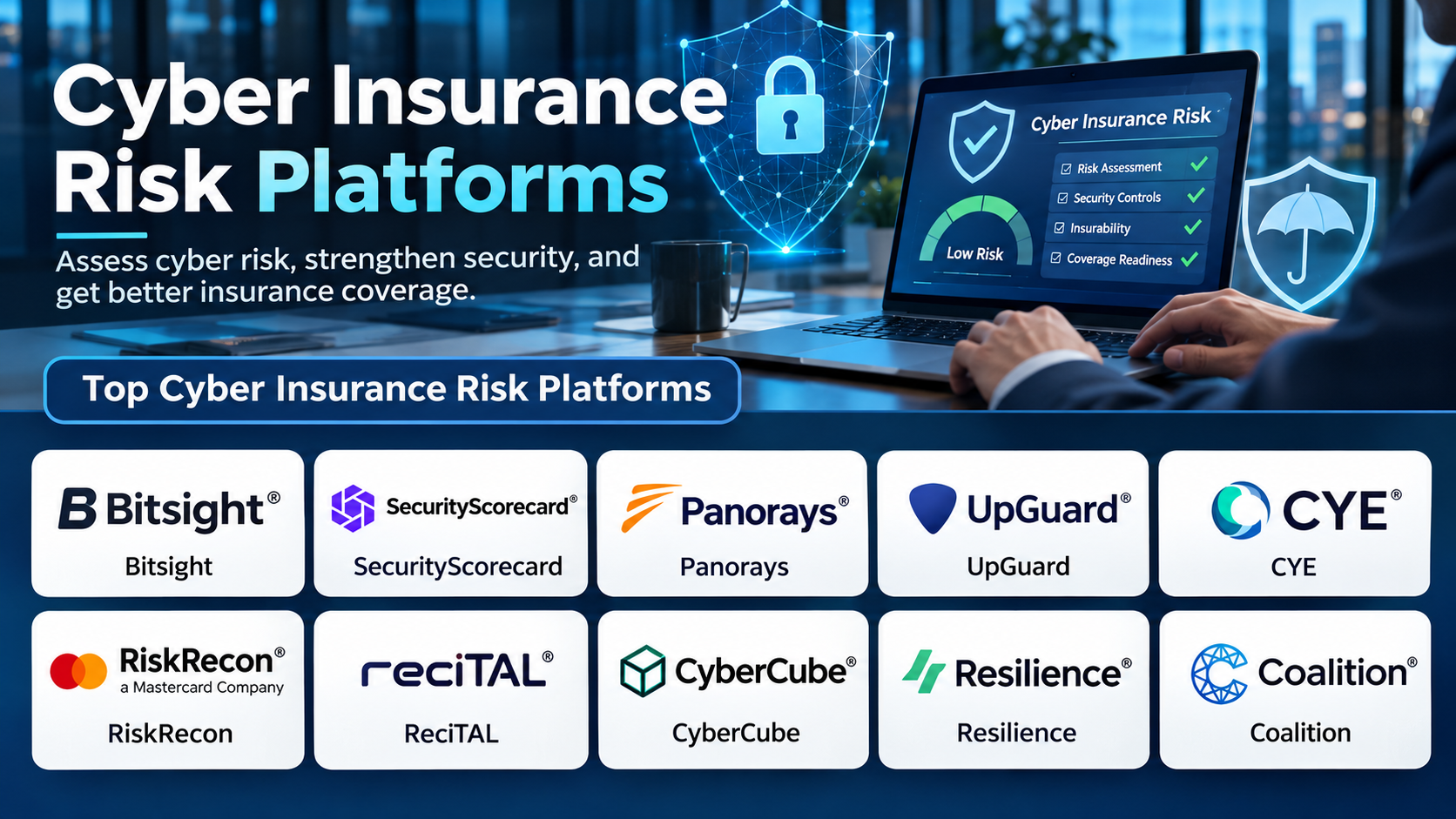
This comprehensive guide examines ten established cyber insurance risk platforms, their capabilities, benefits, limitations, and practical applications. It also provides detailed software comparisons, selection guidance, implementation procedures, financial considerations, performance indicators, and fifty frequently asked questions.
What Are Cyber Insurance Risk Platforms?
Cyber insurance risk platforms are specialized technology solutions that help organizations assess, quantify, monitor, and manage risks associated with cybersecurity incidents. They provide analytical information that supports insurance underwriting, coverage decisions, portfolio management, and risk mitigation.
These platforms typically collect relevant information about internet-facing technology assets, organizational characteristics, historical security incidents, security controls, and business dependencies. Analytical models examine this information to estimate potential vulnerabilities, incident probabilities, or financial consequences.
Insurance carriers use cyber risk platforms to evaluate applicants and determine whether proposed insurance arrangements align with underwriting requirements. The platforms may also support premium assessment, coverage limits, deductibles, and portfolio exposure management when combined with actuarial analysis and professional judgment.
Reinsurance organizations use cyber catastrophe models to evaluate potential losses arising from widespread incidents affecting multiple insured businesses. Understanding these correlated exposures helps organizations assess capital requirements, risk-transfer strategies, and potential accumulation concerns.
Insurance brokers and enterprise risk managers use cyber risk intelligence to improve insurance discussions and explain cybersecurity exposures in financial terms. These capabilities can help businesses compare risk management investments with insurance coverage and retained financial risk.
Cyber insurance risk platforms do not eliminate uncertainty or guarantee that cybersecurity incidents will be prevented. Their outputs depend on information quality, modeling assumptions, appropriate interpretation, and continuing validation against changing security conditions.
How Do Cyber Insurance Risk Platforms Work?
- Organization identification: Establish the identity, industry, size, geographical location, and relevant characteristics of the business being assessed.
- Asset discovery: Identify internet-facing domains, network infrastructure, and other technology assets associated with the organization.
- Security information collection: Gather authorized security assessment information, business questionnaires, external observations, and relevant historical data.
- Information validation: Examine asset attribution, record completeness, information accuracy, and the reliability of available security observations.
- Risk assessment: Evaluate identified security concerns, organizational characteristics, and relevant historical security patterns.
- Financial loss modeling: Estimate potential financial consequences using defined scenarios, probability assumptions, and relevant exposure information.
- Underwriting support: Present relevant information that insurance professionals can use when evaluating coverage, eligibility, and pricing.
- Portfolio aggregation: Examine relationships and common dependencies across insured organizations to identify potentially correlated exposures.
- Continuous monitoring: Evaluate changes in relevant security conditions and risk indicators throughout the insurance lifecycle where supported.
- Governance and review: Validate analytical results, document professional decisions, and update risk assessment procedures according to approved governance arrangements.
Traditional Cyber Insurance Assessment vs Modern Risk Platforms
| Comparison Criteria | Traditional Assessment | Modern Cyber Insurance Risk Platforms |
|---|---|---|
| Assessment frequency | Usually periodic | Periodic or continuous |
| Information sources | Applications and questionnaires | Multiple integrated information sources |
| Security visibility | Self-reported information | External and authorized internal observations |
| Financial modeling | Manual estimates | Structured quantitative models |
| Portfolio analysis | Spreadsheet-based assessment | Configurable exposure analytics |
| Risk accumulation | Manual dependency examination | Modeled correlated exposures |
| Underwriting support | Individual professional review | Analytics-supported professional review |
| Reporting | Static documentation | Interactive analytical reports |
| Scenario analysis | Individually prepared estimates | Repeatable simulation workflows |
| Risk monitoring | Renewal-focused | Ongoing where supported |
| Information validation | Manual verification | Automated checks with professional validation |
| Risk mitigation | General recommendations | Prioritized security findings |
Modern platforms can improve the consistency and timeliness of cyber risk assessments. However, underwriting expertise, accurate asset identification, reliable policy information, and appropriate modeling remain essential.
Common Applications of Cyber Insurance Risk Platforms
- Cyber insurance underwriting: Evaluate applicants using relevant cybersecurity and financial exposure information.
- Insurance premium assessment: Provide analytical inputs for actuarial pricing and underwriting decisions.
- Cyber catastrophe modeling: Estimate potential losses from widespread cybersecurity incidents.
- Portfolio risk management: Monitor aggregate exposure across insurance policies.
- Reinsurance assessment: Evaluate potential risk-transfer requirements and retained exposures.
- Security posture monitoring: Identify observable changes in organizational cybersecurity conditions.
- Third-party risk assessment: Examine cybersecurity exposures associated with business partners and suppliers.
- Financial risk quantification: Express potential cybersecurity losses using defined financial assumptions.
- Insurance renewal preparation: Review changes in security posture and business exposure before renewal.
- Coverage limit evaluation: Assess potential loss scenarios against existing insurance limits.
- Risk mitigation planning: Prioritize relevant security improvements and protective investments.
- Executive risk reporting: Communicate cybersecurity exposure using understandable business and financial information.
Essential Components of Cyber Insurance Risk Platforms
| Component | Primary Function | Practical Importance |
|---|---|---|
| Asset discovery | Identifies relevant technology assets | Establishes assessment coverage |
| Entity identification | Associates assets with organizations | Supports attribution accuracy |
| Security monitoring | Observes relevant security conditions | Identifies changing exposures |
| Threat intelligence | Provides contextual security information | Supports risk interpretation |
| Risk scoring | Summarizes selected risk indicators | Supports prioritization |
| Financial modeling | Estimates potential losses | Supports financial decisions |
| Scenario analysis | Evaluates defined incident situations | Supports stress testing |
| Portfolio aggregation | Combines individual exposures | Identifies concentration risks |
| Dependency analytics | Examines shared technology relationships | Supports systemic risk assessment |
| Underwriting support | Presents relevant applicant information | Improves decision consistency |
| Reporting | Communicates analytical findings | Supports stakeholders |
| Integration interfaces | Connect existing applications | Reduces manual information exchange |
| Access management | Restricts system permissions | Protects sensitive information |
| Model governance | Controls analytical changes | Supports reliability |
| Alerting | Communicates relevant changes | Enables timely review |
| Audit documentation | Maintains assessment records | Supports accountability |
Types of Cyber Insurance Risk Platforms
Cyber Catastrophe Modeling Platforms
Cyber catastrophe modeling platforms simulate potentially severe incidents affecting multiple insured organizations. They help insurers and reinsurers assess aggregate financial exposure, correlated losses, and capital management requirements.
Cyber Underwriting Analytics Platforms
Underwriting analytics platforms provide information about individual insurance applicants and insured organizations. They support professional assessments of risk eligibility, appropriate coverage conditions, and pricing considerations.
Security Rating Platforms
Security rating platforms examine observable cybersecurity conditions and summarize selected findings through standardized assessments. These ratings can provide useful supplementary information, although they do not represent comprehensive internal cybersecurity audits.
Cyber Risk Quantification Platforms
Cyber risk quantification platforms estimate the financial implications of defined cybersecurity scenarios. They help insurance professionals and enterprise risk managers communicate potential exposure through financial measurements.
Insurance-Linked Risk Management Platforms
Some cyber insurance providers offer technology services alongside insurance coverage. These services may include external monitoring, security recommendations, risk assessments, and access to incident response resources.
Third-Party Cyber Risk Platforms
Third-party risk platforms help organizations evaluate security conditions associated with suppliers and business partners. Insurers may use these capabilities to supplement assessment of technology dependencies and indirect exposures.
Key Capabilities of Cyber Insurance Risk Platforms
1. Attack Surface Discovery
Attack surface discovery identifies technology assets that may be observable through external networks. Accurate asset attribution is necessary because incorrectly associated systems can produce misleading risk assessments.
2. Security Posture Assessment
Security posture assessment examines selected indicators related to an organization’s cybersecurity condition. External assessments should be supplemented with authorized internal information when important security controls cannot be observed externally.
3. Cyber Risk Scoring
Cyber risk scores summarize selected information according to a provider’s analytical methodology. Scores from different platforms may not be directly comparable because they can use different inputs, scales, and assumptions.
4. Financial Risk Quantification
Financial risk quantification estimates potential economic losses associated with cybersecurity incidents. Outputs may include expected losses, scenario-specific estimates, or probability distributions rather than guaranteed financial outcomes.
5. Cyber Catastrophe Modeling
Catastrophe models assess potential widespread incidents affecting multiple insured organizations. These models help insurers understand portfolio volatility and evaluate the consequences of correlated exposures.
6. Portfolio Aggregation
Portfolio aggregation combines information about insured organizations and policy arrangements. It helps insurance professionals evaluate concentration risks across industries, geographical markets, and shared technology dependencies.
7. Underwriting Decision Support
Underwriting decision support organizes relevant cybersecurity information for insurance professionals. Final decisions should incorporate approved underwriting requirements, policy terms, actuarial analysis, and professional judgment.
8. Continuous Security Monitoring
Continuous monitoring evaluates changes in selected observable cybersecurity conditions. Monitoring frequency, information coverage, and notification arrangements vary between products and commercial agreements.
9. Third-Party Dependency Analysis
Dependency analysis examines relationships involving suppliers, cloud providers, software services, and other relevant organizations. Shared dependencies can create correlated losses across otherwise unrelated insurance policies.
10. Scenario Simulation
Scenario simulation evaluates the potential consequences of defined cybersecurity incidents. Appropriate scenarios should reflect organizational exposure, realistic loss mechanisms, and relevant insurance coverage conditions.
11. Executive Risk Reporting
Executive reports translate technical security information into understandable operational and financial measurements. Reports should communicate uncertainty and avoid presenting model estimates as certain future losses.
12. Insurance Lifecycle Integration
Insurance lifecycle integration connects risk assessment with application processing, underwriting, monitoring, and renewal activities. Integration capabilities depend on the selected software, insurance systems, and technical arrangements.
Technical Architecture and System Integration
Cyber insurance risk architecture commonly combines external information collection, organizational identification, analytical processing, financial modeling, and operational reporting. Dedicated modeling platforms and security rating products may occupy different layers within the same insurance technology environment.
Integration planning should distinguish security observations from modeled financial exposure and policy-specific financial liability. Combining these categories without appropriate transformations can produce misleading insurance decisions and inaccurate portfolio reporting.
| Architecture Layer | Primary Function | Important Consideration |
|---|---|---|
| Applicant information | Provides business characteristics | Accurate organizational records |
| External security data | Supplies observable conditions | Source reliability |
| Asset attribution | Associates assets with businesses | Matching accuracy |
| Security analytics | Evaluates relevant findings | Methodology transparency |
| Financial models | Estimates potential losses | Validated assumptions |
| Policy information | Describes coverage arrangements | Accurate limits and exclusions |
| Portfolio analytics | Aggregates insured exposures | Correlation assumptions |
| Integration layer | Transfers analytical information | Secure interfaces |
| Operational workflow | Supports underwriting decisions | Professional oversight |
| Governance layer | Controls access and changes | Accountability |
Top 10 Cyber Insurance Risk Platforms
The following products represent several complementary categories of cyber insurance technology. Their numbering organizes the comparison and does not indicate an independently tested performance ranking.
1. CyberCube
Short Description
CyberCube is a cyber risk analytics provider specializing in insurance-related financial exposure assessment and cyber catastrophe modeling. Its technology supports insurers, reinsurers, brokers, and other organizations evaluating potential cyber losses.
The platform’s product portfolio includes capabilities for individual account assessment, portfolio analysis, and insurance risk modeling. These capabilities help insurance professionals examine exposures that may arise from both organization-specific incidents and widespread cybersecurity events.
CyberCube’s analytical approach combines relevant cyber exposure information with financial loss modeling and insurance-specific assumptions. Depending on the selected products, organizations can evaluate individual risks or aggregate financial exposures across insurance portfolios.
The platform is particularly relevant to insurance carriers and reinsurance organizations managing substantial cyber insurance portfolios. Brokers may also benefit from financial modeling capabilities when discussing potential exposures and insurance arrangements with commercial clients.
Implementation requires careful preparation of insured organization records, policy terms, coverage limits, and other relevant exposure information. Organizations should confirm available modules, model versions, geographical coverage, integration arrangements, and analytical assumptions during procurement.
How the Software Works
- Collect relevant insured organization and insurance policy information.
- Validate business identities, coverage records, and exposure characteristics.
- Apply appropriate individual-risk or portfolio analytical models.
- Evaluate organization-specific and correlated cybersecurity scenarios.
- Estimate potential financial losses according to selected assumptions.
- Review exposure results and concentration information.
- Incorporate findings into approved underwriting, portfolio, or reinsurance decisions.
Key Features
- Cyber catastrophe modeling: Evaluates potential widespread incidents affecting multiple insured organizations.
- Portfolio risk analytics: Examines aggregate exposures across cyber insurance portfolios.
- Individual risk assessment: Supports evaluation of specific insured businesses.
- Financial loss estimation: Produces modeled estimates based on relevant exposure information.
- Scenario analysis: Evaluates defined cybersecurity incidents and their potential consequences.
- Accumulation management: Helps identify exposures associated with shared dependencies.
- Insurance-specific modeling: Incorporates analytical considerations relevant to insurance operations.
- Exposure data analysis: Examines relevant characteristics of organizations and portfolios.
- Risk-transfer support: Provides modeled information for reinsurance and capital discussions.
- Broker analytics: Supports financial risk conversations with commercial insurance clients.
- Analytical reporting: Communicates modeled exposure information to relevant stakeholders.
- Model portfolio options: Offers specialized analytical products for different insurance requirements.
Benefits
- Improves understanding of aggregate cyber insurance exposure.
- Supports structured catastrophe risk assessment.
- Helps identify concentration concerns.
- Facilitates reinsurance evaluation.
- Improves financial communication of cyber risks.
- Supports insurance portfolio planning.
- Helps evaluate potential severe-loss scenarios.
- Reduces dependence on fragmented exposure analysis.
- Supports underwriting and actuarial collaboration.
- Encourages documented quantitative risk assessment.
Pros
- Dedicated cyber insurance analytics specialization.
- Strong relevance to reinsurance organizations.
- Supports portfolio-level catastrophe modeling.
- Provides financial exposure assessment capabilities.
- Relevant to individual business risk evaluation.
- Supports scenario-based analytical workflows.
- Suitable for complex insurance portfolios.
- Offers specialized products for different insurance stakeholders.
Cons
- Enterprise commercial pricing requires consultation.
- Model interpretation requires appropriate expertise.
- Accurate insurance policy information is necessary.
- Catastrophe estimates remain sensitive to assumptions.
- Implementation requirements vary by product.
- Smaller organizations may not need comprehensive portfolio modeling.
- Security remediation may require complementary tools.
Use Cases
- Catastrophe exposure modeling: Evaluate potential widespread cybersecurity losses across insured businesses.
- Reinsurance planning: Compare modeled exposure with proposed risk-transfer arrangements.
- Portfolio concentration analysis: Examine dependencies that could produce correlated losses.
- Account underwriting: Evaluate relevant individual-business cyber risk information.
- Capital planning: Provide modeled inputs for financial resilience assessments.
- Broker advisory: Explain potential cyber losses to commercial insurance clients.
- Portfolio stress testing: Evaluate the financial implications of severe hypothetical incidents.
- Insurance product development: Use modeled exposures to inform coverage design discussions.
Industry Applications
- Commercial insurance carriers.
- Cyber insurance specialists.
- Reinsurance organizations.
- Commercial insurance brokerages.
- Enterprise insurance risk management departments.
Integration and Deployment Considerations
CyberCube implementation should begin with a review of existing underwriting records, policy administration systems, and portfolio exposure databases. Each insurance record should contain sufficiently accurate organization identifiers and policy characteristics for the intended analytical purpose.
Organizations should establish controlled procedures for transferring portfolio information and reconciling analytical outputs with source systems. Model versions, assumptions, and submission dates should be documented to support reproducibility and financial governance.
Pricing and Cost Considerations
CyberCube pricing generally requires commercial consultation based on selected analytical products and organizational requirements. Insurance organizations should evaluate licensing, implementation services, information preparation, analytical expertise, integration maintenance, and continuing model evaluation costs.
Best For
- Large cyber insurance carriers.
- Reinsurance companies.
- Insurance catastrophe modeling teams.
- Portfolio risk managers.
- Commercial insurance brokers.
- Insurance actuaries.
- Organizations evaluating correlated cyber exposures.
- Enterprise insurance capital management teams.
Overall Assessment
CyberCube is particularly relevant to organizations that need insurance-specific cyber catastrophe modeling and financial portfolio exposure analysis. Its specialized analytical products can support both individual risk assessment and broader insurance accumulation management.
Organizations primarily seeking external vulnerability monitoring or hands-on security remediation may require complementary technology. Selection should depend on the suitability of the proposed models for the insurer’s actual portfolio and financial decision requirements.
2. Guidewire Cyence
Short Description
Guidewire Cyence provides cyber risk analytics and modeling capabilities designed for insurance organizations. It supports underwriting, portfolio management, risk quantification, and the evaluation of cybersecurity-related financial exposure.
The platform combines relevant exposure information with insurance analytical models to assess potential incidents and financial losses. Its capabilities address both individual insured organizations and aggregate insurance portfolios.
Cyence supports scenario modeling, allowing insurance professionals to evaluate the potential effects of defined cybersecurity events. These analytical outputs can inform pricing discussions, portfolio monitoring, and enterprise risk management.
The solution is especially relevant to insurance carriers seeking coordinated analytical capabilities within their broader insurance technology environment. Existing Guidewire customers may find the platform particularly relevant, although compatibility should be evaluated independently for each implementation.
Organizations should assess available model capabilities, supported data connections, deployment arrangements, and the requirements of their insurance portfolios. Financial model outputs should be validated and interpreted according to documented underwriting and actuarial procedures.
How the Software Works
- Collect relevant applicant, insured organization, and portfolio information.
- Associate business records with available cyber exposure indicators.
- Apply appropriate financial and cybersecurity risk models.
- Evaluate estimated incident probabilities and potential loss severity.
- Simulate relevant cybersecurity scenarios.
- Examine individual and aggregate exposure results.
- Incorporate analytical findings into approved insurance workflows.
Key Features
- Cyber risk quantification: Estimates potential financial consequences of relevant cyber incidents.
- Underwriting analytics: Provides analytical information for evaluating individual insurance applicants.
- Portfolio assessment: Supports examination of aggregate cyber insurance exposure.
- Incident probability modeling: Estimates relevant event probabilities under model assumptions.
- Loss severity analysis: Evaluates potential financial consequences of covered or defined scenarios.
- Scenario simulation: Models common and severe cybersecurity incidents.
- Exposure signals: Uses relevant organizational and security-related indicators.
- Accumulation analysis: Helps examine potentially correlated portfolio risks.
- Underwriting reporting: Presents information intended for insurance professionals.
- Enterprise risk management support: Provides inputs for broader organizational risk assessments.
- Insurance pricing support: Supplies modeled information relevant to actuarial decisions.
- Guidewire ecosystem relevance: Provides analytical capabilities within the provider’s insurance technology portfolio.
Benefits
- Supports consistent underwriting assessments.
- Improves visibility into financial cyber exposure.
- Facilitates portfolio risk evaluation.
- Helps identify aggregate risk concentrations.
- Supports structured scenario analysis.
- Improves actuarial and underwriting collaboration.
- Provides analytical inputs for pricing.
- Supports insurance product planning.
- Facilitates enterprise risk communication.
- Encourages documented financial exposure management.
Pros
- Insurance-focused modeling capabilities.
- Supports individual and portfolio analysis.
- Relevant to insurance pricing workflows.
- Provides scenario simulation functionality.
- Established insurance software ecosystem.
- Suitable for complex enterprise insurance requirements.
- Supports modeled frequency and severity analysis.
- Relevant to insurers evaluating broader digital transformation.
Cons
- Commercial pricing requires direct confirmation.
- Model assumptions require independent evaluation.
- Implementation complexity depends on existing systems.
- Integration with non-Guidewire applications needs assessment.
- Specialist interpretation may be necessary.
- Financial predictions remain inherently uncertain.
- Additional monitoring tools may be required for technical remediation.
Use Cases
- Applicant assessment: Examine the modeled cyber exposure of prospective insured businesses.
- Insurance pricing: Provide financial risk estimates for actuarial evaluation.
- Portfolio monitoring: Examine changes in aggregate insured exposures.
- Scenario modeling: Assess potential losses from defined cybersecurity events.
- Accumulation analysis: Identify relevant shared-risk concentrations.
- Enterprise risk reporting: Communicate cyber financial exposures to management.
- Insurance product planning: Evaluate potential risk characteristics of proposed coverage.
- Risk-transfer evaluation: Support discussions concerning retained and transferred insurance exposure.
Industry Applications
- Property and casualty insurance.
- Commercial cyber insurance underwriting.
- Reinsurance organizations.
- Insurance brokerage operations.
- Enterprise insurance technology programs.
Integration and Deployment Considerations
Insurers should identify how Cyence analytical outputs will enter existing underwriting and portfolio management workflows. Organizations using Guidewire applications should verify the exact supported connections rather than assuming all components integrate automatically.
Deployment should include reconciliation of business identities, insurance coverage information, and portfolio records. Actuarial teams should document analytical assumptions and establish review procedures for material model changes.
Pricing and Cost Considerations
Guidewire Cyence commercial arrangements depend on the selected functionality and organizational requirements. TCO calculations should include software licensing, integration work, analytical support, information preparation, training, and any relevant infrastructure dependencies.
Best For
- Enterprise insurance carriers.
- Guidewire customers.
- Cyber insurance underwriters.
- Insurance actuaries.
- Portfolio risk managers.
- Reinsurance analysts.
- Insurance product development teams.
- Organizations seeking coordinated cyber financial modeling.
Overall Assessment
Guidewire Cyence is a relevant option for insurance organizations seeking individual-risk assessment and portfolio-level cyber risk modeling within an established insurance technology ecosystem. Its scenario and financial analytical capabilities support multiple insurance decision-making processes.
Organizations should evaluate the model methodology, integration requirements, and associated commercial arrangements before selection. Its outputs should complement actuarial expertise rather than replace documented insurance decision procedures.
3. Kovrr
Short Description
Kovrr provides cyber risk quantification and modeling technology designed to help organizations understand cybersecurity exposure in financial terms. Its capabilities are relevant to enterprise risk management, insurance analytics, and financial assessment of cyber incidents.
The platform focuses on estimating potential incident-related financial losses using structured models and relevant exposure information. These assessments can support discussions concerning insurance coverage, retained risk, and investments in cybersecurity improvements.
Kovrr’s analytical approach is relevant to organizations that need more than a conventional security rating. Financial quantification helps stakeholders compare potential cybersecurity exposure against business objectives and financial risk tolerances.
Insurance professionals can evaluate Kovrr when considering individual business exposure, portfolio modeling, or scenario-based insurance assessments. Corporate risk managers may use relevant products to communicate cybersecurity risks to finance departments and senior management.
Implementation requires accurate business information, careful selection of analytical scenarios, and appropriate evaluation of model assumptions. Organizations should confirm current product packaging, available insurance-specific functionality, integrations, and geographical support.
How the Software Works
- Establish the relevant organizational or portfolio assessment scope.
- Collect business, technology, and exposure information.
- Validate information quality and relevant organizational characteristics.
- Apply appropriate cyber financial risk models.
- Evaluate defined incident and loss scenarios.
- Present estimated financial exposure and relevant risk indicators.
- Review results for insurance, investment, or governance decisions.
Key Features
- Cyber financial risk quantification: Estimates potential economic exposure from cybersecurity incidents.
- Scenario-based modeling: Evaluates defined cybersecurity loss situations.
- Loss estimation: Produces financial estimates under documented assumptions.
- Probability assessment: Supports evaluation of potential event likelihoods.
- Business exposure analysis: Considers relevant organizational characteristics.
- Insurance decision support: Provides information for evaluating insurance arrangements.
- Portfolio modeling: Supports aggregate exposure assessment within applicable products.
- Financial reporting: Communicates analytical results in financial terms.
- Risk prioritization: Helps compare potential losses across relevant scenarios.
- Risk appetite alignment: Supports comparison of modeled exposure with business tolerances.
- Analytical benchmarking: Provides comparative context where relevant information is available.
- Executive communication: Supports financial discussions between security and business stakeholders.
Benefits
- Converts technical cybersecurity concerns into financial estimates.
- Supports insurance coverage evaluation.
- Improves communication with finance teams.
- Facilitates structured scenario assessment.
- Helps prioritize cybersecurity investments.
- Supports enterprise risk reporting.
- Improves understanding of potential loss severity.
- Encourages quantitative decision-making.
- Supports risk appetite discussions.
- Provides complementary information for insurance professionals.
Pros
- Strong financial risk quantification orientation.
- Relevant to insurers and enterprise risk managers.
- Supports scenario-based decision-making.
- Helps communicate cyber exposure to executives.
- Suitable for insurance coverage discussions.
- Complements technical security assessment tools.
- Provides a structured quantitative approach.
- Relevant to business investment evaluation.
Cons
- Financial estimates depend on assumptions.
- Accurate business information is required.
- Commercial pricing requires confirmation.
- Insurance-specific product capabilities should be verified.
- Specialist explanation may be necessary.
- Does not replace security operations technology.
- Model validation introduces continuing governance requirements.
Use Cases
- Cyber insurance limit assessment: Compare potential loss scenarios with proposed coverage limits.
- Executive financial reporting: Communicate modeled cybersecurity exposure to senior management.
- Security investment evaluation: Estimate potential financial implications of risk mitigation options.
- Enterprise risk assessment: Incorporate quantified cyber exposure into organizational risk registers.
- Underwriting research: Provide additional financial context for insurance applicants.
- Scenario comparison: Examine differences between relevant cybersecurity incidents.
- Portfolio risk evaluation: Assess aggregate exposure using applicable modeling products.
- Risk retention planning: Evaluate financial exposure that may remain outside insurance coverage.
Industry Applications
- Commercial insurance organizations.
- Financial services institutions.
- Enterprise technology businesses.
- Manufacturing organizations.
- Corporate risk management departments.
Integration and Deployment Considerations
Kovrr implementation should establish consistent definitions for revenue, business interruption exposure, incident scenarios, and relevant security information. Organizations should identify the information required for each model and document any gaps or estimation assumptions.
Integration with insurance and enterprise risk management systems should preserve the distinction between estimated economic losses and policy-covered losses. Insurance professionals must account for coverage conditions before applying model outputs to underwriting or claims-related decisions.
Pricing and Cost Considerations
Pricing requires confirmation from the provider based on product scope and organizational requirements. Buyers should consider recurring licensing, model configuration, information preparation, reporting integration, employee training, and ongoing analytical review.
Best For
- Enterprise cyber risk managers.
- Cyber insurance professionals.
- Chief Information Security Officers (CISOs).
- Finance departments.
- Insurance brokers.
- Organizations evaluating risk retention.
- Executive risk committees.
- Businesses assessing cybersecurity investment priorities.
Overall Assessment
Kovrr is a relevant candidate for organizations seeking to express cyber risks in financial terms and improve insurance-related risk discussions. Its analytical orientation helps connect cybersecurity assessment with financial planning.
Organizations requiring comprehensive catastrophe modeling or technical security monitoring should verify the capabilities included in the proposed product. Financial estimates should be treated as uncertain model outputs rather than guaranteed future losses.
4. Bitsight for Cyber Insurance
Short Description
Bitsight for Cyber Insurance provides cybersecurity exposure intelligence intended to support insurance underwriting, portfolio monitoring, and risk assessment. The platform builds on Bitsight’s broader capabilities in external security monitoring and security ratings.
External security assessments can provide insurers with information about observable technology infrastructure and security-related conditions associated with applicants. Historical security information may provide additional context for evaluating changes in an organization’s security posture.
Bitsight supports insurance professionals seeking scalable security assessments across multiple businesses. Its broader cybersecurity intelligence portfolio also addresses third-party risk management and exposure monitoring.
The platform is particularly relevant to insurers requiring supplementary security information during underwriting and throughout the policy lifecycle. It can complement catastrophe modeling products by providing organization-level security observations.
Organizations should carefully evaluate asset attribution accuracy, information coverage, rating methodology, and notification capabilities. External security findings should be verified and supplemented with internal control information where necessary.
How the Software Works
- Identify organizations and relevant internet-facing assets.
- Collect available external cybersecurity observations.
- Associate observations with the appropriate organizations.
- Apply security assessment and analytical methodologies.
- Present relevant ratings and exposure information.
- Monitor applicable portfolios for meaningful changes.
- Use verified findings to support approved underwriting or risk mitigation activities.
Key Features
- Security ratings: Summarizes selected external cybersecurity conditions through standardized assessments.
- External exposure intelligence: Provides information about observable technology risks.
- Historical security assessment: Supports examination of changes over time.
- Cyber insurance analytics: Provides insurance-oriented information for risk evaluation.
- Portfolio monitoring: Helps insurers review cybersecurity conditions across insured businesses.
- Vulnerability intelligence: Provides contextual information about relevant software vulnerabilities.
- Risk trend reporting: Displays changes in selected security indicators.
- Applicant assessment: Supports evaluation of prospective insured organizations.
- Asset attribution: Associates observable assets with relevant business entities.
- Third-party risk intelligence: Supports assessment of business partner exposures through applicable products.
- Integration interfaces: Enables supported information exchange with external applications.
- Risk mitigation insights: Helps identify findings requiring further technical examination.
Benefits
- Expands underwriting information beyond questionnaires.
- Supports scalable external security assessments.
- Improves visibility into changing exposures.
- Facilitates historical security comparisons.
- Helps prioritize risk mitigation discussions.
- Supports insurance portfolio monitoring.
- Reduces fragmented external security research.
- Improves communication with insured organizations.
- Complements financial modeling platforms.
- Supports cybersecurity-informed renewal assessments.
Pros
- Established security rating and monitoring capabilities.
- Dedicated cyber insurance offering.
- Suitable for monitoring multiple organizations.
- Supports external exposure assessment.
- Provides useful historical security context.
- Relevant to underwriting and renewal workflows.
- Complements catastrophe modeling products.
- Supports third-party risk assessment through broader offerings.
Cons
- External observations cannot reveal every internal security control.
- Asset attribution may require correction.
- Security ratings should not determine underwriting decisions independently.
- Commercial pricing requires consultation.
- Monitoring coverage varies across organizations.
- Additional financial modeling may be necessary.
- Risk findings require contextual interpretation.
Use Cases
- Applicant security assessment: Examine external cybersecurity conditions before underwriting.
- Insurance portfolio monitoring: Monitor relevant security changes across insured businesses.
- Renewal evaluation: Compare security observations with previous assessment periods.
- Vulnerability exposure assessment: Identify potentially relevant security vulnerabilities across a portfolio.
- Third-party assessment: Examine suppliers and business partners through applicable capabilities.
- Risk mitigation communication: Discuss verified security concerns with insured organizations.
- Underwriting enrichment: Supplement questionnaires and internal control assessments.
- Catastrophe model enrichment: Provide relevant organization-level exposure information for broader analysis.
Industry Applications
- Commercial insurance carriers.
- Cyber insurance underwriting organizations.
- Financial services institutions.
- Insurance brokerage operations.
- Enterprise third-party risk management departments.
Integration and Deployment Considerations
Insurance organizations should establish procedures for associating applicants and policyholders with correct business identifiers and technology assets. Incorrect attribution can materially affect the relevance of external security findings.
Integration should distinguish security observations, calculated ratings, and approved underwriting decisions. Security teams and insurance professionals should establish a process for reviewing disputed findings and confirming important observations.
Pricing and Cost Considerations
Bitsight’s commercial pricing depends on selected products and monitoring requirements. Insurers should evaluate licensing scope, monitored organization volumes, integration costs, support requirements, and any complementary analytical products.
Best For
- Cyber insurance underwriters.
- Insurance portfolio monitoring teams.
- Commercial brokers.
- Enterprise risk analysts.
- Third-party risk managers.
- Organizations requiring external security intelligence.
- Insurers supplementing underwriting questionnaires.
- Businesses evaluating historical security posture.
Overall Assessment
Bitsight for Cyber Insurance is particularly relevant to insurance organizations seeking external cybersecurity intelligence and scalable portfolio monitoring. Its security-oriented capabilities complement professional underwriting assessments and financial modeling approaches.
Organizations should recognize that external security ratings offer an incomplete view of internal cybersecurity controls. Appropriate validation and supplementary evidence are necessary before findings influence material insurance decisions.
5. SecurityScorecard
Short Description
SecurityScorecard provides cybersecurity ratings, external risk intelligence, and assessment capabilities for organizations evaluating their own security posture and third-party exposures. Its broader technology is relevant to insurance professionals assessing applicants and monitoring business risks.
The platform collects observable security information and organizes findings into assessment categories and ratings. These outputs help stakeholders compare selected external security characteristics and identify areas requiring additional examination.
SecurityScorecard can support cybersecurity assessment throughout insurance application and renewal processes. Its broader third-party risk capabilities may also provide relevant information about supplier relationships and indirect exposures.
Insurance organizations may use the platform as a supplementary source of security intelligence rather than as a complete actuarial pricing or catastrophe modeling system. Its suitability depends on the insurer’s intended assessment scope, information availability, and operational procedures.
Implementation should establish accurate organization records, appropriate asset attribution procedures, and clear interpretation guidelines. Insurers must confirm current insurance-specific services, integration options, reporting capabilities, and commercial terms.
How the Software Works
- Identify the businesses included in the assessment.
- Associate relevant internet-facing assets with each organization.
- Collect supported external cybersecurity observations.
- Evaluate findings using the platform’s assessment methodology.
- Generate security ratings and relevant risk indicators.
- Review significant findings and verify their applicability.
- Monitor appropriate changes and document insurance-related follow-up.
Key Features
- Cybersecurity ratings: Provides standardized summaries of selected external security conditions.
- External asset intelligence: Helps examine relevant internet-facing technology infrastructure.
- Security factor assessment: Organizes findings into understandable cybersecurity categories.
- Continuous monitoring: Observes changes in supported security indicators.
- Third-party risk management: Supports assessment of suppliers and business partners.
- Portfolio organization: Helps manage multiple monitored organizations.
- Risk notifications: Communicates relevant changes according to available configuration.
- Security benchmarking: Provides comparative assessment context.
- Issue-level findings: Presents information supporting further investigation.
- Executive reporting: Communicates assessment results to business stakeholders.
- Workflow integrations: Supports compatible external systems where available.
- Remediation coordination: Helps organizations identify and manage relevant security concerns.
Benefits
- Improves access to external cybersecurity information.
- Supports consistent applicant assessment.
- Helps identify changing security conditions.
- Facilitates supplier risk evaluation.
- Improves business communication of security findings.
- Supports coordinated risk mitigation discussions.
- Reduces repetitive external assessment activities.
- Helps prioritize cybersecurity review.
- Complements existing insurance underwriting processes.
- Encourages measurable security monitoring.
Pros
- Recognizable security rating methodology.
- Suitable for monitoring multiple organizations.
- Relevant third-party risk capabilities.
- Supports understandable security reporting.
- Provides issue-level assessment context.
- Useful for insurance applicant research.
- Supports external security monitoring.
- Complements internal security assessments.
Cons
- External security observations have coverage limitations.
- Ratings may not fully represent business-specific risk.
- Asset attribution errors may affect results.
- Financial loss modeling requires separate assessment.
- Commercial pricing varies by product scope.
- Organizations must verify significant findings.
- Internal security controls require complementary evidence.
Use Cases
- Cyber insurance applications: Supplement applicant-provided cybersecurity information.
- Portfolio security monitoring: Review observable cybersecurity conditions across insured organizations.
- Supply chain assessment: Evaluate relevant security indicators associated with business partners.
- Renewal preparation: Examine security changes before insurance policy renewal.
- Risk mitigation tracking: Monitor progress on validated cybersecurity findings.
- Executive security reporting: Present understandable assessment results.
- Vendor comparison: Examine selected external security characteristics of prospective suppliers.
- Underwriting workflow enhancement: Integrate supplementary security information into approved assessment procedures.
Industry Applications
- Cyber insurance organizations.
- Financial institutions.
- Retail businesses.
- Healthcare enterprises.
- Third-party risk management programs.
Integration and Deployment Considerations
Insurance organizations should define which ratings and security findings will contribute to underwriting and monitoring processes. Reliance on a single aggregate score may conceal material details or differences in assessment coverage.
Technical deployment should include procedures for mapping organizational identities, reviewing disputed findings, and maintaining appropriate information access. Insurance staff should receive training on the limitations of external cybersecurity assessments.
Pricing and Cost Considerations
SecurityScorecard provides different commercial products and service arrangements. Buyers should obtain written quotations covering monitored organizations, user access, integration services, reporting requirements, and any additional assessment capabilities.
Best For
- Insurance underwriting teams.
- Enterprise security departments.
- Third-party risk managers.
- Commercial insurance brokers.
- Portfolio monitoring specialists.
- Organizations requiring understandable security ratings.
- Supplier risk management programs.
- Insurers supplementing existing analytical platforms.
Overall Assessment
SecurityScorecard is suitable for organizations seeking external security ratings and ongoing assessment of relevant cybersecurity conditions. Its broader third-party risk capabilities may provide additional value where insurance exposures depend on supplier relationships.
Organizations requiring actuarial catastrophe models or policy-specific financial exposure estimates should evaluate complementary products. Security ratings must be interpreted with appropriate context and independent verification.
6. KYND
Short Description
KYND provides cybersecurity risk intelligence and monitoring technology with applications across insurance, investment, and business risk management. Its platform helps organizations identify and communicate relevant cybersecurity exposures.
The company’s insurance-oriented capabilities support assessment of prospective insured businesses and existing policyholders. External cybersecurity intelligence can supplement questionnaires and provide additional context for insurance risk discussions.
KYND emphasizes understandable presentation of cybersecurity findings for both technical and nontechnical stakeholders. This approach can help insurance brokers and underwriters communicate relevant security issues without depending exclusively on complex technical reports.
The platform is particularly relevant to insurance organizations seeking scalable cyber risk assessments and policyholder monitoring. Its capabilities can complement dedicated financial loss models and catastrophe modeling systems.
Implementation requires accurate organization identification, review of information coverage, and appropriate integration with existing insurance procedures. Buyers should confirm current product functionality, available portfolio services, and geographical support.
How the Software Works
- Establish the organization or portfolio requiring assessment.
- Identify relevant domains and externally observable assets.
- Collect supported cybersecurity exposure information.
- Analyze findings using applicable risk methodologies.
- Present prioritized and understandable security information.
- Monitor selected changes where supported.
- Share verified findings through appropriate insurance and risk management workflows.
Key Features
- Cyber risk intelligence: Provides information about relevant observable security exposures.
- Insurance risk assessment: Supports insurance-related evaluation of business cybersecurity conditions.
- External exposure discovery: Identifies supported internet-facing asset information.
- Risk indicators: Summarizes selected cybersecurity concerns.
- Understandable reporting: Presents findings for technical and nontechnical stakeholders.
- Portfolio monitoring: Supports assessment of multiple insured organizations.
- Risk prioritization: Helps organize findings requiring additional review.
- Continuous assessment: Examines changing security conditions within supported services.
- Broker support: Provides information relevant to insurance advisory discussions.
- Underwriting enrichment: Supplements traditional application information.
- Risk mitigation guidance: Helps identify relevant areas for security improvement.
- Integration capabilities: Supports applicable operational information exchange arrangements.
Benefits
- Simplifies communication of cybersecurity risks.
- Supports informed insurance underwriting.
- Improves portfolio exposure visibility.
- Helps identify relevant security concerns.
- Facilitates policyholder risk discussions.
- Supports broker advisory workflows.
- Reduces dependence on manual external research.
- Encourages timely review of changing exposures.
- Complements financial risk modeling.
- Supports insurance-related risk mitigation planning.
Pros
- Relevant insurance risk intelligence specialization.
- Understandable security assessment presentation.
- Supports applicant and portfolio evaluation.
- Suitable for insurance brokers.
- Helps identify observable cybersecurity concerns.
- Complements existing underwriting systems.
- Relevant to nontechnical business stakeholders.
- Supports ongoing monitoring within applicable offerings.
Cons
- External assessments cannot reveal every internal control.
- Accurate asset attribution is necessary.
- Financial catastrophe modeling may require complementary products.
- Commercial pricing requires consultation.
- Information coverage varies by organization.
- Significant findings require professional verification.
- Integration scope depends on commercial arrangements.
Use Cases
- Broker risk assessment: Explain relevant cybersecurity conditions to commercial insurance clients.
- Underwriting enrichment: Supplement insurance application information.
- Policyholder monitoring: Observe supported security changes during coverage periods.
- Portfolio evaluation: Examine risk indicators across insured organizations.
- Renewal review: Assess relevant cybersecurity changes before policy renewal.
- Risk mitigation planning: Identify findings requiring professional technical attention.
- Investment risk research: Evaluate cybersecurity concerns associated with relevant businesses.
- Security communication: Present understandable risk information to nontechnical decision-makers.
Industry Applications
- Commercial insurance brokers.
- Cyber insurance carriers.
- Managing General Agents (MGAs).
- Investment organizations.
- Small and medium-sized business risk programs.
Integration and Deployment Considerations
Insurance teams should establish consistent procedures for submitting organization information and reviewing assessment outputs. Deployment should include verification of significant findings and an appropriate process for resolving incorrect asset associations.
Monitoring workflows should identify who receives notifications and which findings require communication with insured organizations. Insurance professionals should document how external security information contributes to decisions without automatically equating every finding with unacceptable risk.
Pricing and Cost Considerations
KYND pricing requires confirmation according to selected services, assessment volumes, and monitoring requirements. Organizations should consider account access, integration, portfolio reporting, employee training, and continuing service costs.
Best For
- Cyber insurance brokers.
- Commercial underwriters.
- Managing General Agents.
- Policyholder monitoring programs.
- Insurance risk advisory teams.
- Nontechnical risk stakeholders.
- Organizations requiring understandable cyber reports.
- Insurers supplementing financial risk models.
Overall Assessment
KYND is a relevant option for insurance organizations seeking accessible cybersecurity intelligence and scalable external risk monitoring. Its reporting orientation may help brokers communicate security concerns effectively to commercial clients.
Organizations seeking detailed actuarial catastrophe modeling or comprehensive internal security testing may need complementary solutions. Buyers should validate information coverage and commercial functionality using representative insurance applicants.
7. Cyberwrite
Short Description
Cyberwrite provides cyber risk analytics and quantification technology relevant to insurance underwriting, portfolio management, and business risk assessment. Its capabilities help organizations evaluate cybersecurity exposure through structured analytical information.
The platform addresses the need to combine cybersecurity observations with business context and potential financial consequences. These capabilities support insurance professionals evaluating individual applicants and broader insured portfolios.
Cyberwrite is relevant to insurers and brokers seeking information that can support insurance decisions without requiring extensive manual research for every business. Automated assessment processes can improve operational efficiency when appropriately integrated and validated.
The platform’s broader value includes communication of cybersecurity risks through business-oriented information. Organizations should evaluate how available financial estimates, exposure indicators, and reports align with their actual insurance requirements.
Implementation should include verification of data sources, modeling assumptions, supported insurance workflows, and geographical information coverage. Current product packaging and integration arrangements should be confirmed before procurement.
How the Software Works
- Identify the business or portfolio requiring analysis.
- Collect relevant organizational and cybersecurity information.
- Validate available inputs and asset associations.
- Apply appropriate cyber risk analytical models.
- Generate relevant risk indicators and modeled financial information.
- Review findings within approved insurance workflows.
- Monitor subsequent changes and validate analytical performance.
Key Features
- Cyber risk analytics: Evaluates relevant organizational cybersecurity exposure.
- Financial risk quantification: Supports estimation of potential cyber-related financial consequences.
- Underwriting support: Provides information for insurance applicant assessment.
- Portfolio analytics: Helps examine cyber exposure across multiple insured businesses.
- External information analysis: Incorporates supported external cybersecurity indicators.
- Risk reporting: Communicates analytical findings to relevant stakeholders.
- Business context assessment: Considers applicable organizational characteristics.
- Risk prioritization: Helps identify cases requiring additional examination.
- Insurance workflow support: Facilitates applicable insurance assessment activities.
- Automated analytical processing: Supports scalable assessment workflows.
- Risk communication: Helps explain cybersecurity exposure in business terms.
- Integration capabilities: Enables supported connections with operational systems.
Benefits
- Supports consistent cyber insurance assessments.
- Helps quantify potential cyber financial exposure.
- Reduces fragmented underwriting research.
- Facilitates portfolio risk evaluation.
- Improves communication of cybersecurity risks.
- Supports efficient applicant assessment.
- Helps prioritize additional security reviews.
- Provides supplementary inputs for insurance pricing.
- Encourages structured risk documentation.
- Complements professional insurance judgment.
Pros
- Cyber insurance-oriented analytical capabilities.
- Relevant financial quantification functionality.
- Supports scalable assessment requirements.
- Suitable for underwriting research.
- Supports business-oriented reporting.
- Relevant to portfolio analysis.
- Complements existing insurance systems.
- Helps connect security and financial risk considerations.
Cons
- Model assumptions require evaluation.
- Financial estimates remain uncertain.
- Commercial pricing requires confirmation.
- External information coverage may vary.
- Accurate organizational information is necessary.
- Significant findings require professional review.
- Integration capabilities depend on selected products.
Use Cases
- Insurance applicant assessment: Evaluate relevant cybersecurity exposure information.
- Financial risk estimation: Examine potential monetary consequences of cybersecurity incidents.
- Portfolio segmentation: Compare exposure characteristics across insured business groups.
- Broker advisory: Communicate relevant cyber risk information to commercial clients.
- Underwriting modernization: Introduce scalable analytical assessment workflows.
- Coverage discussions: Compare modeled exposure with proposed insurance arrangements.
- Risk prioritization: Identify applications requiring further professional assessment.
- Enterprise risk communication: Present business-oriented cybersecurity findings.
Industry Applications
- Commercial insurance carriers.
- Cyber insurance brokerages.
- Managing General Agents.
- Enterprise risk management departments.
- Financial services organizations.
Integration and Deployment Considerations
Cyberwrite deployment should establish accurate business identification procedures and consistent assessment information requirements. Insurance teams should determine which analytical outputs are appropriate for individual underwriting and which require portfolio-level interpretation.
Organizations should independently assess the reliability of financial models and document their limitations. Approved integrations should preserve assessment records and support review of material information changes.
Pricing and Cost Considerations
Commercial arrangements depend on selected analytical products and usage requirements. Cost assessments should include software access, applicant or portfolio volumes, technical integration, analytical evaluation, and ongoing operational support.
Best For
- Cyber insurance underwriters.
- Commercial insurance brokers.
- Managing General Agents.
- Insurance portfolio analysts.
- Enterprise risk managers.
- Organizations requiring financial cyber assessment.
- Insurers modernizing applicant evaluation.
- Business-oriented cybersecurity reporting teams.
Overall Assessment
Cyberwrite is relevant to insurance organizations seeking scalable cyber risk analytics and financial exposure assessment. Its focus on insurance and business decision support makes it suitable for evaluating underwriting modernization requirements.
Organizations should confirm the specific analytical products included in their proposed commercial arrangements. Representative testing should establish whether available information and model outputs provide useful improvements over current assessment methods.
8. Black Kite
Short Description
Black Kite is a cyber risk intelligence platform specializing in third-party cybersecurity assessment, financial exposure analysis, and technology-related supply chain risk. Its capabilities are relevant to insurers evaluating indirect cybersecurity exposures and business dependencies.
The platform examines supported external security information and provides indicators associated with cybersecurity posture and potential risk. Its broader product capabilities also include ransomware-related risk assessment and financial risk communication.
Cyber insurance portfolios may contain businesses that depend on common technology providers or suppliers. Black Kite can provide supplementary information relevant to these relationships, although comprehensive insurance accumulation modeling requires appropriate specialized models.
The platform is particularly relevant to organizations prioritizing third-party cybersecurity risk and understanding the potential financial implications of supplier-related incidents. Insurance professionals may incorporate relevant findings into underwriting and portfolio assessment workflows.
Implementation requires accurate organization and supplier records, appropriate information validation, and careful interpretation of external cybersecurity indicators. Buyers should confirm current insurance-related capabilities, information coverage, monitoring arrangements, and integration options.
How the Software Works
- Identify the business and relevant third parties.
- Associate organizations with supported externally observable assets.
- Collect relevant security and exposure information.
- Apply appropriate technical and financial risk assessment methodologies.
- Present organization-specific and third-party risk indicators.
- Review significant findings and validate relevant dependencies.
- Monitor selected exposures and support approved risk management procedures.
Key Features
- Third-party cyber risk intelligence: Supports assessment of cybersecurity conditions associated with business partners.
- External security assessment: Examines relevant observable technology exposures.
- Ransomware susceptibility indicators: Provides applicable analytical indicators of ransomware-related exposure.
- Financial risk assessment: Supports communication of potential cyber-related financial consequences.
- Supplier monitoring: Observes relevant changes across monitored third parties.
- Cybersecurity ratings: Summarizes selected security assessment information.
- Dependency context: Supports examination of relevant supplier relationships.
- Portfolio analysis: Helps organize assessment information across multiple organizations.
- Risk prioritization: Identifies findings requiring additional examination.
- Executive reporting: Communicates cybersecurity information to business stakeholders.
- Risk mitigation coordination: Supports appropriate follow-up on significant findings.
- Integration interfaces: Connects supported enterprise risk management applications.
Benefits
- Improves visibility into third-party cybersecurity risks.
- Supports evaluation of supplier-related exposure.
- Helps communicate cybersecurity risks financially.
- Complements insurance underwriting information.
- Facilitates ongoing supplier assessment.
- Helps identify changing security conditions.
- Supports prioritization of risk mitigation.
- Improves cross-departmental risk communication.
- Provides supplementary portfolio risk context.
- Encourages structured supply chain risk management.
Pros
- Strong third-party risk specialization.
- Relevant financial risk assessment capabilities.
- Supports ransomware-related risk indicators.
- Suitable for monitoring complex supplier environments.
- Provides business-oriented reporting.
- Complements insurance exposure analysis.
- Supports enterprise risk management workflows.
- Relevant to indirect cybersecurity risk assessment.
Cons
- External information has coverage limitations.
- Supplier dependency completeness requires validation.
- Financial estimates depend on analytical assumptions.
- Commercial pricing requires consultation.
- Insurance catastrophe modeling may require separate software.
- Significant security findings require corroboration.
- Large supplier portfolios may introduce substantial management requirements.
Use Cases
- Supplier cybersecurity assessment: Examine relevant external security conditions of business partners.
- Cyber insurance underwriting: Supplement assessment of applicants with significant supplier dependencies.
- Supply chain exposure monitoring: Track changing risks within relevant third-party environments.
- Ransomware risk review: Evaluate applicable analytical indicators of exposure.
- Enterprise financial reporting: Communicate potential financial implications of cybersecurity risks.
- Portfolio dependency research: Investigate relationships relevant to shared technology exposure.
- Vendor onboarding: Supplement supplier evaluation with cybersecurity information.
- Risk mitigation planning: Prioritize follow-up on significant third-party security findings.
Industry Applications
- Insurance and financial services.
- Manufacturing supply chains.
- Retail organizations.
- Healthcare enterprises.
- Technology service providers.
Integration and Deployment Considerations
Black Kite implementation should begin with accurate supplier and organizational inventories. Each assessed relationship should have an appropriate owner responsible for validating relevant information and coordinating necessary follow-up.
Insurance professionals should distinguish external supplier security indicators from modeled insured loss accumulation. Shared dependency assessments may require policy terms, exposure values, and catastrophe modeling capabilities beyond third-party risk intelligence alone.
Pricing and Cost Considerations
Pricing depends on selected platform functionality and monitored organization volumes. Buyers should evaluate licensing, information integration, supplier onboarding, employee training, and ongoing risk management resources.
Best For
- Third-party risk management teams.
- Commercial insurance underwriters.
- Supply chain cybersecurity departments.
- Enterprise risk managers.
- Insurers assessing indirect business exposures.
- Organizations managing extensive supplier networks.
- Financial risk reporting teams.
- Businesses evaluating ransomware-related exposure.
Overall Assessment
Black Kite is particularly relevant to organizations seeking third-party cybersecurity intelligence and supplementary financial risk information. It can help insurance professionals understand supplier-related concerns that may not be adequately represented in conventional insurance questionnaires.
Organizations requiring comprehensive insurance catastrophe modeling should evaluate dedicated analytical products in addition to third-party intelligence. Appropriate asset verification and dependency validation are essential for reliable assessments.
9. Coalition Control
Short Description
Coalition Control is a cyber risk management platform associated with Coalition’s broader cyber insurance and cybersecurity services. It provides businesses with visibility into selected cybersecurity exposures and supports risk mitigation activities.
The platform helps organizations examine externally observable security concerns and receive relevant information about changes in their cybersecurity environment. Its capabilities can complement insurance-related risk assessments and continuing security improvement.
Coalition’s active insurance approach connects insurance services with risk monitoring and prevention-oriented resources. However, access to particular technology features, insurance services, and incident response assistance depends on applicable products and commercial arrangements.
Coalition Control is particularly relevant to businesses seeking practical cybersecurity visibility alongside insurance-related considerations. Brokers and policyholders may also benefit from coordinated communication of security concerns where supported.
Organizations should confirm available service features, eligibility requirements, geographical availability, and the relationship between monitoring services and insurance coverage. External monitoring should complement internal cybersecurity controls rather than replace them.
How the Software Works
- Establish the organization’s account and applicable service arrangements.
- Identify relevant business domains and externally observable assets.
- Collect supported cybersecurity exposure information.
- Analyze identified conditions using applicable security assessment capabilities.
- Display relevant findings and risk mitigation information.
- Monitor supported changes and communicate significant concerns.
- Review and address validated findings through appropriate security procedures.
Key Features
- External attack surface monitoring: Provides visibility into supported internet-facing technology assets.
- Security findings: Identifies relevant observable cybersecurity concerns.
- Risk prioritization: Helps organize issues requiring attention.
- Continuous monitoring: Examines relevant changes within available service coverage.
- Exposure notifications: Communicates applicable cybersecurity findings.
- Risk mitigation guidance: Provides information to support appropriate security improvements.
- Insurance-linked services: Connects with relevant components of Coalition’s broader offerings.
- Business security visibility: Helps organizations understand externally observable security conditions.
- Asset assessment: Supports examination of identified technology infrastructure.
- Risk reporting: Presents relevant information for business stakeholders.
- Policyholder support: Provides applicable resources within supported insurance arrangements.
- Preventive risk management: Encourages identification and treatment of cybersecurity concerns before incidents occur.
Benefits
- Improves visibility into external cybersecurity exposures.
- Supports proactive risk mitigation.
- Helps businesses prioritize security improvements.
- Facilitates communication with insurance stakeholders.
- Supports continuing security assessment.
- Helps identify changes between insurance renewals.
- Encourages preventive cybersecurity management.
- Complements internal security technology.
- Provides business-oriented risk information.
- Supports insurance-linked risk management where available.
Pros
- Relevant connection between cybersecurity and insurance services.
- Useful external attack surface monitoring.
- Supports practical risk mitigation.
- Suitable for organizations seeking ongoing visibility.
- Provides understandable security findings.
- Relevant to insurance policyholders.
- Encourages preventive security activities.
- Complements conventional insurance risk assessments.
Cons
- Service eligibility and terms vary.
- Monitoring does not replace internal security controls.
- External assessments may miss important internal weaknesses.
- Advanced features may depend on commercial arrangements.
- Comprehensive insurer portfolio modeling requires different technology.
- Insurance coverage is subject to separate policy terms.
- Findings require verification and appropriate remediation.
Use Cases
- Business attack surface monitoring: Examine observable internet-facing security conditions.
- Insurance preparation: Identify relevant security improvements before applying for coverage.
- Policyholder risk mitigation: Address validated findings during the insurance lifecycle.
- Renewal readiness: Review changing security conditions before renewal.
- Security prioritization: Organize findings according to relevant business concerns.
- Risk advisory discussions: Communicate security information with insurance professionals.
- Preventive security management: Monitor exposures that may require technical attention.
- Small business security improvement: Supplement existing cybersecurity resources.
Industry Applications
- Small and medium-sized businesses.
- Professional services organizations.
- Technology companies.
- Commercial insurance policyholders.
- Insurance broker advisory programs.
Integration and Deployment Considerations
Businesses should establish ownership of domain records and identified technology assets before relying on monitoring information. Significant findings should be reviewed by qualified security personnel to determine whether they are accurate and relevant.
Organizations should separately examine the terms governing platform access, insurance coverage, and incident response services. Using Coalition Control does not independently establish insurance coverage for identified or future incidents.
Pricing and Cost Considerations
Available access arrangements and advanced service pricing should be confirmed directly with Coalition. Businesses should evaluate monitoring scope, additional cybersecurity services, insurance premiums where relevant, and the internal resources needed to address identified concerns.
Best For
- Small and medium-sized businesses.
- Commercial cyber insurance policyholders.
- Organizations seeking preventive risk management.
- Businesses requiring external security visibility.
- Insurance-linked cybersecurity programs.
- Commercial insurance brokers.
- Organizations preparing for insurance renewal.
- Businesses supplementing internal security assessments.
Overall Assessment
Coalition Control is relevant to businesses seeking external cybersecurity monitoring connected with a broader insurance and prevention-oriented service ecosystem. It can support practical risk mitigation activities and communication with insurance stakeholders.
Organizations requiring independent insurance catastrophe models or comprehensive enterprise risk quantification should consider complementary technology. Buyers should confirm service availability and avoid confusing monitoring access with insurance coverage guarantees.
10. Resilience
Short Description
Resilience combines cyber risk management, insurance-related services, and financial risk assessment within a broader cyber resilience offering. Its approach emphasizes connecting cybersecurity improvements with the management of potential financial losses.
The organization’s technology and service capabilities help businesses examine selected cyber exposures and evaluate relevant risk mitigation activities. Depending on applicable arrangements, these capabilities can support assessment, monitoring, insurance decisions, and risk engineering.
Resilience is particularly relevant to organizations seeking coordinated management of cybersecurity and financial risk rather than isolated external security ratings. Its service-oriented approach can help business stakeholders evaluate security investment and insurance-related considerations together.
Insurance brokers and commercial organizations may evaluate Resilience when seeking structured advisory capabilities alongside applicable cyber insurance arrangements. Exact service availability, insurance eligibility, and analytical functionality depend on the selected offering and jurisdiction.
Implementation requires coordination among cybersecurity teams, finance departments, insurance professionals, and enterprise risk managers. Organizations should verify commercial terms, available platform features, information requirements, and the scope of advisory services.
How the Software Works
- Establish the organization’s business and cybersecurity risk assessment objectives.
- Collect relevant technology, operational, and financial information.
- Evaluate available cybersecurity exposure and control information.
- Apply appropriate risk assessment and financial analytical methods.
- Develop relevant risk mitigation priorities.
- Incorporate findings into approved insurance and risk management decisions.
- Review changing conditions and continuing risk improvement activities.
Key Features
- Cyber risk assessment: Evaluates relevant cybersecurity exposure and organizational information.
- Financial risk management: Supports understanding of potential cybersecurity-related financial consequences.
- Insurance-linked risk services: Connects appropriate risk capabilities with applicable insurance arrangements.
- Risk engineering: Provides relevant professional support for cybersecurity risk improvement.
- Risk mitigation planning: Helps prioritize appropriate protective activities.
- Business risk communication: Presents cybersecurity concerns in relevant organizational terms.
- Exposure assessment: Examines supported cybersecurity risk information.
- Continuing risk evaluation: Supports review of relevant changes over time.
- Security investment discussions: Helps businesses evaluate potential risk management priorities.
- Executive reporting: Supports communication across security, finance, and leadership teams.
- Advisory coordination: Connects relevant professional risk management activities.
- Resilience planning: Encourages coordinated consideration of prevention, financial exposure, and recovery.
Benefits
- Connects cybersecurity with financial risk management.
- Supports coordinated insurance and security discussions.
- Helps prioritize appropriate mitigation investments.
- Improves communication between security and finance teams.
- Supports continuing cyber risk assessment.
- Encourages preventive risk management.
- Facilitates professional risk engineering.
- Helps organizations evaluate retained risk.
- Supports business resilience planning.
- Complements existing cybersecurity programs.
Pros
- Integrated cyber risk and insurance orientation.
- Strong emphasis on financial risk understanding.
- Relevant professional risk engineering capabilities.
- Supports cross-functional risk management.
- Suitable for commercial insurance discussions.
- Encourages continuing cybersecurity improvement.
- Relevant to enterprise leadership teams.
- Complements internal security operations.
Cons
- Offerings and eligibility vary by jurisdiction.
- Insurance arrangements require separate contractual evaluation.
- Commercial pricing requires consultation.
- Implementation may require significant stakeholder coordination.
- Standalone software availability needs confirmation.
- Comprehensive independent catastrophe modeling may require additional products.
- Financial assessments depend on available information and assumptions.
Use Cases
- Enterprise cyber risk planning: Coordinate cybersecurity and financial risk objectives.
- Insurance coverage evaluation: Examine insurance arrangements alongside retained business risk.
- Security investment prioritization: Evaluate appropriate cybersecurity improvement activities.
- Risk engineering: Identify and address relevant organizational security concerns.
- Executive reporting: Communicate cyber financial exposure to leadership.
- Insurance renewal preparation: Review risk management improvements and changing exposures.
- Business resilience assessment: Examine organizational preparedness for cybersecurity incidents.
- Cross-functional risk coordination: Align finance, insurance, security, and business stakeholders.
Industry Applications
- Mid-sized commercial enterprises.
- Large technology organizations.
- Financial services businesses.
- Professional services companies.
- Enterprise cyber insurance programs.
Integration and Deployment Considerations
Resilience implementation should establish participation from security, finance, insurance, and enterprise risk management stakeholders. Relevant risk information should be incorporated into existing organizational governance rather than managed as an isolated insurance activity.
Organizations should verify which technology capabilities and professional services are included under proposed arrangements. Insurance policy terms, service eligibility, information-sharing requirements, and operational responsibilities should be independently documented.
Pricing and Cost Considerations
Resilience commercial arrangements depend on selected technology, advisory services, and applicable insurance offerings. Buyers should separately evaluate insurance premiums, risk management service costs, internal employee resources, and potential cybersecurity improvement expenses.
Best For
- Mid-sized and large commercial businesses.
- Enterprise cybersecurity leaders.
- Corporate insurance buyers.
- Finance and risk management departments.
- Organizations seeking professional risk engineering.
- Commercial insurance brokers.
- Businesses evaluating retained cyber risk.
- Organizations developing coordinated cyber resilience programs.
Overall Assessment
Resilience is relevant to businesses seeking a coordinated approach to cybersecurity, financial risk management, and insurance-related services. Its integrated orientation distinguishes it from standalone security ratings and dedicated catastrophe modeling products.
Organizations should confirm whether the proposed offering meets their software, advisory, and insurance requirements independently. Transparent commercial arrangements and clearly documented operational responsibilities are important selection considerations.
Comparison Table: Top 10 Cyber Insurance Risk Platforms
| Platform | Primary Function | Best For | Deployment Considerations | Standout Capability | Pricing Approach |
|---|---|---|---|---|---|
| CyberCube | Cyber catastrophe modeling | Insurers and reinsurers | Enterprise model integration | Portfolio loss modeling | Custom quotation |
| Guidewire Cyence | Insurance risk analytics | Insurance carriers | Insurance system integration | Individual and aggregate modeling | Custom quotation |
| Kovrr | Financial cyber risk quantification | Enterprise risk managers | Confirm selected analytical products | Financial exposure estimates | Custom quotation |
| Bitsight for Cyber Insurance | External security intelligence | Underwriters | Applicant and portfolio integration | Security exposure monitoring | Commercial quotation |
| SecurityScorecard | Security ratings | Third-party risk teams | Organization monitoring setup | Standardized security assessment | Commercial quotation |
| KYND | Cyber risk intelligence | Brokers and insurers | Service integration | Understandable risk reporting | Custom quotation |
| Cyberwrite | Insurance risk analytics | Underwriting teams | Verify insurance connections | Financial cyber assessment | Custom quotation |
| Black Kite | Third-party cyber intelligence | Supply chain risk managers | Supplier information integration | Third-party exposure analysis | Commercial quotation |
| Coalition Control | Insurance-linked monitoring | Commercial policyholders | Account and service eligibility | Preventive security visibility | Verify service terms |
| Resilience | Integrated cyber risk and insurance | Commercial enterprises | Service-dependent implementation | Risk engineering | Commercial arrangement |
Functional Comparison
| Platform | External Monitoring | Financial Quantification | Catastrophe Modeling | Third-Party Risk | Insurance Orientation |
|---|---|---|---|---|---|
| CyberCube | Complementary inputs | Primary capability | Primary capability | Modeled dependencies | Dedicated |
| Guidewire Cyence | Exposure inputs | Primary capability | Scenario modeling | Accumulation analysis | Dedicated |
| Kovrr | Product-dependent | Primary capability | Product-dependent | Relevant context | Relevant |
| Bitsight | Primary capability | Complementary | Requires modeling tools | Supported broader products | Dedicated offering |
| SecurityScorecard | Primary capability | Verify scope | Complementary tools | Primary capability | Supplementary |
| KYND | Primary capability | Verify scope | Complementary tools | Offering-dependent | Strong |
| Cyberwrite | Relevant | Strong orientation | Verify scope | Offering-dependent | Strong |
| Black Kite | Primary capability | Relevant | Complementary tools | Primary capability | Supplementary |
| Coalition Control | Primary capability | Broader offering-dependent | Not primary purpose | Verify scope | Insurance-linked |
| Resilience | Offering-dependent | Relevant | Not primary purpose | Offering-dependent | Integrated services |
Technical Comparison
| Platform | Primary Analytical Approach | Integration Requirements | Information Dependency | Specialist Expertise |
|---|---|---|---|---|
| CyberCube | Insurance loss modeling | Portfolio interfaces | Policy and exposure data | Actuarial expertise |
| Guidewire Cyence | Financial risk models | Insurance interfaces | Exposure and policy data | Insurance analytics |
| Kovrr | Quantitative risk models | Risk management interfaces | Business information | Financial risk analysis |
| Bitsight | External security analytics | Monitoring interfaces | Correct asset attribution | Security assessment |
| SecurityScorecard | Security ratings | Enterprise interfaces | Observable security data | Security interpretation |
| KYND | External risk intelligence | Service integration | Business and asset records | Moderate |
| Cyberwrite | Insurance analytics | Underwriting interfaces | Business and cyber data | Insurance analytics |
| Black Kite | Third-party intelligence | Supplier risk interfaces | Supplier and asset data | Third-party risk expertise |
| Coalition Control | Exposure monitoring | Service-dependent | Business asset information | Security remediation |
| Resilience | Risk assessment and services | Cross-functional coordination | Business and security information | Risk engineering |
Business Suitability Comparison
| Platform | Smaller Businesses | Insurance Carriers | Reinsurers | Primary Consideration |
|---|---|---|---|---|
| CyberCube | Generally indirect benefit | Strong | Strong | Portfolio modeling requirements |
| Guidewire Cyence | Generally indirect benefit | Strong | Relevant | Insurance infrastructure |
| Kovrr | Scope-dependent | Relevant | Product-dependent | Financial modeling requirements |
| Bitsight | Scope-dependent | Strong | Supplementary | Monitoring coverage |
| SecurityScorecard | Relevant | Supplementary | Supplementary | Rating interpretation |
| KYND | Relevant | Strong | Supplementary | Risk reporting |
| Cyberwrite | Relevant through suitable services | Strong | Offering-dependent | Analytical scope |
| Black Kite | Supplier-dependent | Supplementary | Supplementary | Third-party exposure |
| Coalition Control | Relevant | Insurance-linked | Not primary audience | Service availability |
| Resilience | Eligibility-dependent | Insurance-linked | Not primary audience | Integrated service requirements |
Pricing and Ownership Comparison
| Platform | Commercial Model | Main Implementation Cost | Recurring Cost Consideration |
|---|---|---|---|
| CyberCube | Enterprise quotation | Portfolio preparation | Models and licensing |
| Guidewire Cyence | Enterprise quotation | Insurance integration | Analytical services |
| Kovrr | Commercial licensing | Risk model configuration | Model evaluation |
| Bitsight | Selected product licensing | Monitoring setup | Organization coverage |
| SecurityScorecard | Product subscription | Assessment configuration | Supplier monitoring |
| KYND | Commercial arrangement | Portfolio setup | Monitoring scope |
| Cyberwrite | Commercial quotation | Underwriting integration | Assessment volumes |
| Black Kite | Product licensing | Supplier onboarding | Monitored organizations |
| Coalition Control | Service-dependent | Asset setup | Selected security services |
| Resilience | Service-dependent | Risk program preparation | Advisory and insurance arrangements |
Commercial terms and product capabilities vary by provider and selected implementation. Organizations should obtain written proposals instead of assuming that these platforms offer identical licenses, services, or deployment options.
Which Cyber Insurance Risk Platform Is Right for You?
For Cyber Insurance Carriers
CyberCube and Guidewire Cyence are relevant candidates for insurers requiring financial risk modeling and portfolio assessment. Their suitability should be evaluated using representative insurance exposures and documented actuarial requirements.
For Reinsurance Organizations
CyberCube is particularly relevant where catastrophe modeling and aggregate insurance exposures represent central requirements. Guidewire Cyence may also provide relevant scenario analysis capabilities for evaluation.
For Enterprise Financial Risk Managers
Kovrr provides a relevant approach to expressing cybersecurity risks in financial terms. Resilience may be appropriate where organizations also require coordinated risk engineering and insurance-related services.
For Cyber Insurance Underwriters
Bitsight, KYND, Cyberwrite, and Guidewire Cyence offer different approaches to underwriting support. Selection should distinguish external security intelligence from financial risk modeling and insurance pricing requirements.
For Insurance Brokers
KYND, Cyberwrite, and Kovrr may support brokers seeking understandable cyber risk information for commercial clients. Brokers should evaluate reporting suitability, available services, and geographical applicability.
For Third-Party Risk Management
Black Kite and SecurityScorecard are relevant candidates for organizations assessing suppliers and business partners. Their findings can supplement insurance-related dependency assessment.
For Small Businesses
Coalition Control may be relevant to businesses seeking external cybersecurity visibility alongside insurance-related considerations. Service availability and eligibility should be confirmed before relying on specific capabilities.
For Existing Guidewire Customers
Guidewire Cyence deserves consideration where an insurer already operates within the Guidewire ecosystem. Supported connections, implementation requirements, and model suitability must still be assessed independently.
For Continuous Exposure Monitoring
Bitsight, SecurityScorecard, KYND, and Coalition Control offer relevant external monitoring approaches. Organizations should compare information coverage, attribution accuracy, and notification usefulness.
For Portfolio Accumulation Management
CyberCube and Guidewire Cyence provide relevant capabilities for assessing correlated insurance exposures. Financial modeling should incorporate accurate policy information and appropriately validated dependency assumptions.
For Security Investment Evaluation
Kovrr and Resilience can help connect cybersecurity concerns with financial exposure discussions. Organizations should account for model uncertainty when evaluating the expected value of security improvements.
For Integrated Cyber Resilience Programs
Resilience is relevant to organizations requiring coordination between financial risk management, cybersecurity, and insurance-related services. Coalition Control may also be appropriate where preventive external monitoring represents an important requirement.
Best Cyber Insurance Risk Platforms by User Type
| User Type | Relevant Platform | Primary Reason | Important Consideration |
|---|---|---|---|
| Cyber insurance actuary | CyberCube | Financial portfolio models | Model assumptions |
| Insurance enterprise architect | Guidewire Cyence | Insurance analytical integration | Compatibility |
| Chief Information Security Officer | Kovrr | Financial risk communication | Information quality |
| Insurance underwriter | Bitsight | External cybersecurity intelligence | Attribution |
| Third-party risk manager | SecurityScorecard | Security ratings | Assessment coverage |
| Commercial insurance broker | KYND | Accessible risk reporting | Service scope |
| Insurance analytics manager | Cyberwrite | Financial risk assessment | Model validation |
| Supply chain security specialist | Black Kite | Supplier exposure intelligence | Dependency accuracy |
| Small business owner | Coalition Control | External monitoring | Eligibility |
| Corporate insurance buyer | Resilience | Integrated risk services | Commercial terms |
| Reinsurance analyst | CyberCube | Catastrophe modeling | Portfolio completeness |
| Enterprise portfolio manager | Guidewire Cyence | Aggregate exposure analysis | Insurance information |
How to Choose the Best Cyber Insurance Risk Platforms
1. Define Primary Business Objectives
Determine whether the organization requires insurance underwriting support, catastrophe modeling, security monitoring, financial quantification, or a combination of these capabilities. Different software categories address different operational requirements.
Document measurable objectives before assessing vendors. A clearly defined problem helps prevent unnecessary software purchases and reduces implementation complexity.
2. Evaluate Core Platform Functionality
Identify the analytical and operational capabilities necessary for existing insurance workflows. Compare available products against these requirements rather than relying on broad descriptions of cybersecurity technology.
Request demonstrations using representative business records and risk scenarios. Evaluate the relevance, clarity, and practical usefulness of resulting assessments.
3. Assess Financial Modeling Methodology
Financial risk models depend on assumptions about incident likelihood, loss severity, business characteristics, and dependencies. Insurance organizations should understand how these assumptions influence estimated outcomes.
Request available methodology documentation and validation information. Independent actuarial or quantitative review may be appropriate for material financial decisions.
4. Review Security Information Coverage
External cybersecurity information may have different coverage across industries, geographical regions, and technology environments. A platform may provide detailed findings for some organizations and limited information for others.
Evaluate coverage using a representative sample of actual applicants or policyholders. Identify how the platform communicates missing information and uncertain asset associations.
5. Evaluate Asset Attribution Accuracy
Cyber risk assessments depend on associating security observations with the correct organizations. Shared infrastructure, business acquisitions, and outdated records can complicate this process.
Review procedures for correcting incorrect asset associations. Significant underwriting decisions should not rely on disputed findings without appropriate verification.
6. Assess Portfolio Aggregation Capabilities
Insurers and reinsurers should evaluate how a platform combines exposures across multiple policies. Aggregate risk analysis requires more than simply adding individual organization security scores.
Examine available dependency models, coverage information handling, and correlation assumptions. Test scenarios involving common service providers and widespread incidents.
7. Review Integration Requirements
Cyber risk platforms should connect appropriately with underwriting, policy administration, enterprise risk management, and reporting applications. Unsupported connections can increase administrative duplication and operational errors.
Review available interfaces, information formats, authentication, and error-handling procedures. Test representative integrations before approving production deployment.
8. Evaluate Data Security
Cyber risk assessments can contain sensitive business information, infrastructure details, and confidential insurance records. Unauthorized access may create security, commercial, and regulatory consequences.
Assess encryption, access controls, information retention, audit logging, and incident response arrangements. Obtain current security documentation relevant to the proposed service.
9. Assess Model Transparency
Insurance professionals need to understand the assumptions and limitations behind analytical assessments. A numerical score or estimated financial loss without sufficient context may be difficult to use responsibly.
Evaluate available explanations, methodology summaries, and model version information. Establish procedures for reviewing material changes in analytical outputs.
10. Examine Geographical Applicability
Insurance markets have different regulatory requirements, threat environments, and available business information. Analytical models developed for one jurisdiction may not provide identical reliability elsewhere.
Confirm geographical information coverage and the applicability of financial assumptions. Local insurance and cybersecurity requirements should be assessed by appropriate specialists.
11. Evaluate Scalability
An insurance platform must support expected application volumes, portfolio sizes, and reporting requirements. Large insurers may also require regular reassessment of substantial policyholder populations.
Review performance under representative workloads. Consider how future portfolio growth or geographical expansion may affect infrastructure and licensing expenses.
12. Review Operational Usability
Underwriters, actuaries, brokers, security teams, and executives have different information requirements. A platform should communicate appropriate information to each user group.
Conduct usability assessments with relevant employees. Evaluate report readability, analytical interpretation, workflow efficiency, and the ability to investigate significant findings.
13. Examine Vendor Support
Cyber risk analytics evolve as technology, insurance markets, and threat conditions change. Continuing provider support and model maintenance are important long-term considerations.
Review service commitments, analytical update procedures, technical support arrangements, and contractual protections. Establish clear escalation processes for significant operational issues.
14. Conduct a Proof of Concept
A controlled proof of concept helps determine whether a platform addresses actual organizational requirements. Representative testing is more informative than evaluating demonstrations built exclusively around favorable examples.
Include different business sizes, insurance categories, and technology environments. Validate significant findings and compare results with existing assessment procedures.
15. Calculate Total Cost of Ownership
Software expenses include more than licensing fees. Organizations should account for information preparation, integration, model evaluation, training, technical support, and operational monitoring.
Compare realistic implementation scenarios across an appropriate planning period. Separate insurance premiums and security remediation costs from software expenses where relevant.
Software Evaluation Scorecard
The following scorecard provides illustrative evaluation weights for a commercial insurer selecting a cyber risk platform. Organizations should adjust these weights to reflect their own priorities rather than treating them as universal ranking criteria.
| Evaluation Criteria | Suggested Weight | Evaluation Method |
|---|---|---|
| Core analytical functionality | 18% | Representative assessment testing |
| Model reliability | 15% | Independent model review |
| Information coverage and accuracy | 12% | Sample portfolio validation |
| Integration capabilities | 10% | Technical testing |
| Security and privacy | 10% | Security assessment |
| Total ownership cost | 10% | Commercial comparison |
| Portfolio analysis | 8% | Scenario evaluation |
| Model transparency | 6% | Methodology examination |
| Operational usability | 5% | Employee testing |
| Scalability | 3% | Performance assessment |
| Vendor support | 3% | Contract and support review |
| Total | 100% |
Questions to Ask Cyber Insurance Risk Platform Vendors
- Which insurance and enterprise risk management use cases are supported?
- What information is required to assess an individual organization?
- How are internet-facing assets associated with businesses?
- How can organizations dispute or correct inaccurate findings?
- Which geographical markets receive meaningful information coverage?
- How are financial risk models developed and validated?
- What assumptions influence incident frequency and loss severity estimates?
- How are correlated insurance losses modeled?
- Which policy terms can be incorporated into financial calculations?
- What security observations are unavailable through external monitoring?
- Which insurance administration systems support integration?
- What access controls and information protection measures are available?
- How frequently are relevant analytical models updated?
- How are material model changes communicated to customers?
- What commercial modules and additional charges apply?
- What are the service continuity and support arrangements?
- Can assessment information be exported when a contract ends?
- Which capabilities require separate software or professional services?
Industry Applications of Cyber Insurance Risk Platforms
Commercial Insurance and Reinsurance
Commercial insurance organizations evaluate cybersecurity exposure across businesses with different operational characteristics and technology dependencies. Dedicated risk models help these organizations examine potential losses, portfolio concentrations, and appropriate risk-transfer arrangements.
CyberCube and Guidewire Cyence are relevant examples of insurance-focused analytical platforms. Their outputs can complement actuarial pricing, underwriting procedures, and financial planning.
Banking and Financial Services
Financial institutions rely on interconnected technology infrastructure, confidential information, payment systems, and third-party service providers. Cyber risk platforms can help these organizations assess financial exposure and communicate relevant concerns across business departments.
Kovrr, Bitsight, SecurityScorecard, and Black Kite may support different parts of financial services risk management. Assessments should account for operational dependencies, regulatory obligations, and the limitations of external security information.
Healthcare and Life Sciences
Healthcare organizations manage sensitive medical information and depend on technology for clinical and administrative operations. Cybersecurity incidents can create financial losses, operational disruption, and potential patient safety concerns.
External monitoring and financial risk quantification can support appropriate insurance planning and supplier evaluation. Organizations should incorporate internal control assessments and clinical continuity requirements that may not be visible through external cybersecurity monitoring.
Manufacturing and Industrial Operations
Manufacturing businesses rely on enterprise systems, production infrastructure, industrial control systems, and complicated supplier networks. Cyber incidents may interrupt production, delay deliveries, and create financial consequences across business relationships.
Black Kite and SecurityScorecard can support third-party risk assessment, while financial modeling platforms can help evaluate potential business interruption exposure. External monitoring alone may provide limited visibility into isolated Operational Technology (OT) environments.
Retail and E-Commerce
Retail organizations depend on payment processing, online storefronts, logistics providers, customer information, and cloud-based services. Cyber insurance risk platforms help evaluate selected exposures associated with these dependencies.
KYND, Bitsight, and Coalition Control may support relevant monitoring requirements, while Kovrr can provide financial risk assessment capabilities. Organizations should incorporate relevant seasonal business activity when modeling potential interruption losses.
Technology and Cloud Services
Technology providers may create interconnected cybersecurity exposures across many customers. Insurance professionals must consider how a single service disruption could affect numerous insured businesses simultaneously.
CyberCube and Guidewire Cyence may support portfolio-level modeling of correlated exposures. Enterprise providers can also use security monitoring and financial quantification technologies to improve internal risk management and insurance discussions.
Security, Compliance, and Governance Considerations
Cyber insurance risk platforms may process sensitive information about business infrastructure, security weaknesses, financial exposure, and insurance coverage. Organizations must establish appropriate controls governing collection, usage, disclosure, and retention of this information.
Role-Based Access Control (RBAC) should restrict user permissions according to documented responsibilities. Insurance underwriters, cybersecurity investigators, actuaries, and external advisers may require different levels of access.
Financial and cybersecurity models should undergo documented evaluation before being incorporated into material insurance decisions. Organizations should establish approval processes for analytical changes and maintain records of relevant model versions.
External cybersecurity findings should be validated because incorrect asset associations or incomplete observations can materially affect business assessments. Organizations should maintain procedures for examining disputed information and correcting inaccurate records.
Insurance companies should address applicable underwriting regulations, data protection obligations, cybersecurity requirements, and fair business practices. Technology providers can support compliance activities, but organizational responsibilities remain with the relevant businesses and insurance professionals.
Security and Governance Checklist
| Control Area | Recommended Action | Responsible Team |
|---|---|---|
| Authentication | Require appropriate strong authentication | Information technology |
| Authorization | Apply role-based access | System administrators |
| Encryption | Protect sensitive information | Security team |
| Data residency | Verify approved hosting arrangements | Legal and technology |
| Information retention | Establish documented retention schedules | Records management |
| Asset attribution | Validate organization and asset associations | Security analysts |
| Model validation | Review analytical assumptions | Actuarial and risk teams |
| Model change control | Document approval and version management | Model governance |
| Audit logging | Maintain relevant operational records | Compliance |
| Third-party assessment | Review vendor security commitments | Procurement |
| Incident response | Establish notification procedures | Security operations |
| Information correction | Investigate disputed findings | Risk and information owners |
| Policy interpretation | Review actual coverage terms | Insurance specialists |
| Business continuity | Prepare alternative assessment workflows | Operations |
Regulatory obligations vary by jurisdiction and organizational classification. Insurance professionals should obtain appropriate legal and actuarial guidance before applying analytical information to regulated insurance decisions.
How to Implement Cyber Insurance Risk Platforms
1. Establish Business Objectives
Define the intended improvements in underwriting, monitoring, financial modeling, and portfolio assessment. Objectives should include information reliability and appropriate professional oversight rather than focusing exclusively on faster insurance decisions.
2. Identify Project Stakeholders
Include underwriting specialists, actuaries, cybersecurity professionals, insurance operations teams, legal advisers, and technology administrators. Establish clear ownership of analytical models, infrastructure, and operational processes.
3. Assess Existing Systems
Document policy administration applications, applicant information sources, claims databases, portfolio records, and cybersecurity assessment tools. Identify integration dependencies and existing information quality concerns.
4. Define Information Requirements
Identify necessary business characteristics, policy information, technology assets, and relevant security observations. Document information sources and determine how missing or uncertain records will be handled.
5. Shortlist Appropriate Vendors
Evaluate products according to their actual analytical specialization and commercial availability. Recognize that catastrophe modeling and security monitoring products may need to work together rather than compete as direct substitutes.
6. Conduct Representative Testing
Evaluate shortlisted platforms using representative insurance applicant and portfolio records. Review significant findings, model outputs, information coverage, and consistency across different business categories.
7. Establish Governance Procedures
Define approved model usage, validation requirements, access controls, and decision-making responsibilities. Establish procedures for reviewing disputed findings and escalating significant concerns.
8. Prepare and Validate Information
Standardize business identifiers, policy records, organizational classifications, and relevant exposure characteristics. Incorrect or duplicate records should be reviewed before integration.
9. Configure Operational Workflows
Determine where risk assessments will occur during insurance applications, renewals, and ongoing monitoring. Establish appropriate responsibilities for reviewing findings and communicating relevant concerns.
10. Integrate Insurance Applications
Connect selected platforms to existing underwriting, policy, and reporting applications through supported arrangements. Test missing information, delayed updates, authentication errors, and duplicate transactions.
11. Validate Analytical Models
Evaluate the reliability of financial estimates and relevant risk indicators using representative information. Document important assumptions, uncertainty, limitations, and approved analytical purposes.
12. Establish Monitoring Procedures
Define monitoring frequency, relevant notification thresholds, and responsibilities for reviewing changes. Ensure notifications remain operationally manageable and proportionate to their significance.
13. Train Employees
Provide role-specific training for underwriters, brokers, actuaries, security analysts, and system administrators. Training should address interpretation and validation of analytical outputs as well as basic platform operation.
14. Conduct Pilot Deployment
Introduce the platform within a limited and representative insurance population. Compare operational performance, information accuracy, and employee experience with existing procedures.
15. Expand Production Deployment
Authorize wider implementation after resolving significant pilot concerns. Maintain appropriate technical support, governance oversight, and contingency procedures throughout the transition.
16. Establish Continuous Improvement
Regularly review assessment reliability, portfolio visibility, operating expenses, and feedback from insurance professionals. Changes to analytical models and operational procedures should follow documented approval arrangements.
Implementation Roadmap
| Phase | Key Activities | Responsible Teams | Expected Outcome |
|---|---|---|---|
| Discovery | Requirements and scope | Insurance operations | Defined objectives |
| Architecture | Infrastructure assessment | Information technology | Integration design |
| Evaluation | Platform testing | Procurement and analysts | Appropriate selection |
| Governance | Risk and security procedures | Compliance and risk | Approved controls |
| Information preparation | Validation and standardization | Information management | Reliable records |
| Configuration | Analytical workflow setup | Insurance and technology | Operational readiness |
| Integration | System connections | Integration specialists | Reliable information exchange |
| Validation | Model and security testing | Actuarial and security teams | Documented approval |
| Training | Employee preparation | Operations and learning | User competency |
| Pilot | Limited operational rollout | Underwriting and risk | Performance evidence |
| Production | Wider deployment | Project leadership | Operational use |
| Improvement | Monitoring and review | Governance teams | Continuing reliability |
Practical Example: Implementing Cyber Insurance Risk Platforms in a Commercial Insurer
Overview
Consider a hypothetical commercial insurer offering cyber insurance to 8,000 businesses and processing 12,000 new or renewal applications annually. Its portfolio includes technology providers, professional services firms, retailers, healthcare organizations, and manufacturing businesses.
The insurer relies on application questionnaires, manually prepared cybersecurity assessments, and spreadsheet-based portfolio reporting. Management wants to improve assessment consistency, evaluate correlated exposures, and reduce repetitive underwriting research.
All figures in this example are illustrative planning assumptions rather than verified results from any software vendor. Actual financial and operational outcomes depend on the insurer’s information quality, contractual arrangements, implementation, and operating environment.
Step 1: Evaluate Existing Underwriting Challenges
The insurance organization identifies inconsistent external security research and limited visibility into changing policyholder exposures. Underwriters spend substantial time collecting and organizing information from different sources.
Portfolio managers also find it difficult to assess common technology dependencies across insured businesses. The organization establishes a project that combines security intelligence with insurance-specific financial modeling.
Step 2: Establish Baseline Performance Metrics
| Performance Indicator | Illustrative Baseline |
|---|---|
| Active insured businesses | 8,000 |
| Annual insurance applications and renewals | 12,000 |
| Applications receiving structured external assessment | 3,600 |
| External assessment coverage | 30% |
| Preliminary research time per application | 75 minutes |
| Average underwriting turnaround | 6 business days |
| Businesses receiving ongoing structured monitoring | 2,000 |
| Annual underwriting overtime | $180,000 |
| Annual external assessment expenditure | $240,000 |
| Annual external portfolio analytics expenditure | $160,000 |
Step 3: Define Organizational Objectives
Management establishes objectives to increase external assessment coverage, reduce repetitive research, and improve portfolio dependency visibility. Underwriting accuracy and appropriate professional review remain important requirements.
The insurer also intends to expand continuing monitoring without generating an unmanageable number of notifications. Success will be measured using operational performance, information reliability, and verified financial benefits.
Step 4: Evaluate Suitable Platforms
The organization evaluates CyberCube and Guidewire Cyence for financial and portfolio modeling requirements. Bitsight, KYND, and Cyberwrite are assessed for supplementary underwriting intelligence.
Black Kite and SecurityScorecard are considered where third-party cybersecurity information may improve dependency assessment. Selected products must complement each other without introducing unnecessary duplication.
Step 5: Establish Project Governance
The insurer creates a project committee involving underwriting, actuarial services, cybersecurity, finance, legal, and information technology teams. The committee approves procurement requirements and material implementation decisions.
Model validation responsibilities are assigned to appropriate specialists independent of routine underwriting targets. Clear governance helps ensure that analytical recommendations remain subject to appropriate evaluation.
Step 6: Prepare Insurance Portfolio Records
Information specialists review company identities, registered business names, policy limits, deductibles, and coverage classifications. Duplicate records and uncertain organization associations are investigated.
The insurer also documents which information is required for portfolio exposure models. Missing policy characteristics are not automatically replaced with unsupported assumptions.
Step 7: Validate Business Asset Associations
Security analysts examine representative external asset records associated with insurance applicants. Incorrect or uncertain associations are investigated through appropriate verification procedures.
Applicants are provided with an approved process for addressing materially inaccurate external security findings. Insurance professionals record corrections before relying on relevant information.
Step 8: Configure Underwriting Assessments
The implementation team establishes standardized assessment procedures for new applications and insurance renewals. Analytical outputs provide supplementary context alongside questionnaires and approved underwriting requirements.
Underwriters remain responsible for final decisions and must verify significant findings. The platform does not automatically determine policy eligibility based solely on external security ratings.
Step 9: Introduce Portfolio Modeling
The insurer imports validated policy and business exposure information into the selected catastrophe modeling environment. Analysts assess relevant individual and aggregate insurance loss scenarios.
Portfolio reports distinguish gross economic loss, policy-covered losses, and retained insurer exposure where supported. These distinctions help management interpret modeled results appropriately.
Step 10: Evaluate Shared Technology Dependencies
The insurer examines relevant cloud services, software providers, and outsourced business operations associated with insured organizations. Analysts identify concentrations requiring further examination without assuming every observed relationship represents a material dependency.
Catastrophe models evaluate the potential financial consequences of defined widespread incidents. Model assumptions and information limitations are documented.
Step 11: Integrate Existing Insurance Systems
The analytical products connect with existing underwriting and policy administration applications through approved interfaces. Data exchanges are designed to preserve corresponding application and policy identifiers.
Technical testing examines incomplete records, failed requests, delayed assessments, and duplicate transactions. Alternative assessment arrangements are established for significant technology outages.
Step 12: Validate Models and Operational Workflows
Actuarial specialists review the assumptions used for financial loss modeling and portfolio analysis. Cybersecurity specialists evaluate the reliability of representative external security findings.
The insurer also tests workflow performance and employee understanding. Material issues must be resolved before analytical outputs influence production insurance processes.
Step 13: Train Insurance Professionals
Underwriters receive training on security rating interpretation, information verification, and appropriate insurance decision procedures. Actuaries receive relevant instruction concerning model outputs and analytical limitations.
Portfolio managers learn to distinguish estimated financial exposures from guaranteed insurance losses. Security analysts establish procedures for resolving potentially inaccurate external findings.
Step 14: Launch a Controlled Pilot
The insurer implements the new workflow across a representative subset of applications and insured businesses. Pilot assessments include organizations with different sizes, technology environments, and insurance requirements.
Management examines processing times, assessment coverage, validated findings, employee feedback, and technical reliability. Wider deployment follows documented review of pilot results.
Step 15: Increase External Assessment Coverage
Suppose annual applications receiving structured external assessment increase from 3,600 to 11,400. Assessment coverage therefore increases from 30% to 95% of the annual application population.
This represents an increase of 65 percentage points and 7,800 additional structured assessments. Expanded assessment coverage should nevertheless be evaluated alongside information accuracy and operational usefulness.
Step 16: Reduce Underwriting Research Time
Assume average preliminary research time decreases from 75 minutes to 35 minutes per application. Baseline annual research requirements equal 12,000 multiplied by 75 minutes, divided by 60, or 15,000 hours.
Updated annual research requirements equal 12,000 multiplied by 35 minutes, divided by 60, or 7,000 hours. The illustrative annual released employee capacity therefore equals 8,000 hours.
Released employee capacity does not automatically represent a cash saving. Financial analysis must distinguish reduced overtime, avoided recruitment, and productive reassignment from actual expenditure reductions.
Step 17: Expand Policyholder Monitoring
Suppose continuing structured monitoring increases from 2,000 to 7,200 insured businesses. Monitoring coverage consequently increases from 25% to 90% of the 8,000-business portfolio.
This represents a 65-percentage-point improvement under the illustrative assumptions. Monitoring effectiveness must also consider the accuracy and operational usefulness of generated findings.
Step 18: Calculate Initial Implementation Costs
| Investment Category | Illustrative Cost |
|---|---|
| Platform configuration | $85,000 |
| Insurance system integration | $110,000 |
| Portfolio information preparation | $65,000 |
| Financial model validation | $70,000 |
| Security and governance assessment | $30,000 |
| Employee training | $25,000 |
| Project management | $35,000 |
| Contingency | $30,000 |
| Total initial investment | $450,000 |
These amounts are hypothetical implementation planning figures. They do not represent actual commercial quotations from the platforms discussed in this guide.
Step 19: Calculate Annual Financial Benefits
| Benefit Category | Illustrative Annual Value |
|---|---|
| Reduced underwriting overtime | $120,000 |
| Reduced external assessment expenditure | $150,000 |
| Reduced external portfolio analytics expenditure | $100,000 |
| Verified avoided incremental recruitment expenditure | $200,000 |
| Total annual gross financial benefit | $570,000 |
Assume annual incremental platform licensing, support, integration maintenance, and model governance expenses equal $270,000. Illustrative annual net operating benefits would therefore equal $300,000.
Avoided recruitment expenditure is included only under the assumption that management had an independently documented and funded staffing requirement that can now be avoided. The remaining released employee capacity is not separately monetized to prevent double counting.
Step 20: Calculate ROI and Payback
Return on Investment (ROI) measures financial benefits relative to the initial investment. Assuming constant annual net operating benefits, the simplified three-year evaluation uses the following calculations.
Three-year net operating benefits = $300,000 × 3 = $900,000.
Three-year ROI = ($900,000 − $450,000) ÷ $450,000 × 100 = 100%.
Simple payback = $450,000 ÷ $300,000 = 1.5 years, or approximately 18 months. These illustrative calculations exclude financing costs, taxes, discounting, and implementation ramp-up effects.
Potential reductions in insurance claims losses are excluded because they have not been independently established. The example also avoids treating improved risk visibility as a directly realized financial saving.
Step 21: Compare Before-and-After Performance
| Performance Indicator | Baseline | Illustrative Updated Result |
|---|---|---|
| Annual applications | 12,000 | 12,000 |
| Structured external assessments | 3,600 | 11,400 |
| Assessment coverage | 30% | 95% |
| Research time per application | 75 minutes | 35 minutes |
| Annual research requirements | 15,000 hours | 7,000 hours |
| Released employee capacity | — | 8,000 hours |
| Average underwriting turnaround | 6 days | 4 days |
| Continuing monitoring coverage | 25% | 90% |
| Underwriting overtime | $180,000 | $60,000 |
| External assessment expenditure | $240,000 | $90,000 |
| External portfolio analytics expenditure | $160,000 | $60,000 |
| Annual net incremental benefit | — | $300,000 |
| Simple investment payback | — | 18 months |
These values illustrate how an insurance organization might evaluate operational improvements and potential financial returns. Actual measurements should be established through reliable accounting records and appropriately comparable operational information.
Step 22: Establish Continuous Improvement
The insurer reviews security assessment reliability, model performance, portfolio concentrations, and underwriting processing times at defined intervals. Material analytical changes require appropriate approval and documentation.
Management also reviews whether monitoring generates excessive notifications or unnecessary administrative activities. Continuous improvement focuses on assessment quality, appropriate insurance decisions, and measurable operational value.
Important Performance Metrics to Monitor
Key Performance Indicators (KPIs) help organizations evaluate the reliability, effectiveness, and operational consequences of cyber insurance risk platforms. Metrics should be consistently defined and interpreted within the organization’s actual insurance and cybersecurity environment.
| Performance Indicator | Definition | Measurement Method | Business Importance |
|---|---|---|---|
| Assessment coverage | Applications receiving assessment | Assessed applications ÷ eligible applications | Analytical reach |
| Monitoring coverage | Businesses receiving monitoring | Monitored businesses ÷ eligible businesses | Continuing visibility |
| Underwriting turnaround | Time required for assessment | Average recorded duration | Operational efficiency |
| Asset attribution accuracy | Correctly associated assets | Verified matches ÷ sampled matches | Information reliability |
| Significant finding validity | Verified material findings | Validated findings ÷ reviewed findings | Assessment quality |
| Notification usefulness | Relevant actionable notifications | Useful notifications ÷ reviewed notifications | Operational prioritization |
| Research time | Employee time spent gathering information | Recorded hours ÷ assessments | Administrative efficiency |
| Integration reliability | Successful information exchanges | Successful exchanges ÷ attempted exchanges | Technical performance |
| Portfolio completeness | Policies represented in analytical models | Included policies ÷ eligible policies | Exposure visibility |
| Dependency completeness | Verified relevant dependency records | Verified records ÷ identified relevant records | Accumulation analysis |
| Expected annual loss | Model-estimated average annual loss | Approved probabilistic model | Financial planning |
| Tail loss estimate | Modeled severe-loss percentile | Approved loss distribution | Capital and reinsurance |
| Model calibration | Agreement between modeled and observed outcomes | Appropriate statistical evaluation | Analytical reliability |
| Risk remediation completion | Approved findings addressed | Completed actions ÷ assigned actions | Risk improvement |
| Cost per assessment | Operational expenditure per assessment | Assessment cost ÷ completed assessments | Financial efficiency |
| Verified financial benefits | Established incremental savings | Reviewed accounting information | Investment evaluation |
Model-based measurements require careful interpretation because severe cybersecurity events may occur infrequently. Limited historical observations can make direct validation of catastrophe loss estimates challenging.
Understanding the Total Cost of Ownership
Total Cost of Ownership (TCO) represents the financial resources required to acquire, implement, operate, maintain, and eventually transition away from a technology solution. Cyber insurance risk platforms may introduce significant expenses beyond recurring software licensing.
Insurers should account for analytical expertise, information preparation, security governance, integration maintenance, and continuing model validation. Businesses purchasing insurance-linked services should also distinguish software expenses from insurance premiums and separately purchased security services.
| Cost Category | Cost Type | Key Consideration |
|---|---|---|
| Software licensing | Recurring | Included functionality |
| Analytical model access | Recurring | Selected models |
| Implementation | Initial | Configuration scope |
| Insurance system integration | Initial and recurring | Interface complexity |
| Information preparation | Initial and recurring | Record completeness |
| External information access | Recurring or variable | Source and usage coverage |
| Monitoring services | Recurring | Monitored businesses |
| Analytical validation | Periodic | Model complexity |
| Actuarial expertise | Recurring | Financial modeling |
| Security specialists | Recurring | Finding interpretation |
| Employee training | Initial and recurring | Operational readiness |
| Technical support | Recurring | Service commitments |
| Security governance | Recurring | Information protection |
| Infrastructure | Recurring where applicable | Deployment model |
| Cybersecurity remediation | Variable | Identified security needs |
| Vendor transition | Event-based | Information portability |
Organizations should compare costs against demonstrable improvements in analytical coverage, administrative efficiency, and appropriate financial risk management. Speculative reductions in future insurance losses should not be presented as guaranteed investment returns.
Challenges and Limitations of Cyber Insurance Risk Platforms
1. Incomplete External Security Visibility
External cybersecurity assessment cannot reveal every internal control or operational practice. Insurance professionals should supplement external findings with appropriate internal assessments and documentation.
2. Incorrect Asset Attribution
Internet-facing assets may be associated with the wrong organization because of shared infrastructure, outdated records, or business changes. Verification procedures are necessary before significant findings influence insurance decisions.
3. Financial Modeling Uncertainty
Cyber loss estimates depend on uncertain assumptions concerning incident probability and severity. Organizations should evaluate scenario ranges and avoid treating individual estimates as certain outcomes.
4. Limited Historical Catastrophe Information
Cyber catastrophe modeling can be difficult because historical widespread incidents may not fully represent future conditions. Independent evaluation and conservative interpretation are important when assessing severe loss scenarios.
5. Rapidly Changing Technology Environments
Business infrastructure, software dependencies, and cybersecurity threats change frequently. Assessment processes require continuing updates and periodic review to remain relevant.
6. Complex Shared Dependencies
Many organizations depend on common technology providers and business services. Identifying all material relationships and estimating correlated losses may require substantial analytical resources.
7. Inconsistent Security Rating Methodologies
Different providers may assess different security characteristics and use different scoring methods. Aggregate ratings should not be compared directly without understanding their methodologies.
8. Integration Complexity
Legacy insurance systems may lack compatible interfaces or consistent organization identifiers. Integration projects require careful technical planning and reliable contingency arrangements.
9. Commercial and Licensing Complexity
Cyber risk providers may offer different products, monitoring services, financial models, and insurance-linked arrangements. Organizations should confirm which capabilities are included in proposed commercial agreements.
10. Operational Notification Overload
Continuous monitoring can generate large volumes of findings that vary in significance. Organizations should establish appropriate prioritization and escalation procedures to maintain manageable workloads.
Common Mistakes to Avoid
1. Selecting Software Based Only on Security Scores
A security rating represents selected conditions under a particular assessment methodology. It should not independently determine an organization’s complete cybersecurity exposure.
2. Confusing Financial Exposure With Insured Loss
Estimated economic losses may exceed or differ from losses covered under a particular insurance policy. Policy terms, limits, deductibles, and exclusions must be considered separately.
3. Ignoring Shared Technology Dependencies
Insurance portfolios may contain numerous organizations relying on the same technology services. Failure to consider these relationships can underestimate correlated exposure.
4. Assuming External Monitoring Is Comprehensive
External monitoring provides limited visibility into many internal security controls. Important underwriting requirements may require questionnaires and additional authorized evidence.
5. Overlooking Asset Attribution Errors
Incorrect organization and asset associations may produce misleading security findings. Buyers should evaluate correction procedures and validate material observations.
6. Purchasing Catastrophe Models Without Reliable Policy Information
Portfolio models require accurate insured organization records and relevant policy characteristics. Incomplete coverage information can produce unreliable insurer exposure estimates.
7. Treating Model Estimates as Guaranteed Outcomes
Financial risk estimates are conditional on modeling assumptions and available information. Organizations should communicate uncertainty alongside analytical results.
8. Ignoring Geographical Differences
Cybersecurity conditions and insurance regulations vary across jurisdictions. Organizations should evaluate analytical relevance and information availability for their actual operating markets.
9. Underestimating Integration Costs
Connecting analytical platforms with existing insurance infrastructure may require considerable technical effort. Procurement budgets should reflect representative integration testing.
10. Failing to Train Underwriters
Insurance employees may misinterpret analytical outputs without appropriate instruction. Training should cover model limitations and evidence verification in addition to platform navigation.
11. Ignoring Policyholder Corrections
Businesses may identify inaccurate externally observed findings or outdated organizational information. Insurers should maintain fair procedures for reviewing and correcting material inaccuracies.
12. Overestimating Financial Return
Avoided future losses are difficult to establish without reliable counterfactual analysis. Financial evaluations should prioritize verified expenditure reductions and appropriately supported benefits.
13. Purchasing Duplicate Functionality
Several cyber risk platforms offer overlapping security intelligence and assessment capabilities. Organizations should assess whether each additional product provides meaningful incremental value.
14. Confusing Monitoring With Insurance Coverage
Access to security monitoring or risk advisory services does not guarantee coverage for a specific cybersecurity incident. Actual policy terms determine insurance protection.
15. Neglecting Continuing Model Governance
Financial models may change as providers update assumptions and analytical methods. Organizations should establish procedures for reviewing material changes before using updated outputs in important decisions.
Troubleshooting Common Problems
| Problem | Possible Cause | Recommended Investigation | Potential Resolution |
|---|---|---|---|
| Incorrect organization findings | Asset attribution error | Review verified business identifiers | Correct asset associations |
| Unexpected financial estimates | Model assumptions or incomplete information | Examine model inputs | Validate and rerun assessment |
| Duplicate portfolio records | Integration or identity duplication | Reconcile policy identifiers | Apply deduplication procedures |
| Missing insurance policies | Information transfer failure | Review source and integration records | Restore missing records |
| Excessive monitoring alerts | Poor prioritization | Analyze notification categories | Adjust approved notification settings |
| Inconsistent ratings | Different methodologies or observation periods | Compare relevant inputs | Interpret ratings independently |
| Slow underwriting assessment | Integration latency | Review workflow performance | Optimize supported connections |
| Unreliable dependency records | Incomplete supplier information | Verify business relationships | Update relevant dependency records |
| Material model changes | Updated methodology | Review release documentation | Conduct controlled validation |
| Unclear financial exposure | Coverage assumptions omitted | Review actual insurance terms | Separate economic and insured losses |
Troubleshooting should follow approved information management and analytical governance procedures. Production model changes should be documented and validated rather than introduced solely to obtain more favorable financial results.
Best Practices for Using Cyber Insurance Risk Platforms
- Combine complementary technologies: Match financial modeling, security monitoring, and underwriting capabilities to actual organizational requirements.
- Validate organization identities: Confirm that relevant technology assets are associated with the correct businesses.
- Maintain human underwriting oversight: Use analytical information to support qualified insurance professionals rather than replace approved decision procedures.
- Document model assumptions: Maintain records of financial scenarios, probability estimates, and relevant model versions.
- Separate different loss measurements: Distinguish economic exposure, policy-covered loss, and retained insurance exposure.
- Monitor shared dependencies: Identify relevant common technology services across insured organizations.
- Verify significant security findings: Confirm material external observations before using them for consequential decisions.
- Protect sensitive business information: Apply appropriate access restrictions, encryption, and retention controls.
- Review model changes: Conduct suitable validation before introducing material analytical updates.
- Measure operational usefulness: Assess the relevance of findings, employee workloads, and underwriting processing times.
- Establish correction procedures: Provide appropriate processes for addressing inaccurate or disputed information.
- Prepare contingency workflows: Maintain alternative assessment procedures for service interruptions.
- Evaluate financial benefits conservatively: Distinguish realized savings from uncertain future losses and released employee capacity.
- Coordinate insurance and security teams: Establish clear responsibilities for reviewing and addressing relevant cybersecurity concerns.
Future Trends in Cyber Insurance Risk Platforms
1. Improved Cyber Catastrophe Modeling
Cyber catastrophe models are likely to evolve as providers obtain additional exposure information and improve their understanding of correlated risks. Insurance organizations will continue to need independent evaluation of important modeling assumptions.
2. Artificial Intelligence in Risk Assessment
Artificial Intelligence (AI) may increasingly support information processing, risk classification, and analytical reporting. Organizations should validate automated outputs and prevent unsupported conclusions from influencing material insurance decisions.
3. Continuous Insurance Risk Assessment
Cyber insurance assessments may increasingly incorporate information collected throughout the policy lifecycle rather than relying exclusively on initial applications. Monitoring arrangements should balance operational usefulness with information protection and fair insurance practices.
4. Advanced Dependency Intelligence
Improved dependency analytics may help insurers understand relationships involving cloud infrastructure, software providers, and interconnected business services. Reliable dependency identification remains important for meaningful accumulation modeling.
5. Financial Quantification for Business Leaders
More organizations may adopt financial risk quantification to connect cybersecurity decisions with business planning. Communicating model uncertainty will remain essential as these estimates become more widely used.
6. Integrated Cyber Insurance and Prevention Services
Insurance providers may continue developing services that combine coverage with security monitoring and risk mitigation support. Businesses should carefully distinguish contractual insurance protection from associated technology and advisory services.
7. Stronger Model Governance
Insurance organizations may increase oversight of analytical methods, information sources, validation procedures, and model changes. These practices can help address operational, financial, and regulatory concerns associated with automated risk assessment.
8. Improved Information Interoperability
Standardized interfaces and consistent organizational identifiers may improve information exchange between insurers, brokers, cybersecurity platforms, and analytical models. Interoperability could reduce duplicate administrative activities while supporting more reliable assessments.
Frequently Asked Questions (FAQs)
1. What are cyber insurance risk platforms?
Cyber insurance risk platforms are technology solutions that help assess, quantify, monitor, and manage cybersecurity-related exposure. They support activities such as insurance underwriting, portfolio modeling, risk mitigation, and financial planning.
2. Why are cyber insurance risk platforms important?
Cybersecurity incidents can create substantial financial losses and operational disruptions. Appropriate analytical technology helps organizations understand potential exposure and make more informed insurance decisions.
3. How do cyber insurance risk platforms work?
These platforms collect relevant business, cybersecurity, and insurance information and apply appropriate analytical methods. Results may include security findings, financial estimates, risk ratings, and portfolio exposure information.
4. What is CyberCube?
CyberCube specializes in cyber insurance risk analytics and catastrophe modeling. Its products support individual business assessment, portfolio analysis, and insurance-related financial risk evaluation.
5. What is Guidewire Cyence?
Guidewire Cyence provides cyber risk modeling and analytics designed for insurance organizations. It supports financial exposure assessment, underwriting, portfolio management, and scenario simulation.
6. What is Kovrr?
Kovrr provides cyber risk quantification technology that helps organizations understand cybersecurity exposure in financial terms. Its capabilities can support insurance planning and enterprise risk management discussions.
7. What is Bitsight for Cyber Insurance?
Bitsight for Cyber Insurance provides external cybersecurity intelligence relevant to underwriting and portfolio monitoring. Its capabilities help insurers supplement traditional applicant information with observable security conditions.
8. What is SecurityScorecard?
SecurityScorecard provides cybersecurity ratings and external risk intelligence for assessing organizations and third parties. Insurance professionals may use these capabilities as supplementary assessment information.
9. What is KYND?
KYND provides cybersecurity risk intelligence and monitoring services relevant to insurers, brokers, and businesses. Its capabilities help communicate observable cybersecurity exposures in understandable formats.
10. What is Cyberwrite?
Cyberwrite provides cyber risk analytics and financial assessment technology relevant to insurance and business risk management. Its capabilities can support applicant evaluation and broader portfolio assessment.
11. What is Black Kite?
Black Kite provides third-party cybersecurity risk intelligence and related financial risk capabilities. Insurance professionals may use its information to supplement assessment of supplier-related exposures.
12. What is Coalition Control?
Coalition Control is a cyber risk management platform associated with Coalition’s broader insurance and security services. It supports relevant external exposure monitoring and preventive cybersecurity activities.
13. What is Resilience?
Resilience combines cyber risk management, financial assessment, risk engineering, and insurance-related services. Available capabilities depend on selected offerings and applicable commercial arrangements.
14. What is cyber risk quantification?
Cyber risk quantification estimates the potential financial consequences of cybersecurity incidents. These estimates depend on defined scenarios, relevant exposure information, and documented modeling assumptions.
15. What is cyber catastrophe modeling?
Cyber catastrophe modeling evaluates potentially widespread incidents that may affect multiple insured organizations. It supports analysis of aggregate insurance losses, correlated exposures, and financial risk-transfer requirements.
16. What is cyber insurance underwriting?
Cyber insurance underwriting is the process of evaluating cybersecurity-related insurance applications and determining appropriate coverage arrangements. Underwriters consider business characteristics, security controls, financial exposure, and approved insurance requirements.
17. What is a cybersecurity rating?
A cybersecurity rating summarizes selected security-related information according to a particular analytical methodology. It provides useful supplementary context but does not establish a complete assessment of organizational cybersecurity.
18. What is attack surface monitoring?
Attack surface monitoring examines technology assets and relevant security conditions that are observable through supported information collection methods. External monitoring generally provides limited visibility into internal cybersecurity controls.
19. What is cyber risk accumulation?
Cyber risk accumulation occurs when multiple exposures may be affected by the same cybersecurity incident or dependency failure. Insurance organizations assess accumulation to understand potential correlated losses across their portfolios.
20. What is systemic cyber risk?
Systemic cyber risk concerns incidents that may produce widespread consequences across interconnected organizations or industries. Common technology dependencies can contribute to this type of exposure.
21. What is third-party cyber risk?
Third-party cyber risk refers to cybersecurity exposure associated with suppliers, service providers, and other business partners. Appropriate assessment helps organizations understand relevant indirect dependencies.
22. Can cyber insurance platforms prevent cyberattacks?
Cyber insurance risk platforms can help identify selected exposures and support preventive security activities. They cannot guarantee prevention of cybersecurity incidents.
23. Can these tools automatically determine insurance premiums?
Analytical platforms can provide information relevant to insurance pricing. Final premiums depend on actuarial methods, underwriting decisions, commercial conditions, and applicable regulatory requirements.
24. What is an insurance coverage limit?
A coverage limit specifies the maximum amount payable under applicable insurance terms for defined losses or coverage categories. Actual payment depends on policy conditions and the circumstances of the claim.
25. What is an insurance deductible?
A deductible is an amount of covered loss generally retained by the insured before applicable insurance payments begin. Specific deductible arrangements depend on the relevant policy terms.
26. What is retained cyber risk?
Retained cyber risk represents financial exposure that an organization continues to bear rather than transfers through insurance or other mechanisms. It may include deductibles, uninsured losses, and amounts exceeding coverage limits.
27. What is expected annual loss?
Expected annual loss is a model-based estimate of average potential losses over a defined annual period. It does not predict the exact losses that will occur in an individual year.
28. What is a cyber loss scenario?
A cyber loss scenario describes a defined cybersecurity incident and its potential operational and financial consequences. Scenario assessment helps organizations explore relevant risks under documented assumptions.
29. Can small businesses use cyber insurance risk platforms?
Small businesses can benefit from appropriately scoped external monitoring, risk assessments, and insurance advisory services. Suitable products depend on business requirements, financial resources, and service availability.
30. Can these platforms integrate with insurance software?
Many platforms support information exchange with compatible insurance applications. Buyers should confirm available interfaces and actual integration requirements for their existing systems.
31. How much do cyber insurance risk platforms cost?
Costs depend on selected products, monitoring volumes, financial modeling requirements, integrations, and commercial services. Organizations should obtain written proposals for accurate budget planning.
32. Are cyber insurance risk platforms cloud-based?
Many providers offer hosted or cloud-oriented services, although deployment options vary. Organizations should verify hosting, information residency, and security arrangements for the proposed product.
33. Can external security ratings identify every vulnerability?
External ratings cannot identify every internal vulnerability or security control weakness. Appropriate internal assessments and security testing remain necessary.
34. How frequently should cyber risks be assessed?
Assessment frequency depends on organizational exposure, insurance requirements, changing technology conditions, and available monitoring capabilities. Material changes should trigger appropriate reassessment.
35. What is asset attribution?
Asset attribution associates observed technology assets with the organizations responsible for them. Incorrect attribution can produce misleading cybersecurity assessments and should be investigated.
36. Why is model validation important?
Model validation examines whether analytical assumptions and outputs are appropriate for their intended purposes. It helps organizations identify limitations and reduce reliance on unsuitable financial estimates.
37. Can cyber insurance models guarantee financial protection?
Financial models estimate potential exposures and do not independently provide insurance protection. Actual coverage is determined by applicable insurance contracts and policy terms.
38. What is the difference between cyber risk and cyber resilience?
Cyber risk concerns the likelihood and potential consequences of cybersecurity incidents. Cyber resilience describes an organization’s ability to prepare for, withstand, respond to, and recover from relevant disruptions.
39. What is cyber reinsurance?
Cyber reinsurance allows insurance organizations to transfer specified portions of cyber insurance risk to reinsurers. Catastrophe modeling can support evaluation of potential aggregate losses and risk-transfer requirements.
40. Can multiple cyber insurance risk platforms be used together?
Organizations frequently combine financial modeling, external security intelligence, and risk management services. Product combinations should address distinct requirements without unnecessary duplication.
41. How can cyber risk platforms support insurance renewals?
They can provide information about changing cybersecurity exposures, relevant mitigation activities, and updated financial assessments. Renewal decisions should also consider current policy terms and approved underwriting requirements.
42. Can cyber risk platforms assess supplier dependencies?
Some platforms provide third-party cybersecurity intelligence and dependency-related analytical capabilities. Comprehensive assessment may require internal supplier records and additional verification.
43. What is risk engineering?
Risk engineering involves professional assessment and improvement of relevant risk management practices. Within cyber insurance, it may address security controls, exposure reduction, and business resilience.
44. What is the role of AI in cyber insurance risk assessment?
AI can support information analysis, risk classification, and identification of relevant patterns. Automated findings require appropriate validation and professional interpretation.
45. How do insurers manage cyber portfolio concentrations?
Insurers evaluate exposures across business sectors, technology providers, geographical markets, and common dependencies. Appropriate portfolio models help assess potential correlated losses.
46. Can cybersecurity risk platforms improve underwriting efficiency?
Reliable analytical information may reduce repetitive research and improve assessment consistency. Actual efficiency gains depend on integration quality, information reliability, and operational implementation.
47. How should organizations measure software ROI?
Organizations should compare verified incremental financial benefits with implementation and continuing operational costs. Uncertain reductions in future cybersecurity losses should be clearly distinguished from realized expenditure savings.
48. What happens when a security assessment is inaccurate?
Organizations should investigate the disputed information and correct verified errors through approved procedures. Material insurance decisions should not rely on findings known to be unreliable.
49. Are insurance-linked monitoring services the same as cyber insurance?
Monitoring services provide relevant cybersecurity information and risk management capabilities. Insurance provides contractual financial protection according to applicable policy terms, and the two services should be evaluated separately.
50. Which cyber insurance risk platform is best?
The appropriate platform depends on whether the organization requires catastrophe modeling, financial quantification, security intelligence, or integrated insurance-related services. CyberCube, Guidewire Cyence, Kovrr, Bitsight, and the other platforms discussed in this guide address different but potentially complementary requirements.
Conclusion
Cyber insurance risk platforms help organizations assess cybersecurity exposures, understand potential financial consequences, and support appropriate insurance decisions. Their effectiveness depends on reliable information, validated analytical approaches, suitable integrations, and qualified professional oversight.
CyberCube and Guidewire Cyence provide insurance-oriented financial modeling and portfolio assessment capabilities, while Kovrr supports quantitative financial cyber risk evaluation. These platforms are particularly relevant where organizations require structured analysis of potential losses and risk-transfer arrangements.
Bitsight, SecurityScorecard, KYND, Cyberwrite, and Black Kite provide different combinations of cybersecurity intelligence, risk assessment, financial analysis, and third-party exposure information. Their capabilities can supplement insurance underwriting, portfolio monitoring, and enterprise risk management.
Coalition Control and Resilience represent approaches that connect cybersecurity risk management with broader insurance-related services. Organizations evaluating these offerings should independently examine technology functionality, service eligibility, commercial arrangements, and actual insurance policy conditions.
Successful platform selection requires a clear understanding of business objectives, model reliability, information coverage, integration complexity, security governance, and total ownership costs. Controlled testing and appropriate financial evaluation help organizations establish practical benefits without relying on unsupported performance promises.
An effective cyber insurance strategy combines suitable analytical technology with robust cybersecurity controls, responsible underwriting, appropriate insurance coverage, and continuing risk governance. As cybersecurity threats and technology dependencies evolve, organizations must regularly review their assessments to maintain reliable financial and operational resilience.
