Introduction
Contract repository tools help organizations store, organize, retrieve, and manage contractual documents within a centralized digital environment. These platforms improve access to commercial agreements while supporting document security and contractual accountability.
Organizations frequently manage agreements across email accounts, shared folders, spreadsheets, and physical filing systems. Fragmented contract storage can result in missed renewal deadlines, duplicate documents, and difficulties locating important contractual information.
Modern contract repository software combines document storage, advanced search, metadata management, access controls, and automated notifications. These capabilities help legal, procurement, sales, and finance departments coordinate contract administration.
Advanced platforms also incorporate Artificial Intelligence (AI) to extract contractual information and identify relevant clauses. Automated extraction can reduce administrative workloads, although important contractual information requires professional verification.
Different contract repository tools address the requirements of small businesses, legal departments, multinational corporations, and regulated organizations. Selecting suitable software requires evaluating document volumes, security requirements, integration capabilities, and contract management objectives.
This guide examines ten contract repository tools, their features, benefits, limitations, and practical applications. It also provides comparison tables, implementation guidance, selection recommendations, and frequently asked questions.
What Are Contract Repository Tools?
Contract repository tools are software applications designed to maintain contractual documents and associated information within a centralized system. They provide authorized users with structured access to agreements throughout their operational lifecycle.
These platforms store supplier agreements, customer contracts, employment agreements, licensing arrangements, and other legal documents. Metadata fields help organizations classify contracts according to parties, departments, agreement types, and important dates.
Contract repository software can support renewal monitoring, document version management, and contractual information retrieval. Automated reminders help responsible employees prepare for upcoming deadlines and contractual decisions.
A contract repository represents an important component of Contract Lifecycle Management (CLM). Comprehensive CLM platforms additionally support contract creation, negotiation, approval, execution, and obligation management.
How Contract Repository Tools Work
- Document collection: Gather contracts from existing storage locations.
- Document upload: Import agreements into a centralized repository.
- Information extraction: Identify relevant contractual information.
- Metadata classification: Organize agreements using standardized categories.
- Access configuration: Establish appropriate document permissions.
- Search indexing: Enable document and metadata searches.
- Deadline monitoring: Track expiration dates and renewal requirements.
- Notification management: Alert responsible employees about upcoming events.
- Document maintenance: Record amendments and updated agreements.
- Reporting: Generate contract inventory and management reports.
Common Applications
- Supplier agreement management.
- Customer contract storage.
- Employment agreement administration.
- Commercial lease management.
- Licensing agreement tracking.
- Non-disclosure agreement storage.
- Contract renewal monitoring.
- Regulatory documentation.
- Contract compliance reviews.
- Legal document retrieval.
- Procurement contract administration.
- Contract portfolio reporting.
Essential Components of Contract Repository Software
| Component | Purpose |
|---|---|
| Centralized document storage | Maintains contractual documents |
| Metadata management | Organizes contractual information |
| Full-text search | Locates relevant document content |
| Document indexing | Improves information retrieval |
| Version management | Maintains document revision records |
| Access controls | Restricts unauthorized document access |
| Renewal notifications | Identifies approaching deadlines |
| Contract classification | Groups agreements by relevant categories |
| AI extraction | Identifies selected contractual information |
| Audit trails | Records document-related activities |
| Reporting dashboards | Displays contract portfolio information |
| System integrations | Connects contracts with business applications |
Top 10 Contract Repository Tools
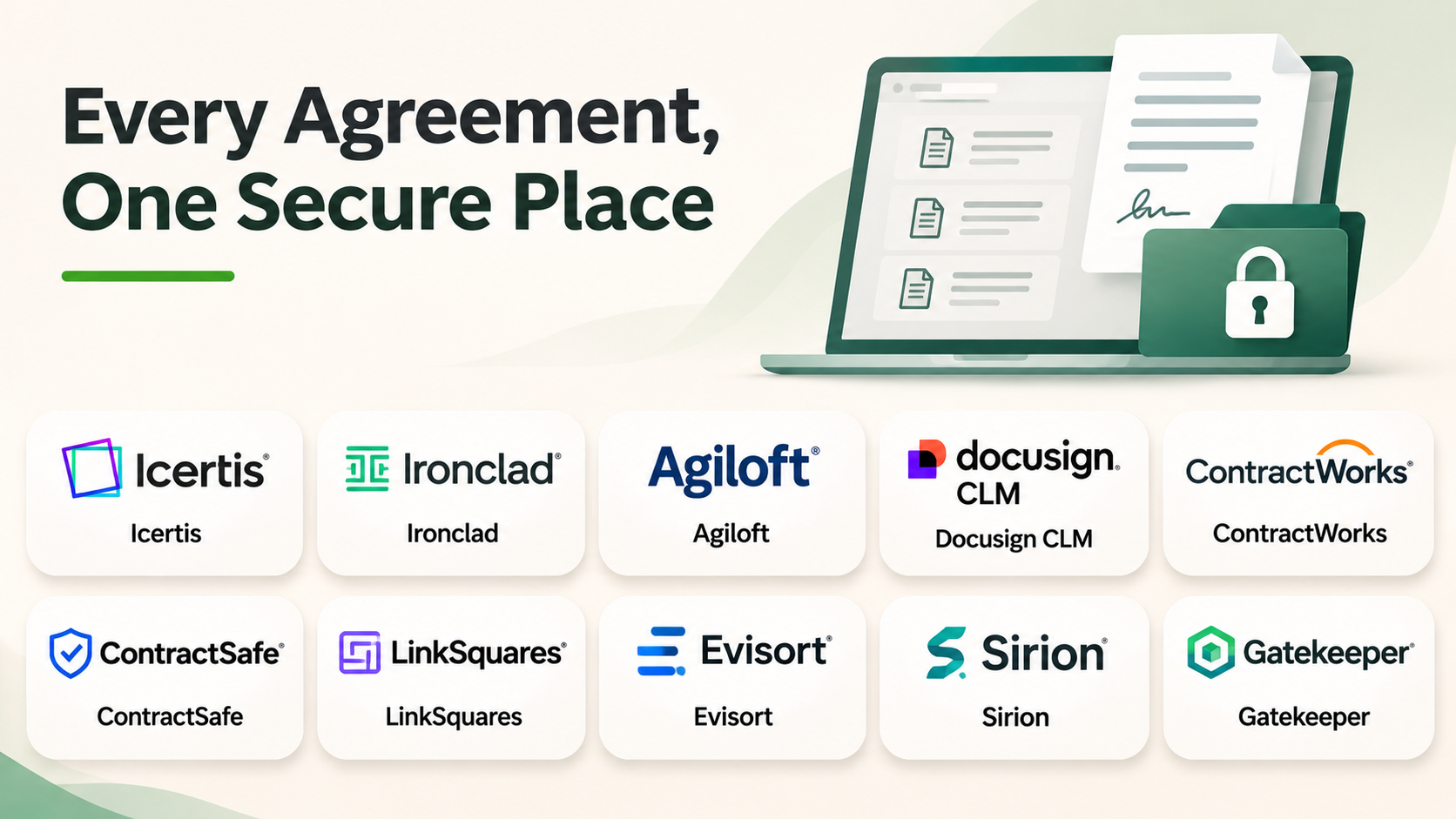
The following solutions include dedicated contract management repositories and comprehensive CLM platforms with centralized storage capabilities. Their numbering does not represent an independently tested performance ranking.
1. Icertis
Short Description
Icertis provides enterprise contract intelligence and lifecycle management technology designed to manage complex contractual relationships. Its centralized repository helps organizations maintain agreements and associated commercial information across multiple business units.
The platform connects contractual documents with broader business processes, including procurement, sales, compliance, and financial management. Its capabilities are particularly relevant to enterprises managing extensive contract portfolios and complex contractual obligations.
Key Features
- Centralized contract repository.
- Contract metadata management.
- Advanced document search.
- AI-assisted contract intelligence.
- Contract relationship management.
- Renewal and expiration monitoring.
- Configurable access controls.
- Enterprise application integrations.
Benefits
- Improves enterprise contract visibility.
- Supports contractual compliance.
- Facilitates contract information retrieval.
- Strengthens commercial accountability.
- Connects contractual and operational information.
Pros
- Comprehensive enterprise CLM functionality.
- Relevant contract intelligence capabilities.
- Supports complex organizational structures.
- Broad enterprise integration options.
Cons
- Implementation can be resource-intensive.
- Configuration requires specialist expertise.
- Commercial pricing requires consultation.
Use Cases
- Global contract repository management.
- Enterprise procurement agreements.
- Commercial obligation monitoring.
- Contract compliance assessments.
Best For: Multinational corporations, enterprise legal departments, procurement teams, and regulated organizations.
2. Ironclad
Short Description
Ironclad provides digital contract management technology supporting contract creation, approval, execution, and centralized document storage. Its repository enables organizations to maintain searchable records of contractual agreements and associated information.
Legal and business teams can use configurable workflows to coordinate contract activities across departments. AI-assisted capabilities can support document analysis and information extraction, subject to appropriate verification.
Key Features
- Centralized digital repository.
- Advanced contract search.
- Configurable metadata fields.
- AI-assisted document analysis.
- Contract workflow automation.
- Renewal date monitoring.
- Document access management.
- Electronic signature integrations.
Benefits
- Improves contract accessibility.
- Reduces fragmented document storage.
- Supports legal and business collaboration.
- Facilitates contract deadline monitoring.
- Strengthens contract administration.
Pros
- Integrated contract lifecycle workflows.
- Relevant search and repository functionality.
- Supports cross-department collaboration.
- Configurable contract processes.
Cons
- Advanced configurations require planning.
- Automated extraction requires validation.
- Pricing depends on commercial arrangements.
Use Cases
- Corporate legal contract storage.
- Sales agreement management.
- Procurement contract administration.
- Contract workflow standardization.
Best For: Corporate legal teams, technology companies, sales operations departments, and growing enterprises.
3. Agiloft
Short Description
Agiloft provides configurable contract lifecycle management technology designed to support diverse contractual workflows. Its repository functionality enables organizations to maintain structured contract records and associated documentation.
The platform allows businesses to configure metadata, permissions, approval processes, and notifications according to organizational requirements. Its flexibility is particularly relevant to organizations with specialized contract administration procedures.
Key Features
- Centralized contract storage.
- Configurable metadata management.
- Advanced search functionality.
- Contract relationship tracking.
- Automated renewal reminders.
- Configurable approval workflows.
- Role-based access controls.
- Contract reporting dashboards.
Benefits
- Supports customized contract management.
- Improves contractual information visibility.
- Facilitates deadline monitoring.
- Strengthens document governance.
- Reduces manual administrative activities.
Pros
- Extensive configuration capabilities.
- Comprehensive contract management functionality.
- Supports specialized workflows.
- Relevant enterprise integration options.
Cons
- Configuration requires careful governance.
- Complex deployments may need specialists.
- Commercial pricing requires consultation.
Use Cases
- Customized contract repositories.
- Supplier agreement administration.
- Legal document management.
- Contract renewal tracking.
Best For: Large enterprises, legal operations teams, procurement departments, and organizations with complex contractual processes.
4. Docusign CLM
Short Description
Docusign CLM provides contract lifecycle management capabilities covering document generation, approval, negotiation, execution, and storage. Its centralized repository supports organizations seeking consistent management of contractual documents.
Integration with compatible Docusign electronic signature capabilities helps connect agreement execution with document administration. Businesses can configure workflows to support contractual approvals and information management.
Key Features
- Centralized agreement repository.
- Contract metadata management.
- Document search.
- Contract workflow automation.
- Document version management.
- Electronic signature integration.
- Configurable access permissions.
- Contract reporting.
Benefits
- Connects contract execution and storage.
- Improves agreement accessibility.
- Supports standardized contract workflows.
- Reduces fragmented document administration.
- Strengthens contractual accountability.
Pros
- Established electronic signature ecosystem.
- Comprehensive contract lifecycle capabilities.
- Relevant enterprise workflow functionality.
- Supports cross-department contract management.
Cons
- Full CLM functionality requires appropriate licensing.
- Implementation complexity varies.
- Integration requirements should be evaluated.
Use Cases
- Executed agreement storage.
- Enterprise sales contracts.
- Supplier agreement administration.
- Digital contract lifecycle management.
Best For: Enterprises, legal departments, sales operations teams, and organizations using Docusign services.
5. ContractWorks
Short Description
ContractWorks, part of Onit, provides contract management software emphasizing centralized document storage, search, reporting, and deadline monitoring. Its capabilities help organizations establish structured contract administration without necessarily implementing complex enterprise workflows.
The platform supports contract tagging and configurable notifications for important contractual dates. Legal and administrative teams can use these capabilities to improve visibility into existing agreements.
Key Features
- Centralized contract repository.
- Searchable document storage.
- Contract tagging.
- AI-assisted information extraction.
- Automated deadline notifications.
- Document permissions.
- Contract reporting.
- Electronic signature capabilities.
Benefits
- Improves contract organization.
- Supports efficient document retrieval.
- Reduces missed contractual deadlines.
- Strengthens document accessibility.
- Simplifies contract administration.
Pros
- Dedicated contract repository orientation.
- Accessible contract management workflows.
- Relevant notification functionality.
- Suitable for smaller legal teams.
Cons
- Complex enterprise workflows require evaluation.
- Automated tagging requires review.
- Current commercial plans should be confirmed.
Use Cases
- Centralized legal document storage.
- Contract expiration tracking.
- Supplier agreement management.
- Corporate contract inventory reporting.
Best For: Small and mid-sized businesses, legal departments, nonprofit organizations, and contract administrators.
6. ContractSafe
Short Description
ContractSafe provides contract management software focused on searchable document storage, contract organization, and deadline monitoring. It helps organizations replace fragmented agreement storage with a centralized digital repository.
Its search and reminder capabilities support teams managing contracts without extensive contract authoring or negotiation requirements. Organizations can establish standardized document categories and permissions to improve contract administration.
Key Features
- Centralized contract storage.
- Full-text document search.
- Optical Character Recognition (OCR).
- Contract metadata fields.
- Renewal and expiration reminders.
- User access management.
- Contract categorization.
- Contract reporting.
Benefits
- Improves contract retrieval.
- Reduces manual document searches.
- Supports renewal management.
- Simplifies contract organization.
- Strengthens document accessibility.
Pros
- Strong repository-focused functionality.
- Searchable scanned documents.
- Relevant deadline notification capabilities.
- Suitable for straightforward contract administration.
Cons
- Advanced negotiation workflows may be limited.
- Scanned document quality affects text recognition.
- Enterprise integration requirements need evaluation.
Use Cases
- Small business contract storage.
- Commercial lease administration.
- Contract renewal monitoring.
- Historical agreement digitization.
Best For: Small businesses, mid-sized organizations, administrative teams, and legal professionals requiring accessible contract repositories.
7. LinkSquares
Short Description
LinkSquares provides contract management technology designed to support legal teams throughout the contractual lifecycle. Its post-signature contract analysis capabilities help organizations organize executed agreements and identify relevant contractual information.
The platform combines centralized storage with AI-assisted contract analysis and reporting. Legal professionals can use extracted information to support contract reviews, subject to appropriate verification.
Key Features
- Centralized contract repository.
- AI-assisted metadata extraction.
- Advanced document search.
- Contract portfolio analytics.
- Renewal date monitoring.
- Contract reporting.
- Configurable access controls.
- Contract workflow integration.
Benefits
- Improves contract portfolio visibility.
- Supports efficient information retrieval.
- Reduces repetitive contract review activities.
- Facilitates contractual deadline monitoring.
- Strengthens legal operations reporting.
Pros
- Relevant post-signature contract intelligence.
- Strong legal operations orientation.
- Supports structured contract analytics.
- Integrated contract management capabilities.
Cons
- Extracted contractual information requires validation.
- Pricing depends on selected functionality.
- Complex integrations may require planning.
Use Cases
- Executed contract analysis.
- Legal operations reporting.
- Commercial agreement reviews.
- Contract renewal assessments.
Best For: Corporate legal departments, technology companies, contract managers, and legal operations professionals.
8. Evisort
Short Description
Evisort, acquired by Workday, provides AI-assisted contract intelligence and management technology. Its capabilities help organizations consolidate contractual documents and extract relevant information from agreements.
The platform supports contract analysis across legal, procurement, finance, and commercial operations. Buyers should confirm current Workday product packaging, integration requirements, and repository functionality.
Key Features
- Centralized contract information management.
- AI-assisted document analysis.
- Contract metadata extraction.
- Advanced agreement search.
- Contract analytics.
- Clause identification.
- Contract deadline monitoring.
- Enterprise information integration.
Benefits
- Improves contractual information visibility.
- Supports large-scale agreement analysis.
- Reduces repetitive information extraction.
- Facilitates contractual risk reviews.
- Connects contracts with business information.
Pros
- Specialized contract intelligence capabilities.
- Relevant AI-assisted document processing.
- Supports enterprise contract portfolios.
- Potential integration with broader Workday applications.
Cons
- Automated extraction requires professional review.
- Current product packaging requires verification.
- Enterprise deployment may require specialists.
Use Cases
- Historical contract analysis.
- Procurement agreement intelligence.
- Contract portfolio consolidation.
- Commercial clause identification.
Best For: Enterprise legal teams, procurement departments, financial organizations, and contract intelligence specialists.
9. Sirion
Short Description
Sirion provides contract lifecycle management technology with capabilities supporting contract intelligence, supplier relationships, and post-signature contract administration. Its repository helps organizations maintain contractual documents and related operational information.
The platform is particularly relevant to businesses managing complex commercial agreements and ongoing supplier performance requirements. Contract information can support obligation monitoring and commercial relationship management.
Key Features
- Centralized contract repository.
- Contract information extraction.
- Advanced document search.
- Obligation management.
- Contract performance monitoring.
- Supplier relationship integration.
- Renewal tracking.
- Contract analytics.
Benefits
- Improves post-signature contract visibility.
- Supports contractual performance monitoring.
- Facilitates supplier relationship management.
- Strengthens obligation accountability.
- Connects contractual and operational information.
Pros
- Strong post-signature contract management orientation.
- Relevant supplier performance capabilities.
- Supports complex commercial agreements.
- Comprehensive CLM functionality.
Cons
- Implementation can be complex.
- Configuration requires contractual expertise.
- Commercial pricing requires consultation.
Use Cases
- Outsourcing contract management.
- Supplier agreement monitoring.
- Contract performance assessment.
- Commercial obligation administration.
Best For: Large enterprises, procurement departments, outsourcing managers, and complex contract management teams.
10. Gatekeeper
Short Description
Gatekeeper provides vendor and contract management technology designed to centralize supplier relationships and contractual information. Its repository helps organizations maintain agreements alongside relevant supplier records and administrative workflows.
Procurement and finance teams can use the platform to coordinate contract renewals, supplier onboarding, and contract-related responsibilities. Its combined vendor and contract management approach supports organizations seeking integrated commercial oversight.
Key Features
- Centralized contract repository.
- Vendor information management.
- Contract metadata fields.
- Renewal and expiration reminders.
- Configurable workflows.
- Document search.
- Access permissions.
- Contract and vendor reporting.
Benefits
- Connects supplier and contract information.
- Improves renewal visibility.
- Supports procurement accountability.
- Facilitates vendor administration.
- Reduces fragmented contractual records.
Pros
- Integrated vendor and contract management.
- Relevant renewal monitoring capabilities.
- Configurable administrative workflows.
- Suitable for procurement-focused organizations.
Cons
- Advanced legal negotiation requirements need evaluation.
- Configuration requires accurate supplier records.
- Commercial costs depend on selected functionality.
Use Cases
- Supplier contract management.
- Vendor renewal monitoring.
- Procurement contract repositories.
- Third-party agreement administration.
Best For: Procurement teams, vendor managers, mid-sized enterprises, and financial controllers.
Comparison Table: Top 10 Contract Repository Tools
| Software | Primary Strength | Best For | Pricing Approach |
|---|---|---|---|
| Icertis | Enterprise contract intelligence | Large corporations | Vendor quotation |
| Ironclad | Digital contract workflows | Corporate legal teams | Commercial subscription |
| Agiloft | Configurable CLM | Complex enterprises | Vendor quotation |
| Docusign CLM | Agreement lifecycle integration | Enterprise contract teams | Commercial licensing |
| ContractWorks | Repository administration | Mid-sized businesses | Plan-dependent |
| ContractSafe | Search and deadline monitoring | Smaller contract teams | Plan-dependent |
| LinkSquares | Post-signature analytics | Legal operations | Vendor quotation |
| Evisort | AI-assisted contract intelligence | Enterprise analytics | Verify Workday offering |
| Sirion | Contract performance management | Complex supplier relationships | Vendor quotation |
| Gatekeeper | Vendor and contract management | Procurement teams | Plan-dependent |
Functional Comparison
| Platform | Repository | Contract Intelligence | Lifecycle Workflows |
|---|---|---|---|
| Icertis | Available | Advanced focus | Comprehensive |
| Ironclad | Available | Available | Comprehensive |
| Agiloft | Available | Configuration-dependent | Comprehensive |
| Docusign CLM | Available | Offering-dependent | Comprehensive |
| ContractWorks | Dedicated focus | Available | Selected workflows |
| ContractSafe | Dedicated focus | Search and extraction | Selected workflows |
| LinkSquares | Available | Advanced focus | Available |
| Evisort | Available | Advanced focus | Verify current offering |
| Sirion | Available | Advanced focus | Comprehensive |
| Gatekeeper | Available | Offering-dependent | Vendor-focused |
How to Choose the Best Contract Repository Tool
Evaluate Contract Storage Requirements
Determine the number, types, and complexity of agreements requiring centralized storage. Organizations should also consider historical documents, amendments, supporting attachments, and anticipated portfolio growth.
Review Search and Retrieval Capabilities
Assess full-text search, metadata filters, document indexing, and scanned document recognition. Representative search tests should include different agreement formats and document quality levels.
Examine Metadata Extraction
Evaluate whether the software can identify contractual parties, dates, renewal conditions, and relevant clauses. Important extracted information should remain subject to appropriate human verification.
Assess Security and Permissions
Review authentication, encryption, document access controls, and audit logging. Contract permissions should reflect departmental responsibilities and confidentiality requirements.
Evaluate Renewal Management
Determine whether the platform supports configurable reminders, notice periods, and assigned contract owners. Renewal monitoring should account for contractual notice deadlines rather than expiration dates alone.
Review Integration and Ownership Costs
Examine compatibility with procurement, sales, financial, and electronic signature applications. Include subscriptions, document migration, configuration, training, and continuing support when evaluating ownership costs.
Best Contract Repository Tools by User Type
| User Type | Relevant Platform |
|---|---|
| Enterprise legal director | Icertis |
| Legal operations manager | Ironclad |
| Contract workflow administrator | Agiloft |
| Electronic agreement manager | Docusign CLM |
| Mid-market contract administrator | ContractWorks |
| Small business administrator | ContractSafe |
| Legal analytics specialist | LinkSquares |
| Contract intelligence analyst | Evisort |
| Outsourcing contract manager | Sirion |
| Procurement and vendor manager | Gatekeeper |
Practical Example: Centralizing Contracts in a Manufacturing Company
Consider a hypothetical manufacturing company managing 3,000 supplier, customer, employment, and commercial agreements. Contract documents are distributed across departmental folders, email accounts, and physical archives.
Management introduces a contract repository to improve document retrieval and reduce missed renewal deadlines. The following implementation process and performance figures are illustrative rather than verified software outcomes.
Implementation Process
- Identify existing contract storage locations.
- Establish a complete contract inventory.
- Remove verified duplicate documents.
- Digitize relevant physical agreements.
- Establish standardized contract categories.
- Configure mandatory metadata fields.
- Import agreements into the repository.
- Validate extracted contractual information.
- Assign responsible contract owners.
- Configure renewal and notice-period reminders.
- Establish departmental access permissions.
- Train legal, procurement, and finance employees.
- Conduct document retrieval and security testing.
- Monitor contract administration performance.
Illustrative Performance Improvements
| Performance Indicator | Before | After |
|---|---|---|
| Average contract retrieval time | 20 minutes | 4 minutes |
| Centralized contract coverage | 45% | 98% |
| Contracts with assigned owners | 55% | 95% |
| Annual missed notice deadlines | 18 | 3 |
| Metadata completeness | 50% | 96% |
| Monthly reporting preparation | 40 hours | 10 hours |
Assume employees conduct 600 contract searches each month and save 16 minutes per search. This improvement releases approximately 160 employee hours each month, or 1,920 hours annually.
At an illustrative labor cost of $30 per hour, the released capacity represents $57,600 in annual labor value. This figure does not automatically represent cash savings unless actual staffing expenditure is reduced or additional hiring is avoided.
Organizations should also consider software subscriptions, document migration, employee training, and continuing support. Additional financial benefits from improved renewal decisions should be measured separately to avoid double counting.
Important Contract Repository Performance Indicators
- Centralized contract coverage.
- Average document retrieval time.
- Contract metadata completeness.
- Contract owner assignment rate.
- Missed contractual notice deadlines.
- Renewal review completion rate.
- Duplicate contract frequency.
- Document classification accuracy.
- Contract migration completion.
- Unauthorized access incidents.
- Contract reporting preparation time.
- Repository user adoption.
Security and Governance Considerations
Contract repositories contain confidential commercial agreements, financial information, intellectual property provisions, and potentially sensitive personal information. Organizations should implement appropriate encryption, authentication, access restrictions, and document retention controls.
Document permissions should follow the principle of least privilege, providing employees with only the access necessary for their responsibilities. Contract amendments, executed agreements, and supporting records should remain traceable throughout their retention periods.
Challenges and Limitations
Contract repository implementation can become difficult when historical agreements contain inconsistent metadata, missing signatures, or incomplete amendments. Organizations should establish document verification procedures before relying on migrated information.
Automated contract analysis may incorrectly interpret complex clauses, scanned documents, or unusual contractual language. Legal professionals should review consequential contractual information before making decisions based on automated extraction.
Best Practices for Contract Repository Management
- Establish a centralized contract inventory.
- Define standardized contract categories.
- Maintain consistent metadata requirements.
- Preserve executed agreement versions.
- Link amendments to original contracts.
- Assign responsible contract owners.
- Configure notice-period reminders.
- Validate automated information extraction.
- Restrict access to confidential agreements.
- Establish appropriate retention policies.
- Train employees on repository procedures.
- Conduct regular contract inventory reviews.
Future Trends in Contract Repository Software
AI-assisted contract analysis may increasingly support document classification, clause identification, and natural language search. These capabilities can improve information accessibility while requiring appropriate validation and legal oversight.
Integrated contract intelligence, automated obligation monitoring, and connected enterprise applications are also important development areas. Future repositories may provide stronger connections between contractual commitments and operational business performance.
Frequently Asked Questions
1. What is contract repository software?
Contract repository software provides centralized storage and management of contractual documents. It supports document retrieval, organization, security, and deadline monitoring.
2. Why is a contract repository important?
A contract repository helps organizations maintain accessible and organized contractual records. It can reduce administrative delays and missed contractual deadlines.
3. What is Icertis?
Icertis provides enterprise contract intelligence and lifecycle management technology. Its capabilities support centralized contract storage and complex contractual workflows.
4. What is Ironclad?
Ironclad provides digital contract management software. Its functionality supports contract workflows, document storage, and legal collaboration.
5. What is Agiloft?
Agiloft provides configurable contract lifecycle management technology. Organizations can customize contract repositories and administrative workflows according to their requirements.
6. What is Docusign CLM?
Docusign CLM provides contract lifecycle management capabilities. It supports contract creation, approval, execution, and centralized agreement storage.
7. What is ContractWorks?
ContractWorks provides contract management software emphasizing centralized storage and deadline monitoring. It helps organizations maintain searchable contractual records.
8. What is ContractSafe?
ContractSafe provides contract repository and management software. Its capabilities focus on document search, organization, and contractual reminders.
9. What is LinkSquares?
LinkSquares provides contract management and contract intelligence technology. Its capabilities support executed agreement analysis and legal operations.
10. What is Evisort?
Evisort provides AI-assisted contract intelligence technology and was acquired by Workday. Organizations should verify current product availability and packaging.
11. What is Sirion?
Sirion provides contract lifecycle management and contract performance technology. Its capabilities support complex commercial agreements and post-signature administration.
12. What is Gatekeeper?
Gatekeeper provides vendor and contract management software. It connects supplier information with contractual documents and administrative workflows.
13. What is contract metadata?
Contract metadata describes important information associated with an agreement. Examples include contractual parties, agreement types, effective dates, and renewal conditions.
14. What is contract lifecycle management?
Contract lifecycle management coordinates contractual activities from creation through expiration or termination. A repository provides centralized document storage within this broader process.
15. What is full-text contract search?
Full-text search allows users to locate information within contractual documents. It complements searches based on document names and metadata fields.
16. What is OCR in contract management?
OCR stands for Optical Character Recognition. It converts text within scanned documents into machine-readable information.
17. Can contract repositories track renewal dates?
Many contract repositories provide renewal and expiration notifications. Organizations should configure reminders based on verified contractual notice requirements.
18. Can AI extract contractual information?
AI-assisted tools can identify selected dates, clauses, and contractual parties. Important extracted information requires professional verification.
19. Are contract repositories suitable for small businesses?
Small businesses can use appropriately scoped repositories to organize agreements and monitor deadlines. Simpler solutions may be more suitable than comprehensive enterprise CLM platforms.
20. Can contract repositories store confidential documents?
Contract repositories can support confidential document storage through appropriate security controls. Organizations should verify security capabilities and configure access permissions carefully.
21. Can contract repositories integrate with ERP systems?
Many enterprise contract platforms support ERP integrations or application interfaces. Compatibility should be confirmed before implementation.
22. How much does contract repository software cost?
Costs depend on document volumes, user requirements, functionality, and implementation scope. Organizations should request detailed commercial quotations.
23. What is a contract audit trail?
A contract audit trail records relevant document activities and changes. It supports accountability and contractual governance.
24. Can contract repository software guarantee compliance?
Contract repository software cannot independently guarantee legal or regulatory compliance. Organizations remain responsible for appropriate contractual reviews and governance procedures.
25. Which contract repository tool is best?
The appropriate platform depends on document volumes, search requirements, security needs, and workflow complexity. Dedicated repositories and comprehensive CLM suites address different organizational requirements.
Conclusion
Contract repository tools help organizations maintain centralized, searchable, and appropriately secured contractual records. These capabilities support efficient document retrieval, renewal monitoring, and contractual accountability.
Icertis, Ironclad, Agiloft, and Docusign CLM provide comprehensive contract lifecycle management capabilities. Their suitability depends on organizational complexity and broader contractual workflow requirements.
ContractWorks and ContractSafe provide repository-focused approaches to contract administration, while LinkSquares and Evisort emphasize contract intelligence. Sirion and Gatekeeper provide relevant capabilities for managing commercial agreements and supplier relationships.
Successful implementation requires accurate document inventories, consistent metadata, appropriate security controls, and clearly assigned contractual responsibilities. Organizations should evaluate information migration requirements and total ownership costs before selecting software.
An effective contract repository strategy combines suitable technology with standardized administrative procedures and professional legal oversight. Regular contract reviews help organizations maintain reliable records, manage contractual deadlines, and strengthen commercial governance.
