Organizations spend millions of dollars reinforcing network perimeters, deploying endpoint detection agents, and enforcing strict identity controls, operating under the assumption that keeping unauthorized users out is enough to keep sensitive data safe. Yet, the most damaging data breaches rarely begin with dramatic external cyberattacks; they happen when well-meaning employees copy customer databases to personal cloud storage, paste proprietary source code into public artificial intelligence chat interfaces, or email financial spreadsheets to unverified external addresses.
Traditional Data Loss Prevention (DLP) solutions earned a reputation for being notoriously heavy, overly restrictive, and prone to generating endless false positives that frustrated developers and business users alike. Modern data protection has evolved far beyond rigid regex matching and blocking USB ports. Today’s enterprise DLP platforms leverage contextual intelligence, cloud-native API integrations, and behavioral analysis to secure sensitive data wherever it lives, moves, or gets processed.
Understanding the Shift in Data Loss Prevention
Data Loss Prevention encompasses tools and strategies designed to detect and prevent unauthorized sharing, transfer, or exfiltration of sensitive information—such as Personally Identifiable Information (PII), intellectual property, and financial records—across endpoints, networks, and cloud environments.
Legacy DLP solutions focused primarily on static signature matching, inspecting emails and file transfers for specific credit card numbers or Social Security patterns. While necessary, this approach fails in modern distributed architectures where data is constantly modified, renamed, or shared via cloud collaboration tools and SaaS applications.
A comprehensive modern DLP framework operates across three primary data states:
- Data at Rest: Discovering and classifying sensitive files stored across local endpoints, file shares, cloud object storage, and SaaS repositories.
- Data in Transit: Monitoring network traffic, email attachments, web uploads, and messaging apps to block unauthorized data exfiltration in real time.
- Data in Use: Inspecting user actions on endpoints, such as copying data to local clipboards, printing confidential documents, or uploading snippets to unauthorized web apps.
The fundamental objective is to protect data flows without introducing administrative friction that grinds business productivity to a halt.
Key Evaluation Criteria for Modern DLP Solutions
Selecting an effective Data Loss Prevention platform requires analyzing classification accuracy, multi-channel coverage, and deployment flexibility.
Contextual Classification and Machine Learning
Rigid regex patterns easily lead to false positives (such as flagging a random serial number as a credit card). Modern DLP platforms utilize advanced machine learning models, exact data matching (EDM), and semantic analysis to understand the true context and sensitivity of data.
Unified Cloud and Endpoint Visibility
Enterprise data no longer resides solely on corporate laptops. A robust DLP solution must extend seamlessly from physical endpoints to cloud storage buckets, SaaS collaboration platforms like Microsoft 365 and Slack, and remote worker connections without requiring separate management consoles.
Policy Granularity and User Coaching
Blocking a user outright often drives shadow IT adoption, where employees find unmonitored workarounds. Leading DLP platforms offer interactive user coaching—prompting users to confirm if an attachment is intentional or providing a business justification before allowing an upload.
Leading Data Loss Prevention Platforms and Approaches
The DLP market features established enterprise security heavyweights alongside specialized cloud-native data protection innovators.
Microsoft Purview Data Loss Prevention
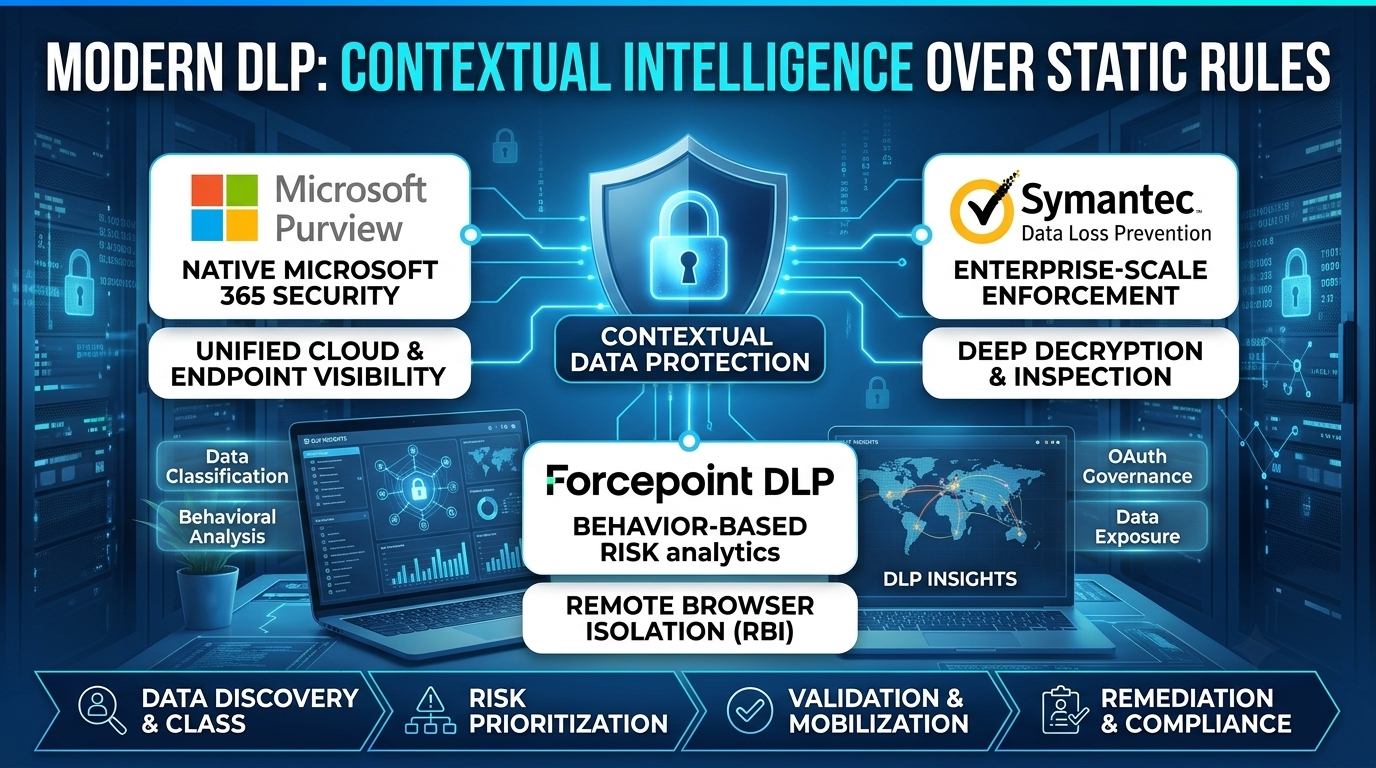
Microsoft Purview provides comprehensive, integrated data protection built directly into the Microsoft 365 ecosystem, offering native classification, endpoint monitoring, and cloud governance.
- Primary Focus: Native data protection and compliance across Microsoft 365 services, endpoints, and multi-cloud environments.
- Deployment Model: Cloud-native SaaS service integrated with Windows endpoints and Microsoft security tooling.
- Significant Advantage: Seamless integration with existing Microsoft infrastructure and document sensitivity labels without requiring third-party agents.
- Important Limitation: Optimized primarily for organizations deeply embedded in the Microsoft enterprise software and cloud ecosystem.
Symantec Data Loss Prevention (Broadcom)
Symantec offers an established, heavy-duty enterprise DLP solution renowned for its comprehensive policy engine and deep visibility across network, storage, and endpoint channels.
- Primary Focus: Deep enterprise-scale data discovery, policy enforcement, and incident remediation.
- Deployment Model: On-premises management servers with network sniffers, storage scanners, and endpoint agents.
- Significant Advantage: Mature, highly granular rule engine capable of enforcing strict compliance policies across complex legacy and modern infrastructures.
- Important Limitation: High deployment complexity, administrative overhead, and infrastructure footprint cater primarily to large enterprises.
Forcepoint DLP
Forcepoint focuses on behavior-based security, combining traditional data loss prevention with risk-adaptive protection that adjusts enforcement based on user behavior and intent.
- Primary Focus: Behavior-based data protection and risk-adaptive policy enforcement.
- Deployment Model: Hybrid deployment supporting cloud and on-premises control points.
- Significant Advantage: Innovative risk-adaptive analytics that apply stricter controls only to high-risk users rather than penalizing the entire organization.
- Important Limitation: Requires careful initial configuration and data baselining to calibrate risk scoring models accurately.
Platform Comparison Overview
| Product | Primary Focus | Deployment Model | Significant Advantage | Important Limitation |
| Microsoft Purview | Native Microsoft ecosystem and cloud data governance | Cloud SaaS / Endpoint | Exceptional integration with Microsoft 365 and Windows environments | Best optimized for organizations standardized on Microsoft software |
| Symantec DLP | Enterprise-scale network, storage, and endpoint monitoring | On-Prem / Hybrid | Deep, highly customizable policy engine for complex corporate networks | High administrative overhead and resource-intensive deployment |
| Forcepoint DLP | Behavior-driven risk analysis and adaptive security | Hybrid / Cloud | Dynamically adjusts controls based on individual user risk profiles | Requires disciplined initial baselining and policy tuning |
Operational Risks and Common Pitfalls
Implementing a Data Loss Prevention program introduces distinct organizational and technical challenges that security leaders must navigate.
The Trap of Overly Restrictive Default Policies
Enabling aggressive blocking rules on day one without proper data discovery and stakeholder alignment usually results in blocked business workflows, frustrated employees, and executive pushback. A phased rollout starting with audit-only mode is essential.
Neglecting Unstructured Data and Shadow IT
Focusing exclusively on structured databases while ignoring unstructured files, personal cloud drives, and collaboration chat apps leaves massive blind spots where sensitive data routinely leaks.
Treating DLP as a Set-It-and-Forget-It Project
Data landscapes change continuously as employees create new files, adopt new SaaS tools, and restructure business units. Continuous policy tuning and classification updates are mandatory to prevent policy drift.
Questions to Guide Vendor Selection
Before procuring a DLP solution, security architects and compliance officers should address several critical operational questions:
- How does the platform classify data? Does it rely solely on basic regex patterns, or does it incorporate machine learning and exact data matching to reduce false positives?
- How well does the solution cover non-traditional channels, such as personal device access, cloud-to-cloud transfers, and AI chat tool data pastes?
- What user notification and coaching capabilities exist to educate employees rather than simply blocking actions without explanation?
- How easily do DLP incident alerts integrate with existing Security Information and Event Management (SIEM) and Security Orchestration, Automation, and Response (SOAR) workflows?
Making the Final Decision
Choosing a Data Loss Prevention platform depends heavily on an organization’s software ecosystem, compliance mandates, and operational maturity.
Organizations heavily standardized on Microsoft collaboration and cloud tools often achieve rapid deployment and deep visibility through Microsoft Purview. Conversely, large, heterogeneous enterprises managing complex hybrid networks and strict regulatory frameworks frequently rely on established enterprise platforms like Symantec or adaptive solutions like Forcepoint to enforce granular data governance.
Ultimately, modern Data Loss Prevention bridges the gap between security and productivity, ensuring that sensitive data remains protected without hindering the speed of modern business.
