Introduction
Differential privacy toolkits help organizations analyze sensitive information while limiting the extent to which computational results reveal information about individual participants. These technologies apply mathematically defined privacy mechanisms to statistical analysis, machine learning, and information publishing workflows.
Traditional information anonymization techniques often depend on removing direct identifiers or modifying sensitive attributes. However, individuals may still be identifiable through information linkage, repeated queries, and combinations of seemingly anonymous records.
Differential privacy provides a mathematical framework for limiting the influence of individual records or participants on released computational results. Appropriately implemented mechanisms introduce controlled randomness while balancing information usefulness and privacy protection.
Modern differential privacy toolkits provide capabilities such as privacy accounting, statistical noise generation, private aggregation, machine learning optimization, and privacy budget management. These capabilities help developers implement measurable privacy guarantees within supported computational environments.
Healthcare organizations, financial institutions, government agencies, research institutions, and technology companies can use differential privacy to support responsible information analysis. Successful implementation requires appropriate privacy parameters, contribution limits, threat modeling, and independent validation.
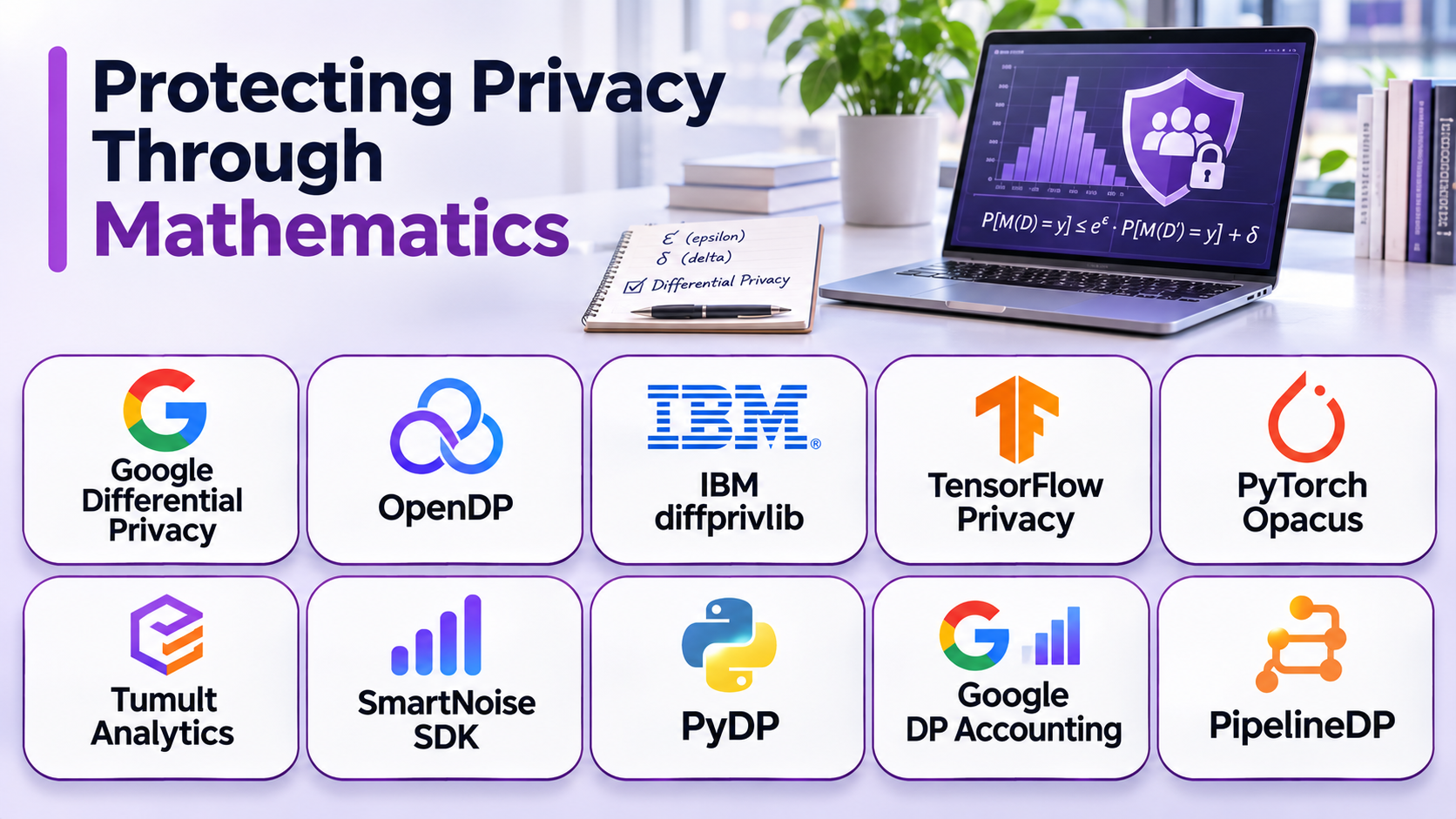
This guide examines ten differential privacy toolkits, including their features, benefits, advantages, limitations, and practical applications. It also provides comparison tables, implementation guidance, security considerations, practical examples, and frequently asked questions.
What Are Differential Privacy Toolkits?
Differential privacy toolkits are software libraries and frameworks designed to implement mathematically defined privacy protection mechanisms. They help organizations release statistical information or train compatible machine learning models while limiting individual-level information disclosure.
Differential privacy evaluates how computational outputs may change when an individual contribution is added, removed, or replaced according to a defined neighboring dataset relationship. A differentially private mechanism limits the distinguishability of these neighboring datasets through a formal mathematical guarantee.
The privacy parameter epsilon represents an important component of this guarantee. Smaller epsilon values generally provide stronger privacy protection under comparable assumptions, although they may introduce greater statistical error.
Some differential privacy mechanisms also use a parameter called delta. Delta represents an additive relaxation of the privacy guarantee and must be selected carefully according to the application and privacy requirements.
Privacy accounting helps organizations evaluate the cumulative privacy implications of multiple computations. Repeated releases can consume additional privacy budget, making coordinated information governance essential.
Differential privacy does not automatically make every dataset anonymous or eliminate every information security risk. Its effectiveness depends on the selected privacy definition, implementation, contribution bounds, parameters, and complete information release process.
How Do Differential Privacy Toolkits Work?
- Identify sensitive datasets and approved analytical objectives.
- Define the protected privacy unit.
- Establish the neighboring dataset relationship.
- Determine individual contribution limits.
- Select an appropriate privacy mechanism.
- Establish epsilon and applicable delta parameters.
- Bound or clip sensitive numerical contributions.
- Calculate the sensitivity of the intended computation.
- Apply calibrated statistical noise.
- Track cumulative privacy expenditure.
- Evaluate analytical accuracy and usefulness.
- Release approved privacy-protected results.
- Monitor subsequent queries and information releases.
- Review privacy guarantees following implementation changes.
Traditional Anonymization vs. Differential Privacy
| Evaluation Area | Traditional Anonymization | Differential Privacy |
|---|---|---|
| Privacy approach | Identifier removal or transformation | Mathematical privacy guarantees |
| Reidentification protection | Method-dependent | Formally bounded under defined assumptions |
| Statistical noise | Optional | Commonly required |
| Privacy measurement | Often heuristic | Quantifiable parameters |
| Repeated query management | Frequently manual | Privacy composition and accounting |
| Individual contribution protection | Method-dependent | Explicit privacy unit |
| External information linkage | May create vulnerabilities | Guarantee accommodates auxiliary information |
| Analytical accuracy | Transformation-dependent | Privacy-utility trade-off |
| Machine learning integration | Conventional preprocessing | Private training mechanisms |
| Contribution bounding | Not always required | Frequently essential |
| Implementation complexity | Method-dependent | Specialized mathematical requirements |
| Governance | Information handling policies | Policies and privacy accounting |
Common Applications of Differential Privacy
- Privacy-preserving healthcare statistics.
- Confidential population analysis.
- Private machine learning model training.
- Government census information publishing.
- Privacy-preserving customer analytics.
- Confidential financial statistics.
- Secure research information sharing.
- Privacy-oriented recommendation systems.
- Private advertising measurement.
- Confidential employee analytics.
- Differentially private synthetic data generation.
- Privacy-preserving federated learning.
Key Components of Differential Privacy Toolkits
| Component | Primary Function |
|---|---|
| Privacy mechanism | Implements formal privacy protection |
| Epsilon parameter | Defines a privacy loss bound |
| Delta parameter | Defines an additive privacy relaxation |
| Privacy accountant | Tracks cumulative privacy expenditure |
| Contribution bounding | Restricts individual influence |
| Sensitivity calculation | Measures potential computational change |
| Noise generator | Produces calibrated randomness |
| Clipping mechanism | Restricts numerical contributions |
| Private aggregation | Produces protected statistical results |
| Sampling mechanism | Supports applicable privacy amplification |
| Private optimizer | Enables privacy-preserving model training |
| Query interface | Supports approved analytical operations |
| Privacy ledger | Records privacy budget expenditure |
| Utility evaluator | Measures analytical accuracy |
| Secure random generation | Supports appropriate randomness requirements |
| Release governance | Controls publication of protected outputs |
Types of Differential Privacy Toolkits
Statistical Differential Privacy Libraries
Statistical libraries provide mechanisms for privacy-preserving counts, sums, averages, histograms, and other supported analytical operations. They are particularly relevant to organizations publishing aggregate information.
Differentially Private Machine Learning Frameworks
These frameworks support model training procedures designed to provide differential privacy guarantees. They commonly incorporate gradient clipping, calibrated noise, and privacy accounting.
Differentially Private Query Engines
Private query engines enable approved analytical queries against sensitive datasets. They may provide contribution bounding, privacy budget management, and protected aggregation capabilities.
Local Differential Privacy Libraries
Local differential privacy mechanisms randomize information before it reaches a central collection service. These approaches reduce reliance on a trusted central information curator but may require greater statistical noise.
Differentially Private Synthetic Data Frameworks
These frameworks generate artificial datasets using mechanisms designed to provide formal privacy guarantees. Synthetic information is not inherently differentially private unless its generation process satisfies an appropriate privacy definition.
Key Features of Differential Privacy Toolkits
- Configurable privacy parameters.
- Calibrated statistical noise.
- Privacy budget management.
- Privacy-preserving aggregation.
- Contribution bounding.
- Sensitivity calculation.
- Private machine learning optimization.
- Privacy accounting.
- Protected statistical publishing.
- Numerical clipping.
- Privacy-utility evaluation.
- Application development interfaces.
Top 10 Differential Privacy Toolkits
The following selection includes statistical libraries, machine learning frameworks, analytical engines, and privacy accounting tools. Their numbering does not represent an independently benchmarked ranking, and several offerings address complementary rather than identical requirements.
1. Google Differential Privacy
Short Description
Google Differential Privacy is an open-source collection of libraries and tools designed to support differentially private information analysis. It provides mechanisms for implementing protected statistical computations across supported development environments.
The toolkit supports private aggregation operations such as counts, sums, and averages through applicable libraries. Developers can use these mechanisms to reduce individual-level information disclosure in analytical results.
Google Differential Privacy includes components for noise generation, contribution bounding, privacy accounting, and distributed information processing. Available functionality varies across programming languages and individual project components.
The toolkit is particularly suitable for organizations developing custom privacy-preserving analytical applications. Correct implementation requires careful evaluation of privacy units, contribution limits, and cumulative information releases.
How Google Differential Privacy Works
- Identify approved statistical computations.
- Define individual contribution limits.
- Configure appropriate privacy parameters.
- Select compatible aggregation mechanisms.
- Apply calibrated statistical noise.
- Validate and release protected results.
Key Features
- Private aggregation: Supports protected statistical calculations.
- Noise mechanisms: Provides applicable Laplace and Gaussian mechanisms.
- Contribution bounding: Restricts individual influence.
- Privacy accounting: Supports cumulative privacy analysis through relevant components.
- Multiple programming languages: Provides compatible development libraries.
- Distributed processing: Supports applicable large-scale analytical workflows.
- Configurable privacy parameters: Enables workload-specific configuration.
- Statistical primitives: Provides reusable privacy mechanisms.
- Open-source architecture: Enables source code inspection.
Benefits
- Supports privacy-preserving statistical analysis.
- Facilitates measurable privacy guarantees.
- Enables customizable analytical workflows.
- Supports protected aggregate publishing.
- Reduces repetitive cryptographic and statistical development.
- Provides reusable privacy mechanisms.
- Reduces conventional software licensing expenses.
Pros
- Open-source availability.
- Broad statistical functionality.
- Established engineering ecosystem.
- Multiple compatible development interfaces.
- Relevant privacy accounting components.
- Suitable for scalable analytical applications.
Cons
- Requires differential privacy expertise.
- Contribution limits require careful selection.
- Integration complexity varies.
- Statistical noise can reduce analytical accuracy.
- Governance across independent releases requires additional planning.
Use Cases
- Customer activity statistics.
- Confidential healthcare reporting.
- Private population analytics.
- Protected business intelligence.
- Privacy-preserving usage measurement.
- Distributed statistical analysis.
Best For
- Data engineers.
- Privacy engineers.
- Enterprise analytics teams.
- Software developers.
- Research institutions.
- Organizations publishing sensitive aggregate statistics.
Pricing and Deployment
Google Differential Privacy is available as open-source software. Organizations should account for engineering, computing infrastructure, privacy assessment, and ongoing maintenance expenses.
2. OpenDP
Short Description
OpenDP is an open-source initiative providing tools for building differentially private information analysis applications. It emphasizes reusable privacy transformations, mathematical mechanisms, and composable analytical workflows.
The library enables developers to construct privacy-preserving computations using supported transformations and measurements. These components can help establish formal privacy guarantees for compatible analytical pipelines.
OpenDP provides programming interfaces for privacy-aware statistical analysis and configurable privacy mechanisms. Its architecture supports explicit reasoning about information domains, stability, sensitivity, and privacy expenditure.
The toolkit is particularly suitable for researchers and organizations requiring mathematically grounded privacy analysis. Developers should evaluate supported operations and the maturity of relevant components before production deployment.
How OpenDP Works
- Define the sensitive information domain.
- Establish the protected privacy unit.
- Select compatible transformations.
- Configure appropriate privacy measurements.
- Compose supported analytical operations.
- Evaluate and release approved private results.
Key Features
- Composable transformations: Supports structured analytical pipelines.
- Privacy measurements: Implements supported privacy mechanisms.
- Formal privacy reasoning: Supports mathematical evaluation of privacy guarantees.
- Statistical operations: Enables compatible protected calculations.
- Python interfaces: Supports accessible application development.
- Rust implementation: Provides foundational library components.
- Sensitivity management: Supports applicable stability analysis.
- Configurable privacy parameters: Enables workload-specific privacy configuration.
- Open-source development: Supports independent technical inspection.
Benefits
- Encourages mathematically grounded privacy analysis.
- Supports reusable analytical components.
- Facilitates privacy-preserving research.
- Enables customizable statistical workflows.
- Supports explicit privacy guarantee evaluation.
- Reduces selected implementation complexity.
- Encourages transparent privacy engineering.
Pros
- Open-source availability.
- Strong mathematical foundations.
- Composable privacy architecture.
- Python-oriented development interfaces.
- Research community relevance.
- Suitable for custom privacy applications.
Cons
- Requires mathematical privacy knowledge.
- Supported operations require evaluation.
- Application integration may require engineering.
- Some advanced workflows can be complex.
- Production suitability depends on component maturity.
Use Cases
- Privacy-preserving statistical research.
- Confidential public information publishing.
- Protected survey analysis.
- Private healthcare statistics.
- Academic privacy research.
- Custom differential privacy applications.
Best For
- Privacy researchers.
- Statistical analysts.
- Academic institutions.
- Government data teams.
- Privacy engineers.
- Organizations requiring formal privacy reasoning.
Pricing and Deployment
OpenDP is available as open-source software. Deployment costs include application development, computing resources, independent privacy validation, and operational maintenance.
3. IBM diffprivlib
Short Description
IBM Differential Privacy Library, commonly known as diffprivlib, is an open-source Python library designed to support privacy-preserving statistical analysis and machine learning. It provides interfaces resembling familiar scientific computing and machine learning workflows.
The toolkit includes differential privacy mechanisms, supported statistical functions, and compatible machine learning estimators. Developers can use these components to implement selected privacy-preserving analytical operations.
IBM diffprivlib provides privacy budget accounting and configurable privacy parameters. Appropriate numerical bounds and application-specific assumptions remain necessary for valid privacy guarantees.
The library is particularly suitable for data scientists seeking accessible differential privacy interfaces within Python applications. Supported estimators and analytical operations should be evaluated before production adoption.
How IBM diffprivlib Works
- Identify the statistical or machine learning objective.
- Establish appropriate information bounds.
- Configure privacy parameters.
- Select a compatible private estimator or mechanism.
- Execute the privacy-preserving computation.
- Evaluate privacy expenditure and analytical usefulness.
Key Features
- Private machine learning: Supports compatible learning estimators.
- Statistical mechanisms: Enables protected numerical computations.
- Python interfaces: Integrates with familiar analytical workflows.
- Privacy accounting: Tracks applicable privacy budget consumption.
- Configurable epsilon: Supports workload-specific privacy requirements.
- Numerical bounds: Restricts sensitive input contributions.
- Noise generation: Provides applicable statistical mechanisms.
- Scikit-learn-style interfaces: Simplifies supported model development.
- Open-source availability: Enables source-level review.
Benefits
- Simplifies selected privacy-preserving analytical tasks.
- Supports familiar Python workflows.
- Facilitates private statistical computation.
- Enables compatible private machine learning.
- Supports privacy expenditure tracking.
- Encourages privacy-aware data science.
- Reduces conventional licensing requirements.
Pros
- Accessible Python development interfaces.
- Statistical and machine learning functionality.
- Privacy accounting capabilities.
- Open-source availability.
- Familiar estimator conventions.
- Suitable for analytical prototyping.
Cons
- Limited supported machine learning algorithms.
- Input bounds require careful configuration.
- Statistical noise may reduce accuracy.
- Not a complete enterprise governance platform.
- Current maintenance status should be verified.
Use Cases
- Private regression analysis.
- Confidential classification models.
- Protected descriptive statistics.
- Privacy-preserving customer analytics.
- Academic machine learning research.
- Sensitive numerical analysis.
Best For
- Python developers.
- Data scientists.
- Machine learning researchers.
- Privacy engineers.
- Academic institutions.
- Organizations requiring accessible private analytics.
Pricing and Deployment
IBM diffprivlib is available as open-source software. Organizations should evaluate computing resources, development requirements, privacy assessment, and dependency maintenance.
4. TensorFlow Privacy
Short Description
TensorFlow Privacy is an open-source library designed to support differentially private machine learning within compatible TensorFlow environments. It provides mechanisms for training supported models with formal privacy guarantees.
The library includes differentially private optimization techniques that apply gradient clipping and calibrated noise during model training. These mechanisms help limit the influence of individual training contributions.
TensorFlow Privacy provides relevant privacy accounting and training configuration capabilities. Valid privacy guarantees depend on the sampling process, clipping configuration, noise parameters, and accounting assumptions.
The toolkit is particularly suitable for organizations developing privacy-preserving neural networks within TensorFlow-based workflows. Framework compatibility and current maintenance status should be evaluated before adoption.
How TensorFlow Privacy Works
- Prepare an authorized training dataset.
- Define the protected privacy unit.
- Configure a compatible machine learning model.
- Select a differentially private optimizer.
- Train using gradient clipping and calibrated noise.
- Calculate privacy expenditure and evaluate model accuracy.
Key Features
- Private optimization: Supports differentially private model training.
- Gradient clipping: Bounds supported training contributions.
- Noise injection: Adds calibrated randomness during optimization.
- Privacy accounting: Evaluates applicable training privacy expenditure.
- TensorFlow integration: Supports compatible neural network workflows.
- Configurable noise parameters: Enables privacy-utility evaluation.
- Batch configuration: Supports applicable training arrangements.
- Model evaluation: Complements standard machine learning assessment.
- Open-source development: Enables technical inspection.
Benefits
- Supports privacy-preserving neural network training.
- Reduces individual training information influence.
- Integrates with compatible TensorFlow applications.
- Enables measurable training privacy guarantees.
- Facilitates privacy-oriented AI development.
- Supports configurable privacy-utility trade-offs.
- Encourages responsible model training.
Pros
- Dedicated private machine learning functionality.
- TensorFlow ecosystem compatibility.
- Gradient clipping mechanisms.
- Privacy accounting support.
- Open-source availability.
- Relevant to neural network development.
Cons
- Training overhead can increase.
- Model accuracy may decrease.
- Framework version compatibility requires evaluation.
- Privacy accounting assumptions must be validated.
- Does not automatically provide user-level privacy for repeated records.
Use Cases
- Private healthcare model training.
- Confidential image classification.
- Privacy-preserving recommendation systems.
- Sensitive customer prediction models.
- Academic AI privacy research.
- Protected neural network development.
Best For
- TensorFlow developers.
- Machine learning engineers.
- Data scientists.
- AI research organizations.
- Privacy engineering teams.
- Organizations requiring private neural network training.
Pricing and Deployment
TensorFlow Privacy is available as open-source software. Organizations should evaluate training infrastructure, engineering resources, model optimization, and privacy validation expenses.
5. PyTorch Opacus
Short Description
Opacus is an open-source library designed to support differentially private machine learning using PyTorch. It provides tools for adapting compatible training workflows to privacy-preserving optimization.
The library supports Differentially Private Stochastic Gradient Descent (DP-SGD) through applicable gradient clipping, noise generation, and privacy accounting mechanisms. These capabilities enable developers to evaluate formal training privacy guarantees.
Opacus provides interfaces for integrating privacy mechanisms into compatible PyTorch models, optimizers, and data loaders. Model architecture and training configuration must satisfy applicable implementation requirements.
The toolkit is particularly suitable for AI developers working within the PyTorch ecosystem. Organizations should evaluate privacy assumptions, model accuracy, training overhead, and supported neural network components.
How Opacus Works
- Prepare an authorized training dataset.
- Configure a compatible PyTorch model.
- Establish clipping and noise parameters.
- Integrate the Opacus privacy engine.
- Execute privacy-preserving training.
- Evaluate privacy expenditure and model performance.
Key Features
- Privacy engine: Coordinates supported private training components.
- DP-SGD: Enables compatible private optimization.
- Per-sample gradient processing: Supports individual gradient contribution management.
- Gradient clipping: Restricts supported gradient norms.
- Calibrated noise: Supports private training mechanisms.
- Privacy accounting: Tracks applicable training privacy expenditure.
- PyTorch integration: Complements supported model development workflows.
- Memory management: Provides applicable training efficiency mechanisms.
- Model validation: Helps identify incompatible model components.
Benefits
- Supports differentially private model training.
- Integrates with compatible PyTorch applications.
- Facilitates privacy budget evaluation.
- Reduces selected individual training information disclosure risks.
- Supports privacy-oriented deep learning research.
- Enables configurable privacy-utility trade-offs.
- Reduces repetitive private training development.
Pros
- Native PyTorch ecosystem integration.
- Dedicated private optimization functionality.
- Privacy accounting mechanisms.
- Open-source availability.
- Compatible model validation tools.
- Suitable for modern neural network development.
Cons
- Per-sample gradient processing may increase memory consumption.
- Model compatibility restrictions apply.
- Private training can reduce accuracy.
- Computational overhead requires benchmarking.
- User-level privacy may require additional implementation design.
Use Cases
- Private neural network training.
- Confidential healthcare AI.
- Privacy-preserving image classification.
- Sensitive language model research.
- Protected recommendation models.
- Differential privacy experimentation.
Best For
- PyTorch developers.
- Deep learning engineers.
- AI researchers.
- Privacy engineers.
- Healthcare AI organizations.
- Enterprises requiring private model training.
Pricing and Deployment
Opacus is available as open-source software. Organizations should account for compatible computing infrastructure, model development, training optimization, and independent privacy assessment.
6. Tumult Analytics
Short Description
Tumult Analytics is a differential privacy toolkit designed to support privacy-preserving statistical analysis. It provides higher-level interfaces for executing approved analytical queries against sensitive datasets.
The toolkit supports applicable private aggregation, privacy budget management, and information contribution constraints. These mechanisms can help organizations establish controlled statistical information publishing workflows.
Tumult Analytics is built on relevant privacy-preserving computational foundations and supports compatible Apache Spark-based processing. Its architecture is particularly relevant to organizations analyzing structured information at scale.
The platform is suitable for statistical agencies, research organizations, and enterprise analytics departments. Current software availability, commercial support arrangements, and supported deployment environments should be verified.
How Tumult Analytics Works
- Identify approved sensitive datasets.
- Establish privacy units and contribution constraints.
- Configure a privacy budget.
- Define compatible analytical queries.
- Execute privacy-preserving aggregations.
- Review and publish authorized statistical results.
Key Features
- Private analytical queries: Supports approved statistical computations.
- Privacy budget management: Tracks applicable privacy expenditure.
- Contribution constraints: Restricts individual information influence.
- Private aggregation: Supports compatible counts and numerical calculations.
- Spark integration: Enables applicable distributed processing.
- Query interfaces: Simplifies supported analytical development.
- Privacy sessions: Coordinates applicable information analysis workflows.
- Configurable privacy definitions: Supports compatible privacy requirements.
- Structured information processing: Enables tabular analytical applications.
Benefits
- Supports protected statistical information publishing.
- Facilitates privacy budget management.
- Simplifies selected analytical workflows.
- Enables applicable large-scale information processing.
- Supports measurable privacy guarantees.
- Encourages consistent contribution management.
- Facilitates privacy-preserving enterprise analytics.
Pros
- Dedicated differential privacy analytics orientation.
- Higher-level query interfaces.
- Privacy budget management.
- Applicable distributed processing support.
- Suitable for structured information analysis.
- Relevant to institutional statistical publishing.
Cons
- Requires supported analytical operations.
- Distributed infrastructure may require administration.
- Privacy parameter selection remains complex.
- Commercial support arrangements require verification.
- Not primarily designed for neural network training.
Use Cases
- Government statistical publishing.
- Confidential population analysis.
- Private healthcare reporting.
- Enterprise customer statistics.
- Privacy-preserving research.
- Protected large-scale information aggregation.
Best For
- Statistical agencies.
- Enterprise data engineers.
- Research organizations.
- Privacy engineering departments.
- Apache Spark users.
- Organizations publishing sensitive statistical information.
Pricing and Deployment
Tumult Analytics provides publicly available software components. Organizations should verify applicable licensing, commercial support, infrastructure requirements, and deployment costs.
7. SmartNoise SDK
Short Description
SmartNoise SDK is an open-source differential privacy project associated with the OpenDP ecosystem. It provides tools for privacy-preserving statistical analysis and applicable synthetic information generation workflows.
The toolkit includes components supporting differentially private Structured Query Language (SQL) operations. It also provides relevant interfaces for generating synthetic information using compatible privacy-preserving algorithms.
SmartNoise enables developers to integrate selected differential privacy capabilities into structured information analysis applications. Correct implementation depends on privacy definitions, contribution assumptions, supported queries, and privacy accounting.
The toolkit is particularly suitable for researchers and organizations developing private query or synthetic information applications. Current project maintenance and dependency compatibility should be evaluated before production deployment.
How SmartNoise SDK Works
- Connect an approved structured dataset.
- Configure information metadata and contribution assumptions.
- Establish privacy parameters.
- Define compatible private queries or synthetic data workflows.
- Execute supported privacy-preserving mechanisms.
- Evaluate and release approved results.
Key Features
- Private SQL queries: Supports compatible protected database analysis.
- Synthetic information generation: Provides applicable private synthesis mechanisms.
- Python interfaces: Supports analytical application development.
- Privacy configuration: Enables workload-specific privacy parameters.
- Metadata management: Supports relevant information bounds and assumptions.
- Statistical noise mechanisms: Protects supported aggregate outputs.
- Database integration: Connects compatible structured information sources.
- Privacy-aware analytical workflows: Supports controlled information publishing.
- Open-source availability: Enables source-level inspection.
Benefits
- Supports privacy-preserving database analysis.
- Facilitates protected statistical queries.
- Enables applicable synthetic information development.
- Supports familiar analytical interfaces.
- Reduces selected custom privacy development requirements.
- Encourages privacy-oriented information sharing.
- Reduces conventional software licensing expenses.
Pros
- Private SQL functionality.
- Applicable synthetic data capabilities.
- Python-oriented development.
- Open-source availability.
- Structured information analysis relevance.
- Suitable for privacy research and prototyping.
Cons
- Supported SQL operations are restricted.
- Synthetic information quality requires evaluation.
- Metadata configuration requires care.
- Current maintenance status should be verified.
- Production governance requires additional controls.
Use Cases
- Private database queries.
- Confidential research information sharing.
- Differentially private synthetic datasets.
- Protected statistical reporting.
- Privacy-preserving business intelligence.
- Academic privacy experimentation.
Best For
- Database developers.
- Data scientists.
- Privacy engineers.
- Research institutions.
- Synthetic data developers.
- Organizations requiring private structured queries.
Pricing and Deployment
SmartNoise SDK is available through open-source project components. Organizations should evaluate compatible databases, engineering requirements, privacy validation, and ongoing maintenance.
8. PyDP
Short Description
PyDP is a Python differential privacy library developed within the OpenMined ecosystem. It provides Python-oriented access to supported Google Differential Privacy functionality.
The toolkit enables developers to implement compatible privacy-preserving statistical calculations through higher-level interfaces. Its architecture reduces selected low-level programming requirements for Python applications.
PyDP provides supported numerical aggregation mechanisms and configurable privacy parameters. Developers must still establish appropriate information bounds, privacy units, and contribution limits.
The toolkit is particularly suitable for Python developers exploring differential privacy and building statistical prototypes. Current project maintenance, supported Python versions, and underlying library compatibility should be verified.
How PyDP Works
- Identify the intended statistical operation.
- Establish appropriate numerical bounds.
- Configure privacy parameters.
- Select a compatible private aggregation mechanism.
- Execute the protected calculation.
- Validate the result and cumulative privacy expenditure.
Key Features
- Python interfaces: Supports accessible differential privacy development.
- Google Differential Privacy foundation: Uses compatible underlying mechanisms.
- Private counts: Supports protected counting operations.
- Private sums: Enables applicable numerical aggregation.
- Private averages: Supports compatible protected mean calculations.
- Configurable epsilon: Enables privacy parameter selection.
- Numerical bounds: Supports contribution restriction requirements.
- Noise mechanisms: Provides applicable statistical randomness.
- Open-source architecture: Enables technical inspection.
Benefits
- Simplifies selected differential privacy tasks.
- Supports familiar Python development workflows.
- Facilitates protected statistical analysis.
- Enables privacy-preserving application prototyping.
- Reduces selected low-level implementation requirements.
- Supports educational privacy projects.
- Reduces conventional licensing expenses.
Pros
- Accessible Python interfaces.
- Established underlying privacy mechanisms.
- Suitable for statistical experimentation.
- Open-source availability.
- Configurable privacy parameters.
- Relevant to privacy engineering education.
Cons
- Functionality depends on supported underlying components.
- Current project activity requires confirmation.
- Enterprise governance capabilities are limited.
- Privacy accounting may require complementary mechanisms.
- Not primarily designed for private deep learning.
Use Cases
- Private descriptive statistics.
- Differential privacy education.
- Confidential numerical analysis.
- Protected analytical prototypes.
- Academic privacy research.
- Privacy-preserving Python applications.
Best For
- Python developers.
- Students.
- Data scientists.
- Academic researchers.
- Privacy engineers.
- Organizations prototyping private statistical applications.
Pricing and Deployment
PyDP is available as open-source software. Deployment costs include compatible computing resources, dependency management, engineering, and independent privacy assessment.
9. Google DP Accounting
Short Description
Google DP Accounting is a specialized software library designed to evaluate privacy expenditure in differentially private computational workflows. It provides mechanisms for reasoning about the composition of supported privacy events.
The library supports applicable privacy accounting techniques, including Rényi Differential Privacy (RDP) and Privacy Loss Distribution (PLD) approaches. These techniques can help estimate cumulative privacy guarantees under defined assumptions.
Google DP Accounting does not independently perform private statistical analysis or train machine learning models. It complements privacy mechanisms and training frameworks by evaluating their applicable privacy expenditure.
The toolkit is particularly suitable for privacy engineers and researchers requiring explicit privacy accounting capabilities. Correct usage requires accurate modeling of sampling, mechanism parameters, and composition assumptions.
How Google DP Accounting Works
- Identify the privacy mechanisms used by an application.
- Represent supported operations as privacy events.
- Configure the applicable accounting approach.
- Compose repeated privacy events.
- Calculate cumulative privacy expenditure.
- Compare the result with approved privacy requirements.
Key Features
- Privacy event representation: Models supported privacy mechanisms.
- Privacy composition: Evaluates cumulative privacy expenditure.
- RDP accounting: Supports applicable Rényi privacy analysis.
- PLD accounting: Supports compatible privacy loss distribution calculations.
- Sampling representation: Models applicable sampling assumptions.
- Gaussian mechanism accounting: Supports relevant privacy calculations.
- Epsilon estimation: Evaluates privacy bounds for selected delta values.
- Python interfaces: Supports integration into privacy applications.
- Open-source development: Enables independent technical review.
Benefits
- Supports explicit privacy expenditure evaluation.
- Facilitates cumulative privacy analysis.
- Complements private machine learning frameworks.
- Supports privacy budget planning.
- Enables comparison of compatible accounting approaches.
- Encourages documented privacy assumptions.
- Reduces repetitive accounting implementation.
Pros
- Dedicated privacy accounting functionality.
- Multiple applicable accounting approaches.
- Open-source availability.
- Python development interfaces.
- Relevant to repeated privacy mechanisms.
- Suitable for specialist privacy research.
Cons
- Does not independently privatize information.
- Requires accurate privacy event modeling.
- Mathematical expertise is necessary.
- Incorrect sampling assumptions can invalidate results.
- Application governance requires complementary controls.
Use Cases
- Private machine learning accounting.
- Repeated query privacy analysis.
- Privacy budget planning.
- Statistical release composition.
- Differential privacy research.
- Independent privacy mechanism evaluation.
Best For
- Privacy engineers.
- Cryptographic and statistical researchers.
- Machine learning engineers.
- Enterprise privacy architects.
- Academic institutions.
- Organizations requiring specialized privacy accounting.
Pricing and Deployment
Google DP Accounting is available as open-source software. Organizations should account for specialist engineering, integration, mathematical validation, and maintenance requirements.
10. Google PipelineDP
Short Description
PipelineDP is an open-source library designed to support differentially private information aggregation in compatible distributed processing environments. It focuses on privacy-preserving computation across analytical pipelines.
The toolkit provides mechanisms for contribution bounding, private aggregation, and privacy budget allocation. These capabilities can help organizations implement protected statistical calculations across supported processing backends.
PipelineDP supports compatible distributed information processing frameworks and higher-level analytical development interfaces. Supported integrations and project maintenance status should be verified for the intended deployment.
The toolkit is particularly suitable for data engineering teams requiring private aggregate calculations within large-scale analytical workflows. It complements broader information governance and privacy accounting requirements.
How PipelineDP Works
- Identify the approved analytical dataset.
- Define the protected privacy unit.
- Configure contribution limits.
- Establish privacy budget requirements.
- Execute supported private aggregation pipelines.
- Evaluate and release protected statistical outputs.
Key Features
- Private aggregation pipelines: Supports protected distributed calculations.
- Contribution bounding: Restricts individual information influence.
- Privacy budget allocation: Coordinates applicable mechanism expenditure.
- Private counts and sums: Supports compatible statistical operations.
- Private means: Enables supported average calculations.
- Distributed processing: Integrates with applicable processing backends.
- Python interfaces: Supports analytical development.
- Partition selection: Provides applicable private partition mechanisms.
- Open-source availability: Enables source-level inspection.
Benefits
- Supports large-scale privacy-preserving analytics.
- Facilitates distributed statistical computation.
- Enables reusable private aggregation workflows.
- Supports contribution management.
- Reduces selected custom privacy engineering requirements.
- Encourages consistent privacy budget allocation.
- Complements enterprise information pipelines.
Pros
- Distributed analytics orientation.
- Contribution bounding capabilities.
- Applicable privacy budget management.
- Python development interfaces.
- Open-source availability.
- Suitable for large analytical datasets.
Cons
- Supported processing backends require verification.
- Not primarily designed for private neural network training.
- Contribution limits require careful configuration.
- Distributed infrastructure may increase operational complexity.
- Current project maintenance should be evaluated.
Use Cases
- Private product usage analytics.
- Confidential customer statistics.
- Distributed healthcare reporting.
- Protected advertising measurement.
- Privacy-preserving information pipelines.
- Large-scale statistical publishing.
Best For
- Data engineers.
- Distributed systems developers.
- Privacy engineering departments.
- Enterprise analytics teams.
- Statistical researchers.
- Organizations requiring scalable private aggregation.
Pricing and Deployment
PipelineDP is available as open-source software. Organizations should evaluate processing infrastructure, application integration, privacy validation, and ongoing maintenance expenses.
Comparison Table: Top 10 Differential Privacy Toolkits
| Toolkit | Primary Capability | Best For | Main Interface | Pricing Model |
|---|---|---|---|---|
| Google Differential Privacy | Private statistical computation | Enterprise analytics | Multiple languages | Open source |
| OpenDP | Composable privacy mechanisms | Formal privacy analysis | Python, Rust | Open source |
| IBM diffprivlib | Private statistics and ML | Python data science | Python | Open source |
| TensorFlow Privacy | Private neural network training | TensorFlow developers | Python | Open source |
| PyTorch Opacus | Private deep learning | PyTorch developers | Python | Open source |
| Tumult Analytics | Private analytical queries | Statistical publishing | Python, Spark | Open-source components |
| SmartNoise SDK | Private SQL and synthetic data | Database analytics | Python | Open source |
| PyDP | Accessible private statistics | Python prototyping | Python | Open source |
| Google DP Accounting | Privacy expenditure evaluation | Privacy engineers | Python | Open source |
| PipelineDP | Distributed private aggregation | Data engineering | Python | Open source |
Functional Comparison
| Toolkit | Statistical Analysis | Private ML Training | Privacy Accounting | Distributed Analytics |
|---|---|---|---|---|
| Google Differential Privacy | Specialized | Complementary | Applicable components | Supported components |
| OpenDP | Specialized | Workflow-dependent | Composable mechanisms | Integration-dependent |
| IBM diffprivlib | Supported | Selected estimators | Supported | Not primary |
| TensorFlow Privacy | Not primary | Specialized | Supported | Configuration-dependent |
| PyTorch Opacus | Not primary | Specialized | Supported | Configuration-dependent |
| Tumult Analytics | Specialized | Not primary | Supported | Spark-based |
| SmartNoise SDK | Supported | Synthetic model-dependent | Component-dependent | Integration-dependent |
| PyDP | Supported | Not primary | Complementary requirements | Not primary |
| Google DP Accounting | Not directly | Accounting only | Specialized | Integration-dependent |
| PipelineDP | Specialized | Not primary | Budget allocation | Specialized |
Technical Comparison
| Toolkit | Main Architecture | Integration Complexity | Primary Output |
|---|---|---|---|
| Google Differential Privacy | Statistical libraries | Medium to high | Private aggregates |
| OpenDP | Composable privacy library | Medium to high | Private analytical results |
| IBM diffprivlib | Python analytical library | Medium | Private statistics and models |
| TensorFlow Privacy | ML optimization library | Medium to high | Privately trained models |
| PyTorch Opacus | PyTorch privacy engine | Medium to high | Privately trained models |
| Tumult Analytics | Analytical query framework | Medium | Private query results |
| SmartNoise SDK | Private query and synthesis components | Medium | Private statistics or synthetic data |
| PyDP | Python statistical interfaces | Low to medium | Private aggregates |
| Google DP Accounting | Mathematical accounting library | High | Privacy expenditure estimates |
| PipelineDP | Distributed aggregation library | Medium to high | Private aggregate outputs |
Business Suitability Comparison
| Toolkit | Small Organizations | Research Institutions | Large Enterprises |
|---|---|---|---|
| Google Differential Privacy | Technical teams | Suitable | Suitable |
| OpenDP | Specialist teams | Highly relevant | Suitable with engineering |
| IBM diffprivlib | Suitable for supported tasks | Suitable | Specialized workloads |
| TensorFlow Privacy | Compatible ML teams | Suitable | Suitable with validation |
| PyTorch Opacus | Compatible ML teams | Suitable | Suitable with validation |
| Tumult Analytics | Infrastructure-dependent | Suitable | Suitable |
| SmartNoise SDK | Prototyping | Suitable | Requires production evaluation |
| PyDP | Suitable for prototypes | Suitable | Requires production evaluation |
| Google DP Accounting | Specialist teams | Highly relevant | Suitable as complementary tooling |
| PipelineDP | Technical teams | Suitable | Suitable for distributed analytics |
Pricing and Ownership Comparison
| Toolkit | Main Cost Consideration | Additional Ownership Costs |
|---|---|---|
| Google Differential Privacy | Analytical infrastructure | Privacy engineering |
| OpenDP | Development resources | Mathematical validation |
| IBM diffprivlib | Computing resources | Statistical integration |
| TensorFlow Privacy | Training infrastructure | Model optimization |
| PyTorch Opacus | Training and memory resources | ML engineering |
| Tumult Analytics | Distributed computing | Analytical administration |
| SmartNoise SDK | Database infrastructure | Query and synthesis validation |
| PyDP | Application development | Dependency maintenance |
| Google DP Accounting | Specialist engineering | Privacy assumption validation |
| PipelineDP | Distributed processing | Pipeline integration |
These comparisons describe general technical positioning rather than measured performance rankings. Organizations should validate actual privacy guarantees, computational requirements, and analytical accuracy using representative workloads.
How to Choose the Best Differential Privacy Toolkit
1. Establish Privacy Objectives
Identify the information disclosure risks that the organization wants to address. Determine whether the primary objective involves statistical publishing, machine learning training, or another privacy-preserving computation.
2. Define the Privacy Unit
Establish whether the protected contribution represents a record, individual, household, device, or another entity. Incorrect privacy unit selection can result in guarantees that do not address the intended protection requirements.
3. Determine Appropriate Privacy Parameters
Select epsilon and applicable delta values according to the organization’s privacy requirements. Avoid treating arbitrary parameter values as universally safe.
4. Evaluate Analytical Requirements
Identify required statistical operations, queries, or machine learning algorithms. Select a toolkit supporting the intended computations without unnecessary architectural complexity.
5. Assess Contribution Bounding
Determine how individual contributions will be restricted before private computation. Appropriate contribution limits are essential for calculating sensitivity and maintaining valid privacy guarantees.
6. Evaluate Privacy Accounting
Organizations conducting repeated computations should assess cumulative privacy expenditure. Select appropriate accounting mechanisms that accurately reflect the application’s privacy events.
7. Consider Machine Learning Compatibility
Evaluate supported model architectures, optimization methods, and training environments. TensorFlow Privacy and Opacus address different machine learning ecosystems.
8. Review Statistical Accuracy
Measure how calibrated noise affects analytical results. Small populations and highly granular statistical queries may experience greater relative error.
9. Assess Infrastructure Compatibility
Determine whether the toolkit supports existing databases, programming languages, and distributed processing environments. Compatible integrations can reduce development and operational complexity.
10. Evaluate Computational Overhead
Private machine learning and large-scale statistical analysis may require additional computing resources. Benchmark representative workloads before selecting production infrastructure.
11. Review Information Release Policies
Determine which statistical results may be published and how repeated requests will be controlled. Differential privacy mechanisms must be coordinated with the complete information release process.
12. Assess Project Maintenance
Review current software releases, documentation, security updates, and community support. Open-source availability does not guarantee active maintenance.
13. Evaluate Specialist Expertise
Differential privacy requires mathematical, statistical, and engineering knowledge. Organizations should select tools they can implement and maintain responsibly.
14. Compare Total Ownership Costs
Evaluate software licensing, computing infrastructure, engineering, model training, and independent privacy assessment. Open-source software may still require substantial implementation investment.
15. Conduct Independent Privacy Validation
Validate the selected mechanism, privacy parameters, contribution limits, and accounting assumptions. Independent assessment can help identify implementation errors before sensitive results are released.
Best Differential Privacy Toolkits by User Type
| User Type | Recommended Toolkit | Primary Reason |
|---|---|---|
| Enterprise data engineers | Google Differential Privacy | Reusable statistical mechanisms |
| Privacy researchers | OpenDP | Composable privacy architecture |
| Python data scientists | IBM diffprivlib | Familiar analytical interfaces |
| TensorFlow developers | TensorFlow Privacy | Private neural network optimization |
| PyTorch developers | Opacus | Private PyTorch training |
| Government statistical agencies | Tumult Analytics | Protected statistical publishing |
| Database developers | SmartNoise SDK | Private SQL capabilities |
| Students and beginners | PyDP | Accessible Python interfaces |
| Privacy accounting specialists | Google DP Accounting | Dedicated privacy expenditure analysis |
| Distributed data engineers | PipelineDP | Scalable private aggregation |
| Synthetic data researchers | SmartNoise SDK | Applicable private synthesis mechanisms |
| Enterprise privacy architects | OpenDP and Google DP Accounting | Composable mechanisms and accounting |
Weighted Toolkit Selection Scorecard
| Selection Criterion | Weight |
|---|---|
| Formal privacy guarantee alignment | 20% |
| Privacy accounting capabilities | 15% |
| Contribution bounding support | 15% |
| Analytical accuracy | 12% |
| Required operation compatibility | 10% |
| Infrastructure integration | 8% |
| Computational performance | 8% |
| Documentation and maintenance | 7% |
| Total ownership costs | 5% |
| Total | 100% |
Organizations can assign consistent evaluation scores to shortlisted toolkits according to approved privacy and business requirements. Weighted results should complement independent mathematical validation and representative application testing.
Questions to Ask Before Selecting a Differential Privacy Toolkit
- Which differential privacy definitions are supported?
- How are neighboring datasets defined?
- Can the application protect individuals rather than individual records?
- How are contribution limits established?
- Which noise mechanisms are available?
- How are epsilon and delta configured?
- Which privacy accounting methods are supported?
- How are repeated queries composed?
- Which statistical operations are available?
- Which machine learning models are compatible?
- How are sampling assumptions represented?
- What computational overhead should be expected?
- How is analytical accuracy evaluated?
- What software maintenance arrangements are available?
- What implementation and infrastructure costs should be anticipated?
Practical Example: Privacy-Preserving Healthcare Analytics
Consider a hypothetical healthcare research organization analyzing information from multiple hospitals. The organization wants to publish useful population-level statistics while limiting disclosure of individual patient information.
The organization selects Tumult Analytics for compatible private statistical queries and Google DP Accounting for applicable independent privacy expenditure evaluation. It combines these tools with authorized information access, contribution bounding, and controlled statistical release procedures.
Step 1: Establish Research Objectives
Identify the approved population-level research questions. Determine which statistical outputs are necessary for the intended analysis.
Step 2: Define the Protected Population
Identify the individuals whose information requires protection. Establish patient-level rather than record-level privacy when patients may contribute multiple clinical records.
Step 3: Establish Information Governance
Document authorized information sources, processing purposes, and access restrictions. Avoid collecting unnecessary patient attributes.
Step 4: Develop a Threat Model
Identify potential information disclosure through published statistics, repeated queries, and external information linkage. Establish the intended mathematical privacy protection requirements.
Step 5: Prepare the Dataset
Standardize approved clinical attributes and resolve relevant information quality problems. Maintain sensitive source information within an authorized environment.
Step 6: Establish Contribution Limits
Define the maximum number of records or numerical contributions permitted for each patient. Evaluate how these restrictions affect analytical usefulness.
Step 7: Configure Numerical Bounds
Establish defensible bounds for numerical clinical attributes. Avoid deriving sensitive bounds through unprotected information releases.
Step 8: Select Privacy Parameters
Establish an approved privacy budget using qualified privacy assessment. Determine appropriate epsilon and applicable delta values for the intended release program.
Step 9: Configure the Analytical Toolkit
Prepare compatible privacy-preserving analytical infrastructure. Establish privacy units, information constraints, and approved query configurations.
Step 10: Define Statistical Queries
Select approved counts, averages, and other supported statistical operations. Avoid unnecessary high-granularity queries that consume privacy budget without sufficient analytical value.
Step 11: Allocate the Privacy Budget
Assign appropriate privacy expenditure to planned statistical outputs. Reserve budget for justified additional releases where necessary.
Step 12: Execute Private Aggregations
Perform approved statistical calculations using calibrated privacy mechanisms. Maintain appropriate restrictions on access to intermediate nonprivate results.
Step 13: Evaluate Privacy Composition
Review the cumulative privacy expenditure associated with planned and completed releases. Use a compatible accounting approach reflecting the actual mechanisms and assumptions.
Step 14: Evaluate Statistical Utility
Compare private results with authorized internal analytical baselines. Measure statistical error and assess whether published results remain useful.
Step 15: Review Publication Requirements
Evaluate statistical outputs for methodological accuracy and appropriate presentation. Clearly communicate relevant uncertainty and limitations.
Step 16: Release Approved Statistics
Publish only authorized privacy-protected results. Maintain documentation of the applicable privacy guarantees and release decisions.
Step 17: Monitor Subsequent Requests
Track additional statistical queries and associated privacy expenditure. Reject or defer requests that would exceed approved privacy requirements.
Step 18: Review and Improve the Program
Evaluate information usefulness, privacy assumptions, and operational performance. Update approved workflows following independent privacy and governance assessments.
Illustrative Implementation Results
| Performance Indicator | Before | After |
|---|---|---|
| Published statistics with documented formal privacy guarantees | 0% | 100% |
| Approved query budget tracking | 0% | 100% |
| Patient contribution bounding coverage | 0% | 100% |
| Manual privacy review effort | 160 hours/month | 60 hours/month |
| Average statistical report preparation time | 5 days | 2 days |
| Median absolute percentage error for selected large-group counts | 0% against internal baseline | 2.5% |
| Median absolute percentage error for selected small-group counts | 0% against internal baseline | 18% |
| Documented release approval coverage | 65% | 100% |
| Monthly operating expenditure | $24,000 | $20,000 |
These figures are hypothetical and do not represent independently verified Tumult Analytics or Google DP Accounting performance. Actual results depend on dataset characteristics, privacy parameters, query sensitivity, implementation quality, and organizational requirements.
The illustrative results demonstrate that privacy protection can introduce different levels of statistical error across population groups. Smaller groups may require additional methodological review because calibrated noise can have a greater relative effect on their published statistics.
Illustrative Return on Investment
| Financial Measure | Amount |
|---|---|
| Initial implementation investment | $40,000 |
| Previous monthly operating cost | $24,000 |
| New monthly operating cost | $20,000 |
| Net monthly savings | $4,000 |
| Annual operating savings | $48,000 |
| First-year net benefit | $8,000 |
| First-year return on investment | 20% |
| Estimated payback period | 10 months |
The hypothetical financial calculation assumes consistent monthly savings from automated analytical workflows and reduced manual administration. Differential privacy itself does not guarantee these savings, and some implementations may increase operational costs.
Important Differential Privacy Performance Metrics
| Metric | Purpose |
|---|---|
| Epsilon expenditure | Tracks applicable privacy loss bounds |
| Delta configuration | Documents additive privacy relaxation |
| Remaining privacy budget | Measures available expenditure under the chosen policy |
| Contribution bounding coverage | Evaluates individual contribution restrictions |
| Statistical error | Measures differences from authorized analytical baselines |
| Mean absolute error | Evaluates average absolute statistical deviation |
| Relative error | Measures statistical error relative to baseline values |
| Model accuracy | Evaluates private machine learning performance |
| Training latency | Measures private model training duration |
| Query execution latency | Tracks private analytical performance |
| Noise multiplier | Documents applicable private training configuration |
| Gradient clipping norm | Tracks supported training contribution limits |
| Privacy accounting coverage | Measures documented expenditure evaluation |
| Approved release coverage | Tracks governed statistical publishing |
| Cost per private computation | Evaluates operational expenditure |
Industry Applications of Differential Privacy
Healthcare
Healthcare organizations can use differential privacy to support population-level statistics and compatible private machine learning. Implementations must address patient-level contribution limits, research authorization, and appropriate analytical uncertainty.
Financial Services
Financial institutions can use differential privacy to publish confidential aggregate financial statistics and train compatible predictive models. Appropriate privacy parameters and numerical bounds are essential for maintaining useful analytical results.
Government
Government agencies can use differential privacy for population statistics, census information, and public research datasets. Statistical accuracy requirements and privacy protection objectives must be evaluated across different population groups.
Retail and E-commerce
Retail organizations can use differential privacy for customer behavior analysis, product usage statistics, and selected recommendation models. Contribution limits should reflect the potential influence of repeated customer interactions.
Artificial Intelligence
AI developers can use differential privacy to limit individual training contributions within compatible machine learning workflows. Privacy accounting, gradient clipping, noise configuration, and model utility evaluation remain essential.
Research and Education
Research institutions can use differential privacy to support responsible information publishing and collaborative statistical analysis. Researchers should document privacy assumptions, methodological limitations, and the statistical effects of calibrated noise.
Differential Privacy Implementation Roadmap
| Stage | Implementation Activity | Expected Deliverable |
|---|---|---|
| 1 | Inventory sensitive datasets | Approved information inventory |
| 2 | Establish privacy objectives | Privacy requirements |
| 3 | Define privacy units | Protected contribution definition |
| 4 | Develop threat models | Documented disclosure risks |
| 5 | Identify analytical requirements | Approved computation list |
| 6 | Establish contribution bounds | Contribution management policies |
| 7 | Select privacy mechanisms | Approved mathematical architecture |
| 8 | Configure privacy parameters | Reviewed privacy budget |
| 9 | Develop pilot workflows | Private analytical prototype |
| 10 | Validate privacy accounting | Documented composition analysis |
| 11 | Evaluate statistical utility | Analytical accuracy report |
| 12 | Conduct independent assessment | Privacy validation report |
| 13 | Establish release governance | Publication approval framework |
| 14 | Configure operational monitoring | Privacy expenditure reporting |
| 15 | Deploy approved workflows | Production private analytics |
| 16 | Review and optimize | Continuous improvement program |
Security and Governance Considerations
Differential privacy provides formal guarantees under explicitly defined mathematical and implementation assumptions. Organizations must document the protected privacy unit, neighboring dataset relationship, applicable parameters, and complete release process.
Central differential privacy generally assumes that an authorized computing environment can access sensitive source information. Conventional access controls, encryption, secure infrastructure, and information governance remain necessary to protect this environment.
Privacy accounting must include all relevant releases that consume the same privacy budget. Independently publishing unprotected intermediate results can undermine the intended information protection architecture.
Applicable requirements may include the General Data Protection Regulation (GDPR), Health Insurance Portability and Accountability Act (HIPAA), and India’s Digital Personal Data Protection (DPDP) Act. Differential privacy can support information protection objectives but does not independently guarantee legal anonymization or regulatory compliance.
Security and Governance Checklist
- Define the protected privacy unit.
- Establish an explicit neighboring dataset relationship.
- Document approved privacy parameters.
- Restrict individual information contributions.
- Establish defensible numerical bounds.
- Validate sensitivity calculations.
- Use appropriate randomness mechanisms.
- Maintain accurate privacy accounting.
- Protect sensitive source information.
- Restrict access to nonprivate intermediate results.
- Evaluate statistical error across population groups.
- Control repeated analytical requests.
- Document approved information releases.
- Maintain supported software dependencies.
- Conduct periodic independent privacy assessments.
Understanding the Total Cost of Ownership
Differential privacy implementation costs extend beyond software licensing and conventional analytical infrastructure. Organizations should account for specialist mathematical expertise, contribution management, private model training, privacy accounting, and information release governance.
Open-source toolkits can reduce conventional subscription expenses but do not eliminate development or operational costs. Private machine learning may require additional training resources, while statistical publishing may require specialist utility evaluation.
| Cost Category | Main Consideration |
|---|---|
| Software licensing | Applicable toolkit and dependency licenses |
| Analytical infrastructure | Statistical processing resources |
| Machine learning infrastructure | Private training requirements |
| Application development | Privacy mechanism integration |
| Mathematical assessment | Privacy guarantee validation |
| Data preparation | Contribution bounding and numerical constraints |
| Privacy accounting | Budget management implementation |
| Utility evaluation | Statistical accuracy assessment |
| Security controls | Sensitive source information protection |
| Employee training | Differential privacy expertise |
| Governance | Information release approval procedures |
| Maintenance | Software updates and dependency management |
Common Challenges in Differential Privacy
- Selecting appropriate privacy parameters.
- Defining individual privacy units.
- Managing repeated information contributions.
- Calculating computational sensitivity.
- Maintaining accurate privacy accounting.
- Preserving statistical usefulness.
- Protecting small population groups.
- Managing private model training overhead.
- Establishing defensible numerical bounds.
- Integrating privacy mechanisms into existing applications.
- Developing specialist mathematical expertise.
- Coordinating information releases across departments.
Common Mistakes to Avoid
1. Selecting Arbitrary Epsilon Values
An epsilon value does not have universally acceptable privacy implications across every application. Organizations should evaluate parameters according to the privacy unit, release context, and applicable requirements.
2. Confusing Record-Level and User-Level Privacy
Protecting individual records does not automatically provide the same guarantee for individuals contributing multiple records. Define the protected privacy unit according to the actual information disclosure risks.
3. Ignoring Contribution Bounding
Unrestricted individual contributions can invalidate intended sensitivity assumptions. Establish and enforce appropriate contribution limits before private computation.
4. Adding Noise Without Formal Calibration
Arbitrary random noise does not automatically provide differential privacy. Noise must be calibrated according to the selected mechanism, sensitivity, and privacy parameters.
5. Neglecting Privacy Composition
Repeated private computations can consume additional privacy budget. Maintain coordinated accounting across relevant analytical releases.
6. Publishing Nonprivate Intermediate Results
Publishing sensitive intermediate statistics can undermine an otherwise private analytical workflow. Restrict access to nonprivate calculations and release only approved outputs.
7. Ignoring Small Population Groups
Calibrated noise can introduce substantial relative error into small-group statistics. Evaluate statistical usefulness and communicate relevant uncertainty.
8. Assuming Synthetic Data Is Automatically Private
Synthetic datasets may reproduce sensitive information from their training sources. Formal differential privacy guarantees require an appropriately private generation process.
9. Using Incorrect Sampling Assumptions
Privacy accounting may depend on the sampling procedure used during computation or model training. Incorrect assumptions can produce invalid privacy expenditure estimates.
10. Overlooking Private Training Accuracy
Gradient clipping and calibrated noise can reduce model performance. Evaluate model accuracy, fairness, and operational suitability before deployment.
11. Treating Privacy Accounting as a Protection Mechanism
Privacy accounting evaluates applicable privacy expenditure but does not independently privatize information. Implement appropriate privacy mechanisms before relying on accounting results.
12. Neglecting Source Information Security
Central differential privacy workflows may require access to sensitive plaintext information. Maintain conventional cybersecurity controls around the trusted computing environment.
13. Assuming Open-Source Software Is Cost-Free
Open-source libraries still require computing resources, specialist engineering, and independent validation. Include these expenses in ownership cost assessments.
14. Ignoring Software Maintenance
Unsupported dependencies and implementation vulnerabilities can affect privacy protection. Establish approved maintenance and security update procedures.
15. Assuming Differential Privacy Guarantees Compliance
Formal mathematical privacy guarantees do not automatically satisfy every legal or regulatory requirement. Maintain appropriate governance and qualified compliance assessments.
Troubleshooting Common Differential Privacy Problems
| Problem | Possible Cause | Recommended Action |
|---|---|---|
| Statistical results are excessively noisy | High sensitivity or restrictive privacy budget | Review contribution bounds and approved query design |
| Privacy budget is exhausted | Excessive repeated releases | Restrict additional queries and review budget allocation |
| Private model accuracy decreases | Clipping or noise configuration | Evaluate approved training adjustments |
| Privacy accounting results differ | Different assumptions or accounting methods | Validate mechanism representation and sampling |
| Individual influence remains excessive | Incorrect privacy unit or contribution bounds | Review contribution management |
| Private training consumes excessive memory | Per-sample gradient processing | Evaluate compatible memory optimization |
| Query execution fails | Unsupported analytical operation | Review toolkit compatibility |
| Synthetic data quality is poor | Model limitations or privacy constraints | Evaluate supported synthesis methods |
| Published counts appear inconsistent | Independent statistical noise | Apply appropriate privacy-preserving post-processing |
| Privacy guarantees cannot be reproduced | Incomplete configuration documentation | Maintain versioned privacy assumptions and accounting records |
Best Practices for Differential Privacy Toolkits
- Establish explicit privacy objectives.
- Define the protected privacy unit correctly.
- Document neighboring dataset assumptions.
- Use established differential privacy mechanisms.
- Enforce individual contribution bounds.
- Establish defensible numerical constraints.
- Select privacy parameters through qualified assessment.
- Maintain coordinated privacy accounting.
- Protect sensitive source information.
- Evaluate statistical accuracy across population groups.
- Validate private machine learning performance.
- Restrict nonprivate intermediate outputs.
- Maintain documented release governance.
- Update supported software dependencies.
- Conduct independent mathematical and implementation reviews.
Future Trends in Differential Privacy
Privacy-Preserving Generative AI
Differential privacy may become more closely integrated into generative AI training and fine-tuning workflows. Improvements in optimization techniques could help balance individual information protection with model performance.
Automated Privacy Accounting
Organizations may adopt more integrated privacy accounting mechanisms across analytical applications. Automated expenditure tracking could improve coordination of repeated information releases.
Improved Private Machine Learning Efficiency
Research may continue reducing computational overhead associated with private model training. More efficient gradient processing and optimization could expand practical deployment opportunities.
Differentially Private Synthetic Data
Private synthetic information generation may become increasingly relevant to research, software testing, and information collaboration. Organizations will still need to validate both formal privacy guarantees and synthetic information usefulness.
Privacy-Aware Analytical Platforms
Differential privacy mechanisms may become more closely integrated into mainstream database and analytical platforms. Higher-level interfaces could simplify selected privacy-preserving query workflows.
Hybrid Privacy-Enhancing Technologies
Organizations may combine differential privacy with federated learning, homomorphic encryption, and secure multiparty computation. These technologies address complementary privacy and security objectives.
Improved Privacy Governance
Enterprises may develop more coordinated privacy budget policies across departments and information products. Effective governance will require consistent privacy definitions and complete release accounting.
Advanced Privacy-Utility Optimization
Research may improve methods for allocating privacy expenditure according to analytical priorities. Better optimization could help preserve useful information while maintaining approved privacy guarantees.
Frequently Asked Questions (FAQs)
1. What is differential privacy?
Differential privacy is a mathematical framework that limits the influence of individual contributions on computational outputs. It provides formal privacy guarantees under explicitly defined assumptions.
2. What are differential privacy toolkits?
Differential privacy toolkits are software libraries and frameworks that implement supported privacy mechanisms, statistical operations, or privacy accounting methods. They help developers build privacy-preserving computational applications.
3. What is Google Differential Privacy?
Google Differential Privacy is an open-source collection of libraries supporting private statistical analysis and related privacy mechanisms. It provides reusable components for compatible analytical applications.
4. What is OpenDP?
OpenDP is an open-source initiative providing composable differential privacy tools. It emphasizes mathematically grounded privacy transformations, measurements, and analytical workflows.
5. What is IBM diffprivlib?
IBM diffprivlib is a Python library supporting differentially private statistical calculations and selected machine learning estimators. It provides familiar analytical interfaces and applicable privacy accounting capabilities.
6. What is TensorFlow Privacy?
TensorFlow Privacy is a library supporting differentially private machine learning within compatible TensorFlow environments. It provides private optimization mechanisms and relevant privacy accounting functionality.
7. What is PyTorch Opacus?
Opacus is an open-source library designed to support differentially private training of compatible PyTorch models. It provides gradient clipping, calibrated noise, and privacy accounting capabilities.
8. What is Tumult Analytics?
Tumult Analytics is a toolkit supporting differentially private statistical queries and aggregation. It is particularly relevant to structured information analysis and institutional statistical publishing.
9. What is SmartNoise SDK?
SmartNoise SDK provides components for privacy-preserving SQL queries and applicable differentially private synthetic information generation. Its supported functionality depends on the selected components and software versions.
10. What is PyDP?
PyDP provides Python-oriented interfaces to supported differential privacy mechanisms. It is particularly suitable for statistical experimentation and privacy-preserving application prototyping.
11. What is Google DP Accounting?
Google DP Accounting is a specialized library for evaluating cumulative privacy expenditure. It complements differential privacy mechanisms rather than independently privatizing information.
12. What is PipelineDP?
PipelineDP is an open-source library designed to support differentially private aggregation in compatible distributed processing environments. It provides contribution bounding, privacy budget allocation, and protected statistical operations.
13. What is epsilon in differential privacy?
Epsilon is a parameter representing a bound on privacy loss within a differential privacy guarantee. Smaller values generally provide stronger protection under comparable definitions and assumptions.
14. What is delta in differential privacy?
Delta is an additive relaxation parameter used in approximate differential privacy. Its appropriate value depends on the application, privacy definition, and approved protection requirements.
15. What is a privacy budget?
A privacy budget represents an approved limit on cumulative privacy expenditure. Organizations use privacy accounting to evaluate how repeated mechanisms consume this budget.
16. What is contribution bounding?
Contribution bounding restricts the amount of information an individual or other protected entity can contribute to a computation. It helps establish appropriate sensitivity and privacy guarantees.
17. What is sensitivity in differential privacy?
Sensitivity measures how much a computational function can change between neighboring datasets. It is an important input for calibrating applicable privacy mechanisms.
18. What is DP-SGD?
Differentially Private Stochastic Gradient Descent is a machine learning optimization technique incorporating contribution clipping and calibrated noise. Appropriate privacy accounting is necessary to evaluate the resulting training guarantee.
19. What is local differential privacy?
Local differential privacy randomizes individual information before it reaches a central collection service. It reduces reliance on a trusted central curator but can introduce greater statistical error.
20. What is central differential privacy?
Central differential privacy applies privacy mechanisms within an authorized computing environment that can access sensitive source information. Published results receive protection according to the selected mathematical guarantee.
21. Does differential privacy reduce statistical accuracy?
Differential privacy can introduce statistical error through calibrated randomness and contribution restrictions. The magnitude of this error depends on the mechanism, privacy parameters, dataset, and analytical operation.
22. Can differential privacy protect machine learning models?
Differentially private training can limit the influence of individual training contributions on released models. It does not independently protect model intellectual property or eliminate every machine learning security risk.
23. Are differential privacy toolkits free?
Many differential privacy toolkits are available as open-source software. Organizations still need to account for engineering, computing infrastructure, mathematical validation, and maintenance expenses.
24. Does differential privacy guarantee regulatory compliance?
Differential privacy can support appropriate information protection and privacy objectives. It does not independently establish compliance with applicable privacy or industry regulations.
25. Which differential privacy toolkit is best?
The most suitable toolkit depends on the required statistical operations, machine learning framework, privacy definition, infrastructure, and available technical expertise. Representative testing and independent privacy validation can help identify an appropriate solution.
Conclusion
Differential privacy toolkits enable organizations to analyze sensitive information while limiting individual-level disclosure through formally defined privacy mechanisms. Their capabilities include calibrated statistical noise, contribution bounding, private optimization, and privacy accounting.
Google Differential Privacy, OpenDP, and IBM diffprivlib provide configurable approaches to privacy-preserving statistical analysis and compatible application development. Their suitability depends on analytical requirements, mathematical privacy objectives, and available technical expertise.
TensorFlow Privacy and PyTorch Opacus provide specialized capabilities for differentially private machine learning training. Organizations should evaluate supported models, training assumptions, computational overhead, and prediction accuracy before adoption.
Tumult Analytics, SmartNoise SDK, PyDP, Google DP Accounting, and PipelineDP address complementary requirements involving private statistical queries, synthetic information generation, accessible development, privacy accounting, and distributed aggregation. These tools can support different components of a broader privacy-preserving analytical architecture.
Successful differential privacy implementation requires explicit privacy units, appropriate contribution bounds, defensible privacy parameters, accurate composition analysis, and independent mathematical validation. Organizations must also maintain conventional information security controls and responsible statistical release governance.
By combining suitable differential privacy toolkits with qualified privacy engineering and responsible information governance, organizations can develop useful analytical applications while limiting individual-level information disclosure. Appropriate technology selection remains essential for balancing formal privacy protection, analytical usefulness, computational performance, and total ownership costs.
