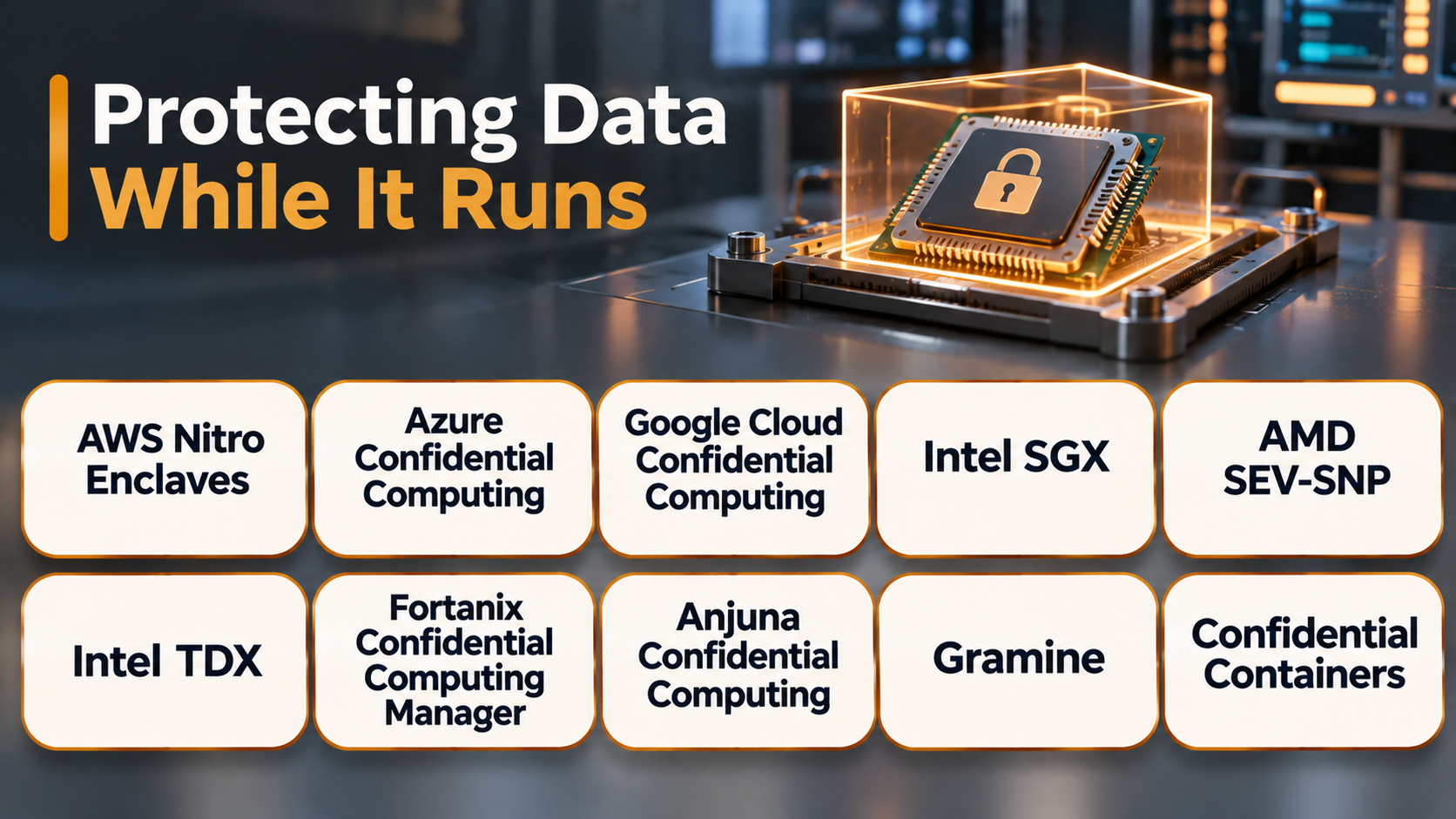
Introduction
Confidential computing platforms help organizations protect sensitive information while it is being processed within computing environments. These platforms use specialized hardware, protected execution environments, cryptographic mechanisms, and workload verification technologies to reduce unauthorized information exposure.
Traditional cybersecurity mechanisms primarily protect information during storage and transmission. Confidential computing extends these protections to supported workloads during execution, addressing selected risks associated with privileged infrastructure access.
Organizations increasingly process sensitive information through cloud applications, artificial intelligence (AI) systems, distributed databases, and collaborative analytics platforms. Confidential computing provides additional security mechanisms for these environments without necessarily requiring organizations to abandon existing cloud infrastructure.
Modern confidential computing platforms support capabilities such as encrypted memory, remote attestation, confidential virtual machines, protected containers, and secure application deployment. Available functionality depends on the underlying hardware architecture, software configuration, and service provider.
Financial institutions, healthcare providers, government agencies, research organizations, and technology companies can benefit from confidential computing. These platforms can support sensitive information processing while complementing existing cybersecurity, privacy, and governance requirements.
This guide examines ten confidential computing platforms and technologies, including their features, benefits, advantages, limitations, and practical applications. It also provides comparison tables, software selection guidance, implementation recommendations, performance metrics, and frequently asked questions.
What Are Confidential Computing Platforms?
Confidential computing platforms are technologies designed to protect selected information and application workloads during execution. They establish additional security boundaries using compatible hardware-assisted protection and trusted software components.
A Trusted Execution Environment (TEE) provides an isolated computing environment designed to protect code and information against specified external threats. Different TEE architectures provide different levels and types of workload isolation.
Confidential virtual machines (VMs) extend protected execution capabilities to supported guest operating systems and applications. These environments can reduce the need for extensive application modifications compared with some application-level enclave architectures.
Confidential containers combine container-based application deployment with compatible protected computing environments. They are particularly relevant to organizations operating cloud-native applications and distributed infrastructure.
Remote attestation enables external systems to evaluate evidence about a protected workload or computing environment. Verified attestation evidence can support authorization decisions and controlled cryptographic key release.
Confidential computing does not eliminate every cybersecurity threat or independently guarantee regulatory compliance. Organizations must continue to address application vulnerabilities, information output risks, hardware security dependencies, and authorized access requirements.
How Do Confidential Computing Platforms Work?
- Identify sensitive applications and information sources.
- Establish workload security requirements.
- Define an appropriate threat model.
- Select compatible confidential computing infrastructure.
- Prepare approved workload images and dependencies.
- Configure protected execution environments.
- Establish cryptographic key management policies.
- Generate workload attestation evidence.
- Verify evidence against approved trust policies.
- Release authorized application secrets.
- Execute workloads within protected environments.
- Secure application communication and information outputs.
- Monitor infrastructure and workload security.
- Maintain approved software and firmware configurations.
Traditional Computing vs. Confidential Computing
| Evaluation Area | Traditional Computing | Confidential Computing |
|---|---|---|
| Data at rest | Storage encryption | Storage encryption remains necessary |
| Data in transit | Network encryption | Network encryption remains necessary |
| Data in use | Conventional processing | Hardware-assisted protection |
| Memory security | Operating system controls | Architecture-dependent memory protection |
| Workload isolation | Conventional virtualization | Additional protected execution boundaries |
| Privileged access | Administrator-dependent | Additional restrictions where supported |
| Workload verification | Conventional integrity checks | Cryptographic attestation |
| Key provisioning | Standard authorization | Attestation-based authorization possible |
| Hardware requirements | General-purpose infrastructure | Compatible confidential hardware |
| Application deployment | Conventional runtime | Protected runtime |
| AI processing | Standard accelerator environments | Compatible confidential AI infrastructure |
| Operational complexity | Established workflows | Additional verification requirements |
Common Applications of Confidential Computing Platforms
- Confidential cloud application hosting.
- Sensitive healthcare analytics.
- Protected financial transaction processing.
- Confidential artificial intelligence inference.
- Secure machine learning workloads.
- Intellectual property protection.
- Confidential database processing.
- Secure multi-party data collaboration.
- Protected cryptographic operations.
- Government information processing.
- Confidential Kubernetes workloads.
- Privacy-oriented enterprise analytics.
Key Components of Confidential Computing Platforms
| Component | Primary Function |
|---|---|
| Trusted execution environment | Provides protected workload execution |
| Hardware root of trust | Establishes foundational hardware trust |
| Memory encryption engine | Protects supported workload memory |
| Attestation service | Generates or verifies workload evidence |
| Confidential virtual machine | Provides protected guest execution |
| Confidential container runtime | Supports protected container workloads |
| Key management system | Protects cryptographic material |
| Secret provisioning service | Releases authorized workload secrets |
| Workload identity | Identifies approved applications |
| Policy engine | Evaluates trust requirements |
| Secure communication interface | Protects authorized information exchange |
| Image verification | Evaluates approved workload artifacts |
| Security monitoring | Tracks relevant operational events |
| Access management | Restricts authorized operations |
| Audit logging | Records relevant security activities |
| Recovery infrastructure | Supports approved continuity procedures |
Types of Confidential Computing Platforms
Managed Cloud Confidential Computing
Managed cloud platforms provide compatible confidential computing infrastructure through cloud service providers. Organizations can deploy supported workloads without independently managing every underlying hardware component.
Application-Level Enclave Platforms
Application-level enclave platforms isolate selected application components and sensitive information. They can provide granular protection but may require specialized development and integration.
Confidential Virtual Machine Platforms
Confidential virtual machine platforms protect supported guest environments using hardware-assisted security mechanisms. They are suitable for compatible applications requiring broader workload protection.
Confidential Container Platforms
Confidential container platforms support protected containerized applications within compatible computing environments. These technologies are particularly relevant to Kubernetes and cloud-native application architectures.
Confidential AI Platforms
Confidential AI platforms combine protected computing infrastructure with compatible AI processing capabilities. They can help protect selected model components, sensitive inputs, and supported inference or training workloads.
Key Features of Confidential Computing Platforms
- Hardware-assisted workload isolation.
- Protected application execution.
- Confidential virtual machines.
- Confidential container deployment.
- Remote attestation.
- Memory encryption.
- Workload integrity verification.
- Controlled cryptographic key provisioning.
- Secure application communication.
- Confidential AI processing.
- Centralized security policy management.
- Operational monitoring and audit reporting.
Top 10 Confidential Computing Platforms
The following selection includes managed cloud services, enterprise confidential computing platforms, open-source orchestration frameworks, and confidential accelerator technologies. These offerings address different architectural layers, and their numbering does not represent an independently benchmarked ranking.
1. Microsoft Azure Confidential Computing
Short Description
Microsoft Azure Confidential Computing provides cloud infrastructure designed to protect supported applications and information during execution. Its offerings include confidential virtual machines, enclave-enabled infrastructure, and applicable confidential container services.
Azure uses compatible hardware security technologies to establish protected execution environments. Available security properties depend on the selected processor architecture, infrastructure configuration, and service capabilities.
The platform integrates with complementary Microsoft Azure identity, attestation, encryption, and cryptographic key management services. Organizations can use these capabilities to establish controlled confidential workload deployment workflows.
Azure Confidential Computing is particularly suitable for enterprises operating sensitive applications within Microsoft Azure. Organizations should verify regional availability, supported hardware, workload compatibility, and applicable service limitations.
How Azure Confidential Computing Works
- Identify sensitive application workloads.
- Select compatible confidential infrastructure.
- Configure protected virtual machines or containers.
- Establish identity and key management policies.
- Verify applicable workload attestation evidence.
- Deploy and monitor confidential applications.
Key Features
- Confidential virtual machines: Protects supported guest environments.
- Hardware-assisted isolation: Uses compatible processor security technologies.
- Memory encryption: Provides architecture-dependent memory protection.
- Azure Attestation: Supports workload evidence verification.
- Confidential containers: Enables applicable protected container workloads.
- Key management integration: Connects compatible Azure security services.
- Identity management: Supports authorized workload access.
- Cloud infrastructure integration: Complements existing Azure environments.
- Confidential AI support: Enables applicable protected AI infrastructure.
Benefits
- Supports sensitive cloud application processing.
- Reduces selected infrastructure-level exposure risks.
- Facilitates confidential workload deployment.
- Complements enterprise Azure security architecture.
- Supports attestation-based authorization.
- Enables privacy-oriented application development.
- Supports compatible existing workload migration.
Pros
- Comprehensive cloud computing ecosystem.
- Multiple confidential infrastructure options.
- Integrated attestation capabilities.
- Enterprise identity management integration.
- Managed infrastructure availability.
- Suitable for regulated enterprise workloads.
Cons
- Regional availability varies.
- Infrastructure pricing requires evaluation.
- Attestation configuration requires expertise.
- Hardware compatibility restrictions apply.
- Application vulnerabilities remain possible.
Use Cases
- Confidential healthcare analytics.
- Protected financial applications.
- Sensitive enterprise databases.
- Confidential AI workloads.
- Secure application migration.
- Protected cloud-native applications.
Best For
- Microsoft Azure customers.
- Enterprise cloud architects.
- Healthcare organizations.
- Financial institutions.
- Government technology teams.
- Confidential application developers.
Pricing and Deployment
Azure Confidential Computing uses applicable cloud infrastructure and service pricing. Organizations should evaluate confidential virtual machine charges, accelerator availability, security service expenses, and deployment requirements.
2. Google Cloud Confidential Computing
Short Description
Google Cloud Confidential Computing provides protected infrastructure capabilities for supported applications and information processing activities. Its offerings include confidential virtual machines and applicable confidential cloud-native services.
The platform uses compatible hardware-assisted security technologies to protect selected workloads during execution. Supported protection mechanisms vary according to machine type, processor architecture, and service configuration.
Google Cloud provides complementary identity management, encryption, key management, and workload verification capabilities. These services can support confidential computing within broader enterprise cloud architectures.
The platform is particularly suitable for organizations operating sensitive analytical and application workloads within Google Cloud. Organizations should verify supported regions, infrastructure types, and service-specific security properties.
How Google Cloud Confidential Computing Works
- Identify confidential workload requirements.
- Select compatible cloud infrastructure.
- Enable applicable confidential computing features.
- Configure workload identities and security policies.
- Establish supported attestation workflows.
- Deploy and monitor protected applications.
Key Features
- Confidential VMs: Supports protected virtual machine execution.
- Memory protection: Uses compatible hardware-assisted security.
- Confidential workload services: Supports applicable protected applications.
- Attestation mechanisms: Enables supported environment verification.
- Cloud-native integration: Complements compatible Google Cloud services.
- Identity management: Supports authorized workload access.
- Key management integration: Connects compatible cryptographic services.
- Confidential accelerator options: Supports applicable protected AI workloads.
- Operational monitoring: Complements cloud administration workflows.
Benefits
- Supports confidential cloud computing.
- Reduces selected infrastructure access risks.
- Facilitates protected analytical workloads.
- Complements existing Google Cloud infrastructure.
- Supports compatible confidential AI processing.
- Enables workload verification mechanisms.
- Encourages information-centric cloud security.
Pros
- Managed cloud infrastructure.
- Confidential virtual machine availability.
- Google Cloud ecosystem integration.
- Multiple compatible hardware options.
- Relevant AI infrastructure capabilities.
- Suitable for distributed enterprise applications.
Cons
- Machine type compatibility varies.
- Regional restrictions may apply.
- Infrastructure expenses require assessment.
- Security properties differ by architecture.
- Service-specific configuration requires expertise.
Use Cases
- Confidential enterprise analytics.
- Sensitive machine learning workloads.
- Protected healthcare applications.
- Financial information processing.
- Confidential cloud services.
- Secure information collaboration.
Best For
- Google Cloud customers.
- Data engineering teams.
- Cloud infrastructure administrators.
- AI development organizations.
- Enterprise security architects.
- Research institutions.
Pricing and Deployment
Google Cloud Confidential Computing uses applicable cloud infrastructure pricing. Organizations should verify confidential computing charges, supported machine types, accelerator costs, and complementary service expenses.
3. AWS Nitro Enclaves
Short Description
AWS Nitro Enclaves provides isolated execution environments associated with compatible Amazon Elastic Compute Cloud (EC2) instances. It enables organizations to separate sensitive application operations from conventional parent-instance processing.
The platform uses the AWS Nitro System to establish protected execution boundaries. Enclaves have restricted communication capabilities and do not provide conventional persistent storage or direct external network access.
AWS Nitro Enclaves supports cryptographic attestation and integration with AWS Key Management Service (KMS). Organizations can configure applicable authorization policies based on verified enclave measurements.
The technology is particularly suitable for AWS applications requiring granular isolation of sensitive processing activities. Application architecture must accommodate enclave resource allocation and communication restrictions.
How AWS Nitro Enclaves Works
- Provision a compatible EC2 instance.
- Enable Nitro Enclaves support.
- Prepare an enclave application image.
- Allocate protected computing resources.
- Establish attestation-based authorization.
- Execute sensitive operations within the enclave.
Key Features
- Isolated execution: Separates selected application workloads.
- Nitro architecture: Provides hardware-assisted isolation.
- Cryptographic attestation: Generates enclave verification evidence.
- AWS KMS integration: Supports attestation-based cryptographic authorization.
- Restricted networking: Limits conventional external communication.
- Enclave image tooling: Supports compatible workload packaging.
- Resource allocation: Assigns enclave memory and processing resources.
- Virtual socket communication: Supports approved parent-instance interaction.
- AWS integration: Complements compatible EC2 applications.
Benefits
- Reduces selected sensitive workload exposure.
- Supports protected cryptographic operations.
- Facilitates granular application isolation.
- Enables attestation-based trust decisions.
- Complements AWS security infrastructure.
- Supports confidential application architectures.
- Helps isolate sensitive processing components.
Pros
- AWS-native confidential execution.
- Dedicated enclave isolation.
- Integrated attestation mechanisms.
- KMS integration.
- Developer-oriented tooling.
- Suitable for specialized sensitive workloads.
Cons
- Requires compatible EC2 infrastructure.
- Application modifications may be necessary.
- Restricted network connectivity.
- No conventional persistent enclave storage.
- Not a general-purpose confidential virtual machine service.
Use Cases
- Protected payment processing.
- Confidential cryptographic services.
- Sensitive identity verification.
- Secure transaction authorization.
- Confidential application components.
- Controlled secret processing.
Best For
- AWS customers.
- Cloud security engineers.
- Financial technology developers.
- Cryptographic application teams.
- Privacy engineers.
- Organizations requiring granular workload isolation.
Pricing and Deployment
AWS Nitro Enclaves has historically been available without a separate enclave service charge, while underlying EC2 resources and related services incur applicable costs. Organizations should verify current pricing and supported instance configurations.
4. IBM Hyper Protect Virtual Servers
Short Description
IBM Hyper Protect Virtual Servers provides protected computing environments designed for sensitive enterprise applications. Its architecture uses compatible IBM infrastructure security technologies to establish additional workload protection boundaries.
The platform is relevant to organizations requiring controlled execution of confidential business applications. Supported configurations can reduce selected risks associated with unauthorized infrastructure access.
IBM provides complementary cryptographic services, enterprise cloud infrastructure, and security management capabilities. These services can support confidential workload deployment within broader enterprise security architectures.
IBM Hyper Protect Virtual Servers is particularly suitable for regulated organizations evaluating IBM infrastructure for sensitive computing requirements. Current service availability, deployment options, and supported workload configurations should be confirmed.
How IBM Hyper Protect Virtual Servers Works
- Establish confidential workload requirements.
- Select compatible IBM infrastructure.
- Prepare approved workload configurations.
- Establish identity and cryptographic policies.
- Deploy supported protected workloads.
- Monitor operational and security activities.
Key Features
- Protected virtual servers: Supports confidential application execution.
- Hardware-backed security: Uses compatible IBM infrastructure technologies.
- Workload isolation: Restricts selected unauthorized access.
- Cryptographic integration: Complements applicable IBM security services.
- Controlled deployment: Supports approved workload configurations.
- Enterprise cloud integration: Connects compatible IBM infrastructure.
- Workload verification: Supports applicable trust mechanisms.
- Administrative restrictions: Reduces selected privileged access risks.
- Security-oriented infrastructure: Supports sensitive enterprise workloads.
Benefits
- Supports confidential enterprise applications.
- Reduces selected infrastructure exposure risks.
- Complements enterprise cryptographic services.
- Supports regulated workload requirements.
- Facilitates protected application deployment.
- Encourages controlled infrastructure administration.
- Supports information-centric security architectures.
Pros
- Enterprise security specialization.
- Hardware-assisted workload protection.
- IBM infrastructure integration.
- Relevant cryptographic service ecosystem.
- Suitable for regulated industries.
- Protected virtual server architecture.
Cons
- Infrastructure compatibility requires verification.
- Commercial pricing requires evaluation.
- Service availability may vary.
- Application integration can require specialist expertise.
- IBM-specific dependencies may affect portability.
Use Cases
- Confidential financial applications.
- Protected enterprise services.
- Sensitive information processing.
- Cryptographic workload hosting.
- Regulated cloud infrastructure.
- Confidential business applications.
Best For
- IBM infrastructure customers.
- Financial institutions.
- Enterprise security architects.
- Government technology departments.
- Regulated businesses.
- Organizations requiring protected virtual servers.
Pricing and Deployment
IBM Hyper Protect Virtual Servers is associated with commercial infrastructure and service arrangements. Organizations should verify current product availability, supported deployment environments, and licensing requirements.
5. Fortanix Confidential Computing Manager
Short Description
Fortanix Confidential Computing Manager provides capabilities for managing compatible confidential computing workloads. It helps organizations coordinate protected application deployment, attestation, and workload security requirements.
The platform focuses on simplifying selected operational aspects of confidential computing. Compatible management tools can support application preparation and protected workload administration.
Fortanix also provides enterprise data security and cryptographic management capabilities through its broader product ecosystem. These capabilities can complement confidential computing architectures requiring controlled secret provisioning.
The platform is particularly relevant to organizations requiring centralized confidential workload management. Current product packaging, supported trusted execution environments, and commercial availability should be verified.
How Fortanix Confidential Computing Manager Works
- Identify sensitive enterprise applications.
- Configure compatible confidential infrastructure.
- Prepare approved application packages.
- Establish workload verification policies.
- Deploy authorized confidential applications.
- Monitor protected workload operations.
Key Features
- Confidential workload management: Coordinates protected application deployment.
- Attestation management: Supports applicable workload verification.
- Application packaging: Prepares compatible protected workloads.
- Centralized administration: Coordinates confidential computing operations.
- Security policy configuration: Establishes approved workload requirements.
- Cryptographic integration: Complements Fortanix security services.
- Infrastructure integration: Connects supported computing environments.
- Workload monitoring: Provides applicable operational visibility.
- Enterprise security integration: Supports broader data protection architectures.
Benefits
- Simplifies selected confidential computing workflows.
- Supports centralized workload management.
- Facilitates protected application deployment.
- Complements cryptographic infrastructure.
- Reduces repetitive configuration activities.
- Supports consistent security policies.
- Encourages enterprise confidential computing adoption.
Pros
- Dedicated confidential computing management approach.
- Enterprise security ecosystem.
- Attestation management relevance.
- Centralized administration capabilities.
- Protected application deployment support.
- Suitable for complex enterprise environments.
Cons
- Current product availability requires confirmation.
- Commercial pricing requires evaluation.
- Supported hardware configurations vary.
- Application compatibility requires testing.
- Underlying infrastructure dependencies remain necessary.
Use Cases
- Enterprise confidential workload management.
- Protected application deployment.
- Confidential analytics.
- Cryptographic application integration.
- Workload verification management.
- Confidential infrastructure administration.
Best For
- Enterprise cybersecurity departments.
- Confidential computing engineers.
- Cloud infrastructure teams.
- Financial institutions.
- Privacy engineering departments.
- Organizations requiring centralized management.
Pricing and Deployment
Fortanix provides commercial enterprise security offerings. Organizations should confirm current Confidential Computing Manager availability, licensing, supported infrastructure, and integration expenses.
6. Anjuna Seaglass
Short Description
Anjuna Seaglass is a confidential computing platform designed to support protected application execution across compatible infrastructure. It focuses on reducing the complexity associated with adapting applications for confidential computing.
The platform helps organizations deploy supported workloads using compatible trusted execution technologies. Available protection mechanisms depend on the underlying infrastructure and selected configuration.
Anjuna is particularly relevant to enterprises seeking to protect existing applications without extensive application redesign. Compatibility and actual modification requirements should be evaluated through representative pilot deployments.
The platform can support confidential application architectures involving sensitive information, proprietary software, and enterprise processing workloads. Organizations should verify current supported environments and commercial arrangements.
How Anjuna Seaglass Works
- Identify applications requiring confidential execution.
- Select supported confidential infrastructure.
- Configure application protection requirements.
- Prepare compatible deployment packages.
- Deploy approved protected applications.
- Validate and monitor workload execution.
Key Features
- Confidential application deployment: Supports compatible protected workloads.
- Application compatibility: Helps adapt selected existing applications.
- Trusted execution integration: Connects supported hardware technologies.
- Workload isolation: Provides architecture-dependent protection.
- Cloud deployment support: Enables compatible infrastructure environments.
- Attestation integration: Supports applicable verification workflows.
- Security policies: Establishes workload protection requirements.
- Deployment automation: Complements existing application workflows.
- Enterprise integration: Supports sensitive business applications.
Benefits
- Reduces selected application adaptation requirements.
- Facilitates confidential workload deployment.
- Supports compatible existing applications.
- Complements enterprise security infrastructure.
- Reduces selected information exposure risks.
- Supports privacy-oriented cloud architecture.
- Encourages confidential computing adoption.
Pros
- Application-oriented deployment approach.
- Existing workload compatibility focus.
- Enterprise security specialization.
- Relevant cloud infrastructure support.
- Reduced application modification potential.
- Suitable for application modernization.
Cons
- Commercial pricing requires confirmation.
- Workload compatibility varies.
- Supported infrastructure requires verification.
- Deployment may introduce additional dependencies.
- Independent application security testing remains necessary.
Use Cases
- Confidential enterprise applications.
- Protected financial processing.
- Sensitive cloud application migration.
- Confidential analytics.
- Proprietary software protection.
- Privacy-oriented application deployment.
Best For
- Enterprise application architects.
- Cloud security teams.
- Financial technology organizations.
- Confidential computing engineers.
- Application modernization departments.
- Businesses protecting existing applications.
Pricing and Deployment
Anjuna provides commercial confidential computing offerings. Organizations should evaluate current licensing, supported infrastructure, workload compatibility, and implementation expenses.
7. Edgeless Systems Constellation
Short Description
Constellation is a confidential Kubernetes technology developed by Edgeless Systems. It is designed to support protected cloud-native application environments using compatible confidential computing infrastructure.
The platform applies confidential computing principles to Kubernetes clusters and associated workload infrastructure. Its architecture can support additional protection for selected cluster components and application information.
Constellation uses applicable attestation and cryptographic mechanisms to establish trust in supported cluster environments. Organizations can integrate compatible workloads into confidential Kubernetes architectures.
The technology is particularly suitable for platform engineering teams requiring protected containerized applications. Current project maintenance, supported cloud environments, and commercial support availability should be verified.
How Constellation Works
- Select compatible confidential cloud infrastructure.
- Configure cluster deployment requirements.
- Initialize the protected Kubernetes environment.
- Establish applicable workload verification mechanisms.
- Deploy approved containerized applications.
- Monitor cluster and workload operations.
Key Features
- Confidential Kubernetes: Supports protected cluster environments.
- Hardware-backed isolation: Uses compatible confidential infrastructure.
- Cluster attestation: Supports applicable environment verification.
- Protected workload deployment: Enables confidential containerized applications.
- Cryptographic integration: Supports applicable information protection mechanisms.
- Kubernetes compatibility: Complements cloud-native application workflows.
- Cluster management: Supports compatible operational administration.
- Open-source components: Enables applicable source code inspection.
- Cloud infrastructure integration: Connects supported computing environments.
Benefits
- Supports confidential Kubernetes applications.
- Facilitates protected cluster deployment.
- Reduces selected infrastructure-level exposure risks.
- Complements cloud-native security architectures.
- Supports workload verification.
- Encourages reusable confidential deployment workflows.
- Supports technical experimentation and development.
Pros
- Kubernetes-oriented confidential computing.
- Hardware-assisted protection.
- Attestation-based architecture.
- Cloud-native workload compatibility.
- Open-source development relevance.
- Suitable for platform engineering teams.
Cons
- Requires Kubernetes expertise.
- Supported infrastructure varies.
- Current project lifecycle requires verification.
- Deployment introduces operational complexity.
- Application-level security controls remain necessary.
Use Cases
- Confidential Kubernetes clusters.
- Protected cloud-native applications.
- Sensitive enterprise microservices.
- Confidential analytics workloads.
- Privacy-oriented application hosting.
- Secure distributed application research.
Best For
- Kubernetes administrators.
- Platform engineering departments.
- Cloud-native developers.
- Confidential computing researchers.
- Enterprise infrastructure architects.
- Organizations requiring protected container orchestration.
Pricing and Deployment
Constellation has been developed with open-source components and associated commercial offerings. Organizations should verify current maintenance status, licensing, support availability, and compatible infrastructure costs.
8. Confidential Containers (CoCo)
Short Description
Confidential Containers is an open-source project designed to enable protected container workloads using compatible trusted execution environments. It integrates confidential computing concepts into cloud-native application architectures.
The project combines protected runtime infrastructure, workload attestation, and controlled resource provisioning mechanisms. These capabilities can support confidential application deployment within compatible Kubernetes environments.
Confidential Containers supports multiple architectural components and applicable hardware security technologies. Actual protection properties depend on the selected runtime, infrastructure, and workload configuration.
The project is particularly suitable for organizations requiring customizable confidential container environments. Production adoption requires careful evaluation of component maturity, compatibility, and security boundaries.
How Confidential Containers Works
- Provision compatible confidential computing infrastructure.
- Configure supported Kubernetes components.
- Install applicable confidential runtime components.
- Establish attestation and resource access policies.
- Launch approved confidential containers.
- Verify and monitor protected workload execution.
Key Features
- Confidential container runtime: Supports protected container execution.
- Kubernetes integration: Enables compatible workload orchestration.
- Trusted execution support: Connects applicable hardware technologies.
- Attestation services: Supports workload evidence verification.
- Protected resource provisioning: Enables controlled secret access.
- Runtime integration: Connects compatible container components.
- Open-source architecture: Supports source code inspection.
- Configurable isolation: Establishes architecture-dependent security boundaries.
- Cloud-native deployment: Complements container delivery workflows.
Benefits
- Supports protected cloud-native applications.
- Facilitates confidential container deployment.
- Enables customizable security architectures.
- Supports attestation-based resource access.
- Complements Kubernetes infrastructure.
- Reduces conventional software licensing requirements.
- Encourages interoperable confidential computing development.
Pros
- Open-source availability.
- Kubernetes ecosystem relevance.
- Multiple compatible hardware technologies.
- Configurable deployment architecture.
- Attestation-oriented resource provisioning.
- Suitable for technical confidential computing projects.
Cons
- Requires specialist technical expertise.
- Infrastructure compatibility must be verified.
- Multiple components require administration.
- Production readiness varies by configuration.
- Ongoing maintenance remains necessary.
Use Cases
- Confidential Kubernetes workloads.
- Protected containerized analytics.
- Sensitive enterprise microservices.
- Confidential AI application hosting.
- Secure cloud-native research.
- Attestation-based secret provisioning.
Best For
- Kubernetes engineers.
- Platform engineering teams.
- Open-source developers.
- Confidential computing researchers.
- Cloud security architects.
- Organizations requiring customizable container protection.
Pricing and Deployment
Confidential Containers is available as open-source software. Organizations should account for compatible infrastructure, Kubernetes administration, security integration, independent validation, and ongoing maintenance.
9. NVIDIA Confidential Computing
Short Description
NVIDIA Confidential Computing provides hardware and software capabilities designed to protect supported graphics processing unit (GPU) workloads. It is particularly relevant to organizations processing sensitive information through accelerated computing and AI applications.
Compatible NVIDIA accelerator technologies can establish additional protection mechanisms for selected workload information. Their security properties depend on GPU models, host infrastructure, software configurations, and supported operating modes.
NVIDIA confidential computing capabilities can complement compatible confidential virtual machines and trusted execution environments. Organizations can integrate these technologies into approved confidential AI processing architectures.
The technology is particularly suitable for enterprises requiring protected accelerated computing. Supported hardware, attestation mechanisms, workload compatibility, and performance characteristics should be independently verified.
How NVIDIA Confidential Computing Works
- Provision compatible confidential GPU infrastructure.
- Configure supported host computing protection.
- Prepare approved accelerated workloads.
- Enable applicable confidential GPU operating modes.
- Verify supported attestation evidence.
- Execute and monitor protected AI workloads.
Key Features
- Confidential GPU execution: Protects supported accelerated workloads.
- Hardware-assisted security: Uses compatible NVIDIA accelerator capabilities.
- GPU attestation: Supports applicable accelerator verification.
- Protected information transfer: Secures supported communication pathways.
- Confidential AI processing: Enables compatible sensitive AI workloads.
- Host TEE integration: Complements supported confidential virtual machines.
- Accelerated computing: Supports compatible GPU-intensive applications.
- Developer ecosystem: Provides applicable software development resources.
- Enterprise infrastructure integration: Supports compatible deployment environments.
Benefits
- Supports confidential accelerated computing.
- Reduces selected sensitive AI workload exposure risks.
- Facilitates protected model inference.
- Complements confidential cloud infrastructure.
- Supports compatible proprietary model processing.
- Enables accelerator verification mechanisms.
- Encourages confidential AI application development.
Pros
- Specialized GPU security capabilities.
- AI workload relevance.
- Hardware-assisted protection.
- Applicable attestation mechanisms.
- Established accelerated computing ecosystem.
- Suitable for supported high-performance workloads.
Cons
- Requires compatible NVIDIA hardware.
- Infrastructure costs may be substantial.
- Supported operating modes vary.
- Performance overhead requires evaluation.
- Does not independently prevent harmful or sensitive model outputs.
Use Cases
- Confidential AI inference.
- Protected machine learning workloads.
- Sensitive medical image processing.
- Proprietary model execution.
- Confidential accelerated analytics.
- Privacy-oriented generative AI services.
Best For
- Enterprise AI developers.
- Machine learning engineers.
- Healthcare technology organizations.
- GPU infrastructure administrators.
- AI security architects.
- Businesses protecting proprietary models.
Pricing and Deployment
NVIDIA Confidential Computing is associated with compatible accelerator hardware and software infrastructure. Costs depend on hardware procurement, cloud GPU usage, software licensing where applicable, and engineering requirements.
10. Gramine
Short Description
Gramine is an open-source library operating system designed to support compatible applications within protected execution environments. It is particularly associated with Intel Software Guard Extensions (SGX) enclaves.
The framework provides relevant operating system functionality that enables selected Linux applications to execute within enclaves. This approach can reduce application modification requirements for supported workloads.
Gramine supports configurable application manifests, applicable attestation mechanisms, and protected information handling capabilities. Developers can use these features to establish customized confidential application architectures.
The framework is particularly suitable for technical teams requiring granular control over enclave application deployment. Hardware compatibility, application behavior, trusted computing base size, and security configuration require evaluation.
How Gramine Works
- Provision compatible enclave infrastructure.
- Install the Gramine framework.
- Prepare a supported Linux application.
- Configure the application execution manifest.
- Establish applicable attestation requirements.
- Execute and validate the protected application.
Key Features
- Library operating system: Provides compatible application runtime functionality.
- Intel SGX integration: Supports applicable hardware enclave execution.
- Linux compatibility: Enables selected existing applications.
- Manifest configuration: Defines application execution requirements.
- Attestation support: Enables applicable verification mechanisms.
- Protected file handling: Supports compatible information protection.
- Open-source availability: Enables source code inspection.
- Developer tooling: Supports application preparation.
- Customizable execution: Enables workload-specific configurations.
Benefits
- Reduces selected enclave application adaptation requirements.
- Supports protected Linux application execution.
- Enables customizable confidential workloads.
- Facilitates technical security evaluation.
- Supports confidential computing research.
- Reduces conventional software licensing requirements.
- Complements hardware-backed enclave technologies.
Pros
- Open-source availability.
- Granular application configuration.
- Intel SGX integration.
- Linux application compatibility.
- Attestation-related functionality.
- Suitable for specialist engineering teams.
Cons
- Requires technical expertise.
- Compatible hardware remains necessary.
- Not every application is supported.
- Security configurations require careful review.
- Infrastructure maintenance remains the organization’s responsibility.
Use Cases
- Confidential Linux applications.
- Protected cryptographic processing.
- Sensitive analytics.
- Confidential computing research.
- Secure application prototyping.
- Existing application adaptation.
Best For
- Linux application developers.
- Confidential computing researchers.
- Security software engineers.
- Open-source infrastructure teams.
- Enterprise application architects.
- Organizations requiring granular enclave customization.
Pricing and Deployment
Gramine is available as open-source software. Organizations should evaluate compatible infrastructure, engineering resources, application integration, security validation, and ongoing maintenance expenses.
Comparison Table: Top 10 Confidential Computing Platforms
| Platform | Primary Capability | Best For | Deployment | Pricing Model |
|---|---|---|---|---|
| Azure Confidential Computing | Confidential cloud infrastructure | Azure enterprises | Managed cloud | Usage-based |
| Google Cloud Confidential Computing | Protected cloud workloads | Google Cloud customers | Managed cloud | Usage-based |
| AWS Nitro Enclaves | Isolated application execution | AWS applications | AWS EC2 | Infrastructure-based |
| IBM Hyper Protect Virtual Servers | Protected virtual servers | Regulated enterprises | IBM infrastructure | Commercial |
| Fortanix Confidential Computing Manager | Confidential workload management | Enterprise security teams | Offering-dependent | Commercial |
| Anjuna Seaglass | Confidential application deployment | Existing applications | Supported infrastructure | Commercial |
| Edgeless Systems Constellation | Confidential Kubernetes | Platform engineering | Compatible cloud | Offering-dependent |
| Confidential Containers | Protected container workloads | Cloud-native applications | Self-managed or integrated | Open source |
| NVIDIA Confidential Computing | Confidential GPU processing | AI workloads | Compatible GPU infrastructure | Infrastructure-based |
| Gramine | Protected application runtime | Linux applications | Compatible enclave infrastructure | Open source |
Functional Comparison
| Platform | Confidential VMs | Application Enclaves | Container Support | AI Relevance |
|---|---|---|---|---|
| Azure | Supported | Offering-dependent | Supported offerings | High |
| Google Cloud | Supported | Offering-dependent | Supported offerings | High |
| AWS Nitro Enclaves | Not primary | Specialized | Enclave image packaging | Workload-dependent |
| IBM Hyper Protect | Protected virtual servers | Not primary | Offering-dependent | Workload-dependent |
| Fortanix | Offering-dependent | Supported workflows | Offering-dependent | Workload-dependent |
| Anjuna | Infrastructure-dependent | Infrastructure-dependent | Offering-dependent | Relevant |
| Constellation | Underlying infrastructure | Not primary | Specialized | Relevant |
| Confidential Containers | Runtime-dependent | Backend-dependent | Specialized | Relevant |
| NVIDIA | Host integration | GPU-specific protection | Infrastructure-dependent | Specialized |
| Gramine | Not primary | Specialized | Integration-dependent | Workload-dependent |
Technical Comparison
| Platform | Main Integration | Protection Boundary | Infrastructure Dependency |
|---|---|---|---|
| Azure | Azure services | Offering-dependent | Compatible cloud hardware |
| Google Cloud | Google Cloud services | Offering-dependent | Compatible cloud hardware |
| AWS Nitro Enclaves | EC2 and virtual sockets | Application enclave | AWS Nitro |
| IBM Hyper Protect | IBM infrastructure services | Protected server workload | Compatible IBM infrastructure |
| Fortanix | Management interfaces | Underlying TEE | Supported hardware |
| Anjuna | Application deployment tooling | Underlying TEE | Supported infrastructure |
| Constellation | Kubernetes | Protected cluster architecture | Confidential cloud infrastructure |
| Confidential Containers | Kubernetes and runtime components | Runtime-dependent | Compatible TEE |
| NVIDIA | GPU and host infrastructure | Protected accelerator workload | Compatible NVIDIA GPUs |
| Gramine | Linux runtime | SGX application enclave | Compatible Intel hardware |
Business Suitability Comparison
| Platform | Small Businesses | Midmarket | Large Enterprises |
|---|---|---|---|
| Azure | Workload-dependent | Suitable | Suitable |
| Google Cloud | Workload-dependent | Suitable | Suitable |
| AWS Nitro Enclaves | Suitable with expertise | Suitable | Suitable |
| IBM Hyper Protect | Budget-dependent | Evaluate requirements | Suitable |
| Fortanix | Budget-dependent | Evaluate offering | Suitable |
| Anjuna | Budget-dependent | Suitable with integration | Suitable |
| Constellation | Specialist teams | Suitable with expertise | Suitable |
| Confidential Containers | Technical teams | Suitable with expertise | Suitable |
| NVIDIA | Infrastructure-dependent | Budget-dependent | Suitable |
| Gramine | Specialist developers | Technical teams | Suitable for specialized workloads |
Pricing and Ownership Comparison
| Platform | Main Cost Consideration | Additional Ownership Costs |
|---|---|---|
| Azure | Confidential cloud infrastructure | Security services and integration |
| Google Cloud | Confidential infrastructure usage | Cloud services and administration |
| AWS Nitro Enclaves | EC2 resource consumption | Application development |
| IBM Hyper Protect | Commercial infrastructure | Integration and support |
| Fortanix | Commercial licensing | Deployment and administration |
| Anjuna | Commercial licensing | Application integration |
| Constellation | Infrastructure and applicable support | Kubernetes administration |
| Confidential Containers | Open-source software | Engineering and infrastructure |
| NVIDIA | Compatible GPU infrastructure | AI integration and computing resources |
| Gramine | Open-source software | Application engineering and hardware |
How to Choose the Best Confidential Computing Platform
1. Establish a Threat Model
Identify the unauthorized access scenarios that confidential computing must address. Distinguish infrastructure-level threats from application vulnerabilities and authorized user misuse.
2. Determine Workload Requirements
Establish whether the organization requires protected virtual machines, application enclaves, confidential containers, or accelerated computing. Select an architecture that matches the workload rather than relying on general platform popularity.
3. Evaluate Hardware Compatibility
Identify supported processors, accelerators, firmware versions, and infrastructure configurations. Hardware incompatibility can prevent confidential workloads from operating correctly.
4. Assess Cloud Compatibility
Organizations should consider their existing cloud infrastructure and planned migration requirements. Cloud-specific confidential computing services may reduce integration complexity within established environments.
5. Review Application Compatibility
Determine whether existing applications can operate within protected environments without substantial modifications. Conduct representative application testing before production deployment.
6. Evaluate Attestation Mechanisms
Review how the platform generates and verifies evidence about protected workloads. Attestation policies should establish appropriate trust requirements before sensitive information is released.
7. Assess Cryptographic Key Management
Identify how application secrets and cryptographic keys are generated, stored, released, rotated, and revoked. Integrate appropriate authorization controls with verified workload identities.
8. Review Confidential AI Requirements
AI workloads may require compatible GPU protection in addition to confidential host infrastructure. Evaluate supported accelerator technologies and information transfer protection mechanisms.
9. Evaluate Container Integration
Organizations operating Kubernetes should assess confidential container runtime compatibility. Review orchestration, workload identity, attestation, and secret provisioning requirements.
10. Consider Performance Overhead
Confidential computing may introduce additional processing, memory, and communication overhead. Benchmark representative workloads using realistic infrastructure configurations.
11. Review Security Dependencies
Identify trusted hardware, firmware, software, and verification components. Evaluate the security implications of vulnerabilities within these trusted components.
12. Assess Information Residency Requirements
Determine where confidential information can be stored and processed. Regional infrastructure availability and third-party service dependencies may influence platform selection.
13. Evaluate Operational Expertise
Confidential computing may require specialized infrastructure, application development, and cryptographic management skills. Select a platform that the organization can maintain responsibly.
14. Compare Total Ownership Costs
Evaluate infrastructure, licensing, development, security testing, and operational maintenance expenses. Open-source platforms may still require substantial engineering investment.
15. Conduct Independent Security Validation
Test shortlisted platforms against representative workloads and approved threat models. Validate attestation, workload isolation, secret provisioning, and information output controls before deployment.
Best Confidential Computing Platforms by User Type
| User Type | Recommended Platform | Primary Reason |
|---|---|---|
| Azure enterprise customers | Azure Confidential Computing | Integrated cloud infrastructure |
| Google Cloud customers | Google Cloud Confidential Computing | Cloud-native workload integration |
| AWS application developers | AWS Nitro Enclaves | Granular isolated execution |
| Regulated enterprise organizations | IBM Hyper Protect Virtual Servers | Protected enterprise infrastructure |
| Centralized security teams | Fortanix Confidential Computing Manager | Confidential workload management |
| Application modernization teams | Anjuna Seaglass | Existing application protection |
| Kubernetes administrators | Edgeless Systems Constellation | Confidential cluster architecture |
| Open-source platform engineers | Confidential Containers | Customizable container protection |
| AI infrastructure developers | NVIDIA Confidential Computing | Protected accelerated workloads |
| Linux application engineers | Gramine | Granular enclave runtime |
| Confidential computing researchers | Gramine and Confidential Containers | Open-source experimentation |
| Multi-cloud security architects | Anjuna or compatible management platforms | Workload deployment flexibility |
Weighted Platform Selection Scorecard
| Selection Criterion | Weight |
|---|---|
| Threat model alignment | 20% |
| Workload protection effectiveness | 15% |
| Attestation capabilities | 15% |
| Application compatibility | 12% |
| Cryptographic key management | 10% |
| Infrastructure compatibility | 8% |
| Performance and scalability | 8% |
| Operational manageability | 7% |
| Total ownership costs | 5% |
| Total | 100% |
Organizations can assign consistent evaluation scores to shortlisted platforms based on approved technical and business requirements. Weighted results should complement independent security testing and architecture reviews.
Questions to Ask Confidential Computing Vendors
- Which security threats does the platform address?
- Which threats remain outside the protection boundary?
- What hardware and firmware configurations are supported?
- Which operating systems and applications are compatible?
- How does remote attestation work?
- Can key release depend on verified workload identity?
- Which confidential GPU configurations are supported?
- What Kubernetes integrations are available?
- What application modifications are necessary?
- How are security updates managed?
- What side-channel protections are available?
- Which information residency options are supported?
- What performance overhead should be evaluated?
- What disaster recovery mechanisms are available?
- What are the complete licensing and infrastructure costs?
Practical Example: Implementing Confidential AI in Healthcare
Consider a hypothetical healthcare technology organization developing an AI-assisted clinical document processing application. The organization wants to reduce selected infrastructure-level exposure risks while processing sensitive clinical information.
The organization selects compatible Azure Confidential Computing infrastructure and NVIDIA Confidential Computing capabilities for supported accelerated workloads. It combines these technologies with independent information governance, application security, and controlled output handling.
Step 1: Define Processing Objectives
Identify approved clinical document processing activities and required AI capabilities. Establish which information is necessary for the application.
Step 2: Establish Information Governance
Document authorized processing purposes, access requirements, and applicable privacy obligations. Avoid unnecessary collection and retention of sensitive clinical information.
Step 3: Develop a Threat Model
Identify infrastructure access risks, application vulnerabilities, unauthorized users, and potential information leakage. Determine which threats confidential computing can address.
Step 4: Select Compatible Infrastructure
Evaluate confidential virtual machines and supported confidential GPU configurations. Confirm compatibility between the host infrastructure, accelerator, and application software.
Step 5: Prepare Approved Workload Images
Build reviewed application images containing approved software dependencies. Establish version control and appropriate software supply chain security procedures.
Step 6: Configure Protected Host Infrastructure
Deploy compatible confidential virtual machines within an approved environment. Configure independent network and identity security controls.
Step 7: Enable Confidential Accelerator Protection
Configure supported GPU confidential computing mechanisms. Verify that the selected operating mode provides the required protection properties.
Step 8: Establish Attestation Policies
Define acceptable workload measurements and infrastructure security characteristics. Configure independent verification of supported host and accelerator attestation evidence.
Step 9: Configure Cryptographic Key Management
Establish approved encryption keys and secret provisioning requirements. Restrict sensitive resource release to authorized and appropriately verified workloads.
Step 10: Secure Information Ingress
Protect clinical documents during transmission and initial processing. Validate application input handling and authorized information access.
Step 11: Deploy the AI Application
Deploy approved model inference and document processing components. Validate application compatibility within the protected environment.
Step 12: Establish Output Controls
Review generated outputs for unnecessary sensitive information disclosure. Apply appropriate authorization and information minimization policies.
Step 13: Conduct Security Testing
Evaluate the deployed environment against the established threat model. Confirm that workload verification and secret provisioning operate according to approved requirements.
Step 14: Benchmark Application Performance
Measure representative inference latency, throughput, memory usage, and infrastructure expenses. Compare results against approved operational requirements.
Step 15: Establish Monitoring
Track workload availability, verification outcomes, and relevant security events. Avoid unnecessary sensitive information exposure through monitoring records.
Step 16: Implement Incident Response
Establish procedures for responding to suspicious activity, compromised components, and failed workload verification. Include appropriate credential revocation and workload isolation procedures.
Step 17: Conduct a Controlled Production Rollout
Release the application to approved users following independent validation. Expand deployment gradually while monitoring operational and security performance.
Step 18: Maintain and Improve the Environment
Apply approved software and firmware security updates. Reevaluate workload trust policies and application security requirements following significant changes.
Illustrative Implementation Results
| Performance Indicator | Before | After |
|---|---|---|
| Eligible workloads using confidential infrastructure | 0% | 95% |
| Verified workload launches | 0% | 98% |
| Automated secret authorization coverage | 20% | 95% |
| Manual security verification effort | 180 hours/month | 65 hours/month |
| Documented information access coverage | 70% | 99% |
| Approved output review coverage | 60% | 98% |
| Monthly operational expenditure | $60,000 | $48,000 |
| Average inference latency | 800 milliseconds | 880 milliseconds |
| Representative processing throughput | 1,000 documents/hour | 950 documents/hour |
These figures are hypothetical and do not represent independently verified Microsoft Azure or NVIDIA performance. Actual results depend on application architecture, hardware configuration, operational requirements, and implementation quality.
The illustrative deployment reduces monthly operating expenditure by 20% while increasing average inference latency by 10%. This demonstrates the importance of evaluating security improvements alongside operational performance and infrastructure expenses.
Illustrative Return on Investment
| Financial Measure | Amount |
|---|---|
| Initial implementation investment | $120,000 |
| Previous monthly operating cost | $60,000 |
| New monthly operating cost | $48,000 |
| Net monthly savings | $12,000 |
| Annual operating savings | $144,000 |
| First-year net benefit | $24,000 |
| First-year return on investment | 20% |
| Estimated payback period | 10 months |
The calculation assumes consistent monthly operating expenses and hypothetical savings from infrastructure consolidation and automated security workflows. Confidential computing itself does not guarantee these savings, and some deployments may increase total operating costs.
Important Confidential Computing Performance Metrics
| Metric | Purpose |
|---|---|
| Confidential workload coverage | Measures eligible workloads protected |
| Attestation verification success rate | Tracks accepted workload evidence |
| Attestation failure rate | Identifies unsuccessful verification |
| Authorized secret release rate | Measures approved resource provisioning |
| Unauthorized resource requests | Tracks suspicious access attempts |
| Workload startup latency | Measures protected environment initialization |
| Application processing latency | Evaluates workload responsiveness |
| Processing throughput | Measures workload capacity |
| Memory overhead | Tracks additional resource requirements |
| GPU utilization | Evaluates accelerator efficiency |
| Infrastructure availability | Measures operational reliability |
| Security update coverage | Tracks approved maintenance |
| Workload integrity violations | Identifies relevant integrity failures |
| Audit documentation coverage | Measures recorded security evidence |
| Cost per confidential workload | Evaluates operational expenditure |
Industry Applications of Confidential Computing Platforms
Healthcare
Healthcare organizations can use confidential computing to protect supported clinical analytics, medical applications, and AI workloads. Appropriate implementations must also address research authorization, patient privacy, and information output risks.
Financial Services
Financial institutions can use confidential computing to protect selected transaction processing, financial analytics, and cryptographic operations. Attestation can support controlled access to sensitive financial information.
Government
Government agencies can use protected computing environments for approved sensitive information processing activities. Infrastructure selection should reflect applicable security classifications, procurement requirements, and information residency obligations.
Manufacturing
Manufacturing organizations can use confidential computing to protect proprietary designs, industrial analytics, and sensitive production information. Compatible platforms can support controlled collaboration with suppliers and technology partners.
Artificial Intelligence
AI developers can use confidential computing to protect selected model components, sensitive inputs, and supported inference workloads. Additional controls remain necessary to address model behavior, information memorization, and inappropriate generated outputs.
Research and Education
Research organizations can use protected computing environments to analyze sensitive datasets and support collaborative research. Appropriate information governance and output review remain necessary to reduce unauthorized disclosure risks.
Confidential Computing Implementation Roadmap
| Stage | Implementation Activity | Expected Deliverable |
|---|---|---|
| 1 | Inventory sensitive workloads | Approved workload inventory |
| 2 | Establish threat models | Security requirements |
| 3 | Classify information | Information protection framework |
| 4 | Evaluate hardware compatibility | Infrastructure assessment |
| 5 | Select confidential architecture | Approved technical design |
| 6 | Prepare application images | Reviewed workload packages |
| 7 | Deploy pilot infrastructure | Protected test environment |
| 8 | Establish attestation policies | Verification framework |
| 9 | Configure key management | Controlled secret provisioning |
| 10 | Configure application access | Authorized identity policies |
| 11 | Validate workload compatibility | Application test results |
| 12 | Conduct security assessments | Independent validation |
| 13 | Benchmark performance | Operational performance report |
| 14 | Establish monitoring | Security reporting |
| 15 | Implement recovery procedures | Incident response plan |
| 16 | Expand production deployment | Approved confidential workloads |
| 17 | Review and optimize | Continuous improvement program |
Security and Governance Considerations
Confidential computing platforms establish additional workload protection boundaries but remain dependent on trusted hardware, firmware, software, and verification mechanisms. Organizations should identify the trusted computing base associated with their selected architecture.
Remote attestation evidence must be evaluated against approved security policies. Workload measurements, trusted endorsements, security versions, and evidence freshness can influence whether an environment should receive sensitive information.
Protected execution does not eliminate risks associated with application vulnerabilities, authorized misuse, insecure outputs, or inappropriate information retention. Organizations should maintain complementary cybersecurity controls throughout the application lifecycle.
Applicable requirements may include the General Data Protection Regulation (GDPR), Health Insurance Portability and Accountability Act (HIPAA), Payment Card Industry Data Security Standard (PCI DSS), and India’s Digital Personal Data Protection (DPDP) Act. Confidential computing can support relevant security controls but does not independently establish regulatory compliance.
Security and Governance Checklist
- Establish explicit workload threat models.
- Identify trusted computing base components.
- Verify hardware and firmware compatibility.
- Maintain approved workload images.
- Validate attestation evidence independently.
- Restrict cryptographic key release.
- Establish least-privilege access policies.
- Protect workload communication channels.
- Maintain appropriate storage encryption.
- Evaluate relevant side-channel risks.
- Validate application inputs and outputs.
- Protect operational and security logs.
- Maintain software and firmware updates.
- Establish incident response procedures.
- Conduct periodic independent security assessments.
Understanding the Total Cost of Ownership
Confidential computing expenses extend beyond infrastructure procurement and commercial software licensing. Organizations should account for application adaptation, attestation services, cryptographic management, security validation, and ongoing maintenance.
Managed confidential computing services can reduce selected infrastructure administration requirements while introducing recurring cloud expenses. Open-source frameworks can provide customization opportunities but may require substantial specialist engineering resources.
| Cost Category | Main Consideration |
|---|---|
| Computing infrastructure | Compatible processors and virtual machines |
| GPU infrastructure | Confidential accelerator resources |
| Software licensing | Commercial platform subscriptions |
| Application development | Workload adaptation and integration |
| Attestation services | Evidence generation and verification |
| Key management | Cryptographic infrastructure |
| Storage | Protected information persistence |
| Networking | Approved communication channels |
| Security testing | Independent architecture validation |
| Monitoring | Operational security visibility |
| Employee training | Confidential computing expertise |
| Maintenance | Software and firmware updates |
| Recovery infrastructure | Business continuity requirements |
Common Challenges in Confidential Computing
- Limited hardware compatibility.
- Application adaptation requirements.
- Attestation verification complexity.
- Cryptographic key management.
- Confidential workload performance overhead.
- Infrastructure availability restrictions.
- Cloud provider dependencies.
- Hardware and firmware security risks.
- Side-channel information leakage.
- Confidential GPU compatibility requirements.
- Kubernetes integration complexity.
- Maintaining trusted workload measurements.
- Controlling sensitive application outputs.
- Developing specialist operational expertise.
Common Mistakes to Avoid
1. Selecting Platforms Without a Threat Model
Confidential computing technologies address different security threats and workload boundaries. Organizations should establish explicit security requirements before selecting infrastructure.
2. Assuming All Confidential Platforms Are Equivalent
Confidential virtual machines, application enclaves, protected containers, and confidential accelerators provide different protection mechanisms. Evaluate the actual security properties of each architecture.
3. Ignoring Attestation Verification
Generating attestation evidence does not automatically establish workload trust. Verify evidence against approved security policies before releasing sensitive information.
4. Neglecting Application Security
Protected execution does not prevent every vulnerability within application code. Maintain secure software development, dependency management, and independent application testing.
5. Providing Excessive Secret Access
Confidential computing protection can be undermined by inappropriate cryptographic key and credential release. Restrict sensitive resource provisioning to authorized and verified workloads.
6. Ignoring Performance Requirements
Confidential computing can introduce processing and infrastructure overhead. Benchmark representative workloads before committing to production deployment.
7. Overlooking Information Output Risks
Protected applications can still generate outputs containing sensitive information. Establish appropriate authorization, output validation, and information minimization controls.
8. Assuming Confidential Computing Guarantees Compliance
Confidential computing supports selected security objectives but does not independently satisfy every regulatory requirement. Maintain appropriate governance and qualified compliance assessments.
9. Neglecting Firmware Maintenance
Hardware-backed security mechanisms depend on supported firmware and platform components. Maintain approved updates and reassess workload trust requirements following significant changes.
10. Ignoring Infrastructure Portability
Cloud-specific integrations and hardware dependencies can affect workload migration. Evaluate portability requirements before adopting confidential computing architectures.
11. Treating Open-Source Platforms as Cost-Free
Open-source software may eliminate conventional subscription charges but still requires infrastructure and engineering resources. Include administration, maintenance, and independent security testing in cost evaluations.
12. Overlooking Recovery Requirements
Confidential workloads may require specialized key recovery and infrastructure restoration procedures. Establish approved recovery mechanisms before production deployment.
13. Ignoring Side-Channel Threats
Hardware-assisted protection does not eliminate every observable information leakage mechanism. Evaluate applicable side-channel threats and available mitigations.
14. Logging Sensitive Information
Operational logs may expose information processed within otherwise protected workloads. Apply appropriate information minimization and access restrictions to monitoring systems.
15. Deploying Confidential AI Without Accelerator Verification
Confidential host infrastructure does not automatically establish protection for every accelerator workload. Verify compatible GPU security modes and applicable attestation mechanisms.
Troubleshooting Common Confidential Computing Problems
| Problem | Possible Cause | Recommended Action |
|---|---|---|
| Confidential VM fails to launch | Unsupported infrastructure | Verify hardware and operating system compatibility |
| Attestation fails | Unapproved workload measurements | Review evidence and trust policies |
| Secret release fails | Authorization mismatch | Validate workload identity and key policies |
| Application crashes | Unsupported runtime behavior | Review application compatibility |
| GPU protection unavailable | Unsupported accelerator configuration | Verify compatible hardware and operating modes |
| Excessive processing latency | Workload overhead or resource limitations | Benchmark and optimize approved configurations |
| Container deployment fails | Runtime incompatibility | Review supported orchestration components |
| Workload fails after updates | Changed trusted measurements | Validate and approve updated workload identity |
| Sensitive information appears in logs | Inappropriate logging configuration | Strengthen information minimization controls |
| Recovery procedures fail | Missing key or infrastructure dependencies | Review approved recovery architecture |
Best Practices for Confidential Computing Platforms
- Establish explicit threat models.
- Select architecture-specific protection mechanisms.
- Verify hardware and firmware compatibility.
- Maintain approved workload images.
- Validate attestation evidence independently.
- Restrict secret provisioning.
- Protect application communication.
- Maintain secure software development practices.
- Evaluate relevant side-channel threats.
- Conduct representative performance testing.
- Monitor workload security and availability.
- Maintain approved infrastructure updates.
- Establish controlled information output procedures.
- Document incident response and recovery requirements.
- Conduct periodic independent security assessments.
Future Trends in Confidential Computing
Confidential Artificial Intelligence
Confidential computing may become increasingly integrated into AI inference and training infrastructure. Compatible accelerator protection could expand the range of sensitive AI applications operating within protected environments.
Confidential GPU Infrastructure
Hardware-assisted accelerator protection may become available across additional computing configurations. Organizations should evaluate actual security properties and workload compatibility as these technologies evolve.
Confidential Kubernetes Adoption
Confidential container technologies may become more closely integrated with mainstream Kubernetes deployment workflows. Improved orchestration capabilities could simplify selected protected workload administration tasks.
Automated Attestation Management
Organizations may adopt increasingly automated workload verification mechanisms. Appropriate trust policies and independent evidence validation will remain essential.
Confidential Multi-Cloud Architectures
Interoperable confidential computing technologies may improve workload portability across supported cloud environments. Hardware-specific dependencies and differing security models may continue to influence deployment decisions.
Privacy-Preserving Data Collaboration
Confidential computing may increasingly support collaborative analytics involving multiple organizations. Participants must evaluate shared trust assumptions, information access policies, and output disclosure risks.
Integrated Cryptographic Governance
Confidential computing platforms may become more closely integrated with enterprise workload identity and key management systems. These integrations can support consistent authorization and secret provisioning workflows.
Continuous Workload Verification
Organizations may adopt more frequent evaluation of confidential workload integrity throughout application lifecycles. Continuous verification can complement conventional startup attestation and infrastructure monitoring.
Frequently Asked Questions (FAQs)
1. What is confidential computing?
Confidential computing protects selected information and application workloads during execution using compatible hardware-assisted security mechanisms. It complements encryption at rest and in transit.
2. What are confidential computing platforms?
Confidential computing platforms provide infrastructure, software, or management capabilities for protected workload execution. Their functionality depends on the underlying hardware and security architecture.
3. What is Azure Confidential Computing?
Azure Confidential Computing provides protected cloud infrastructure for supported applications and virtual machines. It integrates with applicable Microsoft Azure security and attestation services.
4. What is Google Cloud Confidential Computing?
Google Cloud Confidential Computing provides hardware-assisted protection for supported cloud workloads. Available security mechanisms depend on machine types and service configurations.
5. What is AWS Nitro Enclaves?
AWS Nitro Enclaves provides isolated execution environments associated with compatible EC2 instances. It supports protected application processing and cryptographic attestation.
6. What is IBM Hyper Protect Virtual Servers?
IBM Hyper Protect Virtual Servers provides protected computing environments for sensitive enterprise applications. Organizations should verify current service availability and supported deployment configurations.
7. What is Fortanix Confidential Computing Manager?
Fortanix Confidential Computing Manager provides capabilities for administering compatible confidential workloads. It supports applicable deployment, attestation, and enterprise security management workflows.
8. What is Anjuna Seaglass?
Anjuna Seaglass is a confidential computing platform designed to support protected application deployment. It focuses on reducing selected application adaptation requirements.
9. What is Edgeless Systems Constellation?
Constellation is a confidential Kubernetes technology designed to support protected cloud-native application environments. Its security properties depend on compatible infrastructure and cluster configurations.
10. What is Confidential Containers?
Confidential Containers is an open-source project supporting protected container workloads through compatible trusted execution technologies. It is particularly relevant to Kubernetes-based application environments.
11. What is NVIDIA Confidential Computing?
NVIDIA Confidential Computing provides protection capabilities for supported GPU workloads. It is particularly relevant to confidential AI and accelerated computing applications.
12. What is Gramine?
Gramine is an open-source library operating system that supports compatible applications within protected execution environments. It is particularly associated with Intel SGX enclave deployment.
13. What is a Trusted Execution Environment?
A Trusted Execution Environment is a protected computing environment designed to isolate selected code and information against specified external threats. Different technologies provide different security boundaries.
14. What is remote attestation?
Remote attestation enables external systems to evaluate evidence about a protected workload or computing environment. Verified evidence can support authorization and secret provisioning decisions.
15. What is confidential AI?
Confidential AI involves processing supported AI workloads within protected computing environments. It can help reduce selected exposure risks associated with sensitive inputs and proprietary model components.
16. Does confidential computing protect data in use?
Compatible confidential computing technologies protect selected information during processing according to their security architecture. They do not necessarily prevent every form of information leakage.
17. Does confidential computing replace conventional encryption?
No, confidential computing complements conventional encryption mechanisms. Organizations should continue protecting information during storage and transmission.
18. What is a confidential virtual machine?
A confidential virtual machine is a protected guest environment using compatible hardware-assisted security mechanisms. It can support existing applications with fewer modifications than some granular enclave architectures.
19. What are confidential containers?
Confidential containers are containerized workloads operating within compatible protected execution environments. They combine cloud-native deployment mechanisms with additional workload security boundaries.
20. Can confidential computing protect proprietary AI models?
Compatible confidential computing technologies can reduce selected exposure risks involving proprietary model components. Additional controls remain necessary to address model extraction, unauthorized outputs, and application vulnerabilities.
21. Does confidential computing affect performance?
Confidential computing can introduce additional processing, memory, communication, or initialization overhead. Actual performance effects depend on the workload and selected infrastructure.
22. Are confidential computing platforms expensive?
Costs vary according to infrastructure, hardware, software licensing, application integration, and operational requirements. Organizations should evaluate total ownership costs using representative workload measurements.
23. Are open-source confidential computing platforms available?
Yes, projects such as Confidential Containers and Gramine provide open-source confidential computing capabilities. Compatible infrastructure and specialist engineering resources remain necessary.
24. Can confidential computing guarantee regulatory compliance?
Confidential computing can contribute to appropriate information protection controls. It does not independently guarantee compliance with applicable privacy, cybersecurity, or industry regulations.
25. Which confidential computing platform is best?
The most suitable platform depends on workload requirements, threat models, existing infrastructure, and operational resources. Representative pilot deployments and independent security assessments can help identify an appropriate solution.
Conclusion
Confidential computing platforms help organizations protect sensitive information and selected application workloads during execution. Their capabilities include hardware-assisted isolation, memory protection, remote attestation, and controlled resource provisioning.
Microsoft Azure Confidential Computing, Google Cloud Confidential Computing, AWS Nitro Enclaves, and IBM Hyper Protect Virtual Servers provide infrastructure-oriented approaches to confidential workload execution. Organizations should evaluate their existing cloud environments, workload compatibility, and applicable service limitations.
Fortanix Confidential Computing Manager and Anjuna Seaglass provide approaches to confidential workload management and application deployment. Their suitability depends on current product availability, supported infrastructure, integration requirements, and enterprise security objectives.
Edgeless Systems Constellation and Confidential Containers support confidential cloud-native architectures, while NVIDIA Confidential Computing addresses compatible accelerated workloads. Gramine provides an open-source approach to granular protected application execution.
Successful confidential computing implementation requires explicit threat modeling, independent attestation verification, secure cryptographic management, representative performance testing, and appropriate application security controls. Organizations must continue addressing risks outside the selected confidential computing boundary.
By combining suitable confidential computing technologies with responsible information governance and continuous security evaluation, organizations can reduce selected sensitive workload exposure risks. Appropriate architecture selection remains essential for balancing security, application compatibility, operational performance, and total ownership costs.
