Introduction
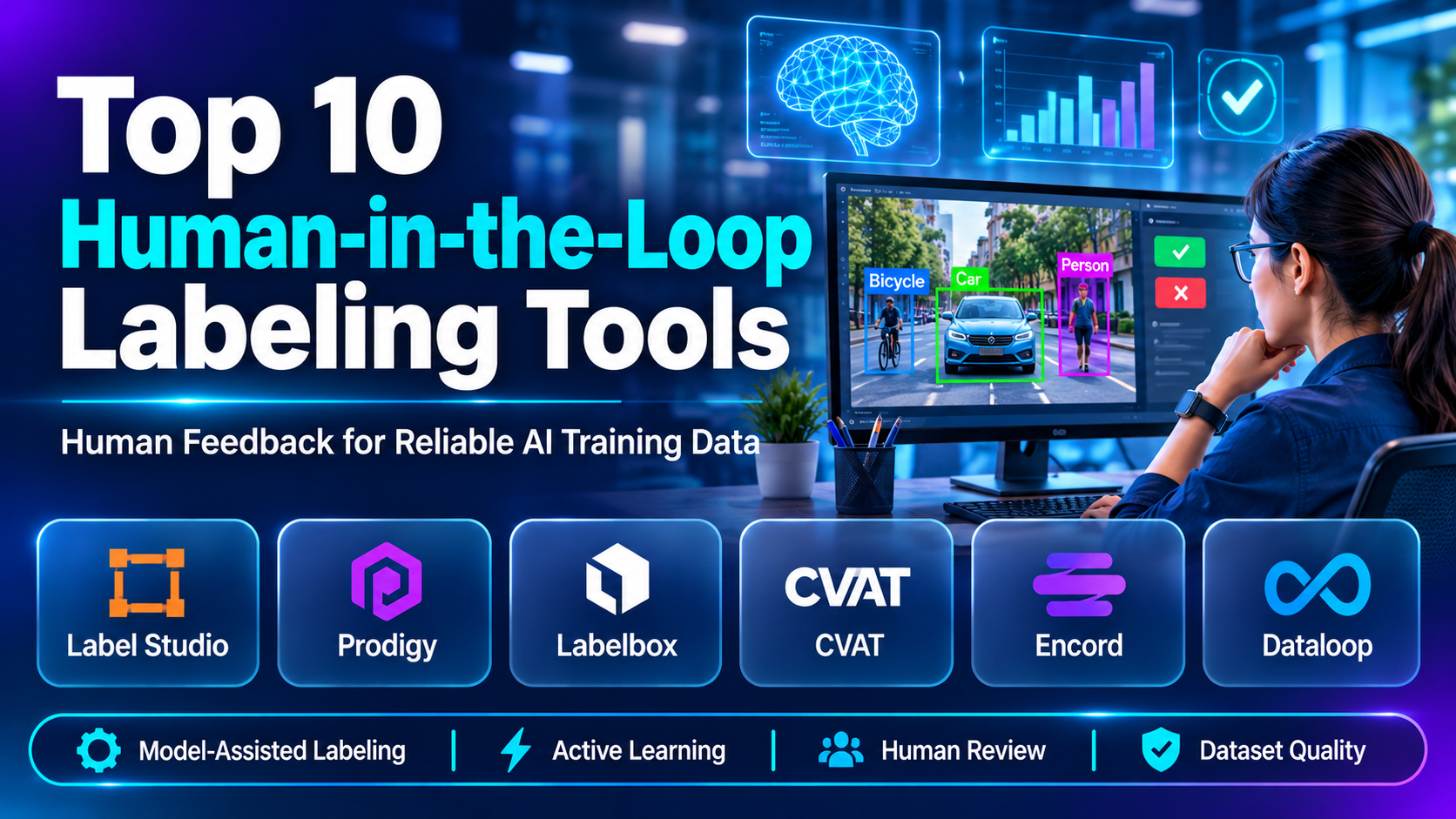
Human-in-the-loop labeling tools help organizations combine human expertise with automated information processing to develop reliable artificial intelligence systems. These technologies provide structured environments where contributors review, correct, validate, and improve machine-generated annotations.
Modern Artificial Intelligence (AI) applications frequently process complex information that automated models cannot consistently interpret without human assistance. Human involvement helps identify ambiguous examples, incorrect predictions, contextual misunderstandings, and potential sources of dataset bias.
Human-in-the-loop labeling platforms combine interactive annotation interfaces, automated predictions, task assignments, quality assurance, and feedback collection mechanisms. These capabilities support continuous improvement across machine learning development, model evaluation, and production information processing workflows.
Advanced labeling technologies support computer vision, Natural Language Processing (NLP), document processing, speech recognition, and generative AI applications. Many platforms also incorporate active learning, confidence-based task routing, preference annotation, and specialized human evaluation workflows.
Different human-in-the-loop labeling tools address varying information modalities, annotation requirements, workforce arrangements, automation objectives, and organizational needs. Selecting appropriate software requires evaluating human review capabilities, integration flexibility, quality controls, scalability, security, and total ownership expenses.
This guide examines ten human-in-the-loop labeling tools, including their features, benefits, advantages, limitations, and practical applications. It also provides comparison tables, implementation recommendations, performance indicators, security considerations, and frequently asked questions.
What Are Human-in-the-Loop Labeling Tools?
Human-in-the-Loop (HITL) labeling tools are software platforms and frameworks that incorporate human judgment into automated information annotation and machine learning workflows. They allow qualified contributors to review model predictions, correct errors, resolve ambiguous cases, and provide structured feedback.
Traditional manual labeling requires contributors to annotate information without necessarily receiving automated predictions. Human-in-the-loop workflows introduce a feedback mechanism in which machine-generated suggestions and human corrections can contribute to subsequent model improvement.
These platforms may use prediction confidence, uncertainty estimates, predefined business rules, or active learning strategies to determine which information assets require human attention. Human-reviewed annotations can subsequently become part of controlled training, validation, or evaluation datasets.
Effective human-in-the-loop labeling requires clearly defined review criteria, representative information, qualified contributors, reliable automation, and appropriate quality assurance procedures. Organizations must also establish safeguards against automation bias, information exposure, inconsistent judgments, and uncontrolled model updates.
How Human-in-the-Loop Labeling Tools Work
- Define machine learning objectives and annotation requirements.
- Collect representative information from approved sources.
- Establish labeling categories and human review instructions.
- Configure compatible machine learning models and annotation interfaces.
- Generate preliminary predictions or annotation suggestions.
- Identify uncertain, incorrect, or high-priority predictions.
- Route selected information assets to qualified human reviewers.
- Allow contributors to validate, correct, or reject generated annotations.
- Conduct additional quality reviews where necessary.
- Store approved annotations in controlled datasets.
- Retrain or refine models through validated development procedures.
- Evaluate model performance using independent test datasets.
- Repeat the feedback cycle according to established improvement objectives.
Common Applications of Human-in-the-Loop Labeling Tools
- Computer vision model improvement.
- Automated document classification.
- Object detection validation.
- Medical image annotation research.
- Industrial defect recognition.
- Autonomous vehicle perception.
- Named Entity Recognition (NER).
- Customer feedback classification.
- Speech recognition correction.
- Audio transcription validation.
- Content moderation model evaluation.
- Large Language Model (LLM) evaluation.
- Human preference collection.
- Reinforcement Learning from Human Feedback (RLHF).
- Intelligent document processing.
- Multimodal AI dataset development.
- Search relevance assessment.
- Semantic segmentation validation.
- Scientific information classification.
- Continuous machine learning improvement.
Essential Components of Human-in-the-Loop Labeling Tools
| Component | Purpose |
|---|---|
| Annotation interface | Allows contributors to create and correct labels |
| Prediction integration | Connects compatible machine learning models |
| Task routing | Assigns information assets to appropriate reviewers |
| Confidence assessment | Helps identify predictions requiring human attention |
| Active learning framework | Prioritizes informative examples for annotation |
| Review workflow | Supports validation and approval activities |
| Quality assurance | Identifies inconsistent or incorrect annotations |
| Contributor management | Coordinates human labeling responsibilities |
| Feedback collection | Captures corrections and structured judgments |
| Dataset management | Organizes reviewed information assets |
| Annotation schema | Defines permitted labels and relationships |
| Model integration | Connects feedback with controlled development workflows |
| Performance monitoring | Tracks annotation quality and productivity |
| Audit records | Documents human and automated processing activities |
| Security administration | Protects information and contributor access |
Top 10 Human-in-the-Loop Labeling Tools
The following tools include open-source annotation platforms, active learning frameworks, enterprise data development software, and managed human feedback services. Their numbering represents presentation order rather than an independently tested performance ranking.
1. Label Studio
Short Description
Label Studio is an open-source data annotation platform developed by HumanSignal that supports human-reviewed labeling across multiple information modalities. It provides configurable interfaces for text, images, video, audio, and other supported information formats.
The platform allows developers to connect compatible machine learning backends that generate preliminary annotation predictions. Human contributors can inspect these predictions, correct inaccurate labels, and submit validated annotations.
Label Studio supports customizable labeling configurations that accommodate classification, segmentation, transcription, entity recognition, and preference assessment workflows. These capabilities make it suitable for organizations developing specialized human-in-the-loop applications.
The platform provides open-source and commercial enterprise offerings with different collaboration, security, and review capabilities. Organizations should evaluate deployment requirements and available integrations before implementing large-scale annotation workflows.
Key Features
- Configurable multimodal annotation interfaces.
- Compatible machine learning backend integration.
- Human correction of automated predictions.
- Custom annotation templates.
- Text classification and entity recognition.
- Image and video labeling.
- Audio annotation capabilities.
- Annotation import and export.
- Supported enterprise review workflows.
Benefits
- Supports flexible human feedback collection.
- Reduces custom annotation interface development.
- Facilitates iterative machine learning improvement.
- Enables configurable review workflows.
- Supports multiple information modalities.
- Reduces proprietary software dependencies.
- Improves annotation process consistency.
Pros
- Open-source software availability.
- Extensive annotation configuration options.
- Supports self-managed deployments.
- Compatible machine learning integrations.
- Broad information modality support.
- Suitable for research and enterprise applications.
Cons
- Advanced configurations require technical expertise.
- Self-managed infrastructure requires administration.
- Enterprise features depend on licensing.
- Large projects require resource planning.
- Specialized feedback workflows may require customization.
Use Cases: Human-reviewed text classification, computer vision correction, document annotation, LLM evaluation, audio transcription validation, and iterative model development.
Best For: Machine learning engineers, AI startups, research institutions, data scientists, enterprise AI teams, and open-source development organizations.
2. Prodigy
Short Description
Prodigy is a scriptable annotation tool developed by Explosion that supports human-in-the-loop machine learning workflows. It is particularly relevant to organizations developing language processing and customized annotation applications.
The platform provides configurable annotation recipes that allow developers to define how information is presented, labeled, and processed. Compatible model integrations enable contributors to review predictions and provide corrections through interactive interfaces.
Prodigy supports active learning workflows in which selected examples receive human attention according to model uncertainty or other configurable selection strategies. These capabilities can help teams prioritize informative annotation tasks during iterative model development.
The software is commercially licensed and provides locally deployable annotation functionality. Organizations should evaluate technical expertise, collaboration requirements, supported integrations, and licensing arrangements.
Key Features
- Scriptable annotation workflows.
- Configurable annotation recipes.
- Active learning support.
- Human review of model predictions.
- Text classification annotation.
- Named entity recognition.
- Supported image annotation.
- Python-based customization.
- Dataset export and integration capabilities.
Benefits
- Supports targeted human annotation.
- Facilitates rapid model experimentation.
- Reduces unnecessary labeling activities.
- Enables specialized annotation workflows.
- Improves control over annotation environments.
- Supports iterative NLP development.
- Facilitates reusable annotation configurations.
Pros
- Highly customizable architecture.
- Strong language processing orientation.
- Supports active learning workflows.
- Local deployment capabilities.
- Developer-friendly Python integration.
- Suitable for specialized annotation projects.
Cons
- Commercial licensing is required.
- Custom workflows require programming knowledge.
- Large workforce management may require additional tools.
- Enterprise collaboration requirements need evaluation.
- Advanced automation requires configuration.
Use Cases: Named entity recognition, text classification, language model evaluation, active learning experiments, document labeling, and domain-specific information extraction.
Best For: NLP engineers, Python developers, machine learning researchers, data scientists, computational linguists, and specialized AI development teams.
3. Labelbox
Short Description
Labelbox is an enterprise AI data development platform that supports annotation, human feedback, dataset management, and model evaluation. It helps organizations coordinate complex labeling activities involving internal teams and external contributors.
The platform provides model-assisted annotation capabilities that allow compatible predictions to become preliminary labels for human review. Contributors can correct inaccurate predictions and submit annotations through structured quality assurance workflows.
Labelbox also supports dataset curation, model evaluation, and human preference collection for compatible generative AI applications. These capabilities help organizations identify model weaknesses and develop targeted improvement datasets.
The platform offers commercial software and compatible managed workforce services. Organizations should assess commercial arrangements, annotation complexity, information protection, and integration requirements.
Key Features
- Multimodal data annotation.
- Model-assisted labeling.
- Human prediction correction.
- Collaborative review workflows.
- Dataset curation and organization.
- Annotation quality management.
- Supported preference evaluation.
- Managed workforce options.
- Application Programming Interface (API) integrations.
Benefits
- Supports scalable human feedback workflows.
- Improves annotation quality visibility.
- Facilitates enterprise model improvement.
- Reduces repetitive labeling activities.
- Supports coordinated workforce management.
- Enables targeted dataset development.
- Improves collaboration across AI teams.
Pros
- Comprehensive enterprise data platform.
- Supports multiple annotation modalities.
- Relevant human evaluation capabilities.
- Integrated quality review workflows.
- Compatible managed workforce services.
- Suitable for large-scale AI projects.
Cons
- Commercial expenses require evaluation.
- Advanced workflows require configuration.
- Enterprise integration may require development.
- External workforce access requires governance.
- Feature availability depends on selected offerings.
Use Cases: Enterprise model evaluation, computer vision labeling, generative AI feedback, multimodal annotation, dataset curation, and human-reviewed prediction correction.
Best For: Large enterprises, AI development departments, data operations managers, machine learning engineers, generative AI teams, and organizations requiring managed annotation capacity.
4. CVAT
Short Description
Computer Vision Annotation Tool (CVAT) is an annotation platform designed primarily for human-reviewed image and video labeling. It provides interactive tools for identifying objects, defining boundaries, and validating visual information.
The platform supports compatible automated annotation models that generate preliminary object detections, segmentation masks, and other supported predictions. Human contributors can correct these outputs before approving annotations for machine learning datasets.
CVAT provides project management, task assignments, annotation review, and compatible quality control mechanisms. Video interpolation and tracking capabilities can reduce repetitive labeling while maintaining opportunities for human correction.
The platform offers open-source and commercial deployment options. Organizations should evaluate visual annotation requirements, infrastructure resources, automation integrations, and available quality assurance features.
Key Features
- Image and video annotation.
- Bounding box and polygon labeling.
- Semantic and instance segmentation.
- Keypoint annotation.
- Compatible automated annotation models.
- Human correction of visual predictions.
- Video tracking and interpolation.
- Annotation task management.
- Supported quality control workflows.
Benefits
- Supports reliable computer vision datasets.
- Reduces repetitive visual annotation.
- Facilitates human validation of predictions.
- Improves visual labeling consistency.
- Enables collaborative annotation activities.
- Supports specialized segmentation tasks.
- Facilitates iterative computer vision development.
Pros
- Open-source software availability.
- Strong computer vision specialization.
- Extensive visual annotation capabilities.
- Compatible automated labeling integrations.
- Supports multiple export formats.
- Relevant video annotation functionality.
Cons
- Primarily focused on visual information.
- Complex annotations require trained contributors.
- Self-managed deployments require administration.
- Large video datasets require substantial resources.
- Advanced commercial features require evaluation.
Use Cases: Object detection correction, autonomous vehicle perception, industrial defect labeling, video tracking validation, image segmentation, and robotics dataset preparation.
Best For: Computer vision engineers, robotics developers, manufacturing organizations, research institutions, autonomous systems teams, and visual annotation specialists.
5. Encord
Short Description
Encord is an AI data development platform that supports annotation, dataset curation, quality assessment, and compatible human-in-the-loop workflows. It helps organizations prepare complex datasets and identify information requiring additional human attention.
The platform provides configurable annotation ontologies and interactive labeling tools for visual and other supported information modalities. Compatible automated predictions can be incorporated into annotation workflows for human validation.
Encord provides dataset analysis and curation capabilities that help teams identify information gaps, unusual examples, and potential labeling inconsistencies. These features can support targeted annotation strategies and iterative model improvement.
The platform is particularly relevant to organizations managing specialized computer vision and multimodal AI datasets. Commercial licensing, deployment requirements, supported modalities, and automation capabilities should be evaluated.
Key Features
- Configurable annotation ontologies.
- Image and video annotation.
- Model-assisted labeling.
- Human annotation review.
- Dataset curation.
- Supported active learning workflows.
- Annotation quality assessment.
- Compatible multimodal data management.
- Dataset analysis capabilities.
Benefits
- Supports targeted human review.
- Improves dataset quality visibility.
- Facilitates specialized annotation workflows.
- Reduces repetitive labeling activities.
- Enables systematic dataset improvement.
- Supports collaborative AI development.
- Helps identify underrepresented information categories.
Pros
- Strong visual data development capabilities.
- Relevant dataset curation functionality.
- Configurable labeling ontologies.
- Supports model-assisted annotation.
- Integrated review capabilities.
- Suitable for complex AI applications.
Cons
- Commercial expenses require assessment.
- Advanced workflows require configuration.
- Specialized projects require domain expertise.
- Large datasets require infrastructure planning.
- Feature availability depends on selected offerings.
Use Cases: Medical image research, autonomous vehicle annotation, robotics perception, dataset quality assessment, visual model improvement, and active learning workflows.
Best For: Enterprise AI teams, computer vision engineers, healthcare AI researchers, robotics organizations, dataset quality specialists, and machine learning developers.
6. Dataloop
Short Description
Dataloop is an AI development platform that provides annotation, data management, automation, and compatible machine learning workflow capabilities. It supports human involvement throughout configurable data preparation and model improvement processes.
The platform allows organizations to establish automated processing pipelines that incorporate machine learning predictions and human annotation tasks. Selected information assets can be routed to contributors according to configured workflow requirements.
Dataloop provides compatible annotation interfaces, workforce management, quality assurance, and dataset administration functionality. These capabilities help organizations coordinate complex annotation operations across distributed AI development teams.
The platform is particularly relevant to enterprises requiring customizable human-in-the-loop automation. Organizations should evaluate integration complexity, supported modalities, security requirements, and commercial arrangements.
Key Features
- Multimodal annotation capabilities.
- Configurable automation pipelines.
- Human review task routing.
- Model-assisted annotation.
- Dataset management.
- Annotation quality assurance.
- Workforce coordination.
- Compatible model integrations.
- Developer application interfaces.
Benefits
- Coordinates human and automated workflows.
- Supports scalable annotation operations.
- Facilitates targeted prediction correction.
- Improves annotation process visibility.
- Enables reusable processing pipelines.
- Supports iterative AI development.
- Reduces repetitive workflow administration.
Pros
- Flexible automation architecture.
- Comprehensive AI data development orientation.
- Supports multiple annotation modalities.
- Relevant workforce management functionality.
- Compatible machine learning integrations.
- Suitable for complex enterprise projects.
Cons
- Advanced workflows require technical expertise.
- Commercial expenses require evaluation.
- Enterprise integrations require planning.
- Complex pipelines require maintenance.
- Feature availability depends on selected offerings.
Use Cases: Automated annotation pipelines, human-reviewed classification, enterprise AI training, multimodal labeling, dataset curation, and continuous model improvement.
Best For: Enterprise AI departments, machine learning engineers, data operations managers, automation specialists, AI infrastructure teams, and organizations requiring configurable review workflows.
7. V7 Darwin
Short Description
V7 Darwin is a data annotation platform that supports visual labeling, automated annotation assistance, and configurable human review workflows. It is designed to help organizations develop structured datasets for computer vision applications.
The platform provides annotation tools for bounding boxes, polygons, segmentation masks, and compatible visual classification tasks. Automated labeling capabilities can generate preliminary annotations that contributors subsequently inspect and correct.
V7 Darwin supports configurable workflow stages for annotation, review, approval, and compatible model-assisted processing. These capabilities allow organizations to establish controlled human feedback procedures for specialized visual information.
The platform is particularly relevant to complex image segmentation and visual AI development projects. Organizations should evaluate current commercial packaging, supported automation functionality, and integration requirements.
Key Features
- Image and video annotation.
- Automated segmentation assistance.
- Bounding box and polygon labeling.
- Configurable annotation workflows.
- Human prediction correction.
- Collaborative review stages.
- Dataset organization.
- Compatible machine learning integrations.
- Supported annotation export formats.
Benefits
- Reduces repetitive visual labeling.
- Supports precise annotation correction.
- Facilitates structured human review.
- Improves visual dataset consistency.
- Enables specialized annotation workflows.
- Supports iterative model development.
- Improves coordination between annotation teams.
Pros
- Strong visual annotation specialization.
- Relevant automated labeling capabilities.
- Configurable review workflows.
- Supports complex segmentation tasks.
- Compatible model integrations.
- Suitable for specialized computer vision projects.
Cons
- Commercial licensing requires assessment.
- Automated predictions require validation.
- Advanced workflows require configuration.
- Primarily oriented toward visual information.
- Large projects require workforce planning.
Use Cases: Medical image segmentation, industrial inspection, automated mask correction, agricultural monitoring, visual model training, and specialized image annotation.
Best For: Computer vision developers, healthcare AI researchers, manufacturing organizations, image segmentation specialists, data operations managers, and visual annotation teams.
8. Argilla
Short Description
Argilla is an open-source data annotation and feedback platform associated with the Hugging Face ecosystem. It supports collaborative dataset development, language model evaluation, and human feedback collection.
The platform provides configurable datasets and annotation interfaces that allow contributors to classify information, evaluate model responses, rank alternatives, and provide structured judgments. Compatible model predictions can be included as suggestions for human review.
Argilla supports workflows involving supervised learning datasets, preference data, text annotation, and generative AI evaluation. Its programmatic interfaces allow developers to integrate human feedback into broader machine learning development environments.
The platform is particularly relevant to organizations developing language models and customized feedback datasets. Deployment requirements, collaboration capabilities, supported annotation fields, and integration compatibility should be evaluated.
Key Features
- Collaborative human feedback collection.
- Configurable annotation datasets.
- Text classification workflows.
- Model prediction suggestions.
- Preference ranking capabilities.
- Structured response evaluation.
- Python-based application interfaces.
- Hugging Face ecosystem integrations.
- Open-source deployment options.
Benefits
- Supports language model improvement.
- Facilitates structured human feedback.
- Reduces custom evaluation interface development.
- Enables collaborative dataset preparation.
- Supports preference data collection.
- Improves control over feedback workflows.
- Reduces proprietary licensing dependencies.
Pros
- Open-source software availability.
- Strong language model evaluation orientation.
- Flexible annotation configurations.
- Relevant Hugging Face integrations.
- Supports collaborative feedback collection.
- Suitable for research and customized AI workflows.
Cons
- Advanced configurations require technical expertise.
- Self-managed deployments require administration.
- Specialized visual annotation may require other tools.
- Large-scale workforce management requires planning.
- Automated model improvement requires complementary infrastructure.
Use Cases: LLM evaluation, preference ranking, text classification, response quality assessment, supervised fine-tuning dataset preparation, and human feedback collection.
Best For: Generative AI developers, NLP engineers, machine learning researchers, Hugging Face users, data scientists, and language model evaluation teams.
9. Amazon SageMaker Ground Truth
Short Description
Amazon SageMaker Ground Truth is a managed data labeling capability within the Amazon Web Services (AWS) machine learning ecosystem. It provides configurable labeling jobs that incorporate human contributors and supported automated annotation mechanisms.
The service supports annotation tasks involving images, text, video, point clouds, and other compatible information types. Organizations can establish labeling workflows using supported task templates or customized annotation interfaces.
Ground Truth provides automated labeling functionality for eligible task types and supports multiple workforce arrangements. Human contributors can label information and participate in compatible verification and adjustment workflows.
The service integrates with supported AWS storage, security, and machine learning infrastructure. Organizations should evaluate regional availability, current service access, task compatibility, workforce restrictions, and processing expenses.
Key Features
- Managed data labeling infrastructure.
- Configurable labeling jobs.
- Supported automated labeling.
- Human annotation workflows.
- Compatible verification and adjustment tasks.
- Private and external workforce options.
- Custom annotation interfaces.
- Annotation consolidation mechanisms.
- AWS storage and machine learning integrations.
Benefits
- Reduces labeling infrastructure administration.
- Supports scalable human annotation.
- Facilitates AWS-based model development.
- Enables configurable workforce arrangements.
- Supports multiple information modalities.
- Reduces selected manual labeling activities.
- Improves coordination with cloud infrastructure.
Pros
- Managed cloud architecture.
- Strong AWS ecosystem integration.
- Supports multiple labeling task types.
- Flexible workforce arrangements.
- Compatible custom annotation workflows.
- Relevant enterprise security integrations.
Cons
- Primarily oriented toward AWS infrastructure.
- Automated labeling availability varies by task.
- Workforce expenses require monitoring.
- Custom workflows may require development.
- Regional availability and service access require verification.
Use Cases: AWS-based machine learning training, image annotation, text classification, point cloud labeling, prediction verification, and enterprise dataset preparation.
Best For: AWS customers, cloud architects, machine learning engineers, enterprise AI teams, computer vision developers, and managed labeling infrastructure users.
10. Scale AI
Short Description
Scale AI provides managed data development, human annotation, and AI evaluation services for organizations developing advanced machine learning systems. Its offerings combine software infrastructure with coordinated human contributor workflows.
The platform supports specialized annotation and evaluation activities involving computer vision, language models, multimodal information, and other compatible AI applications. Human contributors can provide structured labels, preference judgments, and model output assessments.
Scale AI provides managed workforce coordination and compatible quality assurance mechanisms for large-scale data development projects. These services can help organizations address annotation requirements that exceed internal workforce capacity.
The platform is particularly relevant to enterprises requiring specialized human feedback and managed AI evaluation services. Organizations should assess contractual arrangements, contributor qualifications, data protection, workforce conditions, and quality commitments.
Key Features
- Managed human annotation services.
- Computer vision labeling.
- Language model evaluation.
- Human preference collection.
- Supported multimodal annotation.
- Managed workforce coordination.
- Annotation quality management.
- Specialized AI evaluation workflows.
- Enterprise data development services.
Benefits
- Supports large-scale human feedback requirements.
- Reduces internal workforce coordination burdens.
- Facilitates specialized dataset development.
- Enables managed quality assurance.
- Supports advanced AI evaluation.
- Improves access to annotation resources.
- Facilitates complex machine learning projects.
Pros
- Strong managed service orientation.
- Supports complex AI applications.
- Relevant human feedback capabilities.
- Specialized workforce options.
- Suitable for enterprise-scale projects.
- Supports multiple annotation modalities.
Cons
- Commercial pricing requires consultation.
- External workforce access requires governance.
- Managed services introduce vendor dependencies.
- Quality commitments require contractual definition.
- Specialized projects require detailed implementation planning.
Use Cases: Generative AI evaluation, autonomous vehicle annotation, human preference collection, multimodal dataset development, specialized model assessment, and enterprise AI training.
Best For: Large enterprises, generative AI organizations, autonomous systems developers, research institutions, enterprise data operations teams, and organizations requiring managed human feedback.
Comparison Table: Top 10 Human-in-the-Loop Labeling Tools
| Tool | Primary Strength | Best For | Pricing Approach |
|---|---|---|---|
| Label Studio | Flexible multimodal annotation | Customized human feedback workflows | Open-source and commercial editions |
| Prodigy | Scriptable active learning | NLP and targeted annotation | Commercial licensing |
| Labelbox | Enterprise data development | Large-scale human feedback | Commercial licensing |
| CVAT | Human-reviewed visual annotation | Computer vision projects | Open-source and commercial offerings |
| Encord | Dataset curation and annotation | Specialized visual AI development | Commercial licensing |
| Dataloop | Configurable workflow automation | Enterprise HITL pipelines | Commercial licensing |
| V7 Darwin | Automated visual annotation | Complex image segmentation | Commercial licensing |
| Argilla | Collaborative language model feedback | LLM evaluation and preference data | Open-source |
| SageMaker Ground Truth | Managed cloud labeling | AWS machine learning workflows | Usage and workforce-based |
| Scale AI | Managed human feedback services | Enterprise-scale annotation | Contract-based pricing |
Functional Comparison
| Tool | Primary Information Types | Human Feedback Approach | Automation Approach |
|---|---|---|---|
| Label Studio | Multiple modalities | Configurable annotation and review | Compatible model backends |
| Prodigy | Primarily text; supported visual tasks | Interactive annotation recipes | Active learning and custom models |
| Labelbox | Multiple modalities | Collaborative review and evaluation | Model-assisted labeling |
| CVAT | Images and video | Visual prediction correction | Compatible automated annotation |
| Encord | Visual and multimodal data | Structured annotation review | Model assistance and dataset curation |
| Dataloop | Multiple modalities | Configurable human task routing | Automated processing pipelines |
| V7 Darwin | Images and video | Annotation and approval stages | Automated visual labeling |
| Argilla | Primarily text and model responses | Structured judgments and preferences | Compatible prediction suggestions |
| SageMaker Ground Truth | Images, text, video, point clouds | Managed labeling and verification | Task-dependent automated labeling |
| Scale AI | Multiple modalities | Managed human annotation and evaluation | Workflow-dependent automation |
Understanding Human-in-the-Loop Labeling Approaches
Model-Assisted Annotation
Model-assisted annotation uses machine learning predictions as preliminary labels that human contributors subsequently inspect. Reviewers can accept, modify, or reject generated annotations according to established quality requirements.
Active Learning
Active learning selects information assets that may provide substantial value when annotated and incorporated into model development. Selection strategies can consider prediction uncertainty, information diversity, or expected improvements in model performance.
Confidence-Based Review
Confidence-based review routes predictions to human contributors when estimated model confidence falls below a configured threshold. Organizations should calibrate confidence scores and evaluate whether high-confidence predictions can still contain systematic errors.
Human Preference Annotation
Human preference annotation records judgments about the relative quality of alternative model outputs. These assessments can support preference optimization, response evaluation, and other language model development methodologies.
Expert-in-the-Loop Annotation
Expert-in-the-loop annotation incorporates qualified domain specialists into information labeling and review activities. This approach is particularly relevant to medical research, scientific information processing, engineering inspection, and other specialized applications.
Consensus-Based Labeling
Consensus-based labeling assigns the same information asset to multiple contributors and compares their judgments. Organizations can use agreement measurements, majority decisions, or expert adjudication to resolve inconsistent annotations.
Exception-Based Review
Exception-based review directs unusual, incomplete, or potentially incorrect predictions to human contributors according to predefined rules. This approach helps organizations concentrate review resources on selected cases requiring additional attention.
Continuous Feedback Workflows
Continuous feedback workflows collect human corrections during ongoing model use and development. Approved corrections can contribute to future model updates through controlled retraining and independent validation procedures.
Human-in-the-Loop vs. Traditional Manual Labeling
| Evaluation Factor | Traditional Manual Labeling | Human-in-the-Loop Labeling |
|---|---|---|
| Initial annotation | Created by human contributors | May originate from automated predictions |
| Human involvement | Generally required for every assigned item | Can focus on selected or uncertain items |
| Automation | Limited or optional | Integrated into compatible workflows |
| Feedback mechanism | Usually dataset-oriented | Supports iterative model improvement |
| Annotation prioritization | Frequently predefined | Can use uncertainty and active learning |
| Processing efficiency | Dependent on manual productivity | May improve through validated automation |
| Quality risks | Human inconsistency and fatigue | Human inconsistency and automation bias |
| Technical requirements | Relatively straightforward | May require model integration |
| Model improvement | Usually separate from labeling | Can connect to controlled feedback cycles |
| Best application | Initial datasets and independent labels | Iterative development and prediction correction |
How to Choose the Best Human-in-the-Loop Labeling Tool
Evaluate Information Modalities
Identify whether the organization processes text, images, video, audio, point clouds, or multimodal information. Select a platform that provides appropriate annotation interfaces and compatible model integration capabilities.
Assess Human Review Requirements
Determine whether workflows require simple prediction approval, detailed annotation correction, expert adjudication, or preference ranking. Different review requirements influence interface design, contributor qualifications, and quality assurance procedures.
Review Model Integration Capabilities
Examine whether the platform can receive predictions from existing machine learning models and return validated annotations to development environments. Reliable integrations reduce repetitive information transfer and support controlled feedback workflows.
Examine Active Learning Support
Determine whether annotation workloads would benefit from uncertainty-based selection, diversity sampling, or other targeted labeling strategies. Organizations should evaluate whether these strategies improve dataset coverage and downstream model performance.
Evaluate Quality Assurance
Review support for annotation verification, contributor agreement measurement, reference tasks, correction procedures, and approval stages. Quality controls should address both human annotation errors and systematic model prediction failures.
Consider Workforce Requirements
Assess whether annotation activities require internal contributors, specialized experts, external contractors, or managed workforce services. Workforce arrangements influence project expenses, contributor training, access controls, and operational complexity.
Review Automation Flexibility
Determine whether the platform supports configurable task routing, prediction confidence thresholds, automated processing stages, and custom review rules. Flexible automation can help organizations establish workflows aligned with specific operational requirements.
Assess Security and Governance
Evaluate authentication, encryption, contributor permissions, audit records, information residency, and retention capabilities. Sensitive datasets may require restricted deployment environments and specialized contractual protections.
Evaluate Scalability
Identify expected annotation volumes, contributor counts, model inference requirements, and review turnaround objectives. Representative pilot projects help organizations determine whether platforms can accommodate anticipated workloads.
Consider Total Ownership Costs
Evaluate software licensing, human annotation labor, model inference expenses, infrastructure, quality review, and integration development. Organizations should compare the cost of producing validated feedback rather than evaluating automation or subscription expenses independently.
Best Human-in-the-Loop Labeling Tools by User Type
| User Type | Relevant Tool |
|---|---|
| Open-source multimodal AI developer | Label Studio |
| NLP active learning specialist | Prodigy |
| Enterprise AI data operations manager | Labelbox |
| Computer vision annotation engineer | CVAT |
| Dataset curation specialist | Encord |
| Enterprise workflow automation engineer | Dataloop |
| Visual segmentation specialist | V7 Darwin |
| Language model feedback researcher | Argilla |
| AWS machine learning engineer | SageMaker Ground Truth |
| Managed human feedback service customer | Scale AI |
Practical Example: Implementing Human-in-the-Loop Labeling for Industrial Inspection
Consider a hypothetical manufacturing organization developing computer vision models to identify surface defects and assembly inconsistencies across multiple production facilities. Its existing annotation process requires contributors to manually inspect and label every collected production image.
Management introduces a human-in-the-loop labeling workflow that combines automated defect predictions, uncertainty-based review, expert validation, and controlled model retraining. The following outcomes represent illustrative assumptions rather than verified vendor performance.
Implementation Steps
- Collect representative production images covering different defect categories, equipment types, and operating conditions.
- Establish standardized annotation instructions and independently reviewed reference datasets.
- Train an initial computer vision model using validated annotations.
- Integrate model predictions into a compatible human-in-the-loop annotation platform.
- Route uncertain predictions and selected high-confidence samples to trained reviewers.
- Validate corrected annotations and incorporate approved examples into controlled training datasets.
- Retrain models, conduct independent evaluations, and monitor annotation quality and operational expenses.
Illustrative Performance Improvements
| Performance Indicator | Before | After |
|---|---|---|
| Average annotation time per image | 5 minutes | 1.8 minutes |
| Accepted annotations per contributor hour | 10 | 28 |
| Annotation acceptance rate | 76% | 97% |
| Annotation correction rate | 24% | 3% |
| Inter-annotator agreement | 72% | 94% |
| Monthly annotation and review workload | 2,400 hours | 900 hours |
| Dataset preparation duration | 14 weeks | 6 weeks |
| Average review turnaround | 36 hours | 7 hours |
| Independent defect detection recall | 74% | 92% |
| Independent defect detection precision | 79% | 93% |
The assumed model performance improvements depend on representative training information, appropriate model development, and independent evaluation. Introducing a human-in-the-loop labeling platform does not independently guarantee improved model accuracy.
Financial Analysis
Reducing monthly annotation and review workloads by 1,500 hours releases 18,000 employee hours annually. At an illustrative labor cost of $35 per hour, this represents $630,000 in released annual labor capacity rather than guaranteed cash savings.
Suppose the organization eliminates $300,000 in annual external annotation expenses and $150,000 in avoidable legacy processing and review service expenses. These realized reductions would produce total gross annual cash savings of $450,000.
After recurring software, model inference, infrastructure, and quality assurance expenses of $150,000, annual net cash savings would equal $300,000. An initial implementation investment of $450,000 would therefore produce a simple payback period of 18 months.
This calculation excludes taxes, financing costs, discounting, potential manufacturing quality improvements, and the separately estimated value of released employee capacity. Actual financial outcomes would depend on automation effectiveness, workforce expenses, model integration complexity, software licensing, and the organization’s ability to eliminate existing operating costs.
Important Human-in-the-Loop Labeling Performance Indicators
| Indicator | Measurement Purpose |
|---|---|
| Annotation throughput | Measures completed annotations within a defined period |
| Accepted annotation throughput | Tracks annotations passing quality review |
| Human review rate | Measures the proportion of eligible predictions receiving review |
| Automated label acceptance rate | Tracks generated annotations accepted under defined criteria |
| Prediction correction rate | Measures automated predictions requiring modification |
| Annotation acceptance rate | Evaluates annotations satisfying quality requirements |
| Average annotation time | Measures time required to complete labeling tasks |
| Review turnaround time | Tracks duration of human validation activities |
| Inter-annotator agreement | Measures consistency between contributor judgments |
| Reference task accuracy | Evaluates annotations against independently validated examples |
| Model confidence calibration | Assesses agreement between confidence estimates and observed correctness |
| Escalation rate | Tracks tasks requiring additional expert review |
| Annotation backlog | Measures pending labeling and review activities |
| Cost per accepted annotation | Evaluates average validated annotation expenses |
| Feedback incorporation rate | Tracks approved feedback used in controlled development cycles |
| Dataset coverage | Measures representation of required information categories |
| Class distribution | Evaluates representation of different annotation categories |
| Model precision | Measures the proportion of positive predictions that are correct |
| Model recall | Measures the proportion of actual positive examples correctly identified |
| Model regression rate | Tracks performance deterioration against established evaluation baselines |
| Reviewer override rate | Measures the frequency of human changes to automated decisions |
| Audit record completeness | Evaluates documentation of human and automated processing activities |
Security and Governance Considerations
Human-in-the-loop labeling platforms frequently process confidential documents, customer records, medical images, proprietary designs, and sensitive operational information. Organizations should implement appropriate authentication, encryption, role-based access controls, and administrative audit logging.
Human contributors should receive access only to information necessary for assigned annotation and review responsibilities. Organizations should establish appropriate restrictions on information downloads, external sharing, unauthorized reproduction, and local storage.
External annotation providers should undergo appropriate contractual, privacy, and security assessments. Agreements should address confidentiality, information ownership, contributor access, subcontracting, retention requirements, and applicable information protection obligations.
Organizations should maintain records linking automated predictions, human corrections, review decisions, annotation instructions, and approved dataset versions. These records support accountability, reproducibility, and investigation of potential model quality problems.
Human feedback should not automatically trigger unrestricted production model updates. Organizations should establish controlled retraining procedures, independent validation, approval requirements, and rollback mechanisms before deploying modified models.
Governance procedures should also address automation bias, contributor disagreement, demographic representation, and potential systematic annotation errors. Independent reference datasets and representative sampling help organizations identify problems that may not be apparent during routine prediction review.
Contributor welfare should remain an important consideration in human feedback operations. Projects involving sensitive or disturbing information may require appropriate training, exposure controls, support mechanisms, and responsible workforce management.
Challenges and Limitations
Automation Bias
Human contributors may accept machine-generated predictions without sufficiently evaluating their accuracy. Organizations should provide appropriate review instructions and periodically assess annotations without displaying automated suggestions.
Inconsistent Human Judgments
Different contributors may interpret the same information differently, particularly when annotation instructions involve subjective assessments. Clear guidelines, reference examples, agreement measurement, and structured adjudication help improve consistency.
Incorrect Confidence Estimates
Machine learning models can generate incorrect predictions with high estimated confidence. Organizations should validate confidence calibration and review representative samples of predictions that automated workflows would otherwise accept.
Model Feedback Loops
Repeatedly incorporating incorrectly reviewed predictions into training datasets can reinforce existing model errors. Independent evaluation datasets and controlled retraining procedures help reduce this risk.
High Integration Complexity
Human-in-the-loop workflows may require connections between annotation platforms, model inference services, information repositories, and training infrastructure. Organizations should establish maintainable integrations and document responsibilities for each processing component.
Specialized Workforce Requirements
Complex annotation activities may require medical, scientific, legal, engineering, or linguistic expertise. General-purpose contributors may not provide reliable judgments without appropriate training and qualified expert oversight.
Human Review Bottlenecks
Large volumes of uncertain predictions can create substantial annotation backlogs and delay model development. Organizations should monitor review capacity and adjust task prioritization according to operational requirements.
Information Security Risks
External contributors and automated prediction services may introduce additional information exposure risks. Appropriate access controls, contractual protections, information minimization, and security monitoring are essential.
Dataset Selection Bias
Active learning strategies may prioritize unusual or uncertain examples while underrepresenting common operating conditions. Organizations should combine targeted annotation with representative sampling to maintain appropriate dataset coverage.
Operational Expenses
Human annotation, model inference, infrastructure, and quality assurance can introduce significant recurring expenses. Organizations should evaluate the complete cost of validated feedback alongside measurable improvements in model performance.
Best Practices for Human-in-the-Loop Labeling Implementation
- Establish clearly defined machine learning objectives.
- Collect representative and appropriately authorized information.
- Develop detailed annotation and review instructions.
- Establish consistent annotation categories.
- Train contributors using validated reference examples.
- Select compatible machine learning integration mechanisms.
- Validate automated annotation predictions.
- Calibrate prediction confidence estimates.
- Use active learning where appropriate.
- Review representative high-confidence predictions.
- Maintain independent reference annotation datasets.
- Measure inter-annotator agreement.
- Establish structured disagreement resolution procedures.
- Route specialized cases to qualified domain experts.
- Monitor annotation quality and productivity together.
- Protect confidential information throughout processing workflows.
- Restrict contributor access according to assigned responsibilities.
- Maintain records of automated predictions and human corrections.
- Establish controlled dataset version management.
- Separate training, validation, and independent test datasets.
- Require validation before deploying updated models.
- Maintain model rollback procedures.
- Evaluate the cost per accepted annotation.
- Establish appropriate contributor welfare protections.
- Review dataset representation and potential bias.
- Monitor downstream model performance continuously.
Future Trends in Human-in-the-Loop Labeling Tools
Foundation Model-Assisted Labeling
Human-in-the-loop platforms may increasingly incorporate foundation models to generate preliminary annotations across text, images, audio, and other information modalities. Human reviewers will remain important for validating ambiguous, specialized, and consequential predictions.
Intelligent Review Task Routing
Annotation platforms may increasingly use model uncertainty, contributor expertise, task complexity, and quality requirements to assign review activities. These capabilities can improve resource allocation while requiring appropriate monitoring of assignment decisions.
Advanced Active Learning Strategies
Future platforms may incorporate more sophisticated methods for identifying information assets that provide meaningful training value. Organizations should evaluate these strategies against representative datasets rather than assuming that uncertain examples always produce the greatest improvements.
Human Feedback for Generative AI
Labeling technologies may increasingly support response ranking, preference annotation, factual verification, instruction-following assessment, and other generative AI evaluation activities. These workflows require clear assessment criteria and qualified human contributors.
Multimodal Feedback Collection
Human feedback platforms may increasingly provide coordinated annotation interfaces for text, images, video, audio, and three-dimensional information. Multimodal evaluation requires consistent interpretation of relationships between different information formats.
Automated Annotation Quality Assessment
Future systems may increasingly identify suspicious annotations, inconsistent contributor judgments, missing labels, and potential dataset errors. Automated quality recommendations should undergo appropriate validation before being used to reject or modify human annotations.
Continuous Production Feedback
Organizations may increasingly connect production model monitoring systems with controlled human feedback workflows. These integrations can help identify new information requirements and recurring prediction failures while requiring appropriate privacy and governance controls.
Privacy-Preserving Human Annotation
Human-in-the-loop platforms may increasingly incorporate automated redaction, restricted review environments, information minimization, and controlled contributor access. These capabilities can help organizations manage sensitive datasets while preserving necessary annotation context.
Expert-Centered Evaluation
Specialized AI applications may increasingly incorporate qualified domain experts into targeted review and evaluation workflows. Expert involvement can improve interpretation of complex information while requiring careful management of workforce availability and expenses.
Responsible Feedback Governance
Future human-in-the-loop technologies may increasingly incorporate detailed feedback provenance, contributor accountability, annotation bias assessment, and controlled model update procedures. These capabilities can support more transparent and reliable machine learning development practices.
Frequently Asked Questions
1. What are human-in-the-loop labeling tools?
Human-in-the-loop labeling tools are software platforms that incorporate human judgment into automated annotation and machine learning workflows. They allow contributors to review predictions, correct errors, validate annotations, and provide structured feedback.
2. Why is human-in-the-loop labeling important?
Human-in-the-loop labeling helps organizations identify prediction errors, resolve ambiguous examples, and improve training dataset quality. It combines automated processing with human expertise to support more reliable machine learning development.
3. What is Label Studio?
Label Studio is an open-source annotation platform supporting multiple information modalities and configurable labeling interfaces. Compatible machine learning integrations allow contributors to review and correct automated predictions.
4. What is Prodigy?
Prodigy is a commercially licensed, scriptable annotation tool developed by Explosion. It supports customizable annotation recipes, active learning, and human-reviewed machine learning workflows.
5. What is Labelbox?
Labelbox is an enterprise AI data development platform supporting annotation, dataset management, model evaluation, and human feedback collection. It provides compatible model-assisted labeling and managed workforce capabilities.
6. What is CVAT?
CVAT is a computer vision annotation platform designed primarily for image and video labeling. It allows contributors to create and correct visual annotations using interactive tools and compatible automated predictions.
7. What is Encord?
Encord is an AI data development platform supporting annotation, dataset curation, quality assessment, and compatible active learning workflows. It helps organizations identify information requiring additional annotation and review.
8. What is Dataloop?
Dataloop is an AI development platform supporting annotation, data management, automation, and compatible machine learning integrations. It allows organizations to establish configurable workflows combining automated processing and human review.
9. What is V7 Darwin?
V7 Darwin is a visual annotation platform supporting automated labeling assistance, segmentation, and configurable review workflows. It helps organizations coordinate human correction of visual model predictions.
10. What is Argilla?
Argilla is an open-source annotation and feedback platform associated with the Hugging Face ecosystem. It supports collaborative dataset preparation, language model evaluation, preference ranking, and structured human judgments.
11. What is Amazon SageMaker Ground Truth?
Amazon SageMaker Ground Truth is a managed data labeling capability within the AWS machine learning ecosystem. It supports configurable labeling jobs, compatible automated annotation, and multiple workforce arrangements.
12. What is Scale AI?
Scale AI provides managed data annotation, human feedback, and AI evaluation services. Its offerings support large-scale machine learning dataset development and specialized model assessment workflows.
13. What is active learning?
Active learning is a machine learning approach that selects informative examples for annotation and subsequent model development. Selection strategies may consider uncertainty, information diversity, or expected training value.
14. What is model-assisted labeling?
Model-assisted labeling uses machine learning predictions to generate preliminary annotations. Human contributors inspect, correct, or reject these predictions according to established quality requirements.
15. What is confidence-based human review?
Confidence-based human review directs selected predictions to human contributors based on estimated model confidence. Confidence thresholds should be calibrated and supplemented with representative quality checks.
16. What is human preference annotation?
Human preference annotation records judgments about the relative quality or suitability of alternative model outputs. These judgments can support language model evaluation and compatible preference optimization techniques.
17. What is Reinforcement Learning from Human Feedback?
Reinforcement Learning from Human Feedback is a model development approach that uses human judgments to help define optimization objectives. It is one possible method for incorporating human preferences into AI systems and should not be confused with every human-in-the-loop labeling workflow.
18. What is automation bias?
Automation bias occurs when human contributors place excessive trust in automated predictions or recommendations. Independent review, reference examples, and representative quality checks can help reduce this problem.
19. What is expert-in-the-loop annotation?
Expert-in-the-loop annotation incorporates qualified domain specialists into labeling and review activities. It is useful when information interpretation requires specialized medical, scientific, engineering, legal, or other professional knowledge.
20. Can human-in-the-loop labeling improve model accuracy?
Human-in-the-loop labeling can improve model performance by identifying incorrect predictions and producing additional validated training examples. Actual improvements depend on dataset quality, model architecture, training procedures, and independent evaluation results.
21. How does human-in-the-loop labeling reduce annotation expenses?
Human-in-the-loop labeling can reduce selected manual activities by generating preliminary annotations and prioritizing information requiring human attention. Financial savings depend on automation accuracy, review requirements, infrastructure expenses, and realized reductions in operating costs.
22. Are open-source human-in-the-loop labeling tools available?
Label Studio, CVAT, and Argilla provide relevant open-source annotation and feedback capabilities. Organizations may still require infrastructure, technical administration, model integrations, and workforce resources.
23. How can organizations maintain human feedback quality?
Organizations can maintain feedback quality through clear instructions, contributor training, independent reference datasets, structured review, and disagreement resolution procedures. Regular evaluation helps identify automation bias and inconsistent annotation practices.
24. How much do human-in-the-loop labeling tools cost?
Costs depend on software licensing, annotation volumes, contributor expertise, model inference expenses, infrastructure requirements, and quality assurance procedures. Organizations should evaluate the complete cost of producing reliable human-reviewed annotations.
25. Which human-in-the-loop labeling tool is best?
The appropriate tool depends on information modalities, annotation complexity, model integration requirements, workforce arrangements, quality controls, and available technical expertise. Representative pilot projects help organizations identify suitable platforms before committing to large-scale implementations.
Conclusion
Human-in-the-loop labeling tools help organizations combine automated predictions with human expertise to develop reliable machine learning datasets and improve artificial intelligence applications. Their capabilities support prediction correction, structured feedback collection, annotation quality assurance, and controlled model improvement.
Label Studio, CVAT, and Argilla provide flexible open-source annotation and feedback capabilities for different information modalities. Prodigy supports customizable active learning workflows, particularly for language processing and specialized annotation applications.
Labelbox, Encord, Dataloop, and V7 Darwin provide enterprise annotation, dataset development, automation, and human review capabilities. Amazon SageMaker Ground Truth supports managed labeling within compatible AWS environments, while Scale AI provides managed annotation and human feedback services.
Successful human-in-the-loop implementation requires representative information, clear review instructions, qualified contributors, appropriate automation, reliable quality controls, secure information handling, and independent model evaluation. Organizations should measure annotation accuracy alongside productivity, feedback quality, dataset coverage, contributor requirements, and total ownership expenses.
An effective human-in-the-loop strategy combines appropriate technology with responsible human oversight, controlled feedback mechanisms, measurable quality objectives, and continuous improvement. These practices help organizations develop trustworthy datasets, reduce unnecessary annotation activities, strengthen model reliability, and establish scalable foundations for future AI applications.
