Introduction
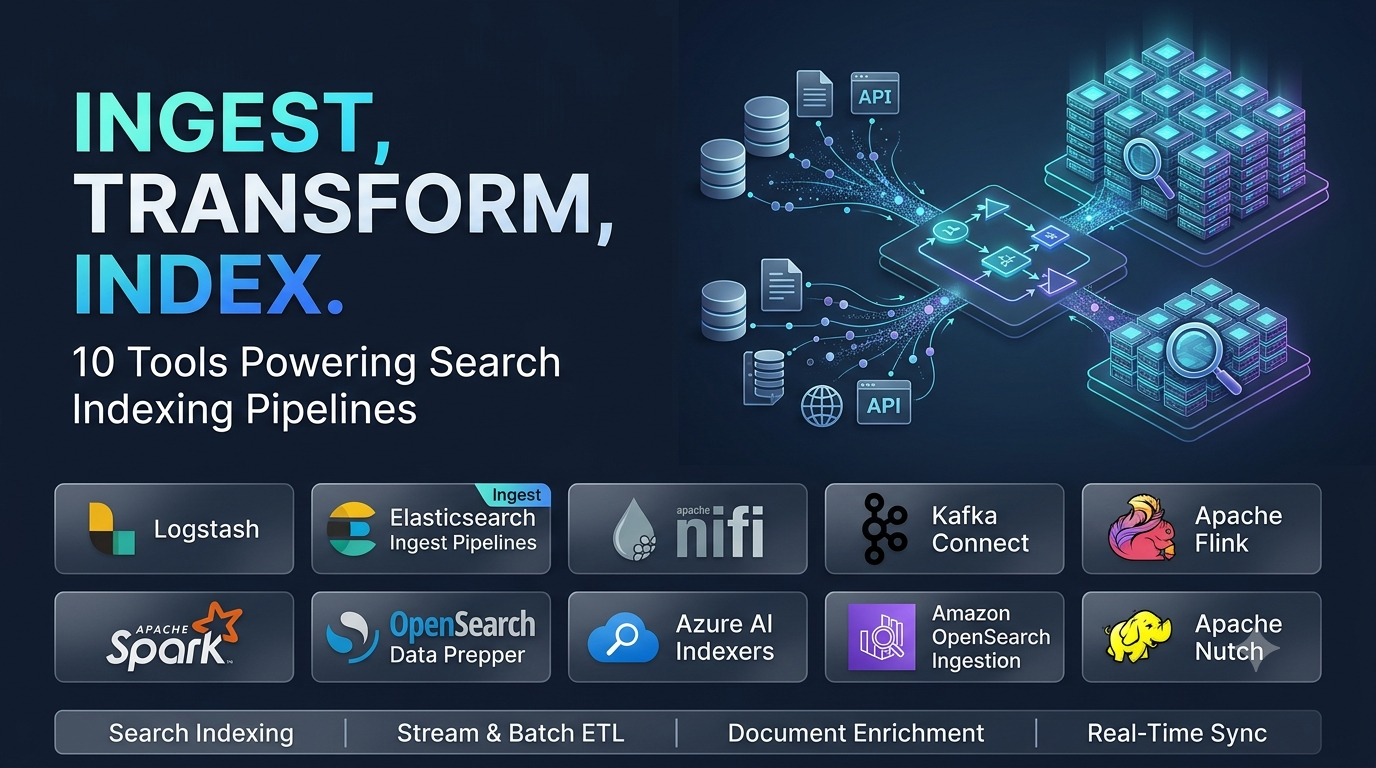
Search indexing pipeline tools help organizations collect, process, transform, and deliver information to searchable indexes. These technologies establish the infrastructure required for efficient information discovery across websites, enterprise applications, document repositories, and intelligent search systems.
Modern organizations generate substantial volumes of structured, semi-structured, and unstructured information across distributed technology environments. Without reliable indexing pipelines, search applications may return outdated information, incomplete results, duplicated documents, or inconsistent metadata.
Search indexing pipelines combine information ingestion, content extraction, transformation, enrichment, validation, and index synchronization capabilities. These processes help organizations convert heterogeneous information sources into standardized representations suitable for search engines and retrieval platforms.
Advanced search indexing pipeline tools support incremental updates, distributed processing, event-driven ingestion, semantic enrichment, and vector embedding generation. These capabilities are particularly relevant to enterprise search, electronic commerce, knowledge management, and Artificial Intelligence (AI) applications.
Different search indexing pipeline tools address varying information volumes, processing requirements, integration architectures, and operational objectives. Selecting appropriate software requires evaluating source connectivity, transformation flexibility, indexing throughput, information freshness, scalability, security, and total ownership expenses.
This guide examines ten search indexing pipeline tools, including their features, benefits, advantages, limitations, and practical applications. It also provides comparison tables, implementation recommendations, performance indicators, security considerations, and frequently asked questions.
What Are Search Indexing Pipeline Tools?
Search indexing pipeline tools are software systems and processing frameworks designed to prepare and deliver information to search engines and searchable repositories. They coordinate the movement of information from original sources through processing stages into appropriate search indexes.
A search indexing pipeline typically collects information from databases, websites, file systems, enterprise applications, event streams, and Application Programming Interfaces (APIs). The collected information undergoes extraction, normalization, transformation, validation, and enrichment before being indexed.
Modern indexing pipelines may generate semantic embeddings, extract named entities, identify document languages, remove duplicate information, and associate searchable records with contextual metadata. These capabilities support conventional keyword search, semantic search, hybrid retrieval, and Retrieval-Augmented Generation (RAG).
Effective search indexing requires reliable information synchronization, appropriate processing rules, consistent document identifiers, and controlled error handling. Organizations must also maintain source permissions, deletion synchronization, index quality, and operational monitoring.
How Search Indexing Pipelines Work
- Identify source systems and searchable information requirements.
- Establish source connectors, crawlers, or ingestion interfaces.
- Collect documents, records, files, and information events.
- Extract relevant text and structured attributes.
- Normalize information into compatible document formats.
- Remove duplicates and validate required information fields.
- Enrich documents with metadata, classifications, or semantic embeddings.
- Transform information according to search index mappings.
- Deliver processed documents to the destination search engine.
- Synchronize updates, deletions, and permission changes.
- Monitor indexing throughput, failures, and information freshness.
- Reprocess unsuccessful records through controlled recovery workflows.
Common Applications of Search Indexing Pipeline Tools
- Enterprise document search.
- Electronic commerce product indexing.
- Website content discovery.
- Customer support knowledge bases.
- Technical documentation indexing.
- Semantic search applications.
- Retrieval-augmented generation systems.
- Enterprise knowledge management.
- Real-time event indexing.
- Digital asset discovery.
- Financial information retrieval.
- Scientific literature indexing.
- Legal document search.
- Healthcare information discovery.
- Application log indexing.
- Multilingual content processing.
- Product catalog synchronization.
- News and media indexing.
Essential Components of Search Indexing Pipelines
| Component | Purpose |
|---|---|
| Source connector | Retrieves information from supported source systems |
| Web crawler | Discovers and extracts website content |
| Ingestion engine | Collects incoming documents and information events |
| Content parser | Extracts text and structured attributes |
| Transformation framework | Converts information into compatible formats |
| Enrichment processor | Adds contextual metadata and derived information |
| Embedding generator | Produces numerical semantic representations |
| Deduplication mechanism | Identifies redundant information records |
| Schema mapper | Aligns documents with destination index mappings |
| Validation framework | Checks information quality and processing requirements |
| Indexing connector | Delivers processed information to search engines |
| Error handling mechanism | Manages unsuccessful processing operations |
| Synchronization framework | Coordinates updates and deletions |
| Monitoring system | Tracks pipeline health and indexing performance |
| Security administration | Protects information and processing operations |
Top 10 Search Indexing Pipeline Tools
The following tools include dedicated search ingestion technologies, distributed processing frameworks, managed indexing services, and configurable information integration platforms. Their numbering represents presentation order rather than an independently tested performance ranking.
1. Logstash
Short Description
Logstash is a server-side information processing pipeline developed within the Elastic ecosystem. It collects information from multiple sources, applies configurable transformations, and delivers processed records to supported destinations.
The platform uses input, filter, and output plugins to establish flexible processing workflows. These plugins support information parsing, field extraction, enrichment, normalization, and delivery to search infrastructure.
Logstash integrates closely with Elasticsearch while also supporting other compatible information destinations. Its architecture is particularly relevant to organizations processing application logs, operational events, database records, and enterprise information streams.
Organizations can configure persistent queues, pipeline workers, and error handling mechanisms according to operational requirements. Production deployments require appropriate resource allocation, plugin management, and continuing performance monitoring.
Key Features
- Configurable information ingestion pipelines.
- Input, filter, and output plugin architecture.
- Structured and unstructured information processing.
- Grok pattern-based parsing.
- Field transformation and normalization.
- Elasticsearch output integration.
- Persistent queue capabilities.
- Configurable pipeline workers.
- Dead-letter queue support for eligible failures.
Benefits
- Simplifies heterogeneous information ingestion.
- Supports standardized search document preparation.
- Reduces repetitive transformation development.
- Facilitates enterprise search indexing.
- Improves information processing consistency.
- Supports configurable enrichment workflows.
- Enables flexible source integration.
Pros
- Established Elastic ecosystem integration.
- Extensive plugin availability.
- Flexible transformation capabilities.
- Supports diverse information sources.
- Configurable processing architecture.
- Relevant operational monitoring functionality.
Cons
- Complex pipelines require technical expertise.
- Memory consumption requires monitoring.
- Plugin compatibility can vary.
- High-volume deployments require tuning.
- Some failure scenarios require custom recovery procedures.
Use Cases: Elasticsearch indexing, application log processing, enterprise document ingestion, operational event transformation, database record indexing, and search information enrichment.
Best For: Elastic customers, search engineers, information integration developers, infrastructure administrators, enterprise application teams, and operational analytics specialists.
2. Elasticsearch Ingest Pipelines
Short Description
Elasticsearch Ingest Pipelines provide native document preprocessing capabilities within the Elasticsearch indexing architecture. They allow organizations to transform incoming documents before those documents are stored in search indexes.
The technology uses configurable processors to perform field manipulation, text extraction, information normalization, and contextual enrichment. Compatible processors can also support machine learning inference and semantic embedding generation.
Ingest pipelines reduce the need for separate processing services in applications with suitable transformation requirements. Developers can associate pipelines with indexing requests or configure default and final pipelines for particular indexes.
The technology is particularly relevant to organizations already using Elasticsearch as their primary search engine. Resource-intensive transformations should undergo representative testing because processing workloads can affect search cluster infrastructure.
Key Features
- Native Elasticsearch document preprocessing.
- Configurable ingest processors.
- Field extraction and transformation.
- Conditional processor execution.
- Date and text normalization.
- Supported attachment extraction.
- Compatible inference processors.
- Pipeline simulation capabilities.
- Configurable failure handling.
Benefits
- Reduces separate processing infrastructure requirements.
- Simplifies Elasticsearch indexing workflows.
- Supports consistent document transformations.
- Facilitates contextual information enrichment.
- Enables centralized processing configurations.
- Supports semantic indexing architectures.
- Improves document preparation consistency.
Pros
- Native Elasticsearch integration.
- Flexible processor configurations.
- Supports pipeline simulation.
- Relevant information enrichment functionality.
- Reduces selected integration complexity.
- Compatible with existing Elastic environments.
Cons
- Primarily designed for Elasticsearch destinations.
- Complex processing can consume cluster resources.
- Source ingestion requires complementary components.
- Some processors depend on deployment capabilities.
- Advanced configurations require specialist expertise.
Use Cases: Elasticsearch document preprocessing, semantic enrichment, field normalization, metadata extraction, attachment indexing, and search index mapping preparation.
Best For: Elasticsearch administrators, enterprise search developers, Elastic application teams, semantic search engineers, data architects, and organizations requiring native indexing transformations.
3. Apache NiFi
Short Description
Apache NiFi is an open-source information flow management platform designed to automate the movement and transformation of information between heterogeneous systems. Its graphical development environment allows users to configure processing pipelines through connected components.
The platform supports information ingestion, routing, transformation, enrichment, and delivery through configurable processors. These capabilities make it relevant to search indexing architectures involving databases, files, APIs, and distributed information sources.
Apache NiFi provides information provenance, queue management, backpressure, and configurable processing controls. These features help administrators monitor document movement and identify unsuccessful processing operations.
The platform can integrate with compatible search engines and external processing services through supported processors and application interfaces. Production implementations require infrastructure administration, security configuration, and appropriate workflow design.
Key Features
- Graphical information flow development.
- Configurable processing components.
- Source and destination connectivity.
- Information transformation capabilities.
- Automated information routing.
- Backpressure management.
- Information provenance tracking.
- Distributed deployment capabilities.
- Configurable security administration.
Benefits
- Simplifies visual indexing pipeline development.
- Improves information processing visibility.
- Supports heterogeneous source integration.
- Facilitates controlled document routing.
- Reduces repetitive integration development.
- Supports reliable information movement.
- Enables configurable processing workflows.
Pros
- Open-source software availability.
- Accessible graphical development interface.
- Strong information provenance functionality.
- Extensive processor ecosystem.
- Flexible routing and transformation capabilities.
- Suitable for complex information environments.
Cons
- Large deployments require infrastructure planning.
- Complex workflows can become difficult to maintain.
- Advanced transformations require technical expertise.
- Resource consumption requires monitoring.
- Search-specific capabilities depend on integrations.
Use Cases: Enterprise document ingestion, distributed indexing workflows, database-to-search synchronization, metadata enrichment, file processing, and information routing.
Best For: Information integration engineers, enterprise architects, search infrastructure teams, open-source organizations, data engineers, and workflow administrators.
4. Apache Kafka Connect
Short Description
Apache Kafka Connect is an information integration framework within the Apache Kafka ecosystem. It provides reusable mechanisms for transferring information between Kafka topics and compatible external systems.
The framework uses source connectors to collect information and sink connectors to deliver records to external destinations. Compatible search engine sink connectors allow organizations to deliver continuously updated information to searchable indexes.
Kafka Connect supports distributed execution, configurable tasks, offset management, and Single Message Transforms (SMTs). These capabilities help organizations establish scalable event-driven indexing architectures.
The framework is particularly relevant to organizations using Kafka for event streaming and Change Data Capture (CDC). Search engine compatibility, delivery semantics, deletion handling, and connector licensing should be evaluated before implementation.
Key Features
- Source and sink connector architecture.
- Kafka topic integration.
- Distributed connector execution.
- Configurable connector tasks.
- Offset management.
- Single message transformations.
- Compatible search engine sink connectors.
- Configurable error handling.
- Supported connector monitoring interfaces.
Benefits
- Supports continuous search index synchronization.
- Facilitates event-driven information ingestion.
- Reduces custom connector development.
- Enables scalable information movement.
- Supports incremental document updates.
- Improves integration workflow consistency.
- Facilitates near-real-time indexing architectures.
Pros
- Open-source framework availability.
- Strong Kafka ecosystem integration.
- Relevant distributed processing capabilities.
- Supports reusable connector configurations.
- Suitable for event-driven architectures.
- Flexible source and destination connectivity.
Cons
- Requires compatible Kafka infrastructure.
- Connector quality and licensing vary.
- Complex transformations require additional processing.
- Delivery guarantees depend on connector behavior.
- Search index deletion handling requires careful configuration.
Use Cases: Database change indexing, real-time product catalog synchronization, event-driven document updates, operational event indexing, enterprise search synchronization, and streaming information delivery.
Best For: Kafka administrators, streaming information engineers, distributed systems developers, enterprise search architects, event-driven application teams, and CDC specialists.
5. Apache Flink
Short Description
Apache Flink is an open-source distributed processing framework designed for stateful computations across bounded and unbounded information streams. It supports complex transformation and enrichment workloads that can prepare information for search indexing.
The platform provides event-time processing, state management, configurable processing windows, and fault-tolerant execution mechanisms. These capabilities are particularly relevant to indexing pipelines that require continuous information processing.
Apache Flink can integrate with Kafka, databases, object storage, and compatible search destinations through supported connectors. Developers can implement document enrichment, aggregation, deduplication, and event-based indexing logic.
The framework is suitable for organizations requiring sophisticated streaming transformations rather than simple information movement. Production deployments require appropriate checkpointing, resource management, connector configuration, and operational expertise.
Key Features
- Distributed stream processing.
- Stateful information transformations.
- Event-time processing.
- Configurable processing windows.
- Checkpointing and recovery mechanisms.
- Information enrichment capabilities.
- Supported source and sink connectors.
- SQL-based processing interfaces.
- Scalable processing architecture.
Benefits
- Supports continuous information processing.
- Enables complex indexing transformations.
- Facilitates stateful document enrichment.
- Improves streaming workflow scalability.
- Supports event-driven index synchronization.
- Enables configurable fault recovery.
- Facilitates sophisticated information processing logic.
Pros
- Open-source software availability.
- Strong stateful processing capabilities.
- Supports event-time computations.
- Relevant distributed execution architecture.
- Flexible processing interfaces.
- Suitable for complex streaming workloads.
Cons
- Requires specialist development expertise.
- Infrastructure administration can be complex.
- Connector compatibility requires verification.
- State management requires resource planning.
- End-to-end delivery guarantees depend on destination behavior.
Use Cases: Real-time search indexing, event enrichment, streaming deduplication, product catalog processing, operational information retrieval, and continuous semantic indexing preparation.
Best For: Streaming engineers, distributed systems developers, enterprise data architects, search infrastructure specialists, event processing teams, and large organizations.
6. Apache Spark
Short Description
Apache Spark is an open-source distributed computing framework that supports large-scale information processing, transformation, analytics, and machine learning workloads. It can prepare extensive document collections and structured datasets for search indexing.
The platform provides DataFrame interfaces, SQL processing, distributed transformations, and Structured Streaming capabilities. These features allow organizations to develop batch and incremental indexing preparation workflows.
Apache Spark can process information from distributed file systems, cloud object storage, databases, and compatible event streaming platforms. Search destination integrations can deliver processed records to Elasticsearch, OpenSearch, and other compatible systems.
The framework is particularly relevant to large-scale reindexing, historical information processing, and computationally intensive enrichment workloads. Organizations should evaluate connector compatibility, cluster expenses, processing latency, and workload scheduling requirements.
Key Features
- Distributed batch information processing.
- Structured Streaming capabilities.
- DataFrame-based transformations.
- SQL processing interfaces.
- Large-scale document preparation.
- Supported machine learning integrations.
- Compatible search engine connectors.
- Distributed file processing.
- Configurable execution resources.
Benefits
- Supports large-scale indexing preparation.
- Enables computationally intensive transformations.
- Facilitates historical information reprocessing.
- Supports reusable processing workflows.
- Improves distributed processing scalability.
- Enables advanced information enrichment.
- Supports batch and incremental processing architectures.
Pros
- Open-source software availability.
- Established distributed computing ecosystem.
- Strong large-scale transformation capabilities.
- Flexible programming interfaces.
- Supports multiple information sources.
- Suitable for complex indexing preparation workloads.
Cons
- Cluster infrastructure requires administration.
- Small indexing workloads may not justify its complexity.
- Resource consumption requires monitoring.
- Search destination integrations require configuration.
- Streaming latency depends on workload architecture.
Use Cases: Enterprise document reindexing, historical information processing, large product catalog transformation, semantic embedding preparation, search index migration, and distributed content enrichment.
Best For: Data engineers, enterprise architects, distributed computing specialists, machine learning engineers, large-scale search teams, and analytics infrastructure administrators.
7. OpenSearch Data Prepper
Short Description
OpenSearch Data Prepper is an open-source server-side information ingestion and processing technology within the OpenSearch ecosystem. It provides configurable pipelines for collecting, transforming, and delivering information to supported destinations.
The platform uses source, buffer, processor, and sink components to establish information processing workflows. Compatible processors support information parsing, enrichment, filtering, aggregation, and transformation.
Data Prepper integrates with OpenSearch and supports selected observability, log analytics, and general indexing workloads. Its extensible architecture allows developers to configure pipelines according to specific information processing requirements.
The technology is particularly relevant to organizations operating OpenSearch infrastructure and requiring dedicated ingestion pipelines. Supported sources, processors, semantic enrichment functionality, and destination capabilities should be evaluated against the selected release.
Key Features
- Configurable information processing pipelines.
- Source and sink plugin architecture.
- OpenSearch destination integration.
- Information parsing and transformation.
- Configurable buffering.
- Metadata enrichment.
- Supported event aggregation.
- Compatible machine learning processing integrations.
- Pipeline monitoring capabilities.
Benefits
- Simplifies OpenSearch information ingestion.
- Supports standardized document preparation.
- Facilitates configurable information enrichment.
- Reduces custom indexing pipeline development.
- Enables flexible processing workflows.
- Supports operational information indexing.
- Improves integration with OpenSearch environments.
Pros
- Open-source software availability.
- Native OpenSearch ecosystem orientation.
- Configurable pipeline architecture.
- Relevant observability processing capabilities.
- Extensible plugin functionality.
- Supports multiple ingestion scenarios.
Cons
- Plugin availability varies by release.
- Complex processing requires technical expertise.
- Infrastructure administration remains necessary.
- Advanced document extraction may require complementary tools.
- High-volume deployments require performance testing.
Use Cases: OpenSearch indexing, application log ingestion, operational event processing, enterprise search preparation, semantic enrichment, and observability information indexing.
Best For: OpenSearch administrators, search engineers, observability teams, information integration specialists, enterprise developers, and open-source infrastructure organizations.
8. Azure AI Search Indexers
Short Description
Azure AI Search Indexers provide managed information ingestion and indexing capabilities within Microsoft Azure AI Search. They help organizations retrieve information from supported data sources and populate searchable indexes through configurable processing workflows.
The technology supports scheduled indexing, field mapping, document extraction, and compatible incremental change detection mechanisms. Supported information sources include selected Azure storage and database services.
Azure AI Search Indexers can integrate with skillsets that perform document enrichment, Optical Character Recognition (OCR), text processing, and compatible embedding generation. These capabilities support conventional search, semantic retrieval, and intelligent knowledge applications.
The managed architecture reduces selected infrastructure administration activities for Azure customers. Organizations should evaluate supported connectors, processing quotas, indexing schedules, deletion detection requirements, and enrichment expenses.
Key Features
- Managed search indexing workflows.
- Supported Azure information source connectors.
- Scheduled indexing capabilities.
- Configurable field mappings.
- Compatible incremental change detection.
- Document text extraction.
- AI enrichment skillsets.
- Supported integrated vectorization.
- Indexer execution monitoring.
Benefits
- Reduces custom indexing infrastructure development.
- Simplifies Azure-based search ingestion.
- Supports automated document processing.
- Facilitates semantic information enrichment.
- Enables scheduled index synchronization.
- Supports intelligent enterprise search applications.
- Reduces selected infrastructure maintenance activities.
Pros
- Managed cloud architecture.
- Strong Microsoft Azure integration.
- Relevant document enrichment capabilities.
- Supports configurable indexing schedules.
- Compatible semantic indexing workflows.
- Integrated execution monitoring.
Cons
- Primarily oriented toward Azure AI Search.
- Supported information sources are limited.
- Enrichment services may introduce additional expenses.
- Indexing quotas and schedules require evaluation.
- Unsupported sources require custom ingestion mechanisms.
Use Cases: Enterprise document indexing, Azure storage content discovery, semantic search preparation, technical documentation indexing, AI knowledge assistants, and managed RAG ingestion.
Best For: Azure customers, enterprise search developers, cloud architects, AI application engineers, Microsoft-oriented organizations, and managed indexing infrastructure teams.
9. Amazon OpenSearch Ingestion
Short Description
Amazon OpenSearch Ingestion is a managed information ingestion service designed to deliver processed information to compatible Amazon OpenSearch Service destinations. It uses technology based on OpenSearch Data Prepper to support configurable processing pipelines.
The service provides supported source integrations, information transformations, buffering, and destination delivery mechanisms. Its managed architecture reduces the need to independently administer dedicated ingestion servers.
Amazon OpenSearch Ingestion supports selected streaming, operational analytics, log processing, and search indexing workloads. Organizations can configure processing pipelines and evaluate capacity requirements according to expected information volumes.
The service is particularly relevant to organizations operating within Amazon Web Services (AWS). Supported connectors, processors, destination configurations, networking requirements, and commercial expenses should be evaluated before implementation.
Key Features
- Managed information ingestion infrastructure.
- Data Prepper-based pipeline configurations.
- Supported AWS source integrations.
- Information transformation processors.
- Configurable pipeline capacity.
- OpenSearch destination integration.
- Supported buffering mechanisms.
- AWS security integrations.
- Operational pipeline monitoring.
Benefits
- Reduces ingestion infrastructure administration.
- Simplifies AWS-based search indexing.
- Supports scalable information processing.
- Facilitates configurable document transformations.
- Enables managed indexing workflows.
- Supports operational information discovery.
- Integrates with compatible AWS services.
Pros
- Managed cloud infrastructure.
- Strong AWS ecosystem integration.
- Relevant OpenSearch processing capabilities.
- Configurable pipeline capacity.
- Reduces selected infrastructure maintenance.
- Supports multiple ingestion workloads.
Cons
- AWS ecosystem dependency requires consideration.
- Usage expenses require monitoring.
- Supported plugins may differ from self-managed Data Prepper.
- Complex transformations may require additional services.
- Destination compatibility requires verification.
Use Cases: AWS-based enterprise search ingestion, operational log indexing, streaming information delivery, cloud document processing, event enrichment, and managed OpenSearch synchronization.
Best For: AWS customers, cloud architects, OpenSearch Service administrators, enterprise search teams, operational analytics specialists, and managed infrastructure organizations.
10. Apache Nutch
Short Description
Apache Nutch is an open-source web crawling framework designed to discover, retrieve, and process website content. It provides configurable crawling mechanisms that can prepare web documents for delivery to compatible search engines.
The platform supports URL discovery, content fetching, document parsing, link extraction, and crawl database management. These capabilities help organizations build search indexes from websites and other accessible web resources.
Apache Nutch uses extensible plugins for content processing, URL filtering, and supported search destination integrations. Organizations can configure crawling policies according to information discovery requirements and website access restrictions.
The framework is particularly relevant to website search, research crawling, and customized web information discovery systems. Production deployments require appropriate crawling infrastructure, respectful request rates, content processing configurations, and continuing maintenance.
Key Features
- Configurable web crawling.
- URL discovery and management.
- Website content retrieval.
- Document parsing capabilities.
- Link extraction.
- Crawl database management.
- Extensible plugin architecture.
- Supported search engine indexing integrations.
- Configurable URL filtering.
Benefits
- Automates website content discovery.
- Supports customized web search indexes.
- Reduces repetitive manual content collection.
- Facilitates large-scale website crawling.
- Enables configurable content processing.
- Supports reusable crawling workflows.
- Reduces proprietary licensing dependencies.
Pros
- Open-source software availability.
- Established web crawling architecture.
- Flexible plugin ecosystem.
- Supports configurable crawling policies.
- Relevant document extraction functionality.
- Suitable for customized website search projects.
Cons
- Primarily designed for web content ingestion.
- Dynamic JavaScript content may require additional tools.
- Distributed crawling requires technical administration.
- Search destination compatibility requires verification.
- Crawl scheduling and freshness require careful planning.
Use Cases: Website search indexing, public web information discovery, research document crawling, institutional website indexing, digital archive discovery, and customized web search engines.
Best For: Web search developers, research institutions, search infrastructure engineers, information discovery specialists, open-source technology teams, and digital archive administrators.
Comparison Table: Top 10 Search Indexing Pipeline Tools
| Tool | Primary Strength | Best For | Pricing Approach |
|---|---|---|---|
| Logstash | Flexible ingestion and transformation | Elasticsearch indexing workflows | Free and commercial ecosystem offerings |
| Elasticsearch Ingest Pipelines | Native document preprocessing | Elasticsearch document enrichment | Deployment and licensing-dependent |
| Apache NiFi | Visual information flow management | Complex source integration | Open-source |
| Apache Kafka Connect | Event-driven information movement | Continuous index synchronization | Open-source; connector costs may apply |
| Apache Flink | Stateful stream processing | Real-time indexing transformations | Open-source |
| Apache Spark | Distributed batch processing | Large-scale reindexing | Open-source; infrastructure costs apply |
| OpenSearch Data Prepper | OpenSearch-oriented ingestion | Open-source indexing pipelines | Open-source |
| Azure AI Search Indexers | Managed document indexing | Azure-based search applications | Service and enrichment usage-dependent |
| Amazon OpenSearch Ingestion | Managed OpenSearch ingestion | AWS search infrastructure | Usage-based |
| Apache Nutch | Web crawling and content extraction | Website search indexing | Open-source |
Functional Comparison
| Tool | Primary Processing Model | Transformation Capabilities | Typical Destination |
|---|---|---|---|
| Logstash | Continuous pipeline processing | Extensive plugin-based transformations | Elasticsearch and compatible systems |
| Elasticsearch Ingest Pipelines | Index-time processing | Native processors | Elasticsearch |
| Apache NiFi | Flow-based processing | Configurable processors | Multiple compatible destinations |
| Apache Kafka Connect | Event-driven integration | Lightweight transformations | Compatible sink systems |
| Apache Flink | Stateful streaming | Advanced programmable processing | Compatible search engines |
| Apache Spark | Batch and streaming | Advanced distributed transformations | Compatible search engines |
| OpenSearch Data Prepper | Pipeline-based ingestion | Configurable processors | OpenSearch and supported sinks |
| Azure AI Search Indexers | Scheduled and incremental indexing | Field mappings and skillsets | Azure AI Search |
| Amazon OpenSearch Ingestion | Managed pipeline processing | Supported Data Prepper processors | Compatible OpenSearch Service destinations |
| Apache Nutch | Web crawling | Content parsing and filtering | Compatible search engines |
Understanding Search Indexing Pipeline Architectures
Batch Indexing
Batch indexing collects and processes information at scheduled intervals or through explicitly triggered jobs. This approach is suitable for large historical datasets, periodic content updates, and complete index rebuilding activities.
Incremental Indexing
Incremental indexing processes records that have changed since an earlier successful indexing operation. It reduces unnecessary information processing while requiring reliable change detection, document identification, and deletion synchronization.
Real-Time Indexing
Real-time or near-real-time indexing processes information shortly after source changes occur. Event streaming and CDC technologies can support these architectures while actual information freshness depends on processing and search engine refresh behavior.
Semantic Indexing
Semantic indexing generates numerical embeddings and contextual metadata that support meaning-based information retrieval. These pipelines require appropriate embedding models, document segmentation strategies, vector storage configurations, and retrieval evaluation.
Hybrid Indexing
Hybrid indexing prepares documents for both conventional lexical retrieval and semantic vector search. It generally maintains searchable text, structured metadata, and compatible embeddings within coordinated retrieval architectures.
Full Reindexing
Full reindexing reconstructs searchable information from original sources or existing information repositories. Organizations may require this process when index mappings, analyzers, embedding models, or search infrastructure change substantially.
How to Choose the Best Search Indexing Pipeline Tool
Evaluate Source Connectivity
Identify the databases, websites, file systems, cloud storage services, applications, and event streams that require indexing. Select tools that provide compatible connectivity or support maintainable custom integration mechanisms.
Assess Information Freshness Requirements
Determine how quickly source changes must become available through search applications. Batch processing may satisfy periodic content discovery requirements, while event-driven pipelines may be necessary for frequently changing product catalogs or operational information.
Review Transformation Requirements
Evaluate whether documents require simple field mapping, complex content extraction, metadata enrichment, deduplication, aggregation, or semantic embedding generation. Processing complexity influences the choice between native indexing processors and dedicated distributed processing frameworks.
Examine Destination Compatibility
Determine whether the organization uses Elasticsearch, OpenSearch, Azure AI Search, vector databases, or other search technologies. Appropriate destination integrations should support document updates, deletion operations, error handling, and compatible index mappings.
Consider Scalability and Performance
Identify expected document volumes, source update rates, processing complexity, and indexing throughput requirements. Organizations should evaluate representative workloads to determine appropriate processing capacity, buffering configurations, and search destination resources.
Assess Reliability and Recovery
Review support for retries, checkpoints, persistent queues, dead-letter queues, and replay mechanisms. Reliable indexing pipelines should recover from temporary failures without silently losing information or introducing unnecessary duplicate records.
Evaluate Semantic Search Requirements
Determine whether indexing workflows must generate embeddings, extract contextual relationships, or support hybrid retrieval. Appropriate semantic processing capabilities should align with embedding models, document segmentation policies, and search relevance objectives.
Review Security and Governance
Assess authentication, encryption, access controls, information provenance, permission synchronization, and retention capabilities. Indexing pipelines must preserve appropriate security restrictions throughout information extraction, processing, storage, and retrieval.
Evaluate Total Ownership Costs
Consider software licensing, infrastructure, connector expenses, processing capacity, embedding generation, search storage, and administrative staffing. Organizations should compare complete indexing architecture expenses rather than evaluating individual software subscription prices alone.
Best Search Indexing Pipeline Tools by User Type
| User Type | Relevant Tool |
|---|---|
| Elasticsearch ingestion engineer | Logstash |
| Elasticsearch document enrichment developer | Elasticsearch Ingest Pipelines |
| Visual information integration specialist | Apache NiFi |
| Event-driven indexing engineer | Apache Kafka Connect |
| Stateful streaming processing specialist | Apache Flink |
| Large-scale batch processing engineer | Apache Spark |
| OpenSearch ingestion administrator | OpenSearch Data Prepper |
| Microsoft Azure search developer | Azure AI Search Indexers |
| AWS search infrastructure architect | Amazon OpenSearch Ingestion |
| Website search and crawling specialist | Apache Nutch |
Practical Example: Implementing an Enterprise Search Indexing Pipeline
Consider a hypothetical multinational electronic commerce organization maintaining ten million product records, technical documents, customer support articles, and supplier information assets. Its existing indexing architecture relies on overnight batch processing and frequently delivers outdated product descriptions, unavailable inventory information, and incomplete searchable metadata.
Management introduces a coordinated search indexing architecture combining event-driven information ingestion, document transformation, semantic enrichment, and incremental index synchronization. The following outcomes represent illustrative assumptions rather than verified vendor performance.
Implementation Steps
- Inventory product databases, document repositories, websites, and existing search infrastructure.
- Identify information freshness requirements and establish baseline indexing performance measurements.
- Select compatible ingestion connectors, processing frameworks, and search destination technologies.
- Configure document extraction, normalization, deduplication, and metadata enrichment workflows.
- Implement incremental synchronization, semantic embedding generation, and index mapping validation.
- Establish retry mechanisms, deletion synchronization, security controls, and operational monitoring.
- Evaluate indexing throughput, information freshness, search relevance, and infrastructure expenses.
Illustrative Performance Improvements
| Performance Indicator | Before | After |
|---|---|---|
| Average indexing delay | 24 hours | 5 minutes |
| Document processing throughput | 15,000 per hour | 150,000 per hour |
| Indexing failure rate | 8% | 0.8% |
| Searchable document coverage | 65% | 98% |
| Duplicate document rate | 12% | 1.5% |
| Monthly manual indexing workload | 1,400 hours | 350 hours |
| Metadata completeness | 58% | 96% |
| Product search success rate | 62% | 91% |
| Average failed record recovery time | 12 hours | 30 minutes |
| Search index availability | 98.5% | 99.9% |
Financial Analysis
Reducing monthly manual indexing workloads by 1,050 hours releases 12,600 employee hours annually. At an illustrative labor cost of $45 per hour, this represents $567,000 in released annual labor capacity rather than guaranteed cash savings.
Suppose the organization eliminates $180,000 in annual expenses associated with redundant information processing infrastructure. Additional realized annual savings of $300,000 from avoidable external support, maintenance contracts, and legacy indexing services would produce total gross cash savings of $480,000.
After recurring indexing infrastructure, processing services, embedding generation, and maintenance expenses of $160,000, annual net cash savings would equal $320,000. An initial implementation investment of $480,000 would therefore produce a simple payback period of 18 months.
This calculation excludes taxes, financing costs, discounting, potential revenue improvements, and the separately estimated value of released employee capacity. Actual financial outcomes would depend on document volumes, processing complexity, infrastructure requirements, licensing arrangements, and the organization’s ability to eliminate existing operating expenses.
Important Search Indexing Pipeline Performance Indicators
| Indicator | Measurement Purpose |
|---|---|
| Indexing throughput | Measures documents successfully indexed within a defined period |
| Information freshness | Evaluates the delay between source changes and searchable updates |
| Indexing success rate | Measures successfully completed indexing operations |
| Indexing failure rate | Tracks unsuccessful document indexing operations |
| Processing latency | Measures time required to transform incoming documents |
| End-to-end indexing latency | Measures time from source ingestion to searchable availability |
| Document coverage | Evaluates the proportion of eligible documents successfully indexed |
| Duplicate document rate | Tracks redundant indexed records |
| Metadata completeness | Measures availability of required document attributes |
| Pipeline availability | Evaluates operational accessibility of processing infrastructure |
| Queue depth | Tracks pending information processing workloads |
| Retry rate | Measures processing operations requiring repeated attempts |
| Dead-letter queue volume | Tracks records isolated after eligible processing failures |
| Recovery time | Measures duration of unsuccessful operation recovery |
| Deletion synchronization rate | Evaluates successful removal of obsolete indexed documents |
| Permission synchronization rate | Measures successful propagation of access control changes |
| Embedding generation latency | Tracks semantic representation processing duration |
| Index storage consumption | Measures storage required by searchable information |
| Cost per indexed document | Evaluates average document processing and indexing expenses |
| Search relevance | Measures usefulness of results produced from indexed information |
Security and Governance Considerations
Search indexing pipelines frequently process confidential business documents, customer information, financial records, proprietary research, and sensitive operational events. Organizations should implement appropriate authentication, encryption, access controls, and administrative audit logging across all processing stages.
Source-level permissions should be preserved throughout document extraction, transformation, enrichment, and destination indexing. Organizations must verify that restricted documents cannot become accessible through incorrectly configured search indexes, metadata fields, cached content, or semantic embeddings.
Indexing pipelines should maintain appropriate information provenance records linking processed documents to their original sources. These records help organizations investigate information quality problems, establish accountability, and coordinate controlled document updates.
External document extraction, enrichment, and embedding generation services should undergo appropriate contractual and security assessments. Organizations must evaluate whether confidential information is transmitted outside approved infrastructure and whether processing arrangements satisfy applicable privacy requirements.
Information retention and deletion procedures should coordinate changes across source repositories, processing queues, search indexes, vector databases, caches, and backups. Administrators should establish appropriate mechanisms for preventing obsolete or restricted information from remaining searchable.
Pipeline configuration changes should undergo controlled review, testing, and deployment procedures. Changes to document mappings, enrichment rules, or embedding models can affect search relevance, information availability, and downstream application behavior.
Challenges and Limitations
Heterogeneous Information Sources
Enterprise information frequently originates from applications with different formats, schemas, authentication mechanisms, and update behaviors. Establishing reliable indexing pipelines requires compatible connectors and maintainable transformation rules.
Information Freshness
Frequently changing source information can create substantial synchronization challenges across distributed search environments. Organizations must balance freshness requirements against processing capacity, destination indexing limits, and infrastructure expenses.
Document Extraction Complexity
Unstructured documents may contain images, tables, scanned pages, embedded files, and inconsistent formatting. Reliable content extraction can require specialized parsing technologies, OCR services, and information quality validation.
Duplicate and Inconsistent Information
Repeated source events, overlapping repositories, and inconsistent document identifiers can introduce duplicate records into search indexes. Stable identifiers, idempotent processing, and controlled deduplication mechanisms help reduce these problems.
Schema Evolution
Changes to source schemas or destination index mappings can interrupt document processing and introduce inconsistent searchable information. Organizations should maintain version-controlled mappings, compatibility tests, and documented migration procedures.
Semantic Processing Expenses
Embedding generation and advanced document enrichment can introduce substantial computing and service expenses. Organizations should evaluate processing models, document segmentation strategies, caching policies, and incremental enrichment requirements.
Operational Recovery
Distributed indexing pipelines can encounter network failures, unavailable destinations, invalid documents, and temporary resource limitations. Reliable recovery requires appropriate retry policies, persistent processing state, monitoring, and controlled replay mechanisms.
Security Synchronization
Source permissions can change independently of document content, creating potential information exposure when indexing pipelines fail to synchronize access restrictions. Organizations should test permission changes and deletion workflows as part of continuing security validation.
Best Practices for Search Indexing Pipeline Implementation
- Establish clearly defined indexing objectives.
- Inventory all relevant information sources.
- Document information freshness requirements.
- Select compatible source and destination connectors.
- Maintain stable document identifiers.
- Establish consistent information normalization procedures.
- Validate document schemas before indexing.
- Configure appropriate metadata enrichment rules.
- Implement reliable deduplication mechanisms.
- Use incremental indexing where appropriate.
- Maintain controlled full reindexing procedures.
- Configure appropriate buffering and backpressure.
- Implement bounded retry policies.
- Maintain dead-letter queues for eligible failures.
- Establish controlled failed-record replay procedures.
- Preserve source-level information permissions.
- Synchronize document deletions and permission changes.
- Protect confidential documents and semantic embeddings.
- Maintain version-controlled pipeline configurations.
- Monitor indexing throughput and information freshness.
- Evaluate semantic embedding quality.
- Test search destination capacity under representative workloads.
- Maintain appropriate backup and recovery procedures.
- Review operational expenses and indexing quality regularly.
Future Trends in Search Indexing Pipeline Tools
AI-Assisted Document Processing
Search indexing pipelines may increasingly use AI technologies to extract document structures, identify important concepts, generate metadata, and recommend classifications. Automatically generated information should undergo appropriate validation before inclusion in authoritative search indexes.
Integrated Vector Embedding Generation
Indexing platforms may increasingly incorporate embedding generation directly within configurable processing workflows. These integrations can reduce selected development requirements while introducing model compatibility, privacy, and processing expense considerations.
Multimodal Search Indexing
Future indexing architectures may increasingly process text, images, audio, video, and other information formats through coordinated workflows. Multimodal processing can support broader information discovery while requiring specialized extraction and representation models.
Event-Driven Index Synchronization
Organizations may increasingly adopt CDC and event streaming technologies to synchronize search indexes with changing operational information. These architectures can improve information freshness while requiring reliable event ordering, deletion handling, and recovery mechanisms.
Automated Pipeline Optimization
Indexing platforms may increasingly provide automated recommendations for processing capacity, buffering configurations, transformation execution, and resource allocation. These capabilities should be evaluated against representative indexing workloads and operational objectives.
Serverless Indexing Infrastructure
Managed indexing services may increasingly provide flexible processing capacity that adjusts according to incoming information volumes. Organizations should evaluate service limitations, usage expenses, operational visibility, and destination compatibility.
Knowledge Graph Enrichment
Indexing pipelines may increasingly incorporate knowledge graph relationships, standardized vocabularies, and formal semantic classifications. These capabilities can improve contextual information discovery by connecting documents with meaningful domain concepts.
Intelligent Document Segmentation
Semantic indexing workflows may increasingly use document structure and contextual relationships to determine appropriate information segments. Improved segmentation can support retrieval relevance while requiring representative evaluation of document coverage and processing expenses.
Automated Information Quality Validation
Search indexing technologies may increasingly incorporate automated schema validation, anomaly detection, duplicate identification, and metadata completeness assessment. These capabilities can help organizations identify processing problems before they affect search applications.
Unified Search and AI Information Pipelines
Organizations may increasingly establish reusable processing architectures that support enterprise search, vector retrieval, recommendation systems, and generative AI applications. Shared information pipelines can reduce duplicated processing activities while requiring consistent governance and compatibility management.
Frequently Asked Questions
1. What are search indexing pipeline tools?
Search indexing pipeline tools collect, process, transform, enrich, and deliver information to searchable indexes. They support reliable information discovery across enterprise applications, websites, document repositories, and intelligent search systems.
2. Why are search indexing pipelines important?
Search indexing pipelines help organizations maintain accurate, complete, and current searchable information. They reduce manual processing activities and support consistent information retrieval across distributed technology environments.
3. What is Logstash?
Logstash is an information processing pipeline developed within the Elastic ecosystem. It uses configurable input, filter, and output plugins to collect, transform, and deliver information to compatible destinations.
4. What are Elasticsearch Ingest Pipelines?
Elasticsearch Ingest Pipelines provide native document preprocessing before information is stored in Elasticsearch indexes. They support configurable processors for field transformation, normalization, enrichment, and compatible inference operations.
5. What is Apache NiFi?
Apache NiFi is an open-source information flow management platform supporting visual pipeline development. It provides configurable processors for information ingestion, routing, transformation, enrichment, and delivery.
6. What is Apache Kafka Connect?
Apache Kafka Connect is an integration framework for transferring information between Kafka topics and external systems. Compatible sink connectors can deliver continuously updated information to search engines.
7. What is Apache Flink?
Apache Flink is a distributed processing framework designed for stateful stream computations. It supports complex information transformations, enrichment, and continuous indexing preparation workflows.
8. What is Apache Spark?
Apache Spark is a distributed computing framework supporting large-scale batch processing, streaming, analytics, and machine learning workloads. It can prepare extensive document collections and structured datasets for search indexing.
9. What is OpenSearch Data Prepper?
OpenSearch Data Prepper is an open-source information ingestion and processing technology within the OpenSearch ecosystem. It provides configurable pipelines for collecting, transforming, enriching, and delivering information.
10. What are Azure AI Search Indexers?
Azure AI Search Indexers provide managed information ingestion and indexing workflows for supported information sources. They support scheduled indexing, field mapping, document extraction, and compatible AI enrichment capabilities.
11. What is Amazon OpenSearch Ingestion?
Amazon OpenSearch Ingestion is a managed AWS service for processing and delivering information to compatible OpenSearch destinations. It uses Data Prepper-based pipeline technology and supports selected information ingestion workloads.
12. What is Apache Nutch?
Apache Nutch is an open-source web crawling framework designed to discover, retrieve, and process website content. It supports configurable crawling, content parsing, URL filtering, and compatible search engine integrations.
13. What is search indexing?
Search indexing organizes processed information into specialized structures that support efficient retrieval. These structures may include inverted text indexes, structured field indexes, and vector indexes.
14. What is incremental indexing?
Incremental indexing processes new, modified, or deleted records rather than rebuilding an entire search index. It reduces unnecessary processing while requiring reliable source change detection and synchronization.
15. What is batch indexing?
Batch indexing processes collections of documents through scheduled or explicitly triggered jobs. It is suitable for periodic information updates, historical document processing, and large-scale reindexing activities.
16. What is real-time indexing?
Real-time or near-real-time indexing processes information shortly after changes occur in source systems. Actual searchable availability depends on ingestion latency, processing duration, destination behavior, and index refresh configurations.
17. What is semantic indexing?
Semantic indexing prepares information for meaning-based retrieval through numerical embeddings and contextual representations. It commonly involves document segmentation, embedding generation, metadata preparation, and vector indexing.
18. What is hybrid indexing?
Hybrid indexing prepares documents for multiple retrieval approaches, commonly keyword search and vector similarity search. It maintains compatible textual, structured, and numerical representations for coordinated information discovery.
19. What is change data capture?
Change Data Capture identifies and communicates changes occurring within supported source databases. Indexing pipelines can use these events to synchronize searchable records with database insertions, updates, and deletions.
20. What is a dead-letter queue?
A dead-letter queue stores eligible records that cannot be processed successfully through normal workflows. Administrators can investigate these records, correct underlying problems, and perform controlled reprocessing.
21. What is indexing backpressure?
Backpressure regulates incoming processing workloads when downstream components cannot handle information at the same rate. It helps prevent uncontrolled queue growth, resource exhaustion, and processing instability.
22. What is document enrichment?
Document enrichment adds contextual information, classifications, extracted entities, standardized metadata, or semantic embeddings to searchable records. These additions can improve filtering, information discovery, and retrieval relevance.
23. Are open-source search indexing pipeline tools available?
Apache NiFi, Apache Kafka Connect, Apache Flink, Apache Spark, OpenSearch Data Prepper, and Apache Nutch provide relevant open-source processing capabilities. Production implementations may still require infrastructure, connector development, security administration, and continuing maintenance.
24. How much do search indexing pipeline tools cost?
Costs depend on software licensing, document volumes, processing complexity, infrastructure capacity, connector requirements, enrichment services, and administrative resources. Organizations should evaluate complete indexing architecture expenses using representative workloads.
25. Which search indexing pipeline tool is best?
The appropriate tool depends on information sources, destination search engines, processing complexity, freshness requirements, scalability objectives, and available technical expertise. Representative integration testing and performance evaluation help organizations identify suitable indexing technologies.
Conclusion
Search indexing pipeline tools help organizations collect, process, transform, enrich, and synchronize information across searchable technology environments. Their capabilities support enterprise search, electronic commerce, customer support, knowledge management, operational analytics, and intelligent applications.
Logstash and Elasticsearch Ingest Pipelines provide flexible processing capabilities for Elasticsearch-oriented indexing architectures. Apache NiFi and Apache Kafka Connect support broader information integration and event-driven synchronization requirements.
Apache Flink and Apache Spark provide distributed processing capabilities for complex streaming and large-scale indexing preparation workloads. OpenSearch Data Prepper, Azure AI Search Indexers, and Amazon OpenSearch Ingestion support specialized search ingestion architectures, while Apache Nutch provides configurable website crawling and content discovery capabilities.
Successful search indexing implementation requires reliable source connectivity, consistent document preparation, appropriate transformation rules, controlled error recovery, secure information synchronization, and continuous operational monitoring. Organizations should evaluate indexing throughput alongside information freshness, document quality, search relevance, infrastructure scalability, and total ownership expenses.
An effective search indexing strategy combines appropriate technology with responsible information management, measurable processing objectives, and continuous improvement. These practices help organizations maintain trustworthy search indexes, strengthen information accessibility, reduce repetitive processing activities, and establish reliable foundations for future semantic search and AI-powered applications.
