Introduction
Device certificate provisioning tools help organizations securely issue, distribute, renew, and revoke digital certificates for connected devices and computing infrastructure. These platforms establish trusted device identities while supporting secure authentication and encrypted communication.
Modern organizations operate extensive networks containing industrial equipment, mobile devices, embedded systems, cloud-connected sensors, and enterprise endpoints. Managing authentication credentials individually becomes increasingly difficult as device populations and security requirements expand.
Device certificate provisioning platforms combine certificate enrollment, identity verification, cryptographic key management, automated renewal, and certificate lifecycle administration. These capabilities help organizations maintain reliable authentication while reducing repetitive administrative activities.
Advanced solutions support Public Key Infrastructure (PKI), automated enrollment protocols, hardware-backed security, and integration with Internet of Things (IoT) management platforms. These capabilities allow technical teams to establish scalable device trust across distributed infrastructure.
Different certificate provisioning tools address varying hardware architectures, operating systems, enrollment protocols, and organizational security requirements. Selecting appropriate software requires evaluating interoperability, automation, scalability, governance capabilities, and total ownership expenses.
This guide examines ten device certificate provisioning tools, including their features, benefits, advantages, limitations, and practical applications. It also provides comparison tables, implementation recommendations, performance indicators, security considerations, and frequently asked questions.
What Are Device Certificate Provisioning Tools?
Device certificate provisioning tools are software platforms designed to establish and maintain trusted digital identities for compatible computing devices. They coordinate certificate enrollment, issuance, distribution, renewal, and revocation throughout device lifecycles.
These platforms frequently use X.509 digital certificates and PKI architectures to establish authentication relationships between devices and trusted services. A Certificate Authority (CA) issues certificates that associate public cryptographic keys with verified identities.
Device certificate provisioning software can support enterprise endpoints, industrial gateways, connected vehicles, embedded systems, cloud workloads, and IoT equipment. Automated provisioning helps organizations establish trusted identities without manually configuring every device.
Effective certificate provisioning requires secure key generation, reliable identity verification, protected certificate authorities, and documented certificate policies. Management platforms support these requirements through automated workflows, centralized administration, and operational monitoring.
How Device Certificate Provisioning Tools Work
- Identify devices requiring trusted digital identities.
- Generate cryptographic key pairs securely.
- Establish device enrollment and authentication requirements.
- Create a Certificate Signing Request (CSR).
- Validate the device identity and enrollment authorization.
- Issue an approved digital certificate.
- Install the certificate on the authorized device.
- Monitor certificate validity and expiration.
- Renew certificates according to approved policies.
- Revoke certificates when devices become compromised or retired.
Common Applications
- IoT device identity management.
- Industrial equipment authentication.
- Enterprise endpoint certificate enrollment.
- Connected vehicle authentication.
- Smart manufacturing infrastructure security.
- Mobile device certificate distribution.
- Embedded system authentication.
- Wireless network access authentication.
- Cloud-connected device security.
- Medical equipment identity management.
- Telecommunications infrastructure authentication.
- Secure machine-to-machine communication.
Essential Components of Device Certificate Provisioning Tools
| Component | Purpose |
|---|---|
| Certificate Authority | Issues trusted digital certificates |
| Registration Authority | Validates enrollment requests |
| Certificate enrollment engine | Coordinates device certificate requests |
| Key management | Protects cryptographic keys |
| Certificate repository | Maintains certificate information |
| Renewal automation | Replaces certificates before expiration |
| Revocation management | Invalidates certificates when necessary |
| Policy administration | Establishes certificate issuance requirements |
| Monitoring system | Tracks certificate conditions and expiration |
| Integration framework | Connects certificate services with external systems |
Top 10 Device Certificate Provisioning Tools
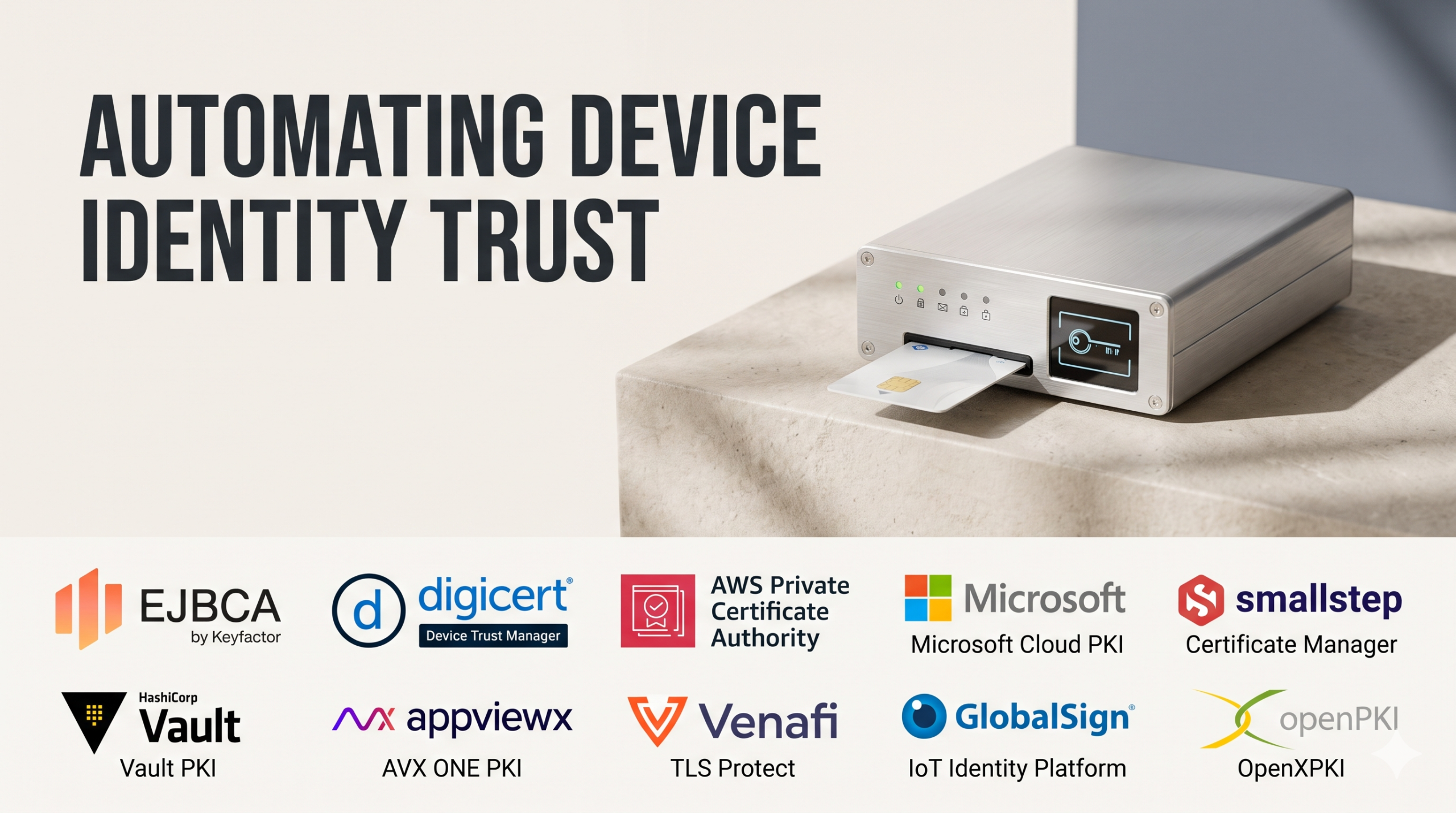
The following tools include dedicated device identity platforms, managed certificate authorities, enterprise PKI solutions, and open-source certificate provisioning systems. Their numbering represents presentation order rather than an independently tested performance ranking.
1. Keyfactor EJBCA
Short Description
Keyfactor EJBCA provides enterprise PKI capabilities for issuing and administering digital certificates across distributed infrastructure. It supports device identities, enterprise authentication, connected equipment, and specialized certificate issuance requirements.
Organizations can configure certificate profiles, enrollment policies, and certificate authority hierarchies. Its supported enrollment protocols help integrate certificate provisioning with compatible IoT and enterprise environments.
Key Features
- Certificate authority administration.
- Automated certificate enrollment.
- X.509 certificate issuance.
- Certificate profile management.
- Enrollment protocol support.
- Certificate revocation administration.
- Hardware Security Module (HSM) integration.
- Certificate lifecycle reporting.
Benefits: Supports scalable certificate issuance, improves device identity governance, reduces manual enrollment activities, and facilitates enterprise integration.
Pros
- Comprehensive PKI functionality.
- Open-source and enterprise offerings.
- Multiple certificate enrollment protocols.
- Flexible certificate authority architecture.
Cons
- Advanced implementation requires PKI expertise.
- Self-managed infrastructure requires maintenance.
- Enterprise functionality depends on licensing.
Use Cases: Industrial device provisioning, IoT authentication, enterprise endpoint identities, and private certificate authority administration.
Best For: Large enterprises, IoT manufacturers, cybersecurity teams, and PKI administrators.
2. DigiCert Device Trust Manager
Short Description
DigiCert Device Trust Manager provides device identity and trust management capabilities for connected equipment throughout product lifecycles. It helps organizations establish trusted device identities and administer compatible digital certificate workflows.
Manufacturers can integrate certificate provisioning with supported production and operational processes. The platform is particularly relevant to organizations requiring scalable device authentication and lifecycle governance.
Key Features
- Device identity provisioning.
- Digital certificate issuance.
- Certificate lifecycle administration.
- Device enrollment automation.
- Supported manufacturing integrations.
- Device identity policy management.
- Certificate renewal workflows.
- Centralized device trust visibility.
Benefits: Strengthens connected device authentication, supports manufacturing-scale provisioning, improves identity visibility, and facilitates lifecycle administration.
Pros
- Dedicated connected device trust orientation.
- Established certificate management ecosystem.
- Relevant manufacturing integrations.
- Supports enterprise security requirements.
Cons
- Commercial pricing requires consultation.
- Manufacturing integrations require planning.
- Device compatibility requires technical assessment.
Use Cases: Connected product manufacturing, industrial equipment authentication, embedded device identities, and IoT certificate management.
Best For: Equipment manufacturers, automotive technology teams, enterprise IoT organizations, and device security engineers.
3. AWS Private Certificate Authority
Short Description
AWS Private Certificate Authority provides managed private certificate authority infrastructure for issuing digital certificates. Organizations can establish private trust hierarchies without directly maintaining all underlying certificate authority infrastructure.
The service supports certificate issuance through compatible applications and integrations. Device enrollment, installation, and renewal workflows may require complementary Amazon Web Services (AWS) or external management components.
Key Features
- Managed private certificate authorities.
- X.509 certificate issuance.
- Certificate authority hierarchy management.
- Certificate templates.
- Certificate revocation capabilities.
- Application Programming Interface (API) integration.
- AWS access control integration.
- Certificate authority audit reporting.
Benefits: Reduces certificate authority infrastructure maintenance, supports scalable private certificate issuance, improves cloud integration, and facilitates centralized trust administration.
Pros
- Managed certificate authority infrastructure.
- Strong AWS ecosystem integration.
- Flexible certificate authority hierarchies.
- Relevant enterprise access controls.
Cons
- Complete device provisioning requires additional integration.
- Certificate authority and issuance charges require evaluation.
- Implementation requires AWS and PKI expertise.
Use Cases: Private device certificates, industrial IoT authentication, enterprise machine identities, and cloud-connected equipment.
Best For: AWS customers, cloud security engineers, enterprise PKI teams, and distributed infrastructure administrators.
4. Microsoft Cloud PKI
Short Description
Microsoft Cloud PKI provides cloud-based certificate infrastructure for supported devices managed through Microsoft Intune. It helps organizations issue and manage certificates without maintaining traditional on-premises certificate authority infrastructure for supported scenarios.
The service integrates certificate issuance with compatible device configuration and enrollment workflows. Its capabilities are particularly relevant to enterprise endpoints requiring certificate-based network authentication.
Key Features
- Cloud-based certificate authority management.
- Intune device integration.
- Simple Certificate Enrollment Protocol (SCEP) support.
- Automated device certificate issuance.
- Certificate profile administration.
- Supported certificate renewal.
- Certificate revocation management.
- Centralized certificate monitoring.
Benefits: Simplifies enterprise certificate provisioning, reduces infrastructure maintenance, improves endpoint authentication, and supports Microsoft device management workflows.
Pros
- Strong Microsoft Intune integration.
- Cloud-managed certificate infrastructure.
- Relevant enterprise endpoint capabilities.
- Simplifies supported certificate deployment scenarios.
Cons
- Requires eligible Microsoft licensing.
- Primarily focused on supported managed endpoints.
- Not a universal embedded IoT provisioning platform.
Use Cases: Managed endpoint authentication, enterprise wireless access, mobile device certificates, and certificate-based network connectivity.
Best For: Microsoft-focused enterprises, endpoint administrators, workplace security teams, and Intune customers.
5. Smallstep Certificate Manager
Short Description
Smallstep Certificate Manager provides automated certificate issuance and lifecycle management capabilities for machine identities and computing infrastructure. Its architecture supports private PKI and compatible certificate enrollment workflows.
Organizations can use Smallstep technologies to establish certificate-based authentication across devices, applications, and infrastructure components. Supported automation mechanisms help reduce manual certificate administration.
Key Features
- Private certificate authority management.
- Automated certificate issuance.
- Short-lived certificate support.
- Certificate renewal automation.
- Automated Certificate Management Environment (ACME) support.
- Identity-based enrollment mechanisms.
- Certificate policy administration.
- Infrastructure integration interfaces.
Benefits: Simplifies machine identity management, supports automated certificate maintenance, improves authentication consistency, and reduces manual certificate handling.
Pros
- Strong certificate automation capabilities.
- Developer-oriented integration workflows.
- Open-source certificate authority components.
- Flexible private PKI architecture.
Cons
- Specialized device integration may require development.
- Advanced commercial capabilities require licensing.
- Implementation requires certificate management knowledge.
Use Cases: Machine authentication, private infrastructure certificates, automated device identities, and secure service communication.
Best For: Platform engineers, infrastructure security teams, development operations teams, and organizations implementing private PKI.
6. HashiCorp Vault PKI
Short Description
HashiCorp Vault PKI provides certificate authority and dynamic certificate issuance capabilities through its PKI secrets engine. It helps organizations establish trusted machine identities and automate certificate generation according to defined policies.
Administrators can configure certificate roles, validity periods, and issuance permissions. Device-specific enrollment and certificate installation typically require integration with compatible applications or provisioning systems.
Key Features
- Dynamic X.509 certificate issuance.
- Private certificate authority administration.
- Certificate role configuration.
- Certificate validity controls.
- Certificate revocation management.
- ACME support.
- API-based certificate provisioning.
- Authentication and access policies.
Benefits: Supports automated certificate issuance, improves machine identity governance, reduces static credential dependence, and facilitates infrastructure integration.
Pros
- Strong infrastructure automation capabilities.
- Flexible certificate issuance policies.
- Extensive secrets management ecosystem.
- Supports short-lived certificates.
Cons
- Requires specialized Vault administration expertise.
- Device-side enrollment requires integration.
- Operational architecture requires careful planning.
Use Cases: Infrastructure machine identities, automated certificate issuance, private device authentication, and secure application communication.
Best For: DevOps engineers, cloud security teams, infrastructure administrators, and enterprise automation specialists.
7. AppViewX AVX ONE PKI
Short Description
AppViewX AVX ONE PKI provides managed private PKI capabilities within a broader certificate lifecycle management ecosystem. It helps organizations establish and administer trusted digital identities across supported enterprise environments.
Its associated automation capabilities can support certificate discovery, enrollment, renewal, and policy-based administration. Device-specific provisioning depends on supported integrations and deployment configurations.
Key Features
- Managed private PKI.
- Certificate issuance automation.
- Certificate lifecycle administration.
- Certificate discovery capabilities.
- Policy-based certificate workflows.
- Supported enrollment integrations.
- Certificate expiration monitoring.
- Centralized governance reporting.
Benefits: Improves certificate lifecycle visibility, reduces repetitive administration, supports centralized governance, and facilitates automated certificate maintenance.
Pros
- Comprehensive certificate management ecosystem.
- Relevant enterprise automation capabilities.
- Centralized policy administration.
- Supports complex certificate environments.
Cons
- Commercial pricing requires consultation.
- Integration complexity depends on infrastructure.
- Specialized embedded device provisioning requires verification.
Use Cases: Enterprise device identities, certificate renewal automation, private PKI modernization, and centralized certificate governance.
Best For: Large enterprises, cybersecurity departments, PKI administrators, and certificate lifecycle management teams.
8. Venafi TLS Protect
Short Description
Venafi TLS Protect provides machine identity and Transport Layer Security (TLS) certificate lifecycle management capabilities. It helps organizations discover certificates, establish ownership, automate renewal, and enforce approved certificate policies.
The platform integrates with supported certificate authorities and infrastructure systems to coordinate certificate management. Its device provisioning capabilities depend on available integrations, certificate types, and deployment architecture.
Key Features
- Certificate discovery.
- Machine identity administration.
- Certificate renewal automation.
- Certificate authority integrations.
- Policy-based certificate management.
- Certificate expiration monitoring.
- Supported certificate installation workflows.
- Compliance and operational reporting.
Benefits: Improves machine identity visibility, reduces certificate expiration risks, strengthens certificate governance, and facilitates enterprise automation.
Pros
- Strong certificate lifecycle management capabilities.
- Broad enterprise integration opportunities.
- Relevant governance and reporting functionality.
- Supports complex certificate environments.
Cons
- Commercial implementation requires investment.
- Specialized IoT provisioning may require additional components.
- Enterprise integration requires planning.
Use Cases: Enterprise certificate automation, machine identity governance, infrastructure certificate renewal, and supported device authentication workflows.
Best For: Large enterprises, cybersecurity teams, machine identity administrators, and certificate management specialists.
9. GlobalSign IoT Identity Platform
Short Description
GlobalSign IoT Identity Platform provides digital identity and certificate issuance capabilities for connected devices and equipment. It helps organizations establish trusted device authentication throughout manufacturing and operational lifecycles.
Manufacturers can integrate certificate issuance services with compatible production systems and device management workflows. Its architecture addresses large-scale device identity requirements through managed certificate infrastructure.
Key Features
- IoT device certificate issuance.
- Device identity provisioning.
- API-based certificate enrollment.
- Managed certificate infrastructure.
- Supported manufacturing integrations.
- Certificate lifecycle administration.
- Device authentication support.
- Scalable certificate issuance.
Benefits: Supports manufacturing-scale device identity provisioning, improves authentication consistency, reduces certificate infrastructure maintenance, and facilitates connected product security.
Pros
- Dedicated IoT identity orientation.
- Managed certificate issuance infrastructure.
- Relevant manufacturing integration capabilities.
- Supports large device populations.
Cons
- Commercial pricing requires consultation.
- Device integration requires engineering resources.
- Certificate lifecycle capabilities depend on implementation.
Use Cases: Connected product manufacturing, industrial IoT identities, smart equipment authentication, and embedded device certificate provisioning.
Best For: IoT manufacturers, industrial equipment providers, telecommunications organizations, and embedded security teams.
10. OpenXPKI
Short Description
OpenXPKI is an open-source PKI management framework supporting customizable certificate issuance and lifecycle administration. It helps organizations establish private certificate infrastructure with configurable enrollment and approval workflows.
Administrators can define certificate policies, integrate supported enrollment protocols, and customize operational processes. Its flexibility is particularly relevant to organizations requiring control over certificate authority infrastructure.
Key Features
- Private PKI administration.
- Certificate issuance workflows.
- Configurable enrollment policies.
- Certificate profile management.
- Supported automated enrollment protocols.
- Certificate revocation administration.
- Workflow customization.
- Open-source deployment architecture.
Benefits: Supports customized certificate provisioning, improves organizational control over PKI infrastructure, facilitates policy enforcement, and reduces proprietary platform dependence.
Pros
- Open-source architecture.
- Flexible certificate workflows.
- Customizable enrollment processes.
- Supports self-managed infrastructure.
Cons
- Requires substantial PKI expertise.
- Self-hosted infrastructure requires maintenance.
- Specialized device integrations may require development.
Use Cases: Private certificate authorities, customized device enrollment, enterprise authentication infrastructure, and open-source certificate management.
Best For: PKI engineers, research institutions, security infrastructure teams, and organizations requiring customized certificate provisioning.
Comparison Table: Top 10 Device Certificate Provisioning Tools
| Platform | Primary Strength | Best For | Pricing Approach |
|---|---|---|---|
| Keyfactor EJBCA | Comprehensive PKI administration | Enterprise and IoT identities | Open-source and commercial |
| DigiCert Device Trust Manager | Connected device trust | Device manufacturers | Commercial licensing |
| AWS Private CA | Managed private certificate authorities | AWS environments | Usage-based |
| Microsoft Cloud PKI | Managed endpoint certificates | Microsoft Intune environments | Subscription licensing |
| Smallstep Certificate Manager | Automated machine certificates | Infrastructure teams | Open-source components and commercial services |
| HashiCorp Vault PKI | Dynamic certificate issuance | Automated infrastructure | Edition and service-dependent |
| AppViewX AVX ONE PKI | Managed PKI and lifecycle automation | Large enterprises | Commercial licensing |
| Venafi TLS Protect | Machine identity governance | Enterprise certificate teams | Commercial licensing |
| GlobalSign IoT Identity Platform | Manufacturing-scale device identities | IoT manufacturers | Commercial services |
| OpenXPKI | Customizable certificate infrastructure | Self-managed PKI teams | Open-source |
Functional Comparison
| Platform | Primary Environment | Provisioning Focus |
|---|---|---|
| Keyfactor EJBCA | Enterprise and industrial infrastructure | Certificate issuance and enrollment |
| DigiCert Device Trust Manager | Connected products | Device identity lifecycle |
| AWS Private CA | Cloud-connected infrastructure | Private certificate issuance |
| Microsoft Cloud PKI | Intune-managed endpoints | Automated endpoint enrollment |
| Smallstep | Machine and infrastructure identities | Automated certificate provisioning |
| Vault PKI | Applications and computing infrastructure | Dynamic certificate generation |
| AppViewX AVX ONE PKI | Enterprise infrastructure | PKI and lifecycle automation |
| Venafi TLS Protect | Enterprise machine identities | Certificate governance |
| GlobalSign IoT Identity Platform | Connected equipment | Scalable device certificate issuance |
| OpenXPKI | Customized private infrastructure | Configurable enrollment workflows |
How to Choose the Best Device Certificate Provisioning Tool
Evaluate Device Compatibility
Identify device operating systems, cryptographic capabilities, hardware security components, and supported enrollment mechanisms. Verify that the selected platform can establish certificates within actual device resource limitations.
Assess Enrollment Protocol Support
Review support for SCEP, Enrollment over Secure Transport (EST), ACME, and other relevant enrollment mechanisms. Protocol selection should reflect device capabilities, security requirements, and existing infrastructure.
Examine Certificate Authority Architecture
Determine whether the organization requires managed certificate authorities, self-hosted PKI infrastructure, or hybrid deployment arrangements. Each approach introduces different operational responsibilities and trust management requirements.
Review Key Protection Capabilities
Evaluate secure key generation, hardware-backed key storage, signing key protection, and administrative access controls. Private cryptographic keys should remain protected throughout certificate provisioning and operational use.
Assess Lifecycle Automation
Determine whether the platform supports certificate discovery, automated renewal, expiration monitoring, and revocation workflows. Effective lifecycle administration helps reduce authentication failures caused by expired or invalid certificates.
Evaluate Total Ownership Costs
Consider certificate issuance charges, platform licensing, infrastructure expenses, hardware security requirements, and integration development. Open-source platforms may reduce licensing expenses while requiring additional internal engineering resources.
Best Device Certificate Provisioning Tools by User Type
| User Type | Relevant Platform |
|---|---|
| Enterprise PKI administrator | Keyfactor EJBCA |
| Connected product manufacturer | DigiCert Device Trust Manager |
| AWS security engineer | AWS Private CA |
| Microsoft endpoint administrator | Microsoft Cloud PKI |
| Infrastructure automation engineer | Smallstep Certificate Manager |
| Secrets management administrator | HashiCorp Vault PKI |
| Enterprise certificate manager | AppViewX AVX ONE PKI |
| Machine identity security specialist | Venafi TLS Protect |
| Industrial IoT manufacturer | GlobalSign IoT Identity Platform |
| Open-source PKI engineer | OpenXPKI |
Practical Example: Implementing Device Certificate Provisioning
Consider a hypothetical industrial organization operating 20,000 connected devices across multiple manufacturing facilities. Its security department experiences inconsistent device authentication, expired certificates, and excessive manual certificate enrollment activities.
Management introduces automated certificate provisioning to improve identity consistency and reduce administrative workloads. The following outcomes represent illustrative assumptions rather than verified vendor performance.
Implementation Steps
- Inventory connected devices and existing authentication credentials.
- Establish certificate authority and trust hierarchy requirements.
- Define approved certificate profiles and enrollment policies.
- Integrate compatible device-side enrollment mechanisms.
- Test certificate issuance, renewal, and revocation workflows.
- Deploy approved certificates across authorized device populations.
- Monitor certificate conditions and refine lifecycle procedures.
Illustrative Performance Improvements
| Performance Indicator | Before | After |
|---|---|---|
| Certificate-enabled device coverage | 48% | 99% |
| Automated certificate enrollment | 20% | 96% |
| Average device enrollment time | 40 minutes | 4 minutes |
| Monthly certificate expiration incidents | 85 | 5 |
| Certificate renewal success rate | 76% | 99% |
| Monthly administrative workload | 650 hours | 190 hours |
| Average certificate revocation time | 8 hours | 15 minutes |
| Certificate policy compliance | 65% | 98% |
Financial Analysis
Reducing monthly administrative workloads by 460 hours releases 5,520 employee hours annually. At an illustrative labor cost of $40 per hour, this represents $220,800 in released annual labor capacity rather than guaranteed cash savings.
Suppose separately realized annual operating savings equal $320,000 and recurring platform expenses equal $100,000. An initial implementation investment of $275,000 would produce a simple payback period of 15 months.
Important Device Certificate Provisioning Performance Indicators
| Indicator | Measurement Purpose |
|---|---|
| Certificate coverage | Measures devices with approved certificates |
| Enrollment success rate | Evaluates successful certificate provisioning |
| Certificate issuance time | Measures enrollment processing efficiency |
| Renewal success rate | Tracks successful certificate replacement |
| Expiration incidents | Measures certificate-related authentication failures |
| Revocation processing time | Evaluates certificate invalidation efficiency |
| Certificate policy compliance | Measures adherence to approved certificate profiles |
| Automated enrollment coverage | Tracks provisioning automation adoption |
| Certificate inventory accuracy | Evaluates correctness of certificate records |
| Administrative workload | Measures continuing certificate management effort |
| Authentication success rate | Tracks successful certificate-based authentication |
Security and Governance Considerations
Device certificate provisioning infrastructure establishes trust relationships across connected equipment and enterprise applications. Organizations should protect certificate authority signing keys, administrative credentials, enrollment secrets, and certificate issuance policies.
Cryptographic keys should be generated and stored securely using appropriate software or hardware-backed mechanisms. Hardware Security Modules, Trusted Platform Modules (TPMs), and secure elements can provide additional key protection where supported.
Administrators should implement least-privilege access controls, multifactor authentication, and appropriate audit logging. Certificate issuance permissions should reflect documented organizational responsibilities and authorized device enrollment requirements.
Certificate revocation procedures should address compromised devices, unauthorized credentials, equipment retirement, and changes in operational ownership. Organizations must also verify that relying systems appropriately evaluate certificate validity and revocation information.
Challenges and Limitations
Connected devices frequently use different operating systems, cryptographic libraries, and enrollment protocols. Organizations may require multiple provisioning mechanisms to support heterogeneous device populations.
Resource-constrained devices may have limited processing capacity, storage, and cryptographic functionality. Certificate profiles and authentication mechanisms should accommodate actual device capabilities without introducing unacceptable security weaknesses.
Certificate expiration can interrupt authentication and prevent devices from accessing essential services. Automated renewal workflows should include monitoring, appropriate retry mechanisms, and documented recovery procedures.
Compromised certificate authority infrastructure can undermine trust across extensive device populations. Organizations should establish protected signing infrastructure, tested recovery procedures, and documented incident response plans.
Best Practices for Device Certificate Provisioning
- Maintain accurate device identity inventories.
- Assign unique identities to authorized devices.
- Establish documented certificate issuance policies.
- Protect certificate authority signing keys.
- Use secure device enrollment mechanisms.
- Generate device private keys securely.
- Avoid unnecessary private key distribution.
- Automate certificate renewal where supported.
- Monitor certificate expiration continuously.
- Implement appropriate certificate revocation procedures.
- Restrict privileged administrative access.
- Maintain certificate issuance audit records.
- Test certificate recovery workflows.
- Securely deactivate retired device identities.
- Review cryptographic policies periodically.
Future Trends in Device Certificate Provisioning Tools
Automated Machine Identity Management
Organizations may increasingly adopt automated certificate provisioning to address expanding machine identity populations. These capabilities can reduce repetitive enrollment and renewal activities while improving centralized identity governance.
Hardware-Backed Device Trust
Connected equipment may increasingly incorporate secure elements and hardware-backed cryptographic capabilities. These technologies can strengthen device identity protection by reducing exposure of sensitive private keys.
Post-Quantum Cryptography Readiness
Organizations may increasingly evaluate certificate infrastructure for compatibility with post-quantum cryptographic standards. Migration planning will require careful consideration of device resources, protocol interoperability, and applicable security requirements.
Short-Lived Digital Certificates
Short-lived certificates may become more common in environments supporting reliable automated renewal. Reduced certificate validity periods can limit certain credential exposure risks while increasing dependence on dependable provisioning infrastructure.
Manufacturing-Integrated Identity Provisioning
Device manufacturers may increasingly integrate certificate issuance directly into production and quality assurance workflows. These practices can help establish trusted device identities before equipment enters operational environments.
Frequently Asked Questions
1. What are device certificate provisioning tools?
Device certificate provisioning tools issue and administer digital certificates for authorized computing devices. They support device enrollment, authentication, certificate renewal, and lifecycle management.
2. Why is device certificate provisioning important?
Certificate provisioning helps establish trusted device identities and secure communication relationships. Automated provisioning also reduces repetitive administrative activities across large device populations.
3. What is Keyfactor EJBCA?
Keyfactor EJBCA provides PKI infrastructure for digital certificate issuance and administration. It supports configurable certificate profiles, enrollment protocols, and certificate authority management.
4. What is DigiCert Device Trust Manager?
DigiCert Device Trust Manager provides connected device identity and trust management capabilities. It supports compatible device certificate provisioning and lifecycle administration workflows.
5. What is AWS Private Certificate Authority?
AWS Private Certificate Authority provides managed infrastructure for issuing private digital certificates. Complete device enrollment and installation workflows may require complementary integrations.
6. What is Microsoft Cloud PKI?
Microsoft Cloud PKI provides cloud-based certificate infrastructure for supported Intune-managed devices. It helps organizations automate compatible enterprise endpoint certificate enrollment.
7. What is Smallstep Certificate Manager?
Smallstep Certificate Manager provides automated certificate issuance and lifecycle management capabilities. It supports private PKI and compatible machine identity provisioning workflows.
8. What is HashiCorp Vault PKI?
HashiCorp Vault PKI provides dynamic digital certificate issuance through its PKI secrets engine. Organizations can configure certificate authorities, issuance roles, and certificate validity policies.
9. What is AppViewX AVX ONE PKI?
AppViewX AVX ONE PKI provides managed private certificate infrastructure within a broader certificate management ecosystem. Its associated capabilities support certificate lifecycle automation and governance.
10. What is Venafi TLS Protect?
Venafi TLS Protect provides machine identity and TLS certificate lifecycle management capabilities. It helps organizations discover, monitor, and automate supported certificate management activities.
11. What is GlobalSign IoT Identity Platform?
GlobalSign IoT Identity Platform provides digital certificate issuance and identity services for connected equipment. It supports compatible manufacturing and device provisioning workflows.
12. What is OpenXPKI?
OpenXPKI is an open-source framework for private certificate infrastructure and lifecycle administration. It supports customizable certificate issuance and enrollment workflows.
13. What is Public Key Infrastructure?
Public Key Infrastructure is a collection of technologies, policies, and procedures supporting digital certificate management. It establishes trust relationships through cryptographic keys and certificate authorities.
14. What is a Certificate Authority?
A Certificate Authority is a trusted entity responsible for issuing and signing digital certificates. It establishes associations between verified identities and public cryptographic keys.
15. What is an X.509 certificate?
An X.509 certificate is a standardized digital certificate containing identity information, a public key, validity information, and a digital signature. It is commonly used for certificate-based authentication.
16. What is a Certificate Signing Request?
A Certificate Signing Request contains a public key and requested certificate identity information. A certificate authority evaluates the request according to applicable issuance policies.
17. What is SCEP?
Simple Certificate Enrollment Protocol supports automated certificate enrollment for compatible devices. It is commonly used in enterprise endpoint and network infrastructure environments.
18. What is EST?
Enrollment over Secure Transport is a certificate enrollment protocol using protected communication channels. It supports compatible certificate enrollment and renewal workflows.
19. What is mutual TLS?
Mutual Transport Layer Security (mTLS) allows both communicating parties to authenticate each other using supported digital certificates. It is frequently used for secure device and application communication.
20. What happens when a device certificate expires?
An expired certificate may prevent a device from successfully authenticating with services that enforce certificate validity. Automated renewal and monitoring can help reduce these operational interruptions.
21. Can device certificates be revoked?
Certificate authorities can revoke certificates according to supported lifecycle policies. Effective revocation also requires relying systems to evaluate relevant certificate status information.
22. Can certificate provisioning tools manage IoT devices?
Several platforms support certificate provisioning for compatible IoT equipment. Device cryptographic capabilities, enrollment protocols, and management integrations must be evaluated.
23. Are open-source device certificate provisioning tools available?
EJBCA Community, OpenXPKI, and Smallstep certificate authority components provide relevant open-source PKI capabilities. Self-managed implementations require infrastructure maintenance and specialized security expertise.
24. How much do device certificate provisioning tools cost?
Costs depend on certificate volumes, software licensing, certificate authority infrastructure, integration requirements, and operational support. Organizations should evaluate complete ownership expenses.
25. Which device certificate provisioning tool is best?
The appropriate platform depends on device architectures, enrollment protocols, certificate authority requirements, deployment scale, and security policies. Representative testing helps organizations identify suitable certificate provisioning solutions.
Conclusion
Device certificate provisioning tools help organizations establish trusted identities across connected equipment, enterprise endpoints, and distributed computing infrastructure. Their capabilities support secure certificate issuance, automated enrollment, renewal, revocation, and identity lifecycle administration.
Keyfactor EJBCA, AWS Private Certificate Authority, and OpenXPKI provide capabilities relevant to private certificate infrastructure. These platforms support different combinations of certificate issuance, configurable policies, and deployment flexibility.
DigiCert Device Trust Manager and GlobalSign IoT Identity Platform address connected product identity requirements, while Microsoft Cloud PKI supports compatible enterprise endpoint environments. Smallstep, HashiCorp Vault PKI, AppViewX, and Venafi provide complementary capabilities for certificate automation and machine identity governance.
Successful implementation requires secure cryptographic key management, reliable enrollment mechanisms, protected certificate authorities, and documented certificate lifecycle procedures. Organizations should evaluate certificate management effectiveness alongside authentication reliability, cybersecurity requirements, and total ownership expenses.
An effective device certificate provisioning strategy combines appropriate technology with responsible governance and continuous improvement. These practices help organizations reduce administrative workloads, strengthen device authentication, and maintain dependable digital trust throughout connected equipment lifecycles.
