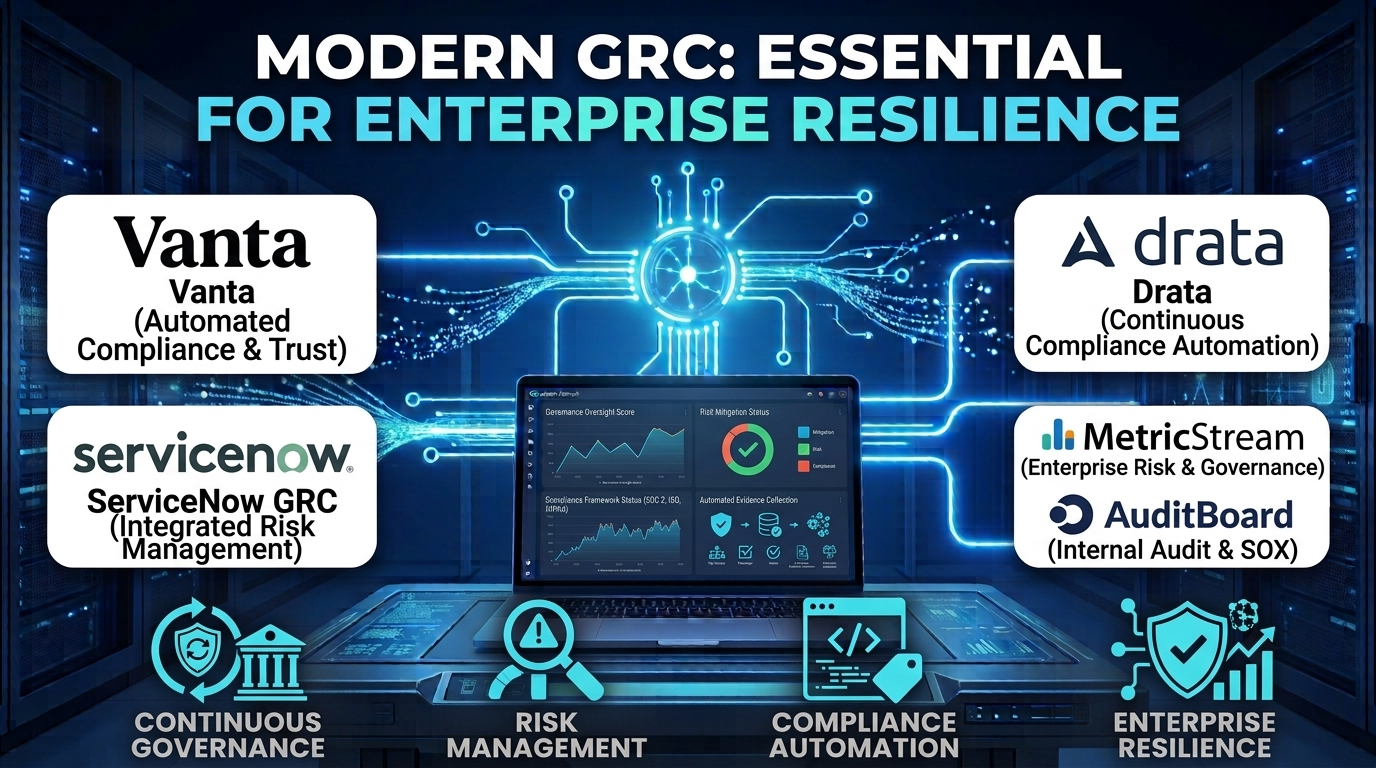
Organizations historically managed governance, risk, and compliance (GRC) through sprawling spreadsheets, disparate departmental silos, and periodic manual audits. When regulatory frameworks were straightforward and business infrastructure resided entirely on-premises, tracking compliance manually in Excel was cumbersome but manageable. Today, that manual approach creates severe operational blind spots. As enterprises scale across multi-cloud environments, face an ever-expanding web of international data privacy laws, and navigate sophisticated cyber threats, managing risk via static spreadsheets guarantees compliance failure and operational inertia.
Governance, Risk, and Compliance platforms automate policy management, streamline risk assessments, unify audit trails, and map overlapping controls across frameworks like SOC 2, ISO, HIPAA, and GDPR. Navigating the modern GRC software market requires understanding how platforms differentiate in automation depth, evidence collection, and cross-framework mapping.
Understanding the Three Pillars of Enterprise GRC
A robust GRC platform unifies three distinct yet deeply interconnected disciplines into a single operating system:
- Governance: Aligning corporate strategy with ethical standards and regulatory mandates, ensuring executive leadership maintains structured oversight over business operations.
- Risk Management: Identifying, evaluating, and mitigating potential threats—ranging from cybersecurity vulnerabilities and third-party vendor risks to financial exposure and operational failures.
- Compliance: Proving adherence to external regulatory requirements and internal policies through continuous monitoring and automated evidence collection.
The fundamental objective is to move away from reactive, check-the-box compliance audits and toward a continuous, risk-aware posture that builds trust with customers and regulators.
Key Evaluation Criteria for GRC Platforms
Selecting an enterprise GRC platform requires examining automation depth, framework mapping flexibility, and third-party integration capabilities.
Continuous Automated Evidence Collection
Traditional GRC tools required compliance teams to manually screenshot cloud consoles or request documents from IT staff every year. Modern GRC platforms integrate directly with cloud infrastructure (AWS, Azure, GCP), Git repositories, and HR tools to automatically collect and verify compliance evidence in real time.
Cross-Framework Mapping (Write Once, Comply Many)
Managing multiple standards independently wastes immense time. An effective GRC platform features robust cross-mapping engines where complying with a single control in SOC 2 automatically satisfies overlapping requirements in ISO and HIPAA frameworks.
User Adoption and Collaboration Workflows
Compliance is a company-wide responsibility, not just a legal team obligation. Platforms that offer intuitive dashboards, automated task reminders, and seamless Jira or Slack integrations drive significantly higher internal adoption rates.
Leading GRC Platforms and Software Solutions
The GRC software market features agile, automation-first compliance platforms built for modern tech companies alongside heavy-duty enterprise governance suites designed for global institutions.
Vanta
Vanta pioneered automated security compliance, helping fast-growing technology companies streamline SOC 2, ISO, HIPAA, and GDPR audits through continuous cloud monitoring.
- Primary Focus: Automated trust management, continuous compliance monitoring, and rapid audit readiness.
- Deployment Model: Cloud-native SaaS platform with deep cloud and developer tool integrations.
- Significant Advantage: Exceptional speed of deployment and automated evidence collection that drastically reduces the time required to pass initial security audits.
- Important Limitation: Specialized focus on technology startups and mid-market SaaS companies means highly complex non-IT enterprise governance workflows require heavier customization.
Drata
Drata provides continuous security and compliance automation, offering robust control monitoring, automated testing, and extensive integrations across the modern enterprise tech stack.
- Primary Focus: Continuous compliance automation, risk management, and vendor security reviews.
- Deployment Model: Cloud-native SaaS platform.
- Significant Advantage: Comprehensive test library and developer-friendly automation that alerts engineering teams instantly when compliance drift occurs.
- Important Limitation: Pricing models and feature tiers scale with asset and employee count, requiring careful budgeting for growing organizations.
ServiceNow GRC (Integrated Risk Management)
ServiceNow integrates risk and compliance directly into its massive enterprise IT service management ecosystem, making it a top choice for large organizations already leveraging ServiceNow.
- Primary Focus: Enterprise-scale risk management, IT compliance, and operational resilience.
- Deployment Model: Cloud-native enterprise SaaS platform.
- Significant Advantage: Unmatched integration with IT operations, incident response, and enterprise workflow automation engines.
- Important Limitation: High implementation costs, complex configuration requirements, and long deployment timelines.
MetricStream
MetricStream delivers heavy-duty governance, risk, and compliance management tailored for heavily regulated global enterprises, financial institutions, and healthcare providers.
- Primary Focus: Enterprise governance, operational risk management, and rigorous regulatory compliance.
- Deployment Model: Enterprise cloud or hybrid deployment options.
- Significant Advantage: Exceptional depth in handling complex, highly customized enterprise risk quantification and regulatory reporting models.
- Important Limitation: Steep learning curve and resource-intensive administration overhead.
AuditBoard
AuditBoard is a modern, cloud-based platform designed specifically for internal audit, SOX compliance, and enterprise risk management, praised for its intuitive user experience.
- Primary Focus: Internal audit management, SOX compliance, and collaborative risk assessments.
- Deployment Model: Cloud SaaS platform.
- Significant Advantage: Superior usability and workflow design tailored specifically for internal auditors and finance teams.
- Important Limitation: Broader IT compliance automation features are continually evolving compared to developer-first platforms like Vanta or Drata.
Platform Comparison Overview
| Product | Primary Focus | Deployment Model | Significant Advantage | Important Limitation |
| Vanta | Automated tech compliance and continuous cloud monitoring | Cloud SaaS | Rapid deployment and seamless developer tool integrations | Less tailored for complex, non-IT enterprise governance |
| Drata | Continuous compliance automation and testing | Cloud SaaS | Robust automated test library and real-time drift alerts | Costs scale dynamically with company and asset growth |
| ServiceNow GRC | Enterprise IT risk and operational resilience | Cloud Enterprise | Deep integration with IT service management workflows | High implementation complexity and long deployment timelines |
| MetricStream | Global enterprise risk and regulatory governance | Enterprise Cloud / Hybrid | Exceptional depth in complex risk quantification and reporting | Heavy administrative overhead and steep learning curve |
| AuditBoard | Internal audit management and SOX compliance | Cloud SaaS | Intuitive, user-friendly interface tailored for auditors | IT compliance automation requires supplementary configuration |
Operational Risks and Common Pitfalls
Implementing a GRC platform without structured internal alignment introduces significant operational hurdles.
Treating Compliance as a Point-in-Time Event
Deploying automation software purely to pass an annual audit without embedding ongoing risk management into daily engineering and operational workflows leads to continuous compliance drift.
Over-Automating Without Human Oversight
Relying entirely on automated tests without validating whether a technical control actually satisfies the spirit of a regulatory requirement can result in compliance failures during formal auditor inspection.
Selecting a Platform That Exceeds Organizational Maturity
Purchasing an overly complex, expensive enterprise GRC suite when the organization only requires a baseline SOC 2 audit creates unnecessary financial and administrative bloat.
Questions to Guide Vendor Selection
Before procuring a GRC platform, security architects, compliance officers, and IT leaders should address several critical operational questions:
- Does the platform offer out-of-the-box automated evidence collection for the specific frameworks (e.g., SOC 2, ISO, HIPAA) required by our customers and regulators?
- How comprehensive is the platform’s integration catalog with our existing cloud infrastructure, HR systems, and developer tools?
- Can the platform map a single compliance control across multiple regulatory frameworks simultaneously?
- What is the total cost of ownership, including implementation professional services, user licensing tiers, and ongoing administration overhead?
Making the Final Decision
Choosing a Governance, Risk, and Compliance platform depends heavily on an organization’s size, industry regulations, and technical maturity.
Technology companies and mid-market SaaS organizations seeking rapid audit readiness and continuous cloud monitoring frequently achieve immediate value using automation-first platforms like Vanta or Drata. Conversely, large global enterprises and financial institutions managing complex operational risks, internal audits, and SOX compliance frequently select robust enterprise suites like ServiceNow GRC, MetricStream, or AuditBoard.
Ultimately, modern GRC platforms transform compliance from a stressful, manual administrative burden into a streamlined, continuous business enabler.
