When a corporation faces federal litigation, regulatory investigation, or a high-stakes internal compliance audit, legal teams rarely struggle with a lack of digital information. Instead, they drown in petabytes of unstructured data distributed across Slack messages, Microsoft Teams chats, cloud emails, shared drives, and mobile device backups. Sifting through millions of disparate digital files to locate a handful of relevant smoking-gun documents manually is an impossible operational task that can result in crippling court sanctions, missed discovery deadlines, and millions of dollars in avoidable legal review costs.
Electronic Discovery (eDiscovery) software solves this data overload by automating the identification, collection, preservation, processing, review, and production of electronically stored information (ESI). Navigating the eDiscovery software landscape requires understanding how modern platforms handle the Electronic Discovery Reference Model (EDRM) and what capabilities separate enterprise-grade solutions from basic file search utilities.
Understanding the eDiscovery Reference Model (EDRM) Workflow
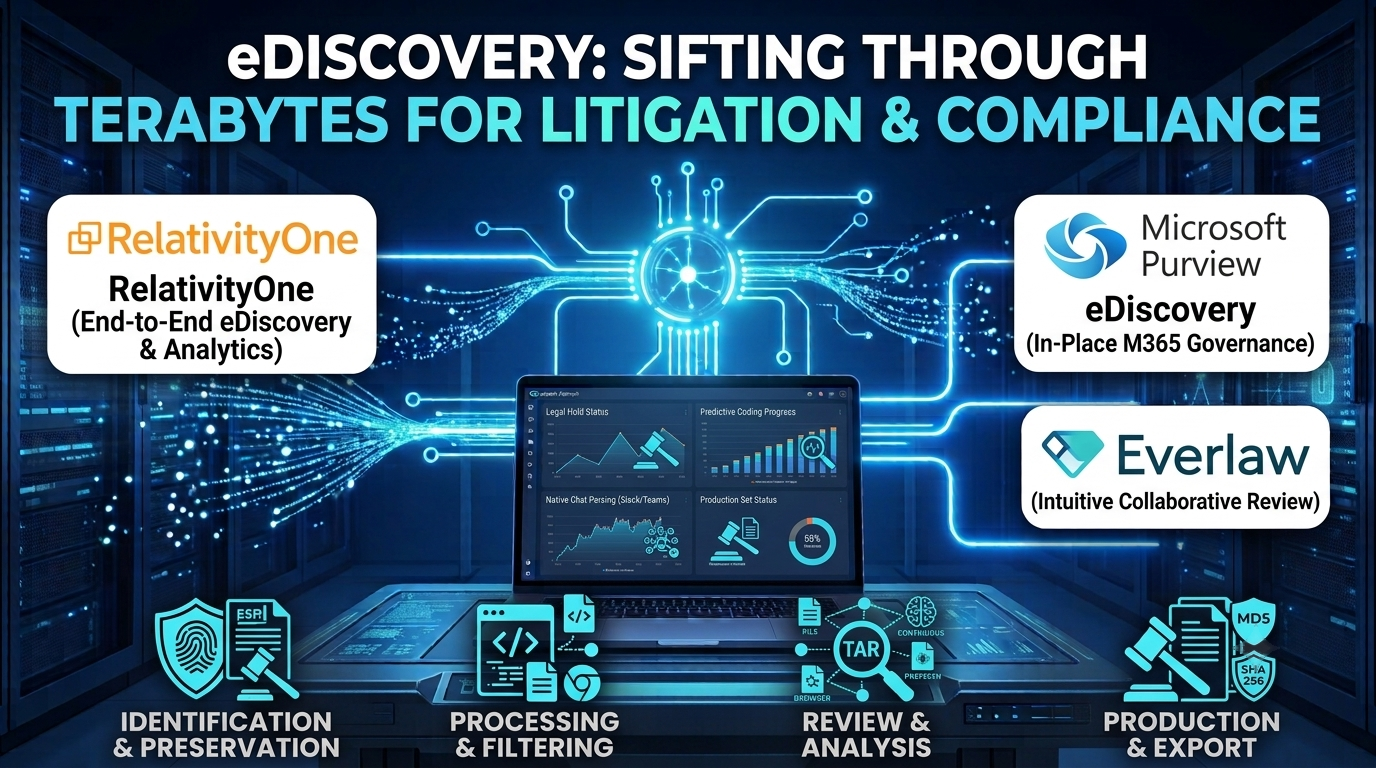
Electronic discovery is both a technical and legal process governed by strict procedural rules and evidentiary standards. Legal teams and corporate compliance officers rely on specialized eDiscovery software to manage information across the standard EDRM lifecycle:
- Identification and Legal Hold: Issuing automated legal holds to preserve relevant data sources across employee devices and cloud repositories, preventing automatic deletion or tampering.
- Collection and Preservation: Gathering forensic collections of ESI while maintaining an unbroken chain of custody and cryptographic hash verification.
- Processing and Filtering: Ingestion of raw data formats, stripping out system files, removing duplicates (de-duplication), and narrowing datasets using date ranges and custodians.
- Review and Analysis: Utilizing technology-assisted review (TAR), keyword searching, and machine learning models to identify responsive, privileged, or confidential documents.
- Production: Exporting finalized document sets in court-compliant formats (such as TIFF, PDF, or native load files with structured metadata).
The primary objective is to reduce data review volumes as aggressively as possible while ensuring that no critical evidence is missed.
Key Evaluation Criteria for eDiscovery Platforms
Selecting an effective eDiscovery platform requires examining processing speed, advanced analytics capabilities, and review workflow efficiency.
Technology-Assisted Review (TAR) and Predictive Coding
Reviewing every single document manually is cost-prohibitive. Leading eDiscovery tools leverage TAR and machine learning algorithms (such as continuous active learning) to extrapolate coding decisions made by senior attorneys across entire document populations rapidly.
Native Cloud Scalability and Security
Modern collaboration data spans massive cloud repositories. Cloud-native eDiscovery platforms can ingest and process terabytes of data dynamically without requiring heavy on-premises processing servers, while maintaining rigorous data encryption and SOC 2 compliance certifications.
Native Chat and Collaboration Data Parsing
Traditional eDiscovery tools were built primarily for email and Word documents. Modern platforms must parse complex, threaded communication channels like Slack, Microsoft Teams, WhatsApp, and SMS messages natively, preserving conversational context and emojis during attorney review.
Leading eDiscovery Software and Platforms
The eDiscovery market features comprehensive cloud-native enterprise suites alongside specialized boutique review platforms.
RelativityOne
RelativityOne is the undisputed enterprise gold standard in eDiscovery, widely adopted by major law firms and corporate legal departments globally for managing massive, complex litigation.
- Primary Focus: End-to-end e-discovery, advanced analytics, custom application extensibility, and massive enterprise litigation support.
- Deployment Model: Cloud-native SaaS platform delivered via secure Azure infrastructure.
- Significant Advantage: Unmatched ecosystem of third-party integrations, robust API extensibility, and proven scalability for terabyte-scale litigation.
- Important Limitation: High commercial cost and configuration complexity mean it is often over-engineered for smaller legal matters.
Microsoft Purview (eDiscovery)
Microsoft Purview provides native eDiscovery capabilities built directly into the Microsoft 365 ecosystem, allowing legal teams to manage legal holds and initial reviews without exporting data.
- Primary Focus: In-place legal hold, search, and early case assessment across Microsoft 365 cloud services.
- Deployment Model: Cloud-native SaaS service integrated into Microsoft enterprise administration portals.
- Significant Advantage: Eliminates the cost and friction of exporting data from Microsoft 365 by conducting search and review in-place.
- Important Limitation: Specialized advanced review, complex productions, and non-Microsoft data source integrations require supplementary specialized eDiscovery platforms.
Everlaw
Everlaw is a modern, user-friendly cloud eDiscovery platform renowned for its intuitive interface, lightning-fast search performance, and powerful predictive coding analytics.
- Primary Focus: Collaborative document review, intuitive case management, and predictive analytics.
- Deployment Model: Cloud-native SaaS platform.
- Significant Advantage: Exceptional user experience and speed that significantly reduces the learning curve for legal reviewers and litigators.
- Important Limitation: Highly customized enterprise workflows or specialized legacy data parsing may require additional configuration.
Platform Comparison Overview
| Product | Primary Focus | Deployment Model | Significant Advantage | Important Limitation |
| RelativityOne | Massive enterprise litigation and custom extensibility | Cloud SaaS (Azure) | Industry-leading scale, robust analytics, and massive developer ecosystem | High cost and steep administrative configuration curve |
| Microsoft Purview | In-place Microsoft 365 legal hold and early assessment | Cloud SaaS (M365) | Zero data export friction for organizations standardized on Microsoft 365 | Less suited for complex cross-platform productions and deep analytics |
| Everlaw | Collaborative review speed and intuitive analytics | Cloud SaaS | Exceptional user interface and rapid document search performance | Specialized enterprise workflows may need custom integration setup |
Operational Risks and Common Pitfalls
Implementing eDiscovery software without structured workflows introduces significant legal and financial exposure.
Failing to Defend Search Methodologies in Court
If opposing counsel challenges a legal discovery production, attorneys must be able to prove exactly how documents were searched, filtered, and reviewed. Using opaque AI models without validating parameters can lead to court challenges.
Over-Collection Leading to Astronomical Review Costs
Collecting entire employee hard drives and full mailboxes indiscriminately rather than interviewing custodians and targeting specific date ranges inflates downstream review costs drastically.
Ignoring Modern Chat and Collaboration Artifacts
Limiting eDiscovery collection to emails while ignoring ephemeral messaging platforms and mobile chat applications can lead to court sanctions for spoliation of evidence.
Questions to Guide Vendor Selection
Before procuring an eDiscovery platform, corporate counsel and legal operations managers should address several critical operational questions:
- How efficiently does the platform handle modern chat data (such as Microsoft Teams and Slack threads) during review and production?
- What machine learning and Technology-Assisted Review (TAR) capabilities are built-in to help attorneys prioritize responsive documents quickly?
- What are the total cost drivers—does the vendor charge based on data ingestion volume, active review storage, user seats, or data processing hours?
- How securely is data handled and encrypted during transit and rest, particularly when complying with international privacy regulations like GDPR?
Making the Final Decision
Choosing eDiscovery software depends heavily on an organization’s litigation volume, IT infrastructure, and budget structure.
Corporations managing massive, complex multi-jurisdictional litigations frequently rely on robust enterprise powerhouses like RelativityOne to handle specialized legal workflows. Conversely, organizations seeking intuitive, fast collaboration and predictable cloud pricing often adopt modern SaaS platforms like Everlaw, while Microsoft-centric enterprises leverage Purview for rapid early case assessment.
Ultimately, modern eDiscovery software transforms unstructured digital chaos into defensible, organized legal evidence, protecting enterprises from costly procedural missteps.
