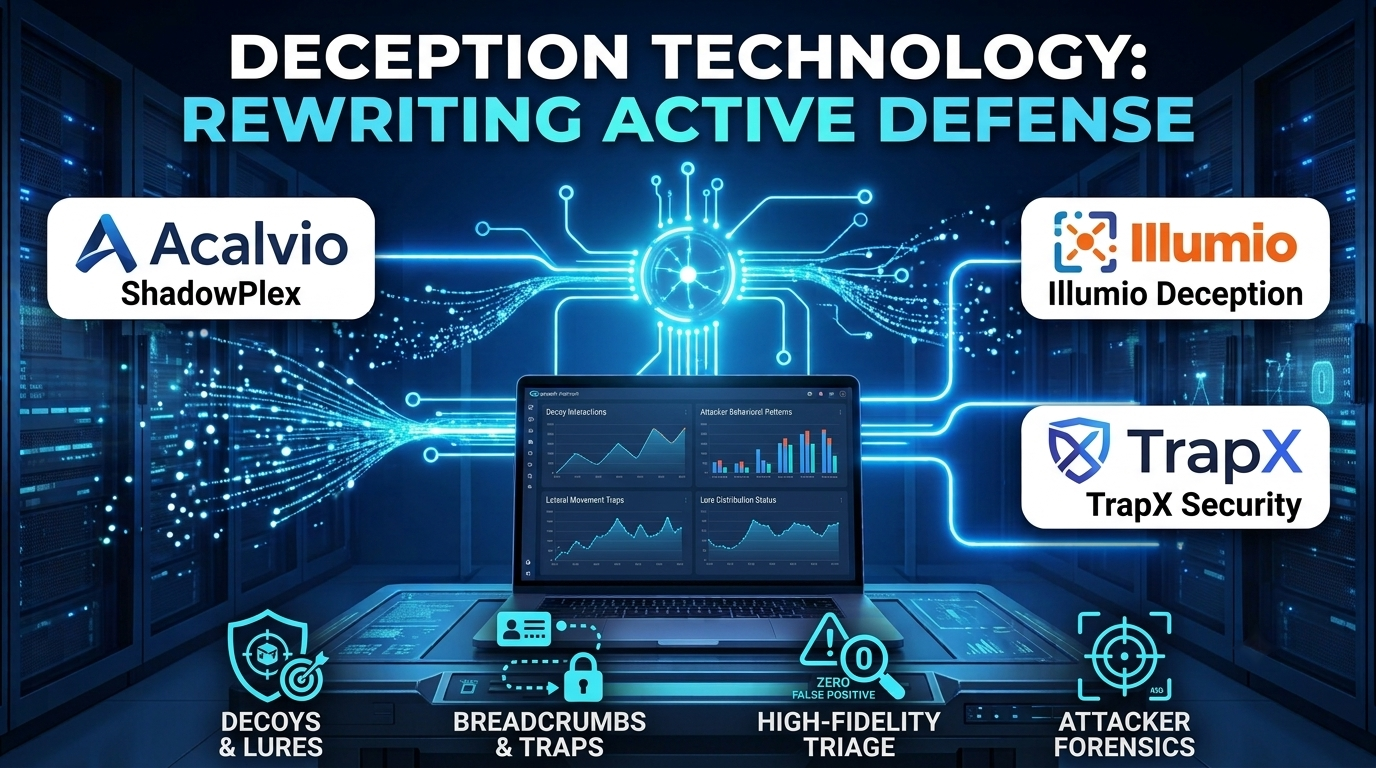
Traditional security controls operate on a deterministic assumption: if we build high enough walls, deploy strict firewalls, and monitor network traffic carefully enough, we can keep attackers out. Yet, sophisticated adversaries eventually bypass perimeter defenses, steal valid administrator credentials, and blend in with legitimate user activity inside the corporate network. Once inside, traditional signature-based detection tools struggle to distinguish between a legitimate database administrator and a threat actor quietly mapping internal shares.
Deception technology flips the operational asymmetry of cybersecurity. Instead of waiting passively for alerts to trigger, security teams deploy synthetic decoys, fake credentials, and simulated endpoints that look indistinguishable from real production assets. In a network where every interaction with a decoy is guaranteed to be malicious, false positives drop to zero, and threat detection becomes instantaneous.
Understanding How Deception Technology Operates
Deception technology encompasses software and architectural frameworks designed to mislead, confuse, and detect adversaries by embedding decoys, lures, and traps throughout an organization’s digital ecosystem.
Unlike traditional honeypots of the past—which were isolated, standalone servers easily spotted by experienced attackers—modern enterprise deception platforms scale seamlessly across cloud workloads, Active Directory environments, endpoints, and IoT networks.
A comprehensive deception architecture typically integrates several distinct layers:
- Decoys (Canaries and Lures): Realistic emulation of servers, databases, network switches, and cloud containers that appear authentic to any automated scanner or human intruder.
- Breadcrumbs and Lures: Fake credentials, cached session tokens, and registry entries deliberately left on legitimate workstations to guide an attacker toward the decoys.
- Alerting and High-Fidelity Triage: Because production users have no business interacting with a decoy server or using fake administrative credentials, any engagement triggers an immediate, zero-false-positive alert.
- Forensic Collection and Attacker Isolation: Automated recording of attacker keystrokes, toolsets, and lateral movement techniques to gather actionable threat intelligence in real time.
The core objective is to waste the adversary’s time, force them to reveal their presence early in the kill chain, and provide security operations teams with definitive proof of compromise.
Key Evaluation Criteria for Deception Platforms
Selecting an enterprise deception platform requires examining deployment scale, fidelity of emulation, and integration automation.
Automated Credential and Breadcrumb Distribution
An effective deception tool must distribute fake credentials and breadcrumbs across enterprise endpoints automatically. Manual placement is unsustainable in dynamic environments. The platform should seed Active Directory and user endpoints continuously so that lateral movement attempts inevitably intersect with a trap.
High-Fidelity Emulation versus Basic Simulation
Basic port-listener honeypots are easily identified by modern attacker enumeration tools. Enterprise deception solutions must emulate operating system behaviors, respond to specific service queries, and simulate realistic database or file contents to convince an intruder they have compromised a genuine production asset.
Automated Incident Response Integration
Detecting an attacker interacting with a decoy is only valuable if it triggers immediate containment. Leading deception platforms integrate smoothly with Security Orchestration, Automation, and Response (SOAR) tools to isolate compromised endpoints or revoke stolen sessions automatically.
Leading Deception Technology Platforms
The deception market features specialized active defense innovators as well as established cybersecurity suites incorporating deception capabilities.
Acalvio ShadowPlex
Acalvio provides comprehensive enterprise deception technology, leveraging advanced automation and AI to deploy scalable decoys across cloud, on-premises, and IoT environments.
- Primary Focus: Scalable enterprise deception, Active Directory protection, and automated threat detection.
- Deployment Model: Cloud-managed platform with distributed virtual decoys.
- Significant Advantage: Rapid automated deployment using patented techniques to seed Active Directory with convincing lures without manual administrative overhead.
- Important Limitation: Specialized active defense focus requires integration with broader SIEM and EDR ecosystems for complete incident response.
Illumio (Illumio CloudSecure / Deception)
Illumio integrates micro-segmentation with deception capabilities, allowing security teams to place decoys within segmented network zones to intercept lateral movement quickly.
- Primary Focus: Zero trust micro-segmentation combined with integrated lateral movement deception.
- Deployment Model: Software-defined segmentation agents and virtual traps.
- Significant Advantage: Combines network isolation with active traps, ensuring that once an attacker attempts to cross a segment, they encounter immediate decoys.
- Important Limitation: Optimized heavily around network segmentation workflows, making it most effective when deployed alongside Illumio’s core architecture.
TrapX Security (Cybereason / Respective Portfolios)
TrapX pioneered automated deception networks designed to protect specialized environments, including legacy medical devices, industrial control systems, and enterprise servers.
- Primary Focus: Deception for specialized IoT, medical, and traditional enterprise IT infrastructure.
- Deployment Model: Virtual appliance and network sensor architecture.
- Significant Advantage: Excellent emulation capabilities for non-standard operating systems and specialized industrial protocols.
- Important Limitation: Integration with modern cloud-native serverless environments requires careful architectural planning.
Platform Comparison Overview
| Product | Primary Focus | Deployment Model | Significant Advantage | Important Limitation |
| Acalvio ShadowPlex | Automated enterprise deception and AD protection | Cloud-Managed SaaS / Virtual | Superior automated Active Directory lure distribution and scalability | Requires complementary EDR and SIEM tools for full remediation |
| Illumio | Micro-segmentation and lateral movement traps | Software Agent / Virtual | Seamlessly blends network isolation with active decoy detection | Maximized value relies on adopting Illumio’s segmentation framework |
| TrapX | Specialized IoT, medical, and IT deception | Appliance / Sensor | Exceptional emulation of legacy and non-standard device protocols | Less optimized for modern cloud-native serverless architectures |
Operational Risks and Common Pitfalls
Implementing deception technology introduces specific organizational and technical challenges that security leaders must navigate carefully.
Accidental Employee Engagement with Decoys
If breadcrumbs or fake administrative credentials are placed carelessly on standard user workstations, legitimate employees might accidentally trigger them, causing false alarms for the security operations center.
Maintenance Overhead of Outdated Decoys
Decoys must evolve alongside production infrastructure. If a corporate environment upgrades its operating systems while deception templates remain stagnant, sophisticated attackers will instantly recognize the anomalies.
Treating Deception as a Standalone Panacea
Deception technology is an exceptional detection and intelligence-gathering mechanism, but it does not replace foundational security controls like vulnerability management, EDR, and identity governance.
Questions to Guide Vendor Selection
Before procuring a deception platform, security architects and operations managers should address several critical operational questions:
- How automated is the deployment of breadcrumbs and fake credentials across user endpoints and Active Directory?
- Can the platform emulate specialized operating systems and protocols relevant to the organization’s unique industry (such as healthcare devices or industrial controls)?
- What level of forensic detail does the system capture when an attacker engages a decoy, and how easily does it export data to existing SIEM tools?
- How does the vendor prevent internal employees from accidentally triggering alerts or interacting with production decoys?
Making the Final Decision
Choosing a deception technology platform depends heavily on an organization’s infrastructure complexity, threat profile, and security operations maturity.
Organizations seeking rapid, automated deployment across complex enterprise networks and Active Directory environments frequently choose scalable platforms like Acalvio ShadowPlex. Conversely, enterprises prioritizing strict network micro-segmentation alongside threat trapping often lean toward integrated solutions like Illumio.
Ultimately, deception technology transforms the cybersecurity dynamic, turning the enterprise network from a passive target into an active, intelligent defense system that catches adversaries in the act.
