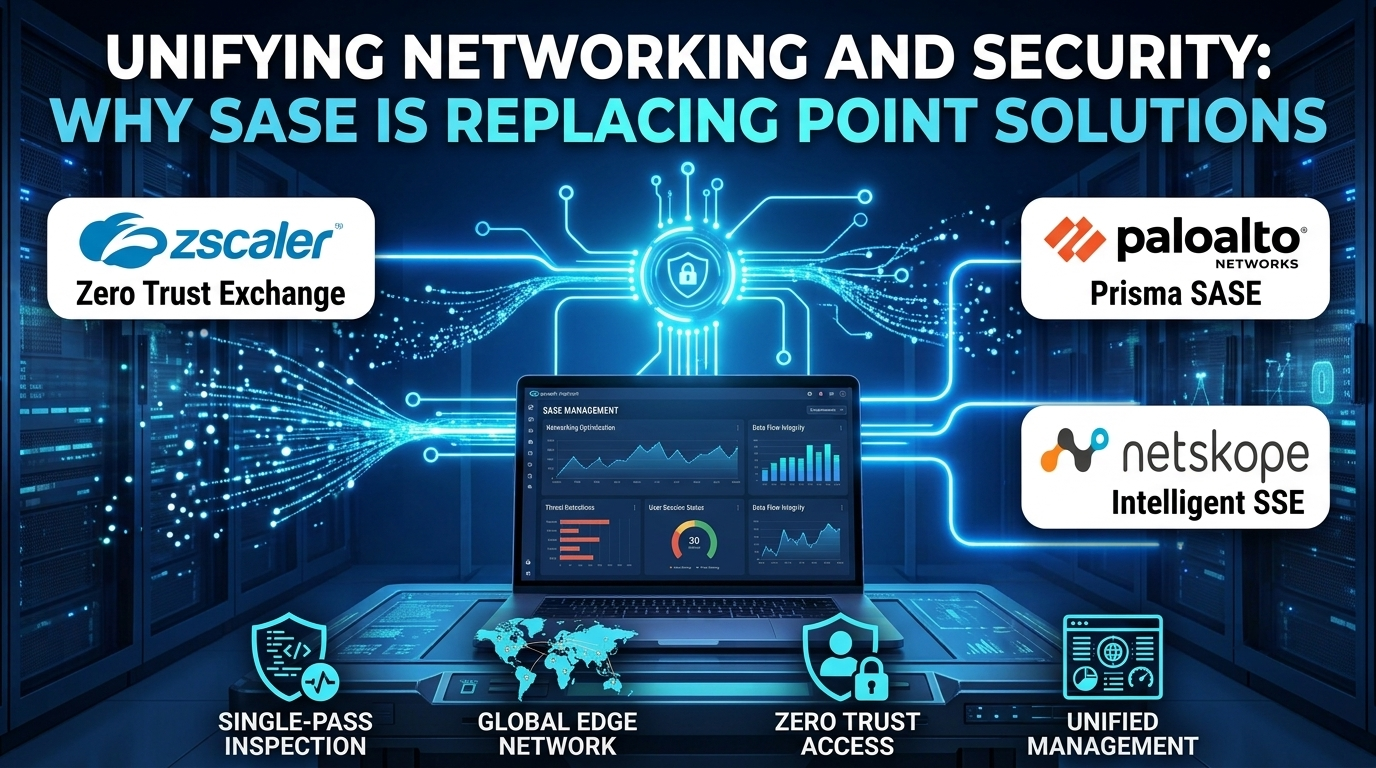
Organizations spent decades managing network infrastructure and cybersecurity as completely separate operational domains. Network engineering teams deployed routers, switches, and Wide Area Network (WAN) circuits to optimize connectivity, while security teams bolted on firewalls, secure web gateways, and virtual private network (VPN) appliances at the corporate perimeter. Today, that siloed operational model collapses under the weight of cloud migration and distributed workforces. When remote employees connect directly to SaaS applications and multi-cloud environments, backhauling traffic through physical data center security appliances introduces unacceptable latency and architectural complexity.
Secure Access Service Edge (SASE) solves this friction by converging Software-Defined WAN (SD-WAN) networking with comprehensive cloud-native security services into a single, unified architecture. Understanding how SASE platforms operate helps enterprise leaders navigate the transition from legacy hardware stacks to elastic, edge-delivered networking and security.
Understanding the Convergence of Networking and Security
Secure Access Service Edge is an architectural framework defined by the convergence of wide-area networking and network security services delivered as a unified cloud service. Instead of managing standalone hardware boxes for routing, URL filtering, firewalling, and remote access, organizations connect branch offices and remote users directly to a global cloud edge.
A mature SASE platform integrates several core technologies natively into a single control plane:
- Software-Defined WAN (SD-WAN): Optimizing multi-path routing across broadband, MPLS, and 5G connections to ensure reliable branch-office connectivity.
- Zero Trust Network Access (ZTNA): Replacing legacy VPNs by granting users access strictly to authorized applications based on continuous identity and device posture verification.
- Secure Web Gateway (SWG): Filtering web traffic, enforcing URL policies, and inspecting encrypted HTTPS traffic for malware.
- Cloud Access Security Broker (CASB): Governing SaaS application usage, discovering shadow IT, and preventing unauthorized data exfiltration.
- Data Loss Prevention (DLP): Inspecting data in motion across endpoints, web traffic, and cloud storage to protect sensitive corporate assets.
The core objective is to simplify IT operations, eliminate hardware appliance sprawl, and enforce consistent security policies regardless of where users or applications are located.
Key Evaluation Criteria for SASE Platforms
Selecting an enterprise SASE platform requires examining global edge performance, single-pass inspection architecture, and administrative management simplicity.
Single-Pass Policy Inspection Engine
An effective SASE solution must inspect network traffic using a “single-pass” architecture. Decrypting packets, checking user identity, applying DLP rules, and scanning for malware simultaneously within a single software pass prevents the severe latency penalties associated with chaining multiple standalone inspection engines together.
Global Point-of-Presence (PoP) Footprint
Because SASE platforms deliver networking and security from the cloud edge, the vendor’s global PoP distribution directly dictates performance. A dense network of local edge nodes ensures low-latency connectivity for distributed remote workers and international branch offices.
Unified Management and Single Pane of Glass
The primary promise of SASE is operational consolidation. Evaluating platforms requires verifying whether networking controls (SD-WAN bandwidth allocation) and security policies (firewall rules and user access rights) are managed from a genuinely unified dashboard or remain stitched together across legacy product acquisitions.
Leading SASE Platforms and Architectures
The SASE market features established network infrastructure giants, cloud security innovators, and comprehensive enterprise security vendors.
Zscaler Zero Trust Exchange
Zscaler pioneered cloud-native security, offering a massively scalable SASE architecture built explicitly around proxy-based zero trust principles without traditional SD-WAN hardware routers.
- Primary Focus: Cloud-native security service edge (SSE), ZTNA, and secure web gateway enforcement.
- Deployment Model: Cloud-delivered SaaS service routed via lightweight software agents.
- Significant Advantage: Unmatched global cloud edge scale and zero hardware infrastructure overhead for remote users.
- Important Limitation: Organizations requiring deep native hardware SD-WAN branch routing must integrate Zscaler with complementary SD-WAN vendor hardware.
Palo Alto Networks Prisma SASE
Palo Alto combines its industry-leading ML-powered firewall and threat intelligence capabilities with robust SD-WAN hardware appliances and cloud-delivered security services.
- Primary Focus: Comprehensive enterprise SASE combining advanced SD-WAN hardware and unified cloud security.
- Deployment Model: Hybrid deployment supporting physical branch appliances and cloud edge points.
- Significant Advantage: Superior threat intelligence, deep application visibility, and seamless integration for complex multi-branch enterprise environments.
- Important Limitation: Enterprise licensing structures and architecture complexity cater primarily to large organizations.
Netskope Intelligent SSE
Netskope delivers advanced cloud security, CASB, and ZTNA capabilities backed by a high-performance global security cloud designed for modern multi-cloud enterprises.
- Primary Focus: Data-centric cloud security, ZTNA, and advanced inline threat prevention.
- Deployment Model: Cloud-native SaaS service with flexible edge routing options.
- Significant Advantage: Exceptional visibility into granular cloud application activities and deep data protection controls.
- Important Limitation: Requires pairing with dedicated SD-WAN partners for complete branch-office networking integration.
Platform Comparison Overview
| Product | Primary Focus | Deployment Model | Significant Advantage | Important Limitation |
| Zscaler | Cloud-native security and proxy-based zero trust | Cloud SaaS Edge | Unmatched global edge scale and zero hardware footprint | Requires third-party integration for physical branch SD-WAN routing |
| Palo Alto Prisma SASE | Comprehensive branch networking and advanced security | Hybrid / Cloud Edge | Unified hardware SD-WAN and cloud security under one roof | Higher architectural complexity and enterprise cost structures |
| Netskope | Data-centric cloud security and SaaS governance | Cloud SaaS Edge | Superior data protection and deep cloud application visibility | Focuses primarily on security edge, needing SD-WAN partner integration |
Operational Risks and Common Pitfalls
Implementing a SASE platform introduces specific organizational and technical challenges that enterprise leaders must navigate carefully.
Organizational Silos Between Networking and Security Teams
Even though SASE unifies technology, enterprise network engineering and cybersecurity teams often operate in separate silos with distinct budgets and KPIs. Successful SASE adoption requires cross-functional collaboration and joint governance.
Rip-and-Replace Complexity
Attempting to migrate an entire enterprise infrastructure to a new SASE architecture overnight can cause severe operational disruption. Adopting a phased rollout—starting with remote workers before migrating physical branch offices—mitigates risk.
Underestimating Bandwidth and Latency Requirements
Routing branch-office traffic through cloud security inspection nodes requires adequate local internet breakout bandwidth. Neglecting local ISP capacity planning can degrade application performance.
Questions to Guide Vendor Selection
Before procuring a SASE platform, enterprise architects and IT leaders should address several critical operational questions:
- Is the platform built on a true single-pass inspection engine, or does it chain disparate legacy security engines together in the cloud?
- What is the vendor’s strategy for branch-office networking? Does it provide native SD-WAN hardware appliances, or does it rely entirely on software-only edge connectivity?
- Where are the vendor’s points of presence (PoPs) located relative to the organization’s primary geographic user clusters?
- How unified is the management console? Can network routing policies and security rules be configured from a single administrative pane of glass?
Making the Final Decision
Choosing a SASE platform depends heavily on an organization’s existing infrastructure, geographic footprint, and cloud migration maturity.
Organizations operating heavily remote workforces with minimal physical branch offices often achieve rapid value using cloud-native security platforms like Zscaler or Netskope. Conversely, large enterprises managing hundreds of physical retail stores, factories, or branch offices requiring robust local hardware routing frequently choose comprehensive platforms like Palo Alto Prisma SASE.
Ultimately, SASE platforms eliminate the friction between connectivity and security, ensuring that enterprise networks scale securely into the multi-cloud era.
