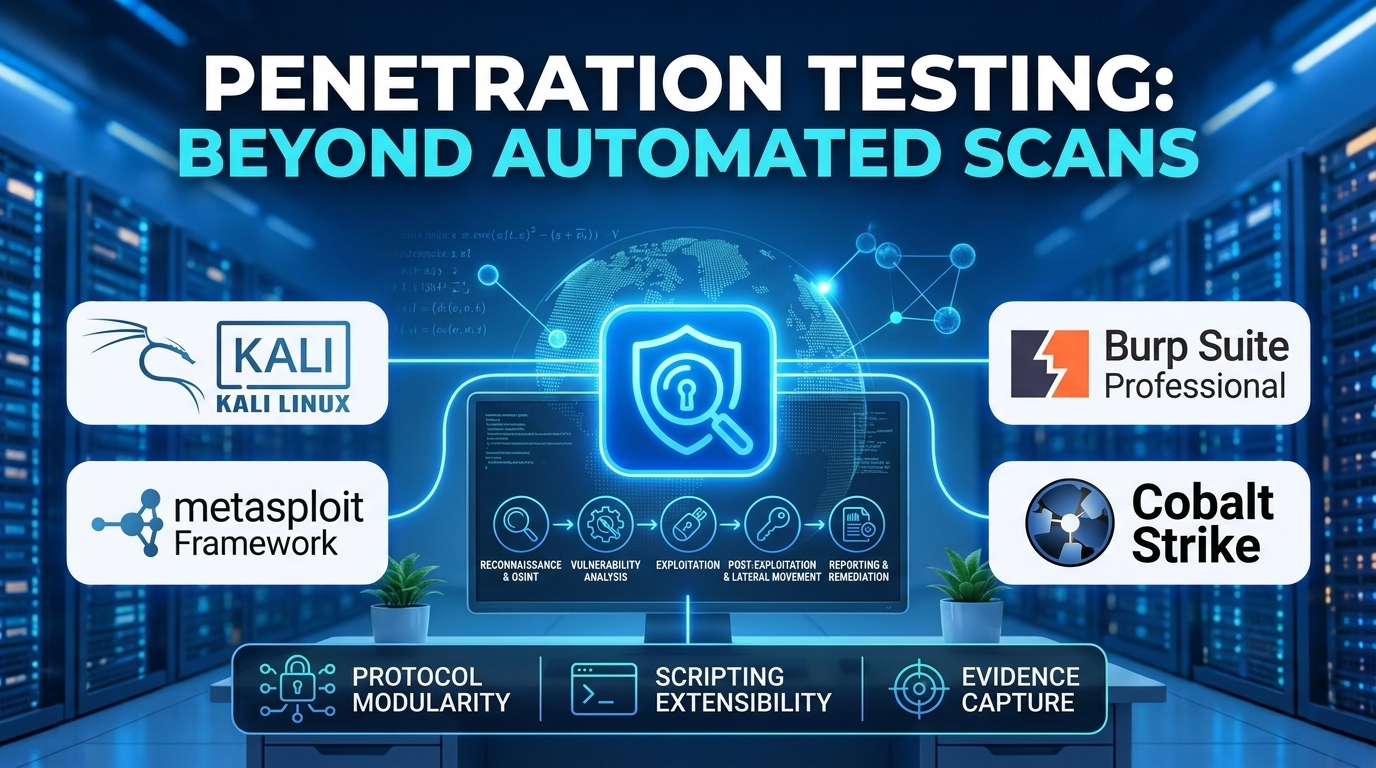
Running automated vulnerability scans provides a baseline inventory of missing patches and default configurations, but it rarely reveals how an actual attacker chains multiple low-risk flaws into a complete domain compromise. Security teams shifting from passive compliance checking to active adversary simulation quickly discover that standard scanners cannot replicate human ingenuity, custom exploit development, or contextual lateral movement.
A penetration testing toolkit bridges that gap by giving security professionals the instruments required to test defenses under realistic attack conditions. However, assembling or selecting the right utility arsenal requires balancing open-source community standards, specialized reconnaissance frameworks, and commercial automation platforms without cluttering the workflow with redundant utilities.
Understanding the Scope of Modern Penetration Testing
Penetration testing is the authorized simulation of cyberattacks against an organization’s systems to evaluate security posture. Unlike automated vulnerability assessment, which relies on static definitions and signature matching, penetration testing involves active exploitation, privilege escalation, and persistence management conducted by human operators or advanced testing orchestration tools.
A comprehensive testing lifecycle typically spans several operational phases:
- Reconnaissance and OSINT: Gathering public intelligence, identifying exposed infrastructure, and mapping external network footprints.
- Vulnerability Analysis and Enumeration: Discovering misconfigurations, unpatched services, and weak authentication mechanisms.
- Exploitation: Delivering payloads or leveraging flaws to gain initial access within predefined testing boundaries.
- Post-Exploitation and Lateral Movement: Moving deeper into internal network segments, harvesting credentials, and assessing data exposure risks.
- Reporting and Remediation Verification: Documenting attack paths and validating that defensive controls successfully block recurrence.
The primary objective is not simply to break systems, but to provide engineering teams with actionable evidence of how real-world attackers bypass perimeters.
Key Evaluation Criteria for Testing Toolkits
Choosing the right collection of penetration testing utilities involves analyzing technical capabilities, operational safety, and environment compatibility.
Protocol Support and Modularity
Modern enterprise networks utilize diverse communication protocols, from standard web and API traffic to proprietary industrial control protocols and cloud microservice meshes. A robust testing platform must support extensible modules or custom script writing to accommodate unique enterprise architectures.
Active versus Passive Capabilities
Effective tooling must balance aggressive active probing—such as port scanning and exploit execution—with stealthy passive reconnaissance that avoids triggering automated incident response alerts prematurely.
Scripting Extensibility and Community Ecosystem
Security landscapes evolve rapidly with new zero-day vulnerabilities and defense mechanisms. Platforms that support scripting languages like Python, PowerShell, or Go allow operators to adapt quickly, write custom modules, and integrate third-party exploit proofs-of-concept.
Reporting and Evidence Capture
An exceptional testing framework does more than execute commands; it logs interaction history, timestamps actions, captures network traffic, and generates structured output that can be translated directly into remediation tickets.
Essential Penetration Testing Software and Frameworks
The penetration testing ecosystem features a blend of foundational open-source distributions, commercial adversary simulation platforms, and specialized reconnaissance utilities.
Kali Linux and Parrot Security OS
Rather than standalone applications, these specialized Linux distributions serve as foundational operating environments pre-configured with hundreds of penetration testing utilities, ranging from packet analyzers to password crackers.
- Primary Focus: Comprehensive operating systems for security testing and forensic analysis.
- Deployment Model: Bare-metal installation, virtual machine images, or cloud containers.
- Significant Advantage: Immediate access to a vast, pre-integrated repository of standard security utilities without manual dependency management.
- Important Limitation: Requires deep command-line familiarity and disciplined environment management to avoid maintaining unneeded attack surfaces.
Metasploit Framework
Metasploit remains one of the most widely adopted exploitation frameworks in the industry, providing a structured database of verified exploit modules, payloads, and post-exploitation automation tools.
- Primary Focus: Exploit execution, payload generation, and session management.
- Deployment Model: Command-line interface and interactive console with modular database backends.
- Significant Advantage: Massive library of vetted exploit modules combined with robust post-exploitation scripting capabilities.
- Important Limitation: Signature-based detection by modern Endpoint Detection and Response (EDR) agents means default modules are often blocked instantly in production environments.
Burp Suite Professional
For web application and API security testing, Burp Suite acts as an industry-standard proxy interceptor, allowing testers to inspect, modify, and replay HTTP traffic in real time.
- Primary Focus: Web application vulnerability assessment and manual exploitation.
- Deployment Model: Local desktop application with extensible proxy listeners.
- Significant Advantage: Exceptional handling of complex session tokens, WebSockets, and custom application logic during manual security reviews.
- Important Limitation: Requires specialized web security expertise to maximize utility beyond automated scanner outputs.
Cobalt Strike / Adversary Simulation Platforms
Commercial platforms designed for Red Teams focus on collaborative, stealthy post-exploitation, command-and-control (C2) infrastructure management, and emulation of sophisticated threat actor behaviors.
- Primary Focus: Enterprise adversary simulation and long-term persistence tracking.
- Deployment Model: Client-server architecture with distributed team servers.
- Significant Advantage: Sophisticated evasion capabilities and multi-operator collaboration features suited for large-scale security assessments.
- Important Limitation: Strict licensing controls, high costs, and mandatory vetting requirements to prevent unauthorized distribution.
Platform Comparison Overview
| Product | Primary Focus | Deployment Model | Significant Advantage | Important Limitation |
| Kali Linux | Operating environment for security tools | ISO / Virtual Machine | Pre-integrated repository of standard testing utilities | Requires high CLI proficiency to manage effectively |
| Metasploit Framework | Exploit execution and payload management | CLI / Framework | Vast community-vetted exploit module library | Default payloads are frequently flagged by modern EDRs |
| Burp Suite Professional | Web application and API proxy testing | Local Desktop App | Unmatched handling of complex web traffic and sessions | Focused exclusively on web and API attack surfaces |
| Cobalt Strike | Collaborative Red Teaming and C2 operations | Client-Server SaaS/On-Prem | Advanced evasion and multi-operator coordination | Expensive commercial licensing and strict vetting |
Operational Risks and Common Pitfalls
Executing penetration tests without strict operational guardrails can introduce significant risks to business continuity.
Uncontrolled Disruption of Production Systems
Running aggressive exploitation scripts or unverified exploit code against live production databases can cause service crashes, data corruption, or system lockouts. Controlled staging environments and strict testing rules of engagement are mandatory.
Over-Reliance on Automated Exploitation Tools
Relying solely on automated point-and-click exploitation tools often leaves complex business-logic flaws undiscovered. True security posture assessment requires manual analysis of application workflows and permission boundaries.
Treating Testing as a One-Time Event
Security environments change continuously through code deployments, cloud provisioning, and infrastructure updates. A penetration test performed once a year provides only a momentary snapshot, whereas robust security demands continuous validation and periodic re-testing.
Questions to Guide Tool Selection and Procurement
Before integrating new penetration testing utilities into an operational workflow, security leaders and engineering managers should address several key questions:
- How effectively do the testing tools simulate modern adversary tactics without triggering immediate, irreversible system crashes or data loss?
- Does the platform integrate smoothly with existing incident response and logging infrastructure so internal defenders can analyze test artifacts?
- Are the tools flexible enough to accommodate custom scripts and proprietary protocols unique to the organization’s application stack?
- What level of training and technical expertise is required for internal staff to operate the tools safely and effectively?
Making the Final Decision
Selecting the right penetration testing toolkit depends heavily on the organization’s testing objectives, internal skill sets, and infrastructure complexity.
Organizations building internal security assessment capabilities typically start with comprehensive open-source frameworks like Kali Linux paired with manual analysis tools like Burp Suite to understand application vulnerabilities deeply. Conversely, mature enterprises conducting continuous Red Team operations often invest in specialized adversary simulation platforms that emphasize stealthy post-exploitation and multi-user collaboration.
Ultimately, the effectiveness of any penetration testing tool is determined not by the price of the software license, but by the technical competence, creativity, and discipline of the operator wielding it.
