Introduction
Digital asset compliance tools help organizations identify financial crime risks, monitor blockchain transactions, and manage regulatory obligations associated with cryptocurrencies and tokenized assets. These solutions support financial institutions, cryptocurrency exchanges, payment providers, and digital asset businesses.
The expansion of blockchain-based financial services has introduced new challenges involving transaction transparency, customer identification, sanctions compliance, and financial crime prevention. Traditional compliance systems may lack the specialized capabilities required to interpret blockchain transactions.
Modern digital asset compliance tools combine blockchain analytics, transaction monitoring, risk intelligence, and automated investigation workflows. They help compliance teams identify potentially suspicious activities and evaluate exposure to high-risk entities.
Organizations can also use these platforms to support Anti-Money Laundering (AML), Know Your Customer (KYC), Know Your Transaction (KYT), and applicable Travel Rule requirements. These capabilities improve operational consistency and provide evidence for compliance investigations.
Selecting an appropriate digital asset compliance platform requires evaluating blockchain coverage, risk intelligence quality, integration capabilities, regulatory requirements, and investigation functionality. Organizations must also consider privacy protection and the limitations of automated risk assessments.
This guide examines ten digital asset compliance tools, including their features, benefits, advantages, limitations, and practical applications. It also provides comparison tables, implementation guidance, security recommendations, and frequently asked questions.
What Are Digital Asset Compliance Tools?
Digital asset compliance tools are specialized software platforms that help organizations monitor cryptocurrency transactions and manage financial crime risks. They combine blockchain data with analytical methods and compliance workflows.
Blockchain transactions are generally recorded using cryptographic addresses rather than conventional customer identities. Compliance platforms attempt to associate relevant blockchain activity with known entities, services, and risk indicators.
These platforms can identify potential exposure to sanctioned entities, fraudulent operations, stolen assets, and other high-risk activities. Their findings are based on available intelligence and analytical methodologies rather than definitive proof of criminal conduct.
Digital asset compliance tools also support investigations by presenting transaction relationships, historical activity, and relevant blockchain intelligence. Investigators can use these capabilities alongside customer information and independently verified evidence.
Some solutions specialize in blockchain transaction monitoring, while others focus on customer screening, Travel Rule compliance, or forensic investigations. Organizations may require multiple complementary tools to address their complete compliance requirements.
Effective digital asset compliance depends on combining software capabilities with appropriate policies, trained personnel, and legal oversight. Automated risk indicators should support informed decisions rather than replace professional judgment.
How Digital Asset Compliance Tools Work
Digital asset compliance platforms collect and analyze information from supported blockchain networks and external intelligence sources. They transform transaction records into structured information that compliance teams can evaluate.
A typical digital asset compliance workflow includes:
- Data collection: Retrieves transaction information from supported blockchain networks.
- Data normalization: Converts blockchain records into consistent analytical formats.
- Entity attribution: Associates relevant addresses with identified services or entities.
- Risk intelligence enrichment: Adds available sanctions and financial crime indicators.
- Wallet screening: Evaluates blockchain addresses against applicable risk information.
- Transaction monitoring: Reviews digital asset transfers for relevant risk indicators.
- Risk scoring: Applies analytical models or configured risk assessment rules.
- Alert generation: Identifies transactions requiring additional review.
- Investigation: Enables analysts to examine relevant transaction relationships.
- Case management: Organizes findings, supporting evidence, and decisions.
- Compliance reporting: Supports applicable reporting and documentation requirements.
- Continuous monitoring: Reassesses relevant activity as new information becomes available.
Traditional Compliance vs Digital Asset Compliance
| Comparison Factor | Traditional Financial Compliance | Digital Asset Compliance |
|---|---|---|
| Transaction records | Banking and payment records | Blockchain transaction records |
| Customer identification | Financial account information | Customer records and blockchain attribution |
| Transaction monitoring | Conventional payment activity | On-chain asset movements |
| Risk intelligence | Financial crime databases | Blockchain and external intelligence |
| Transaction tracing | Financial institution records | Blockchain transaction relationships |
| Sanctions screening | Individuals and organizations | Entities, addresses, and associated activity |
| Operating environment | Financial institution infrastructure | Blockchain and digital asset ecosystems |
| Investigation methods | Account and payment analysis | Blockchain graph analysis |
| Settlement visibility | Institution-dependent | Network-dependent blockchain visibility |
| Regulatory reporting | Conventional financial requirements | Applicable digital asset requirements |
| Asset coverage | Traditional financial instruments | Cryptocurrencies and tokenized assets |
| Integration requirements | Banking and payment systems | Wallets, exchanges, and blockchain services |
Common Applications of Digital Asset Compliance Tools
- Cryptocurrency transaction monitoring.
- Blockchain wallet address screening.
- Sanctions exposure identification.
- Cryptocurrency exchange compliance.
- Digital asset customer risk assessment.
- Financial crime investigations.
- Blockchain fraud analysis.
- Suspicious transaction identification.
- Travel Rule compliance.
- Institutional digital asset governance.
- Stablecoin payment monitoring.
- Digital asset compliance reporting.
Key Components of Digital Asset Compliance Platforms
| Component | Function |
|---|---|
| Blockchain data ingestion | Collects supported blockchain records |
| Transaction indexing | Organizes transaction information |
| Entity attribution | Associates addresses with identified entities |
| Address screening | Evaluates relevant wallet risk indicators |
| Transaction monitoring | Reviews digital asset transfers |
| Risk scoring engine | Assesses configured risk indicators |
| Sanctions intelligence | Provides applicable sanctions-related information |
| Graph visualization | Displays transaction relationships |
| Alert management | Organizes potentially suspicious activity |
| Case management | Records investigations and decisions |
| Customer screening | Evaluates relevant customer information |
| Travel Rule infrastructure | Supports required information exchange |
| Reporting engine | Produces compliance documentation |
| Audit logging | Records operational and administrative activity |
| Integration APIs | Connects external business applications |
| Access management | Controls authorized platform access |
Types of Digital Asset Compliance Tools
Blockchain Analytics Platforms
Blockchain analytics platforms examine transaction relationships and relevant entity attribution information. They support transaction tracing, financial crime investigations, and digital asset risk assessment.
Cryptocurrency Transaction Monitoring Tools
Transaction monitoring tools evaluate digital asset transfers against configured risk indicators. They help compliance teams identify activity requiring further investigation.
Wallet Screening Tools
Wallet screening tools assess blockchain addresses using available risk intelligence. They can support onboarding, transaction reviews, and ongoing customer risk management.
Travel Rule Compliance Platforms
Travel Rule platforms support the exchange of required originator and beneficiary information between applicable financial service providers. Specific obligations depend on jurisdiction and transaction circumstances.
Customer Compliance Platforms
Customer compliance platforms support identity verification, sanctions screening, and customer risk assessment. These tools complement blockchain analytics by providing off-chain compliance information.
Blockchain Investigation Platforms
Blockchain investigation platforms help analysts examine transaction relationships and document findings. They are commonly used by financial crime investigators, compliance teams, and authorized public agencies.
Essential Digital Asset Compliance Capabilities
- Multi-chain transaction monitoring.
- Blockchain address screening.
- Entity attribution intelligence.
- Sanctions exposure assessment.
- Configurable risk scoring.
- Historical transaction analysis.
- Blockchain graph visualization.
- Automated alert generation.
- Investigation case management.
- Compliance reporting.
- Developer API integration.
- Continuous risk intelligence updates.
Digital Asset Compliance Architecture and Integrations
| Integration Layer | Purpose |
|---|---|
| Blockchain networks | Provides transaction information |
| Blockchain indexing services | Organizes on-chain activity |
| Wallet infrastructure | Supplies relevant address and transaction data |
| Cryptocurrency exchanges | Provides customer and transaction context |
| Identity verification systems | Supports customer identification |
| Sanctions databases | Supplies applicable screening information |
| Risk intelligence services | Enriches analytical findings |
| Transaction monitoring engine | Evaluates relevant activity |
| Case management systems | Organizes compliance investigations |
| Travel Rule infrastructure | Supports applicable information exchange |
| Financial reporting systems | Provides operational reporting |
| Audit infrastructure | Maintains compliance evidence |
Top 10 Digital Asset Compliance Tools
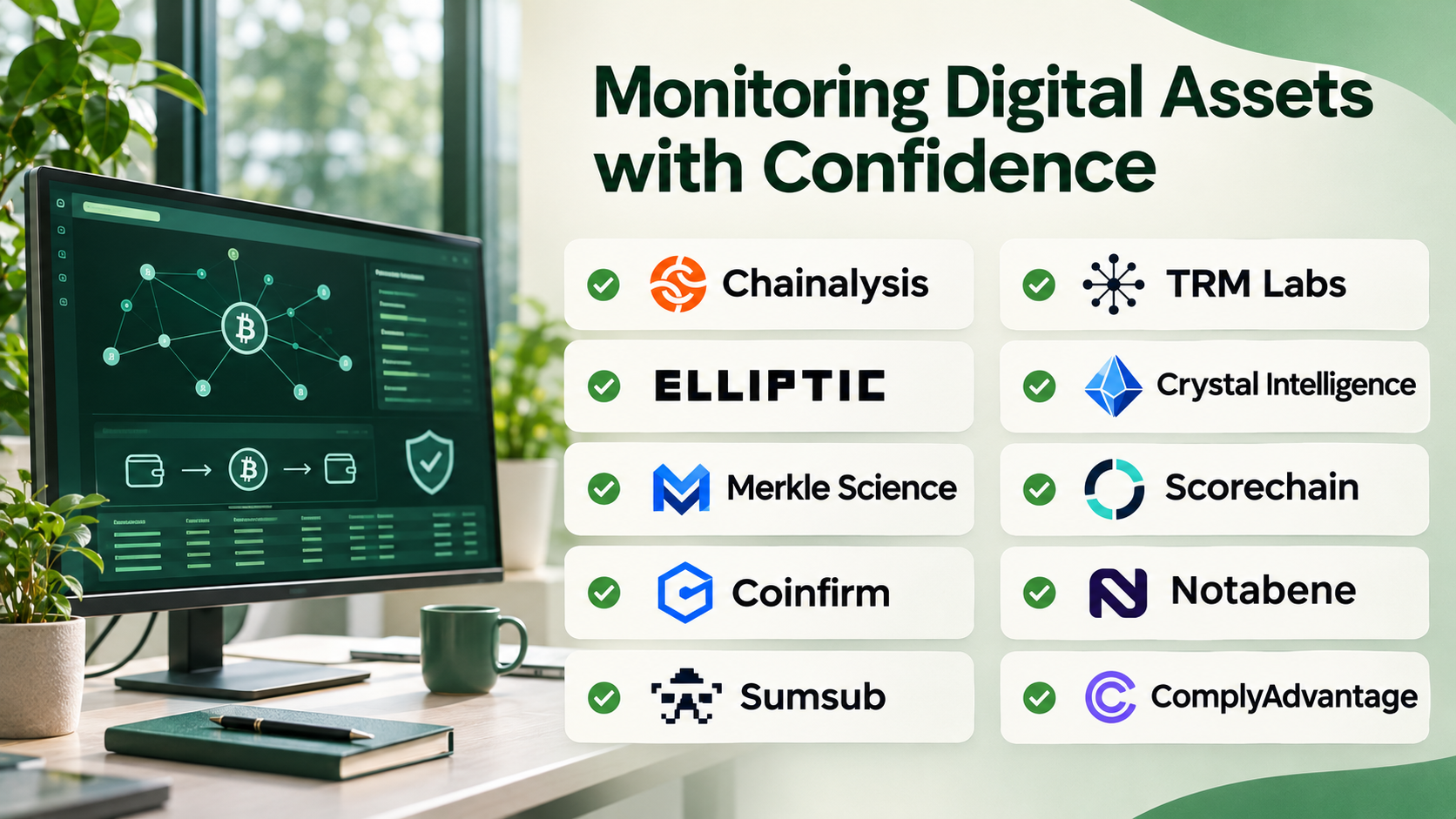
The following selection includes established blockchain analytics, financial crime intelligence, customer compliance, and Travel Rule solutions. The numbering is for organization rather than an independently measured performance ranking.
1. Chainalysis
Short Description
Chainalysis provides blockchain analytics and digital asset compliance solutions for financial institutions, cryptocurrency businesses, and authorized government organizations. Its product ecosystem supports transaction monitoring, blockchain investigations, and risk intelligence.
Chainalysis KYT provides transaction monitoring capabilities for supported digital assets. Organizations can use available risk information to identify transactions requiring additional compliance review.
Chainalysis Reactor provides blockchain investigation and transaction visualization functionality. Investigators can examine relevant transaction relationships and available entity attribution information.
The platform combines blockchain records with proprietary analytical intelligence. Its findings should be evaluated alongside independently verified evidence and relevant customer information.
Chainalysis is particularly relevant for organizations requiring comprehensive blockchain compliance and investigation capabilities. Product selection depends on supported assets, operational requirements, and commercial arrangements.
How Chainalysis Works
- Connect supported transaction information.
- Identify relevant blockchain addresses.
- Enrich records with available entity intelligence.
- Apply configured transaction monitoring rules.
- Generate alerts for relevant risk indicators.
- Investigate suspicious transaction relationships.
- Document findings and compliance decisions.
Key Features
- Chainalysis KYT: Supports cryptocurrency transaction monitoring.
- Chainalysis Reactor: Provides blockchain investigation capabilities.
- Entity attribution: Associates relevant addresses with identified entities.
- Wallet screening: Evaluates supported blockchain address risks.
- Transaction alerts: Identifies activity requiring review.
- Graph visualization: Displays blockchain transaction relationships.
- Historical analysis: Supports examination of previous transactions.
- Sanctions intelligence: Provides applicable sanctions-related indicators.
- Risk categorization: Organizes identified exposure types.
- Developer APIs: Supports compatible business integrations.
- Investigation documentation: Organizes relevant analytical findings.
- Multi-chain coverage: Supports analysis across compatible blockchain networks.
Benefits
- Improves blockchain transaction visibility.
- Supports financial crime investigations.
- Reduces repetitive transaction screening work.
- Enables structured risk assessment.
- Supports sanctions compliance workflows.
- Improves investigation consistency.
- Facilitates transaction relationship analysis.
- Supports institutional compliance operations.
- Enables programmable compliance integration.
- Improves access to blockchain intelligence.
Pros
- Established blockchain analytics ecosystem.
- Dedicated transaction monitoring tools.
- Specialized investigation functionality.
- Extensive entity intelligence capabilities.
- Institutional compliance orientation.
- Developer integration options.
- Visual transaction analysis.
- Multiple complementary products.
Cons
- Commercial pricing requires assessment.
- Advanced investigations require training.
- Attribution accuracy is not guaranteed.
- Supported features vary by blockchain.
- External intelligence dependencies remain.
- False-positive alerts require analyst review.
- Comprehensive deployments may require multiple products.
Use Cases
- Cryptocurrency exchange compliance.
- Institutional digital asset monitoring.
- Blockchain fraud investigations.
- Sanctions exposure assessment.
- Wallet risk screening.
- Financial crime intelligence.
- Transaction relationship analysis.
- Digital asset compliance reporting.
Industry Applications
- Banking.
- Cryptocurrency exchanges.
- Financial technology.
- Government investigations.
- Digital asset investment management.
Integration and Deployment
Chainalysis provides supported APIs and analytical applications for institutional compliance workflows. Organizations can integrate transaction monitoring with existing customer management and financial crime systems.
Deployment should include risk threshold calibration and analyst training. Attribution findings should be independently evaluated before consequential compliance decisions are made.
Pricing
Commercial pricing depends on selected products, transaction volumes, supported services, and contractual requirements. Organizations should request current pricing and implementation details.
Best For
- Cryptocurrency exchanges.
- Institutional compliance teams.
- Financial crime investigators.
- Financial institutions.
- Blockchain forensic analysts.
- Digital asset payment providers.
- Government investigation teams.
- Organizations requiring comprehensive blockchain analytics.
Overall Assessment
Chainalysis provides a broad blockchain intelligence ecosystem covering transaction monitoring and investigations. Its complementary products make it relevant for organizations with complex digital asset compliance requirements.
Organizations should evaluate product-specific costs and blockchain coverage. Automated findings must remain subject to appropriate professional review.
2. TRM Labs
Short Description
TRM Labs provides blockchain intelligence and digital asset financial crime compliance solutions. Its platform supports financial institutions, cryptocurrency businesses, and authorized investigative organizations.
TRM Labs offers transaction monitoring and wallet screening capabilities for supported blockchain networks. These tools help organizations evaluate relevant digital asset risk exposure.
Its forensic investigation capabilities enable analysts to examine blockchain transaction relationships. Available intelligence can support investigations involving fraud, sanctions exposure, and other financial crime concerns.
The platform combines blockchain analytics with risk categorization and entity attribution. Its findings depend on available data and analytical methodologies.
TRM Labs is particularly relevant for organizations requiring multi-chain compliance and investigation capabilities. Customers should assess product coverage and integration requirements before implementation.
How TRM Labs Works
- Collect supported transaction or address information.
- Retrieve relevant blockchain intelligence.
- Evaluate available risk indicators.
- Apply configured monitoring policies.
- Generate relevant compliance alerts.
- Investigate associated blockchain activity.
- Record findings and analyst decisions.
Key Features
- Transaction monitoring: Evaluates supported digital asset transfers.
- Wallet screening: Assesses relevant blockchain address exposure.
- TRM Forensics: Supports blockchain investigations.
- Entity intelligence: Provides available attribution information.
- Risk scoring: Evaluates relevant exposure indicators.
- Sanctions screening: Identifies applicable sanctions-related risks.
- Cross-chain analysis: Supports compatible blockchain relationship analysis.
- Graph visualization: Displays transaction connections.
- Alert management: Organizes monitoring results.
- Developer APIs: Supports application integration.
- Historical intelligence: Enables retrospective analysis.
- Investigation workflows: Supports structured analytical review.
Benefits
- Supports multi-chain financial crime compliance.
- Improves transaction risk visibility.
- Facilitates blockchain investigations.
- Reduces repetitive screening activities.
- Supports institutional risk assessment.
- Enables compliance system integration.
- Improves analyst productivity.
- Supports sanctions-related investigations.
- Provides structured risk intelligence.
- Facilitates consistent compliance workflows.
Pros
- Specialized blockchain intelligence.
- Transaction monitoring capabilities.
- Dedicated forensic tools.
- Multi-chain analytical orientation.
- Institutional compliance functionality.
- Developer API support.
- Visual investigation capabilities.
- Relevant financial crime intelligence.
Cons
- Commercial fees require confirmation.
- Advanced investigations require expertise.
- Risk classifications may contain uncertainty.
- Blockchain coverage varies by feature.
- False positives require review.
- Integration requires technical planning.
- Intelligence accuracy depends on available evidence.
Use Cases
- Cryptocurrency transaction monitoring.
- Blockchain wallet screening.
- Financial crime investigations.
- Cross-chain transaction analysis.
- Institutional compliance operations.
- Sanctions risk assessment.
- Digital asset fraud investigations.
- Cryptocurrency payment monitoring.
Industry Applications
- Banking.
- Financial technology.
- Cryptocurrency exchanges.
- Government investigations.
- Digital asset payments.
Integration and Deployment
TRM Labs provides supported APIs and analytical interfaces for institutional compliance applications. Organizations can connect transaction screening and monitoring capabilities with existing operational systems.
Implementation should include documented risk assessment procedures and representative transaction testing. Analysts must understand the limitations of attribution and automated risk scoring.
Pricing
Pricing depends on selected products, transaction volumes, intelligence requirements, and commercial agreements. Current fees should be confirmed directly.
Best For
- Financial crime investigators.
- Cryptocurrency exchanges.
- Institutional compliance teams.
- Digital asset payment providers.
- Multi-chain analytics users.
- Financial institutions.
- Blockchain forensic analysts.
- Organizations requiring transaction monitoring.
Overall Assessment
TRM Labs provides specialized blockchain intelligence with transaction monitoring and forensic investigation capabilities. Its multi-chain orientation supports organizations managing diverse digital asset activities.
Selection should consider supported networks, intelligence quality, and investigation requirements. Risk indicators should not be treated as definitive evidence without further review.
3. Elliptic
Short Description
Elliptic provides blockchain analytics and digital asset financial crime compliance solutions. Its platform supports wallet screening, transaction monitoring, and blockchain investigations.
Elliptic Lens provides blockchain wallet screening capabilities, while Elliptic Navigator supports transaction monitoring workflows. These products help organizations evaluate relevant digital asset exposure.
Elliptic Investigator supports examination of blockchain transaction relationships. Its analytical capabilities can assist compliance teams and authorized investigators.
The platform emphasizes analysis across supported blockchain ecosystems, including compatible cross-chain activity. Actual analytical coverage depends on the assets and transaction mechanisms involved.
Elliptic is particularly relevant for organizations requiring specialized digital asset compliance intelligence. Its suitability depends on monitoring requirements, integration capabilities, and supported blockchain networks.
How Elliptic Works
- Submit supported wallet or transaction information.
- Retrieve relevant blockchain intelligence.
- Evaluate direct and indirect risk exposure.
- Apply configured risk policies.
- Generate alerts or screening results.
- Investigate relevant transaction relationships.
- Document compliance findings.
Key Features
- Elliptic Lens: Supports blockchain wallet screening.
- Elliptic Navigator: Provides transaction monitoring capabilities.
- Elliptic Investigator: Supports blockchain investigations.
- Entity attribution: Provides available blockchain entity intelligence.
- Cross-chain analytics: Examines supported cross-chain relationships.
- Risk scoring: Evaluates relevant exposure indicators.
- Sanctions intelligence: Supports applicable sanctions screening.
- Transaction visualization: Displays analytical relationships.
- Historical analysis: Reviews previous blockchain activity.
- Developer APIs: Enables compatible system integration.
- Configurable policies: Supports organizational risk requirements.
- Alert workflows: Organizes activity requiring review.
Benefits
- Improves digital asset risk assessment.
- Supports multi-chain compliance.
- Facilitates wallet screening.
- Enables transaction monitoring.
- Supports structured investigations.
- Reduces repetitive analytical work.
- Improves visibility into relevant exposure.
- Facilitates compliance integration.
- Supports institutional governance.
- Enables consistent risk evaluation.
Pros
- Established blockchain analytics expertise.
- Specialized screening products.
- Dedicated investigation capabilities.
- Cross-chain analytical orientation.
- Institutional compliance focus.
- Developer API availability.
- Configurable risk assessment.
- Transaction visualization functionality.
Cons
- Commercial pricing requires evaluation.
- Advanced analytics require training.
- Risk attribution may be incomplete.
- Supported networks vary by capability.
- False-positive findings remain possible.
- Integration requires technical resources.
- Multiple products may be necessary.
Use Cases
- Cryptocurrency wallet screening.
- Digital asset transaction monitoring.
- Institutional financial crime compliance.
- Cross-chain investigations.
- Sanctions exposure assessment.
- Cryptocurrency exchange onboarding.
- Blockchain fraud analysis.
- Digital asset payment compliance.
Industry Applications
- Financial services.
- Cryptocurrency exchanges.
- Digital payments.
- Government investigations.
- Financial technology.
Integration and Deployment
Elliptic supports integration through applicable APIs and analytical interfaces. Organizations can incorporate screening and monitoring capabilities into existing compliance workflows.
Deployment should include risk policy configuration and validation against representative blockchain activity. Compliance personnel should review uncertain or high-impact findings.
Pricing
Pricing depends on selected products, transaction volumes, supported assets, and commercial arrangements. Organizations should obtain current enterprise pricing.
Best For
- Institutional compliance teams.
- Cryptocurrency exchanges.
- Multi-chain digital asset businesses.
- Wallet screening users.
- Blockchain investigators.
- Financial institutions.
- Digital asset payment providers.
- Organizations requiring specialized blockchain analytics.
Overall Assessment
Elliptic provides complementary digital asset compliance products for screening, monitoring, and investigations. Its cross-chain analytical approach makes it relevant for organizations operating across multiple blockchain ecosystems.
Organizations should verify asset coverage and commercial requirements. Automated risk findings require appropriate contextual interpretation.
4. Crystal Intelligence
Short Description
Crystal Intelligence provides blockchain analytics, cryptocurrency compliance, and investigation solutions. Its infrastructure supports organizations evaluating digital asset transaction activity and financial crime exposure.
The platform provides blockchain transaction analysis and relevant entity intelligence. Compliance teams can use these capabilities to assess wallet addresses and transaction relationships.
Crystal Intelligence supports visualization of blockchain activity for investigative workflows. Analysts can examine available connections between relevant addresses and identified entities.
Its compliance capabilities can support monitoring, risk assessment, and institutional investigations. The reliability of findings depends on blockchain coverage and available intelligence.
Crystal Intelligence is particularly relevant for organizations requiring blockchain forensic and compliance capabilities. Customers should assess current product configurations and integration requirements.
How Crystal Intelligence Works
- Collect supported blockchain transaction information.
- Identify relevant addresses and entities.
- Retrieve available risk intelligence.
- Evaluate transaction exposure.
- Generate applicable monitoring findings.
- Visualize relevant blockchain relationships.
- Document investigation results.
Key Features
- Blockchain analytics: Examines supported blockchain activity.
- Wallet screening: Evaluates relevant address risks.
- Transaction monitoring: Supports review of digital asset transfers.
- Entity intelligence: Provides available attribution information.
- Risk categorization: Organizes identified exposure types.
- Graph visualization: Displays transaction relationships.
- Historical analysis: Supports retrospective investigations.
- Sanctions intelligence: Provides applicable risk indicators.
- Investigation tools: Supports structured blockchain analysis.
- Developer integration: Connects compatible business applications.
- Monitoring alerts: Identifies activity requiring review.
- Reporting capabilities: Supports relevant analytical documentation.
Benefits
- Improves blockchain transaction visibility.
- Supports financial crime investigations.
- Facilitates digital asset risk assessment.
- Enables wallet screening workflows.
- Improves investigation organization.
- Reduces repetitive analytical work.
- Supports compliance monitoring.
- Facilitates historical transaction analysis.
- Enables institutional reporting.
- Supports financial crime intelligence.
Pros
- Specialized blockchain forensic capabilities.
- Transaction visualization functionality.
- Wallet screening support.
- Institutional compliance orientation.
- Relevant entity intelligence.
- Historical analytical capabilities.
- Integration options.
- Multiple investigation applications.
Cons
- Commercial pricing requires confirmation.
- Blockchain coverage varies.
- Advanced investigations require training.
- Attribution findings may be uncertain.
- False-positive alerts remain possible.
- Integration complexity varies.
- Current product packaging requires verification.
Use Cases
- Cryptocurrency fraud investigations.
- Blockchain transaction tracing.
- Wallet risk screening.
- Financial crime compliance.
- Sanctions exposure analysis.
- Cryptocurrency exchange monitoring.
- Historical transaction investigations.
- Institutional compliance documentation.
Industry Applications
- Financial services.
- Cryptocurrency exchanges.
- Government investigations.
- Digital asset infrastructure.
- Financial technology.
Integration and Deployment
Crystal Intelligence provides supported analytical interfaces and integration capabilities for digital asset compliance operations. Organizations should assess compatibility with existing transaction monitoring and case management systems.
Deployment requires documented risk policies and trained analysts. Investigation findings should be evaluated according to available evidence and organizational procedures.
Pricing
Commercial pricing depends on selected analytical products, monitoring requirements, and contractual arrangements. Current service availability and pricing should be confirmed.
Best For
- Blockchain investigators.
- Cryptocurrency compliance teams.
- Financial crime analysts.
- Digital asset exchanges.
- Institutional risk teams.
- Government investigation organizations.
- Historical transaction analysis users.
- Organizations requiring visual blockchain investigations.
Overall Assessment
Crystal Intelligence provides blockchain analytics and investigation functionality for digital asset compliance. Its visualization and intelligence capabilities support structured financial crime analysis.
Organizations should assess network coverage, data quality, and integration requirements. Analytical conclusions should remain subject to appropriate evidence review.
5. Merkle Science
Short Description
Merkle Science provides cryptocurrency risk intelligence and blockchain compliance solutions. Its products address transaction monitoring, risk assessment, and digital asset investigations.
The platform’s Compass product supports cryptocurrency transaction monitoring workflows. Organizations can use configurable risk indicators to identify activity requiring additional review.
Merkle Science Tracker provides blockchain investigation capabilities for supported digital assets. Analysts can examine relevant transaction relationships and available risk intelligence.
The platform emphasizes behavioral and transaction-related risk assessment alongside blockchain entity information. These capabilities can help organizations identify relevant patterns beyond basic address screening.
Merkle Science is particularly relevant for digital asset businesses seeking configurable financial crime compliance workflows. Its suitability depends on supported assets, monitoring requirements, and commercial terms.
How Merkle Science Works
- Connect supported transaction records.
- Retrieve available blockchain intelligence.
- Evaluate relevant behavioral and exposure indicators.
- Apply configured monitoring rules.
- Generate compliance alerts.
- Investigate relevant blockchain relationships.
- Document findings and decisions.
Key Features
- Compass: Supports cryptocurrency transaction monitoring.
- Tracker: Provides blockchain investigation functionality.
- Wallet screening: Evaluates supported address risks.
- Behavioral analytics: Examines relevant transaction patterns.
- Risk scoring: Assesses configured risk indicators.
- Entity intelligence: Provides available attribution information.
- Transaction alerts: Identifies activity requiring review.
- Graph visualization: Supports transaction relationship analysis.
- Historical analysis: Reviews previous blockchain activity.
- Developer APIs: Supports compatible integrations.
- Configurable rules: Enables organizational monitoring policies.
- Investigation workflows: Supports structured compliance review.
Benefits
- Supports digital asset financial crime prevention.
- Improves transaction monitoring consistency.
- Facilitates behavioral risk assessment.
- Enables blockchain investigations.
- Reduces repetitive screening work.
- Supports configurable compliance workflows.
- Improves transaction visibility.
- Facilitates financial system integration.
- Supports institutional risk management.
- Enables structured analyst review.
Pros
- Specialized cryptocurrency compliance focus.
- Behavioral risk analysis capabilities.
- Dedicated monitoring functionality.
- Blockchain investigation tools.
- Configurable monitoring rules.
- Developer integration options.
- Relevant institutional applications.
- Structured risk intelligence.
Cons
- Commercial fees require assessment.
- Behavioral indicators may produce false positives.
- Advanced configuration requires expertise.
- Supported blockchain coverage varies.
- Attribution information may be incomplete.
- Integration requires technical planning.
- Independent validation remains necessary.
Use Cases
- Cryptocurrency exchange monitoring.
- Blockchain transaction risk assessment.
- Behavioral financial crime analysis.
- Digital asset payment screening.
- Wallet risk evaluation.
- Blockchain fraud investigations.
- Institutional compliance monitoring.
- Configurable transaction surveillance.
Industry Applications
- Cryptocurrency exchanges.
- Financial technology.
- Digital payments.
- Financial services.
- Blockchain infrastructure.
Integration and Deployment
Merkle Science provides supported APIs and compliance interfaces for digital asset businesses. Organizations can integrate monitoring capabilities into transaction processing and investigation workflows.
Implementation should include testing of behavioral rules and risk thresholds. Analysts should review potentially suspicious activity using appropriate customer and transaction context.
Pricing
Pricing depends on selected products, monitoring volumes, integration requirements, and commercial agreements. Organizations should request current service pricing.
Best For
- Cryptocurrency compliance teams.
- Digital asset payment businesses.
- Behavioral risk monitoring users.
- Financial crime investigators.
- Cryptocurrency exchanges.
- Financial technology companies.
- Blockchain analytics teams.
- Organizations requiring configurable monitoring rules.
Overall Assessment
Merkle Science provides digital asset compliance solutions emphasizing transaction monitoring and behavioral risk analysis. Its investigation capabilities complement automated monitoring workflows.
Organizations should validate risk models and supported blockchain coverage. Behavioral indicators should not independently determine customer wrongdoing.
6. Scorechain
Short Description
Scorechain provides blockchain analytics and digital asset compliance solutions for professional organizations. Its platform supports transaction monitoring, wallet screening, and blockchain investigations.
The software enables compliance teams to evaluate relevant blockchain activity and associated risk indicators. Organizations can use available intelligence to support transaction review processes.
Scorechain provides risk scoring and transaction analysis for supported blockchain networks. Its capabilities help organizations establish structured digital asset compliance workflows.
The platform also supports analytical visualization and reporting functionality. These capabilities can assist investigators in documenting relevant transaction relationships.
Scorechain is particularly relevant for cryptocurrency businesses and financial institutions requiring blockchain compliance infrastructure. Organizations should evaluate current product coverage and commercial arrangements.
How Scorechain Works
- Submit supported blockchain addresses or transactions.
- Retrieve relevant blockchain information.
- Evaluate available entity intelligence.
- Apply configured risk assessment rules.
- Generate screening or monitoring findings.
- Investigate relevant transaction relationships.
- Record compliance decisions.
Key Features
- Blockchain analytics: Examines supported transaction records.
- Wallet screening: Evaluates relevant address risks.
- Transaction monitoring: Reviews supported digital asset transfers.
- Risk scoring: Assesses available exposure indicators.
- Entity attribution: Provides relevant blockchain intelligence.
- Sanctions screening: Supports applicable sanctions assessments.
- Transaction visualization: Displays blockchain relationships.
- Historical analysis: Examines previous transaction activity.
- Developer APIs: Enables compatible integrations.
- Configurable risk settings: Supports organizational policies.
- Alert management: Organizes monitoring findings.
- Compliance reporting: Supports analytical documentation.
Benefits
- Improves digital asset risk visibility.
- Supports cryptocurrency transaction monitoring.
- Facilitates wallet screening.
- Enables structured blockchain investigations.
- Supports organizational risk policies.
- Reduces repetitive compliance work.
- Improves transaction analysis consistency.
- Facilitates application integration.
- Supports compliance documentation.
- Enables historical transaction review.
Pros
- Specialized blockchain compliance functionality.
- Transaction risk assessment capabilities.
- Wallet screening tools.
- Investigation visualization.
- Developer API availability.
- Configurable risk settings.
- Institutional reporting support.
- Multiple digital asset applications.
Cons
- Commercial pricing requires confirmation.
- Supported assets vary by product.
- Risk findings require interpretation.
- Attribution coverage may be incomplete.
- Advanced investigations require training.
- False-positive alerts remain possible.
- Integration requirements vary.
Use Cases
- Cryptocurrency exchange compliance.
- Blockchain wallet screening.
- Institutional transaction monitoring.
- Digital asset fraud investigations.
- Sanctions exposure assessment.
- Financial crime risk evaluation.
- Historical blockchain analysis.
- Compliance reporting.
Industry Applications
- Banking.
- Financial technology.
- Cryptocurrency exchanges.
- Digital asset payments.
- Investment management.
Integration and Deployment
Scorechain provides supported APIs and analytical applications for institutional compliance operations. Organizations can integrate wallet screening and transaction monitoring with compatible business systems.
Deployment should include validation of risk categories and supported blockchain networks. Compliance teams should establish procedures for reviewing uncertain findings.
Pricing
Pricing depends on selected services, transaction requirements, analytical capabilities, and commercial agreements. Current fees should be verified directly.
Best For
- Cryptocurrency exchanges.
- Institutional compliance teams.
- Blockchain investigators.
- Financial technology businesses.
- Wallet screening users.
- Transaction monitoring teams.
- Digital asset payment providers.
- Organizations requiring blockchain risk scoring.
Overall Assessment
Scorechain provides specialized blockchain analytics and digital asset compliance functionality. Its screening, monitoring, and investigation capabilities support multiple institutional workflows.
Organizations should evaluate intelligence coverage and commercial requirements. Risk assessment procedures must include appropriate analyst oversight.
7. Coinfirm
Short Description
Coinfirm provides blockchain analytics and cryptocurrency financial crime compliance technology. Its offerings have focused on digital asset transaction risk assessment and AML-related workflows.
The platform supports blockchain address analysis and relevant transaction intelligence. Organizations can use these capabilities to evaluate potential exposure to identified risk categories.
Coinfirm’s technology includes cryptocurrency risk assessment and transaction monitoring functionality. Available capabilities depend on current product packaging and supported blockchain networks.
Its analytical tools can support compliance investigations and risk-related reporting. Organizations should independently verify current service availability and commercial arrangements.
Coinfirm is particularly relevant as a blockchain compliance technology option for digital asset businesses. Current ownership, branding, and standalone product availability should be confirmed before procurement.
How Coinfirm Works
- Submit supported blockchain information.
- Retrieve relevant transaction intelligence.
- Evaluate available address attribution.
- Assess applicable risk indicators.
- Generate risk assessment findings.
- Review relevant transaction activity.
- Document compliance conclusions.
Key Features
- Blockchain risk analytics: Evaluates supported digital asset activity.
- Address screening: Assesses relevant wallet risk indicators.
- Transaction monitoring: Supports cryptocurrency transaction review.
- AML risk assessment: Organizes relevant financial crime indicators.
- Entity intelligence: Provides available attribution information.
- Risk categorization: Classifies identified exposure types.
- Historical analysis: Examines previous blockchain activity.
- Compliance reporting: Supports relevant risk documentation.
- Developer integration: Enables compatible application connectivity.
- Sanctions-related intelligence: Supports applicable screening workflows.
- Investigation support: Facilitates analytical review.
- Multi-asset analytics: Examines supported digital assets.
Benefits
- Supports digital asset AML workflows.
- Improves transaction risk visibility.
- Facilitates blockchain address screening.
- Enables structured risk assessments.
- Supports compliance documentation.
- Reduces repetitive analytical work.
- Facilitates institutional investigations.
- Supports digital asset monitoring.
- Enables compatible system integration.
- Improves risk assessment consistency.
Pros
- Established blockchain compliance technology.
- Cryptocurrency risk assessment focus.
- Wallet screening capabilities.
- Transaction monitoring functionality.
- AML-oriented analytical tools.
- Relevant institutional applications.
- Risk reporting capabilities.
- Historical blockchain analysis.
Cons
- Current standalone availability requires verification.
- Product branding may have changed.
- Commercial pricing is not independently confirmed.
- Supported blockchain coverage varies.
- Attribution information may be incomplete.
- Risk findings require contextual interpretation.
- Integration and support arrangements require assessment.
Use Cases
- Cryptocurrency AML compliance.
- Blockchain wallet screening.
- Digital asset transaction risk assessment.
- Financial crime investigations.
- Cryptocurrency exchange compliance.
- Sanctions exposure review.
- Institutional risk reporting.
- Historical transaction analysis.
Industry Applications
- Cryptocurrency exchanges.
- Financial technology.
- Financial services.
- Digital asset infrastructure.
- Digital payments.
Integration and Deployment
Coinfirm technology has supported analytical interfaces and application integration for blockchain compliance workflows. Organizations should verify the current product provider and available deployment options.
Implementation should proceed only after confirming service availability and technical support arrangements. Risk assessment findings require appropriate professional review.
Pricing
Current standalone pricing and commercial availability require direct verification. Organizations should confirm the responsible provider and applicable licensing arrangements.
Best For
- Organizations evaluating established blockchain compliance technology.
- Cryptocurrency AML teams.
- Digital asset risk analysts.
- Wallet screening users.
- Financial crime investigators.
- Cryptocurrency exchanges.
- Institutional compliance reporting teams.
- Businesses assessing alternative blockchain intelligence providers.
Overall Assessment
Coinfirm represents established cryptocurrency compliance and blockchain risk assessment technology. Its historical capabilities are relevant to digital asset monitoring and AML workflows.
However, current branding and standalone commercial availability require verification. Organizations should not assume that historical product offerings remain independently purchasable.
8. Notabene
Short Description
Notabene provides compliance infrastructure focused on the cryptocurrency Travel Rule and transaction-related information exchange. Its platform supports Virtual Asset Service Providers (VASPs) and other eligible digital asset businesses.
The Travel Rule requires applicable financial service providers to collect and transmit specified information concerning qualifying transactions. Exact obligations depend on local regulations and transaction circumstances.
Notabene helps organizations identify counterparties and exchange required information through supported workflows. Its capabilities can complement blockchain transaction monitoring and customer compliance systems.
The platform addresses compliance requirements that cannot be satisfied solely through on-chain analytics. Required information exchange may involve customer data that is not publicly available on blockchain networks.
Notabene is particularly relevant for organizations implementing Travel Rule compliance. It should be evaluated as complementary infrastructure rather than a complete replacement for blockchain analytics.
How Notabene Works
- Connect applicable digital asset transaction workflows.
- Identify relevant transaction counterparties.
- Determine applicable information requirements.
- Collect required originator and beneficiary information.
- Exchange information through supported mechanisms.
- Apply organizational compliance policies.
- Document relevant compliance activity.
Key Features
- Travel Rule infrastructure: Supports applicable information exchange.
- Counterparty identification: Helps identify relevant service providers.
- VASP connectivity: Supports compatible institutional communication.
- Transaction workflows: Organizes applicable compliance processes.
- Information validation: Supports review of required transaction data.
- Policy configuration: Applies organizational compliance requirements.
- Developer APIs: Enables compatible transaction system integration.
- Interoperability support: Connects supported information exchange mechanisms.
- Counterparty intelligence: Provides relevant institutional information.
- Operational monitoring: Tracks applicable workflow activity.
- Compliance documentation: Supports relevant recordkeeping.
- Privacy-oriented workflows: Supports controlled handling of sensitive information.
Benefits
- Supports applicable Travel Rule obligations.
- Facilitates institutional information exchange.
- Reduces repetitive compliance administration.
- Improves counterparty identification workflows.
- Supports transaction-related documentation.
- Enables programmable compliance integration.
- Facilitates organizational policy enforcement.
- Improves operational consistency.
- Complements blockchain analytics.
- Supports international digital asset operations.
Pros
- Specialized Travel Rule focus.
- Institutional information exchange capabilities.
- Developer integration options.
- Counterparty identification support.
- Compliance workflow automation.
- Interoperability-oriented infrastructure.
- Relevant cryptocurrency business applications.
- Complementary compliance functionality.
Cons
- Does not replace comprehensive blockchain analytics.
- Counterparty participation can affect workflows.
- Regulatory requirements vary by jurisdiction.
- Commercial pricing requires assessment.
- Sensitive information requires privacy safeguards.
- Integration requires technical resources.
- Unsupported counterparties may require manual procedures.
Use Cases
- Cryptocurrency Travel Rule compliance.
- VASP information exchange.
- Digital asset transaction documentation.
- Institutional counterparty identification.
- Cross-border cryptocurrency compliance.
- Exchange withdrawal compliance.
- Digital asset payment workflows.
- Regulatory information management.
Industry Applications
- Cryptocurrency exchanges.
- Digital asset custody.
- Financial technology.
- Digital payments.
- Financial institutions.
Integration and Deployment
Notabene provides supported APIs and operational interfaces for applicable digital asset transaction workflows. Organizations should integrate its capabilities with existing customer verification and transaction monitoring systems.
Deployment requires assessment of jurisdiction-specific Travel Rule requirements and privacy obligations. Organizations should establish procedures for incomplete or unsuccessful information exchange.
Pricing
Commercial pricing depends on transaction requirements, selected services, integration needs, and contractual arrangements. Current fees should be confirmed directly.
Best For
- Cryptocurrency exchanges.
- Virtual Asset Service Providers.
- Digital asset custody providers.
- Travel Rule compliance teams.
- Cryptocurrency payment businesses.
- Cross-border digital asset services.
- Financial technology companies.
- Organizations requiring counterparty information exchange.
Overall Assessment
Notabene provides specialized infrastructure for applicable cryptocurrency Travel Rule workflows. Its capabilities address information exchange requirements that blockchain analytics alone cannot satisfy.
Organizations should combine it with appropriate customer screening and transaction monitoring tools. Legal requirements and privacy responsibilities require independent assessment.
9. Sumsub
Short Description
Sumsub provides identity verification, fraud prevention, and financial crime compliance infrastructure. Its platform supports financial institutions, cryptocurrency businesses, and other organizations requiring customer risk management.
The software provides customer onboarding and identity verification capabilities. Organizations can use supported verification workflows to evaluate customer-provided information.
Sumsub also offers AML screening, transaction monitoring, and cryptocurrency Travel Rule-related functionality. Specific capabilities depend on selected products and applicable service configurations.
Its broader compliance ecosystem helps organizations connect customer identity information with transaction-related risk assessment. Blockchain forensic analysis may require additional specialized tools or integrations.
Sumsub is particularly relevant for businesses requiring integrated customer compliance infrastructure. Organizations should assess privacy requirements, verification coverage, and product-specific capabilities.
How Sumsub Works
- Configure customer verification workflows.
- Collect applicable customer information.
- Perform supported identity verification checks.
- Evaluate relevant AML screening results.
- Monitor applicable transaction activity.
- Generate findings requiring compliance review.
- Document customer and transaction decisions.
Key Features
- Identity verification: Supports customer identity assessment.
- Document verification: Reviews supported identity documents.
- Liveness checks: Supports applicable identity verification workflows.
- AML screening: Evaluates relevant financial crime databases.
- Customer risk assessment: Organizes applicable risk indicators.
- Transaction monitoring: Supports configured transaction review.
- Travel Rule functionality: Supports applicable cryptocurrency information workflows.
- Business verification: Evaluates relevant organizational information.
- Workflow configuration: Enables customized compliance processes.
- Developer APIs: Supports application integration.
- Case management: Organizes relevant compliance reviews.
- Ongoing monitoring: Supports reassessment of applicable customer risks.
Benefits
- Improves customer onboarding consistency.
- Supports identity verification workflows.
- Facilitates AML screening.
- Reduces repetitive verification work.
- Supports transaction-related compliance.
- Enables integrated customer risk management.
- Facilitates developer integration.
- Supports applicable Travel Rule requirements.
- Improves compliance documentation.
- Enables scalable customer verification.
Pros
- Broad customer compliance ecosystem.
- Identity verification functionality.
- AML screening capabilities.
- Configurable onboarding workflows.
- Developer API availability.
- Transaction monitoring support.
- Cryptocurrency business relevance.
- Business verification capabilities.
Cons
- Specialized blockchain forensics may require another tool.
- Verification coverage varies by jurisdiction.
- Sensitive customer information requires protection.
- Automated verification can produce errors.
- Commercial costs vary by service.
- Complex integrations require technical planning.
- Regulatory compliance remains organization-specific.
Use Cases
- Cryptocurrency exchange onboarding.
- Digital asset customer verification.
- AML customer screening.
- Financial technology onboarding.
- Transaction compliance monitoring.
- Business customer verification.
- Travel Rule compliance workflows.
- Ongoing customer risk assessment.
Industry Applications
- Cryptocurrency exchanges.
- Banking.
- Financial technology.
- Digital payments.
- Digital asset custody.
Integration and Deployment
Sumsub provides supported APIs and software development tools for customer verification and compliance workflows. Organizations can integrate applicable services with customer onboarding and transaction processing systems.
Deployment should include privacy assessment and verification accuracy testing. Blockchain intelligence integrations should be evaluated separately where specialized on-chain analysis is required.
Pricing
Pricing depends on selected verification services, transaction volumes, compliance products, and commercial arrangements. Organizations should confirm current pricing and minimum commitments.
Best For
- Cryptocurrency exchanges.
- Digital asset onboarding teams.
- Financial technology companies.
- Customer compliance departments.
- Identity verification users.
- AML screening teams.
- Digital payment providers.
- Organizations requiring integrated customer risk management.
Overall Assessment
Sumsub provides broad customer verification and financial crime compliance capabilities relevant to digital asset businesses. Its identity and transaction workflows complement specialized blockchain analytics.
Organizations should assess verification accuracy, privacy obligations, and product coverage. Additional blockchain forensic infrastructure may be required for advanced investigations.
10. ComplyAdvantage
Short Description
ComplyAdvantage provides financial crime risk intelligence and AML compliance technology. Its platform supports customer screening, transaction monitoring, and financial crime risk management.
The software provides relevant intelligence concerning sanctions, Politically Exposed Persons (PEPs), and adverse media. Organizations can use these capabilities to support customer and counterparty screening.
ComplyAdvantage also provides transaction monitoring infrastructure for applicable financial workflows. Its capabilities can help digital asset businesses manage broader financial crime compliance requirements.
The platform is primarily a financial crime intelligence and compliance solution rather than a dedicated blockchain forensic investigation platform. Organizations requiring detailed on-chain transaction tracing may need complementary blockchain analytics.
ComplyAdvantage is particularly relevant for digital asset businesses integrating customer screening with broader AML operations. Its suitability depends on product selection, integration requirements, and applicable regulatory obligations.
How ComplyAdvantage Works
- Connect relevant customer or transaction information.
- Retrieve applicable financial crime intelligence.
- Screen customers and counterparties.
- Apply configured monitoring rules.
- Generate relevant compliance alerts.
- Conduct analyst review and investigation.
- Document compliance decisions.
Key Features
- Sanctions screening: Evaluates relevant sanctions-related information.
- PEP screening: Identifies applicable politically exposed person indicators.
- Adverse media screening: Retrieves relevant negative news intelligence.
- Customer monitoring: Supports ongoing customer risk assessment.
- Transaction monitoring: Evaluates applicable financial activity.
- Risk intelligence: Provides structured financial crime information.
- Configurable rules: Supports organizational monitoring policies.
- Alert management: Organizes activity requiring review.
- Developer APIs: Enables compatible application integration.
- Case workflows: Supports structured compliance investigations.
- Risk categorization: Organizes relevant financial crime indicators.
- Operational reporting: Supports applicable compliance documentation.
Benefits
- Supports broader financial crime compliance.
- Improves customer screening consistency.
- Facilitates sanctions exposure assessment.
- Enables ongoing customer monitoring.
- Reduces repetitive screening work.
- Supports configurable transaction monitoring.
- Improves access to risk intelligence.
- Facilitates financial application integration.
- Supports institutional compliance documentation.
- Complements blockchain analytics infrastructure.
Pros
- Established financial crime intelligence focus.
- Sanctions and PEP screening.
- Adverse media intelligence.
- Customer monitoring capabilities.
- Developer integration options.
- Configurable compliance workflows.
- Transaction monitoring infrastructure.
- Broad financial services applicability.
Cons
- Not a complete blockchain forensic platform.
- On-chain analytics may require complementary tools.
- False-positive screening results remain possible.
- Commercial pricing requires evaluation.
- Data coverage varies by jurisdiction.
- Integration requires technical planning.
- Risk findings require contextual interpretation.
Use Cases
- Digital asset customer screening.
- Cryptocurrency exchange AML compliance.
- Sanctions screening.
- Counterparty risk assessment.
- Ongoing customer monitoring.
- Financial transaction monitoring.
- Adverse media investigations.
- Institutional financial crime compliance.
Industry Applications
- Banking.
- Financial technology.
- Cryptocurrency exchanges.
- Digital payments.
- Financial services.
Integration and Deployment
ComplyAdvantage provides supported APIs and compliance applications for institutional financial crime workflows. Organizations can integrate screening capabilities with customer management and transaction monitoring systems.
Digital asset businesses should evaluate complementary blockchain analytics requirements. Implementation should include screening validation, privacy assessment, and documented analyst review procedures.
Pricing
Commercial pricing depends on selected intelligence products, screening volumes, transaction requirements, and contractual arrangements. Current fees should be confirmed directly.
Best For
- Financial crime compliance teams.
- Cryptocurrency exchange onboarding teams.
- Financial institutions.
- AML screening users.
- Digital asset payment providers.
- Customer risk management teams.
- Financial technology companies.
- Organizations requiring broader financial crime intelligence.
Overall Assessment
ComplyAdvantage provides financial crime intelligence and AML infrastructure relevant to digital asset businesses. Its customer and counterparty screening capabilities complement blockchain-specific compliance tools.
Organizations requiring detailed blockchain investigations should evaluate additional specialized analytics. Automated screening results must remain subject to appropriate human review.
Digital Asset Compliance Tools Comparison Table
| Tool | Primary Focus | Main Users | Standout Capability | Pricing |
|---|---|---|---|---|
| Chainalysis | Blockchain analytics | Exchanges and institutions | Transaction monitoring and investigations | Commercial |
| TRM Labs | Blockchain intelligence | Compliance and forensic teams | Multi-chain risk intelligence | Commercial |
| Elliptic | Digital asset compliance | Financial institutions | Cross-chain analytics | Commercial |
| Crystal Intelligence | Blockchain investigations | Investigators and compliance teams | Transaction visualization | Commercial |
| Merkle Science | Cryptocurrency risk monitoring | Digital asset businesses | Behavioral risk analytics | Commercial |
| Scorechain | Blockchain compliance | Exchanges and institutions | Configurable blockchain risk assessment | Commercial |
| Coinfirm | Blockchain AML technology | Digital asset compliance teams | Cryptocurrency risk intelligence | Verify availability |
| Notabene | Travel Rule compliance | VASPs and exchanges | Counterparty information exchange | Commercial |
| Sumsub | Customer compliance | Financial technology businesses | Identity verification and AML workflows | Service-dependent |
| ComplyAdvantage | Financial crime intelligence | Financial institutions | Sanctions and customer screening | Commercial |
Functional Comparison
| Tool | Blockchain Analytics | Wallet Screening | Transaction Monitoring | Specialized Function |
|---|---|---|---|---|
| Chainalysis | Yes | Yes | Yes | Blockchain investigations |
| TRM Labs | Yes | Yes | Yes | Forensic intelligence |
| Elliptic | Yes | Yes | Yes | Cross-chain analysis |
| Crystal Intelligence | Yes | Yes | Yes | Visual investigations |
| Merkle Science | Yes | Yes | Yes | Behavioral risk monitoring |
| Scorechain | Yes | Yes | Yes | Blockchain risk scoring |
| Coinfirm | Established capability | Established capability | Established capability | Cryptocurrency AML |
| Notabene | Not primary focus | Complementary integration | Travel Rule workflows | Information exchange |
| Sumsub | Integration-dependent | Product-dependent | Yes | Customer verification |
| ComplyAdvantage | Not primary focus | Integration-dependent | Yes | Financial crime screening |
Technical Comparison
| Tool | Main Data Orientation | Integration Method | Implementation Complexity |
|---|---|---|---|
| Chainalysis | Blockchain and entity intelligence | APIs and analytical applications | Medium–high |
| TRM Labs | Multi-chain intelligence | APIs and analytical applications | Medium–high |
| Elliptic | Blockchain exposure intelligence | APIs and compliance applications | Medium–high |
| Crystal Intelligence | Blockchain transaction relationships | Supported APIs and interfaces | Medium |
| Merkle Science | Transaction and behavioral intelligence | APIs and monitoring applications | Medium–high |
| Scorechain | Blockchain risk information | APIs and analytical applications | Medium |
| Coinfirm | Blockchain AML intelligence | Verify current interfaces | Availability-dependent |
| Notabene | Counterparty and Travel Rule data | APIs and communication infrastructure | Medium |
| Sumsub | Identity and transaction information | APIs and verification tools | Medium |
| ComplyAdvantage | Financial crime intelligence | APIs and compliance applications | Medium |
Business Suitability Comparison
| Tool | Cryptocurrency Exchanges | Financial Institutions | Investigative Organizations |
|---|---|---|---|
| Chainalysis | Strong fit | Strong fit | Strong fit |
| TRM Labs | Strong fit | Strong fit | Strong fit |
| Elliptic | Strong fit | Strong fit | Strong fit |
| Crystal Intelligence | Strong fit | Suitable | Strong fit |
| Merkle Science | Strong fit | Suitable | Suitable |
| Scorechain | Strong fit | Strong fit | Suitable |
| Coinfirm | Verify availability | Verify availability | Verify availability |
| Notabene | Strong fit for Travel Rule | Suitable | Limited specialization |
| Sumsub | Strong fit for onboarding | Strong fit | Limited specialization |
| ComplyAdvantage | Strong fit for AML | Strong fit | Complementary |
Pricing and Ownership Comparison
| Tool | Main Cost Drivers | Procurement Consideration |
|---|---|---|
| Chainalysis | Products, monitoring volumes, intelligence | Evaluate required modules |
| TRM Labs | Monitoring, screening, forensic access | Confirm supported assets |
| Elliptic | Products, transactions, analytical access | Assess cross-chain coverage |
| Crystal Intelligence | Monitoring and investigation services | Confirm product packaging |
| Merkle Science | Monitoring volumes and analytical tools | Evaluate behavioral monitoring |
| Scorechain | Screening and monitoring usage | Confirm supported networks |
| Coinfirm | Current commercial arrangements | Verify standalone availability |
| Notabene | Travel Rule transactions and services | Assess counterparty connectivity |
| Sumsub | Verification checks and compliance services | Review product-specific charges |
| ComplyAdvantage | Screening, monitoring, intelligence | Assess complementary blockchain tools |
Best Digital Asset Compliance Tools by User Type
The appropriate compliance platform depends on the organization’s regulatory obligations and operational requirements. These recommendations reflect functional suitability rather than independently measured performance.
| User Type | Suggested Tool | Reason |
|---|---|---|
| Enterprise blockchain compliance teams | Chainalysis | Broad analytics ecosystem |
| Multi-chain investigation teams | TRM Labs | Blockchain forensic intelligence |
| Cross-chain compliance teams | Elliptic | Cross-chain analytical capabilities |
| Blockchain forensic analysts | Crystal Intelligence | Visual transaction investigations |
| Behavioral risk monitoring teams | Merkle Science | Configurable behavioral analytics |
| Blockchain risk scoring teams | Scorechain | Specialized risk assessment |
| Alternative blockchain AML evaluations | Coinfirm | Established technology, subject to availability |
| Travel Rule compliance teams | Notabene | Institutional information exchange |
| Cryptocurrency onboarding teams | Sumsub | Identity verification |
| Customer AML screening teams | ComplyAdvantage | Financial crime intelligence |
| Digital asset payment providers | TRM Labs or Elliptic | Transaction risk monitoring |
| Integrated exchange compliance teams | Chainalysis and Notabene | Complementary monitoring and Travel Rule functions |
How to Choose the Best Digital Asset Compliance Tool
1. Regulatory Requirements
Identify the specific compliance obligations applicable to the organization and its jurisdictions. Cryptocurrency regulations can differ substantially between markets.
The selected platform should support relevant operational requirements without being treated as a guarantee of regulatory compliance. Legal interpretation should remain with qualified professionals.
2. Blockchain Coverage
Evaluate support for every blockchain network and digital asset handled by the organization. Coverage may differ between screening, monitoring, and investigation products.
Organizations should test representative transaction types before procurement. Unsupported assets can create important monitoring gaps.
3. Risk Intelligence Quality
Assess the quality, transparency, and update frequency of available risk intelligence. Entity attribution should include sufficient contextual information for analyst interpretation.
Organizations should evaluate how providers correct inaccurate classifications. Intelligence quality directly affects investigation reliability.
4. Transaction Monitoring
Determine whether the platform supports the organization’s transaction processing requirements. Monitoring should address relevant deposits, withdrawals, and supported asset transfers.
Test how alerts are generated and prioritized under representative workloads. Excessive alerts can reduce operational effectiveness.
5. Wallet Screening
Evaluate address screening capabilities for supported blockchain networks. Screening should provide meaningful information about relevant exposure rather than unexplained risk scores.
Organizations should establish procedures for reviewing uncertain or indirect exposure. Address associations alone should not determine customer misconduct.
6. Sanctions Compliance
Assess how the platform identifies applicable sanctions-related information. Coverage should reflect the organization’s legal obligations and risk policies.
Sanctions findings should be verified against authoritative sources where necessary. Automated matching errors can have significant consequences.
7. Investigation Capabilities
Evaluate transaction visualization, historical analysis, and investigation documentation functionality. These capabilities help analysts understand relevant blockchain relationships.
Organizations should ensure that investigation tools support their evidence-handling procedures. Analytical findings should remain distinguishable from confirmed facts.
8. Travel Rule Support
Determine whether applicable Travel Rule obligations require specialized information exchange infrastructure. Blockchain analytics alone may not provide the required customer information.
Evaluate counterparty connectivity and privacy safeguards. Organizations should also establish procedures for incomplete information exchange.
9. Customer Verification
Assess whether identity verification and customer screening are included or require separate tools. Effective compliance often depends on combining customer information with blockchain intelligence.
Verification procedures should reflect applicable legal and privacy requirements. Organizations should avoid unnecessary collection of personal information.
10. Integration Capabilities
Evaluate compatibility with wallet infrastructure, exchanges, payment systems, and case management applications. APIs should support documented operational requirements.
Integration testing should include error handling and service interruptions. Monitoring failures should be visible to authorized personnel.
11. False-Positive Management
Determine how analysts can review and resolve inaccurate or low-confidence alerts. Excessive false positives can increase workload and affect legitimate customers.
Organizations should measure alert quality during pilot implementation. Risk thresholds should be calibrated using representative and appropriately labeled information.
12. Data Privacy
Evaluate how the provider processes, stores, and transfers sensitive information. Customer identity records and compliance investigations may involve confidential personal data.
Organizations should establish appropriate retention periods and access restrictions. Data processing arrangements must reflect applicable privacy obligations.
13. Audit and Reporting
Assess available audit logs, investigation records, and reporting capabilities. Compliance teams should be able to explain and document consequential decisions.
Reports should distinguish automated indicators from independently verified findings. This distinction improves accountability and evidence quality.
14. Scalability
Evaluate platform performance under expected transaction volumes and operational workloads. Growth in supported assets and customer activity can increase monitoring requirements.
Organizations should assess API limits, processing delays, and commercial usage thresholds. Scalability requirements should be documented before procurement.
15. Total Cost of Ownership
Compare subscription fees, transaction charges, implementation costs, and analyst training expenses. Multiple complementary products may be required.
Organizations should evaluate long-term operational costs rather than licensing fees alone. Contractual renewal conditions and data portability should also be considered.
Weighted Digital Asset Compliance Evaluation Scorecard
| Evaluation Criterion | Weight |
|---|---|
| Risk intelligence quality | 18% |
| Regulatory suitability | 15% |
| Blockchain coverage | 12% |
| Transaction monitoring | 12% |
| Investigation capabilities | 10% |
| Data privacy and security | 8% |
| Integration capabilities | 8% |
| Alert quality | 7% |
| Audit and reporting | 5% |
| Total ownership cost | 5% |
| Total | 100% |
Questions to Ask Digital Asset Compliance Vendors
- Which blockchain networks and digital assets are supported?
- How is blockchain entity attribution performed?
- How frequently is risk intelligence updated?
- How are inaccurate entity classifications corrected?
- Which sanctions information sources are used?
- Can organizations configure monitoring thresholds?
- How are indirect transaction exposures evaluated?
- What investigation capabilities are included?
- Does the platform support applicable Travel Rule workflows?
- Which customer verification integrations are available?
- How is sensitive customer information protected?
- What audit and reporting functionality is provided?
- What are the applicable API limits?
- What are the complete licensing and implementation costs?
- How can organizations export compliance records when changing providers?
Industry Applications of Digital Asset Compliance Tools
Banking and Financial Services
Financial institutions can use digital asset compliance tools to assess relevant cryptocurrency exposure and monitor supported transactions. These capabilities complement existing financial crime compliance systems.
Cryptocurrency Exchanges
Exchanges can use blockchain analytics and customer verification tools to support onboarding, deposits, withdrawals, and investigations. Effective compliance requires coordination between transaction monitoring and customer risk assessment.
Digital Asset Custody
Custody providers can use wallet screening and transaction monitoring to evaluate relevant asset movements. Compliance workflows should align with custody responsibilities and applicable legal obligations.
Digital Payments
Cryptocurrency payment businesses can use transaction screening to identify relevant financial crime indicators. Monitoring should account for supported payment networks and customer information.
Investment Management
Digital asset investment firms can use compliance platforms to evaluate relevant counterparties and transaction exposure. These capabilities complement financial risk management and institutional governance.
Government and Authorized Investigations
Authorized public agencies can use blockchain investigation tools to examine relevant financial crime activity. Investigations must follow applicable legal authority, evidence-handling requirements, and privacy safeguards.
Security, Privacy, and Compliance Governance
Digital asset compliance platforms process sensitive transaction information, customer records, and investigative findings. Organizations must protect this information against unauthorized access, inappropriate disclosure, and operational misuse.
Compliance governance should define how risk indicators are interpreted, reviewed, and escalated. Automated classifications should not be treated as definitive evidence of criminal conduct.
Digital Asset Compliance Security Checklist
- Verify applicable regulatory obligations.
- Establish documented risk assessment policies.
- Apply role-based access controls.
- Protect customer identity information.
- Encrypt sensitive data in transit and at rest.
- Establish appropriate retention policies.
- Review vendor data processing arrangements.
- Validate blockchain coverage.
- Monitor intelligence quality.
- Test transaction monitoring rules.
- Review false-positive findings.
- Document investigation decisions.
- Maintain appropriate audit records.
- Establish incident response procedures.
- Conduct periodic compliance assessments.
Digital Asset Compliance Implementation Roadmap
| Stage | Activity | Expected Outcome |
|---|---|---|
| 1 | Define compliance objectives | Documented business requirements |
| 2 | Identify applicable regulations | Defined legal obligations |
| 3 | Inventory digital asset activities | Confirmed monitoring scope |
| 4 | Identify supported blockchain networks | Documented coverage requirements |
| 5 | Assess existing compliance infrastructure | Integration gap analysis |
| 6 | Evaluate candidate platforms | Qualified vendor shortlist |
| 7 | Review risk intelligence quality | Documented analytical suitability |
| 8 | Assess privacy and security | Approved data protection requirements |
| 9 | Configure monitoring policies | Defined risk assessment rules |
| 10 | Integrate business applications | Operational data connectivity |
| 11 | Configure investigation workflows | Structured analyst procedures |
| 12 | Validate monitoring accuracy | Tested screening and alert quality |
| 13 | Train compliance personnel | Operational readiness |
| 14 | Launch controlled pilot | Validated implementation |
| 15 | Expand and monitor | Governed production operations |
Practical Example: Implementing Digital Asset Compliance for a Cryptocurrency Exchange
Consider a hypothetical cryptocurrency exchange that processes transactions across several blockchain networks. Its existing compliance team relies on disconnected screening tools and extensive manual investigation procedures.
The organization evaluates Chainalysis for blockchain monitoring, Notabene for applicable Travel Rule workflows, and Sumsub for customer verification. Its objective is to establish coordinated compliance processes while maintaining appropriate human oversight.
Implementation Steps
- Document existing cryptocurrency transaction workflows.
- Identify applicable regulatory requirements.
- Inventory supported digital assets.
- Identify relevant blockchain networks.
- Review existing customer verification processes.
- Establish organizational risk assessment policies.
- Evaluate blockchain analytics providers.
- Assess available entity attribution intelligence.
- Select appropriate transaction monitoring products.
- Evaluate applicable Travel Rule requirements.
- Configure customer verification workflows.
- Establish transaction monitoring integrations.
- Define alert prioritization rules.
- Configure analyst access permissions.
- Establish investigation case management procedures.
- Test monitoring using representative transactions.
- Evaluate false-positive and missed-alert risks.
- Train compliance personnel.
- Launch a controlled production pilot.
- Monitor performance and refine compliance workflows.
Illustrative Before-and-After Results
The following figures are hypothetical implementation assumptions rather than verified vendor performance measurements. Actual results depend on transaction characteristics, integration quality, intelligence coverage, and analyst procedures.
| Metric | Before | Illustrative After |
|---|---|---|
| Supported transaction screening coverage | 65% | 98% |
| Average initial alert review time | 45 minutes | 15 minutes |
| Monthly manual screening workload | 160 hours | 60 hours |
| Monthly investigation administration workload | 100 hours | 45 hours |
| Documented investigation coverage | 70% | 98% |
| Applicable Travel Rule workflow coverage | 50% | 95% |
| Centralized compliance reporting coverage | 55% | 95% |
| Monthly compliance software costs | $4,000 | $8,000 |
Illustrative Return on Investment
Assume the organization spends $45,000 on implementation and incurs an additional $4,000 in monthly software costs. Reducing manual screening and investigation administration by 155 hours per month at an assumed labor cost of $65 per hour would produce monthly labor savings of $10,075.
After additional software expenses, monthly net operating savings would equal $6,075, producing annual operating savings of $72,900. The illustrative first-year return on investment would be 62%, with a payback period of approximately 7.4 months, excluding other implementation and operating expenses.
Key Performance Indicators for Digital Asset Compliance
| KPI | Measurement |
|---|---|
| Transaction screening coverage | Percentage of applicable transactions screened |
| Wallet screening coverage | Percentage of applicable addresses evaluated |
| Alert volume | Number of generated monitoring alerts |
| False-positive rate | Incorrect positive results divided by verified negative cases |
| Alert precision | Confirmed relevant alerts divided by reviewed alerts |
| Alert review time | Average time required for initial analyst review |
| Investigation completion time | Average duration of completed investigations |
| Investigation documentation coverage | Percentage of cases with required documentation |
| Travel Rule workflow completion | Percentage of applicable workflows completed |
| Customer verification completion | Percentage of required verification workflows completed |
| Monitoring availability | Percentage of monitored service availability |
| Intelligence update latency | Time required to incorporate relevant intelligence updates |
| API error rate | Failed requests divided by total requests |
| Compliance operating cost | Total applicable compliance operating expenses |
| Analyst workload | Staff hours spent on compliance activities |
Total Cost of Ownership
| Cost Category | Description |
|---|---|
| Software licensing | Commercial compliance platform subscriptions |
| Transaction monitoring | Usage-based transaction assessment charges |
| Wallet screening | Address screening expenses |
| Customer verification | Applicable identity verification charges |
| Travel Rule services | Information exchange infrastructure costs |
| Investigation tools | Specialized forensic application access |
| Intelligence subscriptions | Additional financial crime information services |
| Integration development | Business system connectivity |
| Analyst training | Compliance and investigation education |
| Operational staffing | Ongoing compliance personnel expenses |
| Privacy assessment | Data protection and legal evaluation |
| Security testing | Independent infrastructure assessment |
| Maintenance | Ongoing configuration and administration |
| Migration | Platform transition and data portability costs |
Common Digital Asset Compliance Challenges
- Incomplete blockchain coverage.
- Uncertain entity attribution.
- Excessive false-positive alerts.
- Cross-chain transaction analysis complexity.
- Changing regulatory obligations.
- Sensitive customer data protection.
- Disconnected compliance infrastructure.
- Limited investigation resources.
- Counterparty information exchange difficulties.
- Unexpected software and operational costs.
Common Mistakes to Avoid
- Treating automated risk scores as proof of criminal activity.
- Assuming every blockchain network is supported.
- Ignoring jurisdiction-specific regulatory requirements.
- Selecting a platform based only on licensing costs.
- Failing to validate entity attribution quality.
- Ignoring false-positive and false-negative risks.
- Using blockchain analytics as a replacement for customer verification.
- Assuming transaction monitoring automatically satisfies the Travel Rule.
- Collecting unnecessary customer information.
- Failing to protect sensitive compliance records.
- Deploying monitoring without representative testing.
- Neglecting analyst training.
- Failing to document consequential compliance decisions.
- Ignoring integration failures and monitoring gaps.
- Assuming historical vendor products remain commercially available.
Digital Asset Compliance Troubleshooting Guide
| Problem | Possible Cause | Recommended Action |
|---|---|---|
| Excessive alerts | Poorly calibrated risk thresholds | Review monitoring policies using representative data |
| Missing transaction records | Integration or indexing failure | Validate supported data connectivity |
| Incorrect entity classification | Incomplete or outdated intelligence | Request review and independently assess evidence |
| Unsupported blockchain activity | Coverage limitation | Evaluate compatible complementary infrastructure |
| Duplicate alerts | Overlapping monitoring rules | Review alert configuration |
| Delayed screening results | Service or integration latency | Assess processing performance and provider support |
| Incomplete Travel Rule workflow | Missing counterparty information | Follow documented compliance procedures |
| Customer verification failure | Unsupported documents or verification error | Conduct approved alternative verification |
| Missing investigation records | Case management configuration issue | Review documentation and access procedures |
| Unexpected usage charges | Increased monitoring or screening volumes | Review commercial terms and usage records |
Digital Asset Compliance Best Practices
- Establish documented compliance objectives.
- Verify applicable regulatory requirements.
- Evaluate blockchain intelligence quality.
- Combine customer information with transaction analysis.
- Apply appropriate human oversight.
- Calibrate monitoring thresholds carefully.
- Review uncertain entity attribution findings.
- Protect sensitive customer information.
- Maintain complete investigation records.
- Monitor platform availability and integration failures.
- Conduct periodic compliance training.
- Reassess vendor capabilities and commercial arrangements regularly.
Future Trends in Digital Asset Compliance Tools
1. Advanced Cross-Chain Analytics
Blockchain ecosystems increasingly support transactions across multiple networks. Compliance platforms may expand their ability to analyze compatible cross-chain relationships and associated risks.
2. Artificial Intelligence-Assisted Investigations
Artificial Intelligence (AI) may help compliance teams summarize investigation records and prioritize relevant alerts. Generated findings will require verification and appropriate human oversight.
3. Improved Behavioral Risk Assessment
Compliance platforms may increasingly incorporate transaction behavior and contextual indicators into risk assessments. Organizations will need to evaluate model accuracy and potential unintended consequences.
4. Travel Rule Interoperability
Digital asset businesses may adopt more interoperable information exchange infrastructure. Effective implementation will depend on regulatory compatibility and participating counterparties.
5. Stablecoin Compliance Infrastructure
Growing stablecoin payment activity may increase demand for specialized transaction monitoring. Compliance tools will need to address supported networks, payment applications, and relevant financial crime risks.
6. Tokenized Asset Compliance
Tokenized financial instruments may introduce additional ownership and transaction compliance requirements. Digital asset compliance platforms could increasingly integrate with traditional financial governance infrastructure.
7. Privacy-Preserving Compliance
Privacy-enhancing technologies may help organizations exchange required information while reducing unnecessary disclosure. Adoption will depend on technical feasibility and applicable legal requirements.
8. Continuous Compliance Intelligence
Compliance platforms may increasingly reassess historical and ongoing activity as new intelligence becomes available. Organizations will need clear procedures for reviewing changed risk classifications.
Frequently Asked Questions
1. What are digital asset compliance tools?
Digital asset compliance tools help organizations monitor cryptocurrency activity and manage relevant financial crime risks. They support blockchain analytics, customer screening, investigations, and compliance documentation.
2. What is cryptocurrency AML compliance?
Cryptocurrency Anti-Money Laundering compliance involves measures intended to identify and manage money laundering risks associated with digital assets. Applicable obligations depend on jurisdiction and business activities.
3. What is blockchain analytics?
Blockchain analytics involves examining blockchain transaction records and related information. It can support transaction tracing, entity attribution, and financial crime investigations.
4. What is Know Your Transaction?
Know Your Transaction refers to evaluating transaction activity for relevant compliance and financial crime indicators. In digital asset environments, it commonly involves blockchain transaction monitoring.
5. What is Know Your Customer?
Know Your Customer refers to procedures for identifying customers and evaluating relevant risks. It can include identity verification and ongoing customer assessment.
6. What is cryptocurrency wallet screening?
Wallet screening evaluates blockchain addresses using available risk intelligence. Screening results may identify relevant exposure but do not independently establish criminal conduct.
7. What is blockchain entity attribution?
Entity attribution associates blockchain addresses or activity with identified organizations, services, or other entities. Attribution can contain uncertainty and should be evaluated in context.
8. What is cryptocurrency transaction monitoring?
Cryptocurrency transaction monitoring evaluates digital asset transfers against relevant risk indicators and configured policies. It helps identify transactions requiring additional compliance review.
9. What is the cryptocurrency Travel Rule?
The Travel Rule establishes applicable requirements for collecting and exchanging specified transaction participant information. Its implementation depends on local regulations and transaction circumstances.
10. What is a Virtual Asset Service Provider?
A Virtual Asset Service Provider is a business performing specified digital asset activities under applicable regulatory definitions. Exact classifications and obligations vary by jurisdiction.
11. What is Chainalysis used for?
Chainalysis provides blockchain analytics, transaction monitoring, and investigation tools. Its products support digital asset compliance and authorized financial crime investigations.
12. What is TRM Labs?
TRM Labs provides blockchain intelligence and digital asset financial crime compliance solutions. Its capabilities include transaction monitoring, wallet screening, and forensic analysis.
13. What is Elliptic?
Elliptic provides digital asset compliance and blockchain analytics products. Its capabilities include wallet screening, transaction monitoring, and supported cross-chain investigations.
14. What is Crystal Intelligence?
Crystal Intelligence provides blockchain analytics and cryptocurrency investigation functionality. Its tools support transaction visualization and digital asset risk assessment.
15. What is Merkle Science?
Merkle Science provides cryptocurrency compliance and risk intelligence solutions. Its products support transaction monitoring, behavioral risk assessment, and blockchain investigations.
16. What is Scorechain?
Scorechain provides blockchain analytics and digital asset compliance functionality. Its capabilities include wallet screening, transaction monitoring, and blockchain risk assessment.
17. What is Coinfirm?
Coinfirm represents established blockchain analytics and cryptocurrency AML technology. Current ownership, branding, and standalone commercial availability should be verified before procurement.
18. What is Notabene?
Notabene provides infrastructure for applicable cryptocurrency Travel Rule compliance and counterparty information exchange. It complements customer verification and blockchain transaction monitoring systems.
19. What is Sumsub?
Sumsub provides identity verification, customer screening, and financial crime compliance infrastructure. Its products support digital asset businesses alongside other financial technology organizations.
20. What is ComplyAdvantage?
ComplyAdvantage provides financial crime intelligence and AML compliance technology. Its capabilities include sanctions screening, customer monitoring, and applicable transaction monitoring.
21. Can blockchain analytics identify every cryptocurrency user?
No, blockchain analytics cannot reliably identify every cryptocurrency user. Attribution depends on available evidence, transaction characteristics, and analytical methods.
22. Are blockchain risk scores always accurate?
No, blockchain risk scores can contain uncertainty, incomplete information, and analytical errors. Organizations should apply appropriate human review and contextual assessment.
23. What is a false-positive compliance alert?
A false-positive alert incorrectly identifies legitimate or non-target activity as meeting a defined risk condition. Such alerts can increase analyst workload and affect legitimate customers.
24. What is a false-negative compliance result?
A false-negative result fails to identify activity that meets a defined target risk condition. Organizations should evaluate monitoring coverage and analytical limitations to reduce these risks.
25. What is sanctions screening?
Sanctions screening evaluates relevant individuals, organizations, or blockchain addresses against applicable sanctions information. Findings should be interpreted according to authoritative sources and legal requirements.
26. What is a Politically Exposed Person?
A Politically Exposed Person is an individual associated with specified prominent public functions under applicable definitions. PEP status is a risk consideration rather than evidence of criminal conduct.
27. What is adverse media screening?
Adverse media screening identifies relevant negative news or other information concerning customers or counterparties. Results require verification because media reports may be incomplete or inaccurate.
28. What is direct blockchain exposure?
Direct exposure refers to a relevant transaction relationship involving an identified address or entity without intervening transaction relationships. Its significance depends on the circumstances and analytical methodology.
29. What is indirect blockchain exposure?
Indirect exposure refers to transaction relationships involving one or more intervening addresses or entities. Such relationships require careful contextual interpretation and do not necessarily establish wrongdoing.
30. Can digital asset compliance tools monitor stablecoins?
Many blockchain compliance platforms support selected stablecoins and blockchain networks. Organizations should verify specific token standards and monitoring capabilities.
31. Can compliance tools monitor decentralized finance?
Some blockchain analytics platforms support selected decentralized finance protocols and transaction types. Coverage varies according to supported networks and analytical capabilities.
32. What is cross-chain blockchain analysis?
Cross-chain analysis examines relevant digital asset relationships across multiple blockchain networks. Its effectiveness depends on available transaction information and supported cross-chain mechanisms.
33. Can compliance tools prevent every cryptocurrency fraud?
No, compliance tools cannot prevent every fraudulent transaction or financial crime incident. They support risk identification and investigation as part of broader organizational controls.
34. Are digital asset compliance tools mandatory?
Specific compliance obligations depend on jurisdiction and business activities. Regulations may require certain controls without mandating a particular commercial software product.
35. Can small cryptocurrency businesses use compliance platforms?
Small businesses can evaluate appropriately scaled compliance solutions based on their obligations and transaction requirements. Commercial costs and operational responsibilities should be assessed carefully.
36. What is cryptocurrency compliance case management?
Case management organizes compliance alerts, investigation records, supporting evidence, and analyst decisions. It helps organizations maintain structured and accountable investigation workflows.
37. What is blockchain forensic analysis?
Blockchain forensic analysis examines transaction relationships and available intelligence to support authorized investigations. Its findings must be evaluated according to appropriate evidence standards.
38. What is a suspicious transaction report?
A suspicious transaction report is a regulatory submission concerning activity meeting applicable reporting criteria. Filing obligations and terminology depend on the relevant jurisdiction.
39. Can digital asset compliance platforms integrate with cryptocurrency exchanges?
Many platforms provide APIs for supported cryptocurrency exchange workflows. Integration requirements depend on transaction architecture, customer information, and selected compliance products.
40. How much do digital asset compliance tools cost?
Pricing varies according to monitoring volumes, intelligence products, verification services, and contractual requirements. Organizations should request complete commercial proposals.
41. Is customer verification sufficient for cryptocurrency compliance?
Customer verification is only one component of digital asset compliance. Organizations may also require transaction monitoring, sanctions screening, Travel Rule infrastructure, and other controls.
42. Does blockchain transaction monitoring satisfy the Travel Rule?
Blockchain monitoring alone generally does not provide all information required under applicable Travel Rule obligations. Specialized information exchange and customer verification processes may be necessary.
43. How should organizations protect compliance data?
Organizations should apply appropriate encryption, access controls, retention policies, and security monitoring. Sensitive information should be processed according to applicable privacy and legal requirements.
44. Can blockchain intelligence change over time?
Yes, entity attribution and risk intelligence can change as additional evidence becomes available. Organizations should establish procedures for reviewing updated classifications.
45. What is cryptocurrency counterparty risk assessment?
Counterparty risk assessment evaluates relevant financial, operational, legal, and compliance risks associated with external organizations. Blockchain intelligence may provide one component of this assessment.
46. Can compliance tools replace human investigators?
No, automated compliance tools cannot replace every aspect of professional investigation and judgment. Human oversight remains important for uncertain findings and consequential decisions.
47. How can organizations measure monitoring effectiveness?
Organizations can evaluate screening coverage, alert precision, false-positive rates, investigation quality, and operational availability. Testing should use representative information with appropriately verified outcomes.
48. Can digital asset compliance platforms support tokenized securities?
Some platforms support compatible blockchain networks and tokenized assets. Organizations should verify whether the software addresses the specific legal and transaction characteristics of the relevant securities.
49. Should organizations use multiple compliance platforms?
Organizations may require complementary platforms for blockchain analytics, customer screening, and Travel Rule compliance. Additional tools should be selected according to documented requirements rather than unnecessary duplication.
50. Which digital asset compliance tool is best overall?
There is no universally best digital asset compliance tool because organizations have different monitoring, investigation, and regulatory requirements. Selection should prioritize intelligence quality, supported assets, privacy, integration, and operational suitability.
Conclusion
Digital asset compliance tools provide specialized infrastructure for monitoring cryptocurrency transactions, evaluating relevant risks, and supporting financial crime investigations. Their capabilities help organizations establish more consistent and documented compliance operations.
Chainalysis, TRM Labs, and Elliptic provide comprehensive blockchain analytics and digital asset monitoring capabilities. These platforms are relevant for organizations requiring institutional transaction surveillance and investigation functionality.
Crystal Intelligence, Merkle Science, and Scorechain provide specialized analytical capabilities for blockchain investigations and cryptocurrency risk assessment. Coinfirm represents established blockchain compliance technology, although current standalone commercial availability requires confirmation.
Notabene, Sumsub, and ComplyAdvantage address complementary requirements involving Travel Rule compliance, customer verification, and broader financial crime intelligence. Organizations may combine these capabilities with specialized blockchain analytics infrastructure.
Selecting an appropriate digital asset compliance platform requires careful assessment of regulatory obligations, blockchain coverage, intelligence quality, privacy protection, and integration requirements. Automated risk assessments must remain subject to appropriate contextual interpretation and human oversight.
Successful digital asset compliance depends on combining reliable technology with trained personnel, documented policies, and effective organizational governance. A comprehensive compliance strategy can improve financial crime risk management while supporting responsible digital asset operations.
