Introduction
Active learning is a machine learning approach that enables models to identify informative data samples for human annotation rather than relying exclusively on randomly selected training examples. Active learning tools help organizations prioritize labeling activities, improve training datasets, and manage the resources required to develop reliable artificial intelligence systems.
Traditional machine learning development frequently involves labeling large quantities of information before determining whether individual samples contribute meaningful improvements to model performance. This approach can create unnecessary expenses, lengthy development cycles, inconsistent annotations, and inefficient use of specialist knowledge.
Modern active learning platforms address these challenges by combining model predictions, uncertainty estimation, data selection strategies, and human annotation workflows. These capabilities allow development teams to establish iterative feedback loops between model training and dataset improvement.
Advances in computer vision, Natural Language Processing (NLP), foundation models, and vector embeddings have expanded the practical applications of active learning. Organizations can now combine automated pre-labeling, semantic similarity analysis, representative sampling, and human review to improve complex datasets.
Selecting appropriate active learning tooling requires careful consideration of annotation requirements, model architecture, deployment preferences, integration capabilities, security obligations, and available resources. Different products specialize in query strategies, annotation management, dataset analysis, or comprehensive machine learning development.
This guide examines ten relevant active learning tools, their capabilities, advantages, limitations, and practical applications. It also provides comparison tables, implementation guidance, financial considerations, troubleshooting recommendations, and frequently asked questions.
What Is Active Learning Tooling?
Active learning tooling refers to software libraries, annotation platforms, and machine learning infrastructure that support the selective identification and labeling of valuable training examples. Instead of treating every unlabeled observation as equally important, these tools help prioritize examples that may improve model understanding.
An active learning system typically maintains a labeled dataset, an unlabeled data pool, and a machine learning model. The model evaluates unlabeled observations, and a selection strategy identifies samples that should receive additional annotation.
Uncertainty sampling is one commonly used strategy that prioritizes examples for which a model produces uncertain predictions. However, uncertainty alone may select noisy, redundant, or unrepresentative observations, making diversity and data quality important complementary considerations.
Other approaches include query-by-committee, expected model change, representative sampling, and embedding-based selection. These methods differ in computational requirements, model compatibility, and the types of information they prioritize.
Active learning tooling frequently integrates with annotation platforms, model training pipelines, experiment tracking systems, and dataset repositories. These integrations enable teams to repeat selection, annotation, validation, and retraining activities throughout the model lifecycle.
Active learning does not automatically guarantee higher model accuracy or lower costs. Its effectiveness depends on data distribution, annotation quality, selection strategy, evaluation methodology, and the suitability of the underlying model.
How Does Active Learning Work?
- Collect unlabeled information: Assemble relevant images, documents, audio recordings, or structured observations.
- Validate the data pool: Identify corrupt records, duplicates, sensitive information, and unsuitable samples.
- Create an initial labeled dataset: Annotate a representative subset using documented labeling guidelines.
- Train an initial model: Develop a baseline model using the available labeled examples.
- Generate predictions: Apply the model to the remaining unlabeled observations.
- Calculate selection scores: Evaluate uncertainty, diversity, representativeness, or other acquisition criteria.
- Select informative examples: Choose a manageable batch according to annotation capacity and project objectives.
- Conduct human annotation: Assign selected examples to qualified reviewers.
- Validate and retrain: Review annotations, update the training dataset, and retrain the model.
- Evaluate and repeat: Measure performance against an independent evaluation dataset and determine whether further labeling is justified.
Traditional Labeling vs Active Learning
| Evaluation Area | Traditional Labeling | Active Learning |
|---|---|---|
| Sample selection | Random or exhaustive | Model-guided |
| Annotation priorities | Usually predefined | Iteratively adjusted |
| Human involvement | Broad labeling workload | Targeted review |
| Model feedback | Often delayed | Incorporated continuously |
| Redundancy management | Manual | Strategy-dependent |
| Labeling expenditure | Volume-driven | Information-driven |
| Rare-class discovery | Dependent on sampling | Can incorporate targeted selection |
| Dataset development | Fixed collection cycles | Iterative development |
| Computational requirements | Relatively straightforward | Additional scoring and retraining |
| Performance monitoring | Periodic | Integrated with selection cycles |
| Workflow complexity | Lower | Higher |
| Stopping criteria | Dataset completion | Performance and cost considerations |
Active learning introduces additional technical complexity in exchange for potentially more efficient annotation. Organizations should compare both approaches under equivalent evaluation conditions before committing to a particular strategy.
Common Applications of Active Learning
- Medical image analysis: Prioritize difficult radiology images for specialist annotation.
- Autonomous vehicles: Identify unusual road scenes and uncertain object detections.
- Industrial inspection: Select ambiguous manufacturing defects for quality engineers.
- Document classification: Improve models that categorize contracts, invoices, and correspondence.
- Sentiment analysis: Prioritize ambiguous customer feedback.
- Fraud detection: Investigate uncertain transactions using authorized expert review.
- Agricultural monitoring: Identify unfamiliar crop conditions and plant diseases.
- Speech recognition: Select difficult recordings for transcription.
- Satellite imagery: Prioritize complex land-use and environmental observations.
- Content moderation: Route ambiguous content to trained safety reviewers.
- Retail computer vision: Improve recognition of unfamiliar products and packaging.
- Scientific research: Select informative experiments or observations for expert investigation.
Essential Components of Active Learning
| Component | Primary Function | Practical Importance |
|---|---|---|
| Unlabeled data pool | Stores candidate examples | Provides selection opportunities |
| Seed dataset | Supplies initial labels | Establishes baseline learning |
| Predictive model | Generates predictions | Supports acquisition scoring |
| Acquisition function | Scores candidate samples | Determines annotation priorities |
| Embedding model | Represents semantic characteristics | Supports similarity analysis |
| Sampling engine | Selects candidate batches | Controls annotation workload |
| Annotation interface | Captures human labels | Converts observations into training data |
| Review workflow | Validates annotations | Improves consistency |
| Dataset repository | Stores labeled information | Supports reproducibility |
| Training pipeline | Retrains models | Incorporates new knowledge |
| Evaluation dataset | Measures model performance | Supports unbiased assessment |
| Experiment tracker | Records development results | Enables strategy comparisons |
| Access controls | Restricts data access | Protects sensitive information |
| Monitoring system | Tracks operational metrics | Identifies workflow problems |
| Stopping criteria | Determines when to conclude | Controls diminishing returns |
Types of Active Learning Tooling
Algorithm-focused libraries provide programmable query strategies for researchers and machine learning engineers. They generally require separate annotation interfaces and infrastructure.
Annotation-centered platforms combine labeling, review, model assistance, and sample prioritization. Their active learning capabilities may depend on integrations or external scoring systems.
Dataset intelligence platforms help teams discover unusual, redundant, or underrepresented observations through embeddings and visual analysis. These platforms can complement acquisition strategies without necessarily implementing complete active learning algorithms.
Integrated enterprise platforms combine data management, annotation operations, model-assisted workflows, and organizational governance. They may be appropriate for larger teams requiring collaboration and operational oversight.
Key Capabilities of Active Learning Tooling
- Uncertainty sampling: Identifies observations associated with uncertain model predictions.
- Margin sampling: Examines the difference between leading predicted classes to identify ambiguous examples.
- Entropy-based selection: Measures uncertainty across predicted class distributions.
- Diversity sampling: Reduces excessive selection of similar observations.
- Representative sampling: Identifies examples that reflect important regions of the data distribution.
- Batch acquisition: Selects multiple examples for efficient annotation cycles.
- Model-assisted annotation: Generates preliminary labels for human verification.
- Embedding analysis: Supports semantic similarity, clustering, and dataset exploration.
- Annotation quality management: Enables review, correction, and consistency monitoring.
- Iterative retraining: Incorporates newly validated labels into model development.
- Dataset versioning: Preserves the relationship between training datasets and experiments.
- Performance evaluation: Measures improvements against independent validation and test datasets.
Technical Architecture and System Integration
A typical architecture connects data storage, model inference, acquisition scoring, annotation management, and training infrastructure. Individual products may implement only one architectural layer, requiring additional components to complete the workflow.
| Architecture Layer | Function | Example Technology |
|---|---|---|
| Data storage | Stores raw observations | Object storage |
| Metadata management | Tracks sample attributes | Relational database |
| Model inference | Generates predictions | PyTorch or scikit-learn |
| Acquisition engine | Calculates selection scores | modAL or small-text |
| Dataset exploration | Identifies patterns and anomalies | FiftyOne |
| Annotation interface | Collects human labels | Label Studio or CVAT |
| Training pipeline | Updates model parameters | Custom ML pipeline |
| Evaluation | Measures generalization | Independent test framework |
| Governance | Controls access and auditability | Organizational identity systems |
Top 10 Active Learning Tooling
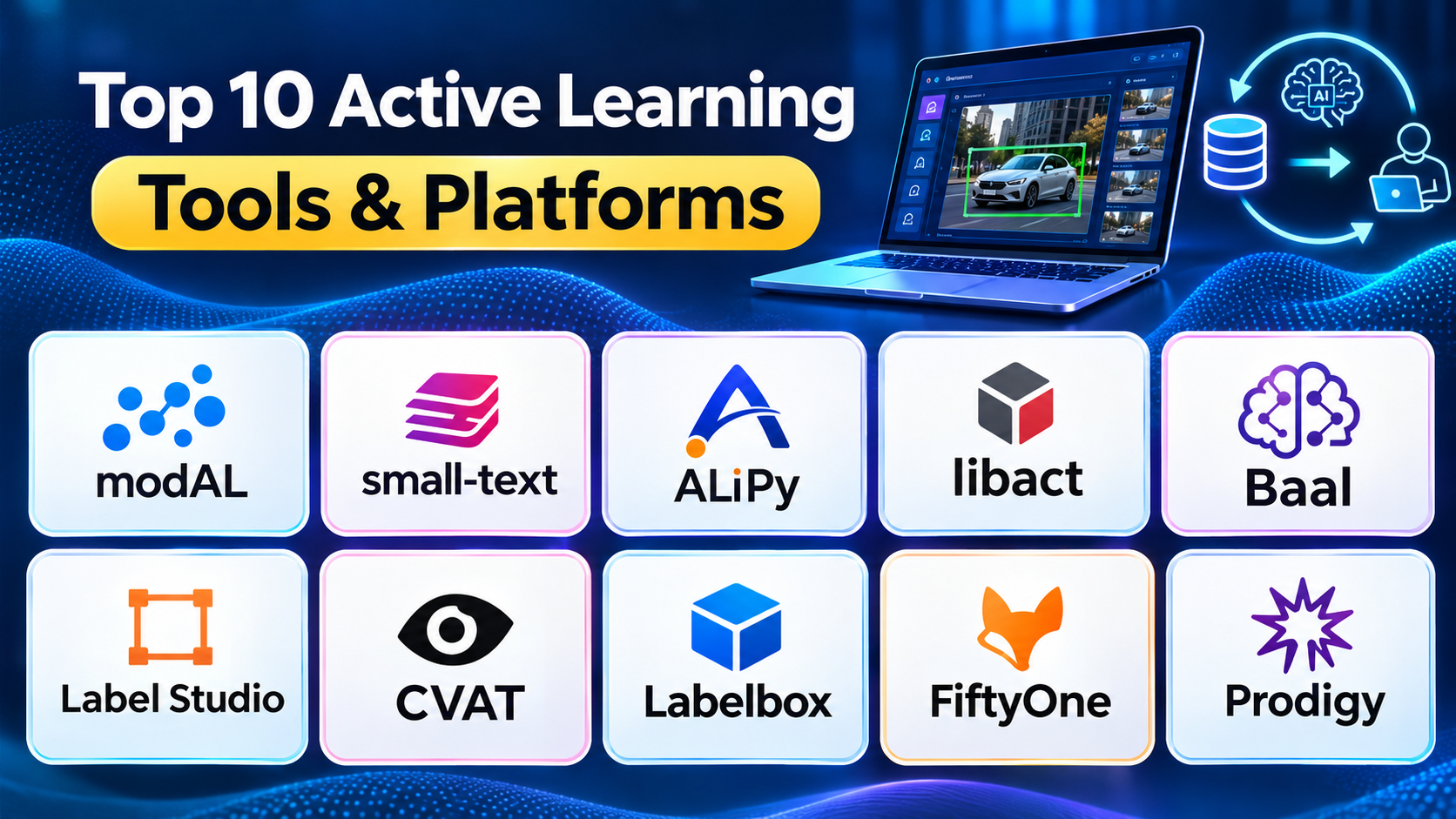
The following products include dedicated active learning libraries and complementary annotation or dataset intelligence platforms. Their numbering organizes the comparison and does not represent independently tested performance rankings.
1. modAL
Short Description
modAL is an open-source Python library designed to support active learning experimentation. It provides abstractions for constructing learners, selecting informative observations, and updating models with newly labeled examples.
The library works with compatible machine learning estimators and supports familiar Python development workflows. Its modular design allows developers to experiment with acquisition functions without constructing every component from scratch.
Common applications include classification research, uncertainty sampling, and interactive model development. Developers can also implement custom query strategies appropriate to specialized datasets.
The library does not provide a complete enterprise annotation environment. Production deployments generally require separate data storage, annotation interfaces, monitoring, and orchestration components.
Teams should evaluate dependency compatibility and current maintenance activity before adopting modAL for long-term projects. Its principal value is programmable active learning rather than managed annotation operations.
How the Software Works
- Initialize a compatible estimator.
- Supply an initial labeled dataset.
- Define an unlabeled data pool.
- Select an acquisition strategy.
- Query informative observations.
- Obtain human labels.
- Update the learner and evaluate performance.
Key Features
- ActiveLearner abstraction: Organizes iterative model updates.
- Uncertainty sampling: Prioritizes uncertain classifications.
- Margin sampling: Identifies closely competing predictions.
- Entropy sampling: Evaluates predictive uncertainty.
- Committee learning: Supports disagreement-based acquisition.
- Custom query strategies: Enables specialized selection logic.
- Batch selection: Supports multiple queries per iteration.
- Estimator integration: Works with compatible model interfaces.
- Python accessibility: Fits common research environments.
- Interactive experimentation: Supports notebook-based development.
- Flexible training updates: Incorporates newly labeled examples.
- Open-source implementation: Allows inspection and adaptation.
Benefits
- Reduces acquisition algorithm development effort.
- Supports reproducible research experiments.
- Enables targeted annotation.
- Encourages strategy comparison.
- Facilitates custom sampling.
- Supports educational demonstrations.
- Integrates with existing Python models.
- Reduces dependence on proprietary interfaces.
- Enables incremental dataset development.
- Provides transparent acquisition logic.
Pros
- Open-source availability.
- Modular architecture.
- Familiar Python interface.
- Multiple acquisition strategies.
- Customization flexibility.
- Suitable for controlled experiments.
- Compatible with common estimator patterns.
- Limited platform overhead.
Cons
- No complete annotation interface.
- Requires programming expertise.
- Production infrastructure is separate.
- Dependency compatibility requires validation.
- Enterprise governance must be implemented externally.
- Large-scale scoring requires additional engineering.
- Maintenance status should be reviewed.
Use Cases
- Text classification: Select ambiguous documents.
- Fraud research: Prioritize uncertain observations.
- Academic experiments: Compare acquisition algorithms.
- Image classification: Query difficult image examples.
- Educational projects: Demonstrate iterative learning.
- Model prototyping: Test acquisition assumptions.
- Committee experiments: Analyze model disagreement.
- Budgeted labeling: Limit annotation batches.
Industry Applications
Education, scientific research, financial analytics, software development, and manufacturing research.
Integration and Deployment Considerations
modAL can be incorporated into Python applications and notebook environments. Developers must manage dependencies, estimator compatibility, and reproducible training configurations.
Enterprise deployment requires additional annotation, security, storage, and monitoring infrastructure. Teams should test acquisition performance against realistic data volumes.
Pricing and Cost Considerations
The library is available as open-source software. Infrastructure, engineering, annotation, and maintenance expenses remain organizational responsibilities.
Best For
Researchers, students, Python developers, data scientists, academic laboratories, classification projects, experimental teams, and custom machine learning pipelines.
Overall Assessment
modAL may be suitable for teams seeking transparent and customizable active learning algorithms. Its programmable approach supports controlled comparisons between selection strategies.
Organizations requiring managed annotation operations or enterprise governance should consider combining it with complementary platforms. Maintenance and compatibility should be assessed before production adoption.
2. small-text
Short Description
small-text is an open-source Python library specializing in active learning for text classification. It supports iterative sample selection and model development for Natural Language Processing applications.
The library provides acquisition strategies and classifier abstractions suited to textual datasets. Developers can use compatible traditional classifiers or supported deep learning approaches.
Its focus on text distinguishes it from broader annotation platforms. It is particularly relevant when document labeling costs constrain model development.
The library supports research into uncertainty, diversity, and embedding-based acquisition methods. Teams can compare strategies using consistent experimental conditions.
small-text requires external annotation and production infrastructure. Its suitability depends on model compatibility, dataset size, and available engineering resources.
How the Software Works
- Prepare a text dataset.
- Label a representative seed subset.
- Initialize a compatible classifier.
- Configure a query strategy.
- Select candidate documents.
- Obtain verified labels.
- Update the classifier.
Key Features
- Text classification focus: Supports document-oriented learning.
- Pool-based learning: Queries from unlabeled text collections.
- Uncertainty strategies: Prioritizes ambiguous documents.
- Embedding-based strategies: Uses semantic representations.
- Batch acquisition: Selects multiple documents.
- Classifier abstractions: Standardizes model interaction.
- Transformer integration: Supports compatible transformer workflows.
- Custom strategies: Enables experimental acquisition logic.
- Dataset abstractions: Organizes textual observations.
- Iterative updates: Incorporates newly labeled documents.
- Research-oriented design: Supports controlled comparisons.
- Open-source access: Enables code inspection.
Benefits
- Reduces unnecessary text annotation.
- Supports NLP experimentation.
- Improves document selection flexibility.
- Enables strategy benchmarking.
- Supports semantic diversity analysis.
- Facilitates model iteration.
- Encourages reproducibility.
- Supports specialized classifiers.
- Reduces acquisition development overhead.
- Enables budget-aware labeling.
Pros
- Specialized NLP functionality.
- Programmable workflows.
- Multiple selection methods.
- Open-source availability.
- Transformer-oriented capabilities.
- Research flexibility.
- Custom acquisition support.
- Suitable for experimentation.
Cons
- Primarily text-focused.
- Requires Python expertise.
- Separate annotation interface needed.
- Transformer inference can be expensive.
- Production governance is external.
- Dependency management requires attention.
- Performance varies by strategy and dataset.
Use Cases
- Support ticket routing: Select difficult customer requests.
- Sentiment classification: Prioritize ambiguous opinions.
- Legal documents: Query uncertain document categories.
- Spam classification: Identify challenging messages.
- Scientific literature: Improve topic classification.
- Intent detection: Select unfamiliar user requests.
- News categorization: Review uncertain articles.
- Compliance classification: Prioritize ambiguous policy documents.
Industry Applications
Legal services, customer support, publishing, financial services, and academic research.
Integration and Deployment Considerations
The library fits Python-based NLP development environments. Teams should evaluate tokenizer compatibility, model dependencies, memory consumption, and inference throughput.
Annotation interfaces and data repositories can be connected through custom integrations. Sensitive documents require appropriate access controls and retention policies.
Pricing and Cost Considerations
Open-source licensing removes a conventional software subscription requirement. Computing resources, specialist annotation, integration, and maintenance still contribute to ownership costs.
Best For
NLP engineers, text classification researchers, document processing teams, academic laboratories, support automation developers, legal technology teams, Python specialists, and budget-conscious research projects.
Overall Assessment
small-text is a relevant option for teams concentrating on active learning in text classification. Its specialized acquisition capabilities can support systematic experimentation.
Organizations handling extensive multimodal annotation may require a broader platform. Production deployment also requires supporting operational infrastructure.
3. ALiPy
Short Description
ALiPy is an open-source active learning library developed for algorithm research and experimental evaluation. It provides tools for constructing active learning experiments and comparing acquisition strategies.
Its research-oriented design supports the study of sample selection under controlled conditions. Developers can investigate how different strategies affect model performance and labeling requirements.
The library includes experiment-management abstractions that can help organize iterative learning activities. It is particularly relevant to researchers studying active learning methodology.
ALiPy is not a managed enterprise annotation service. Human labeling interfaces, scalable infrastructure, and organizational controls require separate implementation.
Teams should review its current repository activity and dependency requirements before adoption. Older research-oriented libraries may require compatibility work in modern development environments.
How the Software Works
- Load the experimental dataset.
- Define labeled and unlabeled partitions.
- Configure a predictive model.
- Select a query strategy.
- Simulate or collect labels.
- Record experimental results.
- Compare learning curves.
Key Features
- Experiment management: Organizes active learning studies.
- Query strategies: Supports multiple acquisition approaches.
- Data partitioning: Separates labeled and unlabeled observations.
- Index management: Tracks selected examples.
- Oracle abstractions: Supports labeling simulations.
- Stopping criteria: Controls experimental termination.
- Performance tracking: Records model evaluation results.
- Experiment comparison: Supports strategy analysis.
- Custom extensions: Enables research modifications.
- Python implementation: Fits scientific computing workflows.
- Cost-aware research support: Enables labeling-budget studies.
- Open-source access: Supports methodological transparency.
Benefits
- Facilitates algorithm comparisons.
- Supports reproducible experiments.
- Reduces research setup effort.
- Enables controlled labeling simulations.
- Helps evaluate acquisition budgets.
- Supports educational projects.
- Encourages methodological transparency.
- Enables experimental extensions.
- Organizes iterative results.
- Supports learning-curve analysis.
Pros
- Research-oriented architecture.
- Multiple query approaches.
- Open-source implementation.
- Experimental flexibility.
- Label tracking capabilities.
- Suitable for simulations.
- Supports controlled comparisons.
- Useful for algorithm education.
Cons
- Limited managed operational capabilities.
- Requires technical expertise.
- Annotation interface is external.
- Compatibility may require maintenance.
- Enterprise controls are not comprehensive.
- Production scaling needs additional engineering.
- Research assumptions may differ from real annotation conditions.
Use Cases
- Algorithm benchmarking: Compare acquisition methods.
- Label-budget experiments: Study performance under constraints.
- Academic instruction: Demonstrate query strategies.
- Oracle simulation: Model annotation interactions.
- Cost-sensitive research: Investigate labeling expenditure.
- Classification experiments: Evaluate sample efficiency.
- Stopping-rule analysis: Compare termination conditions.
- Method development: Prototype new acquisition functions.
Industry Applications
Universities, research institutes, industrial research laboratories, financial analytics research, and machine learning education.
Integration and Deployment Considerations
ALiPy can be deployed within controlled Python research environments. Teams should pin dependencies and preserve experimental configurations for reproducibility.
Production integration requires custom interfaces for annotation, storage, and monitoring. Its research assumptions should be validated against actual operational requirements.
Pricing and Cost Considerations
ALiPy is open-source software. Relevant costs include developer time, computing infrastructure, annotation resources, and compatibility maintenance.
Best For
Academic researchers, students, algorithm developers, experimental laboratories, classification researchers, data scientists, educational institutions, and research-oriented engineering teams.
Overall Assessment
ALiPy may be appropriate for investigating active learning algorithms and experimental methodologies. Its value is strongest when research flexibility matters more than managed operations.
Organizations seeking enterprise-ready annotation workflows should consider complementary platforms. Current maintenance and dependency compatibility deserve particular attention.
4. libact
Short Description
libact is an open-source Python library focused on pool-based active learning. It was developed to provide reusable implementations of active learning algorithms for research and experimentation.
The library organizes datasets, predictive models, labeling interactions, and query strategies through programmable interfaces. This allows developers to study the behavior of different acquisition approaches.
Its capabilities are relevant to supervised classification problems where labeling resources are limited. Researchers can investigate whether targeted selection improves learning efficiency.
libact is primarily an algorithmic toolkit rather than an enterprise annotation platform. It does not independently address every operational requirement of modern machine learning development.
Organizations should assess current maintenance and compatibility before using it in new production environments. Its established research design may remain useful for controlled experiments.
How the Software Works
- Initialize a dataset.
- Identify labeled and unlabeled samples.
- Configure a model.
- Select a query strategy.
- Request labels for selected samples.
- Update dataset state.
- Evaluate the resulting model.
Key Features
- Pool-based acquisition: Selects from candidate observations.
- Dataset abstraction: Tracks labeled examples.
- Query strategy interfaces: Supports algorithm interchange.
- Uncertainty selection: Prioritizes ambiguous predictions.
- Committee approaches: Uses model disagreement.
- Labeler abstractions: Represents annotation interactions.
- Model interfaces: Connects compatible estimators.
- Custom extensions: Supports new acquisition methods.
- Experimental workflows: Enables repeated evaluations.
- Python development: Supports scientific programming.
- Research transparency: Exposes algorithm implementations.
- Open-source licensing: Supports independent adaptation.
Benefits
- Supports algorithm education.
- Facilitates research comparisons.
- Enables controlled experiments.
- Reduces implementation duplication.
- Supports custom acquisition methods.
- Encourages reproducibility.
- Enables annotation simulations.
- Provides transparent selection logic.
- Supports classification research.
- Helps investigate sample efficiency.
Pros
- Dedicated active learning focus.
- Open-source availability.
- Modular abstractions.
- Multiple acquisition approaches.
- Research flexibility.
- Customizable components.
- Suitable for algorithm studies.
- Transparent implementations.
Cons
- Older dependency requirements may arise.
- Current maintenance requires verification.
- No managed annotation workforce.
- Limited enterprise workflow functionality.
- Requires programming expertise.
- Scaling requires custom engineering.
- Modern deep learning integration may require adaptation.
Use Cases
- Classification research: Compare learning strategies.
- Academic demonstrations: Explain active learning concepts.
- Annotation simulations: Study labeling behavior.
- Committee evaluation: Analyze disagreement.
- Budget experiments: Compare sample efficiency.
- Custom algorithms: Develop acquisition methods.
- Benchmark replication: Reproduce research experiments.
- Prototype development: Test selection workflows.
Industry Applications
Higher education, scientific research, industrial research, analytics consulting, and machine learning development.
Integration and Deployment Considerations
libact is most appropriate within carefully configured Python environments. Teams should verify package installation, compiled dependencies, and model compatibility.
Operational deployments require separate annotation interfaces and monitoring. Organizations should assess whether a more actively maintained alternative better meets long-term requirements.
Pricing and Cost Considerations
The library is open source. Engineering effort and dependency maintenance may represent significant costs for production adoption.
Best For
Researchers, students, algorithm specialists, academic laboratories, experimental teams, Python developers, classification projects, and reproducibility studies.
Overall Assessment
libact provides useful abstractions for studying pool-based active learning. It may be particularly relevant when reproducing established experimental methodologies.
New production projects should carefully evaluate maintenance risks. Alternative libraries or managed platforms may provide more suitable operational capabilities.
5. Baal
Short Description
Baal is an open-source active learning library associated with deep learning and Bayesian uncertainty estimation. It supports workflows that use predictive uncertainty to identify valuable training observations.
The library is relevant to teams developing neural networks with limited labeled information. Its capabilities can support experiments involving repeated stochastic predictions and uncertainty-based acquisition.
Baal can be incorporated into compatible deep learning development workflows. Its programmable components allow researchers to investigate acquisition strategies for complex models.
The library does not replace an annotation management platform. Teams must connect human labeling, dataset storage, and operational monitoring independently.
Its computational requirements depend on the model and uncertainty estimation method. Repeated inference can introduce significant processing overhead for large datasets.
How the Software Works
- Prepare labeled and unlabeled datasets.
- Configure a compatible neural network.
- Train the initial model.
- Generate uncertainty estimates.
- Rank candidate observations.
- Obtain additional annotations.
- Retrain and evaluate.
Key Features
- Bayesian active learning: Supports uncertainty-oriented workflows.
- Monte Carlo dropout support: Enables stochastic prediction approaches.
- Acquisition heuristics: Prioritizes informative observations.
- Dataset management: Tracks labeled and unlabeled samples.
- Deep learning integration: Supports compatible neural network workflows.
- Batch querying: Selects groups of observations.
- Uncertainty estimation: Evaluates predictive variability.
- Custom heuristics: Enables specialized acquisition methods.
- Iterative learning: Supports repeated dataset updates.
- Research flexibility: Facilitates experimental comparisons.
- Python accessibility: Fits technical development environments.
- Open-source implementation: Supports independent inspection.
Benefits
- Supports uncertainty-aware learning.
- Facilitates deep learning research.
- Enables targeted neural network annotation.
- Encourages acquisition strategy comparison.
- Supports iterative dataset development.
- Provides customizable selection logic.
- Reduces algorithm development effort.
- Helps investigate model uncertainty.
- Supports controlled experiments.
- Enables transparent implementation.
Pros
- Deep learning orientation.
- Bayesian uncertainty capabilities.
- Programmable acquisition methods.
- Open-source availability.
- Suitable for experimental workflows.
- Flexible dataset handling.
- Custom heuristic support.
- Relevant to neural network research.
Cons
- Repeated inference may be expensive.
- Requires deep learning expertise.
- Separate annotation infrastructure needed.
- Uncertainty estimates require validation.
- Compatibility depends on software versions.
- Enterprise controls are external.
- Poor calibration can affect sample selection.
Use Cases
- Medical imaging: Query uncertain image predictions.
- Industrial vision: Select difficult defect examples.
- Neural network research: Compare uncertainty methods.
- Image classification: Improve limited-label datasets.
- Remote sensing: Prioritize ambiguous observations.
- Acquisition benchmarking: Evaluate heuristic effectiveness.
- Model calibration studies: Investigate prediction reliability.
- Budgeted deep learning: Manage annotation rounds.
Industry Applications
Healthcare research, manufacturing, remote sensing, academic research, and computer vision development.
Integration and Deployment Considerations
Baal requires compatible deep learning dependencies and appropriate computing resources. Teams should measure inference overhead before scoring large unlabeled datasets.
Human annotation can be connected through custom data pipelines. Independent evaluation is necessary to determine whether uncertainty-based selection provides meaningful improvements.
Pricing and Cost Considerations
Baal is available as open-source software. Graphics Processing Unit (GPU) resources, engineering, annotation, and model retraining contribute to total costs.
Best For
Deep learning researchers, computer vision engineers, Bayesian machine learning specialists, medical imaging researchers, academic laboratories, PyTorch-oriented teams, experimental developers, and uncertainty estimation projects.
Overall Assessment
Baal is relevant to teams investigating active learning with neural networks and uncertainty estimation. Its capabilities can support specialized research workflows.
Organizations requiring complete annotation operations should combine it with an appropriate labeling platform. Computational overhead and model calibration require careful evaluation.
6. Label Studio
Short Description
Label Studio is an annotation platform developed by HumanSignal that supports multiple data modalities. It provides configurable interfaces for collecting, reviewing, and managing human-generated labels.
Its machine learning backend integration enables models to generate predictions and assist annotation. External acquisition engines can use prediction scores or dataset metadata to determine which tasks should receive attention.
The platform supports applications involving images, text, audio, video, and structured information. Configurable labeling interfaces make it useful for specialized annotation projects.
Label Studio is complementary to dedicated active learning algorithm libraries. A complete active learning loop may require custom selection, retraining, and orchestration components.
Open-source and commercial offerings have different operational capabilities. Organizations should confirm which collaboration, security, and governance features are available in their selected edition.
How the Software Works
- Create an annotation project.
- Configure the labeling interface.
- Import selected observations.
- Connect a compatible model backend.
- Generate preliminary predictions.
- Collect and review annotations.
- Export validated training data.
Key Features
- Multimodal annotation: Supports several data types.
- Configurable interfaces: Adapts labeling tasks to project requirements.
- ML backend integration: Connects external prediction models.
- Pre-labeling: Presents model-generated suggestions.
- Data import: Supports annotation task ingestion.
- Annotation export: Produces reusable labeled datasets.
- Task metadata: Preserves contextual information.
- API access: Supports programmatic integration.
- Custom labeling configurations: Enables specialized workflows.
- Review capabilities: Supports validation depending on edition.
- Self-hosting options: Supports infrastructure control.
- Commercial collaboration capabilities: Supports larger annotation operations.
Benefits
- Centralizes human annotation.
- Supports multiple data modalities.
- Reduces repetitive labeling through predictions.
- Enables specialized annotation interfaces.
- Connects external acquisition algorithms.
- Supports dataset export.
- Facilitates human review.
- Improves workflow consistency.
- Enables custom integration.
- Supports iterative model development.
Pros
- Broad modality support.
- Flexible labeling configurations.
- Open-source edition.
- Programmable integrations.
- Model-assisted workflows.
- Self-hosting possibilities.
- Extensible interfaces.
- Commercial operational options.
Cons
- Dedicated acquisition algorithms may require integration.
- Advanced capabilities depend on edition.
- Custom backends require development.
- Self-hosting creates maintenance responsibilities.
- Complex interfaces require configuration.
- Annotation quality depends on reviewers.
- Large projects require operational planning.
Use Cases
- Document extraction: Verify model-generated entities.
- Image classification: Label selected uncertain images.
- Audio transcription: Review difficult recordings.
- Video annotation: Validate selected video segments.
- Content moderation: Review ambiguous examples.
- Sentiment analysis: Annotate selected text.
- Medical research: Collect specialist labels.
- Multimodal learning: Manage diverse annotation tasks.
Industry Applications
Healthcare research, financial services, media, retail, and enterprise artificial intelligence development.
Integration and Deployment Considerations
Label Studio can connect to external models through its machine learning backend architecture. Teams should establish a reliable method for importing selected tasks and exporting reviewed labels.
Deployment requirements depend on edition and workload. Sensitive projects should evaluate storage configuration, authentication, permissions, and data retention.
Pricing and Cost Considerations
An open-source edition is available alongside commercial offerings. Commercial pricing, infrastructure requirements, and support costs should be confirmed for the intended deployment.
Best For
Annotation teams, NLP developers, computer vision engineers, multimodal projects, research laboratories, enterprise data teams, custom ML developers, and organizations requiring flexible labeling interfaces.
Overall Assessment
Label Studio is a strong complementary option for human annotation within active learning pipelines. Its flexibility makes it relevant to projects involving several data modalities.
Teams requiring sophisticated acquisition algorithms should integrate an external selection engine. Edition-specific operational capabilities should be assessed before procurement.
7. CVAT
Short Description
Computer Vision Annotation Tool (CVAT) is an annotation platform designed for image and video datasets. It supports labeling workflows used in object detection, segmentation, tracking, and related computer vision tasks.
The platform provides specialized annotation interfaces for visual information. Model-assisted annotation can reduce repetitive work when compatible automated labeling models are available.
CVAT can participate in active learning pipelines by receiving images or video frames selected through external acquisition strategies. Reviewed annotations can then be exported for model retraining.
Its visual annotation focus makes it less suitable for general text classification projects. Teams developing multimodal systems may require additional annotation platforms.
Organizations should distinguish automatic annotation from active learning sample selection. CVAT primarily addresses annotation operations, while acquisition logic may be implemented elsewhere.
How the Software Works
- Create a computer vision project.
- Import selected images or videos.
- Define annotation classes.
- Apply compatible automated annotation.
- Review and correct visual labels.
- Validate annotation quality.
- Export training annotations.
Key Features
- Bounding boxes: Supports object detection labels.
- Polygon annotation: Represents irregular object boundaries.
- Mask annotation: Supports segmentation workflows.
- Video annotation: Enables temporal labeling.
- Object tracking: Supports consistent object identities.
- Automatic annotation: Connects compatible models.
- Project management: Organizes visual datasets.
- Task assignment: Distributes annotation work.
- Annotation formats: Supports common computer vision formats.
- API integration: Enables automated workflows.
- Review functionality: Supports annotation validation.
- Self-hosting options: Enables controlled deployment.
Benefits
- Supports detailed visual annotation.
- Reduces repetitive labeling activities.
- Facilitates computer vision training.
- Enables external sample selection.
- Supports video datasets.
- Improves annotation organization.
- Enables reusable dataset exports.
- Facilitates collaborative labeling.
- Supports specialist review.
- Reduces custom interface development.
Pros
- Specialized computer vision interfaces.
- Multiple annotation geometries.
- Image and video support.
- Open-source availability.
- Model-assisted capabilities.
- Programmatic integration.
- Established dataset format support.
- Flexible deployment possibilities.
Cons
- Primarily visual-data focused.
- Acquisition logic may require external tools.
- Large videos require substantial storage.
- Automated labeling requires compatible models.
- Complex segmentation remains labor-intensive.
- Self-hosting requires administration.
- Commercial capabilities vary by offering.
Use Cases
- Autonomous driving: Annotate selected road scenes.
- Manufacturing inspection: Label unusual defects.
- Medical imaging research: Annotate selected visual regions.
- Retail analytics: Label unfamiliar products.
- Agriculture: Identify crop conditions.
- Satellite analysis: Annotate land features.
- Sports analytics: Track objects in video.
- Robotics: Label challenging environmental observations.
Industry Applications
Automotive, manufacturing, agriculture, healthcare research, and robotics.
Integration and Deployment Considerations
CVAT can be connected to external acquisition engines through programmatic task management. Teams should preserve sample identifiers to maintain traceability between selection scores and exported labels.
Video storage, inference resources, and reviewer capacity require planning. Organizations should validate supported annotation formats against their training pipelines.
Pricing and Cost Considerations
CVAT offers open-source software and commercial services. Hosting, storage, annotation labor, model inference, and commercial subscriptions may contribute to ownership costs.
Best For
Computer vision engineers, video annotation teams, autonomous vehicle developers, manufacturing researchers, robotics teams, image segmentation projects, agricultural technology developers, and visual dataset specialists.
Overall Assessment
CVAT is a relevant annotation component for computer vision active learning. Its specialized interfaces support detailed visual labeling and model-assisted workflows.
It should not be treated as a complete replacement for dedicated acquisition algorithms. Organizations should integrate selection and retraining components according to project requirements.
8. Labelbox
Short Description
Labelbox is a commercial data platform supporting artificial intelligence training data and evaluation workflows. It provides capabilities for annotation, data organization, model-assisted labeling, and quality management.
Its dataset management and model-related workflows can help organizations identify examples requiring additional review. These capabilities support data-centric model improvement and selective annotation.
The platform is relevant to organizations managing substantial annotation workloads across technical and operational teams. It can reduce the need to construct every labeling component internally.
Active learning implementations may combine Labelbox capabilities with external models and acquisition strategies. Exact workflows depend on the available product configuration and integrations.
Commercial adoption requires careful evaluation of pricing, data governance, export capabilities, and annotation requirements. Organizations should confirm current product features directly with the provider.
How the Software Works
- Import candidate datasets.
- Organize data using metadata.
- Connect relevant model predictions.
- Identify examples requiring review.
- Assign annotation activities.
- Validate resulting labels.
- Export or integrate training data.
Key Features
- Data cataloging: Organizes candidate observations.
- Annotation workflows: Supports human labeling.
- Model-assisted labeling: Presents preliminary predictions.
- Data filtering: Identifies relevant subsets.
- Metadata management: Preserves contextual attributes.
- Model evaluation workflows: Supports error analysis.
- Quality review: Enables annotation validation.
- Collaboration: Coordinates multiple contributors.
- API integration: Supports programmatic data operations.
- Dataset organization: Manages training information.
- Evaluation support: Helps assess model outputs.
- Commercial infrastructure: Supports managed operational workflows.
Benefits
- Centralizes annotation operations.
- Supports selective data review.
- Improves dataset visibility.
- Enables collaboration.
- Facilitates model-assisted labeling.
- Supports error investigation.
- Reduces custom platform development.
- Helps coordinate annotation quality.
- Enables integration with training pipelines.
- Supports iterative model improvement.
Pros
- Integrated data workflows.
- Commercial operational support.
- Model-assisted annotation.
- Dataset organization capabilities.
- Collaborative environment.
- Programmatic interfaces.
- Quality management features.
- Relevant to larger AI programs.
Cons
- Commercial expenses require assessment.
- Feature availability may vary.
- Vendor dependency requires consideration.
- Custom acquisition may need integration.
- Data migration requires planning.
- Sensitive data needs governance review.
- Complex workflows require configuration.
Use Cases
- Computer vision: Review model errors.
- Generative AI evaluation: Prioritize difficult outputs.
- Document processing: Validate selected predictions.
- Retail analytics: Improve product datasets.
- Healthcare research: Coordinate specialist annotation.
- Data-centric AI: Investigate dataset weaknesses.
- Enterprise labeling: Manage distributed contributors.
- Model improvement: Collect targeted corrective labels.
Industry Applications
Technology, retail, healthcare research, automotive, and financial services.
Integration and Deployment Considerations
Labelbox can be incorporated into model development pipelines through supported interfaces and data integrations. Organizations should validate the movement of predictions, annotations, and dataset metadata.
Commercial deployments require contractual and security evaluation. Teams should confirm export formats, data residency options, access controls, and support arrangements.
Pricing and Cost Considerations
Commercial pricing depends on the selected offering and usage requirements. Organizations should obtain current pricing and account for annotation labor, integrations, storage, and model evaluation.
Best For
Enterprise AI teams, annotation managers, data-centric AI projects, computer vision organizations, evaluation teams, distributed labeling operations, technology companies, and organizations seeking managed workflows.
Overall Assessment
Labelbox may suit organizations seeking integrated annotation and dataset management capabilities. Its operational features can complement active learning acquisition strategies.
Teams requiring unrestricted algorithm customization should evaluate external acquisition integration. Commercial costs and contractual requirements should be considered alongside functionality.
9. FiftyOne
Short Description
FiftyOne is an open-source visual artificial intelligence dataset analysis toolkit developed by Voxel51. It helps computer vision teams explore datasets, inspect predictions, and identify data quality problems.
The toolkit supports interactive visualization and programmatic dataset analysis. Embedding-based workflows can help identify similar, unusual, or underrepresented visual observations.
These capabilities make FiftyOne useful for active learning sample curation. Teams can combine dataset insights with uncertainty scores and other acquisition criteria.
FiftyOne is not primarily a complete annotation workforce management system. Annotation and model training may be performed through integrated or external tools.
Its open-source toolkit and commercial offerings address different organizational needs. Teams should evaluate current integration support and deployment requirements.
How the Software Works
- Import a visual dataset.
- Load ground-truth labels and predictions.
- Generate or import embeddings.
- Analyze errors and dataset distribution.
- Select informative observations.
- Send selected samples for annotation.
- Import updated labels and evaluate.
Key Features
- Interactive visualization: Enables visual dataset exploration.
- Dataset views: Creates filtered observation subsets.
- Prediction inspection: Compares model outputs with labels.
- Embedding analysis: Supports semantic exploration.
- Similarity search: Identifies related observations.
- Uniqueness analysis: Helps discover unusual samples.
- Evaluation workflows: Supports model performance investigation.
- Metadata filtering: Selects samples using attributes.
- Annotation integrations: Connects supported labeling workflows.
- Python API: Enables programmable analysis.
- Dataset persistence: Supports reusable data collections.
- Extensible workflows: Enables customized dataset operations.
Benefits
- Improves visual dataset understanding.
- Helps discover redundant samples.
- Supports targeted annotation.
- Enables model error investigation.
- Facilitates representative sampling.
- Improves dataset transparency.
- Supports visual quality review.
- Enables custom curation.
- Helps investigate underrepresented conditions.
- Supports iterative model development.
Pros
- Specialized visual dataset analysis.
- Open-source toolkit.
- Interactive exploration.
- Embedding-based capabilities.
- Flexible filtering.
- Programmable interfaces.
- Annotation integrations.
- Useful for data-centric development.
Cons
- Primarily computer vision oriented.
- Complete annotation operations require integration.
- Embedding computation consumes resources.
- Similarity metrics require interpretation.
- Large datasets require infrastructure planning.
- Advanced commercial features may involve licensing.
- Acquisition policies require customization.
Use Cases
- Duplicate detection: Reduce redundant image labeling.
- Rare-scene discovery: Identify unusual environments.
- Model error analysis: Inspect incorrect predictions.
- Dataset balancing: Explore underrepresented categories.
- Industrial inspection: Curate difficult defect images.
- Autonomous systems: Analyze challenging road scenes.
- Annotation review: Inspect inconsistent labels.
- Active learning: Combine diversity and uncertainty scores.
Industry Applications
Automotive, robotics, manufacturing, retail computer vision, and geospatial analytics.
Integration and Deployment Considerations
FiftyOne can connect visual datasets, prediction outputs, embeddings, and supported annotation systems. Teams should maintain consistent identifiers across these components.
Computing and storage requirements depend on dataset size and embedding workflows. Commercial capabilities and deployment arrangements should be confirmed when enterprise features are required.
Pricing and Cost Considerations
The core toolkit is open source, with commercial offerings available. Infrastructure, embedding computation, integration development, and enterprise licensing may affect total costs.
Best For
Computer vision engineers, dataset curators, autonomous vehicle developers, industrial AI teams, model evaluation specialists, research laboratories, visual analytics teams, and data-centric AI projects.
Overall Assessment
FiftyOne is particularly useful for visual dataset exploration and informative sample discovery. It complements uncertainty-based acquisition by helping teams investigate diversity and redundancy.
Organizations requiring end-to-end annotation operations should connect appropriate labeling tools. Its suitability depends on the importance of visual data analysis within the learning pipeline.
10. Prodigy
Short Description
Prodigy is a programmable annotation tool developed by Explosion, the organization behind spaCy. It supports interactive annotation workflows and model-assisted data collection.
Its recipe-based architecture enables developers to customize how examples are presented, annotated, and processed. This flexibility supports active learning workflows that incorporate model predictions and selection logic.
Prodigy is especially relevant to Natural Language Processing tasks such as text classification and named entity recognition. It also supports additional annotation interfaces for other data types.
The tool is designed for technical teams comfortable with programmable workflows. Developers can create custom recipes to connect acquisition algorithms and specialized annotation requirements.
Organizations should evaluate licensing, deployment arrangements, and the engineering effort required for customized workflows. Its developer-oriented design differs from fully managed annotation services.
How the Software Works
- Prepare candidate data.
- Select or develop an annotation recipe.
- Connect a compatible model.
- Prioritize relevant examples.
- Collect human annotations.
- Store validated labels.
- Update the training workflow.
Key Features
- Recipe architecture: Enables programmable annotation workflows.
- Model-assisted annotation: Presents predicted labels.
- Interactive learning: Supports iterative annotation approaches.
- Text classification interfaces: Supports document labeling.
- Entity annotation: Captures named entities.
- Span annotation: Identifies relevant text regions.
- Custom interfaces: Supports specialized tasks.
- Python integration: Connects technical workflows.
- Dataset management: Stores annotation results.
- Data streaming: Supplies examples to annotation interfaces.
- spaCy integration: Supports compatible NLP workflows.
- Local deployment: Enables infrastructure control.
Benefits
- Supports targeted annotation.
- Enables customized labeling workflows.
- Facilitates NLP development.
- Reduces repetitive annotation.
- Connects model predictions with human review.
- Supports iterative experimentation.
- Enables specialist annotation interfaces.
- Improves workflow flexibility.
- Supports local data handling.
- Reduces custom interface development.
Pros
- Developer-oriented flexibility.
- Strong NLP relevance.
- Programmable recipes.
- Model-assisted workflows.
- Local deployment.
- Custom selection possibilities.
- Compatible Python ecosystem.
- Suitable for iterative annotation.
Cons
- Commercial licensing applies.
- Requires technical expertise.
- Custom recipes require development.
- Enterprise workforce management may require additional systems.
- Scaling needs operational planning.
- Model integration depends on compatibility.
- Annotation quality remains dependent on human reviewers.
Use Cases
- Named entity recognition: Select uncertain entities.
- Text classification: Review ambiguous documents.
- Intent detection: Annotate unfamiliar requests.
- Legal NLP: Identify specialized contractual language.
- Biomedical research: Label domain-specific entities.
- Sentiment analysis: Review difficult opinions.
- Information extraction: Correct model-generated spans.
- Custom active learning: Implement specialized acquisition recipes.
Industry Applications
Legal technology, healthcare research, customer support, publishing, and enterprise NLP.
Integration and Deployment Considerations
Prodigy integrates with Python-based workflows and compatible NLP models. Teams can develop recipes that incorporate custom selection logic and annotation requirements.
Organizations should plan dataset storage, backup, authentication, and reviewer access. Licensing terms should be confirmed for the intended number of users and deployment arrangement.
Pricing and Cost Considerations
Prodigy is commercially licensed. Current licensing prices should be confirmed directly, while engineering, annotation, hosting, and maintenance should be included in the budget.
Best For
NLP engineers, spaCy developers, research teams, legal technology developers, biomedical NLP specialists, technical annotation teams, custom workflow developers, and text classification projects.
Overall Assessment
Prodigy may be suitable for technical teams seeking programmable annotation and interactive model improvement. Its recipe architecture offers flexibility for specialized active learning workflows.
Organizations seeking fully managed annotation operations may prefer broader commercial platforms. The available engineering resources should influence the selection decision.
Comparison Table: Top 10 Active Learning Tooling
| Software | Primary Function | Best For | Deployment | Standout Capability | Pricing Model |
|---|---|---|---|---|---|
| modAL | Active learning algorithms | Python researchers | Local/custom | Modular acquisition | Open source |
| small-text | Text active learning | NLP teams | Local/custom | Text acquisition | Open source |
| ALiPy | Experimental active learning | Researchers | Local/custom | Experiment management | Open source |
| libact | Pool-based learning | Algorithm research | Local/custom | Query strategies | Open source |
| Baal | Deep learning acquisition | Neural network teams | Local/custom | Bayesian uncertainty | Open source |
| Label Studio | Multimodal annotation | Annotation teams | Self-hosted/managed options | Flexible interfaces | Open source/commercial |
| CVAT | Visual annotation | Vision teams | Self-hosted/managed options | Image and video labeling | Open source/commercial |
| Labelbox | Training data operations | Enterprise teams | Managed offerings | Integrated workflows | Commercial |
| FiftyOne | Visual dataset analysis | Data curation teams | Local/enterprise options | Embedding exploration | Open source/commercial |
| Prodigy | Programmable annotation | NLP developers | Local/custom | Recipe-based annotation | Commercial |
Functional Comparison
| Tool | Acquisition Algorithms | Text Support | Visual Support | Annotation UI | Dataset Analysis |
|---|---|---|---|---|---|
| modAL | Native | Model-dependent | Model-dependent | External | Custom |
| small-text | Native | Specialized | Limited | External | Custom |
| ALiPy | Native | Model-dependent | Model-dependent | External | Experimental |
| libact | Native | Model-dependent | Model-dependent | External | Custom |
| Baal | Native | Model-dependent | Strong research relevance | External | Custom |
| Label Studio | External/custom | Yes | Yes | Native | Project-dependent |
| CVAT | External | Limited | Specialized | Native | Visual review |
| Labelbox | Integrated/custom workflows | Supported | Supported | Native | Integrated |
| FiftyOne | Custom curation | Limited | Specialized | Integrations | Extensive |
| Prodigy | Recipe-based | Specialized | Supported interfaces | Native | Custom |
Technical Comparison
| Tool | Integration Approach | Customization | Model Dependency | Infrastructure |
|---|---|---|---|---|
| modAL | Python | High | Compatible estimator | User-managed |
| small-text | Python | High | Text classifier | User-managed |
| ALiPy | Python | High | Experimental model | User-managed |
| libact | Python | High | Compatible model | User-managed |
| Baal | Deep learning interfaces | High | Neural network | User-managed |
| Label Studio | API/backend | High | Optional external model | Edition-dependent |
| CVAT | API/model integration | Moderate to high | Optional vision model | Edition-dependent |
| Labelbox | API/platform | Configuration-dependent | External or integrated | Managed |
| FiftyOne | Python/integrations | High | Optional predictions | Deployment-dependent |
| Prodigy | Python recipes | High | Optional compatible model | User-managed |
Business Suitability Comparison
| Software | Small Teams | Enterprises | Research | Limited Engineering Resources |
|---|---|---|---|---|
| modAL | Suitable with developers | Component only | Strong | Limited |
| small-text | Suitable for NLP | Component only | Strong | Limited |
| ALiPy | Research-oriented | Specialized component | Strong | Limited |
| libact | Research-oriented | Specialized component | Strong | Limited |
| Baal | Technical teams | Specialized component | Strong | Limited |
| Label Studio | Suitable | Edition-dependent | Suitable | Moderate |
| CVAT | Suitable | Deployment-dependent | Suitable | Moderate |
| Labelbox | Budget-dependent | Relevant | Suitable | Managed workflows |
| FiftyOne | Suitable | Commercial options | Strong | Technical setup |
| Prodigy | Technical teams | Workflow-dependent | Suitable | Developer-oriented |
Pricing and Ownership Considerations
| Tool | Software Cost Model | Implementation Consideration | Additional Costs |
|---|---|---|---|
| modAL | Open source | Custom acquisition pipeline | Engineering |
| small-text | Open source | NLP integration | Inference |
| ALiPy | Open source | Research configuration | Compatibility |
| libact | Open source | Dependency validation | Maintenance |
| Baal | Open source | Neural network integration | GPU computing |
| Label Studio | Mixed | Annotation configuration | Hosting and review |
| CVAT | Mixed | Visual task configuration | Video storage |
| Labelbox | Commercial | Platform integration | Usage and services |
| FiftyOne | Mixed | Dataset and embedding setup | Computing and storage |
| Prodigy | Commercial | Recipe development | Licensing and engineering |
Which Active Learning Tool Is Right for You?
Best Tools by User Type
| User Type | Suggested Software | Primary Reason | Consideration |
|---|---|---|---|
| Beginners | modAL | Accessible algorithm concepts | Python knowledge |
| NLP researchers | small-text | Specialized text strategies | Model compatibility |
| Academic researchers | ALiPy | Experimental workflows | Maintenance |
| Algorithm developers | libact | Query abstractions | Dependencies |
| Deep learning researchers | Baal | Uncertainty estimation | Inference cost |
| Multimodal teams | Label Studio | Flexible interfaces | Acquisition integration |
| Vision annotators | CVAT | Specialized visual tools | Storage |
| Enterprise data teams | Labelbox | Integrated operations | Commercial costs |
| Dataset curators | FiftyOne | Visual exploration | Embedding resources |
| spaCy developers | Prodigy | Programmable recipes | Licensing |
| Budget-conscious teams | modAL, CVAT | Open-source components | Engineering effort |
| Regulated research teams | Self-hosted Label Studio or CVAT | Deployment control | Security validation |
How to Choose the Best Active Learning Tooling
1. Data Modality
Identify whether the project uses text, images, audio, video, or structured information. Select acquisition algorithms and annotation interfaces compatible with those data types.
2. Acquisition Strategy
Evaluate uncertainty, diversity, representativeness, and cost-aware selection methods. Compare strategies against a random-sampling baseline using consistent labeling budgets.
3. Model Compatibility
Confirm that the tooling supports the intended model architecture and prediction interface. Compatibility testing should include training, inference, and model updates.
4. Annotation Complexity
Assess whether reviewers must classify observations, draw bounding boxes, create masks, or identify entities. Complex tasks may require specialized annotation interfaces.
5. Scalability
Measure the cost of scoring realistic unlabeled datasets. Large pools may require batch inference, caching, or candidate filtering.
6. Annotation Quality
Establish review processes, labeling guidelines, and disagreement resolution procedures. Informative examples are often difficult to label consistently.
7. Integration Requirements
Identify required connections to storage, training pipelines, annotation platforms, and experiment trackers. Evaluate supported APIs and export formats.
8. Deployment Preferences
Determine whether local, self-hosted, or managed deployment meets organizational requirements. Consider operational responsibilities and data residency.
9. Security
Evaluate authentication, authorization, encryption, and access logging. Annotation systems may expose sensitive training information.
10. Maintenance
Review release activity, dependency compatibility, and support arrangements. Research libraries may require additional engineering for long-term operation.
11. Model Calibration
Assess whether predicted probabilities provide useful uncertainty estimates. Poorly calibrated predictions can distort acquisition priorities.
12. Data Diversity
Evaluate whether the acquisition strategy selects redundant observations. Diversity constraints can improve coverage of different data conditions.
13. Human Expertise
Determine whether selected examples require specialist reviewers. Annotation capacity should influence batch size and selection frequency.
14. Evaluation Methodology
Maintain independent validation and test datasets. Avoid evaluating acquisition effectiveness exclusively on actively selected observations.
15. Total Cost
Compare annotation savings with computing, integration, retraining, and maintenance expenses. A technically sophisticated strategy may not be financially appropriate for every project.
Illustrative Software Evaluation Scorecard
| Criterion | Weight | Evaluation Method | Evidence |
|---|---|---|---|
| Acquisition effectiveness | 20% | Controlled experiment | Learning curves |
| Model compatibility | 15% | Integration test | Successful training |
| Annotation usability | 15% | Reviewer pilot | User feedback |
| Scalability | 10% | Load test | Throughput results |
| Security | 10% | Security assessment | Control documentation |
| Integration | 10% | Proof of concept | Data exchange results |
| Cost | 10% | Ownership analysis | Budget estimates |
| Maintenance | 5% | Lifecycle review | Release history |
| Reproducibility | 5% | Experiment audit | Versioned records |
| Total | 100% |
These weights are illustrative and should be adjusted according to project priorities. Organizations should assign product scores only after collecting relevant evaluation evidence.
Questions to Ask Software Vendors and Maintainers
- Which acquisition strategies are supported?
- Can custom selection algorithms be integrated?
- Which data modalities are supported?
- Which model frameworks are compatible?
- How are annotation disagreements resolved?
- Can data be exported without proprietary dependencies?
- What deployment options are available?
- How are sensitive observations protected?
- What access controls are supported?
- Can annotation decisions be audited?
- How does pricing change with usage?
- What infrastructure is required?
- How are software updates managed?
- What technical support is available?
- How can organizations migrate their datasets?
Industry Applications of Active Learning Tooling
Healthcare
Healthcare researchers can use active learning to prioritize medical images or clinical documents requiring specialist annotation. This approach may help manage limited expert availability while supporting dataset development.
Baal, CVAT, and Label Studio can contribute to research workflows involving uncertainty estimation and human review. Clinical applications require appropriate validation, privacy safeguards, and regulatory oversight.
Manufacturing
Manufacturing organizations can prioritize unusual product defects and uncertain inspection results. This is particularly relevant when defective products represent a small proportion of available observations.
FiftyOne and CVAT can support visual dataset curation and annotation. External acquisition algorithms can help identify examples requiring additional inspection.
Financial Services
Financial institutions can use active learning to investigate ambiguous transaction classifications and document categories. Specialist review remains important when errors have financial or regulatory consequences.
modAL, small-text, and Label Studio can support customized analytical workflows. Organizations should implement privacy controls and independent model validation.
Automotive
Autonomous vehicle development generates extensive visual datasets containing repetitive and unusual driving conditions. Active learning can help prioritize difficult scenes for annotation.
CVAT, FiftyOne, and Labelbox can contribute to visual data operations. Safety-critical evaluation must remain independent of acquisition-based dataset selection.
Retail
Retail organizations can improve product recognition, inventory monitoring, and customer feedback classification through targeted labeling. Changing packaging and seasonal products can introduce unfamiliar examples.
FiftyOne and CVAT support visual data workflows, while small-text can support customer feedback classification. Teams should monitor distribution changes and annotation consistency.
Legal Technology
Legal document classification and information extraction frequently require specialist knowledge. Active learning can help prioritize ambiguous contractual language and unfamiliar document structures.
Prodigy, small-text, and Label Studio can support programmable text annotation. Confidentiality, access controls, and professional review remain essential.
Security and Governance Considerations
Active learning pipelines may process sensitive documents, personal information, medical records, and proprietary business data. Organizations must protect information throughout acquisition, annotation, storage, and model training.
Model uncertainty should not be treated as permission to expose sensitive information to unauthorized reviewers. Selection workflows must incorporate access restrictions and data-handling policies before annotation tasks are distributed.
| Governance Control | Recommended Practice |
|---|---|
| Authentication | Verify reviewer identities |
| Authorization | Apply least-privilege permissions |
| Encryption | Protect stored and transmitted information |
| Data minimization | Expose only necessary fields |
| Audit logging | Record annotation and dataset changes |
| Retention | Define deletion and archival schedules |
| Data residency | Confirm approved storage locations |
| Human oversight | Review high-impact labels |
| Dataset provenance | Track sample origins and modifications |
| Model versioning | Associate predictions with model versions |
| Incident response | Establish escalation procedures |
| Backup and recovery | Test restoration of annotation records |
How to Implement Active Learning Tooling
- Define objectives: Establish measurable model and annotation goals.
- Identify stakeholders: Assign responsibilities to technical and operational teams.
- Assess datasets: Review quality, diversity, and labeling requirements.
- Establish governance: Define privacy and access controls.
- Prepare seed labels: Create a representative initial dataset.
- Select evaluation data: Preserve independent validation and test subsets.
- Choose software: Evaluate acquisition and annotation components.
- Build baseline models: Measure initial performance.
- Configure acquisition: Implement selection strategies.
- Connect annotation: Establish reviewer workflows.
- Conduct a pilot: Test a limited annotation cycle.
- Validate quality: Review labels and disagreements.
- Retrain models: Incorporate verified annotations.
- Compare strategies: Evaluate results against random sampling.
- Monitor costs: Track annotation and computing expenditure.
- Scale operations: Expand only after demonstrating practical value.
Implementation Roadmap
| Phase | Activities | Responsible Teams | Expected Outcome |
|---|---|---|---|
| Discovery | Define objectives and data needs | Business and ML teams | Requirements |
| Preparation | Clean data and establish labels | Data engineers | Validated datasets |
| Evaluation | Compare tools and strategies | ML engineers | Selected architecture |
| Integration | Connect acquisition and annotation | Engineering | Working pipeline |
| Pilot | Execute limited learning cycles | Reviewers and ML teams | Evaluation evidence |
| Production | Scale validated workflows | Operations | Controlled deployment |
| Improvement | Monitor performance and costs | Governance and ML teams | Sustainable operations |
Practical Example: Implementing Active Learning in a Manufacturing Organization
Organization Background
Consider a hypothetical electronics manufacturer developing a computer vision system for identifying surface defects. The organization has accumulated 50,000 candidate production images and has a limited number of trained quality inspectors.
Its existing approach relies on randomly selecting images for annotation. Management wants to determine whether targeted acquisition can reduce annotation requirements while maintaining acceptable defect detection performance.
Baseline Performance Metrics
| Indicator | Illustrative Baseline |
|---|---|
| Candidate image pool | 50,000 |
| Initial labeled training images | 2,000 |
| Additional random-labeling budget | 10,000 |
| Annotation time per image | 2 minutes |
| Annotation labor rate | $30/hour |
| Defect recall | 78% |
| Precision | 85% |
| F1 score | 81.35% |
Detailed Implementation Steps
- Document defect categories and inspection requirements.
- Identify authorized quality inspectors.
- Collect representative production images.
- Remove corrupt and inappropriate records.
- Reserve independent evaluation datasets.
- Annotate 2,000 initial training images.
- Establish defect-labeling guidelines.
- Train an initial computer vision model.
- Generate predictions for unlabeled images.
- Calculate model uncertainty using a compatible acquisition method.
- Generate embeddings for visual diversity analysis.
- Use FiftyOne to investigate redundant and unusual images.
- Combine uncertainty and diversity criteria.
- Send selected images to CVAT.
- Collect and validate inspector annotations.
- Retrain the computer vision model.
- Compare results with an equivalent random-sampling experiment.
- Repeat acquisition until performance and cost objectives are satisfied.
- Conduct independent production-readiness validation.
- Monitor changing production conditions after deployment.
Illustrative Operational Results
Assume the random-sampling approach requires 10,000 additional annotations to reach a specified performance target, while the experimental active learning approach requires 6,000. These hypothetical figures demonstrate financial calculation methods and are not actual vendor results.
| Indicator | Random Sampling | Active Learning |
|---|---|---|
| Additional labels | 10,000 | 6,000 |
| Annotation hours | 333.33 | 200 |
| Annotation labor cost | $10,000 | $6,000 |
| Defect recall | 90% | 90% |
| Precision | 92% | 92% |
| F1 score | 90.99% | 90.99% |
| Annotation volume reduction | — | 40% |
| Released annotation capacity | — | 133.33 hours |
Financial Benefits
The illustrative annotation labor reduction is $4,000 per comparable labeling cycle. This represents direct financial savings only when the organization avoids paid annotation expenditure rather than simply reallocating salaried employee time.
Assume four comparable annual cycles, $4,000 in annual additional computing and maintenance expenses, and $8,000 in initial implementation costs. The following calculations apply only if the projected annotation savings are financially realizable.
| Financial Item | Illustrative Amount |
|---|---|
| Annual gross annotation savings | $16,000 |
| Annual additional operating costs | $4,000 |
| Annual net operating benefit | $12,000 |
| Initial implementation cost | $8,000 |
| First-year net benefit | $4,000 |
| First-year ROI on total first-year costs | 33.33% |
| Simple payback period | 8 months |
ROI calculation: ($16,000 − $12,000) ÷ $12,000 × 100 = 33.33%.
Payback calculation: $8,000 ÷ $12,000 × 12 = 8 months.
Actual outcomes depend on defect distribution, acquisition effectiveness, annotation quality, computing requirements, and operational costs. The organization should validate results through controlled experiments before expanding the system.
Important Performance Metrics to Monitor
| KPI | Definition | Measurement Method | Importance |
|---|---|---|---|
| Annotation volume | Number of labeled samples | Task records | Workload |
| Labeling cost | Cost of annotation | Financial records | Budget control |
| Annotation throughput | Labels per hour | Workflow logs | Productivity |
| Model accuracy | Correct prediction proportion | Test evaluation | General performance |
| Precision | Correct positive prediction proportion | Test evaluation | False-positive control |
| Recall | Detected actual positive proportion | Test evaluation | Missed-event control |
| F1 score | Harmonic mean of precision and recall | Test evaluation | Balanced performance |
| Acquisition cost | Cost of candidate scoring | Computing records | Efficiency |
| Label disagreement | Conflicting annotation proportion | Review records | Quality |
| Duplicate selection rate | Redundant selected observations | Similarity analysis | Diversity |
| Performance gain per label | Improvement divided by new labels | Learning curves | Sample efficiency |
| Retraining duration | Time required for model updates | Pipeline logs | Operational efficiency |
| Class coverage | Representation of target categories | Dataset analysis | Distribution coverage |
| Calibration error | Difference between confidence and observed correctness | Calibration evaluation | Uncertainty reliability |
Understanding the Total Cost of Ownership
Active learning introduces costs beyond conventional annotation and model training. Organizations must account for acquisition scoring, repeated inference, dataset management, integration, and operational maintenance.
Open-source libraries can reduce licensing expenses but may increase engineering responsibilities. Commercial platforms can reduce internal development requirements while introducing subscription and usage costs.
| Cost Category | Cost Type | Consideration |
|---|---|---|
| Software licensing | Recurring or initial | Commercial terms |
| Acquisition development | Initial and ongoing | Custom algorithms |
| Model inference | Variable | Pool size and model complexity |
| Annotation | Variable | Selected sample volume |
| Specialist review | Variable | Domain expertise |
| Storage | Recurring | Dataset size |
| Integration | Initial and ongoing | Connected systems |
| Retraining | Variable | Learning frequency |
| Security | Initial and recurring | Data protection |
| Training | Initial and recurring | Reviewer skills |
| Maintenance | Recurring | Dependencies and updates |
| Migration | Occasional | Data portability |
Challenges and Limitations of Active Learning
- Poor initial models: Unreliable predictions may produce ineffective acquisition priorities.
- Selection bias: Repeatedly selecting particular observation types can distort training distributions.
- Noisy observations: Uncertainty sampling may prioritize corrupted or inherently ambiguous data.
- Redundant selections: Similar examples can consume annotation capacity without adding substantial information.
- Model miscalibration: Confidence scores may not accurately represent prediction reliability.
- Computational overhead: Repeated inference and retraining can increase infrastructure expenses.
- Annotation disagreement: Difficult observations may generate inconsistent human labels.
- Rare-class discovery: Uncertainty-based methods may overlook unfamiliar categories.
- Integration complexity: Separate acquisition, annotation, and training systems require coordination.
- Diminishing returns: Additional learning cycles may produce progressively smaller improvements.
Common Mistakes to Avoid
1. Using an Unrepresentative Seed Dataset
A narrow initial dataset can produce misleading model predictions. Include representative examples from relevant operating conditions.
2. Ignoring Random-Sampling Baselines
Without a baseline, organizations cannot reliably determine acquisition effectiveness. Compare strategies using equivalent labeling budgets.
3. Relying Exclusively on Uncertainty
Uncertainty may identify redundant or noisy observations. Combine uncertainty with appropriate diversity and quality controls.
4. Contaminating Evaluation Datasets
Using test observations for acquisition compromises independent evaluation. Maintain separate, protected evaluation datasets.
5. Ignoring Annotation Guidelines
Inconsistent labels can undermine model development. Establish documented instructions and reviewer training.
6. Selecting Excessively Large Batches
Large batches may contain redundant observations. Adjust batch size according to model update frequency and annotation capacity.
7. Overlooking Computing Costs
Repeated inference may offset annotation savings. Measure acquisition and retraining expenses during pilot projects.
8. Assuming Confidence Equals Accuracy
Highly confident predictions can still be incorrect. Evaluate model calibration and error patterns.
9. Ignoring Rare Categories
Acquisition methods may fail to discover unfamiliar classes. Include targeted exploration and representative sampling.
10. Neglecting Data Security
Selected examples may contain sensitive information. Apply access controls before distributing annotation tasks.
11. Failing to Track Dataset Versions
Untracked dataset changes make results difficult to reproduce. Associate training experiments with specific dataset versions.
12. Choosing Unsupported Libraries
Outdated dependencies can create operational problems. Review maintenance activity and compatibility before adoption.
13. Treating Automated Labels as Ground Truth
Model-generated suggestions can introduce systematic errors. Require appropriate human validation.
14. Overstating Financial Benefits
Released employee capacity does not automatically reduce expenditure. Separate direct savings from productivity improvements.
15. Continuing Without Stopping Criteria
Additional annotation may eventually provide limited value. Define measurable performance and financial stopping conditions.
Troubleshooting Common Problems
| Problem | Possible Cause | Investigation | Potential Resolution |
|---|---|---|---|
| Model performance declines | Noisy new labels | Review recent annotations | Correct labels |
| Similar samples dominate | Weak diversity controls | Analyze embeddings | Add diversity selection |
| Rare classes remain absent | Acquisition bias | Review class coverage | Introduce targeted sampling |
| Scoring takes too long | Large inference workload | Profile processing | Batch or filter candidates |
| Reviewers disagree | Ambiguous guidelines | Analyze conflicts | Refine instructions |
| Export fails | Format mismatch | Inspect schemas | Standardize conversion |
| Results cannot be reproduced | Missing versions | Audit experiment records | Version data and models |
| Costs increase | Excessive retraining | Review resource usage | Adjust cycle frequency |
Best Practices for Using Active Learning Tooling
- Establish independent evaluation datasets.
- Compare acquisition strategies against random sampling.
- Maintain representative initial training examples.
- Combine uncertainty and diversity when appropriate.
- Monitor model calibration.
- Validate human annotations.
- Preserve dataset and model versions.
- Document acquisition decisions.
- Measure annotation and computing costs.
- Protect sensitive training information.
- Establish clear stopping criteria.
- Review performance across important data subgroups.
Future Trends in Active Learning Tooling
Foundation Model Integration
Foundation models can provide useful representations and preliminary annotations for specialized datasets. Their suitability must be evaluated against domain-specific requirements.
Multimodal Acquisition
Future workflows may increasingly combine text, images, audio, and other information when selecting examples. Cross-modal selection introduces additional representation and evaluation challenges.
Cost-Aware Acquisition
Selection strategies may incorporate differences in annotation complexity and specialist availability. This could improve decisions when individual labels have substantially different costs.
Improved Uncertainty Estimation
Advances in calibration and uncertainty modeling may improve the reliability of acquisition decisions. Computational efficiency will remain an important consideration.
Human-AI Collaboration
Annotation systems are increasingly incorporating model suggestions and interactive review. Effective interface design will be necessary to reduce automation bias.
Continuous Dataset Improvement
Active learning may become more closely integrated with production model monitoring. Distribution changes can help identify areas requiring additional data collection.
Privacy-Preserving Workflows
Organizations may adopt stronger data minimization and controlled annotation environments. These approaches are particularly relevant to sensitive enterprise datasets.
Automated Acquisition Evaluation
Improved experiment tracking may simplify comparisons between selection strategies. Organizations should continue validating results through independent evaluation.
Frequently Asked Questions (FAQs)
1. What is active learning?
Active learning is a machine learning approach that selects informative observations for annotation. Its objective is to improve learning efficiency under labeling constraints.
2. What is active learning tooling?
It includes libraries and platforms supporting sample selection, annotation, and iterative model improvement. Individual tools may address only one part of the workflow.
3. How does active learning differ from supervised learning?
Conventional supervised learning typically starts with a predefined labeled dataset. Active learning determines which additional observations should receive labels.
4. What is uncertainty sampling?
Uncertainty sampling prioritizes observations for which a model produces uncertain predictions. Its effectiveness depends partly on the reliability of model confidence estimates.
5. What is margin sampling?
Margin sampling examines the difference between the leading predicted classes. Smaller differences can indicate ambiguous classification decisions.
6. What is entropy sampling?
Entropy sampling measures uncertainty across predicted class probabilities. Higher entropy generally indicates a less concentrated prediction distribution.
7. What is diversity sampling?
Diversity sampling selects observations representing different regions of the dataset. It can help reduce redundant annotation.
8. What is query-by-committee?
Query-by-committee uses disagreement among multiple models to identify informative observations. It can require more computation than single-model strategies.
9. What is pool-based active learning?
Pool-based learning selects examples from an existing collection of unlabeled observations. It is commonly used when candidate data is available before annotation.
10. What is a seed dataset?
A seed dataset is the initial labeled information used to train a baseline model. Its quality and representativeness influence subsequent acquisition decisions.
11. What is modAL used for?
modAL supports programmable active learning experiments in Python. It provides learner abstractions and acquisition strategies.
12. What is small-text used for?
small-text specializes in active learning for text classification. It supports compatible classifiers and textual acquisition workflows.
13. What is ALiPy used for?
ALiPy supports active learning research and experimental evaluation. It helps organize query strategies and iterative learning experiments.
14. What is libact used for?
libact provides reusable components for pool-based active learning. Its maintenance and dependency compatibility should be reviewed before adoption.
15. What is Baal used for?
Baal supports active learning involving deep learning and uncertainty estimation. It is relevant to neural network research workflows.
16. Can Label Studio support active learning?
Label Studio can collect annotations for examples selected through active learning strategies. External acquisition and retraining components may be required.
17. Is CVAT an active learning algorithm library?
CVAT primarily provides computer vision annotation functionality. It can complement external active learning acquisition engines.
18. How does Labelbox support active learning?
Labelbox provides data management, annotation, and model-related workflows that can support targeted data improvement. Specific acquisition functionality depends on configuration and integrations.
19. What is FiftyOne used for?
FiftyOne helps teams explore and analyze visual datasets. Its embedding and filtering capabilities can support informative sample curation.
20. What is Prodigy used for?
Prodigy provides programmable annotation workflows, particularly for NLP. Custom recipes can incorporate model-assisted selection and iterative learning.
21. Can active learning reduce annotation costs?
It can reduce annotation requirements in suitable projects. Savings must be demonstrated through controlled comparisons.
22. Does active learning guarantee better accuracy?
No acquisition strategy guarantees improved accuracy. Results depend on model quality, data distribution, annotation reliability, and evaluation methodology.
23. Can active learning be used for computer vision?
Yes, it can prioritize informative images and video observations. Specialized annotation tools can then capture visual labels.
24. Can active learning be used for NLP?
Yes, active learning can support text classification, entity recognition, and other language tasks. Acquisition strategies should match the model and annotation requirements.
25. Is active learning suitable for medical data?
It can support medical research by prioritizing observations for specialist annotation. Clinical applications require appropriate privacy safeguards and independent validation.
26. How much initial labeled data is required?
The appropriate amount depends on the model, task complexity, and data distribution. Organizations should establish an adequate seed dataset through experimentation.
27. What is an acquisition function?
An acquisition function assigns selection scores to candidate observations. These scores determine which examples receive annotation priority.
28. What is model calibration?
Calibration measures how closely predicted confidence corresponds to observed correctness. Reliable calibration can improve interpretation of uncertainty scores.
29. Why is random sampling important?
Random sampling provides a useful baseline for evaluating active learning strategies. Comparisons should use equivalent labeling budgets and evaluation conditions.
30. Can active learning identify rare classes?
Some strategies can help discover unusual observations. Rare-class discovery may require targeted exploration beyond uncertainty sampling.
31. What is batch active learning?
Batch active learning selects multiple observations during each acquisition cycle. It can improve operational efficiency but may introduce redundancy.
32. What is an annotation oracle?
An oracle represents a source of labels for selected observations. It may be a human expert, simulated labeler, or another authorized labeling mechanism.
33. How frequently should models be retrained?
Retraining frequency depends on annotation volume, model cost, and performance requirements. Pilot experiments can help identify an appropriate schedule.
34. Can active learning work with transformers?
Yes, compatible acquisition strategies can be applied to transformer-based models. Inference cost and uncertainty reliability require evaluation.
35. What is embedding-based acquisition?
It uses numerical representations of observations to support sample selection. Embeddings can help identify semantic similarity and dataset diversity.
36. Is active learning the same as reinforcement learning?
No, active learning focuses on selecting informative training observations. Reinforcement learning focuses on learning behavior through interactions and reward signals.
37. Is active learning the same as semi-supervised learning?
Active learning requests labels for selected observations, while semi-supervised learning incorporates unlabeled information into training. The approaches can be combined.
38. Can automated labels replace human review?
Automated labels can accelerate annotation but may contain systematic errors. Human validation remains important where label accuracy affects model reliability.
39. How should annotation disagreements be handled?
Organizations should establish review and adjudication procedures. Labeling guidelines should be updated when recurring disagreements reveal ambiguity.
40. What security risks affect active learning?
Risks include unauthorized data access, sensitive information exposure, and compromised annotation records. Access controls and auditability should cover the entire pipeline.
41. Can active learning platforms be self-hosted?
Several annotation platforms and open-source libraries support self-managed deployment. Organizations must verify the specific software edition and infrastructure requirements.
42. What does active learning software cost?
Costs vary between open-source libraries and commercial platforms. Annotation, computing, integration, and maintenance expenses should also be included.
43. What is the biggest computational expense?
Large-scale model inference and repeated retraining can be significant expenses. The relative cost depends on model architecture and dataset size.
44. How can teams measure sample efficiency?
Teams can compare model performance against the number of acquired labels. Learning curves provide a practical method for evaluating sample efficiency.
45. When should active learning stop?
A project may stop when performance targets are met or additional labels provide insufficient value. Stopping decisions should consider both technical and financial criteria.
46. Can active learning introduce bias?
Yes, acquisition strategies can disproportionately select certain observations. Teams should monitor representation and performance across relevant subgroups.
47. Is active learning suitable for small businesses?
It may be useful when labeling expenses constrain model development. Smaller organizations should compare expected benefits against integration complexity.
48. What is the best active learning tool?
The appropriate tool depends on data modality, model architecture, annotation requirements, and resources. No single product is universally superior.
49. Can active learning be integrated with MLOps?
Yes, acquisition and annotation workflows can connect to Machine Learning Operations (MLOps) pipelines. Dataset versioning and experiment tracking support reproducibility.
50. What is the future of active learning?
Active learning is likely to become more closely connected with foundation models, dataset intelligence, and human review workflows. Its practical value will continue to depend on reliable evaluation and responsible implementation.
Conclusion
Active learning tooling provides a systematic approach to identifying training examples that deserve additional annotation. It can help organizations manage labeling resources while developing more informative datasets.
Dedicated libraries such as modAL, small-text, ALiPy, libact, and Baal support algorithm development and experimental acquisition strategies. Complementary platforms such as Label Studio, CVAT, Labelbox, FiftyOne, and Prodigy address annotation, dataset exploration, and operational workflows.
Research teams may prioritize transparent algorithms and reproducibility, while enterprise teams may require integrated collaboration and governance. Computer vision and NLP projects also have distinct annotation and model compatibility requirements.
Software selection should consider acquisition effectiveness, technical integration, computing requirements, annotation quality, maintenance, and total ownership costs. Controlled experiments against random sampling are essential for establishing practical value.
Successful implementation requires representative seed datasets, independent evaluation, secure information handling, and consistent human review. Continuous monitoring helps organizations identify selection bias, diminishing returns, and operational inefficiencies.
The most appropriate active learning solution is one that aligns technical capabilities with measurable organizational objectives. Combining suitable acquisition algorithms with reliable annotation and evaluation processes can support sustainable, data-centric machine learning development.
